

Vegetative Cannabis Feeding Strategy: Canopy Biomass Dynamics, High-Nitrate Ratios, and Transpiration Flux
The vegetative phase of cannabis cultivation serves a single foundational purpose: engineering an expansive photosynthetic engine, thick vascular transport architecture, and a resilient root system capable of supporting heavy floral biomass during bloom. Unlike generative flowering nutrition, vegetative fertility relies heavily on high nitrate-nitrogen (NO3–) ratios to drive cell division, amino acid synthesis, and RuBisCO enzyme assembly. Calcium (Ca2+) and magnesium (Mg2+) must be delivered at continuous, elevated concentrations to fuel cell wall expansion and chlorophyll pigment formation under modern high-PPFD LED fixtures. However, commercial growers frequently undermine vegetative vitality through two opposing extremes: under-fertigation that starves structural nodes, or toxic ammonium-dominated overfeeding that induces hyper-salinity, flaccid internodes, and root hypoxia. This comprehensive guide details the biophysical mechanisms governing vegetative ion assimilation, models dynamic crop-steering irrigation across coco coir, rockwool, and living soils, and provides actionable protocols to eliminate nutrient antagonisms before light flip.
Vegetative Plant Physiology: The Nitrogen-Driven Carbon Factory
During the vegetative growth phase (spanning from the establishment of the first true five-bladed leaves to the final day before photoperiod reduction), cannabis operates as an exponential vegetative biomass engine. The primary physiological objective is structural hypertrophy: constructing thick, lignin-reinforced stems, deep primary and lateral root matrices, and an expansive canopy of light-harvesting fan leaves.
At the center of this rapid cellular expansion is nitrogen assimilation. Nitrogen (N) is the fundamental atomic backbone of amino acids, nucleic acids (RNA and DNA), structural proteins, and chlorophyll pigments. In commercial horticulture, cannabis plants absorb nitrogen in two primary inorganic ionic forms: nitrate (NO3–) and ammonium (NH4+). The physiological consequences of these two nitrogen species are starkly different:
- Nitrate Nitrogen (NO3–): Nitrate represents the safest and most efficient nitrogen source for vegetative cannabis. Upon entering root cortical cells through high-affinity nitrate transporters (NRTs), nitrate is transported via the xylem stream directly to mature fan leaves. Inside leaf mesophyll cells, nitrate is enzymatically reduced to nitrite by nitrate reductase (NR) in the cytoplasm, and then immediately converted into ammonium by nitrite reductase (NiR) inside chloroplasts. This reduction process is powered directly by photosynthetic light reactions, allowing the plant to store surplus nitrate safely in cellular vacuoles without causing intracellular pH toxicity. Feeding high-nitrate solutions promotes sturdy stem development, thick cuticle layers, and optimal lateral branching.
- Ammonium Nitrogen (NH4+): Unlike nitrate, ammonium cannot be safely accumulated inside plant vacuoles because free ammonium uncouples photophosphorylation and disrupts intracellular pH balance. Consequently, ammonium absorbed by roots must be immediately assimilated into glutamine and glutamate within root tissue via the GS-GOGAT (glutamine synthetase-glutamate synthase) enzyme pathway. This rapid detoxification consumes massive amounts of root carbohydrates that would otherwise fuel root elongation and lateral root branching. If ammonium accounts for more than 10% to 15% of total input nitrogen in soilless culture, roots experience carbohydrate starvation, leaf tissue becomes dark green and bloated, and stems develop soft, hollow, water-filled piths highly vulnerable to mechanical breakage.
For optimal vegetative architecture, commercial fertigation formulations should maintain a strict 90:10 to 95:5 Nitrate-to-Ammonium ratio. This ensures vigorous cellular expansion while preserving root carbohydrate reserves and root-zone pH stability.
A disciplined vegetative cannabis feeding strategy establishes high photosynthetic capacity and expansive vascular architecture before the onset of flowering.
Xylem Transport Dynamics and Transpiration Flux
Mineral nutrition in the vegetative canopy is directly governed by the physics of plant transpiration. Water absorbed by root epidermal hairs travels through cortical tissue, crosses the Casparian strip in the endodermis, and enters the xylem conduits. From there, negative hydrostatic pressure generated by water evaporation from stomatal pores pulls the xylem sap upward into petioles and leaf blades.
This transpiration-driven mass flow is the primary mechanism for translocating immobile plant nutrients, most notably calcium (Ca2+) and boron (B). Calcium is not phloem-mobile; once deposited into older fan leaf cell walls, it cannot be remobilized to support newly expanding apical tips. Therefore, maintaining continuous, uninterrupted xylem sap velocity is an essential prerequisite for preventing vegetative tip burn and marginal leaf curl.
Transpirational velocity is governed directly by the vapor pressure deficit (VPD) of the growing environment. VPD represents the difference between the vapor pressure inside the saturated substomatal cavity of the leaf and the vapor pressure of the surrounding room air:
- Low VPD (<0.8 kPa – High Humidity): When the grow room air is excessively humid, the atmospheric evaporative demand drops near zero. Stomatal transpiration slows to a crawl, stalling xylem flow. Even if the substrate solution contains abundant dissolved calcium (150 ppm Ca), the calcium ions cannot travel upward to the rapid cell division centers in the shoot apical meristem. Emerging leaf tips develop classic hooked tips, wrinkled margins, and localized necrotic lesions.
- High VPD (>1.5 kPa – Low Humidity): Conversely, dry grow room air exerts extreme evaporative tension on leaf stomata. The plant transpires water at excessive rates, drinking root-zone water much faster than it can assimilate mineral salts. This leaves fertilizer salts behind in the substrate, rapidly elevating substrate pore-water electrical conductivity. Eventually, root cells experience osmotic drought, forcing stomata to close to prevent desiccation, which shuts down photosynthetic carbon fixation entirely.
During the vegetative phase, commercial growers should maintain ambient temperatures between 26 °C and 28 °C with relative humidity at 65% to 75%, establishing a stable vegetative VPD of 0.9 to 1.1 kPa. This target drives robust, consistent xylem transpiration without triggering drought-induced stomatal closure.

Expansive solar fan leaves act as primary carbohydrate factories, requiring a steady influx of nitrate nitrogen and magnesium to maintain high thylakoid chlorophyll density.
How Stage, Substrate, and Climate Shift Vegetative Demand
Vegetative nutrient demand is not static; it scales dramatically as the plant progresses from an unrooted cutting or freshly sprouted seedling into an expansive multi-topped bush covering a canopy footprint of 1 m2 or more. Cultivators must calibrate electrical conductivity and irrigation frequency to match this physiological progression.
1. Early Veg (Week 1 to 2) vs Late Veg (Week 4 to 5)
In early vegetative growth, the young plant possesses a limited root volume and small total leaf surface area. Transpirational water consumption is modest, typically less than 200 mL per plant per day. High fertilizer concentrations at this stage saturate the small root zone with excess solutes, inducing osmotic stress that stunts vegetative growth. Input EC should be held at a gentle 1.2 to 1.4 dS/m, providing balanced baseline nutrition without osmotic tension.
By late vegetative growth (Weeks 4 and 5), after multiple topping and training events, the canopy contains thousands of active stomata and a dense root system filling the container. Water consumption surges to 1.5 to 3.0 liters per day per plant under high light (600 to 800 μmol/m2/s PPFD). To keep pace with massive daily carbon assimilation, input EC should be gradually increased to 1.8 to 2.2 dS/m, with elemental nitrogen maintained at 160 to 190 ppm N and potassium at 180 to 220 ppm K.
2. Substrate Physics: Inert Soilless vs Living Organic Beds
The physical and chemical properties of the growing medium dictate how nutrients must be formulated and applied:
- Coco Coir and Rockwool: These substrates possess zero natural fertility and very distinct hydraulic properties. Inert rockwool has negligible cation exchange capacity (CEC), meaning every mineral ion must be precisely engineered into the fertigation water. Coco coir possesses a high CEC loaded naturally with sodium and potassium ions; it must be continuously supplied with calcium and magnesium to prevent competitive desorption. Both inert media thrive under high-frequency fertigation (pulse feeding) where small, controlled doses of nutrient solution maintain steady moisture and electrical conductivity.
- Living Organic Soils: In living soil, plants rely on a diverse rhizosphere microbiome (bacteria, saprophytic fungi, mycorrhizae, nematodes) to decompose complex organic amendments (crustacean meal, kelp, feather meal, rock dusts) into plant-available ionic orthophosphates, nitrates, and cations. Rather than managing daily liquid fertilizer EC, living soil cultivators monitor substrate volumetric water content, maintaining a steady 55% to 65% water-holding capacity to ensure aerobic microbial mineralization without creating waterlogged anaerobic zones.

Vegetative internodal elongation and robust lateral branching require balanced calcium uptake driven by active transpirational xylem flow.
Cation Antagonism, Salt Accumulation, and pH Lockouts
One of the most frequent errors in vegetative canopy management is diagnosing foliar symptoms as simple elemental deficiencies when they are actually caused by ion antagonisms or substrate chemistry imbalances. Root cortical cells absorb mineral ions via specialized transmembrane transport channels. Many of these transporters are non-specific and accept multiple ions sharing similar atomic valence and ionic radii.
1. The Cation Competition: Potassium vs Calcium vs Magnesium
Potassium (K+), calcium (Ca2+), and magnesium (Mg2+) engage in intense competitive inhibition at the root-substrate interface:
- Excessive Potassium: If a cultivator adds excessive potassium during late veg, the sheer numerical abundance of monovalent K+ ions floods root membrane transporters. This competitively suppresses the uptake of divalent magnesium (Mg2+) and calcium (Ca2+). The plant rapidly develops classic magnesium deficiency: brilliant interveinal chlorosis across mid-canopy leaves, accompanied by marginal calcium spotting on new shoots, despite the nutrient reservoir containing standard Cal-Mag levels.
- Excessive Calcium: Conversely, dumping massive doses of calcium nitrate or calcium chloride to fix suspected leaf spotting elevates Ca2+ concentrations beyond ideal biological ratios, competitively suppressing both magnesium and potassium absorption.
To prevent competitive antagonism, maintain a stable elemental cation ratio in your vegetative nutrient solution: approximately 4 parts Potassium to 2 parts Calcium to 1 part Magnesium (4:2:1 K:Ca:Mg) by mass.
2. Substrate pH Drift and Chemical Precipitation
Substrate root-zone pH dictates the chemical solubility and bio-availability of every essential mineral ion. In soilless culture (coco, rockwool, peat), the optimal vegetative root-zone pH window is strictly 5.8 to 6.2:
- Substrate pH > 6.5: High pH causes dissolved iron (Fe2+/Fe3+), manganese (Mn2+), and zinc (Zn2+) to react with hydroxide ions, precipitating out of solution as insoluble metal hydroxides. Upper new growth turns lemon-yellow or bleached white due to acute iron chlorosis.
- Substrate pH < 5.5: Acidic root-zone conditions drastically reduce the solubility and uptake of calcium, magnesium, and phosphorus, while simultaneously increasing aluminum and manganese solubility to levels that can induce cellular toxicity and root tip dieback.
Grower Question: Resolving Leaf Cupping in Fast-Growing Coco Veg
Why are our vegetative leaf margins canoeing upward despite healthy green color?
Question sent by: Marcus Vance, via email.
“We are running Week 3 of vegetative growth in 70/30 coco/perlite under high-output LEDs at 700 μmol/m2/s PPFD. Our input feed is 1.8 dS/m at pH 5.9 with 180 ppm Nitrogen and 140 ppm Calcium. Over the past three days, our fastest-growing apical fan leaves have started ‘canoeing’ – curling their outer serrated margins straight upward like tacos. The leaf color is deep green, no necrotic burn, and roots look pure white. Are our lights too close, or is this an invisible root-zone nutrient lockout?”
Marcus, your canopy is exhibiting classic transpirational vapor pressure deficit stress compounded by high root-zone osmotic solute load. Under 700 μmol/m2/s PPFD, your vegetative canopies are running hot and metabolically active. When the grow room relative humidity drops below 55% at 27 °C room temperature, room VPD spikes above 1.4 kPa.
To defend against excessive cellular water loss through stomatal guard cells, the cannabis leaf physically curls its outer margins upward. This ‘canoeing’ behavior traps a micro-boundary layer of humid air immediately above the stomata on the lower leaf surface, reducing the rate of water vapor loss. When combined with a relatively stiff 1.8 dS/m input feed in Week 3, the roots must exert extra osmotic force to draw water into the xylem conduits, exaggerating the foliar curl.
To eliminate this condition completely, execute two targeted adjustments:
- Rebalance the Environment: Raise your vegetative grow room relative humidity from 55% up to 65% to 70% while keeping air temperature at 27 °C. This dials your room VPD down into the sweet spot of 0.95 to 1.05 kPa, instantly relieving the physical atmospheric suction on the stomata.
- Step Down Input EC: Reduce your input fertigation EC slightly from 1.8 dS/m down to 1.5 dS/m for the next four days while ensuring a generous 20% runoff leaching fraction. This reduces substrate pore-water salinity, allowing leaf cells to regain maximum hydrostatic turgor pressure. Within 48 hours, the leaf margins will relax and flatten into wide, horizontal solar capture planes.
Precision Analytics: Input EC, Pour-Thru Runoff, and Tissue Benchmarks
Mastering vegetative cannabis feeding requires replacing guesswork and sensory hunches with quantifiable laboratory and benchtop analytics. Three analytical protocols form the foundation of commercial vegetative diagnostics:
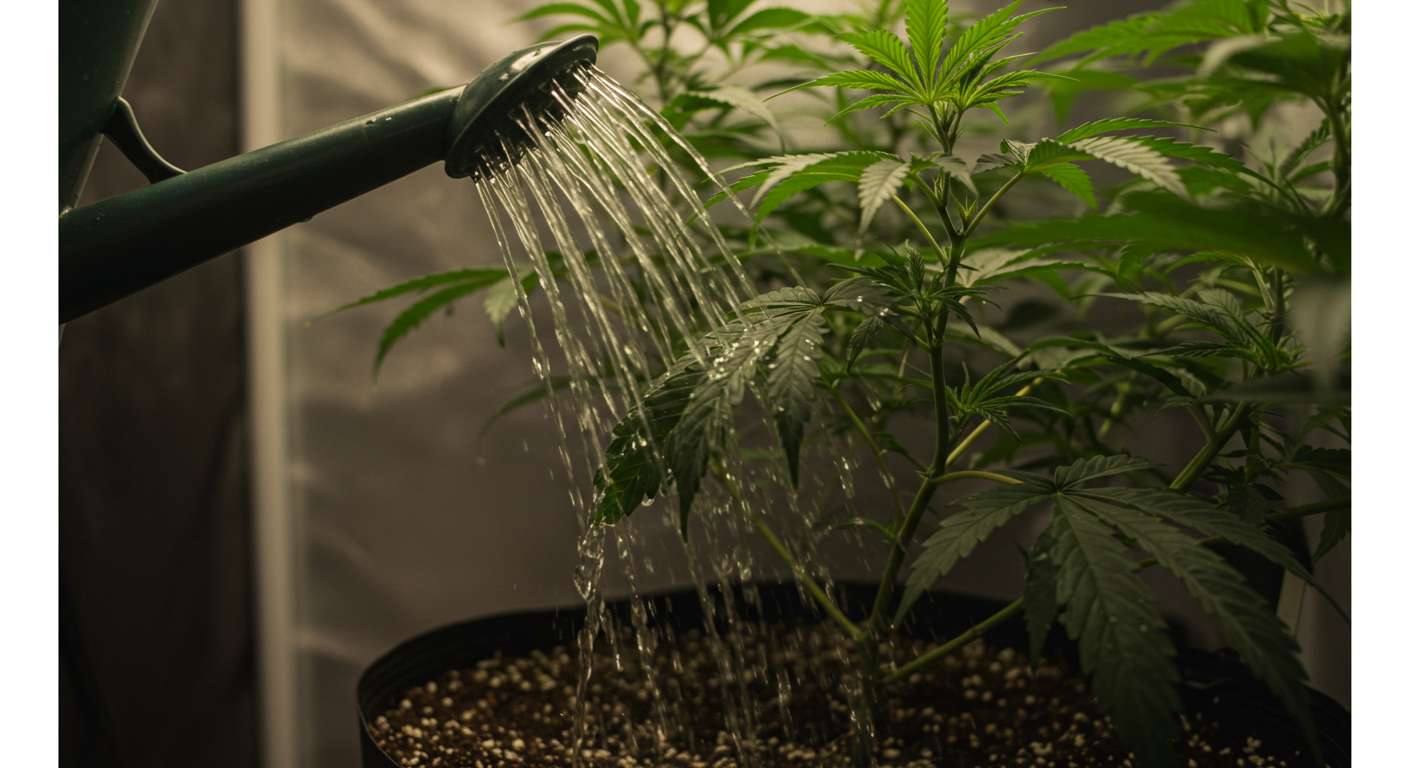
Precision fertigation during the vegetative phase balances root-zone volumetric dry-backs with steady dissolved oxygen replenishment to maximize vegetative root expansion.
1. The Delta EC (ΔEC) Metric
Rather than looking at runoff electrical conductivity in isolation, commercial operators calculate Delta EC, defined as the mathematical difference between leachate runoff EC and incoming feed EC:
ΔEC = EC_runoff – EC_input
Interpreting Delta EC in vegetative crops provides clear actionable operational guidance:
- ΔEC between 0.0 and +0.3 dS/m: Optimal equilibrium. The plant is assimilating mineral ions at the exact same proportional rate that it is consuming water. Substrate salt accumulation is stable.
- ΔEC > +0.6 dS/m: Salt accumulation warning. The substrate is accumulating unabsorbed fertilizer salts faster than the leaching fraction can sweep them out. The plant is transpiring water rapidly and rejecting excess solute mass. Remediate immediately by increasing irrigation leaching fraction from 15% to 25% or reducing input feed EC by 0.3 dS/m.
- ΔEC < -0.2 dS/m: Underfeeding. The crop is consuming nutrients out of the substrate faster than the fertigation system is supplying them, stripping the root-zone reservoir. Increase input feed EC by 0.2 to 0.3 dS/m to meet the crop’s expanding metabolic appetite.
2. Petiole Sap and Dry Leaf Tissue Benchmarks
Laboratory dry-tissue testing provides definitive quantification of internal nutritional status before visual deficiency or toxicity symptoms become visible. For vegetative cannabis, fully expanded, most-recently-matured fan leaves (typically the 4th or 5th node from the growing tip) should fall within these clinical dry-matter benchmarks:
- Total Nitrogen (N): 4.0% to 5.2% dry weight
- Phosphorus (P): 0.35% to 0.55% dry weight
- Potassium (K): 3.0% to 4.5% dry weight
- Calcium (Ca): 1.5% to 2.5% dry weight
- Magnesium (Mg): 0.45% to 0.75% dry weight
- Sulfur (S): 0.30% to 0.50% dry weight
- Iron (Fe): 80 to 150 mg/kg (ppm)
- Manganese (Mn): 40 to 100 mg/kg (ppm)
- Zinc (Zn): 30 to 70 mg/kg (ppm)
- Boron (B): 30 to 60 mg/kg (ppm)
If leaf tissue nitrogen drops below 3.8% during late veg, vegetative biomass accumulation slows, internodes become thin, and premature senescence of lower canopy leaves begins.
Comprehensive Vegetative Elemental Target Matrix (Weeks 1 to 5)
The following empirical matrix outlines target input electrical conductivity, pH thresholds, and elemental mineral concentrations across the complete vegetative cycle in closed-environment soilless fertigation:
| Agronomic Parameter | Week 1 (Establishment) | Week 2 (Early Veg) | Week 3 (Mid Veg) | Week 4 (Peak Canopy) | Week 5 (Pre-Flip Bulk) |
|---|---|---|---|---|---|
| Input EC (dS/m) | 1.1 – 1.3 | 1.3 – 1.5 | 1.5 – 1.8 | 1.8 – 2.1 | 2.0 – 2.3 |
| Target Input pH | 5.7 – 5.9 | 5.8 – 6.0 | 5.8 – 6.0 | 5.8 – 6.1 | 5.9 – 6.1 |
| Nitrate Nitrogen (ppm NO3-N) | 90 – 110 | 120 – 140 | 150 – 170 | 170 – 195 | 180 – 200 |
| Ammonium Nitrogen (ppm NH4-N) | 5 – 10 | 8 – 12 | 10 – 15 | 10 – 15 | 10 – 15 |
| Elemental Phosphorus (ppm P) | 25 – 35 | 30 – 40 | 35 – 45 | 40 – 50 | 45 – 55 |
| Elemental Potassium (ppm K) | 100 – 120 | 130 – 150 | 160 – 180 | 180 – 210 | 200 – 230 |
| Elemental Calcium (ppm Ca) | 90 – 110 | 110 – 130 | 130 – 150 | 140 – 160 | 140 – 165 |
| Elemental Magnesium (ppm Mg) | 40 – 50 | 45 – 55 | 50 – 60 | 55 – 65 | 55 – 70 |
| Elemental Sulfur (ppm S) | 45 – 55 | 50 – 65 | 60 – 75 | 70 – 85 | 75 – 90 |
| Target Leaching Fraction (%) | 10% – 15% | 15% – 20% | 15% – 20% | 20% – 25% | 20% – 25% |
Comparing Delivery Systems: Mineral Hydroponics vs Organic Amendments
The strategy used to deliver vegetative fertility fundamentally dictates how problems are diagnosed, how quickly corrections take effect, and how much operational oversight is required.
1. Soluble Mineral Salts (Dry Salts and Liquid Concentrates)
Commercial production overwhelmingly relies on technical-grade soluble dry salts (calcium nitrate, potassium nitrate, monopotassium phosphate, magnesium sulfate, and chelated micronutrients). Soluble mineral salts offer unparalleled operational advantages: immediate bioavailability, 100% precise elemental control down to the individual part-per-million, and seamless automation via computerized fertigation skids. When a deficiency or cation imbalance is identified, adjusting the recipe yields measurable root-zone correction within 2 to 4 hours. However, the system provides zero buffer: an uncalibrated injector or broken dosing pump can deliver toxic solute concentrations that burn roots in a single irrigation cycle.
2. Organic Amendment Regimes and Microbial Inoculants
Organic cultivation relies on building a biological soil food web capable of mineralizing organic substrates. High-nitrogen organic amendments include blood meal, feather meal, alfalfa meal, and insect frass. These materials release nitrogen slowly as heterotrophic soil bacteria break down complex peptide bonds into ammonium and eventually nitrate via nitrification (Nitrosomonas and Nitrobacter bacteria).
Living organic beds provide exceptional biological buffering against pH shifts and salinity shocks. However, they lack rapid agility: if an organic canopy shows nitrogen starvation in Week 4, top-dressing blood meal or feather meal requires 7 to 14 days of microbial breakdown before significant plant uptake occurs. To bridge this lag phase, organic cultivators utilize fermented plant extracts (FPEs), amino acid chelates, or aerated compost teas applied as immediate foliar supplements while root-zone microbial digestion catches up.
3. Monosilicic Acid and Mechanical Reinforcement
While silicon is not classified as a strictly essential plant element, supplying bio-available monosilicic acid (H4SiO4) at 15 to 25 mg/L Si during vegetative growth provides profound structural advantages. Absorbed monosilicic acid is carried upward through xylem transpiration and deposited as amorphous silica (SiO2·nH2O) within the apoplast of leaf epidermal cells and xylem vessels, forming microscopic structural phytoliths.
These silica deposits form a rigid mechanical layer beneath the leaf cuticle, physically impeding the stylets of piercing-sucking insect pests (such as western flower thrips and two-spotted spider mites) and blocking fungal hyphae penetration from powdery mildew spores. In addition, silicified xylem vessels resist physical collapse under high negative tension during peak midday transpirational flux, allowing thicker main stalks and lateral branches to bear heavier future floral loads without requiring excessive trellising.
4. Foliar Micronutrient and Amino Acid Translocation
During vegetative canopy manipulation – such as aggressive topping, super-cropping, or low-stress training (LST) – root hydraulic conductance can temporarily lag behind localized cellular repair demands. Under these operational conditions, targeted foliar feeding functions as an invaluable bypass mechanism. Foliar sprays formulated with enzymatically hydrolyzed L-amino acids (glycine, glutamic acid) and chelated iron/magnesium bypass root-zone cation antagonisms completely.
Nutrient ions enter leaf tissue through stomatal apertures and hydrophilic ectodesmata in the outer cuticular wax layer. For maximum cuticular penetration, foliar applications should be administered when stomatal conductance is elevated but transpirational drying is slow: specifically during early morning or immediately before lights extinguish, with spray solution pH buffered strictly between 5.7 and 6.2 and electrical conductivity held below 0.8 dS/m. Incorporating a non-ionic organosilicone surfactant reduces spray droplet surface tension from 72 mN/m down to less than 22 mN/m, creating a continuous thin wetting film across both adaxial (upper) and abaxial (lower) leaf surfaces without causing foliar lens burn.
Systematic Troubleshooting Sequence: Isolating Vegetative Stress
When a vegetative canopy displays abnormal foliar symptoms (chlorosis, necrosis, curling, clawing, or stunted nodes), cultivators must follow a disciplined, hypothesis-driven diagnostic sequence rather than dumping random amendments into the reservoir.
Step 1: Environmental Audit (VPD and Root Temperature)
Before altering nutrient chemistry, verify that the physical physics engine is operating correctly. Measure room air temperature, relative humidity, and canopy leaf surface temperature with an infrared thermometer. Confirm that vegetative VPD sits between 0.9 and 1.1 kPa. Next, probe the substrate core temperature: optimal root-zone temperature is strictly 20 °C to 23 °C. Cold substrate (<18 °C) inhibits root respiration and paralyzes phosphorus and calcium transport, producing purpling petioles and curled leaves regardless of fertilizer strength.
Step 2: Substrate Chemical Audit (Delta EC and Pour-Thru pH)
Measure input EC and pH against leachate runoff EC and pH across at least 10% of the room. If runoff EC exceeds input by more than 0.8 dS/m, the symptom is driven by evaporative salt toxicity, not nutrient starvation. If runoff pH has drifted below 5.5 or above 6.5, correct the root-zone pH using stepped fertigation rather than adding more nutrients.
Step 3: Root Health Inspection
Gently slide several root balls out of their containers to inspect root morphology. Healthy vegetative roots are bright white, fibrous, and densely covered in fine root hairs, with a crisp, earthy aroma. Brown, water-soaked, slippery roots with a sour odor indicate Pythium or root hypoxia caused by overwatering and lack of air-filled porosity. Pathogenic root rot destroys active transport proteins, mimicking systemic iron, nitrogen, and magnesium deficiencies.
Step 4: The Single-Variable Corrective Reset
Once the root cause is identified, change only one variable at a time. If salt buildup is confirmed, execute a volumetric reset using a complete 1.2 dS/m balanced nutrient solution with 35% leaching. Never flush with pure RO water, which strips the calcium buffer and induces osmotic shock. Allow 48 hours to verify new vegetative shoot recovery before making further adjustments.
Vegetative Facility Standard Operating Checklist
Enforce these clinical agronomic checkpoints throughout every day of the vegetative cycle:
- Input EC is scaled progressively from 1.2 dS/m (Week 1) up to 2.1 dS/m (Week 5).
- Nitrate-to-ammonium ratio is held at 90:10 or higher to maintain root carbohydrate reserves and stem rigidity.
- Input pH is calibrated between 5.8 and 6.0 for soilless media, and 6.2 to 6.6 for living organic soil.
- Grow room climate is managed to maintain vegetative VPD between 0.9 and 1.1 kPa, ensuring steady xylem calcium mass flow.
- Root-zone substrate temperature is maintained continuously between 20 °C and 23 °C to support active enzymatic uptake.
- Delta EC is monitored daily across all benches; leaching fractions are adjusted if Delta EC exceeds +0.5 dS/m.
- Calcium-to-magnesium ratio is locked at 2.5:1 to 3:1 to eliminate competitive cation transport blockades.
- Automated drip emitters and manifolds are inspected weekly for flow uniformity and salt encrustation.
- Pure water flushing is strictly prohibited; root-zone salinity corrections use stepped 1.2 dS/m balanced nutrition.
- Canopy leaf tissue is submitted for laboratory dry-matter analysis 7 days prior to flowering photoperiod flip.
Scientific References
- Bernstein, N., Gorelick, J., Zerahia, R., & Koch, S. (2019). Impact of environmental conditions and nutrient availability on secondary metabolite production in medical cannabis. Industrial Crops and Products, 138, 111467.
- Bugbee, B. (2020). Toward an optimal spectral quality and nutritional regime for indoor cannabis cultivation. Frontiers in Plant Science, 11, 570.
- Epstein, E., & Bloom, A. J. (2005). Mineral Nutrition of Plants: Principles and Perspectives (2nd ed.). Sinauer Associates, Sunderland, MA.
- Marschner, H. (2012). Marschner’s Mineral Nutrition of Higher Plants (3rd ed.). Academic Press, London.
- Saloner, A., & Bernstein, N. (2020). Response of medical cannabis to nitrogen supply under long photoperiod. Frontiers in Plant Science, 11, 572293.
- Taiz, L., Zeiger, E., Møller, I. M., & Murphy, A. (2015). Plant Physiology and Development (6th ed.). Sinauer Associates, Sunderland, MA.
- Zheng, Y. (2021). Handbook of Cannabis Production in Controlled Environments. CRC Press, Boca Raton, FL.
Share this article
A quick overview of the topics covered in this article.