
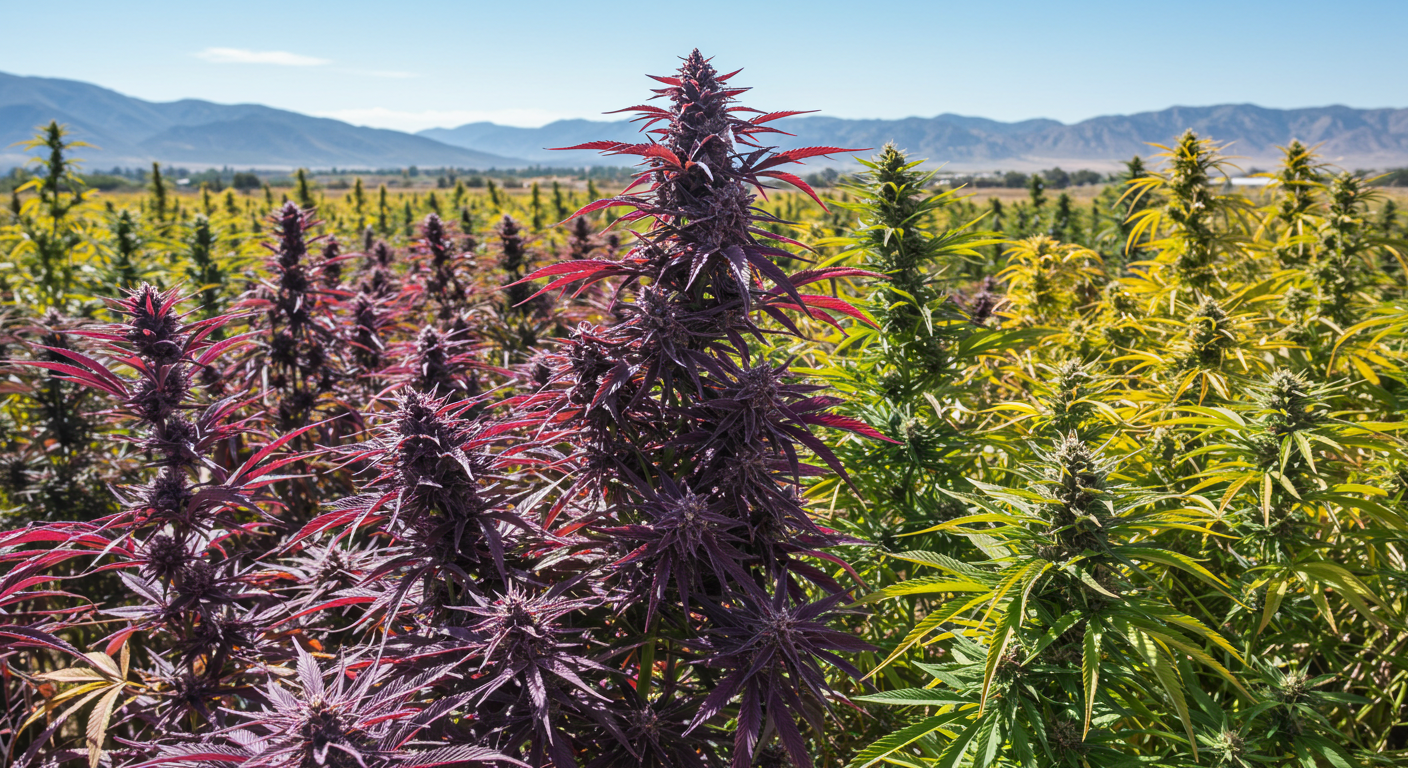
Average Yield of a Cannabis Plant
How much cannabis can one plant produce? The honest answer is that one plant may finish with a small jar of dried flower or a harvest measured in pounds. The plant count alone does not tell us enough. An indoor plant filling a carefully lit canopy, a compact autoflower in a small container, and a full-season outdoor photoperiod plant are all “one plant,” but they are not comparable production units.
If you need a practical planning answer, a modest indoor plant may finish somewhere around 30 to 200 grams (about 1 to 7 ounces) of dried, trimmed flower, while a healthy photoperiod plant given more indoor space and vegetative time can move beyond that range. A well-sited outdoor photoperiod plant may produce 200 to 1,000 grams (about 7 ounces to 2.2 pounds) or more. Compact plants, short seasons, weak light, root restriction, pests, pollination, or environmental stress can reduce those figures sharply. These are planning bands, not promises.
Important: Every yield figure in this guide refers to dried, trimmed flower unless we clearly say otherwise. Freshly cut branches, wet flowers, leaves, stems, and untrimmed biomass can make a harvest look several times heavier than the finished result.
That distinction is where many yield articles lose the reader. They mix indoor and outdoor numbers, compare a single plant with a square meter of canopy, treat seed-company maximums as averages, or quote record plants without explaining the months of growth and space behind them. We are going to keep the useful core of the question and make the comparison fair.
What “yield” means here
Yield is the weight of usable, dried, trimmed cannabis flowers produced at harvest. It does not automatically include fan leaves, stems, roots, loose trim, failed flowers, or fresh water weight. When comparing two harvests, use the same trimming standard and the same final moisture condition.
The Quick Yield Table
Start with the growing format, then narrow the estimate using the rest of this guide. A plant at the lower end is not necessarily a failure, and a plant at the upper end is not automatically better. Quality, safety, time, energy, legal limits, and consistency matter too.
| Growing format | Useful planning range per plant | What usually sets the ceiling |
|---|---|---|
| Small indoor plant | About 15–80 g (0.5–2.8 oz) dry | Small canopy, short vegetative period, compact container, or modest light |
| Established indoor photoperiod plant | About 50–300+ g (1.8–10.6+ oz) dry | Usable canopy area, light distribution, climate control, and time |
| Indoor autoflower | About 20–150+ g (0.7–5.3+ oz) dry | Fixed life cycle, early stress, root volume, and available daily light |
| Outdoor autoflower | About 20–200+ g (0.7–7.1+ oz) dry | Planting date, uninterrupted early growth, sun, weather, and pests |
| Outdoor photoperiod plant | About 200–1,000+ g (7 oz–2.2+ lb) dry | Season length, direct sun, root space, cultivar finish time, weather, and support |
| Large full-season outdoor plant | One kilogram or more is possible, but not an average | A long suitable season, very large root zone, healthy canopy, irrigation, and late-season protection |
The ranges are intentionally wide. Even international technical guidance notes that cannabis yields vary so much with cultivar, light, nutrition, cultivation method, and growing duration that a universal wet- or dry-weight formula is not meaningful. That is not a reason to avoid estimates. It is a reason to label them honestly.
“So what should I expect from one healthy indoor plant?”
Question sent by: Claire Dawson, via email.
If the plant has a modest but properly lit canopy, a healthy root zone, and a complete flowering cycle, think in broad tens to a few hundred grams of dry flower, not in a guaranteed number. A compact setup may land below 50 g, while a plant trained to fill more productive canopy can pass 200 g. Measure the canopy and light before trusting the plant count.
Why “Per Plant” Is a Difficult Measurement Indoors
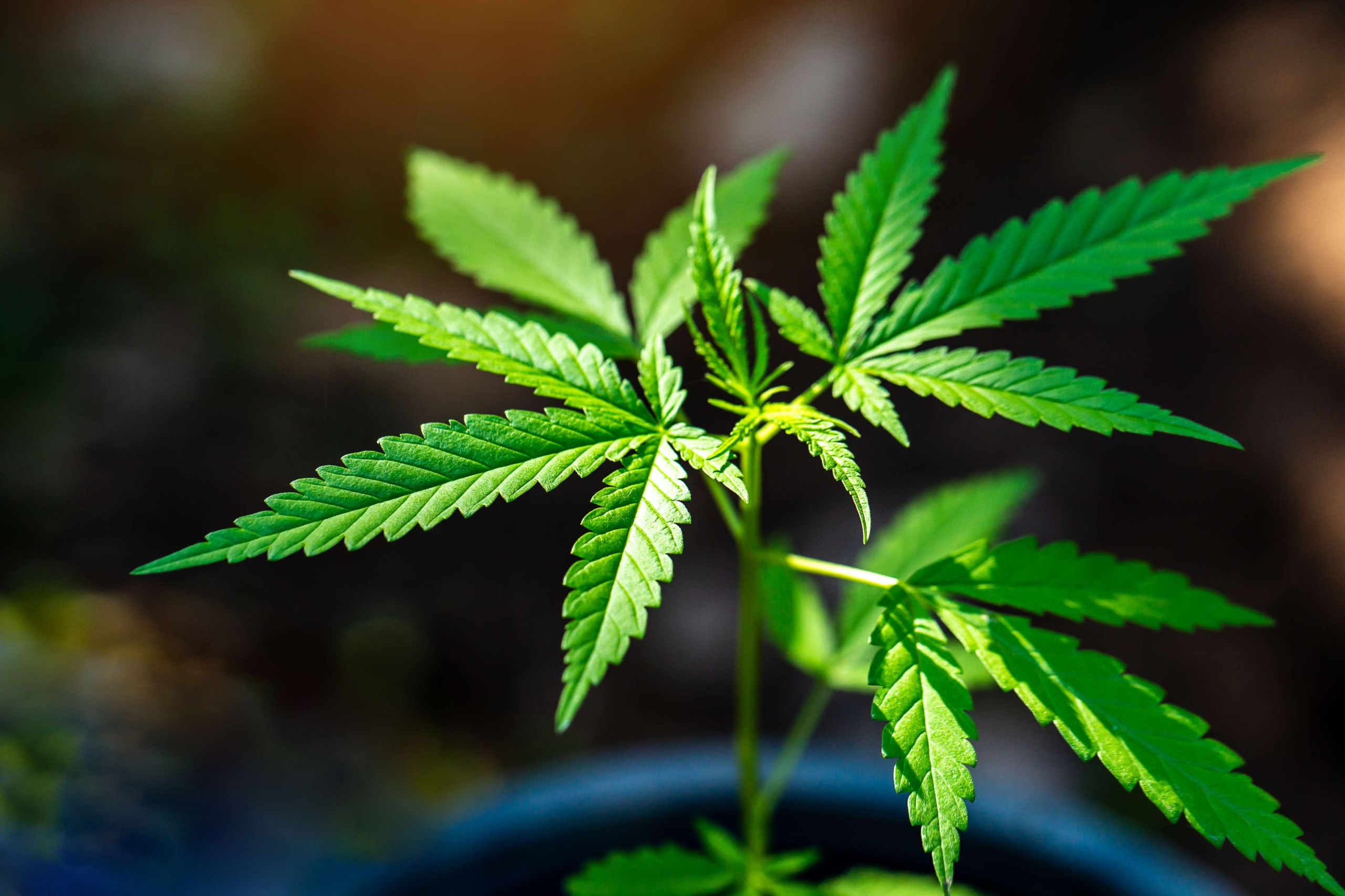
Indoors, one plant can occupy a fraction of a shelf, half of a tent, or an entire room. A grower may place many small plants under one fixture or spend weeks training a single plant across the same area. If both gardens fill the same productive canopy and receive similar light, their total harvests may be closer than the plant counts suggest.
This is why indoor growers often learn more from grams per square meter, grams per square foot, grams per day, or carefully interpreted grams per watt. Per-plant yield remains useful for your own records, especially when plants share similar genetics, containers, age, and canopy allocation. It becomes misleading when any of those conditions change.
Indoor Yield per Square Meter
Area-based yield asks a cleaner question: how much dried flower did the illuminated canopy produce? Scientific cannabis trials have reported very different outputs because cultivars, plant density, vegetative duration, lighting, and harvest standards differ. One recent greenhouse density and vegetative-duration study, for example, produced area yields spanning roughly 119 to 571 g/m² across its treatments. That range belongs to that experiment, not to every home garden, but it shows why a single number cannot describe every room.
For personal record keeping, define the canopy you actually flowered. A 1.2 × 1.2 m tent has a floor area of 1.44 m², but the productive canopy may be smaller if corners are empty or equipment occupies space. Do not divide by the advertised tent size if the plants only used part of it.
Productive canopy
The productive canopy is the leaf-and-flower area receiving useful, reasonably even light. Empty floor, inaccessible corners, shaded lower branches, fans, humidifiers, and equipment do not become productive canopy merely because they sit inside the enclosure.
Indoor Yield per Watt
The familiar grams-per-watt calculation is simple:
Total dried, trimmed flower in grams ÷ actual lighting power in watts = grams per watt.
If 400 g of dried flower came from a fixture drawing 400 W during flowering, the result is 1.0 g/W. The calculation is useful within the same garden, but it has limits. It ignores flowering duration, vegetative lighting, fixture efficiency, dimming, canopy area, and all the electricity used by fans, cooling, heating, dehumidification, and pumps. It also becomes unfair when comparing an older HID fixture with a more efficient modern LED because equal electrical watts do not guarantee equal photon output.
Remember: Grams per watt is a crop result divided by one input. It is not a direct measure of plant health, flower quality, profit, or total energy efficiency.
Indoor Yield per Day
Time can change the conclusion completely. A single photoperiod plant may deliver a large harvest after a long vegetative stage, while several smaller plants may fill the same canopy sooner. Divide the finished dry yield by the number of days from the start of the comparable production period. If you compare cycles, always start the clock at the same event, such as transplant, rooted clone, germination, or the first day of flowering.
“Can one plant under a 600-watt light produce 600 grams?”
Question sent by: PrairieMeter, via Facebook page.
It is possible for a productive canopy to approach or exceed 1 g/W, but the fixture does not assign that yield to one plant. The plant must fill the lighted area, the photons must reach useful leaves and flowers, and the root zone and climate must support that growth. A small plant under a large fixture will not use the fixture’s full potential.
Indoor vs. Outdoor Yield: A Fair Comparison
Outdoors, the plant can receive an enormous root zone, months of vegetative growth, and sunlight across a canopy much larger than a typical indoor enclosure. That is why a full-season outdoor photoperiod plant can outweigh a single indoor plant. Indoors, however, the grower can control the season, repeat cycles, manage the canopy, and reduce some weather-related losses.
The useful comparison is not “Which environment always yields more?” It is “Which environment can provide the plant with more productive light, healthy root volume, suitable time, and manageable risk?”
| Question | Indoor | Outdoor |
|---|---|---|
| Typical unit | Canopy area, fixture input, or crop cycle | Plant, root zone, season, or land area |
| Main yield advantage | Repeatable environment and multiple cycles | Sunlight, root space, and large plant size |
| Main yield risk | Insufficient light distribution, heat, humidity, equipment failure, and limited space | Short season, storms, pests, disease, pollination, theft, and an unsuitable finish date |
| Best comparison | Dry flower per canopy area, day, or total energy | Dry flower per plant and per season, with losses recorded |
| Can one plant exceed 1 kg? | Possible but highly unusual and space intensive | Possible in a long, favorable season with a very large root zone |
Why Outdoor Plants Can Become So Large
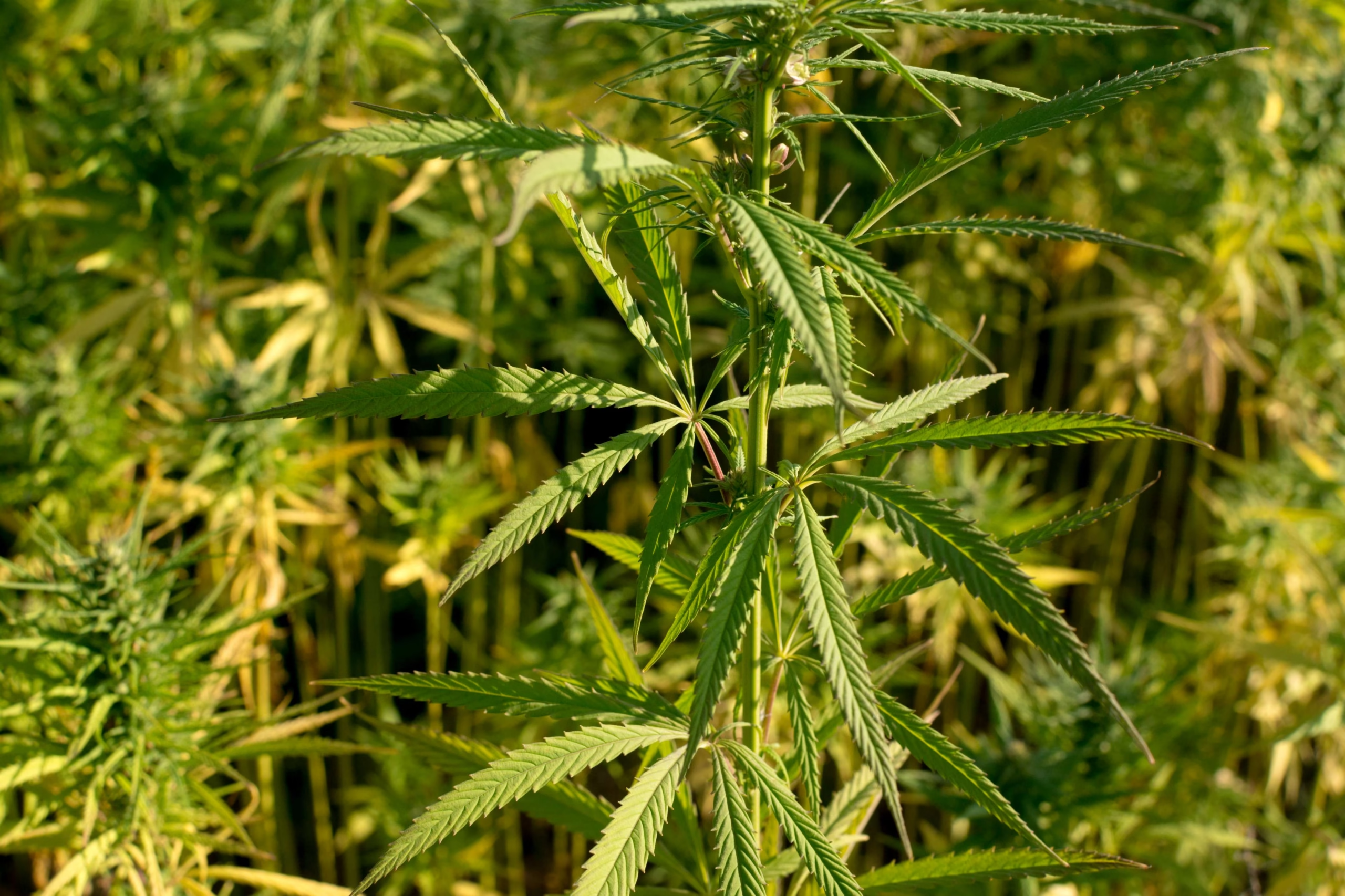
A photoperiod plant placed outdoors early enough can remain vegetative for months before the seasonal daylength triggers flowering. During that time it can establish a wide root system and a large branch framework. Full sun also moves across the canopy, reaching different surfaces during the day rather than staying in one fixed overhead position.
None of that makes a large harvest automatic. A huge plant can lose flowers to caterpillars, mold, wind, early frost, pollination, nutrient stress, broken branches, or a cultivar that finishes too late for the location. Outdoor yield is often a story of potential minus losses.
Large flowers can carry large late-season risks
Dense, heavy flowers are not automatically an advantage in a wet autumn. Support branches before they fail, inspect flower interiors after rain, remove visibly diseased material safely, and do not consume moldy cannabis. Choose genetics that can finish within the local season rather than choosing by a maximum-yield claim alone.
“Does more sun always mean more flower outdoors?”
Question sent by: Samuel Wright, via email.
Useful direct sun generally raises the plant’s productive potential, but only while water, roots, temperature, nutrition, and plant health can keep up. Moving a stressed or poorly rooted plant into harsher sun can increase water demand faster than it increases growth. Build the root zone and irrigation plan around the light the site receives.
Photoperiod vs. Autoflower Yield
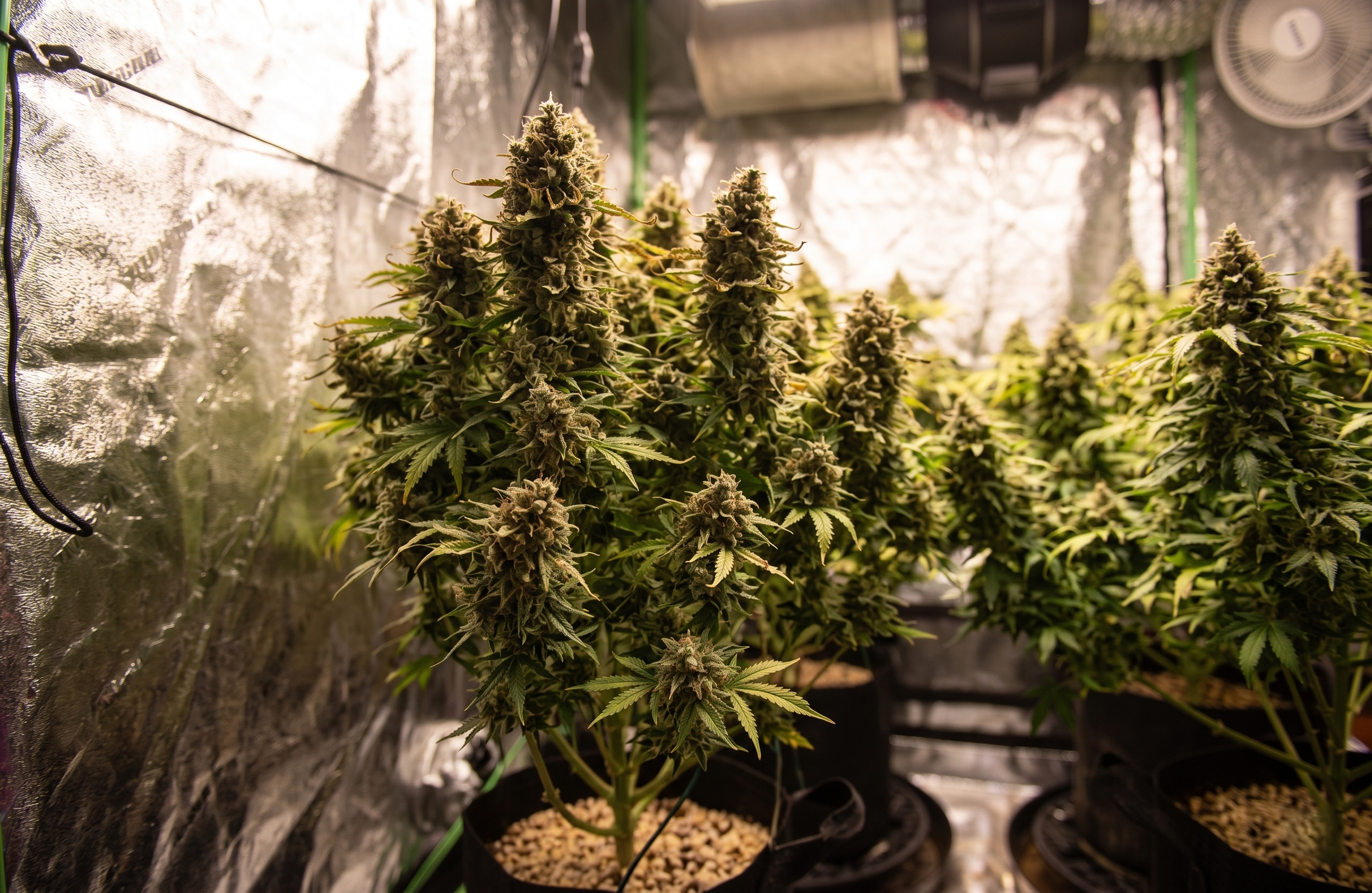
The original question becomes easier once flowering type is separated. Photoperiod cannabis responds to daylength and can remain vegetative while long-day conditions continue. The grower therefore has more control over plant size before flowering indoors, and a plant outdoors may use much of the season to build structure.
Autoflowering cannabis transitions according to age rather than waiting for a short-day flowering signal. Its speed can be valuable, but early stress costs more because there is less time to replace lost growth before flowering advances. An autoflower is not automatically easy; it is simply less dependent on a manually changed photoperiod.
| Yield factor | Photoperiod plant | Autoflower plant |
|---|---|---|
| Control over final size | High indoors because vegetative time can be extended | Lower because the life cycle keeps moving |
| Recovery from early stress | The schedule can often be extended before flowering | Lost early growth may remain visible in the final yield |
| Potential per plant | Usually higher when extra space and time are available | Often lower per plant, though strong modern examples can be substantial |
| Potential per year | Depends on cycle length and room scheduling | Fast cycles may partly offset lower per-plant output |
| Outdoor advantage | Can use a long season to become very large | Can finish before difficult autumn weather or allow more than one seasonal window |
Advice: Compare autoflowers and photoperiod plants by the result you actually need. Per plant favors a large photoperiod plant. Per day, per season, discretion, height, or an early outdoor finish may make an autoflower the more useful choice.
“Do photoperiod plants always yield more than autoflowers?”
Question sent by: Morgan Lee, via contact form.
Not in every real garden. Photoperiod plants have the higher size ceiling because their vegetative period can be extended, but a poorly filled photoperiod canopy can lose to a healthy autoflower crop. Compare equal space, light, time, and management before deciding which one was more productive.
Seed, Clone, and Phenotype: Why Genetics Change the Estimate
A cultivar name is not a guaranteed production specification. Plants grown from seed can differ in height, branching, flowering time, flower density, and stress response. Clones reduce genetic variation because they share a source plant, yet their starting health, root quality, disease status, and environment still affect the outcome.
Scientific work examining hundreds of drug-type cannabis plants has found substantial variation in inflorescence morphology among genotypes. That helps explain why two healthy plants in the same room may distribute flower mass differently. One may form fewer large tops; another may spread weight across many smaller flowers.
Genetic potential is a ceiling, not a forecast
A genetic line can carry traits associated with plant architecture, flowering time, and flower production. The final harvest is the expression of those traits inside a particular environment. A high claimed ceiling cannot repair weak light, a small root zone, disease, or an unsuitable season.
Seed-Company Yield Numbers
Indoor catalog figures are often shown in grams per square meter, while outdoor figures are shown in grams per plant. That difference is meaningful. The indoor number assumes a filled canopy under a particular but often unstated production standard. It does not mean one seed automatically produces that many grams. The outdoor number often represents a large plant in favorable conditions rather than a typical result across climates.
Use those figures to compare entries within the same catalog, then reduce confidence when the growing method, light level, plant density, container, finish date, and dry-trim standard are missing.
“The seed description says 600 g/m². Is that what one plant yields?”
Question sent by: NorthCanopy, via Facebook page.
No. It describes an area result, usually under favorable indoor conditions. One plant might fill that square meter after a long vegetative period, or several smaller plants might share it. The number also depends on how completely and evenly that canopy is lit.
The Factors That Affect Cannabis Yield Most
Yield is a system result. Increasing one input only helps until another part of the system becomes limiting. More light raises potential, but it also raises water demand and can expose weak climate control. A larger container creates room for roots, but it does not replace oxygen, irrigation discipline, or balanced nutrition. Training creates more exposed sites, but it cannot create photons.
1. Productive Light Across the Canopy
Light is the energy source behind flower biomass. Controlled-environment research has shown dry inflorescence yield increasing as canopy-level light intensity increased across the tested range. The same research also found that leaf-level photosynthesis did not predict the whole-plant yield response well, reminding us that a single leaf measurement is not the whole canopy.
The practical goal is not the highest number at one point. It is useful distribution across the occupied canopy without creating heat, bleaching, water-demand, or environmental problems the rest of the system cannot manage. Measure more than the center. Corners and edges often explain why an apparently powerful fixture produces an uneven harvest.
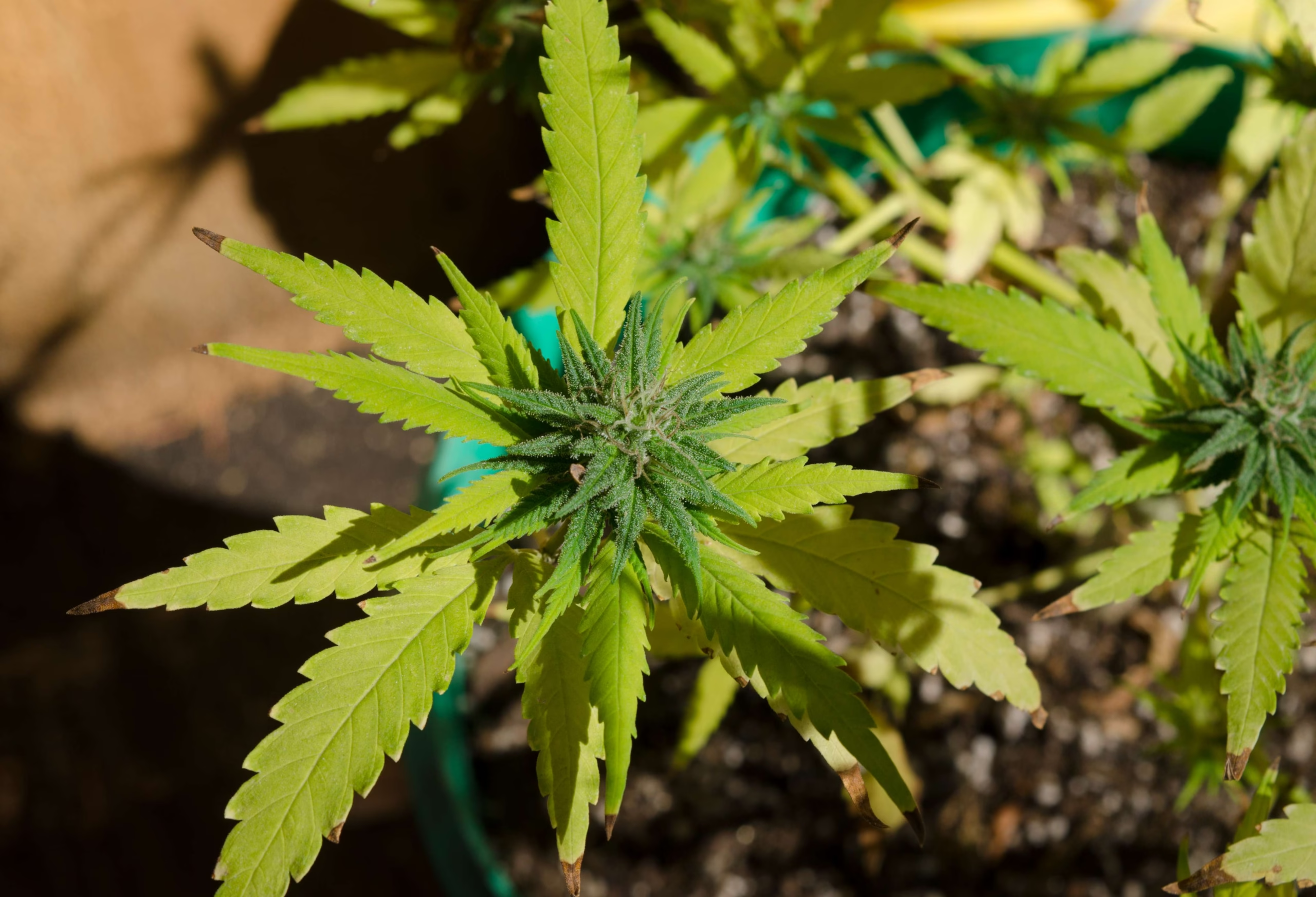
Pro Tip: Before buying a larger light, map the canopy you already have. Improving fixture height, plant spacing, training, reflective boundaries, or canopy evenness may recover underused light without increasing power.
2. Canopy Area and Plant Architecture
A taller plant is not automatically a higher-yielding plant indoors. If upper flowers sit close to the fixture while lower branches remain shaded, much of the plant consumes time and resources without contributing equivalent finished flower. Training can spread the plant horizontally and keep more flowering sites within a useful light range.
Research on plant density shows an important tradeoff: increasing density can reduce yield per plant while increasing yield per area. This is one reason arguments about “the best number of plants” go nowhere without discussing veg time, cultivar architecture, legal plant limits, and canopy size.
“Will four plants yield four times more than one plant?”
Question sent by: Ethan Price, via email.
Not when all five scenarios use the same filled canopy and light. More plants can fill the area faster, while one plant may need more vegetative time. Once the canopy is occupied, adding plant count without adding productive area or light usually divides the same resources among more plants.
3. Vegetative Time
Longer vegetative growth can increase plant size and the number of potential flowering sites, particularly for photoperiod plants. It also consumes time, space, electricity indoors, and seasonal opportunity outdoors. The goal is not “veg as long as possible.” It is to enter flowering when the healthy plant can fill the intended canopy after its expected stretch without becoming unmanageable.
A small plant flowered early may produce less per plant but complete the room sooner. A large plant may produce more per plant but reduce annual cycle count. Track both the harvest and the calendar.
4. Root Volume, Medium, and Irrigation
Roots need water, nutrients, and oxygen at the same time. A larger container can support more plant mass when the medium drains and re-aerates properly, but “larger” is not a cure for poor irrigation. Oversized wet containers can remain saturated around a small root system, while undersized containers can dry too rapidly and restrict the plant during peak demand.
Choose container size around plant size, medium behavior, climate, and the watering frequency you can maintain. Outdoors, prepared ground or a large bed can support a much larger root system than a compact pot, but soil structure, drainage, and water access still decide whether that volume becomes useful.
“Does a bigger pot always mean a bigger yield?”
Question sent by: Alicia Grant, via email.
Only when root volume is the limiting factor and the larger container is managed well. If light, genetics, time, temperature, or plant health already sets the ceiling, extra wet medium may add cost without adding flower. Move up in container size for a reason, not as a ritual.
5. Nutrition, pH, EC, and Root-Zone Balance
Yield responds to adequate fertility, not to the highest possible nutrient concentration. Deficiency can limit leaf area and flower development; excess can damage roots, disturb nutrient balance, raise salinity, and waste money. The useful target depends on water quality, medium, cultivar, plant stage, climate, and feeding method.
Watch the plant and the root zone together. A wet pot with a hungry-looking canopy may have an oxygen or root-health problem rather than a lack of fertilizer. Adding more nutrients to a poorly functioning root zone can make the problem harder to diagnose.
Do
Build yield by removing a measured limit
Check water quality and root-zone behavior, change one major variable at a time, and record pH, EC, irrigation volume, climate, and plant response. Let healthy new growth and flower development provide the evidence.
Avoid
Chasing yield with more of everything
Do not treat every pale leaf as a feeding problem, combine several additives, or raise light, fertilizer, and irrigation together without monitoring demand. Catalog maximums are not a reason to force the plant.
6. Temperature, Humidity, Air Movement, and CO₂
The environment determines how effectively the plant can use light and water. Excess heat can increase demand and reduce performance; low temperature can slow root and shoot activity. Humidity affects transpiration, disease risk, and drying conditions around dense flowers. Air movement should mix the canopy air and reduce stagnant pockets without constantly wind-burning the leaves.
Supplemental carbon dioxide can support higher photosynthetic performance in a genuinely sealed and well-instrumented environment with enough light and suitable temperature, but it is not a shortcut for a weak room. It adds cost, monitoring requirements, and serious human-safety considerations. Fix light distribution, air exchange, heat, humidity, irrigation, and electrical safety first.
Do not improvise with carbon dioxide
Elevated CO₂ can create an invisible asphyxiation hazard. Use only lawful, purpose-built equipment with monitoring, alarms, safe occupancy procedures, and professional guidance. Never use open-flame devices in an unsuitable enclosed space.
7. Plant Health and Biosecurity
Pests and disease remove productive leaf area, damage roots, consume flower tissue, and can make part of the harvest unusable. Prevention usually protects more yield than late rescue attempts. Start with clean material, inspect leaf undersides and growing tips, separate new plants when practical, sanitize tools, and correct persistent environmental conditions that favor disease.
Pollination also changes the result. Seed formation redirects reproductive development and reduces the amount of seedless flower a grower expects to harvest. Inspect for unwanted male flowers and respect neighboring crops and local rules.
8. Harvest Timing and Post-Harvest Handling
Harvesting too early can leave flower mass and maturity behind. Waiting too long can expose the crop to senescence, weather, disease, or quality loss. The correct window depends on the cultivar, flower development, resin-gland maturity, weather risk, and the intended product. Do not use pistil color alone as an absolute clock.
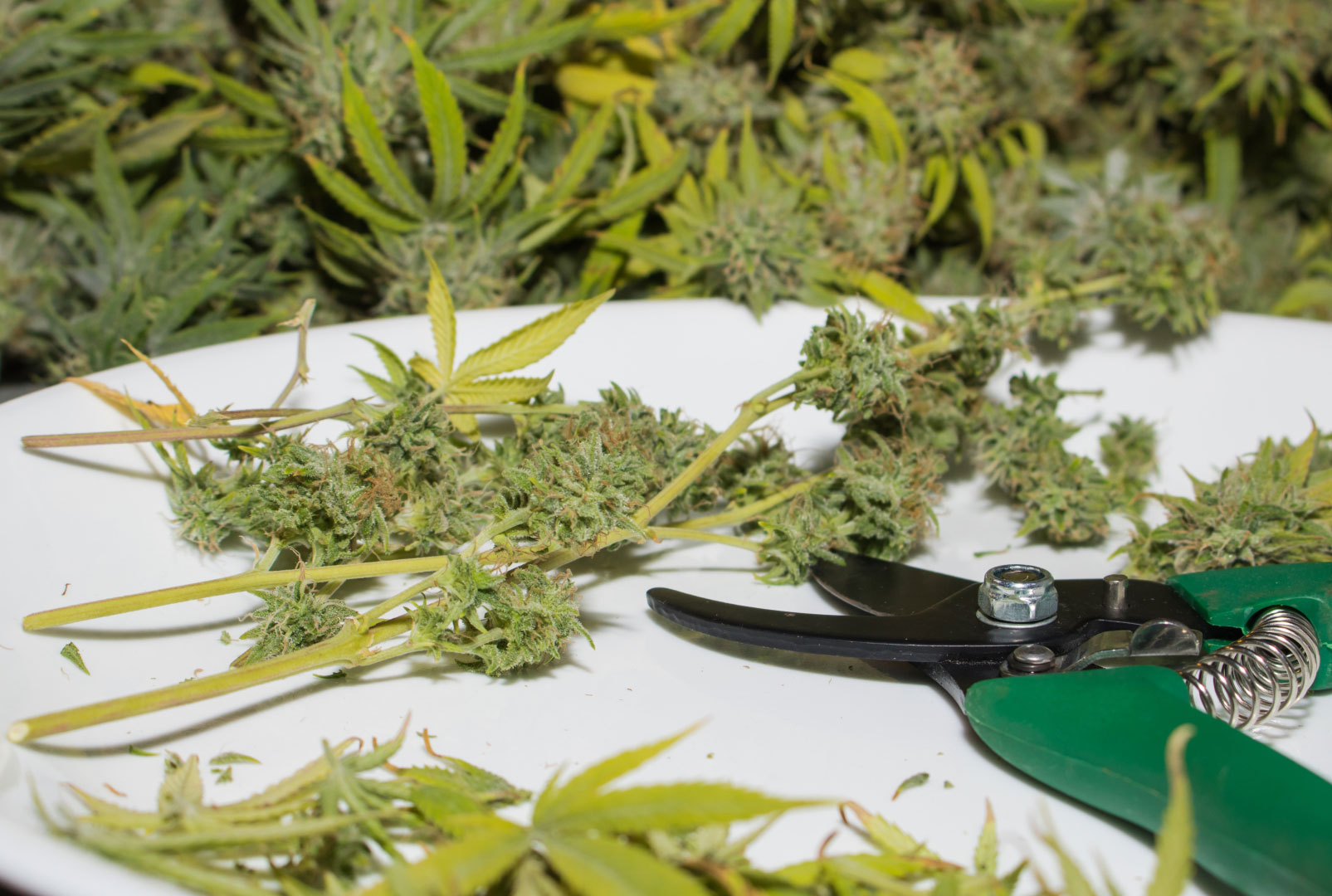
After cutting, drying and trimming determine the reported yield. A harvest can lose roughly four-fifths of its fresh weight as water and removed plant material, although the exact ratio varies. A legal fresh-to-dried equivalency used in Canada treats 5 g fresh as equivalent to 1 g dried, which is useful as a rough planning reference, not as a prediction for every batch.
Wet Weight vs. Dry Weight
Fresh flowers can feel impressively heavy because the tissue still contains most of its harvest moisture. Drying removes water; trimming removes stems and leaves; handling may remove loose material. The number that matters for a fair yield comparison is the stable dried and trimmed flower weight.
| Fresh trimmed flower | 20% planning estimate | 25% planning estimate | Why the final number varies |
|---|---|---|---|
| 100 g | 20 g dry | 25 g dry | Stem content, flower density, trim, and final moisture |
| 250 g | 50 g dry | 62.5 g dry | The wet sample may include different amounts of leaf and branch |
| 500 g | 100 g dry | 125 g dry | Drying conditions and trimming standard change the result |
| 1,000 g | 200 g dry | 250 g dry | Large batches can contain uneven flower sizes and moisture levels |
Use the 20 to 25 percent column only as an early estimate. The final scale reading after a consistent drying and trimming process is the real result. Do not rush drying merely to reach a target weight. Post-harvest research shows that drying method and conditions affect safety and quality as well as moisture.
“I harvested 800 grams wet. Did I grow almost two pounds?”
Question sent by: LakeGrowNotes, via Facebook page.
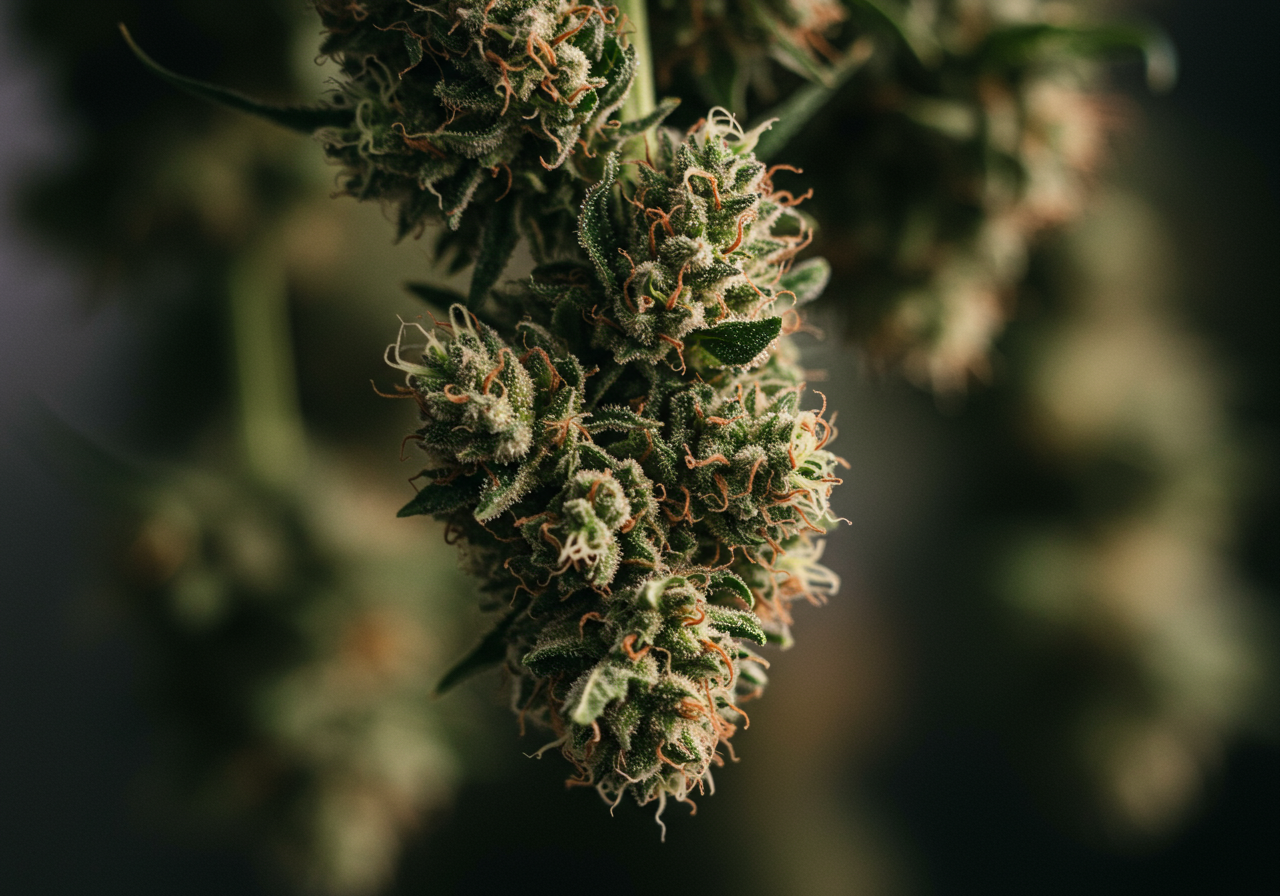
Not as finished flower. A rough 20 to 25 percent planning conversion would place 800 g fresh around 160 to 200 g dry before the batch proves its actual ratio. Record the wet figure if it helps your process, but report yield only after consistent drying and trimming.
How to Calculate Your Cannabis Yield Correctly
A good harvest record answers more than “How many grams?” It preserves the context that made the number possible. Use a calibrated scale and assign one consistent definition to finished flower.
Grams per Plant
Total dry flower ÷ harvested plants = average grams per plant.
Example: 420 g from four plants equals 105 g per plant. If one plant occupied twice as much canopy as the others, also keep individual weights or note the unequal space.
Grams per Square Meter
Total dry flower ÷ productive canopy area in m² = g/m².
Example: 520 g from 1.2 m² of productive canopy equals about 433 g/m². Measure the occupied canopy, not merely the room.
Grams per Square Foot
Total dry flower ÷ productive canopy area in ft² = g/ft².
One square meter is about 10.76 square feet. Keep the original unit in your records to avoid repeated rounding.
Grams per Watt
Total dry flower ÷ actual fixture draw during flowering = g/W.
Record whether the fixture was dimmed and, if possible, the average power used rather than the maximum printed on the product. Do not include a fixture’s marketing name as wattage.
Grams per Day
Total dry flower ÷ comparable crop days = grams per day.
This helps compare a fast modest cycle with a slow large harvest. Define the start day clearly.
Yield per Total Energy
For a more serious efficiency picture, record lighting kilowatt-hours and major climate loads. A crop that produces more grams per fixture watt but requires much more cooling or dehumidification may not be more efficient overall.
Record these details at every harvest
- Final dried and trimmed flower weight
- Number of plants actually harvested
- Productive canopy dimensions
- Cultivar and whether each plant came from seed or clone
- Vegetative and flowering duration
- Fixture model, actual draw, dimming level, and flowering schedule
- Container size, medium, and irrigation method
- Major pest, disease, pollination, weather, or equipment losses
- Harvest date, trim standard, drying method, and final weighing date
- Quality notes, because weight alone never tells the whole story
“Should I include small lower flowers in the total?”
Question sent by: Owen Martin, via email.
Include whatever meets your defined usable-flower standard, then keep that standard consistent. If lower material is separated for another purpose, record it in a second category. The comparison fails when one harvest includes every fragment and another includes only selected flowers.
Three Realistic Yield Scenarios
These examples are not promises. They show how the same plant count produces different answers once space, time, and environment are included.
Scenario 1: One Compact Indoor Autoflower
A single autoflower grows in a modest container under a small fixture. It stays healthy but never fills the whole enclosure. The final result is 55 g dry. That may look small beside a catalog maximum, yet it can be a sensible result for the plant’s occupied area, short cycle, and light access.
The useful next question is not “How do I force 200 g from this plant?” It is “Was the canopy fully used, did early stress reduce size, and would the next improvement come from roots, light distribution, or choosing a different format?”
Scenario 2: Four Indoor Photoperiod Plants Sharing One Canopy
Four plants share a 1.44 m² tent and finish with 620 g dry. The per-plant average is 155 g. The area result is about 431 g/m². If a 480 W fixture provided the flowering light at full draw, the lighting result is about 1.29 g/W. None of those metrics is “the truth” alone; together they describe the crop.
Scenario 3: One Full-Season Outdoor Photoperiod Plant
One plant grows in prepared ground through a long season, receives strong direct sun, and finishes with 850 g of dry flower after weather-damaged material is removed. Its per-plant result is much higher than either indoor example. It also occupied more area, grew for longer, and carried risks that do not appear in the indoor number.
What to Remember: A fair yield comparison keeps at least four things visible: finished dry weight, productive space, production time, and the resources or risks behind the result.
Can You Estimate Yield Before Harvest?
You can build a range, but you cannot accurately weigh a living canopy with your eyes. Flower density changes late, branch interiors may hide disease or seed, and fresh appearance does not reveal final moisture loss. Photos are especially deceptive because lens distance and perspective change apparent size.
A better pre-harvest estimate uses your own previous wet-to-dry ratio, comparable genetics, the same trimming standard, and representative sample branches. Even then, keep a low, middle, and high scenario rather than one confident number.
| Estimate signal | What it can tell you | What it cannot tell you |
|---|---|---|
| Canopy area | Whether the productive space is filled | Flower density, final moisture, or hidden loss |
| Number of tops | How the plant distributed flowering sites | The finished weight of each top |
| One sample branch | A local wet-to-dry ratio for that branch | Whether the whole canopy is equally dense |
| Catalog yield | A comparative potential claim | Your site, skill, season, or final result |
| Harvest photo | General structure and apparent coverage | Reliable weight without scale and drying |
“Can you estimate my harvest from a photo?”
Question sent by: Marc-André Roy, via contact form.
A photo can show canopy coverage, visible flower size, and obvious health problems, but it cannot reveal density, moisture, hidden damage, or the amount removed during trimming. Use photographs for progress records, then let the dry scale answer the weight question.
Common Yield Myths
“More Plants Always Mean More Cannabis”
More plants can fill an area faster. Once the productive canopy is full, plant count often changes how that space is divided more than it changes the space itself. Legal plant limits and biosecurity may also favor fewer plants in some locations.
“More Light Always Means More Yield”
Increasing useful light can raise yield potential, and controlled studies support a strong response across tested ranges. But the whole system must support the added demand. Excessive or badly distributed light can create stress and inefficiency. More light is productive only when the plant can use it.
“A Taller Plant Is a Bigger Harvest”
Height is only one dimension. Indoors, a flat, well-lit canopy can outperform a tall plant with shaded lower growth. Outdoors, height can contribute to a large framework, but branch strength, sun exposure, and finish time matter.
“Hydroponics Automatically Yields More Than Soil”
A well-managed soilless or hydroponic system can support rapid growth and precise feeding. A poorly oxygenated, unstable, or neglected system can fail quickly. A healthy biological or soil-based root zone can also produce substantial harvests. Compare complete systems, not labels.
“More Nutrients Make Bigger Flowers”
Plants require adequate nutrition. Beyond that point, excess does not become free flower. It can create root stress, imbalance, and waste.
“Dense Flowers Always Mean the Best Yield”
Dense flowers can increase weight per volume, but they may also hold moisture and become vulnerable in humid conditions. Marketable or usable yield is what remains healthy after inspection, drying, and trimming.
“Record Plants Reveal the Average”
They do not. Record-style claims often omit verified dry-weight methods, canopy area, production time, trimming standard, or independent confirmation. A huge outdoor plant or exceptional autoflower can demonstrate biological potential, but it is not a planning baseline.
“Why did my smaller plant produce denser flowers than the larger one?”
Question sent by: Tobias Klein, via email.
Plant size and flower density are related but separate traits. Genetics, canopy position, light exposure, temperature, pollination, maturity, and flower structure all matter. Compare total usable dry weight and quality, not the appearance of one top.
Commercial Yield Is Measured Differently
Commercial production cannot rely on spectacular single plants. A facility needs repeatable output, uniform quality, predictable schedules, efficient labor, and controlled losses. Yield is therefore measured by canopy area, room, cycle, year, energy, labor, and the proportion of flower that meets the required specification.

A room reporting 600 g/m² once may be less successful than a room repeatedly producing 500 g/m² with fewer failures, lower energy use, and more uniform flower. Recent research on inner-canopy lighting is a useful example: changing light distribution increased dry inflorescence yield and reduced variability in the tested medical cannabis system. The lesson is broader than the hardware. Uniformity can be as valuable as a peak.
Marketable yield
Marketable yield is the portion of the harvested crop that meets the defined quality, safety, and product specification. Total flower biomass can be higher than marketable yield when disease, seeds, contamination, poor structure, or inconsistent processing removes material.
How to Improve Yield Without Chasing a Fantasy Number
The most reliable gains usually come from removing one clear bottleneck while keeping the rest of the garden stable. Work in this order:
- Protect legality and safety. Follow local cultivation, electrical, structural, water, access, odor, and possession rules.
- Start with healthy genetics and clean plant material. A compromised start is difficult to outgrow.
- Define the productive canopy. Know the area you intend to fill and the height you can safely use.
- Distribute useful light. Measure more than the brightest point and correct major shadows.
- Match roots and irrigation to plant demand. Avoid both chronic saturation and repeated severe drought.
- Stabilize temperature, humidity, and air movement. Dense flowers require a climate that can protect them.
- Train for access and evenness. Do not create a canopy too dense to inspect or ventilate.
- Record losses. A pest-damaged or moldy gram never becomes usable yield.
- Standardize harvest and drying. Improvement cannot be measured with changing definitions.
- Compare several cycles. One exceptional or disappointing harvest is not a stable average.
Master Advice: Do not ask the plant for a number. Ask the garden which resource is limiting healthy flower production today, then correct that limit without destabilizing everything else.
“What is the cheapest way to increase my next harvest?”
Question sent by: Jordan Hayes, via email.
Use the equipment you already own more evenly. Fill empty productive space, correct major canopy shadows, stop preventable irrigation stress, and record the cycle. Buying another additive is rarely as valuable as fixing an obvious light, root, climate, or plant-health limit.
Average Yield Questions, Answered Clearly
How many ounces can one cannabis plant produce?
A compact plant may produce less than an ounce. A healthy indoor plant commonly lands somewhere in the range of one to several ounces, while a well-developed plant occupying more canopy can move higher. A full-season outdoor photoperiod plant can produce many ounces and, under favorable conditions, one or more pounds. Always ask whether the number is dry, trimmed flower.
Can one cannabis plant produce a pound?
Yes. It is possible indoors with substantial productive space and an optimized long cycle, and it is more plausible outdoors where a photoperiod plant can become much larger. It is not a universal average.
Can one plant produce a kilogram?
Yes, particularly a large outdoor photoperiod plant in a long suitable season. The root zone, canopy, support, water supply, plant health, cultivar, and late-season conditions must all support that scale. The possibility should not be confused with the expected result.
How much does an autoflower yield?
A practical planning range is often tens of grams to around 100 g or more per plant, with strong examples moving beyond it. The final result depends heavily on uninterrupted early growth, container and root health, daily light, cultivar, and environment.
How much does an indoor plant yield?
Think in terms of occupied canopy. A small plant may produce 15 to 80 g; an established photoperiod plant with more space may produce 50 to 300 g or more. Very large indoor single-plant harvests require enough time and canopy to make “one plant” a very large production unit.
How much does an outdoor plant yield?
An outdoor plant may produce very little in a poor site or short season. A healthy full-season photoperiod plant may produce several hundred grams, and a large plant in favorable conditions can exceed a kilogram. Outdoor estimates must include weather and disease losses.
Does indica or sativa yield more?
Those broad labels are not reliable yield calculators. Modern cultivars are genetically complex, and plant architecture, flowering time, phenotype, and environment are more useful than assuming every “sativa” is larger or every “indica” is denser.
Does topping increase yield?
Topping can redistribute growth and help form a more even canopy, but the result depends on timing, cultivar, recovery, and available space. It does not create energy. Applied badly or too late, it can delay growth or reduce the benefit.
Is 1 gram per watt good?
It can be a useful indoor lighting benchmark, but it should not be treated as a universal pass mark. Fixture efficiency, canopy area, cycle duration, dimming, climate energy, and quality all affect the meaning of the number.
Why is my yield lower than the seed description?
The catalog figure may describe favorable area-based production rather than one plant, and it may not state the light, density, container, vegetative time, climate, or trim standard. Compare your crop with your previous crop under known conditions before comparing it with a maximum claim.
“Is a low-yielding plant always poor genetics?”
Question sent by: SunroomAlex, via X.
No. Genetics may set a lower ceiling, but one low result can also come from weak roots, insufficient canopy light, early stress, short veg time, pollination, disease, or an early harvest. Repeat the comparison under controlled conditions before blaming one factor.
A Final Yield Checklist
Confirm that the comparison answers the same question
- Is the cultivation lawful where it takes place?
- Is the number fresh weight or dried, trimmed flower?
- Is it per plant, per square meter, per square foot, per watt, or per cycle?
- How much productive canopy did each plant occupy?
- How long was the vegetative and flowering period?
- Was the plant photoperiod or autoflowering?
- Did the comparison use similar genetics, containers, roots, and light?
- Were mold, pests, seeds, weather damage, and trimming losses removed?
- Was the fixture’s actual power used instead of a product name?
- Was the final weight taken after a consistent drying process?
- Does the result include quality and safety, not weight alone?
Planning Yield Around the Garden You Actually Have
There is no single average yield of a cannabis plant that remains accurate across indoor rooms, outdoor gardens, autoflowers, photoperiod plants, small containers, and full-season ground-grown specimens. A useful planning answer is that a modest indoor plant may produce tens to a few hundred grams of dried flower, while a healthy outdoor photoperiod plant may produce several hundred grams and sometimes more than a kilogram. The same plant can land far below its genetic potential when light, roots, time, climate, or health becomes limiting.
Keep the original question, but improve the measurement. Record dry trimmed weight, productive area, time, lighting, genetics, root conditions, and losses. After several comparable cycles, your own garden will give you a far better “average” than any record plant or catalog maximum ever could.
Never Forget: The best yield is not the largest number a plant can be pushed to produce. It is the largest healthy, safe, lawful, and repeatable harvest your complete environment can support.
Scientific and Technical References
- United Nations Office on Drugs and Crime. Recommended Methods for the Identification and Analysis of Cannabis and Cannabis Products.
- Backer R, et al. Closing the Yield Gap for Cannabis: A Meta-Analysis of Factors Determining Cannabis Yield.
- Rodriguez-Morrison V, Llewellyn D, Zheng Y. Cannabis Yield, Potency, and Leaf Photosynthesis Respond Differently to Increasing Light Levels in an Indoor Environment.
- Danziger N, Bernstein N. Too Dense or Not Too Dense: Higher Planting Density Reduces Cannabinoid Uniformity but Increases Yield per Area.
- Ahrens A, Llewellyn D, Zheng Y. Longer Photoperiod Substantially Increases Indoor-Grown Cannabis Yield and Quality in Two Tested Cultivars.
- Schober S, et al. Effects of Plant Density and Vegetative Growth Duration on Medicinal Cannabis Agronomic Traits.
- Naim-Feil E, et al. Empirical Evaluation of Inflorescence Morphological Attributes for Yield Optimization of Medicinal Cannabis Cultivars.
- Postharvest Operations of Cannabis and Their Effect on Cannabinoid Content: A Review.
- Baek Y, Grab H, Chen C. Postharvest Drying and Curing Affect Cannabinoid Contents and Microbial Levels in Industrial Hemp.
- Health Canada. Fresh and Dried Cannabis Equivalency Guidance.
Share this article
A quick overview of the topics covered in this article.
Follow us
Latest articles
September 24, 2026

September 24, 2026
September 24, 2026
September 24, 2026

Great article regarding yields.
Thank you, we really appreciate that. It also means a lot to us because this is the very first comment on the site, which makes it especially valuable. We’re glad you found the article useful. If you ever want to share your own experience with yields, or if there’s another growing topic you’d like us to cover next, feel free to leave a comment anytime.