
How to Choose an Outdoor Cannabis Cultivar for Your Climate
Choosing an outdoor cannabis cultivar is not really a question of finding the strongest genetics, the highest advertised yield, or the most familiar name. It is a question of finding material that can complete its life cycle inside the climate you actually have. A cultivar that grows beautifully through summer but repeatedly enters its final flowering weeks during cold rain, heavy dew, wildfire season, tropical storms, or early frost is not a good climate match, even if its indoor reputation is excellent.
The practical way to choose is to work backwards from the site. Record your latitude, realistic outdoor finish window, autumn rainfall pattern, humidity and dew pressure, summer heat, water reliability, wind exposure, available root volume, legal limits, and how often you can inspect the garden. Then compare cultivar information against those constraints. The label on the packet is only useful when it is supported by evidence that predicts something you can measure outdoors.
This resource stays focused on cultivar-to-climate matching. It does not replace a complete outdoor growing plan. For broader site selection, seasonal planning, watering, support, weather protection, and harvest management, use the Outdoor Grow Comprehensive Guide.
Define Climate Fit Before You Read Cultivar Labels
Climate fit begins with the conditions the plant must survive and finish in, not with a category such as indica, sativa, hybrid, landrace, fast, outdoor, or mold resistant. Those words may describe part of a breeding history or a seller’s intended market, but they are too broad to answer the decisions that matter in an outdoor garden.
The useful questions are more concrete. When does flowering usually begin at a latitude similar to yours? How much time does the material normally need after visible flowering begins? Does the plant remain structurally manageable in your wind exposure? Are the flowers open enough to dry after dew, or unusually dense? Does the source have field observations under humid, hot, cool, high-elevation, coastal, or drought-prone conditions that actually resemble your site? How much variation should you expect between seeds?
Cultivar, phenotype, and provenance are not the same thing
Cultivar is the named cultivated material you are considering. Phenotype is the expression of one individual plant under its genetics and environment. Provenance is the documented origin of the material, including who produced it, the lot or mother plant, where it was evaluated, and what conditions produced the performance claims. For climate selection, provenance and measured phenotype records are often more useful than the name alone.
How to Choose an Outdoor Cannabis Cultivar for Your Climate
Start by writing a one-page climate brief before looking at genetics. It does not need sophisticated climate modelling. It needs enough information to expose the conditions that can prevent a plant from finishing safely.
Record your latitude and the approximate dates when your site moves from reliable summer weather into repeated late-season risk. That risk may be the first likely frost, several weeks of cold rain, long humid nights, tropical storm season, persistent coastal fog, declining daylight plus cold nights at elevation, or extreme late-summer heat. Then note the garden’s microclimate: morning sun, afternoon heat, cold pockets, drainage, wind, access to water, and how rapidly flowers normally dry after rain or dew.
Next, separate hard constraints from preferences. A hard constraint is something that can end or seriously compromise the crop. Examples include a finish date that regularly collides with frost, a site that cannot support a very large plant, repeated late-flower Botrytis pressure, or a water system that cannot keep a large container supplied in hot weather. Preferences such as color, aroma, plant shape, or theoretical maximum yield come after those constraints.
Field Advice: A climate-matched cultivar is not the one that grows fastest in June. It is the one that can still be healthy, structurally manageable, and mature when your local season becomes difficult.
Build a climate brief from measurements, not regional stereotypes
Two gardens in the same city can create different cultivar decisions. One may sit on a warm south-facing slope with rapid morning dry-down. Another may be in a low backyard where cold air pools and trees block the first hours of sunlight. A regional climate classification is useful background, but the plant experiences the microclimate around its own canopy and roots.
At minimum, record the approximate first and last frost windows, typical late-season rainfall pattern, longest humid or wet period you expect during flowering, hottest recurring summer period, water reliability, wind exposure, and the hours when direct sun reaches the site. If you have already mapped the garden microclimate, use those measurements instead of repeating the work.
Turn the end of the season into the first selection filter
Many poor cultivar choices are made because growers plan forward from spring instead of backward from autumn. A long vegetative season can make a plant large, but large size does not compensate for flowers that cannot finish before damaging weather arrives.
Define three dates or periods: an earliest acceptable finish window, a preferred finish window, and a latest defensible finish window. The last one should still leave enough margin to inspect, harvest, and handle weather interruptions. Do not make the latest date equal to the first historical frost or the first day of the rainy season. Outdoor weather is variable, and a cultivar that only succeeds in an unusually kind autumn is a fragile choice.
| Climate information | What it should change in cultivar selection | What it does not tell you by itself |
|---|---|---|
| Short frost-free season | Prioritize verified early flowering and a finish window with margin before recurring cold. | That every compact or indica-labelled plant will finish early. |
| Humid, rainy autumn | Prioritize field evidence for disease tolerance, workable flower architecture, and earlier finish. | That a “mold-resistant” claim guarantees clean flowers. |
| Hot, arid summer | Prioritize heat and drought performance, water-manageable size, and recovery under high atmospheric demand. | That a sativa label proves heat tolerance. |
| High elevation | Prioritize finish margin, wind structure, cold-night performance, and realistic season length. | That stronger UV automatically improves quality or makes a cultivar suitable. |
| Coastal site | Prioritize sturdy architecture, disease observations in humid air, and manageable flower density. | That general salt tolerance is established because a plant was sold as outdoor genetics. |
Do not let indica, sativa, or hybrid percentages decide the climate match
Commercial cannabis labels often use indica, sativa, and hybrid as shortcuts for plant shape, flowering time, or expected effects. Genetic studies have repeatedly shown that these labels do not reliably describe genome-wide relatedness, and samples carrying the same cultivar name can differ genetically between sources. That makes broad ancestry percentages a weak foundation for an outdoor climate decision.
Use measurable traits instead: first-flower timing, critical photoperiod or day-length response where known, outdoor finish reports, final size, branch stiffness, internode pattern, flower density, disease observations, and performance in comparable field conditions. If those traits are undocumented, treat the cultivar as an experiment rather than as a predictable climate solution.
Choose by traits that can be checked outdoors
Use documented flowering, finish, architecture, disease response, and local or regional field performance.
Choose by ancestry percentages or marketing archetypes
“80% indica,” “tropical sativa,” “outdoor monster,” or similar labels do not prove a specific finish date, disease response, or climate tolerance.
Match Flowering Behavior to Latitude and the Real Finish Window
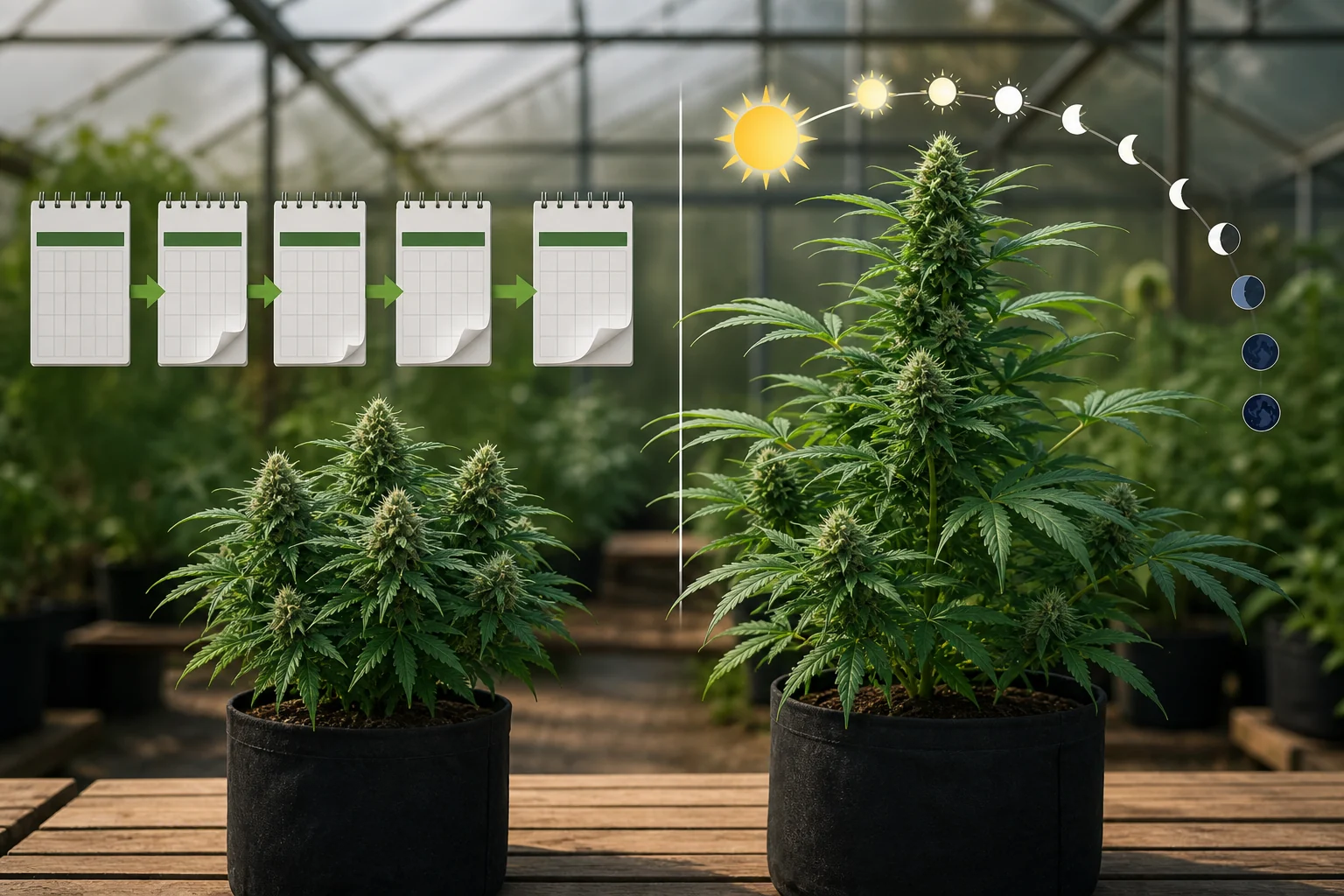
For photoperiod cannabis, flowering behavior is usually the most important climate-fit trait because it determines whether the plant reaches maturity before the local season turns against it. Cannabis is commonly described as a short-day plant, but outdoor flowering is not governed by one universal 12-hour trigger. Cultivars can differ substantially in critical photoperiod, juvenile phase, and the speed of transition after nights become long enough.
Field and controlled studies in hemp show meaningful cultivar differences in photoperiod response, including cases where changes as small as minutes around the critical range changed floral initiation. Other field trials show how material developed at one latitude can flower unexpectedly early or late when moved to another. Those findings are directly useful for selection even though hemp and drug-type cannabis are not identical production systems: the general lesson is that flowering timing is genetic, environmentally expressed, and strongly connected to latitude.
Separate indoor flowering weeks from outdoor finish information
A statement such as “8 to 9 weeks flowering” is often based on controlled cultivation where a plant is moved abruptly from a long vegetative photoperiod to a fixed flowering schedule. Outdoors, the signal changes gradually. The plant experiences a moving day length, civil twilight, variable cloud cover, artificial night light, temperature shifts, and a cultivar-specific threshold.
Indoor flowering duration can still provide information about the time a genotype may need after reproductive development is well established, but it should not be converted into an outdoor harvest date by simply adding weeks to a calendar. Stronger evidence is an outdoor finish range from a location with similar latitude, autumn temperatures, and light environment.
“The description says eight weeks of flowering. Can I assume it will finish before October?”
Question sent by: NorthernGarden, via email.
No. First confirm whether the eight weeks refer to indoor flowering or documented outdoor performance. Outdoors, the plant must first reach its own flowering threshold under your latitude and night conditions. Use comparable outdoor finish data as the planning evidence, then verify the first-flower and maturity dates in your own garden.
Use latitude as a photoperiod clue, not a cultivar recommendation
Latitude changes the seasonal pattern of day length. That makes the latitude where a cultivar or breeding population was developed useful context, especially when its flowering response has been observed there. It does not mean that geographic origin alone predicts the modern cultivar.
Modern cannabis has been heavily hybridized and commercial names are not consistent enough to infer flowering behavior from a geographic-sounding name. Provenance becomes useful when it includes actual trial data: latitude, planting date, first flower, harvest period, and the weather during that season.
Distinguish photoperiod cultivars from age-driven autoflowering material
Autoflowering behavior can be useful where the outdoor season is unusually short, where autumn weather becomes dangerous early, or where a grower wants the flowering clock to depend less on seasonal day length. Genetic research has identified major loci associated with autoflowering and early flowering in Cannabis, confirming that these are heritable traits rather than merely management effects.
That does not make autoflowering material automatically easier or better outdoors. The age-driven clock also reduces recovery time. A plant that is badly stunted by transplant shock, waterlogging, heat, or root damage cannot simply remain vegetative for several extra weeks while the grower repairs the problem. Climate fit therefore depends on whether a short fixed life cycle is an advantage for your site or an unnecessary loss of flexibility.
Ask for the right flowering evidence
When evaluating a source description, look for the way flowering data were collected. A useful outdoor claim includes location or latitude, approximate first-flower date, harvest window, whether the population was uniform, and whether the result was repeated across more than one season or site.
A weaker claim gives only a week count, a single harvest photograph, or an unqualified phrase such as “early finisher.” The difference matters because field trials repeatedly show genotype-by-environment effects. A cultivar can be early relative to other material in one environment without being early enough for your own.
Important: The strongest outdoor flowering evidence is not a famous cultivar name. It is repeatable flowering and finish data from the same source in conditions that resemble your latitude and season.
Match Architecture and Stress Tolerance to the Weather That Usually Ends Your Season
Flowering date determines whether the plant has enough calendar time. Architecture and stress response determine whether it can remain healthy during that time. A climate-matched cultivar should fit the weather pressure that repeatedly appears at your site, not every theoretical stress cannabis can experience.
In a cool humid garden, flower density, branch spacing, morning dry-down, and disease susceptibility may matter more than extreme heat tolerance. In a windy high-elevation site, structural strength and finish margin may matter more than maximum plant height. In an arid climate, root-zone volume, water demand, heat response, and recovery from high atmospheric demand may dominate the decision.
Separate inherited tendencies from environmental expression
Genetics influence flowering time, architecture, disease response, chemotype, vigor, and many stress responses. The environment changes how strongly those traits are expressed. A genetically compact plant can still become much larger in deep soil with a long season than it does in a restricted container. A cultivar with useful disease resistance can still develop disease under severe inoculum pressure, dense canopy conditions, injury, or prolonged wetness.
This is the practical meaning of genotype-by-environment interaction. The cultivar matters, the environment matters, and their interaction can matter enough to change the ranking of cultivars between sites or years. Recent multi-location hemp field research continues to show substantial environmental and GxE effects, which is why one season or one seller description should not be treated as universal performance.
In humid climates, evaluate disease evidence and flower architecture separately
A cultivar can avoid some disease because it has true genetic resistance, because it flowers later or earlier than peak disease pressure, because its canopy dries quickly, or because the flowers are less compact. Those mechanisms are not equivalent.
Powdery mildew research in Cannabis has identified real genetic differences in resistance, including mapped resistance loci. Other studies and field observations show genotype differences in susceptibility to powdery mildew, Botrytis, and microbial loads. This means disease-tolerance claims can have biological substance, but the claim still needs evidence. Ask which disease was measured, at what plant stage, under what infection pressure, and whether the observation was replicated.
“If a cultivar is advertised as mold resistant, is that enough for a wet autumn?”
Question sent by: CoastalRoots, via email.
Treat it as a lead, not proof. Find out whether the claim refers to powdery mildew, Botrytis bud rot, general outdoor survival, or simply the seller’s experience. Give more weight to replicated disease screening or repeated field observations from humid climates. Even useful genetic resistance is not immunity when dense flowers stay wet for long periods.
Use flower density as a risk trait, not a quality score
Dense flowers are often marketed as a sign of quality, but density also changes moisture behavior. In humid or rainy climates, tightly packed inflorescences can hold a more humid internal microclimate and make inspection more difficult. A slightly more open flower architecture can be an advantage when repeated dew and rain are the main late-season threat.
This does not mean growers in humid regions should search for the loosest flowers possible. The point is to include flower structure in the risk calculation. If you select exceptionally dense material, compensate with an earlier finish window, excellent morning sun, strong airflow, wider plant spacing, and more frequent inspection.
Match plant size and branch structure to wind, access, and legal space
Outdoor vigor is only useful when the garden can support it. A cultivar capable of becoming a very large plant may demand more root volume, more water, more branch support, more pruning access, and more distance from boundaries than the site can provide.
Record the maximum practical height and width before choosing genetics. If the garden is exposed to strong seasonal wind, prioritize branching that can be supported efficiently and avoid assuming that tall, flexible growth is automatically wind tolerant. If you cannot inspect the center of the plant without climbing through branches, disease scouting becomes harder as flowering advances.
Match drought and heat claims to water reality
Heat tolerance and drought tolerance are not the same trait. A plant may maintain photosynthesis reasonably well at high temperature when water is available yet decline quickly when root-zone moisture is limited. Another may conserve water but grow too slowly for the production goal. Genotypic variation in drought response has been demonstrated in Cannabis, which supports selecting for stress performance when drought is a recurring site pressure.
For a home garden, the practical question is whether the cultivar’s likely canopy size and root demand fit the water system you can reliably maintain. A heat-tolerant plant that becomes enormous can still be a poor choice if your container, well, rain reserve, or visit schedule cannot keep up with peak demand.
Do not turn regional origin into a hardiness myth
Geographic provenance can help when it is genuine and documented. It can suggest the kind of photoperiod, temperature regime, or seasonal pattern under which a population was historically selected. But modern commercial cultivars often have mixed ancestry, uncertain naming, and selection histories that are much more complicated than a place name implies.
Use origin as supporting evidence, then look for the traits you actually need. A cultivar described as mountain, tropical, coastal, northern, or desert adapted should still be evaluated for finish timing, disease response, architecture, and field performance.
Evaluate Seller Claims, Provenance, and Genetic Stability
The quality of the climate decision is limited by the quality of the cultivar information. Cannabis naming has a documented consistency problem. Genetic studies have found that samples sold under the same name can be significantly different, and common indica/sativa labels do not reliably describe genetic identity. High-cannabinoid hemp studies have also reported important variation between accessions carrying the same name from different suppliers.
For the outdoor grower, the implication is straightforward: source identity is part of the cultivar. A climate report from one supplier’s material may not accurately predict another supplier’s material carrying the same market name.
Start with source consistency before parentage stories
Parentage can be useful when it is documented and the parents themselves are stable, but a pedigree does not automatically predict outdoor performance. Ask what the current seed lot or clone line actually does. A beautifully described family tree is weaker evidence than several seasons of measured flowering and disease data from the exact material being sold.
If buying seeds, keep the packet, lot number, purchase date, and the exact product page or technical sheet. If acquiring a clone, record the source, mother-line identity if provided, date received, rooting condition, and quarantine observations. These records let you distinguish genetic performance from source problems later.
Read generation labels carefully
Terms such as F1, F2, backcross, selfed, stabilized, or inbred describe breeding relationships when they are used precisely. They do not all predict the same level of uniformity. An F1 from carefully selected, genetically consistent parents can be relatively uniform, while a casually marketed F1 from heterozygous parents can still express substantial variation.
For climate selection, ask whether the source reports the range rather than only the ideal phenotype. How many plants were evaluated? How many flowered early or late? Did some plants autoflower while others remained photoperiod sensitive? Were there large differences in height, chemotype, or disease response? Cornell cultivar work has documented commercial populations segregating for important traits, illustrating why the range matters.
Demand context for flowering claims
A useful flowering claim should say whether the number is indoor or outdoor. For outdoor data, it should ideally include latitude or region, approximate planting or transplant date, first-flower period, harvest range, and whether the season was unusually warm, cold, wet, or dry.
If the seller provides only “September” or “October,” ask whether that means early, mid, or late month and in which hemisphere and latitude. A three-week shift can completely change the suitability of a cultivar in a short or wet season.
Demand specificity for disease claims
“Mold resistant” combines several different problems into one phrase. Powdery mildew and Botrytis bud rot are different diseases. Root pathogens are different again. A cultivar may show useful tolerance to one and high susceptibility to another.
Evidence quality improves when the claim identifies the pathogen or disease, the assessment method, the environment, the plant stage, and the comparison group. Replicated inoculation or multi-environment field data are stronger than an anecdote, but repeated observations from a similar outdoor climate can still be useful when formal data are unavailable.
Distinguish a documented negative result from missing data
If no one has tested a cultivar for Botrytis resistance, the correct label is “unknown,” not resistant and not susceptible. Missing data are common in cannabis. Treating uncertainty honestly improves selection because it tells you where the first-season trial needs closer observation.
The same applies to heat, drought, cold, salinity, wind, and high-elevation performance. A marketing page that does not mention a problem is not evidence that the cultivar tolerates it.
| Claim | Stronger evidence | Weaker evidence |
|---|---|---|
| Early outdoor finish | Repeated finish range from comparable latitude and climate, with first-flower dates. | Indoor flowering weeks or “fast” in the product name. |
| Mold resistance | Named disease, replicated screening, or repeated humid-climate field observations. | “Good outdoors” or “mold proof” without disease details. |
| Heat or drought tolerance | Measured performance under heat/water stress or repeated hot-climate field records. | Tropical ancestry, narrow leaves, or sativa label. |
| Uniformity | Lot-specific phenotype range from multiple plants and seasons. | F1 or “stable” without population data. |
| Climate fit | Finish, disease, architecture, and stress evidence from comparable conditions. | A geographic name or generic “outdoor” category. |
“I found the same cultivar name from two different sources. Should I expect the same outdoor plant?”
Question sent by: PrairieRoots, via Facebook page.
Do not assume it. Cannabis naming is not consistent enough for the name alone to guarantee genetic identity. Treat source and lot as part of the record. If one supplier has outdoor data that match your climate, that evidence applies most directly to that supplier’s material, not automatically to every product carrying the same name.
Build a Shortlist With Elimination Rules Before You Compare Desirable Traits
A climate-selection system works better when it eliminates poor fits before scoring attractive features. Otherwise, a cultivar with exceptional aroma, yield claims, or popularity can remain in the shortlist even when its finish date or disease risk is fundamentally incompatible with the site.
Use three levels: must pass, strong preference, and optional preference. Must-pass criteria are conditions that can cause repeated crop failure or force an unsafe harvest. Strong preferences affect workload, reliability, and quality. Optional preferences matter only after the plant can actually finish.
Pass 1: Can it finish with weather margin?
Reject material whose best available outdoor evidence places normal maturity beyond your defensible finish window. If the evidence is missing rather than negative, decide whether you are willing to run a small trial. Do not fill the information gap with optimism.
For short-season or wet-autumn gardens, finish timing usually carries more weight than theoretical maximum yield. A plant harvested mature and clean is more useful than a larger plant that repeatedly reaches peak flower density when disease pressure or frost is already high.
Pass 2: Does the flower and canopy structure fit the moisture regime?
In humid climates, compare flower density, branch spacing, total plant size, and reported disease response. In arid climates, compare canopy size with water supply and consider how rapidly the root zone can be serviced during heat. In windy or storm-prone sites, compare branch leverage and how easily the plant can be supported without creating an inaccessible cage.
This step is where “maximum yield” often changes meaning. A cultivar that produces somewhat less theoretical biomass but fits the site can deliver more usable finished flower because less is lost to weather, disease, breakage, or premature harvest.
Pass 3: Does the material fit your management capacity?
Climate fit includes the grower’s schedule. A cultivar that needs daily late-flower inspection may be unsuitable for a remote garden visited only twice a week. A very large plant can be a poor choice when the legal plant count is low but the available water, support system, or neighbor distance is also limited.
Write down how often you can inspect, irrigate, support, and respond to storms. Choose plant behavior that fits that reality. Genetics should reduce avoidable management conflict rather than create it.
Match the cultivar to the failure you cannot easily correct
Some climate problems can be managed with infrastructure. Others are difficult to correct once flowering is underway. A windy site can often be improved with support and a properly designed windbreak. A hot container can sometimes be shaded or enlarged. Irrigation capacity can sometimes be increased. By contrast, a cultivar that initiates flowering too late for the local autumn is difficult to rescue without changing the production system itself.
Rank the site’s risks by how reversible they are. If the garden repeatedly develops cold wet nights in late September, genetics that finish earlier may be more valuable than genetics that merely tolerate vegetative cold. If the site is dry but has a reliable large water reserve, drought tolerance may be a strong preference rather than a must-pass trait. If water is rationed or the garden is remote, water demand becomes a harder genetic filter because daily rescue irrigation is not realistic.
This way of thinking keeps cultivar selection from trying to solve every environmental problem with genetics. Use site design to correct what the site can correct. Use cultivar selection for constraints that remain after practical site improvements are made.
Pass 4: Compare desirable traits only after the climate filters are passed
Once several candidates can plausibly finish, tolerate the major site pressures, and fit the available space, then compare secondary traits such as aroma family, color, cannabinoid profile, plant form, expected yield, or preferred cultivation style. This order prevents a desirable consumer trait from overriding a basic horticultural failure.
Do not make a long-season cultivar “fit” by assuming autumn will cooperate
Weather margin is part of cultivar selection. If normal maturity overlaps repeated cold rain, frost, or another predictable local hazard, the cultivar is a high-risk choice even if an unusually warm year could finish it.
Use a simple elimination-first comparison sheet
| Criterion | Must Pass? | Evidence to record | Decision |
|---|---|---|---|
| Finish before local risk window | Usually yes | Comparable outdoor finish dates, first-flower records, your climate window | Pass / Trial / Reject |
| Disease fit | Yes in high-pressure climates | Named disease observations, flower architecture, local reports | Pass / Unknown / Reject |
| Plant size and structure | Yes where space or wind is limiting | Height/width range, branch habit, support needs | Pass / Manageable / Reject |
| Water and heat demand | Yes where water is constrained | Canopy size, stress reports, container/root plan, reserve capacity | Pass / Trial / Reject |
| Source stability | Strong preference | Lot information, phenotype range, repeated trial data | Strong / Moderate / Unknown |
| Aroma, color, maximum yield | No | Preference data after climate fit is established | Compare finalists |
Use small trials when the evidence is promising but incomplete
Not every useful cultivar has published field data. When a candidate looks promising but important information is missing, trialing a small number of plants can be more rational than either rejecting it outright or committing the whole legal garden to it.
The trial should answer specific questions. Does flowering begin early enough? How much phenotype variation appears? Does the canopy dry after dew? Does one plant repeatedly show powdery mildew before the others? How much water does the mature plant use? Does it recover after wind? A trial with a written question produces information you can reuse.
Record the Source, Lot, Phenotype, and Season Instead of Trusting the Name
The first outdoor season turns seller information into your own field data. That information becomes valuable only when you can connect each plant back to the exact material that produced it. A notebook that says “the purple one did well” is much less useful than a record that connects plant ID, seed lot, source, first flower, disease observations, finish date, and final structure.
Save the original source information before it changes
Product pages can be edited or removed. Save the packet or label, lot number, purchase date, seller’s flowering description, parentage statement, generation label, outdoor claims, and any disease or climate claims. A screenshot or PDF of the original page can be useful for comparing the claim with the season later.
Do not copy marketing language into your own record as fact. Keep a separate column for “source claim” and “observed result.” The distinction prevents the original description from shaping what you think you saw.
Give every plant an individual identity
Seed-grown plants can vary. Label them individually from the start. Record germination or rooting date, transplant date, site position, container or root-zone type, and any major early stress. When flowering begins, record the first clear reproductive signs for each plant rather than assigning one date to the entire packet.
Individual records reveal whether a cultivar is reasonably uniform or whether one early and one late phenotype create very different climate risk. They also prevent the best plant from erasing evidence that several siblings performed poorly.
Record climate data around the critical stages
You do not need a research station. Record the weather that changes interpretation: major heat events, prolonged rain, unusually cool nights, frost warnings, irrigation failure, storm damage, or weeks of high humidity. Note when those events occurred relative to first flower and late flower.
If one season is unusually dry, a clean finish does not prove strong mold resistance. If an exceptionally warm autumn allows a late plant to finish, that does not prove the cultivar fits a normal year. The season record tells you how much of the success belonged to the genetics and how much belonged to unusual weather.
Score phenotype traits that influence climate fit
Useful traits include plant height, width, branch angle, internode spacing, flower density, morning dry-down, first flower, finish window, visible disease, pest pressure, support demand, water use, response to drought or heat, and recovery after storms. Keep the scale simple enough that you will actually use it.
Photographs from the same angles can support the written record. Take a whole-plant image, a branch-structure image, and representative flower images at several stages. Consistent photographs make year-to-year comparison easier.
Track clones and purchased plants for health history as well as genetics
A clone can provide a known phenotype when the source is reliable, but it can also carry pests, pathogens, viroids, poor roots, or residues from previous treatments. Keep quarantine and health observations with the cultivar record rather than assuming every later problem is genetic.
This article does not replace a propagation or quarantine protocol. The selection point is simply that a climate trial is hard to interpret when one plant begins the season with an unknown health problem.
Remember: If you cannot trace a successful plant back to the exact source and lot, you may not be able to reproduce the result next season even if you buy the same name again.
Verify Climate Fit in the Garden and Use the Result Next Season
A cultivar is not proven climate fit because it survives one summer. Verification means the plant completes the season inside the required weather window and does so without creating management problems that make the result impractical to repeat.
At the end of the season, compare the actual plant with the original selection assumptions. Did it begin flowering when expected? Did it reach maturity before the risk window? Was the disease behavior consistent with the claim? Did the plant remain manageable in wind and rain? Did water use fit the irrigation system? Was phenotype variation acceptable?
Verify the first-flower and finish window before anything else
These are the most transferable outdoor records. Write the date of first clear flower development and a realistic maturity window rather than only the final harvest day. If you harvested early because of weather, record that separately. An emergency harvest is not evidence that the cultivar naturally finishes on that date.
If several plants from the same seed lot finish at very different times, record the range. The range is more useful than the average when the late tail collides with frost or rain.
Verify disease performance against the pressure that actually occurred
A disease-free season is meaningful only if disease pressure existed. If autumn was unusually dry, record the result as “no disease observed under low pressure,” not “mold resistant.” If neighboring cultivars developed powdery mildew while one remained clean under the same conditions, that is stronger comparative evidence.
When possible, keep the disease name specific. Powdery mildew tolerance should not be generalized to Botrytis tolerance, and neither should be generalized to root pathogens.
Verify architecture at mature size
Many cultivars look easy to manage in early vegetative growth. Climate fit should be judged at the size and flower weight reached late in the season. Record whether the plant needed emergency staking, whether branches blocked inspection access, whether flowers crowded each other after rain, and whether wind repeatedly shifted the canopy.
A plant that requires a complicated support cage can still be a good fit if you are willing to build it. The record should describe the workload honestly so the next decision is intentional.
Verify water demand during the hardest week
Average water use is less useful than peak demand. Note how often irrigation was required during the hottest, driest mature-canopy period. If the cultivar repeatedly approached drought stress before the next practical watering, the plant may be mismatched to the root volume or water system even if it survived.
Conversely, a smaller or earlier-finishing plant may reduce water pressure enough to become the more reliable outdoor choice.
Use more than one season before turning a good result into a climate rule
Outdoor seasons are noisy experiments. One year may be unusually dry, another may contain an early frost, and another may deliver several weeks of warm autumn weather. A cultivar that performs well twice under different seasons provides stronger climate-fit evidence than a cultivar that was exceptional once under unusually favorable conditions.
You do not need to wait several years before using the result. You can still repeat a promising cultivar after one good season. The difference is in the confidence of the claim. After one year, say that the material performed well in that season. After repeated performance across contrasting years, you can begin to call the behavior locally reliable. Keep the language in your records proportional to the evidence.
If you grow several candidates in the same season, comparisons become even more useful. Plants exposed to the same rain, heat, photoperiod, and disease pressure provide a local reference group. That does not create a formal scientific trial, but it is more informative than comparing one cultivar this year with a different cultivar grown under completely different weather three years earlier.
Decide whether the result is repeatable, promising, or unresolved
Use three outcomes rather than pass/fail. Repeatable means the cultivar finished within the climate window, major risks were manageable, and the source can likely be obtained again. Promising means the result was good but important uncertainty remains, such as a single plant, an unusually favorable season, or a disease claim that was never tested by real pressure. Unresolved means the season could not answer the question because of early damage, source problems, or missing records.
This prevents one lucky plant from becoming a permanent recommendation and prevents one unrelated failure from eliminating useful genetics.
Climate-Fit Checklist Before You Buy or Plant
Before committing garden space, confirm these points
- I know the site’s preferred and latest defensible finish window.
- I know whether the flowering information is indoor, outdoor, or unknown.
- I have outdoor flowering or finish evidence from a comparable latitude when possible.
- I have separated actual disease evidence from a generic “mold-resistant” claim.
- The expected plant size fits the root volume, water supply, legal space, and support system.
- I know whether the material is photoperiod or autoflowering and why that fits my season.
- I have recorded the exact source, lot, clone line, or other provenance information.
- I understand which important traits are still unknown and need to be trialed.
- I am not choosing primarily from indica/sativa percentages, a geographic name, or maximum-yield marketing.
- I have a plan to record first flower, finish range, disease, water use, architecture, and phenotype variation.
The strongest long-term strategy is to turn every legal outdoor season into local cultivar data. Climate charts and research narrow the search. Source records make the material traceable. The plant then supplies the final evidence. After several seasons, your own first-flower dates, finish windows, disease patterns, and management notes become more predictive than generic catalog categories.
Share this article
A quick overview of the topics covered in this article.
Follow us
Latest articles

September 4, 2026
September 4, 2026
September 4, 2026
September 4, 2026