
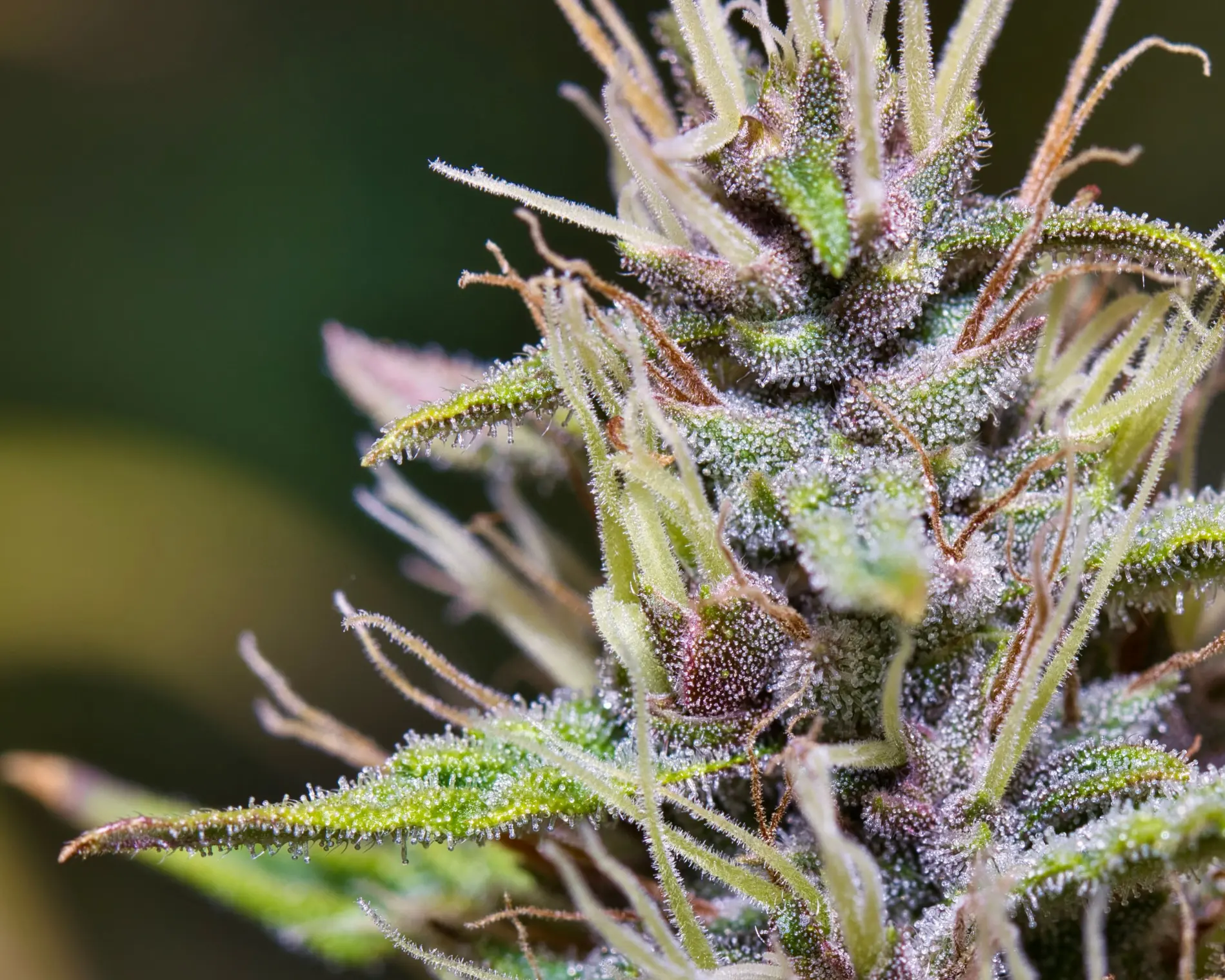
Chronic
Chronic is often remembered as a yield strain, which is accurate but incomplete. Its real cultivation lesson is that high yield can come from architectural restraint rather than maximum branching. The best-documented original Chronic line was selected to build a very large main flower with relatively limited side branching, and historical grow notes specifically warn that it does not always respond well to topping. That makes it a useful counterexample to the modern habit of automatically topping every photoperiod plant and flattening every canopy into the same shape.
The established lineage is more complex than the simplified "Northern Lights x Skunk x AK-47" description. Detailed genealogy records describe Northern Light x (Skunk x Northern Light) x AK-47, combining broadleaf resin, Skunk vigor and AK-47 influence. Chronic was refined as a medium-height, high-output hybrid with a mild sweet fragrance, large central cola and relatively straightforward indoor production. It can reward beginners, but its dense top flower and central-column architecture create their own risks: support, internal drying and late-flower humidity need more attention than the uncomplicated vegetative phase suggests.
For Weedth, Chronic should be approached as a quality-yield study. The grower should ask how much of the plant's theoretical mass becomes properly matured, clean, aromatic flower. A huge central cola is impressive only if its center remains healthy and it dries evenly. The strain's subtle sweet, citrus, honey, spice and skunk notes also demand careful post-harvest work because its fragrance can be less loud than modern dessert or gas cultivars. A rough dry can erase the very nuance that turns Chronic from a commercial-yield plant into a connoisseur-quality one.
Strain Features
| Feature | Chronic |
|---|---|
| Type | Balanced to indica-leaning hybrid depending on phenotype |
| Documented lineage | Northern Light x (Skunk x Northern Light) x AK-47 |
| Common effect direction | Happy, talkative and relaxed; later physical calm can become sleepy at larger doses |
| THC | Historically moderate-to-high rather than defined by modern extreme THC; current lab results vary |
| CBD | Usually low in the original THC-forward line |
| Common aroma | Sweet honey, citrus, lemon, soft flower, spice, earth and Skunk |
| Reported terpenes | Caryophyllene, myrcene and terpinolene commonly appear in tested samples |
| Indoor flowering | Commonly about 8-10 weeks, often near 60-63 days |
| Outdoor finish | Typically mid-to-late autumn in suitable climates |
| Plant structure | Medium height, often central-cola dominant with limited-to-moderate side branching |
| Stretch | Highly phenotype-dependent in grower records; should be measured rather than assumed |
| Yield tendency | High to very high when grown in an architecture suited to the phenotype |
| Bud structure | Large, hard, compact flowers; main cola can become very dense |
| Training response | Often better with minimal topping and selective branch management than aggressive repeated topping |
| Main cultivation risk | Oversized dense central flower, support needs and humidity/mold risk in the main cola |
| Difficulty | Easy to moderate; beginners can succeed when humidity and harvest drying are controlled |
| Best environment | Indoor, greenhouse or protected outdoor environment with a reliable dry finish |
| Flavor priority | Preserve subtle sweet citrus, honey and spice rather than accepting generic Skunk-earth after drying |
| Typical use window | Afternoon to evening; effect is often more functional than heavy narcotic indicas at moderate dose |
Chronic's reputation for production should not encourage growers to treat it as a biomass machine. The cultivar is most impressive when its central-flower tendency is used deliberately and when the drying system is sized for the density that follows.
Genetic Lineage
The detailed Chronic pedigree is Northern Light x (Skunk x Northern Light) x AK-47. This is more specific than simply naming three famous families and helps explain why the plant can combine an indica-like flower structure with a more balanced psychoactive effect.
Northern Light contributes compact resin production, broadleaf strength and a tendency toward dense flowers. It appears more than once in the deeper pedigree, which likely reinforces the heavy central-flower behavior and manageable indoor height found in many Chronic expressions.
Skunk contributes vigor, adaptation and a sweet-pungent aromatic backbone. Skunk influence helps explain why Chronic can be easy to grow in a range of conditions even though its final flowers are dense. It also supports the earthy-sweet and floral-spice side of the aroma.
AK-47 contributes a more cerebral and social element to the effect and may also contribute to phenotype variation in stretch. Some Chronic grower records describe relatively little stretch, while others report a much larger transition. This variation should not be dismissed simply because the official plant description emphasizes medium height.
The lineage also creates an important architecture question. Chronic was selected as a high-yield plant with a strong central cola and fewer side branches. That means the grower should not automatically treat it like a modern branch-heavy cookie hybrid. If the phenotype naturally concentrates flower into the main stem, repeated topping can divide that advantage into many smaller sites without necessarily improving premium yield.
There are, however, grower reports of branchier phenotypes that do respond to topping. This is why a first seed run should be observed rather than forced. If the plant produces strong lateral growth naturally, a wider canopy may be appropriate. If it remains columnar with short laterals, support the central architecture instead of fighting it.
The keeper should be selected after cure for more than weight. Compare main-cola density, internal flower health, trim efficiency, stretch predictability and aroma retention. A huge plant that loses half its premium flower to mold or dries unevenly is not the best Chronic phenotype for a home environment.
Effect Breakdown
Chronic's effect is often more balanced and social than its dense indica-like flowers suggest.
Initial phase
The onset commonly feels happy, mentally lighter and slightly talkative. Some users describe giggliness or a pleasant increase in social ease. The effect is usually less aggressive than a very high-THC modern hybrid, though current flower potency can vary widely.
This first stage can suit music, casual conversation, a meal or low-pressure creative activity. It is not generally described as a sharp stimulant. The mood lift is warmer and more comfortable than intensely focused.
Middle phase
Physical relaxation gradually becomes more apparent. The user may still feel conversational and mentally present while shoulders and body tension soften. This is the point where Chronic's hybrid balance becomes clearest.
A moderate amount can remain functional for an experienced user. Larger amounts make the physical side more dominant and can increase appetite. The strain's old-school reputation is partly built on this combination of strong effect without always producing immediate couch-lock.
Late phase
The finish tends to be calm and long. Some users become sleepy, especially with larger doses, while others remain relaxed without needing to sleep. The effect is generally less narcotic than very heavy Bubba or Kush cultivars.
Anxiety and dose sensitivity
Paranoia is reported by a minority of users. A strain that feels cheerful at a low dose can become mentally uncomfortable when too much THC is consumed quickly. New users should begin low and allow the effect to develop.
Phenotype and harvest
A more AK-leaning phenotype may feel brighter, while a Northern-Light-dominant expression can feel more body-heavy. Harvest maturity also changes the overall sensory balance. For a classic Chronic experience, fully mature but not excessively overripe flower is the safer target.
Flavor & Aroma Profile
Chronic's aroma is not necessarily loud in the way a modern gas strain is loud. Its quality lies in sweetness, honey, soft citrus, spice, flower and a clean Skunk-earth background.
The living plant often develops a mild sweet fragrance during flowering. That subtlety is important. Growers who are used to extremely pungent cultivars may assume a quieter plant lacks terpene quality and overfeed or stress it trying to intensify smell. Chronic should be judged by clarity and persistence, not room-filling loudness alone.
During late flower, lemon and sweet floral notes can become more distinct. Some grower degustation records mention tangerine, sweet lemon or lemon, while consumer databases also describe Skunk, earth and wood. The combined profile is best understood as old-school sweetness rather than dessert candy.
A well-cured jar can smell like light honey and citrus over dry herb and earth. Breaking a dense flower releases more Skunk and spice. The inhale is often smooth when cured correctly, with sweet lemon or floral tones. The exhale can bring pepper, wood and an earthy finish.
Historical cultivation notes specifically emphasize careful, thorough drying to maintain the subtle fragrance. That advice makes sense chemically. A mild aromatic profile has less room for post-harvest error than an overwhelmingly pungent cultivar. If the bright compounds are lost, the remaining flower can smell generic.
This makes Chronic a strong test of drying skill. The grower cannot rely on raw intensity to hide mistakes. A hot, fast dry can turn sweet lemon and honey into hay and wood. A slow, wet dry can replace delicacy with mustiness. The successful result sits between those extremes.
Dominant Terpenes
Tested Chronic flower is commonly associated with beta-caryophyllene, myrcene and terpinolene, although exact profiles differ across samples and producers.
Beta-caryophyllene
Caryophyllene contributes pepper, dry spice and woody warmth. In Chronic, it can be subtle under the sweeter top notes and become more obvious on exhale. It provides structure to a profile that might otherwise feel light.
Caryophyllene can interact with CB2 receptors, but that biochemical property does not establish Chronic as a disease treatment. It is more appropriate to describe the terpene's sensory role and acknowledge broader research separately.
Myrcene
Myrcene contributes earth, herb and ripe-fruit depth. It can soften the citrus and help produce the relaxed body component many users report. Again, effect cannot be assigned to myrcene alone.
Terpinolene
Terpinolene can supply sweet herb, fresh wood, citrus and floral complexity. This is especially relevant to the strain's delicate top notes. It is also one reason warm drying should be avoided; the value is in keeping the brighter aromatic layer visible after cure.
Secondary compounds
Limonene may strengthen sweet lemon or tangerine in some samples. Pinene can add fresh resin or wood. Esters and other volatile compounds probably contribute to the honey-floral impression that is difficult to explain by the three most common terpenes alone.
Selecting for aroma
A Chronic phenotype should be judged after drying and cure because the live aroma can be mild. If one plant develops a clean honey-lemon profile after a month while another becomes mostly woody, the first is the stronger quality keeper even if both yield similarly.
Indoor vs. Outdoor Growing
Indoor growing
Indoor cultivation is where Chronic's architecture is easiest to exploit. A central-cola phenotype can be grown at higher plant density with a relatively short vegetative period. The grower can allow each plant to form a strong main flower while keeping side growth limited and the lower area clean.
This approach resembles SOG logic more than a heavily branched SCROG. It is not about maximizing plant count for its own sake. It is about matching the plant's natural columnar habit to even light distribution.
Indoor climate control is especially important late because the main cola can become large and hard. Room RH may look safe while the interior of the flower remains wetter. Provide circulation around, not directly at, the flowers.
Outdoor growing
Chronic can be grown outdoors, but historical descriptions often recommend a protected environment. The dense central flower is the reason. A large outdoor plant with a single huge top can be vulnerable to autumn rain or dew.
Use a site with morning sun and airflow. If the phenotype builds an oversized main cola, consider whether gentle early training can distribute flower mass without aggressively topping the plant. Bending the main stem during vegetative growth may create better light exposure and reduce a single moisture trap while preserving apical dominance.
Greenhouse
A greenhouse can be excellent because it protects from rain while providing natural sunlight. Ventilation is critical. Dense main flowers should never sit in stagnant humid night air.
Which system best matches Chronic?
For repeatable quality, indoor cultivation with a controlled vertical canopy is the simplest. Outdoor growing can produce large yields but magnifies the main-cola weather risk. Chronic is not a strain that needs enormous plant size to prove its productivity.
Strain-Specific Grow Guidance
Do not top automatically
This is the most important cultivar-specific rule. Historical Chronic descriptions explicitly say the strain does not respond well to topping and naturally grows a huge central bud with limited side branches. Grower reports show some phenotypes can respond well, but that does not invalidate the original warning.
On the first run, allow at least one plant to express its natural structure. Compare it with a topped plant only if you have enough plants and legal space to test. Do not assume topping improves yield because it improves canopy shape in other strains.
When topping might work
If the phenotype is naturally branchy, topping can create a wider plant successfully. Grower records include bushy expressions with strong side branches. In that case, top early and then select the best leaders rather than repeatedly cutting.
The decision should be phenotype-based. Columnar plant: preserve the main leader. Branchy plant: consider one early top.
LST as the safer compromise
Low-stress bending is often more useful than topping. A central-dominant plant can be bent gradually to expose side sites without removing the apical tip. This redistributes light while preserving the plant's natural hormonal structure.
Use soft ties and begin while the stem is flexible. Do not bend a thick late-veg trunk violently simply to force a flat canopy.
Plant density
Chronic's limited side branching can make it suitable for closer spacing, but plant density should be based on actual canopy diameter. Overcrowding defeats the advantage by trapping humidity around the main colas.
Leave enough space that air can move around each central flower late in bloom. If leaves from neighboring plants are constantly touching, density is too high for premium quality.
Stretch variability
Grower records show extreme variation in stretch reports, from very little to several-fold extension. Some of this may reflect phenotype and methodology. Measure your plant.
Record height at flip, day 10, day 20 and the end of stretch. A selected clone can then be flipped at the correct height on future runs.
Supporting the main cola
A large central flower creates leverage. Even a sturdy stem can lean late. Use a stake, plant yo-yo or loose net before the top becomes heavy. Support should keep the plant upright without squeezing the flower.
Lower canopy
Remove weak lower shoots that cannot become mature flower. In a columnar plant, a clean lower stem can improve airflow and direct resources upward. Do not strip productive short side branches merely to create a textbook lollipop.
Defoliation
Use light selective defoliation. Chronic's architecture does not automatically require a major leaf strip. Remove leaves that completely block airflow around the central flower or shade useful side sites.
Scientific cannabis pruning research shows architecture and chemical uniformity can respond differently by genotype. The cultivar's historical central-cola selection is a strong reason to avoid blindly copying a high-defoliation protocol from branch-heavy hybrids.
Nutrition
Chronic is often described as tolerant and easy, but individual grower reports differ. Some plants handle feeding mistakes well; others are less forgiving. Begin with moderate nutrition.
More feed is not automatically more quality
Avoid excessive nitrogen late in veg. A central-cola plant does not need to carry unnecessary leaf mass into dense flowering. Healthy medium-green leaves and steady growth are enough.
Root zone
High yield depends on sustained root function. Use an aerated medium and irrigation practices that maintain oxygen. A plant carrying one enormous main flower can have high late demand, but oversaturation is not insurance against thirst.
Light
Chronic can convert good light into substantial flower mass. A vertical central-cola system should keep the upper canopy level enough that no top is extremely close to the fixture.
Controlled cannabis research shows increasing light can raise yield when other inputs support demand, while cannabinoid potency does not necessarily increase in parallel. For Chronic, the practical goal is uniform productive light across all main flowers, not maximum intensity on one top.
Humidity and flower microclimate
Dense cannabis inflorescences can maintain humidity well above the ambient room. Chronic's huge main cola should be treated as a separate microclimate. Increase late-flower airflow and reduce prolonged humidity spikes, especially around the dark period.
Inspect the center of the largest flowers during the final weeks. Brown internal leaf tips, soft tissue or musty smell deserve immediate attention.
Flowering progression
Most original descriptions place Chronic around 8-9 weeks, while some current references use 9-10 weeks. Grower records often cluster near 59-66 days, with occasional longer finishes.
The flower can gain density rapidly during the last weeks. Do not harvest because the plant looks big enough. Watch calyx swelling, trichome maturity and aroma.
Harvest timing
The quality-first harvest should occur when the central flower is fully developed but still aromatically fresh. If the sweet lemon and honey notes are fading while the plant simply becomes heavier and darker, additional days may not improve the final experience.
A first-run architecture test that actually teaches you something
Chronic is one of the strains where a small controlled comparison can save several future harvests. If plant count and local law allow it, keep one plant essentially natural, give one plant a single early top, and train another with only gentle bending. Keep container size, light exposure, irrigation and vegetative time as similar as practical. The purpose is not to prove one technique universally superior. The purpose is to identify which architecture converts this particular seed population or clone into the highest percentage of mature flower.
On the natural plant, record how quickly the main leader separates itself from the side branches, how thick the upper stem becomes, and how much useful flower forms below the crown. On the topped plant, watch whether the two replacement leaders become genuinely strong or whether topping simply triggers a forest of smaller shoots. On the bent plant, note whether lateral sites strengthen without the plant losing its central-cola efficiency. These observations tell you far more than a generic recommendation to top or SCROG.
At harvest, compare four numbers: dry premium flower, lower-grade flower, trim time and discarded material. Then compare the cured aroma of the best upper flowers. A topped plant can look beautifully even during flowering yet still lose to the natural plant if it creates more shaded interior buds and more trimming. Conversely, a branchier Chronic phenotype may clearly benefit from one top. The winning method is the one that improves usable quality, not the one that produces the most photogenic canopy.
Managing the crown as its own environment
A mature Chronic crown should be treated almost like a separate room inside the grow room. The ambient hygrometer tells you what the room is doing, but the spaces between swollen bracts and small sugar leaves can remain more humid and less ventilated. That difference becomes more meaningful as the central flower gains diameter late in bloom.
I would begin late-flower inspections before there is any visible problem. Look at the small leaves emerging from the interior of the crown. A single leaf that browns abruptly or pulls free too easily can be an early warning that tissue deeper inside is compromised. Smell the flower from several angles. Healthy Chronic should remain sweet, herbal and citrus-skunk. A dull basement, mushroom or fermented-wet smell is not a terpene expression to admire.
Air movement should cross the plant from more than one direction without hammering the flower surface. A strong fan aimed directly at one side can dry exposed tissue while leaving the protected center unchanged. The better goal is continuous exchange of the humid boundary layer around the cola. During the final weeks, avoid watering practices that create an unnecessary lights-off humidity surge. If irrigation timing is flexible, give the root zone enough time to move some water before the room enters its coolest period.
Do not use late defoliation as a panic response to a humidity problem. Removing a large amount of healthy leaf tissue close to harvest can stress the plant without opening the dense interior of the flower itself. The useful work should have been done earlier: clean weak interior shoots, avoid crowding neighboring crowns, and maintain enough spacing that every main flower has moving air around it.
The last two weeks decide whether the yield is premium
Chronic can look essentially finished before it has completed its final quality gain. The main cola may already be large, but calyx swelling, resin maturity and aromatic definition can continue. This is where yield-focused growers sometimes make opposite mistakes: some harvest early because the plant already appears heavy, while others leave it too long simply hoping for additional grams.
A better decision uses several signals together. Watch whether new white pistils are still appearing in meaningful numbers, whether calyxes are continuing to swell, and whether trichomes on the actual flower bracts are mostly mature. Smell the plant at the same time each day. If the honey-citrus-spice character is becoming clearer while the flower is still adding density, patience is useful. If the aroma begins to flatten and the flower has stopped changing except for increasing amber trichomes, the quality window may already be passing.
The main cola should also influence harvest strategy. If one central flower is clearly ahead of lower branches, a staged harvest can be rational. Removing the mature crown while allowing lower sites additional light and time may improve total premium percentage. It also prevents a fully ripe dense top from sitting in humid conditions merely because the bottom of the plant is not ready. This is not necessary on every Chronic plant, but it is a useful option when maturity is visibly uneven.
Weedth Bud Flavor Tips
Take the historical drying warning seriously
Chronic has long been described as needing a thorough, careful dry to preserve its subtle fragrance. That advice is more important than it sounds because the strain's aroma is nuanced rather than overwhelmingly loud.
Do not dry a giant cola intact without a reason
A central flower can be visually impressive and internally wet. In a humid drying room, divide unusually large colas into major branch sections so moisture can leave safely. In a dry room, keeping larger sections can slow surface drying.
Dark and cool
Keep harvested material away from light and heat. Scientific post-harvest work shows cannabis volatile profiles change with drying method and storage. Chronic's sweet-citrus layer should be treated as perishable.
Gentle circulation
Move air through the room rather than blasting directly onto the central flowers. Direct fan exposure can make the outside crisp while the center remains damp.
Smell checkpoints
Fresh cut: sweet green plant, citrus and mild Skunk.
Mid dry: green aroma should decline while honey-lemon becomes clearer.
End dry: flowers should smell clean and concentrated, not damp.
After cure: sweet citrus, spice and earth should separate rather than collapse.
Cure time
Give the strain at least a few weeks before judging flavor. The mild aroma can become more coherent after moisture equalizes. Chronic is not a cultivar I would evaluate from a jar that has been curing for three days.
Avoid artificial flavor additions
Do not put citrus peel, honey, herbs or fruit in the jar. These add contamination and moisture risk. The authentic flavor must come from the plant.
Long-term storage
Use airtight glass in cool darkness once cure is stable. Research shows storage alters cannabis volatile composition even under controlled conditions, so the goal is to slow degradation and avoid repeated air exchange.
Drying the oversized central cola without sacrificing the signature
Chronic's main flower creates a post-harvest problem that smaller-budded cultivars do not create to the same degree: the outside can feel ready while the interior is still carrying substantial moisture. If the crown is exceptionally thick, preserving it whole for appearance can be a poor quality decision. In a moderate or humid drying environment, break the harvest into large branch sections that expose enough surface area for safe moisture movement. The goal is not to shred the flower into small buds on day one, but to remove the hidden wet core created by an oversized stem-and-flower mass.
Judge drying by the flower, not by a fixed calendar. Early in the process, the surface should lose its wet softness without becoming crispy. Midway through, squeeze a representative bud very gently. The outer bracts should feel drier but the flower should still have internal resilience. Near the end, smaller stems begin to stiffen and the aroma should move away from cut grass toward sweet citrus, honey, spice and dry Skunk. If the outside is brittle while thick stems remain rubbery, the room is drying too aggressively at the surface.
The first days of cure are especially revealing. A jar that climbs rapidly in humidity after being closed contains flower that was packaged too wet. Remove it and continue drying rather than repeatedly opening a dangerously wet jar for a few minutes. Chronic's subtle aroma is worth protecting, but safety comes first. A slightly slower cure cannot rescue flower that begins molding from retained internal moisture.
Once moisture is stable, minimize unnecessary handling. Repeatedly opening jars to smell the crop can be enjoyable, but every opening exchanges aromatic air and oxygen. Chronic is not so loud that it can afford careless terpene loss. After the initial cure-management period, longer undisturbed storage intervals generally serve the strain better than constant inspection.
Weedth Bud Boost Tips
Respect apical dominance
The highest-value bud-boost technique may be doing less. If the phenotype is clearly central-cola dominant, preserve the main leader and optimize plant spacing around it.
Use plant count or veg time, not topping, to fill space
If columnar plants leave gaps, adding appropriate plant density or slightly more veg may be better than forcing every plant into multiple tops. Always operate within local legal plant limits.
Support early
A huge main cola can lean suddenly. Install support before week six rather than after the stem starts bending.
Keep the lower stem clean
Removing weak low growth improves airflow and simplifies harvest. Do not preserve tiny shaded buds just because the plant is known for yield.
Match light to the column
Keep central tops at a uniform distance from the light. If one plant stretches more, lower it with gentle bending or raise its container neighbors rather than moving the fixture far away from the entire canopy.
Avoid overfeeding for size
Chronic already has high-yield genetics. Excess salts or nitrogen can create more leaf and root-zone stress without improving premium flower. Stable physiology is the best yield booster.
Root volume and irrigation
A high-yield central plant needs enough root volume to support late-flower demand. Use container size appropriate to veg time. A small root zone can force very frequent irrigation and create large swings in moisture and EC.
Quality-yield score
Track total dry weight, premium flower percentage, mold loss, trim time and aroma score after cure. Chronic should win by producing a lot of usable flower, not by producing the heaviest wet plant.
CO2 only when the room is ready
In a sealed high-light environment, supplemental CO2 can support more photosynthesis. In a normal home grow, improving light uniformity, root health and humidity control is more valuable.
A second-run density experiment is more valuable than another training trick
Once the keeper phenotype is known, the next useful experiment is plant spacing rather than more aggressive training. A truly columnar Chronic clone may be capable of running closer than a branch-heavy hybrid because much of its premium flower sits near the central axis. Move plants closer only in small increments. The moment neighboring leaves overlap heavily and air around the crowns becomes sluggish, the theoretical gain in flowers per square meter can turn into a loss in premium percentage.
Record yield by occupied canopy area, not only yield per plant. A smaller Chronic plant can be more efficient if it finishes with one clean crown and very little larf. Also record how many minutes the plant takes to trim. A production-oriented cultivar should save labor as well as produce weight. If tighter spacing increases grams but doubles trimming and increases humidity management, it may not be the better system for a home grower.
This is also where clone consistency becomes valuable. Once stretch and crown width are predictable, flip height, stake position, irrigation volume and harvest date become repeatable. Chronic's greatest strength is not simply that one plant can become heavy. It is that a selected expression can be turned into a repeatable quality-production system when the grower stops changing techniques every cycle.
Medical Uses & Benefits
No cultivar-specific clinical trial establishes Chronic as a medical treatment. User reports and broader cannabinoid research can suggest possible use patterns, but they are not prescriptions.
Stress
Happy and relaxed effects are commonly reported. A moderate dose may temporarily reduce perceived stress and make social activity feel easier. High doses can cause paranoia in sensitive users.
Low mood
The early cheerful and talkative phase may provide temporary mood lift. Persistent depression requires professional care, and cannabis can worsen motivation or anxiety for some people.
Physical discomfort
The later body relaxation may reduce attention to aches and tension. Broader cannabinoid evidence suggests some cannabis products offer modest pain relief for selected chronic pain conditions, but results vary.
Appetite
Increased appetite is possible. This may be useful in some settings, but unexplained or persistent appetite loss should be medically evaluated.
Sleep
Some users become sleepy late in the experience. Chronic is generally less immediately sedating than heavy Kush cultivars, so it may fit users who want relaxation before sleep rather than instant couch-lock.
Safety
High-THC flower impairs reaction time and judgment. Do not drive. People who are pregnant, breastfeeding, adolescents, at high psychosis risk, taking interacting medications or struggling with cannabis use should seek professional guidance.
Ideal User Profile
Chronic is well suited to someone who likes old-school hybrid effects: happy and social first, relaxed later. It is less appropriate for a user seeking intense modern THC impact or immediate nighttime sedation.
A moderate dose may fit a film, dinner, music, a casual gathering or an unhurried evening. Larger doses are better reserved for a schedule with no driving or complex work.
Flavor-focused consumers should appreciate subtle profiles. Chronic is not always a room-filling gas strain. Its appeal is sweet lemon, honey, spice and clean Skunk-earth balance.
The ideal grower values predictable architecture and high usable yield. It is particularly interesting for someone willing to test a minimally topped central-cola approach rather than applying the same flat-canopy technique to every cultivar.
Grower Notes and Feedback
The most important grower feedback is contradictory stretch data. Some plants remain compact, while individual reports describe substantial stretch. This reinforces the need to measure the first run.
Another repeated theme is high yield. Growers frequently describe dense, hard buds and good production. That reputation is deserved, but yield should be discounted by any mold loss or airy lower flower.
Reports on topping are also mixed. Historical official descriptions advise against topping because the plant is selected for a huge central bud. Some individual growers report successful topping. Both can be true if phenotypes differ.
The practical response is experimentation with controls. If legal plant numbers allow, grow one natural plant and one topped plant under similar conditions. Compare premium dry weight, trim time and flower uniformity, not just total grams.
Some reports describe good tolerance to temperature or feeding variation, while others call the plant more demanding. Treat easy-growing reputation as margin, not permission to neglect root-zone and climate control.
Drying deserves its own grower note because the main cola can be much wetter internally than smaller branches. Plan the drying method before harvest day.
The second run should adjust plant spacing around the chosen phenotype. A true columnar keeper can be run closer. A branchier expression needs more footprint. Do not keep the same spacing purely because the strain name is unchanged.
Weedth Editor's Note
The decision I would not postpone
Chronic is a strain that reminds me not to turn training into ideology. I like topping and screens when a plant benefits from them, but I would not cut the main stem of a classic central-cola phenotype just because topping is considered "advanced."
On the first run, I would let the plant show me what it was selected to do. If it wants to build one massive main flower with short laterals, I would support that architecture, clean the weak bottom and focus on air around the top. If the phenotype clearly branches harder, then I would adapt.
The main cola is where I would be strict about humidity. I do not care how impressive it looks if the center cannot stay clean. I would rather split flower mass across a few healthy sections than lose the crown to rot.
For flavor, Chronic rewards patience in a different way from loud modern strains. I am looking for sweet lemon, soft honey and spice to become clearer after cure. If I dry it too fast, it becomes ordinary. That makes the drying room part of the strain profile.
As a user, I like the balanced old-school progression. It can feel cheerful and social before the body settles. That gives it more versatility than its commercial-yield reputation suggests.
Weedth Score
Growing Experience – 8.8/10: Straightforward vigor and high yield make it friendly, but the correct response to topping depends on phenotype and the huge central cola needs climate control.
Bud Structure & Visual Appeal – 8.8/10: Hard, large flowers and a dramatic main cola are visually strong. Oversized density can become a drying risk.
Aroma Complexity – 8.2/10: Honey, lemon, flower, spice, Skunk and earth are pleasing but subtler than many modern cultivars.
Flavor & Smoothness – 8.5/10: A careful cure brings excellent old-school sweetness. Rough post-harvest work flattens it quickly.
Effects & High Experience – 8.5/10: Happy and talkative onset with later calm creates a useful balanced evening effect.
Overall Satisfaction & Recommendation – 8.7/10: An excellent example of how production genetics can still produce quality when architecture and drying are respected.
"With Chronic, I would test the natural main cola before assuming the plant needs to be topped."
FAQ
What is the original Chronic lineage?
The detailed documented pedigree is Northern Light x (Skunk x Northern Light) x AK-47. Simplified descriptions often list Northern Lights, Skunk and AK-47.
Is Chronic a high-yield strain?
Yes, high yield is one of its best-known traits. The important metric is usable premium flower after drying, not the maximum wet biomass.
Should I top Chronic?
Not automatically. Historical descriptions say the classic central-cola phenotype does not respond well to topping. Some branchier phenotypes do. Observe the plant first or compare topped and untopped plants if possible.
Is Chronic good for SOG?
A columnar phenotype can be very suitable because it forms a strong central flower and limited side branching. Leave enough spacing for airflow around the main colas.
Can Chronic be grown in SCROG?
A branchier phenotype can work in SCROG, but the classic central-dominant expression is not the most natural choice for an aggressively flattened screen.
How long does Chronic flower?
Usually around eight to ten weeks, with many grower records near 60-63 days. Actual maturity should decide harvest.
How much does it stretch?
Grower records vary widely. Measure your plant during the first run and use clone-specific data for future cycles.
Is mold a risk?
Yes, mainly because the large central flower can become very dense. Control late humidity and inspect the interior of the main cola.
Why is the aroma milder than expected?
Chronic's classic fragrance is often subtle sweet citrus, honey and spice rather than extreme gas. A mild but clear aroma can be normal. A hay-like aroma suggests drying problems.
How should I dry the main cola?
Match flower size to room humidity. In humid conditions, divide very large sections so the center dries safely. In dry conditions, larger branch sections can slow the surface. Do not keep a giant wet cola intact purely for appearance.
Is Chronic beginner friendly?
Generally yes. It is vigorous and productive, but beginners should pay attention to support, main-cola humidity and drying.
Similar Strains
Northern Lights: Shares dense resinous flowers, manageable indoor height and physical calm. Chronic is generally more social and sweet-citrus in its early effect.
AK-47: Contributes to Chronic's deeper lineage and offers a useful comparison for happy, mentally brighter effects. AK-47 is usually more cerebral and can branch or stretch more.
Skunk #1: Similar old-school vigor, sweet-skunk aroma and production reliability. Skunk #1 generally has a more pungent skunk identity and less central-cola emphasis.
Big Bud: Comparable for growers prioritizing high output and large flowers. Big Bud often produces more side-branch mass, while Chronic's classic selection emphasizes a huge central flower and better balance of quality with yield.
Sensi Star: Similar fast indoor finish, dense resin and manageable size. Sensi Star usually has a heavier, more narcotic effect and stronger pungent hash profile.
Power Plant: Another production-oriented classic that can deliver high yield without an extremely long flowering cycle. Power Plant is more sativa-leaning in effect and usually more open in architecture.
Share this article
A quick overview of the topics covered in this article.
Follow us
Latest articles
September 9, 2026
September 9, 2026
September 9, 2026