
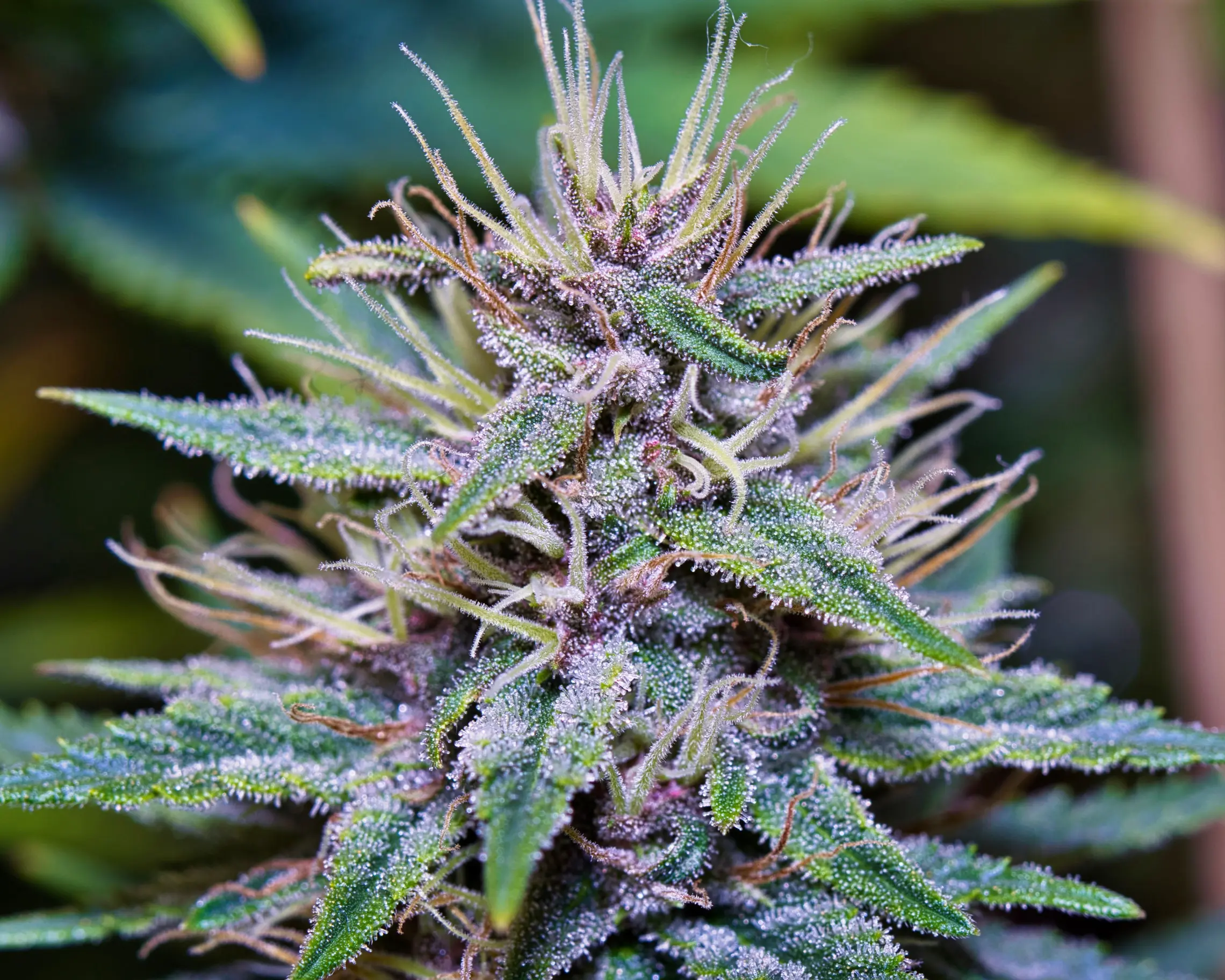
Critical Mass
Critical Mass is named for the point at which yield stops being an abstract promise and becomes a structural problem. Its flowers can become so heavy that productive branches bend outward, split at the junction, or collapse into neighboring colas. The same density that makes the plant attractive to yield-focused growers also creates its defining weakness. Moisture can remain trapped inside mature flowers even when the room itself appears acceptably dry.
This is not a cultivar that needs complicated training to prove its productivity. It naturally builds substantial flower mass on a compact to medium frame, often within a relatively short flowering cycle. The difficult part is preserving that mass as clean, aromatic, premium flower. A grower who keeps every branch, allows the canopy to close, and waits for the largest possible colas may record more wet weight while losing the best buds to shade, uneven maturity, branch damage, or internal rot.
The strongest Critical Mass expressions combine sweet fruit, citrus peel, earthy musk, old-school skunk, dry wood, and a light hash-like finish. Some phenotypes lean heavily toward Afghan earth and body relaxation. Others reveal more of the Skunk side through brighter fruit, sharper citrus, and a livelier first stage of the effect. The name now also appears on separate CBD-rich derivatives, which is why cannabinoid claims can look contradictory across databases. The original Critical Mass profile is generally THC-dominant. A product labeled Critical Mass CBD should be treated as a related but distinct cultivar.
For cultivation, one question matters more than all the others: how much flower can the plant carry while the canopy still remains open, inspectable, and dry enough to finish safely? **The best Critical Mass harvest is not the crop with the greatest number of swollen branches. It is the crop that reaches harvest with every major cola supported, evenly mature, and free from hidden moisture damage.**
Strain Features
| Feature | Details |
|---|---|
| Strain Type | Indica-dominant hybrid |
| Genetic Profile | Commonly described as strongly indica-leaning, though exact percentages vary by line |
| Lineage | Heavy Afghani selection crossed with Skunk #1; historically presented as a reworking of Big Bud genetics |
| THC | Usually reported from the mid-teens into the low twenties; batch and phenotype dependent |
| CBD | Usually low in the original THC-dominant cultivar. CBD-rich Critical Mass lines are separate derivatives |
| Dominant Terpenes | Myrcene and beta-caryophyllene appear frequently, with limonene, humulene, pinene, and linalool varying by sample |
| Flavor and Aroma | Sweet fruit, citrus peel, earthy musk, skunk, dry wood, pepper, herbs, and a mild hash-like finish |
| Effect Character | Calm euphoria followed by deep physical relaxation, appetite, heaviness, and possible sleepiness |
| Flowering Time | Commonly about 7 to 8 weeks indoors; some expressions need closer to 9 weeks |
| Outdoor Harvest | Often late September into early October in the Northern Hemisphere, depending on phenotype and climate |
| Height and Stretch | Short to medium with moderate stretch; usually easier to control vertically than a Haze-dominant plant |
| Plant Architecture | Broad, productive lateral branching with heavy flower formation across several primary limbs |
| Bud Density | Very high in mature upper flowers, which increases internal humidity and drying risk |
| Branch Strength | Stems can be sturdy early, yet branch failure becomes possible once flower mass accumulates |
| Training Compatibility | Responds to topping, LST, SOG, selective pruning, and support trellises. An overfilled SCROG can become a humidity trap |
| Mold Risk | High when mature flowers meet stagnant air, rain, damaged tissue, or elevated late-flower humidity |
| Yield Potential | Very high, but total biomass can rise faster than premium bud percentage if the canopy is overcrowded |
| Phenotype Variation | Some plants are low-leaf and fruit-forward. Others are muskier, leafier, or slightly slower to finish |
| Grow Difficulty | Moderate. The plant grows readily, but clean late-flower management demands attention |
| Best Time of Use | Late afternoon through nighttime, especially for consumers seeking body relaxation |
Genetic Lineage
Critical Mass is most consistently documented as a cross between a heavy Afghani selection and Skunk #1. It was developed as a refined expression of the yield-first genetic family once associated with Big Bud. That history explains both the plant's commercial reputation and its central cultivation tradeoff. Afghan influence contributes compact stature, substantial calyx mass, broad leaves, earthy depth, and a body-heavy effect. Skunk #1 contributes vigor, lateral productivity, faster transition into flower, penetrating odor, and a brighter sweet or citrus edge in selected plants.
The connection to Big Bud is best understood as a breeding direction rather than a perfectly documented modern pedigree. Big Bud became a general reference point for unusually productive Afghan-Skunk material. Critical Mass was selected to retain that massive flowering habit while strengthening potency and overall flower quality. Available records agree on the Afghan and Skunk foundation, but they do not always agree on whether Big Bud should be listed as a direct parent, an earlier name, or the genetic population from which Critical Mass was reworked.
What the Afghan Side Contributes
The Afghan side is visible in the plant before the flowers become heavy. Many expressions remain short to medium in height, form broad leaflets, and build thick primary branches. Internodes are usually closer than those of a sativa-dominant cultivar, which allows bud sites to merge into large continuous colas. This is the source of both the yield and the moisture problem. Tight floral construction reduces open space inside the finished flower, especially around the central stem.
The same influence shapes the later effect. Critical Mass may begin with a mild lift or creative calm, but the body normally becomes more important as the session develops. Muscles loosen, activity becomes less appealing, and a sufficiently large dose can turn comfortable relaxation into couch-lock or sleepiness.
What the Skunk Side Contributes
Skunk #1 helps explain why Critical Mass is not merely a dull, earthy indica. Fruit, citrus, fermented sweetness, sharp herbal notes, and a strong room-filling odor appear more clearly in Skunk-leaning phenotypes. These plants may branch more freely and can feel slightly brighter during the first stage of the high. They may also produce a better bud-to-leaf ratio, which makes the final flowers easier to trim despite their size.
Phenotype selection matters because the highest-yielding plant is not always the most aromatic or potent. Some heavy-yield families have historically been criticized for prioritizing weight over intensity. Critical Mass can escape that criticism in a strong expression, but growers choosing a keeper should compare cured aroma, flower firmness, effect, and mold tolerance rather than selecting the largest plant automatically.
Do Not Confuse the Original With CBD-Rich Versions
Critical Mass now exists in several CBD-rich crosses that retain part of the original name. Those plants can carry balanced or CBD-dominant cannabinoid ratios and may smell different from the THC-dominant cultivar. This naming overlap explains why some profiles report very low CBD while others describe substantial CBD content. The safest approach is to treat the original Critical Mass as a THC-dominant Afghan-Skunk hybrid and verify any CBD claim at the batch or genetic-line level.
Effect Breakdown
Critical Mass is dose-responsive in a way that matches its genetic balance. A small amount can feel calmer and more functional than its indica reputation suggests. A large amount can remove most interest in movement and make sleep the natural next step.
A Small Dose Keeps the Mind Present
At a restrained dose, the onset is often gentle rather than abrupt. The mood can lift without becoming racy. Conversation may feel easier and simple creative activities can become more enjoyable. The mind usually remains present enough for music, a film, light gaming, cooking, or quiet social time. This stage reflects the Skunk side more clearly because the emotional tone is warm and slightly playful rather than immediately narcotic.
The functional window should not be mistaken for stimulation. Critical Mass rarely feels like a true daytime energizer. It is more accurate to describe the early stage as relaxed engagement. The user may still want to do something, but pressure and urgency fade.
The Body Becomes the Center of the Experience
With a moderate dose, physical relaxation becomes the defining feature. Tension may release from the shoulders, back, jaw, and legs. Movement feels slower and the body can become pleasantly heavy. Appetite often rises as the cerebral lift settles into a quieter mood.
This middle stage is where the strain earns most of its reputation. The user is not necessarily asleep or mentally blank, but active plans lose importance. It suits an evening when the main goal is to reduce pace rather than increase productivity.
Heavy Consumption Turns Calm Into Sedation
At a high dose, the same gradual progression can become deeply sedating. Couch-lock, strong appetite, short-term memory disruption, dry mouth, dry eyes, and next-stage tiredness become more likely. Sensitive users may also experience dizziness or anxiety, especially when the flower is more potent than expected or when consumption is increased before the first dose has fully developed.
Critical Mass is not famous for panic-inducing mental intensity, but no THC-rich cultivar is universally calming. A user who is already anxious about feeling physically heavy may interpret the body load as uncomfortable. Slow dosing is more useful than relying on the strain's indica label.
Duration and the Following Morning
The primary effect commonly lasts several hours. A heavier session can leave residual sleepiness or mental softness after the main high fades. For many consumers this is desirable at night. It is less useful when an early morning requires sharp attention. The cultivar is best approached as evening flower with a broad dose range, not as a universal all-day strain.
Flavor & Aroma Profile
Critical Mass does not rely on one fashionable flavor note. Its strongest flowers smell like a layered mixture of sweet fruit, damp earth, citrus skin, old-school skunk, dry timber, pepper, and a soft hash-like finish. The balance changes with phenotype and cure. Some plants are immediately fruity. Others need several weeks after drying before their sweetness becomes clear.
The Living Plant: Sweetness Under a Heavy Skunk Cloud
During late flower, the plant can become intensely aromatic. The first impression is often musky and skunky, especially when several mature plants share a room. Close to the flowers, sweeter details emerge. Growers report fruit-cocktail, honeyed citrus, apple skin, lime, and soft herbal notes depending on the expression.
The odor can become stronger than the visual size of the plant suggests. A compact canopy carrying a few huge colas may release more scent than a taller plant with loose flowers because so much resinous tissue is concentrated in a small area.
Freshly Dried Flower Can Smell More Earthy Than Expected
Immediately after drying, Critical Mass may appear less fruity than it did on the plant. Moist plant compounds and the heavier Afghan base can temporarily dominate. The jar may smell of earth, fresh wood, skunk, pepper, and green herbs. This stage is not necessarily the final flavor.
A controlled cure can reveal sweetness as the harsh green edge settles. Fruit and citrus become easier to separate from the earthy base. The best result is not candy-like in the modern dessert sense. It is closer to ripe fruit mixed with musk, lemon peel, wood, and mild hash spice.
Inhale, Exhale, and Aftertaste
The inhale often begins with sweet earth and mild citrus. Some phenotypes add a creamy or honey-like softness. The exhale is darker. Pepper, skunk, wood, herbs, and hash tend to remain on the palate after the brighter notes fade.
Well-finished flower should feel full rather than sharp. A rushed crop may taste aggressively skunky and earthy with little fruit. Over-dried flower can become thin and woody. When the plant reaches full maturity and the dry is controlled, the sweet top layer remains long enough to balance the heavier base.
Phenotype Differences Matter More Than Color
Critical Mass is not selected primarily for dramatic pigmentation. Most plants remain green with orange or rust-colored pistils. Quality variation is easier to identify through aroma and structure. A fruit-forward phenotype may carry a stronger citrus or mixed-fruit jar note, while an Afghan-leaning plant may smell muskier, woodier, and more hash-like. A keeper should retain aroma after drying. Loud odor on the living plant is useful, but cured flavor is the final test.
Dominant Terpenes
Critical Mass terpene reports are not perfectly uniform. Myrcene and beta-caryophyllene appear frequently, while limonene, humulene, pinene, and linalool change position between samples. This variation fits the cultivar's sensory range from sweet citrus and fruit to pepper, wood, musk, and earth.
| Terpene | Likely Sensory Role | Responsible Interpretation |
|---|---|---|
| Myrcene | Earth, musk, herbs, ripe fruit, and a soft fermented sweetness | Often present at meaningful levels. It may help shape the heavy aromatic base, but it should not be treated as the sole cause of sedation. |
| Beta-Caryophyllene | Black pepper, warm spice, dry wood, and skunky depth | Interacts with CB2 receptors and has been studied for potential anti-inflammatory relevance. Aroma contribution is more certain than a specific subjective effect. |
| Limonene | Lemon peel, lime, and brighter sweet-citrus top notes | Can make selected phenotypes feel fresher and less purely earthy. Mood claims remain individual and dose dependent. |
| Humulene | Dry earth, hops, wood, and herbal bitterness | Supports the old-school, hash-like base in some samples. |
| Pinene | Pine needles, fresh wood, and crisp herbal lift | Usually secondary. It may sharpen the aroma when the Afghan musk would otherwise feel flat. |
| Linalool | Soft flowers and mild sweetness | Not dominant in every sample, but it can smooth the edges of peppery or skunky expressions. |
The original cultivar also suffers from a naming problem in chemical databases. CBD-rich derivatives, unrelated products using the same name, and different selected cuts can all be grouped together. A single terpene chart should therefore be read as a batch description rather than a permanent chemical identity.
Indoor vs. Outdoor Growing
| Decision Point | Indoor Growing | Outdoor Growing |
|---|---|---|
| Structural Control | Trellises, stakes, and canopy spacing can be installed early and adjusted before the buds become immovable. | Large plants need cages or perimeter support before flowering. Late repairs are difficult after rain adds weight. |
| Humidity Risk | Environmental control makes indoor cultivation safer, but room RH can underestimate moisture inside the colas. | Rain, dew, and cool nights can saturate dense flowers. Dry climates are strongly preferred. |
| Yield Strategy | SOG or a limited number of topped plants can produce a highly efficient canopy. Overfilling the room reduces premium flower percentage. | Large root volume can create very heavy plants, but excessive size makes inspection and weather protection harder. |
| Flower Quality | Better consistency, cleaner flowers, and more control over the harvest window. | Full sun can build excellent mass and rich earthy flavor, but weather can force an early harvest. |
| Branch Failure | A support net can hold several heavy tops evenly. | Wind and rain increase leverage on loaded branches. Split junctions are a serious late-season risk. |
| Harvest Timing | The grower can wait for phenotype-specific maturity if mold pressure remains controlled. | The cleanest harvest may need to occur before maximum swelling when rain or cold approaches. |
| Drying Challenge | Indoor flowers can be moved directly into a controlled dry room and divided according to density. | Outdoor colas may carry surface moisture, insect damage, or hidden contamination and need closer inspection. |
| Best Fit | Growers who prioritize reliable quality yield and have dehumidification and airflow control. | Growers in dry, warm regions with a stable early autumn and strong structural support. |
Indoor Growing Protects the Cultivar From Its Own Success
Critical Mass is easier to finish indoors because the grower can control the exact factors that become dangerous as the flowers swell. The plant does not usually create a height emergency. It creates a density emergency. A room can look orderly from above while the inner canopy holds touching leaves, shaded shoots, and colas that are beginning to press against one another.
The most useful indoor advantage is not simply lower humidity. It is the ability to combine climate control with branch spacing, direct inspection, and a planned support system. Dense flower research has shown that humidity inside cannabis inflorescences can remain substantially higher than the surrounding greenhouse air. In one study, internal flower humidity averaged about fifteen percentage points above ambient conditions during bloom. **This means a wall-mounted sensor can report a safe-looking room while the center of a Critical Mass cola remains humid enough to support disease.**
Outdoor Growing Is Climate-Limited, Not Plant-Limited
The plant can become extremely productive outdoors. Its relatively early finish is an advantage compared with long Haze cultivars, but the final weeks still overlap with rain and cool nights in many regions. The flowers do not need several days of constant rain to become vulnerable. Morning dew, damaged sugar leaves, caterpillar wounds, or two colas resting against each other can create a protected wet zone inside the canopy.
Outdoor Critical Mass makes the most sense where September is reliably warm and dry. In wetter regions, a smaller plant under a well-ventilated protective structure may be safer than a huge unprotected plant. A roof can prevent direct rain, but enclosed sides without adequate air exchange can raise humidity and reproduce the same disease pressure in a different form.
Strain-Specific Grow Guidance
Build the Support System Before the Flowers Need It
Critical Mass branches often look strong enough during vegetative growth. The stems are not necessarily thin or weak. Failure occurs because the final load rises faster than the branch architecture was designed to carry. Long side branches create leverage, and dense terminal flowers pull the branch outward from the main stem.
Support should be installed before major swelling. Indoors, a horizontal net can distribute several tops while leaving space between them. A second support layer can keep the heaviest colas from falling together. Individual stakes work when plants are accessible from all sides, but a crowded room becomes difficult to repair once the flowers are sticky and rigid. Outdoors, cages or perimeter frames are more reliable than tying every branch to the central stem. The support should carry flower weight without compressing the flowers into a single humid mass.
**Do not wait for the first branch to lean. By the time one cola has collapsed, the plant is already too heavy to reposition without trichome loss and tissue damage.**
Vegetative Shape: Wide Enough to Yield, Open Enough to Breathe
Most expressions develop a broad, indica-leaning frame with productive side branches. The plant can be grown naturally as a central cola with several secondary branches, but one enormous main flower concentrates risk. Topping once during healthy vegetative growth usually creates a safer distribution of weight. The lateral branches then need to be spread outward rather than allowed to rise in a tight cluster.
Repeated topping can increase the number of flowering tips, but it is not automatically beneficial. Critical Mass already has the genetic capacity to create more flower mass than the canopy can safely hold. Too many equal tops can turn a productive plant into a continuous layer of touching colas. The goal is a limited number of major branches with enough space for air, light, and inspection between them.
SOG, SCROG, and the Difference Between Training and Support
Sea of Green can suit the cultivar because the flowering cycle is relatively short and untrained or lightly trained plants can form large dominant colas. The method works best when spacing and climate prevent the main flowers from touching. A dense SOG should not be judged only by how many plants fit under the light. It should be judged by whether air can move around each mature cola.
SCROG can also work, but the net is often more valuable as a support structure than as permission to fill every opening. Critical Mass does not need an extremely crowded screen to yield heavily. A partially open net with well-spaced branches often produces a higher proportion of clean premium flower than a fully packed screen. This cultivar makes the difference between training and support especially clear. Training determines where the branches grow. Support prevents the finished flowers from destroying that structure.
Pruning the Interior Before It Disappears
The most useful pruning happens before the colas close around the stems. Remove weak interior shoots that cannot reach meaningful light. Clear branches that grow directly into the center and will become impossible to inspect. Retain strong lateral growth that can be placed near the top plane without touching its neighbors.
Lower flower quality varies by phenotype and light distribution. Some plants produce useful side buds when the lower canopy remains open. Shaded interior sites usually become leafy, late, and soft. Allowing them to remain can increase total wet weight while adding little premium flower. They also trap humidity beneath the main crop and complicate watering and inspection.
Defoliation should be selective. Large fan leaves that block several major flower sites or remain pressed against the interior can be removed. Aggressive late stripping is less useful. By that stage, the plant needs healthy leaf area to finish a heavy crop, and constant handling increases the chance of damaged tissue near mold-prone flowers.
The Flower Microclimate Matters More Than the Room Number
Dense flowers change the airflow plan
Botrytis does not begin because a humidity display crosses one magical threshold. Disease develops through a combination of susceptible flower tissue, moisture, temperature, poor air exchange, and available spores. Mature cannabis flowers are especially vulnerable because bracts and small leaves create a protected internal microclimate. Research on greenhouse cannabis has shown that internal flower humidity can remain much higher and more stable than surrounding air.
For Critical Mass, the late-flower environment should be managed around the flower rather than the sensor. Air needs to pass through the branch structure and around individual colas. Oscillating air across the top of the canopy is not enough when the center remains still. At the same time, direct fan pressure should not dehydrate one side of the flowers or cause wind damage.
The earliest warning sign is often not visible gray mold. A single sugar leaf that dies suddenly and pulls away without resistance can indicate decay at its base. Brown tissue inside an otherwise green flower, a soft section near the stem, an unusual sour smell, or a cola that wilts locally should be investigated immediately. Infected material should not be consumed or mixed with clean flower.
Watering a Plant That Carries More Biomass Than Its Height Suggests
Critical Mass can develop a large water demand once flower mass accumulates. A medium-height plant may carry as much active tissue as a much taller cultivar. Containers that seemed generous during vegetative growth can begin drying quickly in mid and late flower.
The answer is not to keep the root zone constantly wet. Saturated media reduce oxygen and can prolong soft vegetative growth. Excess moisture also raises local humidity beneath the canopy. Water thoroughly, then allow an appropriate dryback for the chosen medium and root mass. Severe wilting should be avoided because repeated drought during bulking can interrupt calyx expansion and weaken branch tissue.
Feeding: High Yield Does Not Automatically Mean Heavy Feed
Grow reports differ on appetite. Some Critical Mass plants accept substantial nutrition and remain vigorous. Others show burned tips when pushed. The common mistake is assuming that a high-yield cultivar must receive the strongest possible nutrient program. Genetics create the capacity for flower mass. The root zone, light, and environment determine how much nutrition the plant can use.
Excess nitrogen during the transition and early bloom is particularly unhelpful. It can deepen the canopy, increase leaf area around the developing colas, and delay the shift toward flower-dominant growth. A dark, clawed, overly soft plant may still produce large buds, but the crop becomes harder to ventilate and slower to finish cleanly.
Moderate, responsive feeding is safer than automatic escalation. Watch leaf color, tip condition, water use, growth rate, and root-zone behavior. Late in flower, some natural fading is acceptable. Trying to keep every leaf dark green until harvest can preserve unnecessary leaf tissue around already dense flowers.
Light Distribution and the Premium Flower Zone
Critical Mass can convert strong, even light into substantial weight. Uneven light produces a different result. The highest colas become extremely large while lower branches remain shaded and soft. Those oversized tops are harder to support, harder to dry, and more vulnerable to internal moisture.
An even canopy spreads the plant's yield across several manageable flowers instead of one dangerous centerpiece. This may reduce the visual drama of the largest cola while improving the percentage of flowers that mature evenly. Stronger light should not be used to compensate for a closed canopy. Once upper leaves and flowers block the lower structure, increasing intensity mainly adds stress to the top.
Flower Development and the Late-Weight Illusion
The cultivar transitions quickly compared with long-flowering sativas, but the most important structural change occurs late. Early flower sites can look ordinary, then connect rapidly as calyxes swell around the stem. The plant may appear ready because the colas are already large, yet several days can add meaningful density and weight.
This creates a difficult harvest decision. Waiting can improve mass and deepen the effect. Waiting can also raise the chance of branch failure and hidden rot. The correct window is not the date that produces the biggest possible number. It is the point at which the flower has reached mature aroma and calyx development while the crop remains structurally and microbiologically sound.
Harvest Signals and the Mold Tradeoff
Use trichomes on the calyxes, pistil recession, calyx swelling, aroma maturity, and declining new flower production together. Do not judge only by the sugar leaves, which can show mature resin earlier. A clean mature flower should feel firm and aromatic without containing dead internal tissue.
An earlier harvest tends to feel brighter and less sedating. The fruit and citrus can remain sharper, but the body of the flavor may be lighter. A later harvest usually emphasizes physical heaviness, earth, and hash-like depth. In a dry, controlled room, the grower can wait for this fuller expression. When mold warning signs appear or outdoor weather deteriorates, protecting clean flower should take priority over theoretical maximum weight.
Trimming and Inspection Are the Same Job
Critical Mass can have a favorable bud-to-leaf ratio, especially in selected low-leaf phenotypes. This makes it faster to manicure than many dense indica hybrids. The size of the flowers still demands careful handling. Every major cola should be inspected as it is divided. Trimming should reveal the interior rather than simply improve appearance.
Resinous sugar leaves can be saved for lawful secondary use, but damaged or suspicious tissue should be discarded. Do not blend questionable trim with clean material. The cultivar's large flowers make visual inspection a quality-control step, not a cosmetic step.
Weedth Bud Flavor Tips
Preserve the Sweet Layer Before It Disappears
The earthy, woody, and skunky base of Critical Mass is relatively robust. The fruit, citrus, honey, and soft floral notes are easier to lose. Average flower often retains the heavy base but loses the contrast that makes the aroma interesting. The result smells strong yet tastes generic.
Late-flower heat, repeated drought, excess nitrogen, damaged flowers, and a rushed dry all weaken the sweeter top layer. A healthy plant should reach harvest with a complete aroma, not merely with the largest possible cola. If the living flower smells sharply skunky but never develops fruit or citrus depth, the phenotype may be naturally earth-forward. If the fruit was present before harvest and disappears afterward, post-harvest handling is the more likely cause.
Indoor Flavor: Control Heat at the Top of the Cola
The upper section of a massive cola can sit in a warmer, drier zone than the lower section. This creates uneven maturation and can mute bright aroma in the part of the flower receiving the most intense light. Keep the canopy even enough that no single top becomes a heat sink near the fixture. The cultivar does not need extreme light stress to become dense.
A supported, spaced canopy also improves flavor indirectly by allowing each cola to finish without touching another. Flowers that remain clean can be harvested at aromatic maturity rather than being removed early because of disease pressure.
Outdoor Flavor: Dry Weather Is Part of the Terpene Strategy
Outdoor Critical Mass can produce a deeper earthy and herbal profile under full sun. The flavor advantage disappears if autumn moisture forces repeated wetting or an emergency harvest after rot begins. Choose the harvest day around flower condition and weather. Surface dew should be allowed to evaporate before cutting when possible, but waiting through a long wet forecast is not a flavor strategy.
Inspect insect-damaged flowers carefully. Caterpillar feeding and dead internal tissue can create entry points for pathogens. A cola with concealed damage may look impressive from the outside and become unusable during drying.
Do Not Hang the Largest Colas as Trophies
Critical Mass creates a strong temptation to preserve each giant cola intact. That is often the wrong drying decision. Very large flowers lose moisture unevenly. The exterior can feel dry while the center remains wet. This increases the risk of microbial growth and makes curing unpredictable.
Divide oversized colas into sections that can dry evenly. Smaller branches may remain intact when the room is dry and well controlled. Outdoor flowers, rain-exposed flowers, and unusually thick tops deserve more separation. The visual loss from dividing one cola is minor compared with the quality loss from hidden mold.
Drying Must Be Slow Enough for Flavor and Fast Enough for Safety
Cannabis drying research shows that higher temperatures can sharply reduce terpene retention, while poorly controlled slow drying can increase fungal risk. The correct method is therefore not simply “slower is always better.” The flowers need a cool, dark, stable environment with gentle air exchange and enough separation to prevent wet internal zones.
Do not aim a fan directly at the flowers. Direct air can harden the exterior before internal moisture has migrated outward. Critical Mass is especially vulnerable to this false-dry condition because its largest buds contain a large amount of water within a compact structure.
Cure the Density, Not the Calendar
Dense flowers often soften after several sealed hours because internal moisture moves toward the surface. Monitor this redistribution closely during the early cure. If the buds become clearly damp or compressible, they were not ready for extended sealing.
A successful cure should reveal more fruit, citrus, and smooth musk while reducing green sharpness. Several weeks can improve integration, but time cannot restore terpenes lost through heat or over-drying. Divide the finished crop into smaller containers so one frequently opened jar does not expose the whole harvest to repeated oxygen exchange.
Weedth Bud Boost Tips
Quality Yield Begins With a Maximum Cola Size
Most growers think about the minimum flower size worth keeping. Critical Mass also requires thinking about the maximum flower size that can be supported, inspected, dried, and cured safely. One enormous cola may look like superior yield while creating a disproportionate risk.
Topping once and distributing growth across several strong branches often creates a better harvest than preserving one dominant central flower. Each cola remains substantial, but the crop is easier to ventilate and process. This is not a strategy for making the plant small. It is a strategy for turning one extreme load into several manageable loads.
Indoor Plant Count Should Match Airflow Capacity
Critical Mass can work as a SOG with many small plants or as a low-count crop with wider trained plants. The better method depends on access and climate capacity. A SOG shortens vegetative time and uses the cultivar's fast flowering habit, but every main cola needs its own air space. Low-count plants allow more access to the interior, yet a long vegetative period can create too many side branches.
The deciding factor should be the amount of mature flower the room can dehumidify and circulate around, not the number of plants the floor can physically hold.
Keep the Productive Zone Shallow
The cultivar can form useful side flowers, but deeply shaded lower growth rarely matches the upper crop. Remove shoots that will never approach the main lighted zone. This reduces low-grade flower and makes it easier to move air under the canopy.
A shallow productive zone also simplifies harvest timing. Flowers that receive similar light tend to mature more evenly, which reduces the need to choose between overripe tops and immature lower branches.
Root Space Supports Weight, but Oversizing Has a Cost
Larger root volume can support more canopy and greater water demand. Indoors, the container should match the planned vegetative period. An oversized container is not automatically harmful, but it can remain wet too long when the plant is small. A container that is too small can require frequent irrigation and accumulate salts as the flowers bulk.
Outdoors, unrestricted roots can create extremely large plants. That potential should be used only when the grower can support, inspect, and protect the resulting crop. A smaller well-managed plant can deliver more usable premium flower than a giant plant that cannot be covered, pruned, or checked after rain.
Do Not Chase Weight With Excess Nitrogen or Bloom Additives
Critical Mass already carries a strong genetic drive toward flower mass. Heavy feeding cannot replace light distribution, healthy roots, and structural support. Excess nitrogen increases the exact leaf density the grower is trying to control. Aggressive late bloom additives can raise salt stress without solving branch strength or internal humidity.
Continuous healthy growth through the middle of flower is more valuable than one dramatic feeding peak. The best bud boost is keeping the plant active, supported, and clean until the natural late swelling is complete.
Staged Harvest Can Protect the Lower Crop
A staged harvest may be useful when the upper colas are fully mature and the lower branches remain healthy. Removing the heaviest tops can improve access and allow lower flowers additional light. The method only makes sense when environmental conditions are stable. If mold, rain, or general decline is already present, extending the crop increases risk rather than quality.
Medical Uses & Benefits
Critical Mass is commonly chosen by consumers seeking physical relaxation, stress reduction, sleep support, appetite, and relief from mild to moderate discomfort. These uses are based primarily on reported experience. They do not establish that the cultivar treats a disease, and the original THC-dominant strain should not be confused with CBD-rich derivatives carrying a similar name.
Stress and Physical Tension
The gradual shift from calm euphoria into body heaviness may help some users disengage from evening stress. It can be especially appealing when mental tension is accompanied by tight shoulders, muscle fatigue, or difficulty slowing down after work.
The same heaviness can feel unpleasant to someone who dislikes losing physical energy. Dose matters. A small amount may create a calm, sociable mood, while a large amount may make the user want to lie down and stop interacting.
Sleep
Sleep is one of the more plausible reported use cases because the later phase can become distinctly sedating. Critical Mass may be most useful when sleep difficulty is connected to stress, discomfort, or an inability to settle physically.
It should not be presented as a guaranteed insomnia treatment. High THC can disrupt sleep quality for some users, and tolerance changes the response over time. A heavy session may also cause next-morning fog.
Pain and Body Discomfort
Consumers often report using the strain for aches, muscle tension, and general physical discomfort. The combination of THC-driven intoxication and a body-centered effect may reduce how intrusive discomfort feels. Beta-caryophyllene has also been studied for potential anti-inflammatory relevance, but a terpene profile cannot predict clinical relief for an individual.
Appetite and Nausea
Appetite commonly increases as the effect deepens. This may be useful for people who struggle to eat, though the response varies. Some users also report nausea relief. High doses can produce dizziness or discomfort in sensitive consumers, so more is not automatically better.
Limitations
The original cultivar is usually THC-dominant and may contain little CBD. It can be too sedating for daytime use. Heavy consumption may worsen anxiety, impair coordination, and reduce short-term memory. Anyone using cannabis for a medical concern should consider professional guidance and batch-specific testing rather than relying only on a strain name.
Ideal User Profile
The Evening Consumer Who Wants the Body to Slow Down
Critical Mass best suits someone who has finished the demanding part of the day. The early lift can support a relaxed conversation or a film, but the later body effect is likely to reduce motivation. It fits an evening routine better than work, driving, exercise, or detailed problem-solving.
The Grower Who Values Usable Weight
The ideal grower is interested in yield but does not confuse biomass with success. This person is willing to remove weak growth, install support early, open the canopy, inspect large flowers, and divide oversized colas during drying. A grower who wants to leave the plant untouched and harvest the largest possible intact tops may find the cultivar less forgiving than its fast flowering time suggests.
The Old-School Flavor Seeker
Critical Mass suits consumers who appreciate skunk, earth, wood, pepper, citrus peel, musk, and hash-like depth. It is less likely to satisfy someone looking only for candy, cream, tropical fruit, or sharp fuel. The best phenotype offers sweetness, but the foundation remains traditional and earthy.
Who Should Choose Something Else
THC-sensitive users, people seeking daytime energy, and consumers who dislike physical heaviness may prefer a lighter cultivar. Outdoor growers in wet autumn climates should also think carefully. Critical Mass can grow vigorously in those regions, but finishing cleanly is the real test. A strain with smaller or more open flowers may produce less theoretical weight and more dependable usable flower.
Grower Notes and Feedback
Across grow reports, the most consistent observation is that the name is literal. Flowers become heavy enough to change the shape of the plant. Branches that looked self-supporting in early flower may lean rapidly near harvest. Growers who install a net or stakes early describe a straightforward finish. Those who wait often end up tying individual colas after the canopy is already difficult to reach.
Another recurring pattern is moderate stretch. Critical Mass usually remains easier to control than sativa-dominant hybrids. This can mislead the grower into allowing a longer vegetative period. The plant may not hit the ceiling, but it can still overfill the room horizontally. A compact plant with broad branches can crowd neighboring plants as completely as a tall one.
Growers frequently disagree about how hard the plant should be fed. Some describe it as forgiving and productive under a substantial nutrient program. Others report that the best flavor and cleaner finish came from moderate feeding. The disagreement likely reflects phenotype, medium, root health, and environmental demand. It reinforces the value of reading the plant instead of feeding the reputation.
Flowering reports commonly place maturity near the middle of the eight-week range, though some plants finish sooner and others continue toward nine weeks. Several growers note that the calyxes become visibly swollen late, which can make the last days feel highly productive. That final gain is also when mold and branch failure become most consequential.
Aroma reports reveal meaningful variation. Fruit-cocktail sweetness, citrus, honey, apple, lime, skunk, musk, and earth all appear. The low-leaf fruit-forward phenotype is often praised because it combines easier trimming with stronger flavor. Heavier Afghan expressions may produce tremendous mass and a deeper body effect but can feel less aromatic after cure.
The most important criticism is that yield consistency can exceed quality consistency. Most plants will produce well. Not every plant will deliver the same potency, terpene intensity, or smoothness. A keeper hunt should therefore continue through drying and curing. Selecting during week six based only on bud size risks preserving the least interesting plant in the room.
Weedth Editor's Note
The decision I would not postpone
By late flower, I would stop asking how much more weight Critical Mass can add and start asking how much weight the room can finish safely.
That change in priority is the difference between understanding the cultivar and merely admiring it. The plant makes large flowers without needing to be persuaded. The grower's contribution is restraint. Fewer productive branches, earlier support, more space between colas, and a willingness to divide the biggest flowers after harvest all improve the result.
I think the strain's reputation for easy cultivation is only half true. It is easy to make Critical Mass produce a lot of flower. It is more demanding to make that flower uniformly clean, aromatic, and smooth. The final weeks expose every structural mistake made earlier. A closed canopy becomes difficult to inspect. Unsupported branches fall together. A huge cola that seemed impressive becomes the hardest part of the crop to dry correctly.
I would not judge a keeper by yield alone. The best plant would be the one that combines a low leaf-to-bud ratio with fruit or citrus that survives the cure. I would also value a slightly more open flower structure if it reduced mold risk without making the buds weak. The absolute heaviest phenotype may not be the smartest long-term choice.
Its effect is honest. The first stage can be pleasant and sociable, but the destination is usually physical stillness. I see it as end-of-day flower rather than a balanced anytime hybrid. That limitation is also part of its value. It does one job clearly.
On a second run, I would flip with more empty space than instinct suggests. I would install the final support before the transition is complete. I would remove weak interior shoots earlier, and I would prepare the drying room around the density of the harvest rather than around the size of the plants.
**Critical Mass is worth growing when usable quality yield is the goal. It is less impressive when the grower chases one giant cola, one extreme number, or one perfect photograph.**
Weedth Score
Growing Experience 7.7/10 Fast flowering and naturally productive, but late support, humidity control, and flower inspection demand more skill than the compact structure suggests.
Bud Structure & Visual Appeal 8.8/10 Large, firm, resinous colas create exceptional visual mass. The deduction reflects branch failure and hidden-moisture risk.
Aroma Complexity 8.0/10 Strong old-school layers of fruit, citrus, skunk, wood, pepper, and earth. Some phenotypes prioritize weight over aromatic intensity.
Flavor & Smoothness 8.1/10 Sweet earth and citrus can cure into a satisfying hash-like profile. Rapid drying or an average phenotype can leave a more generic skunk-and-wood finish.
Effects & High Experience 8.0/10 Reliable calm and physical relaxation with a useful dose range. It is less versatile for daytime use and can become heavily sedating.
Overall Satisfaction & Recommendation 8.3/10 A strong choice for quality-focused yield growers in controlled or dry conditions. It is not ideal for wet outdoor climates or growers who cannot manage heavy colas.
Personal line: I would rather harvest six supported, clean Critical Mass colas than one record-sized flower I cannot trust in the center.
FAQ
Is Critical Mass an indica or a sativa?
Critical Mass is generally classified as an indica-dominant hybrid. Its compact to medium stature, broad growth, dense flowers, and body-heavy finish reflect the Afghan side. Skunk #1 adds vigor, fruit, citrus, and a brighter early mood. Exact percentages vary between lines, so the plant's behavior is more useful than a rigid ratio.
Is Critical Mass the same as Big Bud?
They are closely connected but should not always be treated as identical. Critical Mass was developed as a refined or reworked expression of the yield-focused genetic family once associated with Big Bud. Available records consistently describe Afghan and Skunk #1 ancestry, but they differ on whether Big Bud is a direct parent, an earlier form, or the population from which Critical Mass was selected.
Is Critical Mass naturally high in CBD?
The original Critical Mass is generally THC-dominant and often contains little CBD. Separate CBD-rich cultivars were later created using Critical Mass genetics, and those products may carry very similar names. This overlap causes conflicting cannabinoid descriptions. Verify the specific line or batch instead of assuming that every Critical Mass flower is CBD-rich.
Why do Critical Mass branches break?
The branches can fail because dense terminal flowers create substantial leverage. A stem may look thick and healthy but still bend at the junction once the upper cola gains weight. Topping can distribute the load, and support should be installed before late swelling. A trellis, cage, or well-placed stakes are more effective than emergency ties after the branches begin collapsing.
Does Critical Mass need a trellis?
A trellis is strongly recommended indoors, although the exact system depends on plant count. The net can spread primary branches and later support the heavy flowers. It should not be used to pack the canopy completely. Leave space between mature colas so airflow and inspection remain possible.
Is Critical Mass suitable for SCROG?
Yes, but it does not need an extremely full screen. Critical Mass already produces substantial mass on each branch. A support-focused SCROG with open spaces is often safer than a densely woven screen. Overfilling increases the chance that leaves and colas will touch during late flower.
Is Critical Mass good for Sea of Green?
It can perform well in SOG because it flowers relatively quickly and can form a large main cola with limited vegetative time. Plant spacing must be based on the size of the mature flowers. A high plant count that produces touching colas can erase the efficiency advantage by increasing mold risk.
How much does Critical Mass stretch?
Stretch is usually moderate rather than extreme. Many plants remain manageable in height, but the canopy can expand significantly sideways through productive lateral branches. Growers should plan for width as carefully as height. Phenotype, vegetative time, root volume, and nitrogen level all influence the final size.
Why is Critical Mass prone to bud rot?
The mature flowers can become extremely dense. Bracts and small leaves create a protected microclimate around the central stem, where humidity may remain higher than the room air. Rain, dead sugar leaves, insect damage, touching colas, and weak airflow increase the risk. The disease may begin inside the flower before gray growth becomes visible outside.
What are the first signs of mold in Critical Mass?
Watch for a sugar leaf that dies suddenly and pulls away easily, brown tissue inside a green cola, an unusual soft section near the stem, a local wilt, or a sour or musty odor. Open suspicious flowers carefully and isolate them from clean material. Moldy flower should not be consumed or processed with healthy buds.
Can Critical Mass be grown outdoors in a humid climate?
The plant can grow outdoors, but finishing safely is difficult in a wet autumn. Its relatively early harvest helps, yet dense flowers remain vulnerable to rain and cool nights. A ventilated rain cover, wide branch spacing, strong support, and frequent inspection can reduce risk. In consistently humid regions, a more open-flowered cultivar may be the safer choice.
Does Critical Mass need heavy feeding?
Not automatically. Some expressions accept substantial nutrition, while others show tip burn when pushed. High yield comes from genetics, healthy roots, strong light distribution, and stable climate. Excess nitrogen can increase leaf density around the flowers and delay a clean finish. Start moderately and adjust according to plant response.
When should Critical Mass be harvested?
Many expressions finish in roughly seven to eight weeks, though some need closer to nine. Use mature calyx trichomes, pistil recession, calyx swelling, aroma, and the slowdown of new flower growth together. In a high-risk environment, a slightly earlier clean harvest is preferable to waiting for maximum weight while mold develops.
Should the largest Critical Mass colas be dried whole?
Not when their density prevents even moisture loss. Oversized colas should be divided into manageable sections and inspected internally. The outer surface can dry while the center remains wet. Smaller branches may be hung intact when the drying room is controlled and the flowers are clean.
Why did my Critical Mass lose its fruity smell after drying?
Warm drying, direct fan pressure, over-drying, late-flower heat, and an immature harvest can all reduce the sweet citrus and fruit layer. The heavier earth, wood, and skunk notes often remain, making the flower smell strong but less complex. A cool controlled dry and careful cure protect the contrast between top and base notes.
Is Critical Mass beginner-friendly?
The plant is forgiving enough for a careful beginner, and its moderate height reduces one common indoor problem. The difficulty appears late. Heavy colas need support, humidity must be controlled, and the largest flowers need careful inspection and drying. A beginner who plans these steps early can succeed. Someone relying on a simple set-and-forget grow may lose quality near harvest.
Similar Strains
Big Bud
Big Bud is the closest historical comparison because Critical Mass emerged from the same yield-first Afghan-Skunk direction. Both produce heavy flowers and can require branch support. Big Bud is often discussed more purely as a biomass cultivar, while a strong Critical Mass expression aims to retain massive yield with a more convincing effect and aromatic profile.
Skunk #1
Skunk #1 contributes directly to Critical Mass and explains much of its vigor, penetrating odor, and fruit-citrus edge. Skunk #1 usually offers a more balanced effect and a less extreme flower-weight problem. It suits growers who want the old-school aroma family without managing the same level of branch load.
Afghan Kush
Afghan Kush reflects the darker side of the lineage through compact growth, earthy hash flavor, and strong physical relaxation. It is generally less focused on record yield and may form a simpler, more central structure. Choose it when body effect and traditional hash character matter more than maximum canopy productivity.
Granddaddy Purple
Granddaddy Purple offers a similar evening use case and can also produce heavy branches that need support. Its identity is more fruit-forward, with grape and berry notes and stronger color potential. Critical Mass is usually skunkier, earthier, faster, and more directly associated with yield.
White Widow
White Widow is another productive classic that combines manageable height with strong flower development. Its resin coverage and balanced cerebral-to-body effect are more prominent, while Critical Mass produces heavier individual colas and demands stricter mold prevention. White Widow is the better option when frost and effect balance matter more than maximum flower mass.
Northern Lights
Northern Lights shares the compact indoor habit, relatively fast flowering, earthy sweetness, and nighttime relaxation. It usually produces a more controlled branch load and can be easier to manage in a small room. Critical Mass offers higher yield potential, while Northern Lights is often chosen for simplicity, discretion, and a cleaner structural finish.
Share this article
A quick overview of the topics covered in this article.
Follow us
Latest articles
September 9, 2026
September 9, 2026
September 9, 2026