
Direct Sun Hours vs Daily Light Integral Outdoors
A garden can receive eight hours of direct sun and still collect less usable photosynthetic light than another garden with fewer direct-sun hours. That sounds contradictory only if hours are being used as a substitute for light quantity. They are not the same measurement. Direct sun hours describe how long the sun is unobstructed at a location. Daily light integral, or DLI, describes how many photosynthetically active photons reach that location over the whole day.
For outdoor cannabis site planning, direct-sun hours are the faster screening tool. They help you see when a wall, tree, roofline, fence, hill, or neighboring structure blocks the solar disk. DLI is the stronger verification tool when two sites look similar, when intermittent shade makes an hour count misleading, or when you need to compare the actual daily light dose through changing clouds and sun angles.
The practical decision is therefore not to choose one metric and discard the other. Use sun-path and direct-sun observations to map the geometry of the site, then use DLI when the decision is close enough that the total light dose matters. Keep photoperiod as a separate variable. Cannabis can receive the same DLI under different day lengths, but photoperiod-sensitive cultivars do not interpret those days as biologically identical.
This resource stays narrowly focused on that comparison and the field procedure behind it. For the broader outdoor system, including soil, water, cultivar selection, weather, security, and seasonal planning, use the Outdoor Grow Comprehensive Guide.
In This Resource
- Define the outdoor decision in terms of site, season, climate, legal access, and plant risk
- Measure the site: sun path, shade, temperature, humidity, wind, drainage, water access, cold pockets, or contamination as relevant
- Seasonal timing: latitude, photoperiod, weather windows, and cultivar behavior
- Practical setup/response plan with materials, placement, inspection points, and a backup option
- Failure modes: stagnant air, trapped moisture, heat load, frost, wind damage, water shortage, security, or neighbor impact
- Legal/safety boundary without guessing local rules or recommending dangerous traps
- Pre-season and weekly checklist that turns the article into a repeatable field procedure
Define the outdoor decision in terms of site, season, climate, legal access, and plant risk
The direct answer: hours tell you when, DLI tells you how much
Direct sun hours answer a geometric question: during how much of the day can a point in the garden see the sun without a solid obstruction in the way? DLI answers an accumulation question: how much photosynthetically active radiation reached that point after the entire day was added together? A bright hour near solar noon and a weak hour just after sunrise both count as one direct-sun hour, but they do not deliver the same number of photons.
That distinction matters outdoors because sunlight is not a fixed-output lamp. Solar elevation changes through the day. Clouds can cut direct-beam radiation while leaving substantial diffuse light from the sky. Tree canopies create moving shade. Haze, smoke, terrain, and neighboring structures alter the amount of PAR reaching the future canopy. The result is that an hour count is useful but incomplete.
Key Term
Daily Light Integral (DLI)
The total photosynthetically active radiation received by a surface over a day. It is commonly expressed as mol m-2 d-1. DLI combines light intensity and duration. A quantum sensor records PPFD in micromoles per square meter per second, and those readings are integrated over time to obtain the daily total.
Purdue Extension describes DLI as the amount of PAR received each day as a function of instantaneous intensity and duration. Its outdoor maps also show why the metric is useful for field work: latitude, season, photoperiod, and cloud cover can shift the outdoor daily total dramatically. A site label such as “full sun” cannot carry all of that information.
Direct sun hours are still valuable
DLI is more informative about total photon delivery, but that does not make direct-sun hours obsolete. The hour method is cheap, fast, visual, and excellent for finding recurring obstructions. If a shed blocks a candidate spot from 08:00 to 10:30 every clear morning, DLI will reflect the loss, but the sun-path log tells you exactly why the loss occurs. If a deciduous tree creates afternoon shade after leaf-out, the hour log gives you an intuitive picture of the change.
For a first site screen, mark when direct sunlight begins, when it ends, and every major shade interruption. Do that at the height where the canopy is expected to develop, not at ground level only. A low fence may shade a seedling in spring and become irrelevant to a two-meter plant later. A tall tree or building may do the opposite by casting a longer seasonal shadow as the sun angle falls.
DLI is the better comparison when sites look similar
Suppose Site A has eight direct-sun hours and Site B has nine. The hour count seems to favor Site B. Now suppose Site A receives open sky from late morning through mid-afternoon, while Site B gains its extra hour very early in the morning and loses part of noon to moving branch shade. Site A can plausibly accumulate more PAR even though its direct-sun duration is shorter. A DLI logger resolves the argument by measuring the total rather than asking you to guess how much each hour was worth.
The reverse can also happen. A site with several hours of broken cloud or open-sky shade still receives diffuse PAR. If you count only moments when the solar disk is visible, you may describe the day as poorly lit even when the plant received a useful amount of photosynthetic radiation. DLI captures that diffuse contribution.
Weedth Verdict: Use direct-sun hours to understand the site geometry. Use DLI to compare the actual daily light dose. When the two appear to disagree, do not average the disagreement away. Find out whether sun angle, cloud, diffuse light, or a moving obstruction explains it.
Do not confuse DLI with photoperiod
This is one of the most important boundaries in the article. DLI describes photon quantity. Photoperiod describes the duration of light and darkness as a biological timing signal. Two days can deliver the same DLI while having very different day lengths. For example, a shorter bright day and a longer dimmer day can accumulate a similar photon total. A photoperiod-sensitive cannabis plant may still respond differently because the night length is different.
Research on Cannabis sativa and hemp demonstrates cultivar-dependent critical photoperiods rather than one universal outdoor flowering threshold. Small differences in day length can affect floral initiation in some cultivars, and twilight can contribute to the photoperiodic signal. That is why DLI should never be used as a flowering calendar.
Grower Question
“If I know my DLI, can I ignore how many hours of daylight the plant gets?”
Question sent by: Ethan Brooks, via email.
No. DLI and photoperiod answer different questions. DLI helps quantify daily photosynthetic light. Photoperiod and uninterrupted darkness help regulate flowering in photoperiod-sensitive cannabis. Track both when seasonal flowering matters.
The outdoor decision also includes the cost of receiving that light
A high-DLI site is not automatically the best site if the extra radiation arrives with a severe water, heat, access, security, or wind penalty. Light is one input in a coupled system. More radiation can support more photosynthesis when the plant can maintain water status, leaf temperature, root-zone oxygen, and nutrient supply. The same radiation can become a stress amplifier if containers overheat, irrigation cannot keep pace, or the site is exposed to hot dry wind.
The decision therefore becomes: which legal site delivers the strongest repeatable light environment without creating a larger problem somewhere else? If two sites have similar DLI, the better drainage, water access, wind protection, or privacy may matter more than a small difference in accumulated photons.
| Question | Direct sun hours | DLI |
|---|---|---|
| What does it measure? | Time with an unobstructed view of the sun | Total PAR photons accumulated over the day |
| Best use | Fast site screening and obstruction mapping | Comparing actual light dose between candidate sites or dates |
| Includes diffuse sky light? | No, not directly | Yes, if the PAR sensor receives it |
| Shows why shade occurs? | Usually yes when paired with a sun-path log | No. It shows the result, not the obstruction |
| Can one reading represent the day? | No. Observation must cover the day | No. DLI requires integration through the day |
| Can it predict flowering by itself? | No | No |
Measure the site: sun path, shade, temperature, humidity, wind, drainage, water access, cold pockets, or contamination as relevant

Start with the future canopy, not the empty ground
Light mapping becomes misleading when measurements are taken where the plant will not be. A sensor sitting on bare soil can be shaded by a raised bed edge, grass, or fence that will not shade the mature canopy. A sensor mounted above the eventual canopy can report open-sky light that lower leaves never receive. Choose a reference height that represents the canopy during the stage you are planning, and document that height so repeat measurements are comparable.
For a new garden, it is often useful to create more than one measurement layer. A low point can represent early establishment. A higher point can represent the expected mature canopy. If you have only one logger, move it between candidate sites on matched days or use repeated measurement blocks rather than pretending two different days are identical.
Build a direct-sun timeline first
On a mostly clear day, visit or observe the site at regular intervals. Every 30 to 60 minutes is usually enough for a practical map, but shorten the interval when branch shade or structures create rapid transitions. Record whether the sun is direct, partially obstructed, or fully blocked. Also note the object causing the shade. “Shaded at 14:00” is less useful than “west maple canopy begins crossing Site B at 13:40.”
Repeat the observation on another representative clear day. One day can be distorted by temporary vehicles, construction equipment, unusual cloud, or a measurement mistake. The second pass confirms that the shade geometry is real.
Then measure DLI with a PAR-capable sensor
DLI requires a sensor that measures photosynthetic photon flux density, normally PPFD in micromoles per square meter per second, and a logger or integrating meter that accumulates those readings over time. A single noon PPFD reading is not DLI. Ten hand readings spread through a variable outdoor day can still miss cloud transitions and moving shade.
If your instrument reports DLI automatically, confirm the measurement interval and the manufacturer’s placement instructions. If you are logging PPFD yourself, DLI is the sum of PPFD multiplied by the duration represented by each reading, divided by one million to convert micromoles to moles. For a truly constant light source, the shortcut is PPFD × light hours × 0.0036. Outdoors, light is rarely constant enough for one instantaneous PPFD value to be multiplied by the whole day without creating a large error.
| Illustrative light pattern | Average PPFD used for example | Duration | Calculated DLI |
|---|---|---|---|
| Shorter, strong-light period | 800 µmol m-2 s-1 | 8 h | 23.0 mol m-2 d-1 |
| Longer, moderate-light period | 500 µmol m-2 s-1 | 14 h | 25.2 mol m-2 d-1 |
| Ten-hour strong average | 1,000 µmol m-2 s-1 | 10 h | 36.0 mol m-2 d-1 |
These rows are mathematical examples, not outdoor cannabis prescriptions. Real sunlight rises, peaks, falls, disappears behind clouds, returns, and changes spectral composition through the day. Their purpose is to show why duration alone cannot determine DLI.
Warning
Do not convert one bright PPFD reading into a daily total
If you measure 1,500 µmol m-2 s-1 at noon and multiply that value by the entire daylight period, you are assuming every second of daylight was as bright as noon. Outdoor light does not behave that way. Log through the day or use an integrating DLI meter.
Use an open-sky reference when the site is complicated
A reference sensor or reference measurement is extremely useful when shade is the variable you care about. Place the reference in the most open legal area available, at a comparable height and orientation. The candidate site can then be expressed as a fraction of the open-sky daily total. If the open reference records 42 mol m-2 d-1 and the candidate records 29, the candidate received about 69 percent of the reference DLI that day.
That ratio does not create a universal pass/fail threshold. It does something more useful: it shows how much the site geometry reduced the locally available solar resource on the same weather day. Repeat the comparison on several days to see whether the loss is stable or driven by temporary cloud patterns.
Measure light together with temperature and water demand
A DLI reading becomes more actionable when paired with simple environment notes. Record the daily maximum air temperature near the canopy, whether leaves wilt during peak radiation, how rapidly containers or the root zone dry, and whether hot wind coincides with the brightest period. A sunny masonry wall may add reflected radiation and heat. A dark fence can warm the air and root zone. An exposed ridge may receive excellent light but also high evaporative demand.
Do not try to force every variable into one score. The goal is to reveal tradeoffs. Site A may win for light but lose for water access. Site B may receive slightly less DLI but stay within a more manageable temperature and moisture range. The grower’s job is to choose the system that remains controllable through the season.
Map drainage, cold pockets, wind, and contamination separately
Sunlight cannot rescue a saturated root zone, contaminated soil, or a frost pocket. Add those layers to the site map instead of letting the strongest light reading dominate the decision. After rainfall, look for ponding and slow infiltration. On calm clear nights, compare low areas with slightly elevated ground for cold-air pooling. Observe prevailing wind and gust channels around buildings and fences. If the property has an uncertain industrial, roadside, fill-soil, or pesticide history, investigate contamination before planting in native ground.
The practical point is not that DLI should control the whole site decision. It should replace a weak proxy, direct-sun hours, only for the part of the decision that concerns accumulated photosynthetic light.
Grower Question
“My phone app says both sites get the same DLI. Is that enough to choose?”
Question sent by: MapleGrower, via Facebook page.
Treat phone-based estimates as scouting information unless the device and method have been validated against a PAR quantum sensor. For a close site decision, use a purpose-built PAR/DLI sensor or compare the app against one. A small reported difference is not meaningful if the measurement uncertainty is just as large.
Field Advice: Write the sensor model, height, orientation, interval, date, and weather on every light record. Numbers without measurement context are difficult to compare a month later.
Seasonal timing: latitude, photoperiod, weather windows, and cultivar behavior
A light map expires as the season changes
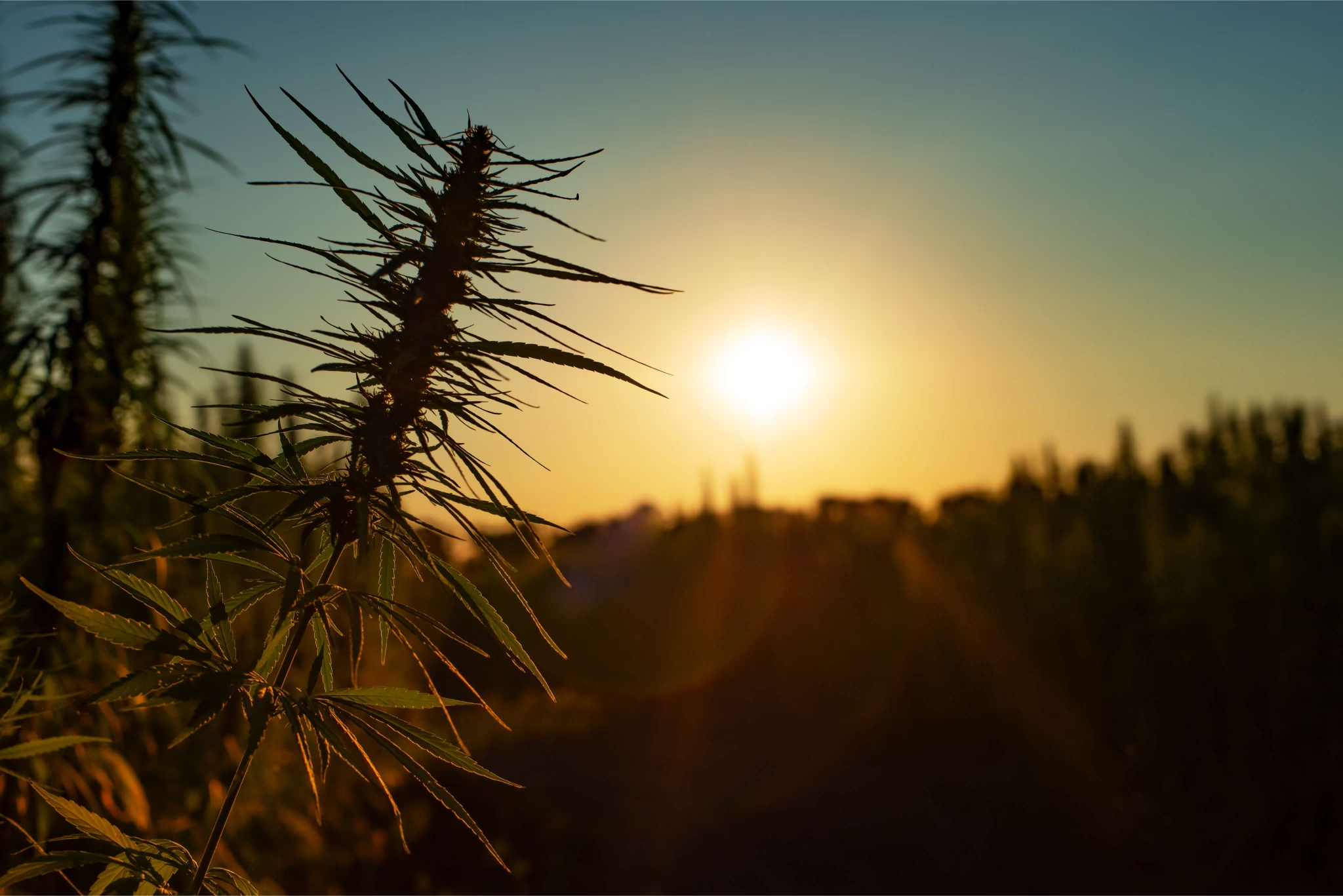
The sun does not follow the same path in April, June, August, and October. Solar elevation and day length shift with latitude and date. Shadows from buildings and trees therefore change length and direction. A location that looks open near the summer solstice can lose several useful hours as the sun drops lower later in the season. This matters especially when flowering and ripening occur after peak summer light.
Deciduous trees create another seasonal trap. A pre-planting survey done before full leaf-out can dramatically overestimate later DLI. The branch structure may look sparse in early spring and become a dense light filter weeks later. Conversely, late-season leaf drop can increase light after much of the crop cycle has already passed.
Use at least three seasonal checkpoints
A practical outdoor light plan benefits from three checkpoints rather than one heroic measurement day. The first is pre-planting or early establishment. The second is near the period of maximum canopy expansion. The third is during the expected flowering or finishing window. The exact dates depend on latitude, planting date, cultivar, and local season, so use developmental and solar-season cues rather than copying someone else’s calendar.
At each checkpoint, repeat both layers: direct-sun timeline and DLI. You are looking for change. Did a tree begin shading the western canopy? Did a neighboring crop or hedge grow taller? Did the lower sun angle move a roofline shadow across the garden? Did seasonal cloudiness reduce the daily total even though the direct-sun geometry stayed similar?
| Checkpoint | What to measure | Main question |
|---|---|---|
| Pre-planting | Sun path, obstacles, one or more DLI days, soil and water constraints | Is this location worth committing to? |
| Canopy expansion | Canopy-height DLI, self-shading, tree leaf-out, heat and water demand | Did the real canopy receive what the empty-site survey predicted? |
| Flowering/finish window | Lower sun angle, seasonal cloud, morning drying light, late-day shade | Will the site still provide useful light while flowers are finishing? |
Latitude changes both quantity and timing
Latitude affects the seasonal arc of the sun and the length of the day. Higher latitudes can produce very long summer days and large seasonal swings. Lower latitudes have smaller day-length changes but different solar angles and weather patterns. DLI captures the photon total produced by those conditions, while the direct-sun map reveals which local obstacles intercept the sun.
Do not treat a DLI map or weather-station average as your garden measurement. Regional maps are useful context. Your fence, trees, slope, smoke, haze, and local cloud pattern can move the actual canopy value away from the regional average. The field sensor is the local truth for the day measured.
Photoperiod-sensitive cultivars add a second clock
Outdoor cannabis is especially easy to misunderstand because light quantity and flowering timing sit beside each other. A high DLI can support photosynthesis, but it does not cancel the plant’s photoperiodic flowering response. Research with diverse Cannabis sativa cultivars shows meaningful genetic differences in critical day length. In some tested cultivars, relatively small changes in photoperiod altered flowering timing.
This means you need two records during the seasonal transition: the accumulated light the canopy receives and the day/night timing the cultivar experiences. A falling DLI in late season may reduce the amount of photosynthetic energy available. At the same time, a lengthening dark period may promote reproductive development in a photoperiod-sensitive cultivar. Those are related seasonal events, but they are not the same mechanism.
Remember: DLI is a dose meter, not a flowering switch. Photoperiod is a timing signal, not a measure of how much photosynthetic light the canopy received.
Weather can change DLI without changing the sun path
A week of cloud does not move the tree or the shed, yet it can sharply reduce DLI. That is why sun-path mapping and DLI logging complement each other. The geometry may be excellent while the seasonal weather resource is poor. In another climate, the geometry may be imperfect but frequent bright conditions still produce a substantial daily total.
Smoke and haze can also alter solar radiation, sometimes while the day still looks bright to the human eye. If a smoke episode is part of your regional season, record it rather than treating the low reading as sensor failure. The purpose of a light log is to document the environment the plant actually experienced.
Grower Question
“My June DLI looked excellent. Do I need to measure again in flower?”
Question sent by: Olivia Carter, via contact form.
Yes if you want a decision-quality record. Summer-solstice conditions can overstate the light available later in the season. Recheck when the sun angle, tree canopy, cloud pattern, or flowering stage has materially changed.
Practical setup/response plan with materials, placement, inspection points, and a backup option
A two-layer field method works better than chasing one perfect number
The most repeatable approach uses two layers. Layer one maps direct sun and obstruction timing. Layer two logs DLI at the candidate canopy. You can complete the first layer with a notebook, clock, compass or map, and consistent observation. The second layer requires a PAR-capable sensor if you want defensible DLI data.
If equipment is limited, do not fabricate precision. You can still rank obviously different sites by sun path and obstruction pattern. Reserve DLI measurement for the final two candidates or borrow/rent a suitable meter. The method becomes more valuable when it reduces uncertainty, not when it creates an expensive ritual for a decision that was already obvious.
Materials that make the procedure repeatable
Measurement Kit
- A site sketch or aerial printout with candidate locations labeled A, B, C, and so on.
- A clock or timestamped observation method for direct-sun intervals.
- A fixed measuring reference for sensor height.
- A PAR/PPFD quantum sensor with data logging or direct DLI integration when DLI is required.
- A stable, level mount that keeps the sensor horizontal unless the manufacturer specifies otherwise.
- A cleaning method that does not scratch or coat the sensor.
- Basic air-temperature and humidity logging if heat load is part of the decision.
- A notebook or spreadsheet for date, weather, sensor position, DLI, sun windows, and site notes.
- One open-sky reference point when local shade losses need to be separated from weather.
Step 1: label candidate sites before measuring
Do not move the sensor around a vague area and call every reading “the garden.” Mark the actual planting zones. If the area is large, divide it into zones that have visibly different shade patterns. A two-meter shift beside a fence or tree line can change the afternoon light environment enough to matter.
Step 2: establish the sun-path record
Choose a mostly clear day. Starting after sunrise, record direct sun at regular intervals until sunset. Use three simple states: direct, partial/interrupted, and blocked. Note the obstruction and, if useful, photograph the shadow line from a consistent position. Repeat on a second clear day to confirm the pattern.
The result should be a timeline, not just a total. “7.5 direct hours” hides whether the site is shaded in the morning, at noon, or late afternoon. A timeline preserves the part of the day that is missing.
Step 3: log DLI at canopy height
Mount the PAR sensor level and as unobstructed as the future canopy surface would be. Avoid letting the mount itself shade the sensor. Keep the sensor clean. If birds, dust, irrigation splash, or leaf growth can cover it, inspect it before trusting the record. Log continuously through the day and allow the device to calculate DLI or integrate the PPFD readings afterward.
When comparing two locations with one sensor, matched weather matters. The cleanest approach is simultaneous sensors. If that is not possible, alternate locations over several comparable days and use an open weather reference or regional solar record to flag unusually different days. Do not compare a cloudless Site A day with a stormy Site B day as if the difference came from the location.
Step 4: compare total dose and obstruction pattern together
Create a small table for each site: direct-sun timeline, daily DLI, open-reference DLI if available, maximum temperature, irrigation demand notes, and major risk. Look for repeated differences rather than one dramatic day. If Site A consistently delivers more daily light and remains manageable for heat and water, it has a clear light advantage. If the DLI difference is small and inconsistent, other site variables should decide the choice.
Step 5: use plant response as a verification layer
Measurement does not end when the plant goes outside. Once the canopy is established, compare what you predicted with what the plant and root zone are doing. Is internode spacing changing sharply in the shaded sector? Is one side of the canopy consistently thinner? Does the brightest zone also show midday droop, leaf-edge stress, or much faster dry-back? Is late-season shade keeping flowers wet longer in the morning?
These observations do not replace DLI. They verify whether the light environment is interacting with temperature, water, and canopy architecture the way you expected. If the plant response contradicts the measurement, recheck sensor height, cleanliness, shade from the mount, and whether the canopy has grown above or around the measurement point.
Step 6: keep a backup site or mitigation option
Pre-planting measurements are most useful before the garden becomes difficult to move. If Site A has the best DLI but is marginal for water access, identify Site B before transplanting. If a container crop can be moved early in the season, decide what evidence would justify the move. If plants are going into native ground, the threshold for commitment should be higher because relocation is no longer a simple correction.
Mitigation does not always mean moving the plant. Selective pruning of vegetation on your own property, where legal and horticulturally appropriate, may restore light. A container can sometimes be shifted a short distance. A reflective wall may increase radiation but also heat, so it should be measured rather than assumed beneficial. Avoid creating new problems in pursuit of a larger DLI number.
Do
- Compare multiple days, not one showcase day.
- Keep sensor height and orientation consistent.
- Use the sun-path log to explain the DLI result.
- Recheck after leaf-out and during the finish window.
- Pair high-light sites with a realistic water and heat plan.
Avoid
- Using noon PPFD as if it represented the day.
- Counting diffuse bright conditions as zero light.
- Calling a regional DLI map your canopy measurement.
- Using DLI to predict flowering timing.
- Choosing a site solely because it has the biggest number.
Read the daily PPFD curve, not only the final DLI number
Two days can finish with similar DLI values and still expose the canopy to very different light patterns. One day may rise smoothly from morning to a strong midday peak and taper gradually into evening. Another may alternate between intense sun and deep cloud every few minutes. The integrated daily totals can be close even though leaf temperature, stomatal behavior, irrigation demand, and short-term photosynthetic conditions were not identical.
If your logger stores PPFD through the day, keep the curve. It can explain why two equal-looking DLI values produced different field observations. A sharp midday depression in the curve may reveal a building shadow. Repeating narrow dips can reveal moving branch shade. A broad afternoon decline can show when a tree line or hillside begins blocking the sun. DLI tells you how much light arrived; the time series tells you when it arrived.
This is particularly useful when comparing morning-heavy and afternoon-heavy sites. The total may be similar, but the environmental cost can differ. Afternoon radiation often coincides with warmer air, warmer containers, and greater evaporative demand. Morning light may arrive when the canopy is cooler and can help dry dew sooner. These are site-specific interactions, not reasons to assign a universal value to one part of the day, but the curve helps you see them.
What DLI does not measure
DLI is powerful because it reduces a changing day of PAR into one accumulated quantity, but compression always removes information. Standard DLI does not tell you the spectral distribution of the light, the amount of ultraviolet radiation, the red-to-far-red balance, leaf temperature, CO2 concentration, wind speed, water status, or how photons were distributed through a three-dimensional canopy. It also does not say how efficiently the plant used the photons it received.
This matters outdoors because direct sunlight and diffuse skylight distribute through a canopy differently. Diffuse radiation can penetrate from more angles, while strong direct radiation creates bright and shaded leaf sectors. A horizontal sensor above the plant can report the same daily total even when canopy architecture causes different internal light distribution. Use DLI as an incident-light measurement, not as a complete model of whole-plant photosynthesis.
The same caution applies when comparing DLI from a weather station with DLI measured in the garden. A station in an open field may characterize the regional solar resource well, but it cannot see your fence shadow, pergola, tree line, or wall reflection. Use station data as a weather reference. Use canopy-level measurements for the micro-site decision.
A practical three-site example
Imagine three lawful planting locations on the same property. Site A receives direct sun from about 08:30 to 16:30 with a clear midday sky. Site B receives direct sun from 07:00 to 17:00, but a loose tree canopy creates repeated shade between late morning and early afternoon. Site C receives only about seven hours of direct sun but has a broad open sky and no overhead branches.
The hour count ranks B first, A second, and C third. A DLI logger may tell a different story. If A accumulates the highest daily PAR because its strongest solar hours remain unobstructed, its shorter clock total is not a disadvantage. If C receives strong diffuse sky radiation during the periods without direct sun, it may finish closer to A than the hour count suggests. B may still win, but now the result is measured rather than assumed.
Next add the non-light layers. If A is beside a heat-reflecting wall and repeatedly dries too fast, while C has reliable irrigation and good airflow, the smaller DLI difference between A and C may not justify the extra stress exposure. This is why the final decision sheet should show both the light measurement and the operating consequences of that light.
How many DLI days are enough?
There is no universal number of logging days that makes an outdoor site permanently characterized. The answer depends on why you are measuring. One clear day can reveal obstruction geometry. It cannot represent a cloudy season. A few representative days can be enough to separate obviously different candidate locations. A closer comparison benefits from repeated days that include the weather patterns common to the site.
Use repetition until the decision becomes stable. If Site A beats Site B on every comparable day and the difference is larger than normal day-to-day noise, more logging may not change the choice. If the ranking reverses with clouds or seasonal angle, the variability itself is the result. Record that uncertainty instead of hiding it in an average.
Always check the accuracy specification of the meter you are using. When two sites differ by only a few percent, the apparent ranking may be smaller than instrument uncertainty, placement error, or weather mismatch. In that case, treat the light environments as practically similar until repeat measurements show a consistent separation.
Failure modes: stagnant air, trapped moisture, heat load, frost, wind damage, water shortage, security, or neighbor impact
Failure mode 1: choosing the longest sun window instead of the strongest daily total
The classic mistake is to count direct-sun hours and stop. The method favors any site that sees the solar disk for longer, even if several of those hours occur at low solar elevation or through partial obstruction. When the candidates are close, DLI is the correction because it weights each moment by photon flux rather than by the clock alone.
Failure mode 2: choosing the highest DLI without checking heat load
More DLI can increase productive potential, but the plant still has to use the light. A dry container against a reflective wall can receive a high daily photon dose and a punishing thermal load at the same time. Water demand can rise, leaf temperature can exceed air temperature, and roots can warm beyond the conditions you intended to manage. Light measurement therefore needs a temperature and moisture reality check.
Controlled cannabis studies are useful here because they show that cannabis can respond strongly to increasing light under well-managed conditions. One indoor study observed increasing dry inflorescence yield across PPFD treatments up to 1,800 µmol m-2 s-1, which corresponded to a very high DLI under the study’s 12-hour photoperiod. That finding demonstrates high-light potential under those conditions. It does not mean every outdoor plant should be pushed toward that DLI. Outdoor leaf temperature, CO2, water status, wind, root volume, nutrition, acclimation, and cultivar are different.
Warning
Do not turn controlled-environment DLI values into an outdoor prescription
A research treatment proves what happened under the tested cultivar, photoperiod, temperature, irrigation, CO2, root zone, and canopy. It does not establish one universal outdoor target. Use cannabis studies to understand response, then use your field measurements to manage the site in front of you.
Failure mode 3: ignoring self-shading as the plant grows
An empty garden can log excellent DLI while a mature dense canopy distributes that light unevenly. The top surface intercepts radiation first. Interior and lower leaves may receive much less. DLI measured above the canopy therefore describes incident light, not the light dose of every leaf.
This is not a reason to abandon the metric. It is a reason to be precise about what was measured. Canopy-top DLI is useful for site comparison. Canopy architecture, spacing, training, and pruning determine how effectively that incident light is distributed through the plant.
Failure mode 4: measuring only on clear days
Clear-day testing is excellent for mapping obstruction geometry. It is poor for estimating the seasonal light environment if your climate regularly has cloud, marine layer, smoke, or storms. Add mixed and overcast days when possible. The comparison between candidate sites can change because diffuse light enters shaded spaces differently from a direct solar beam.
Failure mode 5: sensor bias and placement errors
A dirty or tilted quantum sensor can distort the result. A support pole can cast a narrow shadow. A leaf can grow over the sensor. A logger left at knee height can become irrelevant after the canopy rises. Water droplets, dust, bird debris, or a protective cover not intended by the manufacturer can alter transmission.
Inspect the setup before interpreting a strange DLI change as biology or weather. If the number drops unexpectedly, compare it with the open reference, weather record, and direct-sun notes. A clean reference sensor makes troubleshooting much easier.
Failure mode 6: substituting lux or visual brightness without understanding the conversion
Lux describes brightness weighted to human vision. Plants respond to photon flux across the photosynthetically active waveband, so a PAR quantum sensor is the more appropriate instrument for PPFD and DLI. A lux-to-PAR conversion can only be an estimate tied to the spectral distribution of the light source. Sunlight itself changes with angle, cloud, and atmospheric conditions, which weakens the idea of one permanent conversion factor.
If a phone or lux meter is all you have, use it to identify relative shade patterns rather than claiming laboratory-grade DLI. Once the site decision becomes close or expensive, measure the quantity you actually want.
Failure mode 7: letting light hide moisture and disease risk
The brightest site can still hold trapped moisture if fences, hedges, terrain, or a dense canopy restrict air movement. Morning light can help surfaces dry, but DLI does not measure leaf wetness, dew duration, or airflow. During flower, a site that remains damp after rain may carry a larger disease risk even if its daily photon total looks good.
Record when the canopy actually dries after dew or rainfall. This is especially useful when comparing a bright but sheltered courtyard with a slightly lower-DLI site that receives clean morning sun and air movement. The best outdoor site is a functioning environment, not a light meter contest.
Failure mode 8: ignoring wind, frost, water shortage, security, and neighbors
A high-light exposed ridge may be vulnerable to wind damage. A low protected hollow may be a cold-air pocket. A distant sunny corner may require long hose runs or manual water transport. An open southern boundary may be visually exposed to neighbors or public access. These are independent constraints that belong on the same decision sheet.
When light and another risk conflict, quantify both as far as practical. Do not say “Site A is better because DLI is higher.” Say “Site A averaged more DLI on the measured days, but Site B has reliable water and less wind exposure.” That wording keeps the decision honest and gives you a reason to revisit it if conditions change.
Grower Question
“My highest-DLI spot dries much faster than the others. Should I still use it?”
Question sent by: NorthSideMike, via email.
Only if the irrigation and root-zone system can reliably support the extra evaporative load. A light advantage that repeatedly pushes the plant into water stress is not automatically an advantage. Compare the usable light gain with the water-management cost and the consequences of missing an irrigation.
Legal/safety boundary without guessing local rules or recommending dangerous traps
Measure only where you are allowed to be
Sun and DLI mapping does not create an exception to property, access, or cannabis laws. Grow only where home cultivation is legal and only on land you own or have explicit permission to use. Do not enter neighboring property, roofs, restricted land, utility areas, or unsafe slopes to obtain a better sun-path angle or sensor position.
Local rules may regulate outdoor plant visibility, locked areas, setbacks, structures, lighting, odors, water use, electrical installations, and plant counts. Those rules vary and change. This article does not guess which rules apply to your address. Verify the current official sources for your jurisdiction before the garden is committed.
Do not alter neighboring trees or structures to improve DLI
A tree that shades your garden may not be yours to prune. A fence, hedge, building, or drainage feature may have ownership or permit restrictions. Treat a shade obstacle as a site constraint until you have confirmed that you have legal authority to modify it. The same applies to attaching sensors, reflectors, shade cloth, or cameras to shared structures.
Avoid unsafe sensor placement
A perfect measurement is not worth a fall. Do not climb unstable ladders, roofs, trees, retaining walls, or utility structures to position a sensor. In many gardens, a stable pole or ground-mounted mast at representative canopy height is enough. Secure equipment so wind cannot turn it into a falling or flying hazard.
Artificial night light creates a different problem
A grower trying to “improve light” may be tempted to add outdoor lamps. That moves the garden beyond simple sunlight measurement and into electrical, nuisance-light, neighbor, and photoperiod questions. Poorly timed night lighting can also interfere with the dark period perceived by photoperiod-sensitive cannabis. If supplemental outdoor lighting is legal at all, it needs a separate plan rather than an improvised extension cord and floodlight.
Safety Note: Keep measuring equipment low-risk, weather-rated where required, and out of normal walking paths. Do not create trip hazards with cables or leave electrical connectors exposed to irrigation or rain.
DLI data does not override legal site requirements
If the sunniest place on the property is not a legal cultivation location, remove it from the candidate list. Do not use privacy screens, hidden routes, or misleading landscaping to bypass a rule. The purpose of measurement is to optimize among lawful options, not to justify an unlawful one.
Grower Question
“The best sun is just across my property line. Can I put the pots there if nobody uses the area?”
Question sent by: Sophie, via X.
Not without explicit lawful permission and compliance with the rules that apply to that location. A good light measurement never substitutes for legal access. Keep the garden within the area where you are authorized to cultivate.
Pre-season and weekly checklist that turns the article into a repeatable field procedure
Pre-season: create the light map before the roots commit you to the site
The strongest use of this procedure is before planting in native ground or before large containers become difficult to move. Start with two or three lawful candidate locations. Map direct-sun windows on clear days. Record the obstacles. Then measure DLI when the sites are similar enough that accumulated light could change the decision.
Pre-Season Light Mapping Checklist
- Confirm that each candidate location is lawful and accessible for cultivation.
- Mark each candidate site on a sketch and define the future canopy measurement height.
- Run at least two clear-day sun-path observations and record direct, partial, and blocked periods.
- Identify permanent obstacles and seasonal obstacles such as deciduous trees.
- Log DLI continuously with a PAR-capable sensor when the site comparison requires it.
- Use an open-sky reference when you need to separate local shade from the day’s weather.
- Record temperature, water access, drainage, wind, cold-air exposure, privacy, and contamination concerns separately.
- Choose a primary site and a backup site before transplanting.
- Save the baseline so later seasonal measurements can be compared with the same method.
Weekly: inspect the measurement, not just the plant
You do not need to log DLI every day for the entire season unless the data has a purpose. A weekly review can be much lighter. Check whether new vegetation, plant growth, construction, shade cloth, supports, or weather patterns changed the light environment. If the answer is no, keep the existing baseline. If the answer is yes, repeat the measurement that can resolve the change.
Weekly Recheck
- Look for new shade from the crop itself, trees, hedges, structures, or neighboring vegetation.
- Check that any PAR sensor is level, clean, unobstructed, and still at a representative canopy height.
- Compare the week’s weather with the baseline before interpreting a DLI change.
- Note midday leaf posture, canopy temperature concerns, and root-zone dry-back during the brightest period.
- After rain or dew, note how quickly morning light and airflow dry the canopy.
- Check whether wind or staking changes have altered canopy orientation or self-shading.
- Record any significant move, pruning event, shade change, or sensor change in the same log.
- Remeasure a candidate or backup area before moving plants, not after the move is complete.
Seasonal verification: repeat the test when the solar geometry changes
Plan at least one meaningful recheck after the canopy expands and another during the expected flowering or finishing window. The exact timing should follow the season and plant, not a fixed internet date. Your goal is to answer a simple question: does the garden still receive the light environment that justified planting here?
If DLI has fallen, use the direct-sun timeline to identify why. If the loss comes from a tree or building shadow, the pattern will usually be repeatable. If the loss comes from seasonal cloud, the sun-path geometry may be unchanged. If the sensor is the problem, the open reference and equipment inspection should expose the mismatch.
How to make the final decision
For most home outdoor gardens, the decision can be made with this hierarchy. First, remove illegal, unsafe, contaminated, badly drained, or practically inaccessible sites. Second, compare direct-sun geometry. Third, use DLI to resolve sites that remain close or complicated. Fourth, check the cost of the light advantage in heat, water, wind, and privacy. Fifth, verify the chosen site again when the season and canopy change.
This prevents both common extremes. You avoid choosing a site from a vague “six hours is enough” rule, and you avoid turning horticulture into an instrumentation project where the biggest DLI number automatically wins. The point of measurement is better decisions.
Master Advice: If direct-sun hours and DLI tell the same story, the decision is easy. If they tell different stories, investigate the timing and intensity of the light before choosing. The disagreement is information.
| What you observe | What it probably means | Next check |
|---|---|---|
| More direct-sun hours and higher DLI | Clear light advantage | Verify heat, water, wind, and legal constraints |
| More direct-sun hours but lower DLI | The extra hours may be weak, interrupted, or low-angle | Inspect the hourly sun timeline and PPFD curve |
| Fewer direct-sun hours but similar DLI | Strong midday radiation or substantial diffuse light may compensate | Repeat on another representative day |
| High DLI but repeated midday stress | The site may be exceeding the water/temperature system’s capacity | Measure root-zone moisture, leaf/air temperature, and irrigation response |
| June DLI strong, late-season DLI weak | Seasonal solar angle, shade, or cloud has changed the resource | Map the new obstruction and finishing window |
The decision you should leave with
Use direct sun hours when you need a fast, visual answer about when the garden is shaded. Use DLI when you need a defensible answer about how much photosynthetic light the canopy received over the day. Outdoors, the two belong together because one explains the geometry and the other measures the accumulated result.
For cannabis, keep a third variable beside them: photoperiod. DLI can help you compare photosynthetic opportunity, but it cannot tell you when a photoperiod-sensitive cultivar will flower. A well-planned outdoor garden tracks the daily light dose, the seasonal day/night signal, and the environmental capacity to use that light without creating water, temperature, or disease problems.
Share this article
A quick overview of the topics covered in this article.
Follow us
Latest articles
September 4, 2026
September 4, 2026
September 4, 2026
September 4, 2026