
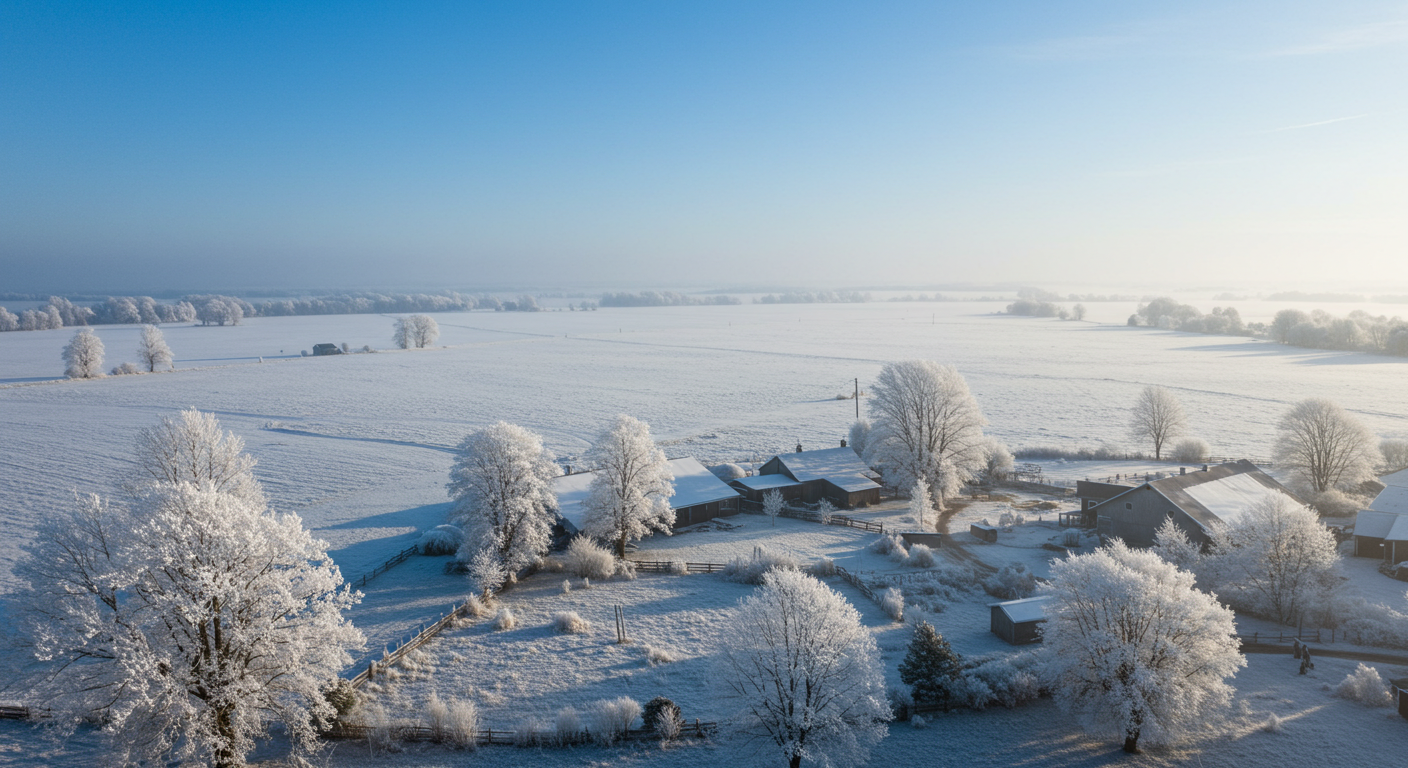
Finding Frost Pockets in a Garden
A regional forecast can say the overnight low will stay just above freezing while one corner of a garden still frosts. That is not necessarily a bad forecast. It can be a local cold-air problem. On clear, calm nights, surfaces lose heat to the sky, the air closest to the ground cools, and that denser air can move downslope until it reaches a hollow, terrace, wall, dense hedge, fence, building, or other obstruction. Where the cold air slows and collects, the minimum temperature can fall below nearby parts of the same property.
That local cold zone is commonly called a frost pocket. For an outdoor cannabis grower, identifying it before planting matters because the coldest few metres of a garden can shorten the useful season, increase late-flower risk, delay morning drying, and turn a forecast that looks manageable into a plant-level problem.
You do not need to guess from elevation alone. A useful frost-pocket survey compares at least one suspected cold zone with a nearby reference point using the same measurement method. The goal is to see whether the candidate area becomes colder earlier, by more, or for longer on the kinds of nights when cold-air pooling actually develops.
This resource stays focused on finding and confirming those local cold zones. It does not repeat the full outdoor growing process. For the larger sequence of outdoor site selection, root-zone preparation, irrigation, flowering, weather management, security, and harvest planning, use the complete outdoor cannabis growing guide as the parent resource.
Resource Navigation
In This Resource
- Define the outdoor decision in terms of site, season, climate, legal access, and plant risk
- Measure the site: sun path, shade, temperature, humidity, wind, drainage, water access, cold pockets, or contamination as relevant
- Seasonal timing: latitude, photoperiod, weather windows, and cultivar behavior
- Practical setup/response plan with materials, placement, inspection points, and a backup option
- Failure modes: stagnant air, trapped moisture, heat load, frost, wind damage, water shortage, security, or neighbor impact
- Legal/safety boundary without guessing local rules or recommending dangerous traps
- Pre-season and weekly checklist that turns the article into a repeatable field procedure
Define the outdoor decision in terms of site, season, climate, legal access, and plant risk
The practical question is not simply, “Does this garden ever get frost?” In many climates, almost every outdoor site eventually does. The useful question is: Does one realistic planting zone repeatedly become colder than the rest of the property under frost-producing conditions, and is that difference large enough to change where or how you grow?
That distinction matters. A whole-region freeze can affect every part of the property. A frost pocket is a local pattern. If the regional air mass is extremely cold and windy, moving a plant six metres uphill may not make a meaningful difference. On a calm radiation-frost night, however, those same six metres can sometimes separate a low pool of cold air from slightly warmer ground.
Frost pocket
A frost pocket is a localized area where cold air tends to collect or persist, commonly in a hollow, low spot, terrace, basin, or upslope side of an obstruction. It is most evident during clear, calm nights when radiational cooling and cold-air drainage create temperature differences over short distances.
First separate radiation frost from a regional cold-air event
Cold-air pooling is most useful to map during a radiation frost. These events commonly develop under clear or mostly clear skies with little wind. The ground and plant surfaces lose heat to the sky. The air touching those surfaces cools, becomes denser, and can slide downslope. If an inversion forms, the coldest air may sit close to the ground while somewhat warmer air remains above it.
An advective freeze is different. A cold air mass moves into the region, usually with more wind and less vertical temperature advantage. Cold-air drainage can still influence local conditions, but the whole area may be cold enough that the small benefit of a better microsite is overwhelmed.
This is why a frost-pocket survey should record wind and sky conditions along with temperature. If you compare sites only during a windy regional freeze, you may conclude that the garden has no frost pocket when you simply tested it under the wrong weather pattern.
Field Advice: Think of a frost pocket as a behavior, not a shape. A hollow is suspicious, but it is not confirmed until the temperature pattern shows that cold air actually collects or persists there under suitable conditions.
The planting decision is about relative risk
For a first survey, classify potential planting areas into three practical categories. A preferred zone has acceptable sun, legal access, water, root-zone conditions, and no repeated cold disadvantage relative to the rest of the garden. A conditional zone performs well most of the season but shows a modest cold penalty that may be manageable with cultivar choice, containers, timing, or a backup plan. A high-risk zone repeatedly becomes the coldest part of the site and also has poor cold-air escape, slow morning drying, difficult access, or another factor that compounds the risk.
The objective is not to find a magically frost-free spot. It is to avoid choosing the worst local cold sink when a better legal planting position is available nearby.
Plant stage changes what the same cold pocket means
A frost pocket is not equally consequential every week of the season. A small plant that can legally and safely be moved or protected gives you options. A large late-flowering plant fixed in the ground has fewer. Tender new growth and developing flowers also respond differently to cold than hardened stems or dormant perennial tissues, so it is misleading to apply one universal “damage temperature” to every outdoor cannabis plant.
For planning, the important information is therefore not just the minimum temperature. Record when the cold difference begins, how low each site goes, how long the difference persists, and what stage the plant would be in when those nights usually occur.
My lowest corner is sheltered from wind. Does that make it safer from frost?
Question sent by: CedarRoute, via email.
Not automatically. Wind shelter can be useful during damaging gusts, but the same fence, hedge, wall, or dense vegetation can slow cold-air drainage on a clear, calm night. A sheltered corner can therefore be comfortable on a windy afternoon and still become the coldest part of the property before dawn. Measure it against an open reference point instead of assigning it a single label such as “protected.”
Legal access belongs in the site decision from the beginning
A horticulturally warmer location is not usable if cultivation is not legal there or if the area conflicts with property, visibility, setback, fencing, tenancy, access, or other applicable rules. Likewise, do not move plants onto neighboring land, public land, a shared area without permission, or an unsafe slope simply to escape a cold spot.
Confirm the lawful growing boundary first. Then compare the microsites that are genuinely available inside it.
Measure the site: sun path, shade, temperature, humidity, wind, drainage, water access, cold pockets, or contamination as relevant

Finding a frost pocket is a comparison exercise. The most reliable small-garden method is to measure one or more suspected cold zones against a reference location during several clear, calm, cold nights.
You can learn a surprising amount with two temperature loggers, but consistency matters more than gadget count. If one logger is hanging against a wall, another is sitting on wet soil, and a third is in full sun, their differences do not tell you only about the air. They also tell you about placement error.
Draw the cold-air map before placing sensors
Start with a simple sketch of the legal garden area. Mark the highest and lowest ground, terraces, retaining walls, steps, fences, hedges, sheds, buildings, dense tree lines, ditches, drains, swales, and openings where air might leave the property. Add arrows showing the direction water would flow after a heavy rain. Cold air does not behave exactly like water, but the exercise is useful because dense air often follows slope and collects where downhill movement is blocked.
Then stand at the lower boundary and ask a second question: If a shallow layer of cold air moved down this slope tonight, where could it leave? A gap below a fence, an open driveway, a swale, or a continuing downhill slope may provide a path. A solid fence across the contour, a dense hedge, a retaining wall, or a building may create a dam.
Do not assume every barrier is bad. A wall can store daytime heat and sometimes create a locally warmer zone. A hedge can reduce damaging wind. What matters is the combined effect at night, which is why the map must be tested with temperature data.
Choose a reference point and candidate cold zones
Your reference point should be a realistic alternative planting position, not a weather-station ideal located somewhere you would never grow. If the suspected pocket is a low lawn corner, a useful reference might be a slightly higher, open part of the same garden with similar sky exposure.
For a small property, two to four points are usually enough:
| Measurement point | Purpose |
|---|---|
| Reference zone | A legal, realistic planting area on slightly higher or better-drained air terrain. |
| Suspected low point | Tests whether the obvious hollow or lowest corner actually becomes colder. |
| Upslope side of a barrier | Tests whether a fence, wall, hedge, or structure is causing cold air to back up. |
| Exit or drainage path | Shows whether an opening or continuing downhill route stays warmer than the blocked zone. |
Standardize sensor height and exposure
Use the same logger model where possible. Place the main comparison sensors at approximately the same height and with similar exposure. For a site-selection survey, future lower-canopy height is often more useful than mounting every sensor at rooftop weather-station height. If the plants would occupy containers 45 to 60 cm above grade, do not compare that zone with another sensor lying directly on the soil.
Because temperature close to the ground can be colder than the value reported at eye level or by a regional station, you may add a second near-ground comparison if that is relevant to seedlings or low plants. The key is to compare like with like: near-ground sensor against near-ground sensor, and canopy-height sensor against canopy-height sensor.
Protect air-temperature sensors from direct solar radiation and strong reflected heat. A logger heated by sun can read warmer than the surrounding air. A proper radiation shield is best. At minimum, use consistent shaded, ventilated placement designed for air measurement rather than attaching the sensor to a heat-absorbing wall or enclosing it in an unventilated box.
Do not compare a sun-heated sensor with a shaded sensor
A few degrees of apparent “microclimate difference” can come from measurement error. Use the same sensor type, similar shielding, similar height, and similar exposure before interpreting the difference as cold-air pooling.
Log through the full cooling cycle
A single thermometer reading at midnight can miss the pattern. Set the loggers before sunset and continue through at least an hour after sunrise. A five- or ten-minute logging interval is usually detailed enough for a small garden because it shows when the locations begin to separate and when they recover.
For each test night, note:
- forecast minimum temperature;
- cloud cover during the evening and overnight;
- wind or calm conditions;
- approximate dew point if available;
- whether the ground was wet, dry, bare, mulched, or covered by dense vegetation;
- sunset time;
- the lowest temperature at each sensor;
- the time of each minimum;
- how long the candidate zone stayed meaningfully colder than the reference;
- where visible frost, fog, or dew persisted after sunrise.
The absolute minimum matters, but the difference between zones is what confirms the local pattern. If the low point repeatedly runs 1 to 3°C colder than the nearby reference during radiation-frost conditions, that is actionable information even though the exact difference will change from night to night.
Use dawn as a visual diagnostic
Walk the garden near dawn or shortly after sunrise after a suitable cold night. Frost that persists in one lawn strip, hollow, or upslope side of a barrier can reveal the shape of the cold pool. Low ground fog can be even more informative because it may trace shallow air movement and show where air is collecting or escaping.
But do not let shade fool you. Frost will naturally disappear later from a zone that receives morning shade. If one corner stays white after the rest of the garden clears, compare the temperature logger data before concluding that the lingering frost proves the air there was colder.
Remember: Visual frost is evidence, not a calibrated thermometer. Use the pattern to guide your map, then verify it with paired temperature data.
Measure the barrier, not just the depression
Some of the most useful frost-pocket discoveries happen above an obstruction rather than at the property’s absolute lowest elevation. Cold air moving downslope can collect behind a solid fence, dense hedge, earth bank, retaining wall, or building. The area immediately upslope may become colder even though another part of the property is technically lower.
Place one sensor just upslope of the suspected barrier and another in an open path at similar elevation if possible. If the blocked zone consistently cools earlier or remains colder longer, the barrier is part of the frost-pocket mechanism.
Do not confuse soil drainage with air drainage
A low spot can have both poor water drainage and poor cold-air drainage, but the two are not the same. Sandy soil in a hollow may drain water quickly while the hollow still traps cold air. A gentle slope with heavy soil may shed cold air well while retaining too much water around roots.
Map both because they compound risk. A low, wet zone may stay humid, warm slowly after sunrise, and expose flowers to longer periods of leaf or flower wetness. That can make the site unattractive even if the minimum-temperature penalty is modest.
The weather station says 2°C, but my grass was frosted. Is my thermometer wrong?
Question sent by: Olivia Carter, via contact form.
Not necessarily. The weather station may be kilometres away, at a different elevation, and measured at a standardized height. Plant and ground surfaces can cool below the reported air temperature during radiative conditions, and air close to the ground can be colder than air higher up. Place paired local sensors at standardized heights and compare the suspect zone with another part of your own garden.
Build a simple frost-pocket score from repeated nights
You do not need a complicated statistical model. After each suitable test night, give every candidate zone a simple field score:
| Observation | 0 points | 1 point | 2 points |
|---|---|---|---|
| Minimum vs reference | Same or warmer | 0.5 to 1.0°C colder | More than 1.0°C colder |
| Cold duration | No meaningful extension | Shorter than 1 hour | 1 hour or more |
| Visual pooling | No repeat pattern | Possible frost/fog concentration | Clear repeated concentration |
| Air escape | Open downhill path | Partly restricted | Strong barrier or enclosed hollow |
This is not a scientific frost-injury index. It is a decision aid. A site that accumulates high scores on three suitable nights deserves much more caution than a site that looked cold once because it was shaded after sunrise.
Seasonal timing: latitude, photoperiod, weather windows, and cultivar behavior
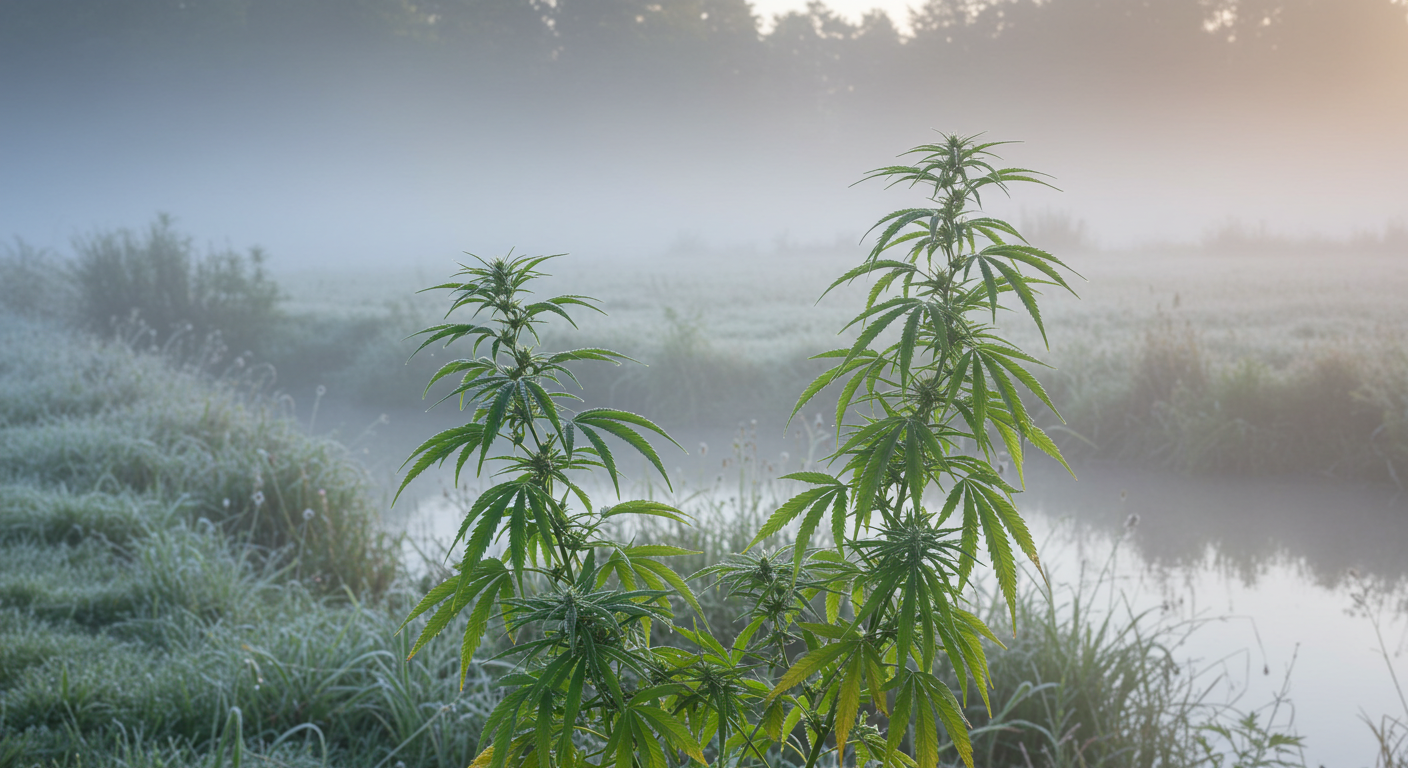
A frost pocket does not move through the calendar in a simple way. The terrain may stay the same, but the consequences of that terrain change as nights lengthen, vegetation grows, barriers fill in, soil moisture changes, and the cannabis plant moves from establishment through vegetative growth and flowering.
Spring and autumn reveal different versions of the same site
In spring, bare deciduous trees and hedges may allow more cold-air movement than they do later. The soil may also be wetter, and young plants may sit lower to the ground. In autumn, dense vegetation, mature hedges, tall cannabis canopies, privacy screening, and temporary structures can alter the drainage path. A frost map made in early spring is therefore a starting map, not a permanent certificate.
Repeat at least part of the survey later in the season if the garden changes substantially. Pay particular attention after installing a fence, adding a greenhouse or shelter, allowing a hedge to become dense, stacking materials along a boundary, or changing the grade.
Latitude shapes the season, not the pocket itself
Latitude helps explain day length, solar angle, and the broad timing of seasonal cooling. It does not tell you whether the back-right corner of a garden will collect cold air. Two properties at the same latitude can have very different frost behavior because their slope, elevation, barriers, surrounding buildings, vegetation, and exposure are different.
Use regional climate data to understand when frost becomes plausible, then use your local measurements to understand where it will be worst.
Photoperiod changes the value of every late-season degree
Photoperiod-sensitive cannabis cultivars begin reproductive development according to cultivar-specific responses to night length and light environment. The outdoor plant therefore enters its most weather-sensitive flowering period on a biological schedule that may or may not fit the local first-frost pattern.
This is where a confirmed frost pocket becomes more than a curiosity. If one candidate site repeatedly loses 1 or 2°C before dawn and the cultivar tends to finish late, that local penalty can compress the practical finish window. A slightly warmer microsite may buy useful time even though it cannot change the regional season.
Do not convert this into a rigid rule such as “move every late cultivar uphill.” Sunlight, wind, irrigation access, root-zone quality, privacy, and legal placement still matter. The better decision is the site with the best combined risk profile.
Use forecast windows to choose survey nights
You do not need to wait for a damaging freeze to map the pattern. Clear, calm nights that approach the low single digits Celsius can already reveal which zones cool fastest. A near-frost night is often safer for testing because you can collect useful comparative data without intentionally exposing a plant to severe cold.
Watch for nights with:
- clear or mostly clear skies;
- light wind or calm conditions;
- a cool, dry air mass;
- a forecast minimum low enough to create meaningful nocturnal cooling;
- no heavy rain or storm conditions that would invalidate a normal comparison.
If the evening stays windy, record the night but label it as a poor frost-pocket test. Your data archive becomes more useful when you keep the “failed” test nights instead of silently mixing them with the good ones.
Track first-risk dates as a range, not a deadline
Regional first-frost dates are probabilities based on historical observations. They are useful for planning but cannot predict the exact first damaging night at one garden. Your frost-pocket map adds a second layer: it tells you whether the planting zone tends to behave colder or warmer than the surrounding property when the region approaches that risk period.
For a late-season outdoor crop, build three windows:
| Window | What it means | What to do |
|---|---|---|
| Early warning | Cold nights become plausible but hard frost is not yet common. | Restart temperature logging, inspect cold-air paths, and confirm backup materials and access. |
| Active frost-risk window | Clear, calm nights can bring local temperatures near freezing. | Check forecasts daily, compare local sensors, and inspect late-flowering plants more frequently. |
| Season-limiting window | Repeated or stronger cold events become likely enough that local microsite advantage may no longer be sufficient. | Use plant maturity, disease risk, local law, and forecast confidence to make finish decisions rather than relying on the frost map alone. |
Cultivar behavior changes the cost of a cold site
An earlier-finishing cultivar may complete most flowering before a garden’s frost-pocket penalty becomes severe. A later cultivar may still be building flowers when repeated clear nights begin pushing the low zone toward damaging temperatures. Plant architecture can also matter indirectly: dense flowers and canopies may dry slowly after cold, humid mornings.
The frost map should therefore inform cultivar and placement decisions, but it should not pretend to predict genetics. Use actual flowering onset, development, and finish behavior from the plant in front of you.
Master Advice: A frost map tells you where the garden is coldest. It does not tell you when a cultivar is ready. Keep site risk and maturity assessment as separate measurements, then combine them for the final outdoor decision.
Practical setup/response plan with materials, placement, inspection points, and a backup option
The most useful frost-pocket survey is simple enough that you will actually repeat it. You are trying to build evidence before planting or before the risky part of the season, not create a permanent meteorological station.
Minimum useful kit
For a small garden, a practical kit is:
- two matching temperature loggers, ideally temperature/RH loggers;
- radiation shields or consistent ventilated shielding;
- two stakes or mounts that hold the sensors at the same height;
- a simple site map;
- flags, tape, or labels for measurement points;
- a weather source for forecast low, wind, cloud cover, and dew point;
- a notebook or spreadsheet;
- an optional third or fourth logger for barriers or secondary pockets.
If you only have two sensors, that is enough to start. One remains at the reference. The other rotates through candidate zones over several suitable nights. Multiple simultaneous sensors are better because weather changes from one night to the next, but a disciplined two-sensor survey is still more informative than guessing.
Run the three-night paired test
Use this repeatable sequence:
- Map the terrain. Mark slope, lows, barriers, and likely air exits.
- Choose a reference. Select a realistic legal planting point that appears to have better air drainage.
- Choose the suspect point. Start with the most likely cold pool or the area you are seriously considering for plants.
- Standardize the sensors. Same model, same height, similar shielding, same logging interval.
- Start before sunset. Record through dawn and into early morning.
- Note weather conditions. Clear/calm nights receive the greatest weight.
- Calculate the temperature difference. Compare minimum, timing, and duration.
- Repeat on at least two more suitable nights. Look for the same direction of difference.
- Walk the garden at dawn. Add visible frost, fog, and delayed thaw to the map without treating them as temperature measurements.
- Make the planting decision only after the pattern repeats.
Compare the same way every night
- Use matching sensor placement.
- Log the whole night.
- Record wind and cloud cover.
- Keep the reference point fixed.
- Repeat the test.
Building the map from one impression
- One frosty lawn photo.
- One regional weather-station low.
- Different sensor heights.
- A windy freeze as the only test.
- Assuming the lowest contour is automatically worst.
Use temperature difference before absolute thresholds
When the purpose is site selection, relative difference is often more robust than debating an exact cannabis frost-injury threshold. Suppose the reference location reaches 1.8°C and the low corner reaches -0.2°C on the same clear, calm morning. You have learned something important about the site even if neither plant shows visible injury that day.
Record the difference as:
Candidate temperature minus reference temperature.
A negative result means the candidate is colder. Track the minimum difference, but also look at the full curve. A site that is only briefly colder just before sunrise is different from one that falls behind at 10 p.m. and stays colder for eight hours.
Test whether the pocket is topographic or barrier-driven
If the cold zone sits upslope of a fence or hedge, add one comparison after identifying the pattern. Measure at the same elevation near an opening or farther from the obstruction. If the open point stays warmer while the blocked point repeatedly cools more, the barrier is probably contributing.
This does not mean you should immediately cut a fence, hedge, or structure. It means you have diagnosed the mechanism. Any modification must respect property law, security requirements, privacy, structural safety, neighbor boundaries, and the other functions the barrier serves.
Choose the least complicated response first
If a better planting zone exists a short distance away, relocation is usually more dependable than trying to engineer a poor frost pocket into a perfect site. That is especially true before planting. A modestly higher point with an open downhill air path may solve the cold problem without adding equipment.
If relocation is not possible, options may include:
- keeping movable containers in the warmer verified zone;
- avoiding the deepest part of the hollow;
- maintaining a lawful, safe air-drainage opening where a barrier is the cause;
- choosing a cultivar whose finish behavior better matches the local season;
- keeping legal, plant-safe frost protection ready for isolated events;
- planning earlier harvest decisions when maturity and forecast risk converge;
- using the coldest verified sensor point for alerts rather than relying only on the regional forecast.
Do not expect a raised bed or taller container to erase a broad cold-air pool. Raising the root zone can improve soil drainage and change near-ground exposure, but the flowers on a large plant still occupy the cold air mass if the whole corner fills with it.
If I put the pots on a table, can I escape the frost pocket?
Question sent by: Lukas Becker, via email.
Sometimes the air a little higher above ground is warmer during a radiation frost, but a table is not a reliable cure for a deep cold pool. It also changes stability, wind exposure, irrigation, access, and the risk of tipping a mature plant. Measure the air at the height the canopy would actually occupy. If the whole lower garden is colder than the reference, moving the garden to a better microsite is usually the more robust solution.
Build a backup trigger before you need it
A backup plan works best when the trigger is defined in advance. For example: if the coldest garden sensor falls below a chosen warning level while the forecast also shows clear skies and calm wind, you perform a physical inspection and deploy only the safe, legal protection method you have already prepared.
The trigger should not be a magical injury threshold copied from another crop. It is an operational warning that gives you time to act. Your plant stage, cultivar, site history, local law, and the expected duration of cold all affect the final response.
Verify the correction on the next suitable night
If you relocate a container, open a lawful air path, remove an obstruction, or change the site layout, repeat the paired measurement. A change is not confirmed because it looks logical. The next clear, calm cold night should show whether the temperature disadvantage actually narrowed.
Keep the old data. Before-and-after curves are much more useful than memory.
Failure modes: stagnant air, trapped moisture, heat load, frost, wind damage, water shortage, security, or neighbor impact
Frost-pocket mapping can fail even when the thermometer is accurate. Most mistakes come from asking the instrument to answer a question the test design did not isolate.
Failure mode 1: assuming the absolute lowest point is automatically the pocket
Low ground is a strong candidate, but cold air can be diverted, drained, or blocked. An upslope terrace behind a solid barrier may be colder than a slightly lower open lane where air continues to move away.
Correction: map likely air paths and barriers, then measure.
Failure mode 2: diagnosing from one night
One frost event can be distorted by cloud, wind, wet ground, temporary shelter, irrigation, or sensor error. A site decision that may last an entire season deserves repeated evidence.
Correction: require the same cold bias on multiple suitable nights.
Failure mode 3: using a windy advective freeze as the main test
Strong wind mixes the boundary layer and changes the way cold air pools. A widespread cold-air mass can also make every sensor similarly cold.
Correction: label the event type. Give clear, calm nights the most weight for frost-pocket diagnosis.
Failure mode 4: comparing sensors at different heights
Near-ground air may be much colder than air one or two metres higher during a radiation frost. If one logger is at soil level and another is at canopy height, the difference may be vertical stratification rather than a horizontal frost pocket.
Correction: compare matched heights first. Add a separate vertical profile only if you want to study height effects.
Failure mode 5: measuring the sensor instead of the air
A logger touching metal, masonry, wet soil, black plastic, or a heat-retaining wall is influenced by that surface. An unshielded sensor exposed to sunrise can also warm rapidly and make one site appear to recover faster.
Correction: standardize mounting and radiation shielding.
Failure mode 6: confusing persistent frost with persistent shade
The north side of a wall or hedge may stay frosted later because morning sunlight reaches it later. That does not prove the minimum air temperature was lower.
Correction: compare the overnight logger curve, not only the thaw time.
Failure mode 7: fixing air drainage and creating another problem
Removing a windbreak or opening a barrier may improve cold-air drainage but increase damaging wind, visibility, animal access, neighbor impact, or security risk. The warmest microsite is not automatically the best total site.
Correction: evaluate the change against the full garden risk map.
Failure mode 8: ignoring stagnant moisture
A low, sheltered pocket may also hold humidity and delay drying after rain or dew. Late-season flowers can therefore experience two linked pressures: colder pre-dawn temperatures and longer wetness after sunrise.
Correction: record RH, dew persistence, and morning drying time alongside temperature if moisture is a concern.
Failure mode 9: moving to the ridge and trading frost for wind
Higher ground often drains cold air better, but exposed ridges can experience strong wind, faster container drying, broken branches, and greater heat or water stress. The best planting zone may be mid-slope rather than the highest point.
Correction: compare both cold risk and wind exposure before relocating.
Failure mode 10: assuming a nearby building always warms the site
Walls can store and release heat, but they can also block drainage. A building at the bottom of a slope may create a cold-air dam on its upslope side.
Correction: measure the actual side of the building you plan to use.
Failure mode 11: relying on the regional minimum
The official low may be measured far away, at a different elevation and standardized height. It is useful context, not your garden’s coldest temperature.
Correction: keep a local cold-point sensor once the pocket has been identified.
Failure mode 12: treating frost prevention as more important than safe access
A remote corner that is warmer but difficult to reach in darkness, slippery after dew, close to a retaining edge, or unsafe during bad weather may be a poor operational choice.
Correction: include nighttime and emergency access in the site score.
A small temperature advantage is not permission to ignore the forecast
A warmer microsite can reduce local risk during some radiation frosts. It cannot guarantee protection from a stronger regional freeze, persistent cold spell, wind-driven advective event, or prolonged wet weather. Continue to monitor the regional forecast and the plant itself.
Legal/safety boundary without guessing local rules or recommending dangerous traps
Frost-pocket mapping is mostly passive observation, but the response to a cold site can involve structures, fencing, electrical equipment, water, heaters, temporary covers, or changes to property boundaries. Those additions bring legal and safety questions that are separate from the temperature data.
Do not alter property boundaries without permission
A fence or hedge may be contributing to cold-air pooling, but cutting, removing, raising, or opening it can affect property rights, security, child or pet access, privacy, and local cultivation rules. If the barrier is shared or belongs to someone else, do not modify it without explicit authorization.
Often the simpler solution is moving the plant to a better legal position inside the existing boundary.
Avoid improvised flame and heater solutions
Do not respond to a frost pocket by placing open flames, homemade burners, charcoal devices, unvented fuel heaters, or improvised electrical heaters around plants. Fire, carbon monoxide, electrical shock, burns, and ignition of dry vegetation are more serious hazards than the horticultural problem you are trying to solve.
If active frost protection is legal and appropriate where you live, use equipment specifically designed for the setting and follow the manufacturer’s instructions, electrical requirements, fire restrictions, and clearance rules. For a home-scale cannabis garden, good site selection and safe passive planning are usually the first tools to consider.
Water-based frost protection is not a casual garden trick
Commercial frost-protection irrigation works only when water is applied at the correct rate and continuously through the relevant freezing process. Starting without enough water, pressure, uniformity, drainage, or understanding can make the situation worse and create ice, slip, electrical, structural, and root-zone problems.
Do not improvise an overhead freeze-protection system because you saw ice-covered commercial orchards. A home garden may have very different equipment and legal water constraints.
Keep covers and supports structurally safe
Temporary covers should not collapse onto plants under rain, wind, snow, or ice. Keep them clear of unsafe electrical equipment and do not create blocked exits or trip hazards. In a garden used by children or pets, secure stakes, cords, clips, and frames so the frost response does not create a new injury risk.
Check local cultivation and structure rules separately
Legal home cultivation rules can govern where plants may be located, whether they must be enclosed or locked, whether they may be visible, how many plants are allowed, and what structures are permitted. Building, fire, electrical, water, nuisance, and tenancy rules may apply in addition to cannabis law.
Do not guess. Verify the current rules for the exact property and jurisdiction before making permanent changes. The outdoor growing pillar provides broader planning context, while local legal verification should always come from current authoritative sources.
Can I cut a gap under the fence if my sensors prove it is trapping cold air?
Question sent by: Sophie, via X.
The temperature data can show that the barrier is associated with colder conditions, but it does not answer the property or legal question. First confirm ownership, structural function, security requirements, child and pet access, and local rules. If modification is not clearly permitted, use a different planting zone or another safe response.
Safety Note: The goal is to reduce plant risk without increasing human, animal, fire, electrical, property, or legal risk. A slightly colder garden is always preferable to an unsafe frost-control setup.
Pre-season and weekly checklist that turns the article into a repeatable field procedure
A frost-pocket map becomes useful when it changes a decision. The checklist below turns the survey into a repeatable process that you can run before planting, revisit as the garden fills in, and reactivate when autumn nights begin to cool.
Pre-season frost-pocket survey
- Confirm the legal outdoor growing area and realistic planting zones.
- Sketch slope, hollows, terraces, retaining walls, fences, hedges, buildings, and likely air exits.
- Identify one reference point with reasonably good air drainage.
- Identify one to three suspected cold zones.
- Use matching temperature loggers at matching heights.
- Shield sensors consistently from direct radiation and hot surfaces.
- Choose clear, calm, cold nights for the strongest tests.
- Log from before sunset through at least one hour after sunrise.
- Record wind, cloud cover, dew point, ground condition, and forecast low.
- Walk the garden near dawn and map persistent frost or low fog.
- Repeat on at least three suitable nights.
- Classify each candidate as preferred, conditional, or high-risk.
- Choose the planting zone using frost risk together with sun, wind, water, root-zone quality, security, neighbor impact, and access.
The five-minute weekly recheck
Once the site is chosen, you do not need to rerun the full survey every week. Instead, walk the cold-air path and ask five questions:
- Has vegetation, fencing, storage, or a temporary structure blocked an air exit?
- Has the canopy become dense enough to change airflow or morning drying?
- Is the low zone staying wetter than the reference after rain?
- Are upcoming overnight lows entering the range where local differences matter?
- Can you still reach and inspect the site safely before dawn or after bad weather?
When the answer changes, reactivate the loggers.
Trigger a full recheck after site changes
Repeat the paired temperature test after:
- installing or replacing a solid fence;
- allowing a hedge to become significantly denser;
- adding a shed, greenhouse, privacy screen, or seasonal shelter;
- changing the grade or building a retaining wall;
- moving the main garden to a different elevation;
- major tree removal or new tree canopy development;
- a surprising frost event that does not match the existing map.
Use a three-level planting decision
| Decision | What the measurements show | Practical response |
|---|---|---|
| Green: preferred | No repeated meaningful cold penalty, acceptable air escape, and no major linked moisture or access problem. | Use the site if sun, water, root zone, legality, and other risks also fit. |
| Yellow: conditional | Modest repeated cold penalty or one correctable barrier, but the site has other strong advantages. | Keep local temperature monitoring active, define a backup response, and reassess as flowering and autumn approach. |
| Red: high risk | Repeatedly coldest zone, long cold duration, trapped air, slow drying, or multiple linked risks. | Prefer another legal planting location rather than designing the entire season around frost rescue. |
Verify the map again when flowering becomes weather-sensitive
As outdoor plants move deeper into flowering, restart monitoring before the historic frost-risk period. The mature canopy may have changed the local airflow since spring. Use the same reference point if it still exists so the new data remains comparable.
Do not wait for visible injury. The purpose of monitoring is to see the risk building while you still have choices.
Final field procedure
If you want the shortest version of the method, use this:
- Find the likely low or blocked zones.
- Choose a realistic warmer reference point.
- Place matching, shielded loggers at matching heights.
- Measure clear, calm cold nights from sunset through dawn.
- Compare temperature difference, timing, and duration.
- Repeat the test at least three times.
- Confirm the pattern with dawn frost or fog observations where available.
- Check whether a barrier explains the cold pool.
- Choose relocation before complicated engineering when a better site exists.
- After any correction, measure again.
A frost pocket is confirmed by a pattern, not by a label on a map. When one zone repeatedly cools earlier, reaches a lower minimum, or stays colder longer than a nearby reference under radiation-frost conditions, you have enough evidence to treat that part of the garden differently. That is the real value of mapping it before a late-season cold night makes the decision for you.
Share this article
A quick overview of the topics covered in this article.
Follow us
Latest articles

September 4, 2026

September 4, 2026
September 4, 2026
September 4, 2026
