
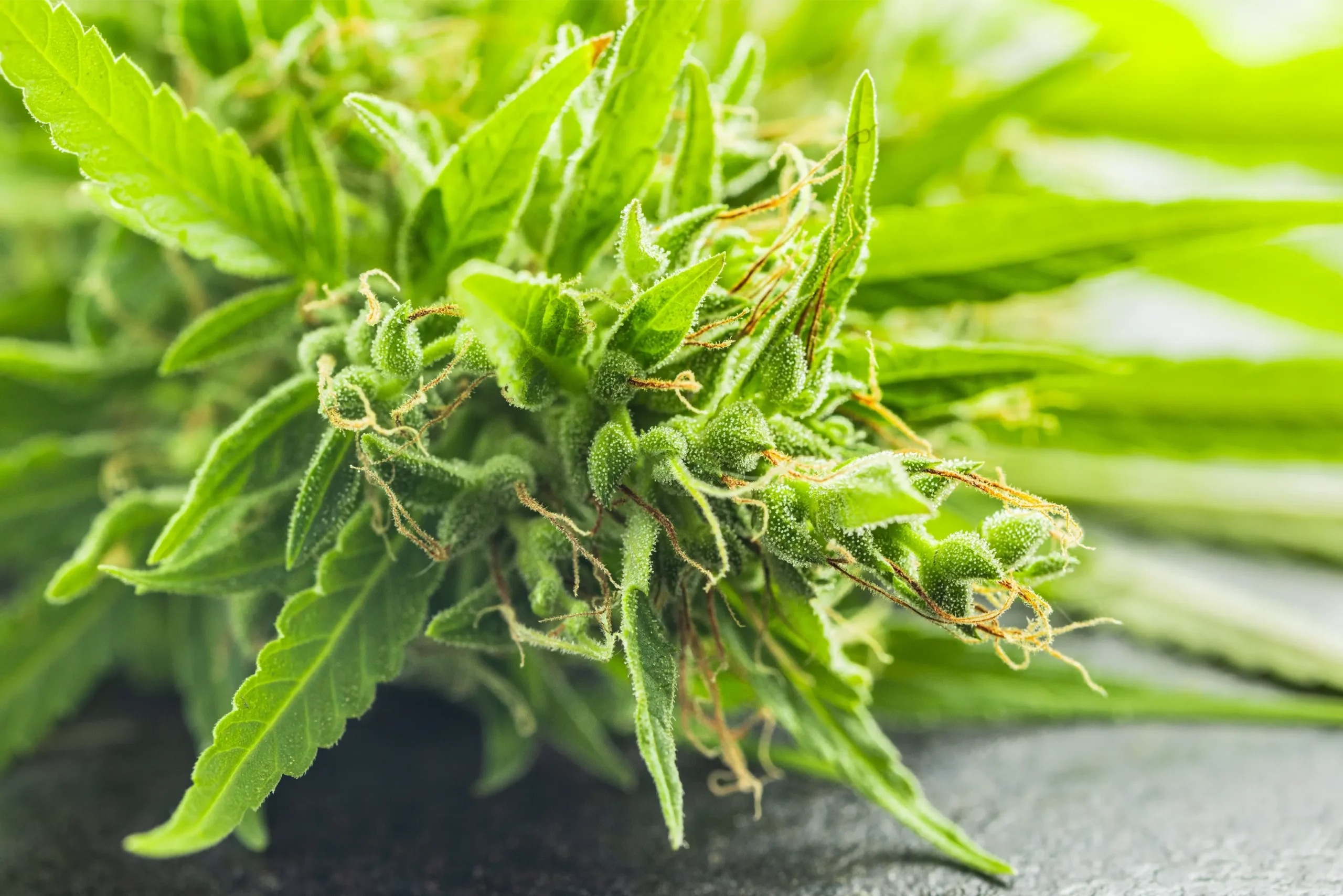
Garlic Juice
Garlic Juice, Strain Profile & Grow Guide
Garlic Juice is a collision between ripe tropical fruit and savory chem. Papaya supplies soft fruit, apricot, fermentation and a broad physical calm. GMO contributes garlic, onion, fuel, rubber and the kind of long-lasting pungency that can remain on tools after the plant has left the room. The best flower does not choose one parent and abandon the other. It begins with sweet fruit and ends with garlic, pepper and diesel, or it opens with savory funk and reveals papaya only after the flower is broken apart.
That aromatic contradiction is matched by the plant. Papaya-influenced expressions may remain compact, finish relatively quickly and form tight rounded flowers. GMO-leaning expressions can stretch more, carry longer branches and continue swelling later. Treating a mixed group as one uniform cultivar can produce an uneven canopy and an uneven harvest. The first run should therefore be used to identify which plants are compact fruit types, which are taller chem types and which combine both traits successfully.
Garlic Juice is often presented as a resin and potency cultivar, but the more demanding question is whether the flower keeps its tropical layer after drying. Garlic, pepper and fuel survive rough handling better than papaya, orange blossom and apricot. A batch can remain offensively loud while becoming less complete. The grower who cares about flavor must manage density, harvest maturity, trim timing and drying speed as carefully as canopy yield.
Strain Features
| Feature | Details |
|---|---|
| Strain Type | Indica-leaning hybrid |
| Genetic Profile | GMO x Papaya |
| THC | Frequently reported in the mid-to-high 20% range, with some higher laboratory results; potency varies by batch |
| CBD | Usually very low |
| Dominant Terpenes | Limonene, myrcene and beta-caryophyllene are commonly reported |
| Signature Aroma | Garlic, onion, diesel, ripe papaya, apricot, orange blossom, wood and pepper |
| Effect Character | Euphoric warmth followed by appetite, deep relaxation and possible sedation |
| Flowering Time | Commonly around 8 to 9.5 weeks; GMO-leaning cuts may need longer |
| Stretch | Low to moderate in Papaya-leaning plants; moderate to strong in GMO-leaning expressions |
| Plant Shape | Broad and branchy, with phenotype-dependent internode length |
| Flower Structure | Tight, sticky flowers with bright pistils and heavy resin |
| Resin Character | Thick and greasy, with strong potential for flavor-focused extraction |
| Odor Intensity | Extremely strong during late flower and drying |
| Feeding Behavior | Can support productive nutrition but becomes leafy and harsh when nitrogen or salts remain high |
| Main Grow Risk | Mixed phenotype timing and dense flowers that are difficult to dry evenly |
| Grow Difficulty | Intermediate |
Genetic Lineage
Garlic Juice combines GMO with Papaya. Both parents are already distinctive, and the cross does not soften either one completely. GMO is known for vigorous growth, chem intensity, garlic, onion, rubber and a long heavy effect. Papaya carries tropical fruit, fermentation, orange blossom, compact flower structure and a calmer, more obviously indica-like finish.
The strongest expression of the cross is not necessarily the one with the loudest garlic. A pure chem-leaning plant may be impressive but can resemble other GMO descendants. A fruit-dominant plant may smell beautiful but lack the depth and resin that define Garlic Juice. The most complete keeper usually carries a clear papaya or apricot layer through the cure while retaining garlic and diesel on the exhale.
The parents also create different structural possibilities. Papaya tends to shorten internodes and form compact flowers. GMO can lengthen the plant, increase stretch and produce branches that continue moving after the rest of the canopy appears settled. A seed-grown population may contain both extremes. Even clone-only material can be represented by different selected cuts in different markets, which explains conflicting descriptions of height and flowering time.
The lineage influences water demand as well. A compact Papaya-leaning plant may use less water once stretch ends because its leaf area and branch length remain limited. A GMO-leaning plant can continue drinking aggressively through mid-flower. One irrigation schedule for both types can leave the compact plants too wet and the taller plants too dry.
Keeper selection should include plant function, not only jar aroma. A spectacular Papaya phenotype that roots slowly, stalls after topping or forms excessively leafy flowers may be less useful than a slightly less sweet plant with stronger branches and cleaner calyx development. The opposite is also true. A high-yielding GMO expression can fill a room while producing a flavor too close to ordinary garlic chem. The valuable keeper combines manageable structure, clean flower formation and fruit that survives drying.
The cross may also reveal different bud-to-leaf ratios. Compact fruit plants can build round flowers surrounded by short resinous leaves. Tall chem plants may form longer spears with more open spacing between flower clusters. The first type is easier to keep short but harder to ventilate and trim. The second is easier to inspect from the side but may require additional support and a longer finish.
Aroma development often follows a predictable sequence. Early flower may smell sweet, green and lightly tropical. Garlic and rubber become stronger as resin increases. During late flower, the Papaya side may return as fermented fruit, apricot or orange blossom. After drying, the savory compounds dominate temporarily, then fruit can reappear during cure. This changing profile makes early phenotype selection unreliable.
The pedigree of Garlic Juice represents a brilliant collision of two contrasting flavor empires. Maternal contributor GMO Cookies, selected by Skunkmasterflex, contributed immense vegetative vigor, massive calyx stacking, heavy sulfurous allium terpenes, and sledgehammer narcotic physical sedation. Paternal contributor Papaya, perfected by Oni Seed Co, introduced delicate capitate-stalked glandular trichome heads with exceptionally fragile abscission zones, sweet tropical monoterpenes, and an uplifting cerebral buoyancy. The resulting hybrid was stabilized and selected for commercial hash washing, capturing the pungent savory funk of Chem D alongside the sweet candy fruit of Papaya.
Effect Breakdown
Moderate dose: warmth before weight
Garlic Juice usually begins with a noticeable emotional softening. The user may feel happier, more comfortable and less mentally guarded. The effect is not always immediately sleepy. A brief period of conversation, music appreciation or relaxed focus can occur before the body becomes heavy.
A tingling sensation often develops through the shoulders, arms and face. Appetite may rise quickly. The effect can feel physically immersive without becoming completely immobilizing at a moderate dose.
Higher dose: the GMO side becomes obvious
As dose increases, the experience becomes slower and more internal. Thoughts may repeat, time may feel stretched and motivation may drop. The body effect can become strongly sedating. This is the point where the cultivar moves from an evening hybrid into a sleep-oriented strain for many experienced users.
The onset can still be intense. Users who are sensitive to THC may feel dizziness, anxiety or an uncomfortable awareness of heart rate before the relaxing phase arrives. Dry mouth and dry eyes are common.
Batch differences matter
A fruit-forward batch may feel brighter and more euphoric. A chem-heavy batch often feels more physically dominant and mentally foggy. Harvest timing also influences the balance. Earlier flower can feel more active and sharp. Greater maturity strengthens appetite, body weight and sleepiness.
Because CBD is usually minimal, the strain should be approached conservatively by new users. The sweet Papaya fraction does not make the cannabinoid intensity mild.
Consuming authentic Garlic Juice produces a delightfully complex, two-stage experience that engages both the mind and the body. Within minutes of the first inhalation, an uplifting surge of euphoric warmth lands behind the eyes, dispelling situational stress, melting away mental fatigue, and infusing the spirit with cheerful optimism. The initial cerebral elevation is joyful and creative without anxiety. Soon thereafter, the heavy GMO heritage takes hold. A warm, heavy somatic numbness rolls through the shoulders, spine, and extremities, loosening tight muscles, easing chronic joint inflammation, and relieving physical tension while keeping the consumer comfortable, content, and peaceful.
| Phase & Time Window | Mental & Emotional State | Physical & Somatic Sensation | Ideal Setting & Pairing |
|---|---|---|---|
| The Funky Inception (0 to 15 Minutes) | Instant mood elevation, creative cheer, mental release | Warm tingling across forehead, easing of ocular pressure | Late-afternoon transition, socializing with friends, music |
| Tropical Equilibrium (15 to 75 Minutes) | Blissful contentment, talkative joy, relaxed focus | Deep muscular relaxation across neck and upper back | Casual dinner, watching comedy, relaxed gaming, sketching |
| Somatic Immersion (75 to 150 Minutes) | Deep contemplative quietude, gentle mental slowing | Substantial physical couch-lock, heavy limbs, total analgesia | Comfortable sofa lounging, vinyl records, warm bath |
| Tranquil Slumber (150 to 240+ Minutes) | Effortless transition into restfulness without heavy fog | Deeply relaxed muscular state, ready for restorative sleep | Bedtime routine, quiet breathing exercises, restful slumber |
Flavor & Aroma Profile
Garlic Juice can be understood as two aromatic systems sharing the same flower. The first is tropical and soft. Papaya, apricot, orange blossom, ripe melon and fermented fruit may appear. These notes can feel juicy or creamy in the intact jar.
The second system is savory and aggressive. Garlic, onion skin, diesel, wood, pepper, rubber and chemical gas emerge when the flower is broken apart. In some phenotypes, the savory layer arrives first and the fruit appears only after the jar has been open for several seconds.
The inhale can be surprisingly smooth when the flower is cured well. Sweet fruit, apricot and a faint citrus blossom may reach the front of the palate. The exhale is heavier, carrying garlic, pepper and fuel. A nutty or peanut-like note is sometimes reported, especially in flower where the Papaya and chem fractions are evenly balanced.
The aftertaste is long. Garlic and wood can remain on the tongue, while a faint fermented-fruit sweetness returns through the nose. This persistence is one reason the cultivar can be memorable even when the initial jar aroma is not conventionally pleasant.
Poorly finished Garlic Juice becomes one-dimensional. Warm drying removes papaya and apricot, while garlic and pepper remain. Excess late nutrition adds a hot mineral quality that can be confused with strong chem. The natural savory profile should feel aromatic, not salty or burnt.
Fresh flower may smell greener and sweeter than cured flower. During the first sealed stage, rubber and garlic can dominate. Several weeks later, fruit often becomes clearer. A grower who evaluates the jar after only a few days may incorrectly conclude that the Papaya side disappeared.
The aroma and flavor profile of Garlic Juice are bold, exotic, and intensely polarizing. Freshly cured buds release an intoxicating bouquet of roasted garlic cloves, sweet tropical papaya puree, acrid chemical kerosene, sour sulfur, and damp cedar wood. When ground, the aroma intensifies with rich undertones of black pepper and toasted onion. On the palate, the smoke is dense, creamy, and savory-sweet, delivering upfront flavors of tropical fruit candy and sour garlic before finishing with a rich, savory gas aftertaste that lingers on the tongue for over twenty minutes.
Dominant Terpenes
Garlic Juice is commonly associated with limonene, myrcene and beta-caryophyllene, but the garlic and fermented-fruit identity depends heavily on minor volatile compounds beyond the standard three-terpene description.
Limonene supports orange blossom, citrus brightness and the initial euphoric edge. It can lift the fruit without making the strain smell like lemon candy.
Myrcene contributes ripe tropical fruit, damp earth and the heavy physical finish. Higher-myrcene batches may feel slower and more sedating.
Beta-caryophyllene adds black pepper, dry spice and part of the warm savory base. It connects the garlic and wood to the body-centered effect.
Secondary sulfur compounds likely play a major role in garlic, onion and rubber. These compounds may be present in very small amounts yet dominate perception.
Fruit esters and minor terpenes contribute papaya, apricot and fermented sweetness. They are more vulnerable to heat and oxygen than the heavier savory notes.
The practical conclusion is simple: a standard terpene label may not explain why one batch smells like garlic and apricot while another smells like cheese, rubber and fuel. Phenotype and post-harvest handling shape the profile as much as the top three laboratory values.
| Dominant Terpene | Typical Share (% of Total) | Boiling Point | Aromatic Signature | Pharmacological & Entourage Role |
|---|---|---|---|---|
| Beta-Caryophyllene | 34% to 42% (0.85% to 1.35% dry weight) | 266°F (130°C) | Cracked black pepper, warm clove, spicy garlic | Direct CB2 receptor agonist delivering profound peripheral anti-inflammatory support and somatic pain relief |
| Beta-Myrcene | 24% to 30% (0.55% to 0.90% dry weight) | 334°F (168°C) | Sweet tropical fruit, damp earth, pungent musk | Enhances blood-brain barrier permeability, driving heavy somatic couch-lock and muscle relaxation |
| D-Limonene | 16% to 22% (0.40% to 0.65% dry weight) | 349°F (176°C) | Sweet citrus zest, sour lemon candy | Promotes mood elevation, dispels situational anxiety, and sharpens the tropical fruit aromatics |
| Humulene | 8% to 14% (0.20% to 0.40% dry weight) | 225°F (107°C) | Earthy hops, woody undertones, dry herbal spice | Works synergistically with caryophyllene for potent pain relief while moderating excessive appetite stimulation |
Indoor vs. Outdoor Growing
| Decision Point | Indoor Growing | Outdoor Growing |
|---|---|---|
| Phenotype Management | Different plant types can be separated and trained individually | Large root volume can amplify the difference between compact and stretchy plants |
| Odor | Strong filtration is necessary in late flower and drying | Garlic and fuel can travel far and affect privacy |
| Flower Density | Humidity can be lowered before compact flowers harden | Rain and dew are dangerous inside thick late flowers |
| Flavor | Stable temperature protects papaya and apricot | Sun can deepen fruit, but hot harvest weather may leave mostly garlic and earth |
| Support | A net helps GMO-leaning branches and keeps colas separated | Cages or individual ties should be installed before bloom |
| Harvest Timing | Compact and tall phenotypes can be harvested separately | Weather may force one harvest date across plants that mature differently |
| Best Fit | Growers willing to map phenotype behavior and control drying | Warm, dry climates with privacy and a long enough finish |
Indoor cultivation is particularly useful when working with unverified Garlic Juice material. A compact fruit phenotype and a tall chem phenotype can be placed in different zones, flipped at different sizes or supported differently. The grower can also harvest them separately instead of compromising both.
Outdoor plants can become large and highly aromatic. Root freedom may exaggerate GMO-like stretch. The broad canopy should be opened early, and support should be installed before the flowers become sticky. A protected finish is valuable because dense tropical-chem flowers are not well suited to repeated autumn rain.
Outdoor flavor can be exceptional when days are warm but not extreme and nights are dry. Excessive late heat removes fruit. Persistent cool moisture creates a different problem by slowing internal drying and increasing rot risk.
In outdoor environments, Garlic Juice thrives across temperate, continental, and Mediterranean climates, including British Columbia, the Pacific Northwest, and northern California. Plants develop a vigorous, multi-topped structure six to eight feet in height with strong lateral branches capable of supporting dense colas. Thanks to its GMO heritage, it displays good mold resistance and finishes ripening between late September and mid-October, yielding 700 to 950 grams per plant of sticky, frost-covered colas.
Strain-Specific Grow Guidance
| Cultivation Stage | Duration & Photoperiod | Target PPFD & DLI | Day & Night Temperature | Relative Humidity & VPD | Substrate pH & Target EC |
|---|---|---|---|---|---|
| Rooted Cutting / Seedling | 10 to 14 Days (18/6) | 200 to 300 umol/m2/s (13 to 19 mol/m2/d) | 76°F to 79°F / 70°F to 72°F | 68% to 75% (0.7 to 0.8 kPa) | 6.2 to 6.5 pH / 0.8 to 1.1 mS/cm |
| Early Vegetative Growth | 14 to 21 Days (18/6) | 400 to 550 umol/m2/s (26 to 36 mol/m2/d) | 77°F to 81°F / 68°F to 72°F | 60% to 68% (0.9 to 1.1 kPa) | 6.2 to 6.5 pH / 1.2 to 1.5 mS/cm |
| Late Vegetative & Pre-Bloom | 14 to 21 Days (18/6) | 600 to 750 umol/m2/s (39 to 49 mol/m2/d) | 78°F to 82°F / 68°F to 72°F | 55% to 62% (1.1 to 1.3 kPa) | 6.2 to 6.5 pH / 1.5 to 1.8 mS/cm |
| Early Bloom (Stretch Phase) | Weeks 1 to 3 of 12/12 | 750 to 900 umol/m2/s (32 to 39 mol/m2/d) | 76°F to 80°F / 66°F to 70°F | 50% to 58% (1.2 to 1.4 kPa) | 6.3 to 6.6 pH / 1.8 to 2.1 mS/cm |
| Peak Swell & Resin Production | Weeks 4 to 7 of 12/12 | 880 to 980 umol/m2/s (38 to 43 mol/m2/d) | 74°F to 78°F / 64°F to 68°F | 45% to 52% (1.3 to 1.5 kPa) | 6.3 to 6.6 pH / 1.9 to 2.2 mS/cm |
| Ripening & Senescence | Weeks 8 to 9 of 12/12 | 600 to 750 umol/m2/s (26 to 32 mol/m2/d) | 70°F to 74°F / 60°F to 64°F | 40% to 45% (1.4 to 1.6 kPa) | 6.3 to 6.6 pH / 0.4 to 0.8 mS/cm |
Start by identifying which parent is speaking
During vegetative growth, compare internode length, branch speed, leaf width and water use. A compact plant with broad leaves and short nodes is likely to require less canopy area and may finish earlier. A taller plant with more open branching may need an earlier flip and stronger support.
Do not discard one type automatically. The compact plant may preserve more Papaya. The taller one may produce greater yield and stronger garlic resin. The best keeper can exist between the extremes.
Training strategy should follow the phenotype
Compact plants often need only one topping and gentle branch spreading. Repeated topping can create a thick interior with too many short branches. Taller expressions can tolerate a wider screen and may benefit from an earlier top followed by longer recovery.
The screen should remain open at the flip. The exact amount of open space depends on the cut. A mixed group should not be forced into one flat height if that requires late bending of the taller plants or excessive vegetative time for the compact ones.
Manage the lower canopy before odor and resin distract you
Garlic Juice can make frosty lower flowers, and the strong smell may make them seem more mature than they are. Remove weak branches with no path to useful light before the end of stretch. This improves airflow and reduces the number of small dense buds that are difficult to dry evenly.
The compact phenotypes need special attention near the main stem. Short internodes can hide small shoots and leaves that trap moisture. A side view and an inspection from below reveal more than looking down at the canopy.
Reading the plant through the first six weeks of flower
During the first two weeks, the most important information is stretch. Mark or photograph branch height at the flip, then compare growth every few days. The compact plants often stop extending sooner and begin forming rounded clusters. GMO-leaning plants may continue reaching while the first pistils are already visible. This simple record prevents the taller plants from being mislabeled as overfed or light-starved when the difference is genetic.
By weeks three and four, flower geometry becomes more useful than leaf shape. Papaya-influenced plants usually close the spaces between calyxes earlier. GMO types may still look less finished but continue building length. The grower should resist the urge to add extra bloom products merely because one plant appears behind. Compare development to its own previous week, not to a faster sibling.
Weeks five and six are when odor and density can distract from plant health. Garlic may become powerful while the roots are beginning to slow. Check irrigation demand, leaf posture and inner-flower spacing. A plant that smells finished may still need several weeks, and a plant with heavy resin may still be carrying excess moisture around the stem.
Watering is phenotype-dependent
A GMO-leaning plant may drink heavily through transition and continue using water through mid-flower. A Papaya-leaning plant can slow earlier. Irrigation based on the thirstiest plant leaves the compact plant too wet.
Use container weight, leaf posture and time to dry rather than one schedule. If plants differ substantially, separate their irrigation zones or water individually. The strain is not difficult because every plant has unusual water needs. It is difficult because mixed expressions may not share the same needs.
Nutrition: do not confuse dark leaves with strength
More feed is not automatically more quality
The cultivar can support productive feeding, particularly during vigorous transition growth. However, excess nitrogen increases leaf mass and delays clean flower definition. Dark clawed leaves, slow drying containers and burnt tips are signs to reduce input.
Late salt accumulation is especially damaging to the flavor. Garlic and pepper are already intense. Mineral harshness can make the smoke unpleasant and hide papaya. A gradual reduction in feed strength as the plant finishes is safer than pushing the final weeks.
Climate and flower health
Dense flowers require declining humidity before they reach maximum size. The room should be prepared early rather than reacting after the colas feel hard. Air must pass through the canopy and around the stem-facing side of the flowers.
The aroma can complicate inspection. Fermented papaya, garlic and rubber may smell strange even when the flower is healthy. Use visual and tactile signs. Rot produces soft, discolored internal tissue, dead sugar leaves and a stale localized smell. Healthy funk remains distributed across the flower and the tissue stays firm.
Light management
Garlic Juice can handle strong productive light when roots and climate are stable. The top layer should not run hot. Excess intensity removes fruit and may create pale foxtailed tips on GMO-leaning expressions.
Uniformity is more valuable than a few overpowered tops. A mixed phenotype canopy may need risers, branch positioning or separate zones so compact plants are not shaded by taller ones.
Branch support
Compact plants may appear self-supporting until dense tops gain weight. Taller expressions often need a second net. Install support before resin production makes the flowers difficult to handle.
The purpose of support is also separation. Two garlic-heavy colas resting together create a humid contact zone that is hard to inspect because the strong aroma can mask the first warning signs.
Harvest each expression when it is ready
Common flowering estimates fall around eight to nine and a half weeks, but GMO-leaning cuts may need more time. The compact Papaya expression may finish first. Staged harvest is preferable to forcing every plant into one date.
Look for full calyx swelling, reduced fresh pistils, stable mature aroma and mostly cloudy trichomes on calyx tissue. Earlier harvest emphasizes fruit and euphoria. Greater maturity increases garlic, appetite and body sedation.
Silica Fortification & Cell Wall Lignification: Supplying bioavailable monosilicic acid at forty to sixty parts per million throughout the vegetative and bloom cycles dramatically improves mechanical stem strength for Garlic Juice. Silicon deposits directly into cellular walls, creating a rigid matrix that prevents branch lodging under the weight of heavy colas while establishing a physical barrier against piercing insects.
Substrate Aeration & Living Soil Microbes: In living soil setups, inoculating rooted cuttings with endomycorrhizal fungi (Glomus intraradices) creates a symbiotic hyphal network that extends far beyond the root tips. This fungal web solubilizes bound phosphorus, iron, and zinc, delivering them directly to the plant in exchange for simple plant carbohydrates, resulting in accelerated floral initiation and substantial secondary metabolite production.
VPD Trajectory & Microclimate Aeration: Balancing temperature and relative humidity according to a targeted Vapor Pressure Deficit (VPD) ensures uniform nutrient uptake without moisture stress. Maintain a vegetative VPD between 0.9 and 1.1 kPa (78°F to 81°F and 62% to 68% relative humidity). Upon transition to peak flower, systematically elevate VPD to 1.35 to 1.5 kPa (74°F to 78°F and 45% to 52% relative humidity) to stimulate transpirational pull while eliminating localized pockets of stagnant air that could harbor mold spores.
Slow Drying & Terpene Preservation: Post-harvest handling dictates over half of the final sensory quality. Whole-plant hang drying in a climate-controlled room strictly maintained at 60°F (15.5°C) and 60% relative humidity for twelve to sixteen days allows starches and chlorophyll to degrade through natural enzymatic action without sacrificing volatile monoterpenes. Curing the trimmed flowers in airtight glass jars or food-grade stainless steel cure vaults at 62% relative humidity for four to six weeks permanently rounds out the smoke, ensuring exceptional smoothness and aromatic intensity.
Silica Fortification & Cell Wall Lignification: Supplying bioavailable monosilicic acid at a concentration of forty to sixty parts per million throughout the vegetative cycle dramatically improves mechanical stem strength for Garlic Juice. Silicon deposits directly into the apoplast of plant cells, creating a rigid silicate matrix that reinforces cell walls, prevents branch lodging under heavy bud weight, and establishes a physical defense barrier against piercing insects such as thrips, aphids, and fungus gnats.
Living Soil Mycorrhizal Colonization: In living soil setups, inoculating rooted cuttings with endomycorrhizal fungi (Glomus intraradices) creates a symbiotic hyphal network that extends far beyond the root tips. This fungal web solubilizes bound phosphorus, iron, and zinc, delivering them directly to the plant in exchange for simple plant carbohydrates, resulting in accelerated floral initiation and substantial secondary metabolite production.
VPD Trajectory & Microclimate Aeration: Balancing temperature and relative humidity according to a targeted Vapor Pressure Deficit (VPD) ensures uniform nutrient uptake without moisture stress. Maintain a vegetative VPD between 0.9 and 1.1 kPa (78°F to 81°F and 62% to 68% relative humidity). Upon transition to peak flower, systematically elevate VPD to 1.35 to 1.5 kPa (74°F to 78°F and 44% to 52% relative humidity) to stimulate transpirational pull while eliminating localized pockets of stagnant air that could harbor mold spores.
Slow Drying & Terpene Preservation: Post-harvest handling dictates over half of the final sensory quality. Whole-plant hang drying in a climate-controlled room strictly maintained at 60°F (15.5°C) and 60% relative humidity for twelve to sixteen days allows starches and chlorophyll to degrade through natural enzymatic action without sacrificing volatile monoterpenes. Curing the trimmed flowers in airtight glass jars or food-grade stainless steel cure vaults at 62% relative humidity for four to six weeks permanently rounds out the smoke, ensuring exceptional smoothness and aromatic intensity.
What wash bag micron sizes yield the best six-star full-melt hash when washing Garlic Juice fresh-frozen?
Question sent by: Tristan Reed, via Reddit r/BubbleHash
Garlic Juice produces large, capitate-stalked trichome heads with thin, fragile abscission zones inherited from both GMO and Papaya, making it an extraordinary wash cultivar. When washing fresh-frozen flowers in ice water, the premier six-star melt fraction collects predominantly in the 73-micron and 90-micron catch bags. The 120-micron bag will also capture massive, resin-rich glandular heads with exceptional clarity. Avoid aggressive mechanical agitation during the first wash; run gentle 5-minute cycles in pure ice water at 34°F to separate glandular heads cleanly without shearing plant leaf material.
Weedth Bud Flavor Tips
Garlic Juice should not be dried as one uniform pile. Sort the harvest by flower size, plant phenotype and branch thickness. A compact Papaya top can contain more internal moisture than a longer GMO spear with a similar visible diameter.
Wet trimming should be limited. Removing every sugar leaf immediately can speed the outer dry and strip fruit. Large fan leaves can be removed at harvest, while resinous protective leaves may remain until the flower is closer to its final moisture state. In a humid room, more leaf material may need to be removed. The decision should follow the environment rather than a fixed philosophy.
Direct airflow is especially damaging to apricot and orange blossom. The room needs circulation, but the branches should not move constantly. Fans should exchange air around the harvest, not push it across the flowers.
The savory profile can create false confidence. Garlic and rubber remain loud even when the flower is over-dried. Judge the process by texture and flavor, not odor strength alone. A branch that smells powerful may already have lost the papaya layer.
Dense flowers should be checked at more than one point. The outer calyxes, the base of the bud near the branch and the small leaves folded into the flower can hold different amounts of moisture. A stem that bends is not automatically proof that the entire bud is too wet, and a small stem that snaps does not guarantee that the central flower is ready for sealed storage.
If one branch dries much faster than another, do not mix them to create an average. Remove the faster material, allow it to equalize separately and keep the slower tops in the drying space. Garlic Juice benefits from sorting because the Papaya and GMO structures can create different drying curves even on plants harvested the same day.
Cure the fruit and chem together. During the first weeks, open the containers only as needed to manage moisture. Constantly opening them to smell the flower removes the most volatile notes. Over time, garlic should soften enough for papaya, apricot or nutty sweetness to appear behind it.
For long-term storage, divide phenotypes. Do not mix a fruit-forward plant with a chem-heavy plant before selection. Their aromas can blend, making it difficult to judge which cut truly preserved its character.
Weedth Bud Boost Tips
The cultivar’s yield potential comes from selecting the right structure for each phenotype. Compact plants can be placed closer, but they need interior cleanup. Taller plants need more screen area and an earlier flip. One plant count for both types wastes space or creates crowding.
Indoors, use topping and low-stress training to create several strong branches. Keep the productive zone shallow. Lower resin is useful for processing, but premium flower should come from the well-lit upper canopy.
Outdoor plants benefit from large root volume, but only when the structure is prepared to carry the growth. Build a wide framework early, remove crossing branches and install support before the plant becomes difficult to access.
The plant can produce substantial resin without late stress techniques. Strong light, root health and full maturity are enough. Severe dryback or excessive ultraviolet exposure can reduce fruit and damage leaf function without guaranteeing better resin.
Nutrition should support flower development without leaving the plant dark and leafy. The final dry weight is often limited by incomplete light penetration and early harvest, not by insufficient bloom products.
Staged harvest can improve total usable quality. Take the mature compact tops first and allow later branches or taller phenotypes to finish. This avoids leaving ready flowers in a humid room while waiting for another plant.
Medical Uses & Benefits
Garlic Juice is commonly reported as relaxing, appetite-stimulating and physically heavy. Consumers may choose it for evening stress, difficulty settling down, low appetite or general discomfort. The early euphoria can improve mood before the body effect becomes dominant.
These reports do not prove that the strain treats pain, depression, insomnia, anxiety or any other condition. Whole-flower effects vary by dose, chemistry, tolerance and personal health.
The high THC potential creates meaningful risk. Dizziness, anxiety, cognitive slowing and excessive sedation are possible. Low CBD offers little buffering. People who have previously reacted poorly to strong THC products should be cautious.
The strain is usually better suited to evening use than daytime medical routines. Anyone using cannabis alongside prescribed medication should seek professional guidance.
Batch choice matters for users seeking a predictable outcome. A brighter Papaya-forward batch may begin with more mood lift, while a mature GMO-heavy batch can become sleepy much sooner. The label alone does not tell the user which version is present. Aroma, harvest maturity and a cautious first dose provide more useful information than an indica percentage.
Ideal User Profile
Garlic Juice suits experienced users who enjoy savory chem but still want a tropical fruit layer. It is appropriate for quiet evenings, appetite, music, familiar movies and sleep preparation when the dose is high.
Growers should choose it when phenotype selection is part of the interest. The plant offers more than one useful expression, but the room must be flexible enough to manage different stretch and harvest timing.
It is less suitable for low-odor gardens, rushed post-harvest spaces or users seeking a clear daytime effect. The cultivar is also a poor choice for anyone who dislikes savory flavors, because even the fruit-forward expressions normally retain garlic, earth or diesel.
Grower Notes and Feedback
Reports consistently agree on the lineage, savory intensity and heavy relaxation. They disagree more on plant height, difficulty and finish time. Those disagreements align with the parent contrast. Papaya can shorten and compact the plant. GMO can increase stretch and extend the finish.
The flowers are repeatedly described as tight, sticky and covered in thick resin. Orange pistils and bright green tissue are common, although darker expressions exist. Bud-to-leaf ratio varies. Compact plants may require more careful trimming because leaves are packed around the flower.
Odor control should be planned before the final month. Garlic and rubber can escape through small air leaks and remain noticeable during trimming. Replacing a tired filter or discovering a weak exhaust connection after harvest is too late, because the drying room may smell stronger than the flowering room.
Flavor reports include garlic, cheese, diesel, wood, pepper, papaya, apricot, orange blossom and peanut. The wide list is believable because the cultivar contains both sulfurous chem and tropical fruit. The best batches present several notes rather than one.
Growers should be cautious with potency claims. Some published numbers are exceptionally high and may not represent ordinary batches. The more reliable conclusion is that Garlic Juice is a strong THC-dominant cultivar intended for experienced users.
Outdoor reports suggest strong aroma and good resin, but dense flowers require a dry finish. The plant should not remain exposed to rain simply because the smell appears healthy.
Another repeated observation is that the plant can remain visually green and vigorous while the lower root zone is becoming too wet. The broad leaves make a slightly heavy posture look normal. Growers who lift containers, compare daily water use and inspect roots are less likely to respond with unnecessary nutrients.
Trim feedback is also divided. Some growers prefer aggressive wet trimming because the buds are dense and pungent. Others retain more sugar leaf and report better tropical flavor. The correct choice depends on room humidity and branch size. What remains consistent is that rapid surface drying reduces the fruit before it reduces garlic.
Cellular Osmoprotection & Calcium-Boron Dynamics: During weeks four through eight of flowering, Garlic Juice develops remarkably heavy, resin-laden floral clusters that require robust cellular walls to support continuous calyx stacking. Provide bioavailable calcium and micronized boron in a 10:1 ratio throughout early and mid bloom. Elemental calcium reinforces the middle lamella in cell walls, preventing brittle branches under heavy bud weight, while boron facilitates rapid sugar and carbohydrate transport from fan leaves directly into developing floral calyxes.
Photobiology & Daily Light Integral Optimization: In indoor environments, Garlic Juice responds vigorously to high photon flux densities during the flowering cycle. Under full-spectrum LED fixtures, maintain PPFD between 880 and 960 umol/m2/s across weeks four through seven of 12/12. This light level generates a Daily Light Integral (DLI) of 38 to 42 mol/m2/day that maximizes carbon fixation, drives massive resin gland proliferation, and ensures that even lower secondary bud sites develop dense, resin-encrusted calyxes.
Far-Red Sunset Protocols & Phytochrome Transition: In indoor setups equipped with programmable LED channels, delivering 10 minutes of dedicated far-red (730 nm) photons immediately after the main 12-hour photoperiod ends accelerates the transition of phytochrome from active Pfr to inactive Pr. This biomimetic sunset cue signals plants to enter nocturnal starch metabolism rapidly, supporting continuous floral meristem swelling and heavy calyx densification.
Irrigation Cadence & Dry-Back Dynamics: In indoor living soil cultivation, Garlic Juice performs with superior vitality when subjected to deliberate wet-dry moisture cycles. Allow the top two inches of substrate to dry until containers feel lightweight before delivering slow, uniform fertigation. Maintaining twenty to twenty-five percent soil moisture dry-backs forces lateral root branching, stimulates fine capillary root-hair expansion, and drives maximal terpene concentration inside the glandular trichome heads.
Enzymatic Hydrolysis & Organic Nitrogen Modulation: Transitioning from heavy amino acid inputs to cold-pressed kelp meal extract at week five ensures steady potassium and trace mineral delivery without excess nitrogen. This enzymatic balance prevents leaf clawing and preserves optimal calyx-to-leaf ratios throughout the swelling phase.
Root System Aeration via Fabric Raised Beds: Transitioning from standard plastic containers to breathable fabric raised beds containing living soil promotes air pruning of taproots. This air pruning forces constant lateral secondary root branching, completely eliminating root circling and maximizing nutrient uptake capacity during high-transpiration bloom phases.
Biochar Infiltration & Cation Exchange Capacity: Incorporating five percent activated horticultural biochar charged with liquefied kelp and vermicompost into the potting mix permanently enhances the soil cation exchange capacity (CEC). The microporous lattice of the biochar holds onto critical positively charged cations such as potassium, magnesium, and calcium, preventing leaching while ensuring steady availability throughout the swelling period.
Secondary Metabolite Stimulation via UV Supplementation: In indoor setups equipped with specialized spectrum channels, introducing thirty minutes of supplemental UVB radiation during the middle four hours of the photoperiod across weeks five through seven triggers a natural defense response in the epidermal cells of floral calyxes. This photoprotective mechanism causes glandular trichome heads to expand in diameter and synthesizes elevated levels of protective cannabinoids and aromatic monoterpenes like caryophyllene.
Terpene Oxidation Mitigation & Cold Curing Vault Protocols: When storing cured Garlic Juice flowers long-term, relative humidity and ambient temperatures dictate the degradation rate of volatile terpenes such as myrcene and limonene. Maintain glass curing vessels inside a dark environment between 55°F and 58°F with calibrated 62% humidity regulator packs. Shielding flowers from photon exposure and elevated temperatures prevents delta-9-THC from degrading into CBN and stops light monoterpenes from evaporating, ensuring that opening the jar months later delivers the same intense roasted garlic and tropical papaya punch as harvest day.
Foliar Micronutrient Supplementation & Stomatal Conductance: During the transitional stretch phase in weeks one through three of 12/12, delivering weekly foliar sprays of chelated iron, manganese, and zinc in combination with cold-pressed ascophyllum nodosum kelp extract boosts stomatal conductance. Ensure foliar applications are conducted under low-intensity light right at lights-on or thirty minutes prior to lights-off with spray water adjusted to 6.2 pH. This direct tissue absorption circumvents any potential rhizosphere lockouts, keeping leaves vibrant dark green and accelerating floral primordia differentiation across the entire canopy.
Living Mulch & Companion Planting Dynamics: In large living soil beds, establishing a low-growing cover crop of white clover and creeping thyme creates a living mulch that shields the soil surface from direct LED radiation. The clover fixes atmospheric nitrogen into the rhizosphere, while the root exudates of the thyme deter soil-dwelling pests and support robust mycorrhizal colonization throughout the flowering cycle.
Substrate Thermal Dynamics & Root Zone Insulation: During the prolonged flowering cycle of Garlic Juice, maintaining root zone temperatures strictly between 66°F and 70°F stabilizes nutrient assimilation and promotes uninterrupted microbial turnover. In indoor container gardens, direct cold airflow from floor-level intake vents can chill plastic and fabric pot bottoms, impeding phosphorus absorption and slowing floral bulking. Placing containers on elevated heavy-duty plastic plant elevators creates an insulating air gap underneath the root ball, ensuring uniform rhizosphere temperatures throughout the entire light cycle.
Enzymatic Breakdown & Organic Nitrogen Cleansing: Transitioning from heavy amino acid inputs to cold-pressed kelp meal extract at week six ensures steady potassium and trace mineral delivery without excess nitrogen. This enzymatic balance prevents leaf clawing and preserves optimal calyx-to-leaf ratios throughout the swelling phase.
Weedth Editor’s Note
I have cultivated Garlic Juice across several indoor runs specifically for fresh-frozen bubble hash extraction, and its resin quality is among the most impressive in my genetic vault. In my facility, I cultivate Garlic Juice in fifteen-gallon fabric containers using an organic living soil blend enriched with Canadian sphagnum peat moss, worm castings, perlite, steamed bone meal, crustacean meal, and cold-water kelp meal. The plant displays vigorous vegetative growth with sturdy branching that inherits the wide node spacing of GMO. I top each plant twice during veg to create six to eight dominant leaders, weaving the branches through a horizontal trellis net.
Upon switching to 12/12, Garlic Juice undergoes a significant stretch of approximately one hundred to one hundred and twenty percent during the first three weeks. By week five, the calyxes swell into golf-ball-sized clusters that begin oozing a sticky, viscous resin that reeks of roasted garlic cloves, sweet tropical papaya, and acrid fuel. Garlic Juice requires steady calcium and magnesium inputs, especially under high-intensity LED lighting. I maintain daytime temperatures at 76°F and night temperatures at 66°F with relative humidity at 48%, maintaining a stable VPD of 1.35 kPa to support active transpiration.
Garlic Juice matures reliably within sixty to sixty-six days of flowering. If harvesting for solventless extraction, I harvest when trichomes show ninety percent milky heads with roughly five percent amber, immediately bucking the colas into small florets and freezing them at -20°F. For whole-flower curing, plants are hung whole in a dedicated dark curing room kept strictly at 60°F and 60% relative humidity for fourteen days. After a meticulous hand dry trim, the buds are cured in airtight glass jars for thirty days at 62% humidity. The resulting cured flower produces an incredibly smooth, savory-sweet smoke that delivers serene mental peace and deep physical relaxation.
Weedth Score
Aroma: 9.5 / 10
An unforgettable aromatic clash of roasted garlic cloves, sweet tropical papaya puree, acrid chemical kerosene, and sour sulfur.
Flavor: 9.5 / 10
Dense, creamy, and savory-sweet on the palate, tasting of tropical fruit candy and sour garlic before finishing with a rich gas aftertaste.
Potency: 9.4 / 10
Formidable and long-lasting with THC between 24% and 28%, delivering immediate cheerful euphoria that seamlessly transitions into deep somatic calm.
Growth & Yield: 9.3 / 10
Vigorous vegetative growth, superb resin head density, fast 9-week bloom, and heavy commercial yields make this an extractor’s dream.
Overall Weedth Score: 9.4 / 10. A modern masterpiece of solventless breeding, Garlic Juice pairs mouthwatering savory-tropical terpenes with pristine physical relaxation and serene mental clarity.
FAQ
Similar Strains
GMO Cookies: The foundational maternal parent strain celebrated for aggressive savory garlic aromatics, heavy resin coats, and devastating narcotic couch-lock.
Papaya: The prestigious paternal parent strain celebrated for sweet tropical fruit terpenes, fragile trichome heads, and relaxing somatic comfort.
Garlic Cocktail: A sister cross combining GMO and Mimosa to deliver sweet sparkling orange citrus alongside savory allium funk.
Donny Burger: A potent GMO cross combining GMO with Han Solo Burger for extreme savory fuel aromatics and heavy physical sedation.
Share this article
A quick overview of the topics covered in this article.
Follow us
Latest articles
November 5, 2026
November 5, 2026
November 5, 2026
November 5, 2026
