
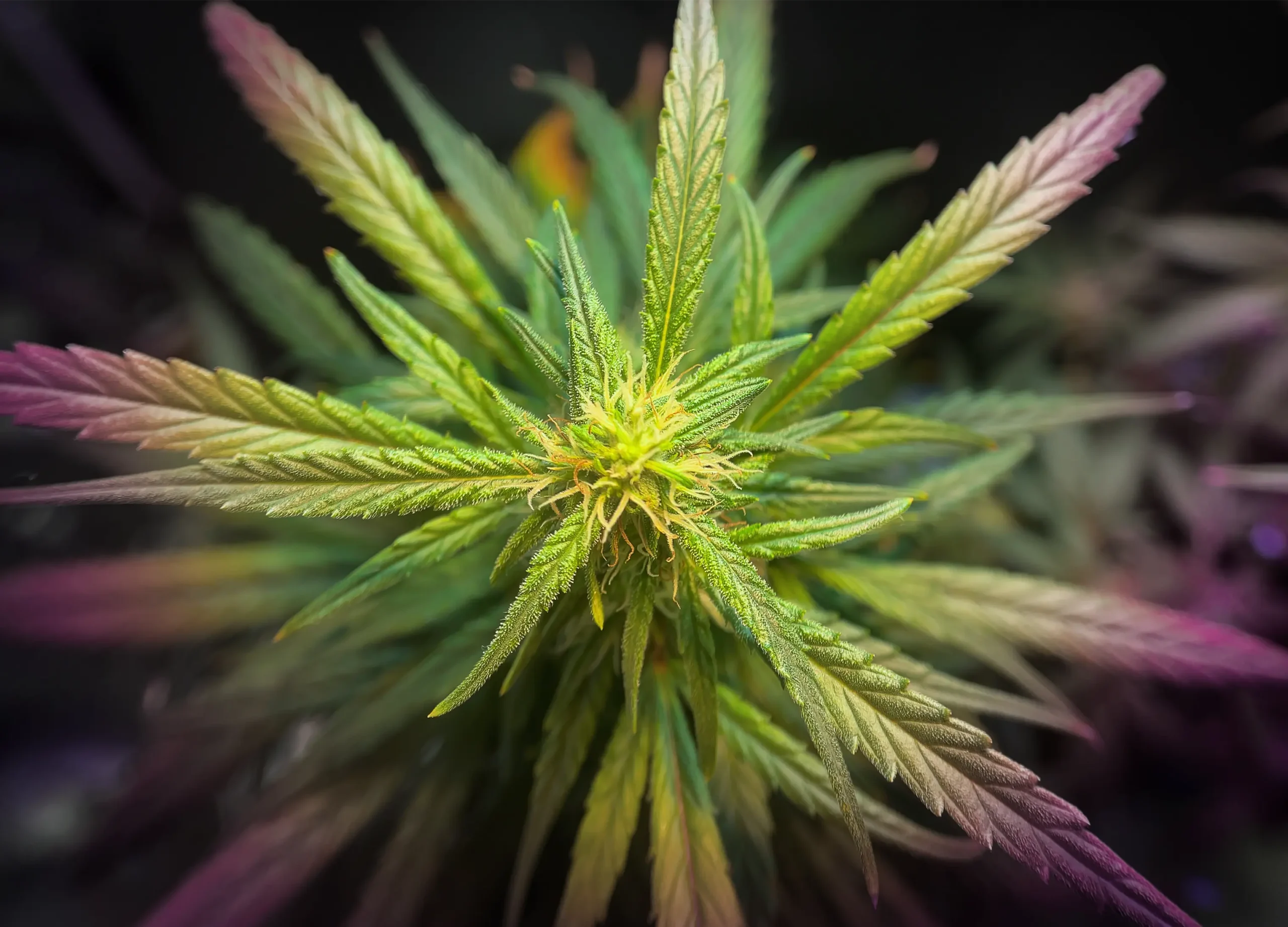
God’s Gift
God's Gift is compact in almost every sense that matters to a grower. The plant is usually short, the internodes stay relatively close, and the flowers form dense, sticky clusters rather than long spears. Its lineage, Granddaddy Purple crossed with OG Kush, explains the combination well: grape-dark sweetness and purple potential from one side, resin, citrus, wood and a heavier Kush body effect from the other.
That compactness is both the cultivar's convenience and its trap. A grower can look at a small plant and assume it needs more vegetative time, more tops, or more interior growth to make the space worthwhile. By late flowering, the same decisions can create a congested bush filled with dense buds that touch one another, receive uneven light and hold more moisture than the room average suggests. God's Gift rarely needs help becoming compact. It needs help remaining organized.
The central cultivation question is how to turn a short, low-stretch plant with smaller dense colas into a productive open canopy without over-vegging it, while preserving grape, citrus, hash and earthy Kush character through a fast finish. The answer is not extreme training. It is accurate plant count, early branch selection, modest topping where useful, and enough space around every mature flower for light and air.
God's Gift also illustrates why purple color should be treated as a phenotype trait rather than a goal. Some plants finish with striking blue-violet or plum tones, while others remain greener. The color can improve visual appeal, but it does not tell the grower whether the plant is mature, more potent, or better tasting. The best finished flower is the one that keeps the grape-citrus-hash profile intact and dries evenly through its dense center.
Strain Features
| Feature | Details |
|---|---|
| Strain Type | Indica-dominant hybrid with a compact, resinous growth pattern |
| Genetic Profile | Granddaddy Purple x OG Kush |
| THC | Commonly strong in modern flower, but exact potency varies by cut and environment |
| CBD | Usually low |
| Dominant Terpenes | Limonene, beta-caryophyllene and myrcene commonly recur in modern tested examples |
| Flavor / Aroma | Grape, dark fruit, citrus peel, hash, earth, wood and mild spice |
| Effect Character | Relaxed, sleepy, tingly and euphoric; physical heaviness increases quickly with dose |
| Flowering Time | Usually about 7 to 9 weeks, with many examples finishing in roughly 49 to 63 days |
| Stretch | Low to moderate; generally much easier to contain than tall hybrids |
| Plant Architecture | Short, compact, relatively tight internodes, often with a strong central tendency and useful side branching |
| Bud Structure | Dense, sticky, small-to-medium colas rather than especially long spears |
| Leafiness | Often moderate to low around the finished buds, though canopy density can still become high because internodes are close |
| Color Expression | Purple, violet and blue tones may appear, but are not universal |
| Training Compatibility | SOG, one early topping, LST and simple open multi-top structures |
| Humidity Risk | Moderate to high once compact flowers harden and begin touching |
| Outdoor Climate | Best where the finishing period is relatively warm and dry |
| Grow Difficulty | Easy to moderate, with late flower spacing more important than height control |
| Best Time of Use | Evening and nighttime |
Genetic Lineage
God's Gift has a lineage that is much easier to interpret than many old strain histories. Granddaddy Purple supplies the dark-fruit direction, compact indica influence and potential for purple coloration. OG Kush contributes resin, citrus-wood depth and a heavier physical finish. The cross does not simply split the difference. In cultivation, the two sides reinforce one another around compactness and dense flower.
That inherited structure explains why the plant can remain short without being unproductive. Side branches do not need to travel far before forming usable tops, and the internodal distance can stay close enough that a modest plant carries many flowers. The downside appears later: a canopy that seemed underfilled during vegetative growth can become physically crowded once every short branch develops a dense cola.
The flavor inheritance is equally clear. Granddaddy Purple-like grape and berry tones can sit above OG-style citrus, wood, earth and hash. Some phenotypes lean sweeter and darker; others show more lemon peel, pine or dry earth. A grower choosing a keeper should decide whether the priority is fruit complexity, OG depth or the best balance between them.
Purple expression is variable because pigmentation depends on genetics and environment. A highly colored phenotype can be beautiful, but a greener plant may still carry the better grape aroma or a more useful branch structure. The lineage should therefore be read through multiple traits rather than reduced to one visual expectation.
Effect Breakdown
God's Gift is not usually a strain that stays mentally energetic for long. The beginning can contain a brief euphoric lift, a warm change in mood and a slightly tingly sensory feeling, but the plant's identity becomes clearer as the body component builds.
The Point Where the Session Slows Down
At a moderate dose, physical tension tends to soften quickly. Sitting becomes more appealing, conversation can become quieter, and the user often feels content rather than driven. This is where the strain's reputation as an evening cultivar makes sense.
The mental state is commonly calm and pleasantly detached rather than completely foggy. Experienced users may still enjoy films, music, food or low-pressure conversation, but the effect is poorly suited to tasks that require speed, planning or precise coordination.
Higher Doses Change the Balance
With more flower, the heavy side takes control. Sleepiness, strong appetite and couch-lock can become much more pronounced. The transition can happen faster than expected because the early euphoria is not especially racy or alarming.
Low-tolerance users should treat the strain as potentially potent even when the first minutes feel comfortable. Redosing before the physical phase has developed can turn a relaxing session into excessive sedation or dizziness.
Dry mouth and dry eyes are common, and anxiety remains possible with high-THC cannabis even though God's Gift is generally described as calming. The practical effect profile is brief uplift followed by increasingly deep physical relaxation, with the strongest fit in the evening or close to bedtime.
Flavor & Aroma Profile
God's Gift is often described as grape-forward, but the better flower is more layered than a sweet-purple label suggests. Dark grape or berry sits on top, while citrus rind, earth, wood, hash and mild spice form the base. Some phenotypes feel almost jam-like when the jar is opened; others lean more resinous and Kush-like once the bud is broken apart.
The intact flower can smell sweeter than the smoke tastes. On inhale, fruit and mild citrus may appear first. The exhale often becomes heavier, with hash, earth and wood taking over and a faint peppery finish lingering after the sweetness has faded.
The OG side prevents the flavor from becoming pure grape candy. That is an advantage. A well-finished batch should have enough resinous depth that the fruit feels natural rather than flavored. If the flower tastes only earthy and hashy, the lighter grape and citrus layers may have been lost to canopy heat, early harvest or aggressive drying.
Color again has little predictive value. Deep violet buds can be less aromatic than green ones, and a beautiful fade does not make a rushed cure smoother. The palate should be evaluated after enough cure time for chlorophyll and raw plant odor to recede.
Dense flowers make the post-harvest phase especially important. A large compact bud can feel dry on the surface while the center remains wet. Sealing that flower too early can flatten the grape aroma, create stale or sour notes and increase microbial risk. Breaking unusually large colas into similar drying sizes is sometimes better for quality than preserving them whole for appearance.
A successful cure pulls the profile together. Grape becomes less sharp, citrus becomes more integrated, and the earthy hash finish smooths out. Average God's Gift is sweet and heavy. Excellent God's Gift is sweet, resinous and clearly layered from fruit to Kush.
Dominant Terpenes
| Terpene | Aroma / Flavor Role | What It Means Here |
|---|---|---|
| Limonene | Citrus peel and bright fruit | Often appears prominently in modern samples and fits the citrus lift beneath grape sweetness. |
| Beta-Caryophyllene | Pepper, dry wood and spice | Supports the darker Kush finish and can make the exhale feel less purely fruity. |
| Myrcene | Earth, herbs and ripe fruit | Commonly contributes to the earthy, musky base beneath the sweeter top notes. |
| Minor fruit and floral volatiles | Dark grape, berry and sweet perfume | Important to the cultivar's recognizable purple-fruit identity even when they are not listed as dominant terpenes. |
The terpene order should be treated as a recurring modern pattern rather than a universal formula. Different cuts can place more emphasis on fruit, citrus or earth, and standard terpene panels do not capture every volatile compound responsible for grape-like aroma.
The strain's sleepy effect should not be attributed to myrcene or another single terpene. Terpenes shape aroma with far greater certainty than they explain subjective sedation. THC dose, total chemistry and individual tolerance matter more.
Indoor vs. Outdoor Growing
| Decision Point | Indoor | Outdoor |
|---|---|---|
| Primary Space Problem | Horizontal density and flower contact are usually more important than ceiling height. | The plant remains manageable in height, but dense flowers still need branch spacing and dry weather. |
| Stretch | Low to moderate. The canopy often closes more from flower width than from vertical extension. | Easy to absorb outdoors, making early topping optional rather than necessary for height. |
| Training | SOG, one topping, LST or a simple open multi-top canopy. | Early topping or natural bush form both work if major branches remain separated. |
| Flowering Window | Fast enough for efficient indoor turnover, usually around 7 to 9 weeks. | A relatively quick finish can avoid some late-season risk in suitable climates. |
| Bud Density | Dense flowers are easy to inspect indoors if the plant count is not excessive. | Rain and dew can sit inside compact colas, particularly when branches lean together. |
| Color | Environment can be kept stable so pigmentation is observed rather than forced. | Cooler autumn nights may deepen purple expression, but color should not justify weather exposure. |
| Flavor Control | Indoor temperature and drying conditions make grape-citrus preservation easier to standardize. | Outdoor sun can produce rich aroma, but hot finishes can mute lighter fruit notes. |
| Best Fit | Growers wanting a short, fast, high-quality indica without extreme training. | Dry climates where compact plants can finish before prolonged rain. |
Indoors, God's Gift is attractive because height control is rarely the main battle. That does not mean the grower should fill the room with as many plants or tops as possible. Dense buds add width late, and a compact sea of plants can become harder to ventilate than a taller but more open crop.
A modest SOG can make sense with uniform clones because the cultivar naturally stays compact and finishes relatively fast. The important word is modest. Each plant still needs a visible pocket of air around its mature tops, and plant count should be based on final flower width rather than vegetative pot spacing.
Outdoors, the short stature can be convenient in windy areas because the plant has less leverage than a tall sativa. The flowers themselves remain the vulnerability. A dry, sunny finish matters more than maximum vegetative size, especially when autumn rain becomes frequent.
Strain-Specific Grow Guidance
Do Not Over-Veg a Plant That Is Already Designed to Stay Compact
Build support before the flowers demand it
God's Gift can look modest during vegetative growth, which tempts growers to wait for a bigger bush before the flip. The problem is that each short branch can later add a dense flower cluster, so visual emptiness in veg does not predict empty space at harvest.
Indoors, flip based on the expected final footprint rather than waiting for the leaves to fill every gap. The first run should leave a little more space than instinct suggests; the second run can use the actual clone width.
Choose a Simple Structure Early
One topping can be useful when the plant has strong apical dominance and the grower wants several similar colas. Low-stress branch spreading works equally well when the natural laterals are already strong.
Repeated topping is usually unnecessary. The cultivar's advantage is efficient compact flower, not the ability to recover from endless structural experiments.
Use SOG for Uniformity, Not Maximum Crowding
God's Gift can work well in a sea-of-green style because individual plants remain compact and flower quickly. Uniform clones make this easier because stretch and finish are predictable.
The yield benefit disappears when neighboring colas touch. Leave enough spacing that the final flower can expand without turning the whole room into one continuous humid surface.
Selective Pruning Matters More Than Heavy Defoliation
The finished buds are not always excessively leafy, so broad stripping is rarely the main need. Instead, remove weak interior shoots that will remain shaded and leaves that genuinely block the center from moving air.
The goal is to preserve healthy photosynthetic leaf while preventing the short internodes from creating a damp core.
Feed for Dense Flower Without Forcing Dark Foliage
God's Gift is sometimes described as able to use substantial nutrition, but that should not become an automatic heavy-feeding program. The plant is short enough that overly dark, thick foliage can crowd the flower zone quickly.
Increase concentration only when growth rate and water use justify it. If tips burn, foliage becomes clawed or dryback slows, reduce pressure rather than assuming a dense indica should tolerate more.
Watch Water Demand After the Stretch Ends
A compact plant can drink strongly while it is building branches and then slow once vertical growth stops. If irrigation frequency remains fixed, the root zone may stay wetter precisely when dense flowers are increasing humidity above it.
Continue watering from actual dryback and pot behavior. Root-zone oxygen and canopy humidity are connected more closely than they appear.
Build Air Space Before the Colas Harden
Once mature flowers are dense, forcing them apart with late pruning is clumsy and damaging. The correct airflow strategy is branch spacing established earlier, followed by gentle circulation through the existing gaps.
Room RH alone does not describe the inside of a compact flower. Cannabis inflorescences can retain more moisture internally than the surrounding air suggests, so flower contact points deserve direct inspection.
Use Support Only Where the Plant Asks for It
God's Gift often has enough branch strength for its moderate size, but especially dense side colas can lean late. Soft ties or a loose support net can keep those branches in their light lanes.
Do not compress the canopy into a tight net merely because support is available. The support should separate and hold, not bundle.
Do Not Manufacture Purple
If the cut wants to color, cooler late-season conditions may deepen anthocyanin expression. That is not evidence that deliberately cold roots or severe night drops improve potency or flavor.
Maintain a healthy finishing environment and treat color as a genetic bonus. A fully mature green God's Gift can be better flower than a stressed purple plant.
Harvest From Calyx Maturity and Aroma
The fast flowering range can encourage growers to schedule the harvest before the plant has fully expressed itself. Use complete calyx swelling, mature trichomes on the flower itself, slowing fresh pistil production and a developed grape-citrus-hash aroma together.
If the trichomes are mature but the highest buds smell flatter than the side flowers, canopy heat may be limiting flavor. That is a second-run environmental lesson, not a reason to extend the current plant indefinitely.
Weedth Bud Flavor Tips
The defining flavor goal is to keep grape and citrus visible above the hashy Kush base. Earth, wood and resin are relatively durable; the fruit is easier to lose. That means flavor preservation begins with late-flower canopy temperature and ends with storage discipline.
Indoor growers should avoid letting a short canopy sit too close to intense light simply because height is easy to manage. A compact plant can still create hot top flowers. Compare the aroma of the highest cola with a cooler side branch. If grape and citrus are clearer lower down, the top zone is costing quality.
Outdoor growers should prioritize a clean dry harvest window. A dense purple cola left through repeated rain to gain more color is not an upgrade. Once the flower is biologically mature, avoiding trapped water and damaged aroma matters more than another cold night of pigmentation.
Drying should be slow enough to protect volatile fruit but not so humid that the dense center remains unsafe. Larger colas may need to be separated from smaller branches so moisture loss remains even. Preserve structure only when it does not compromise the dry.
Direct fan air can make the outside crisp while the center remains wetter. Instead, use gentle room circulation and enough spacing that each branch loses moisture from all sides. The flower should gradually become evenly dry rather than forming a dry shell.
The cure should soften the heavy hash note and make grape and citrus easier to distinguish. If the jar becomes only earthy and woody after several weeks, the fruit was either weak genetically or lost earlier through heat, premature harvest or drying.
Keep promising phenotypes separate through cure. A purple plant and a greener plant can change ranking after four weeks in storage. The keeper should be selected from the finished jar rather than from harvest-day appearance.
Long-term storage should be cool, dark and airtight. Use smaller working containers when possible so the main batch is not repeatedly exposed to warm fresh air. God's Gift keeps its identity best when the fruit is protected rather than artificially enhanced.
Weedth Bud Boost Tips
The most productive indoor strategy is usually to let God's Gift do what it already does well: build several dense flowers within a modest vertical footprint. Yield is improved by using the full light area, not by forcing unnecessary height or an excessive number of tips.
With clones, plant count can be tuned tightly after one run. Measure final diameter and average cola width, then leave enough space that neighboring plants finish with visible gaps. That small amount of unused floor early can translate into more premium dry flower because side buds receive better light and late humidity is easier to control.
One early topping can increase the number of similar main flowers, while an untopped plant can work well in SOG. Choose one strategy based on plant count and room geometry rather than combining every training technique on the same compact plant.
Remove interior shoots that cannot become premium flower, but do not lollipop mechanically by percentage. A low side branch that reaches its own light lane can produce excellent dense buds even if it originates near the base.
Nutrition should aim for complete flower development rather than maximum foliage. General cannabis research does not support the idea that progressively heavier potassium automatically creates progressively larger buds. The plant needs balanced nutrition, healthy roots and enough photosynthetic leaf to finish.
Outdoor growers gain more from early root establishment and branch spacing than from extreme late feeding. The plant is compact enough that a well-rooted specimen can carry substantial weight without becoming a giant. Support the major branches before storms and keep the flower zone open as autumn approaches.
When comparing keepers, use usable dry yield after trimming and any humidity losses. A phenotype with spectacular dense colas is not truly high yielding if part of the interior has to be discarded. God's Gift quality yield is compact, clean, fully mature flower with enough grape-citrus character to justify the density.
Medical Uses & Benefits
God's Gift is most often chosen by users seeking strong evening relaxation. Reported uses include stress relief, easing physical tension, sleep support, appetite stimulation and distraction from pain. These are user-reported experiences rather than clinical evidence that the cultivar treats a disease.
The physical heaviness can be useful to people who specifically want to disengage from activity at the end of the day. The brief euphoric opening may improve mood before sedation becomes more dominant, which is one reason the strain is often described as comforting rather than simply narcotic.
That same profile limits daytime usefulness. People who need to work, drive, exercise or remain sharply attentive should not assume that a small compact flower produces a mild effect. Higher doses can be strongly sedating and impairing.
Most versions are THC-dominant with little CBD. THC-sensitive users may experience dizziness, anxiety or excessive sedation, especially when consuming a potent batch too quickly. Dose should be approached conservatively.
Anyone using cannabis for a diagnosed medical condition, combining it with prescription medication, or relying on it for sleep or pain management should consult a qualified healthcare professional and use tested cannabinoid information when available.
Ideal User Profile
God's Gift is best suited to someone who wants cannabis to mark the end of the active part of the day. It fits evenings at home, music, films, a meal, quiet conversation and bedtime routines more naturally than a morning schedule.
Flavor preference matters. Users who enjoy grape, dark fruit, earthy Kush and hash will find more to appreciate than people searching for bright tropical candy or sharp fuel. The strain has sweetness, but the sweetness is anchored by resin and wood.
Growers who work in limited vertical space are a natural fit because height is rarely extreme. The more important skill is recognizing final flower width and keeping a compact room from becoming overcrowded.
It can be a reasonable first photoperiod cultivar for a careful beginner because the plant is manageable and the flowering cycle is relatively quick. The beginner still needs to understand that dense buds demand late humidity awareness even when the plant is easy to contain.
People who are highly sensitive to sedation or who want daytime creativity should probably choose a more uplifting cultivar. God's Gift is most satisfying when deep relaxation is a feature rather than a side effect.
Grower Notes and Feedback
The most consistent real-world observation is that God's Gift stays relatively small. That sounds simple, but it changes the entire cultivation strategy. Growers who are used to compensating for compact plants with extra veg frequently discover that the final canopy becomes much fuller than expected once dense colas add width.
A second recurring theme is the favorable calyx-to-leaf impression. Many descriptions emphasize sticky, well-defined flowers without an excessive amount of leaf protruding from the finished bud. That can make trimming pleasant, but it does not mean the plant's interior is automatically airy. Short internodes can still create a dense whole-plant structure.
Purple and blue color appear often enough to be associated with the strain, yet not every plant colors strongly. Growers should expect a spectrum rather than a guaranteed dark-purple finish. The best comparisons record color next to flavor and finish rather than using it as a proxy for quality.
Reports of flowering time generally cluster around a fast seven-to-nine-week range. That makes the cultivar attractive for indoor turnover, but it also means structural mistakes made at the flip have little time to be corrected before flower development is well underway.
The odor is usually less one-dimensional than 'grape.' Some plants become sweeter, while others reveal more citrus, dry earth, hash and wood. The selected clone can therefore change the way the strain should be harvested and cured. A fruit-heavy phenotype deserves especially careful temperature control.
The practical second-run lesson is to use less guesswork. Record final footprint, cola width, branch support needs, which lower sites became premium flower and how the grape note changed during cure. Those measurements are more useful than copying a generic indica schedule.
Weedth Editor's Note
What matters after the headline numbers
The mistake I would be most likely to make with God's Gift is giving it too much space in vegetative growth because the plant looks polite and compact. I would rather flip a little early and learn the clone's true footprint than discover in week six that every dense cola is touching its neighbor.
I would keep the training simple. One topping or a naturally single-leader SOG plant both make sense. What I would not do is turn a short indica into a complicated web of tiny branches just because the plant can survive the work.
By late flower, my attention would move almost entirely to the spaces between the buds. Dense grape-scented flower is the reason to grow the cultivar, but that density also creates the point where quality can be lost fastest.
I would not select a mother from color alone. The plant with the best purple finish would still need to beat the others in cured aroma, branch organization and usable dry flower. A beautiful phenotype that tastes flat would not stay in the room.
My keeper would be the God's Gift that stays genuinely compact, finishes cleanly within the expected window, and opens the jar with grape and citrus before settling into earth and hash.
Weedth Score
Growing Experience 8.6/10 Compact size and quick flowering are easy to manage, with late canopy density as the main limitation.
Bud Structure & Visual Appeal 9.0/10 Dense sticky colas and potential violet coloration create excellent visual quality.
Aroma Complexity 8.7/10 Grape, citrus, earth, hash and wood give the strain more depth than a simple purple-fruit profile.
Flavor & Smoothness 8.6/10 Very satisfying when dense buds dry evenly and the fruit remains present through cure.
Effects & High Experience 8.8/10 A reliable progression from warm euphoria into deep physical relaxation and sleepiness.
Overall Satisfaction & Recommendation 8.7/10 A strong compact evening cultivar for growers who value manageable size and classic purple-Kush flower.
My final take: God's Gift is at its best when the grower stops trying to make a small plant look bigger and instead protects what its compact structure already produces well.
FAQ
What is God's Gift lineage?
God's Gift is most commonly described as Granddaddy Purple crossed with OG Kush, which explains its grape-dark-fruit side and its earthy citrus Kush base.
How long does God's Gift flower?
Roughly seven to nine weeks is common, with many examples finishing between about 49 and 63 days depending on the cut and environment.
How much does God's Gift stretch?
Usually low to moderate. Final canopy width and bud density are more important planning issues than extreme height.
Is God's Gift good for small grow tents?
Yes. Its compact stature suits limited vertical space, provided the grower does not over-veg and crowd dense flowers together.
Does God's Gift respond well to topping?
One early topping can work very well when several similar colas are desired. Repeated topping is usually unnecessary.
Is God's Gift good for SOG?
Yes, especially with uniform clones. Keep enough space between mature tops so the dense flowers do not touch.
Should God's Gift be heavily defoliated?
Usually no. Selective removal of true blockers and weak interior shoots is more useful than broad stripping.
Is God's Gift a heavy feeder?
Some plants tolerate substantial nutrition, but feeding should follow actual demand. A short dense plant can become overly leafy if nitrogen is pushed too hard.
Why is my God's Gift not turning purple?
Color is phenotype and environment dependent. A green plant can still be completely mature and excellent in flavor and potency.
Should I lower temperature to make God's Gift purple?
Cooler conditions can influence pigmentation, but severe cold is not a quality strategy. Protect root health, flower health and aroma first.
Is God's Gift prone to bud rot?
The cultivar's dense flowers can retain internal moisture, especially when colas touch or late humidity remains high. Spacing and inspection are important.
When should God's Gift be harvested?
Use complete calyx development, mature flower trichomes, a decline in fresh pistil production and a developed grape-citrus-hash aroma rather than a fixed day alone.
How can I preserve the grape flavor?
Avoid excessive late canopy heat, dry the dense flower evenly and store the cured buds cool, dark and airtight.
Is God's Gift good for daytime use?
It is usually better later in the day. The effect tends to become physically heavy and sleepy as dose increases.
Is God's Gift beginner-friendly to grow?
It can be. The plant is compact and relatively quick, but beginners still need to respect the humidity risk inside dense mature flowers.
Similar Strains
Granddaddy Purple: A direct parent with stronger grape identity and a similarly heavy evening effect, but often a slightly broader purple-fruit expression.
OG Kush: The other parent reference, with more pine, citrus and earth and usually less obvious grape sweetness.
Purple Punch: A sweeter, softer purple indica with dense flowers and strong nighttime relaxation, but a more dessert-like fruit profile.
Purple Urkle: A slower, compact purple cultivar with dark grape flavor and a more demanding vegetative phase.
Bubba Kush: A compact evening Kush with coffee-earth depth rather than grape and generally less emphasis on color.
Northern Lights: A faster old-school indica alternative with pine-earth flavor and exceptional cultivation simplicity, but less fruit complexity.
Share this article
A quick overview of the topics covered in this article.
Follow us
Latest articles
September 9, 2026
September 9, 2026
September 9, 2026