
Hail Protection That Will Not Collapse on the Canopy
Hail protection only works when the protection system survives the storm without becoming a second source of damage. A net that stops hailstones but sags onto flowers, pulls posts inward, tears loose in a gust, or dumps accumulated ice onto one side of the plant has not protected the canopy. It has simply changed the failure mode.
For an outdoor cannabis garden, the practical goal is straightforward: intercept hail above the crop, move impact and accumulated load into a separate support structure, keep enough clearance for deflection, and give water and hail a way to leave the surface instead of collecting over the plant. That is a structural problem as much as a crop-protection problem.
This resource stays tightly focused on that job. It does not repeat the full outdoor growing process, branch-training system, or regional weather planning covered elsewhere. For broader site, seasonal, irrigation, and cultivar decisions, use the Outdoor Grow Comprehensive Guide.
Confirm the Hail Risk Before You Design the Structure
Start with the hazard you actually need to solve. Hail protection makes sense where convective storms repeatedly bring damaging hail during the period when plants are outdoors. It makes less sense to build a large permanent overhead structure because one isolated forecast mentioned a small chance of ice. The right system depends on how often hail occurs, when it occurs in relation to plant size and flowering, how exposed the site is to wind, and whether the structure can legally and safely remain in place.
Hail is easy to recognize after a confirmed storm, but the damage pattern can be confused with insect chewing, wind abrasion, falling debris, animal damage, or a netting system that struck the plant. The first inspection should therefore separate impact injury caused by hail from damage created by the protection system itself.
What hail damage usually looks like
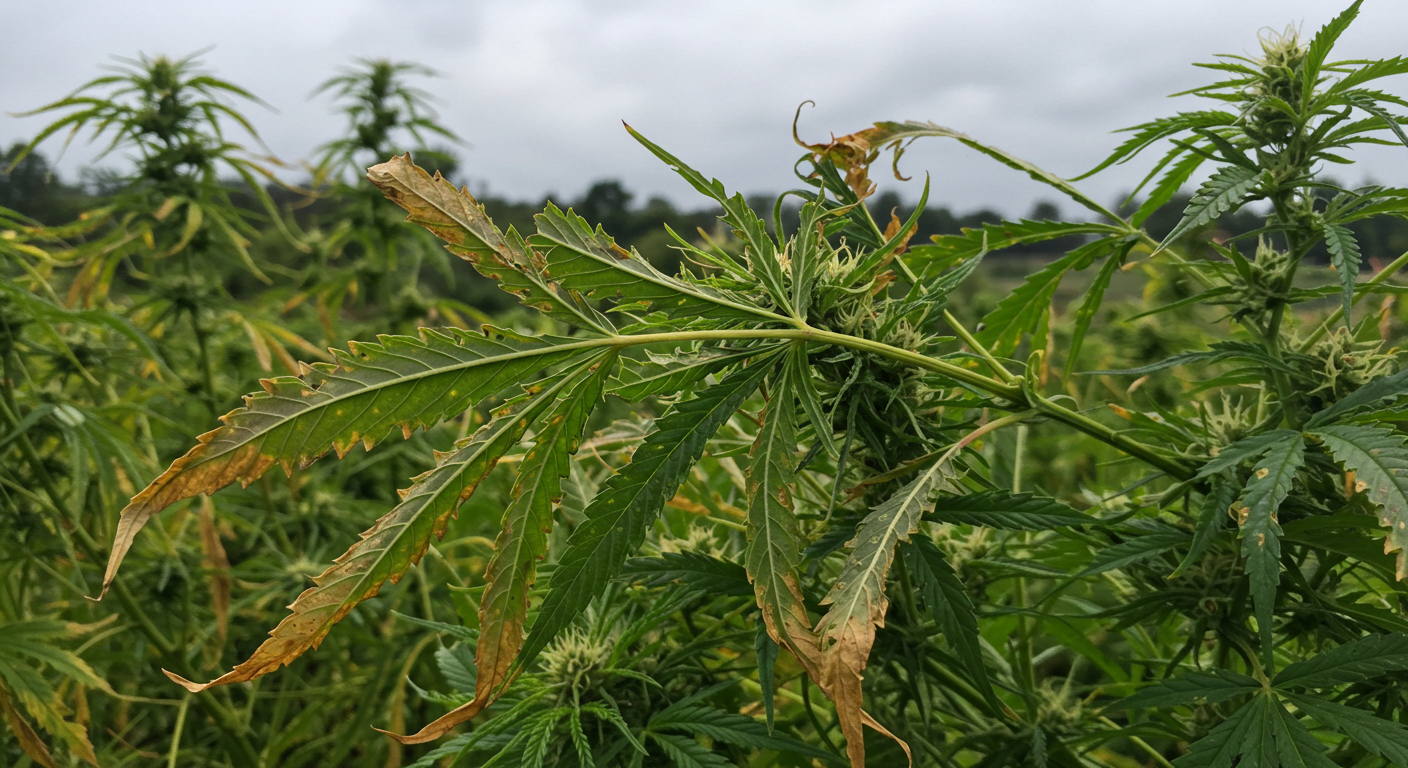
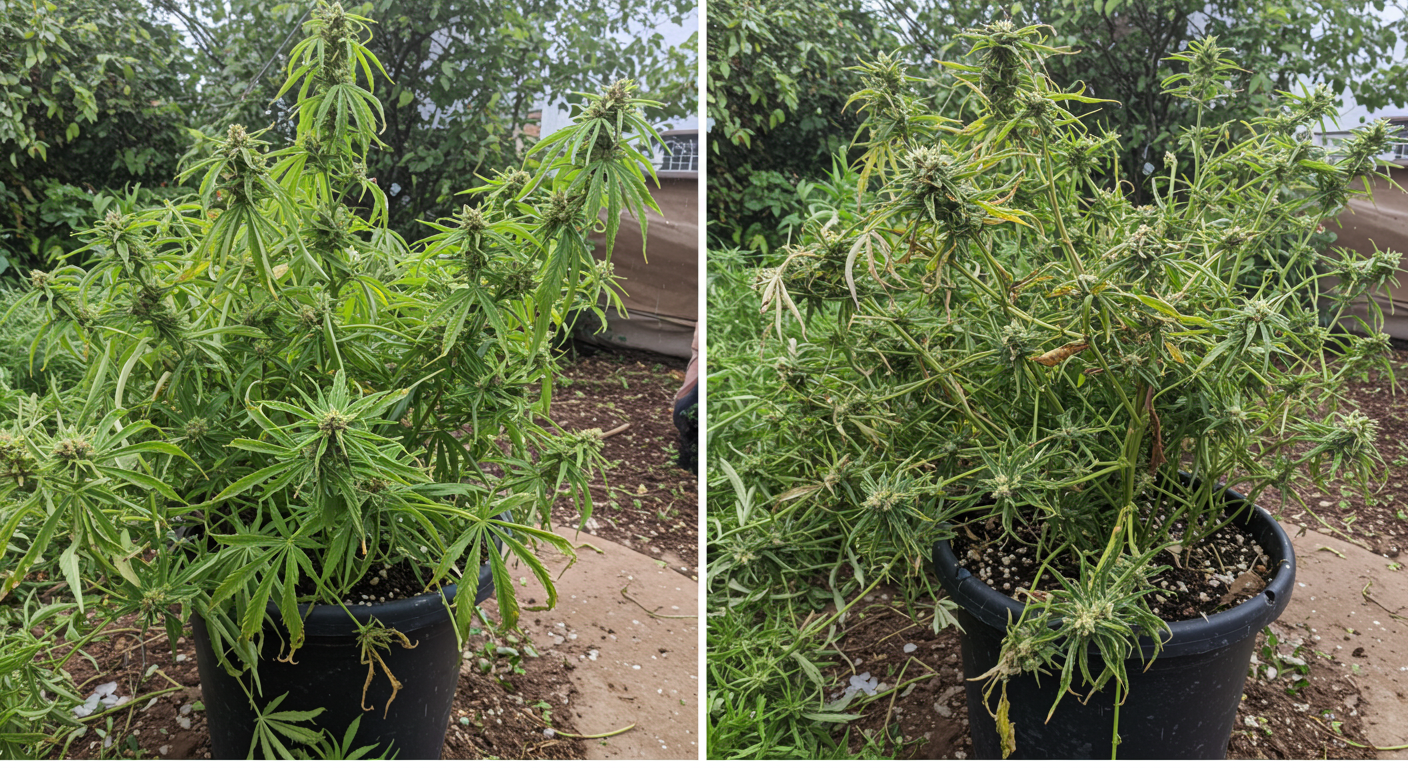
Hail can produce sudden, irregular holes and tears in leaves, bruised petioles, shredded leaf margins, broken stems, bark or epidermal bruising, and localized impact marks on exposed tissue. The pattern often appears immediately after severe weather and can be highly uneven across a garden. Plants on the windward edge may show heavier injury than plants partly sheltered by a wall, hedge, or neighboring canopy.
During flowering, the same event can be more consequential because dense inflorescences hold water and damaged flowers may be harder to dry. Heavy wet flowers also increase branch loading at the exact moment that wind and impact forces are acting on the plant. A support system that was adequate in vegetative growth may be much less forgiving late in the season.
Separate hail impact from net or frame contact
If damage appears only where the net sagged, where a crossbar touched the plant, or where the edge of the cover whipped against flowers, the system contributed to the injury. Look for straight abrasion lines, repeated rubbing marks, flattened flower tops, snapped outer branches directly beneath a sagging span, or contact points that match the frame geometry. Hail damage itself is usually more random than a single line of repeated mechanical contact.
This distinction matters because the correction is different. True hail impact means the barrier did not intercept enough of the event. Net-contact damage means the protection surface came too close to the crop or deflected farther than expected. Anchor or post movement means the load path was weak. Do not solve all three by simply adding another layer of net.
Load path
The load path is the route force follows from the hail net through its clips, cables or rails, posts or frame members, anchors, and finally into the ground or another rated structure. If any link in that path is weaker than the others, the system can fail even when the net itself is intact.
Hail, heavy rain, wind, and snow are different loads
A hail net may face more than falling ice. The storm that produces hail can also generate powerful gusts, rapid rainfall, and sudden changes in wind direction. A flat or poorly drained net can hold hailstones, leaves, water, or slush. A structure left up beyond the hail season may later face snow or freezing rain. Agricultural net-structure research treats wind, hail, snow, permanent loads, and equipment loads as distinct actions that can combine.
For a home garden, the lesson is not that you need to calculate a professional structural model yourself. The lesson is that you should not assume a lightweight garden net can be stretched over any improvised frame and remain safe under every weather combination. The larger and more permanent the structure becomes, the more appropriate it is to use a purpose-designed system and local structural guidance rather than homemade guesswork.
Use local storm history, not a generic hail calendar
Record when hail warnings and actual hail events occur in your area. Note month, time of day, storm direction, approximate hail size if safely observable after the event, wind strength, and whether the event arrived with heavy rain. Even a simple two- or three-season record can reveal whether your highest hail risk overlaps with young plants, maximum vegetative size, or heavy flowering.
That seasonal overlap changes the design. A system protecting small spring plants can be low and simple. A system that must remain above mature flowering cannabis needs more clearance, stronger anchoring, better access for inspection, and a plan for growing branches that may reach the protection surface later in the season.
“Do I need hail netting if hail only happens once or twice most years?”
Question sent by: FrostLineGrower, via contact form.
Frequency is only part of the decision. Also consider when those storms occur, how large the plants are at that time, how exposed the site is, and what one damaging event would mean for the crop. A simple removable system may be enough for occasional risk. A large permanent structure is harder to justify unless the risk, crop value, and local building conditions support it.
Define success before choosing material
A successful hail system should do more than keep visible holes out of leaves. It should remain stable in the weather it is intended to face, avoid touching the canopy under expected deflection, release water and accumulated hail rather than storing it over the plant, maintain useful airflow, leave inspection access, and remain safe for people and animals using the garden.
Write those requirements down before buying netting. This prevents a common mistake: choosing a mesh first because it looks strong and then trying to invent a structure around it. The crop, storm exposure, span, support geometry, anchors, and seasonal access should define the system. The net is one component.
Measure the Canopy, Clearance, and Structural Footprint
A hail frame should be designed around the plant at its largest expected size, not around the plant on installation day. Outdoor cannabis can add substantial height, width, and branch mass as the season progresses. A generous-looking gap in early summer can disappear by flowering, and a net that never touched leaves when installed can become a mechanical hazard during the exact storms it was meant to manage.
Measure height, width, and the moving canopy
Record the current maximum canopy height and the widest branch spread in two directions. Mark the highest flower or growth tip separately from the average canopy. Then identify branches that move the most in wind. The protection frame must clear not only the static plant but also the space that flexible branches occupy when they sway.
Do not build to a single vertical number. The upper corner of a large plant may reach toward the net while a long lateral branch swings outward. A roof with adequate center clearance can still fail at an edge or corner. Think of the canopy as a moving three-dimensional envelope.
Allow for net deflection, not just empty air
Clearance is useful only if the net stays above the plant when loaded. Every flexible surface deflects. Hail, rain, retained debris, loose tension, and wind pressure can push a net downward. A span that sits comfortably above the crop on a calm day may bow dramatically during a storm.
The practical commissioning question is therefore: how close can the net come to the canopy under the maximum deflection you are willing to accept? If the answer is “close enough to touch,” the system has no useful clearance reserve. Reduce the unsupported span, change the geometry, increase the structural support, or increase the height before relying on it.
Use smaller structural bays when possible
For a home garden, one of the simplest ways to reduce dramatic sag is to avoid very large unsupported spans. A smaller bay between supports is generally easier to keep clear of a tall irregular canopy than a broad sheet stretched across a large garden. It also makes repairs, seasonal removal, and partial deployment easier.
That does not mean there is one universal post spacing for cannabis. Spacing depends on the net, frame material, cable system, anchors, exposure, wind, and local structural requirements. If the system is large enough that post failure could injure someone or damage property, use a rated commercial design or professional structural advice rather than copying dimensions from an orchard photo.
Map the protected footprint on the ground
Mark where every post, anchor, cable, guy line, gate, irrigation line, and walking route will sit. The best canopy position is not useful if the anchor line crosses the only safe access path. Keep trip hazards out of normal inspection routes and do not create hidden wires at neck or face height.
Also inspect the ground itself. Loose fill, recently disturbed soil, saturated ground, shallow rocky soil, raised-bed edges, and steep slopes can behave differently under anchor load. A support that feels solid in dry midsummer soil may loosen after a soaking storm. Ground condition is part of the system and should be rechecked after heavy rain.
Keep the hail structure separate from branch support where practical
The plant may already use stakes, trellis lines, cages, or branch ties. Avoid making the hail frame depend on those same plant-support points. If a branch stake carries the hail net and the net receives a storm load, that force can be transferred directly into the branch or root ball.
A cleaner design separates jobs: the crop support carries branches; the hail structure carries the protective surface. They can occupy the same garden, but they should not fight each other. This separation also makes post-storm diagnosis easier because you can tell whether a leaning plant came from branch load or from hail-frame movement.
Build for the mature moving canopy
Measure height, spread, branch movement, expected late-season growth, and net deflection before fixing the final roof height and footprint.
Stretching a flat sheet just above today’s plant
A small clearance margin can disappear after growth or during storm deflection, turning the net into a weighted surface resting on flowers.
Plan inspection access before the canopy fills the space
Leave a route that lets you inspect anchors, frame connections, net tension, and flowers after a storm. A structure that protects the canopy but prevents you from seeing the interior of a dense flowering plant can create a second management problem. You need to be able to look for broken stems, retained water, torn mesh, abrasion, and disease-prone wet pockets without climbing on the structure.
Access matters even more when the net stays deployed for weeks. Plant growth can lift into the net, ties can tighten, branches can lean into posts, and debris can collect along an edge. A design that cannot be inspected is difficult to keep safe.
Choose Netting and Geometry That Shed Load
The best hail surface is not merely “strong mesh.” It is a surface and geometry that intercept impact while reducing the chance that hail, water, leaves, or slush remain suspended over the crop. Agricultural hail systems often use overhead netting supported by posts and wires, and some designs introduce slope or flexible load-release behavior specifically because retained hail can create dangerous structural load.
Use material intended for agricultural hail protection
Bird netting, insect mesh, shade cloth, trellis netting, and hail netting are not interchangeable simply because all of them have holes. They differ in mesh geometry, tensile behavior, UV stability, air permeability, shading, impact resistance, and how they connect to support systems.
Use a product with documented agricultural use and installation guidance appropriate to hail exposure. Read the manufacturer’s requirements for support spacing, clips, tension, orientation, UV life, seasonal removal, and wind conditions. If the documentation is vague, treat that as uncertainty rather than filling the gap with assumptions.
Avoid designing a bowl over the canopy
A flat net can work in engineered systems, but it must be designed for the loads it may retain. For a small garden, uncontrolled sag is the bigger concern. If the geometry naturally forms a depression, hail and rain can migrate toward that low point. The result is increasing load exactly where clearance is smallest.
A pitched, ridged, tented, or otherwise load-shedding geometry can help move hail toward edges rather than concentrating it in the middle. The exact angle should come from the system design, netting guidance, and site constraints. Do not copy a commercial orchard roof angle and assume a small backyard frame built from different materials behaves the same way.
Keep the surface taut enough to avoid deep pockets, but not blindly over-tensioned
Loose material can flap, pocket, and sag. Excessive tension can overload clips, cables, posts, and anchors before the storm even arrives. The target is controlled geometry, not maximum possible tension.
Follow the netting system’s tensioning method. Recheck after the material has been exposed to sun, temperature changes, and rain because some systems relax or settle after installation. If you repeatedly need to pull the net tighter to stop ponding, the structural layout may be the problem rather than tension alone.
Never let the hail net use the cannabis canopy as a support
Draping net directly across mature flowering cannabis may look simple, but hail, rain, and wind can push that load into flowers and branches. A protection surface intended to prevent impact damage should not be allowed to become a weighted blanket on the crop.
Shading is a side effect worth measuring
Hail nets can reduce incoming solar radiation to some degree, and the amount depends on material, color, mesh, angle, contamination, and sun position. That does not make hail netting inherently harmful. It means light interception should be treated as a measured tradeoff, especially if the material remains over the crop for a large part of the season.
Compare the plant’s light environment before and after deployment using the same measurement method at the same canopy points. If you use a PAR meter, compare representative daily periods rather than one random reading. If you do not have a PAR meter, at minimum track direct-sun windows and visual shadowing consistently. Do not guess from how transparent the net looks from below.
Design for rain passing through without creating a waterfall
Most hail netting is permeable, but water can still concentrate along seams, low points, edges, or clogged areas. Watch where runoff goes during a normal rain. If the surface channels water into one narrow stream that repeatedly pounds the same flower cluster or saturates one side of a container, that is a layout problem.
Clean leaves and debris from the net before storm season and after major wind events. A mesh that drains well when clean can behave differently when pollen, leaves, broken twigs, or plant material reduce open area.
“Would a tight flat net be safer because hail cannot push it down as far?”
Question sent by: PrairieWindow, via email.
Not automatically. A flat surface may retain more hail or water depending on the design, and increasing tension can transfer greater force into posts, cables, clips, and anchors. The safer question is whether the complete system is designed to shed or carry the expected load while maintaining canopy clearance.
Do not leave a seasonal system exposed to a different season’s load
An overhead hail net left deployed into snow season can face a load it was never intended to carry. University of Minnesota Extension notes that overhead orchard hail netting is separated and bundled after the growing season to prevent damage from heavy snowfall. The broader lesson is simple: protection structures have operating seasons.
If your system is temporary, define the deployment and removal dates before the season starts. If it is permanent, it should be designed for the full local set of environmental loads that can occur while it remains installed. “It survived summer” is not evidence that it is safe under winter snow or freezing rain.
Build a Separate Load Path From Net to Ground
Once the geometry is chosen, follow the force from the net to the soil. Every clip, seam, line, cross-member, post, anchor, and connection is part of the protection system. A garden frame often fails at a connection long before the main post or net reaches its theoretical strength.
Start at the net attachment
Inspect how the mesh connects to the support line or frame. A small hard fastener concentrated on a few mesh strands can become a tear point. Purpose-made clips or connection methods that distribute load across the material are preferable to sharp improvised wire twists that can cut through the mesh under repeated movement.
Connections also need to survive ultraviolet exposure and wet weather for the period they remain installed. A brittle plastic tie that feels strong on installation day can become the weakest part of the system later. Keep a replacement schedule and inspect high-load corners more often than quiet interior spans.
Keep posts vertical and connections predictable
Posts that are already leaning before the first storm indicate a load or soil problem. Check alignment after tensioning the net. If a post moves significantly when the system is tensioned in calm weather, it is unlikely to become more stable when hail and wind arrive.
Corner and end positions often experience different forces from interior supports. Do not assume every post and connection can be identical. Large agricultural systems use dedicated anchors, cable layouts, and structural design precisely because the forces are not distributed evenly.
Anchors must resist uplift and lateral movement
Wind can pull upward on a net-covered frame while tension and hail load pull in other directions. Check anchors for both sliding and uplift. The correct method depends on soil, frame size, local structure rules, and system design, so avoid generic “drive this stake X centimeters” advice that ignores soil condition.
After prolonged rain, inspect anchors again. Saturated ground can reduce holding behavior and make posts or stakes easier to move. If a storm forecast combines hail with heavy rain and wind, a previously adequate dry-soil test may not describe the real condition.
Use redundancy where a single connection would cause total collapse
Think about what happens if one clip, guy, or anchor fails. Does one local area sag while the rest of the structure remains above the plant, or does the whole roof fold inward? A small amount of sensible redundancy can prevent a single weak point from turning into a full-canopy collapse.
Redundancy does not mean randomly adding ropes in every direction. Extra lines can create trip hazards, uneven loads, and confusing force paths. The goal is a simple system where critical connections are backed up without making inspection difficult.
Master Advice: If you cannot explain where the force goes after hail hits the net, the structure is not ready. Follow the load from mesh to clip, clip to support, support to post, and post to ground.
Keep the protection structure out of the electrical and utility zone
Do not position tall poles, metal frames, cables, or elevated netting where they can contact overhead power lines or create an unsafe working distance. Check buried utilities before installing deep anchors or permanent posts. Local rules may also treat a large overhead garden frame as a structure requiring setbacks or permits.
If the project grows beyond a small removable garden cover into a permanent overhead canopy, treat that transition seriously. Structural wind loads and public safety matter more than saving a few posts. Use local code guidance and professional design when appropriate.
Separate quick-release features from accidental weak points
Some agricultural hail systems deliberately use components designed to release or deform under excessive load so that the net drops before the main structure is destroyed. That is an engineered safety concept, not permission to create random weak knots or under-sized anchors.
If a commercial system includes a breakaway or load-release feature, install it exactly as specified. For a DIY small garden frame, the safer default is not to invent a sacrificial failure mechanism you cannot predict. Keep spans manageable, use appropriate components, and define a weather limit beyond which the temporary net is removed if it can be removed safely in advance.
Commission the System Before the First Severe Storm
Commissioning is the difference between a structure that looks finished and a structure that has been tested. Do not wait for the first damaging hail warning to discover that the net ponds water, an anchor pulls loose, a corner post twists, or the highest flower can touch the mesh.
Run the hand-clearance test at every bay
Walk under the installed net and inspect the minimum clearance above the highest and most mobile parts of the canopy. Gently press or pull the net downward at representative locations to simulate moderate deflection without imposing a structural load test. The goal is not to prove ultimate strength. It is to reveal obvious contact risk.
If a small manual deflection brings the mesh onto flowers, the operating margin is poor. Raise the surface, reduce the span, add properly designed intermediate support, or reposition the plant-support system before storm season.
Test drainage with ordinary water, not a simulated hail load
Use a normal hose spray or wait for moderate rain to see where water travels. Do not pile weight onto an overhead net as a home-made hail simulation. Watch for low pockets, seam channels, edge waterfalls, frame movement, and slow drainage. Mark every location where water remains longer than the surrounding surface.
If water collects in one pocket, correct the geometry rather than repeatedly pushing the pocket empty by hand. A problem that appears under ordinary rain can become much more serious when hail and wind arrive together.
Inspect uplift behavior on a windy but non-severe day
Observe the structure in ordinary gusty weather before trusting it during a convective storm. Watch corners, end posts, guy lines, clips, and the leeward edge. Some movement is normal in flexible systems, but progressive loosening, post rotation, anchor creep, or violent snapping deserves correction.
Do not stand beneath or beside a questionable structure during strong wind for the sake of observing it. Use safe distance and visual checks. If the system behaves unpredictably in ordinary wind, redesign it before hail season.
Photograph reference points after commissioning
Take clear photographs of anchor positions, post alignment, cable sag, connection details, and minimum canopy clearance. These become your baseline. After a storm, compare the same points. A post that moved only a few degrees or an anchor that crept slightly may be hard to remember accurately without a reference.
Mark tension adjustment points and date the record. If you repeatedly tighten the same area, investigate the cause instead of treating retensioning as routine maintenance.
Create a simple pass, caution, and fail system
| Result | What you observe | Decision |
|---|---|---|
| Pass | Stable posts and anchors, useful canopy clearance under normal deflection, no persistent water pockets, and no progressive loosening in routine wind. | Record the baseline and continue scheduled inspections. |
| Caution | One low pocket, marginal clearance, a connection that loosens, or minor anchor movement after rain. | Correct the weak point and recommission before relying on the system during severe weather. |
| Fail | Net contacts the crop easily, a post shifts, anchors pull, drainage creates heavy pockets, or wind causes uncontrolled frame movement. | Do not rely on the system. Reduce span, rebuild, use a rated design, or remove it before the next severe event when safe to do so. |
Recommission as the cannabis canopy grows
A hail structure can pass in June and fail in September without any change to the frame. The plant changed. Recheck clearance after major stretch, training, branch support work, storms, and rapid flower mass gain. If a branch is tied upward, that adjustment may reduce the net clearance above it.
Late flowering is the stage when inspection matters most because flower mass, rain retention, branch leverage, and disease consequences are all higher. Do not let a successful early-season test become permanent proof.
“Can I test my frame by hanging heavy weights from the net before storm season?”
Question sent by: Derek Wallace, via email.
Do not improvise a structural proof test unless the system manufacturer or a qualified professional provides the method. Concentrated weights can create unrealistic loads and can damage a frame that might otherwise be serviceable. For home commissioning, focus on clearance, drainage, anchor movement, connection condition, and normal-wind behavior.
Diagnose Sag, Ponding, Uplift, and Anchor Failure
When a hail system looks wrong, identify the failure mechanism before tightening, adding posts, or replacing the net. Several different problems can produce the same visible symptom. A sagging roof can come from loose tension, stretched material, an excessive span, a moving post, anchor creep, retained debris, or a support line that shifted.
| Symptom | Possible Cause | How to Confirm | Corrective Action | Prevention |
|---|---|---|---|---|
| Deep center sag | Unsupported span, relaxed net, shifted support line, or retained water/debris. | Compare with baseline photos and inspect support alignment and drainage after normal rain. | Restore designed geometry, reduce span, or repair the support system rather than only pulling harder on the net. | Commission drainage and clearance early, then recheck as material and canopy change. |
| Net touches flowers only during gusts | Insufficient clearance or excessive flexible movement. | Observe from a safe distance in ordinary wind and compare the moving canopy envelope with net deflection. | Increase clearance or improve properly designed support. | Design around moving mature branches, not the static early-season plant. |
| One anchor creeps after rain | Reduced soil holding capacity, poor anchor placement, or uneven load distribution. | Mark anchor position and compare before and after wet weather. | Unload and rebuild using a site-appropriate rated anchoring method. | Include saturated-soil inspection in storm preparation. |
| Corner whips or snaps | Loose edge, poor connection, wind funnel, or unbalanced tension. | Inspect clips and edge tension during non-severe wind from a safe location. | Repair the connection and restore the intended edge geometry. | Inspect corners more frequently because they often carry different loads than interior spans. |
| Waterfall from one seam | Low point, clogged mesh, seam geometry, or uneven slope. | Observe ordinary rainfall and inspect debris accumulation. | Clean the surface and correct geometry so runoff is distributed away from vulnerable flowers and root zones. | Keep the net clean and test drainage before hail season. |
| Whole frame leans after storm | Post or anchor movement, excessive load, or connection failure. | Compare post alignment and anchor marks with the commissioning baseline. | Keep people away, unload only when safe, and repair or redesign the structure before reuse. | Use appropriate structural design for the span and expected load combination. |
Ponding is a geometry warning, not a housekeeping task
If you repeatedly find a deep pocket of water, hail, leaves, or slush in the same location, do not make “empty the pocket” part of your storm routine. The structure is telling you that the load is being concentrated there. Correct the slope, support, span, or attachment system.
Never stand beneath a heavily loaded net and push accumulated hail upward from below. A sudden release can drop material, shift the frame, or cause a connection to fail. Wait until conditions are safe and unload according to the system design.
Anchor movement can masquerade as net stretch
When the center starts sagging, growers often assume the fabric stretched. Check the perimeter first. A post that moved inward by a small amount can remove tension from a large area. An anchor that crept in saturated soil can do the same.
Use permanent reference marks on posts or anchors where appropriate. A small visible mark aligned with the ground or frame gives you a fast way to see whether a component shifted after a storm.
More tension is not the universal correction
Retensioning can help when a system has settled within its intended adjustment range. It cannot repair an under-sized anchor, a badly placed post, a span that is too wide, or a geometry that traps hail. Pulling harder may simply transfer the problem to the next weak component.
If tension repeatedly disappears, stop and find the moving part. A reliable system should not require constant rescue adjustments to remain above the crop.
Net tears have different meanings
A small tear from abrasion at a sharp edge points to a contact problem. A tear around a clip may indicate concentrated load or incorrect attachment. A large torn area after severe hail may show that the material reached its impact limit. Repair decisions should therefore include the cause, not only the hole size.
Patch or replace according to the net manufacturer’s method. Random knots and stiff wire patches can create new stress concentrations or sharp points above the canopy.
Stagnant air is a separate design failure
A hail roof should not become a sealed greenhouse. Netting is permeable, but side curtains, adjacent walls, dense privacy screens, or overlapping weather covers can reduce airflow around flowering plants. After rain, track how quickly the canopy dries compared with the same site before the structure was installed.
If flowers remain wet substantially longer after deployment, inspect the whole shelter layout. The answer may be to open side obstruction, increase spacing, or change how additional rain covers are used. Do not solve hail by quietly creating a moisture problem.
Storm Response, Reinspection, and Recovery
A hail system is most useful when the storm plan is already decided. Severe weather is a poor time to climb ladders, tighten overhead lines, or rebuild anchors. The operating rule should be simple: prepare before the storm reaches the site, stay away from the structure during dangerous weather, and inspect methodically after conditions are safe.
Before the storm: clear load and access problems
Check the forecast and local alerts. Remove loose tools, empty pots, and objects that can become airborne. Verify that normal access paths are clear and that nobody needs to cross guy lines in darkness. Inspect anchor movement after recent rain, confirm net clearance above the canopy, and remove debris already sitting on the net.
If the system is designed to be removable and the forecast exceeds its documented operating conditions, decide early whether safe removal is appropriate. Do not wait until gusts are already strong. A large loose net is difficult and dangerous to handle in wind.
During the storm: do not make overhead adjustments
Do not stand under the hail structure, climb posts, or pull on a loaded net during hail, lightning, or severe wind. The crop is not worth a personal injury. If a camera can safely show the structure from a protected location, use it only for observation. The repair phase begins after the storm has passed.
Never enter beneath a visibly overloaded or leaning hail structure
If posts are leaning, cables are displaced, anchors have pulled, or a heavy pocket of hail remains suspended overhead, keep people and animals out of the collapse zone until the structure is safely unloaded and assessed.
First inspection: structure before plant
After the site is safe, look at the frame from outside the protected zone. Check post alignment, cable position, anchors, clips, seams, net sag, and retained hail. Only enter beneath the structure when there is no obvious collapse risk. This sequence prevents a damaged protection system from injuring you while you are focused on the plant.
Compare the structure with commissioning photos. Record every changed point before moving anything. Those observations tell you whether the system absorbed the storm normally or whether it needs redesign before the next event.
Second inspection: map plant damage by zone
Divide the canopy into windward edge, leeward edge, center, top, and lower interior. Record torn leaves, broken petioles, bruised stems, split branches, flattened flowers, net abrasion, and any flower cluster that remained unusually wet. Photograph representative damage.
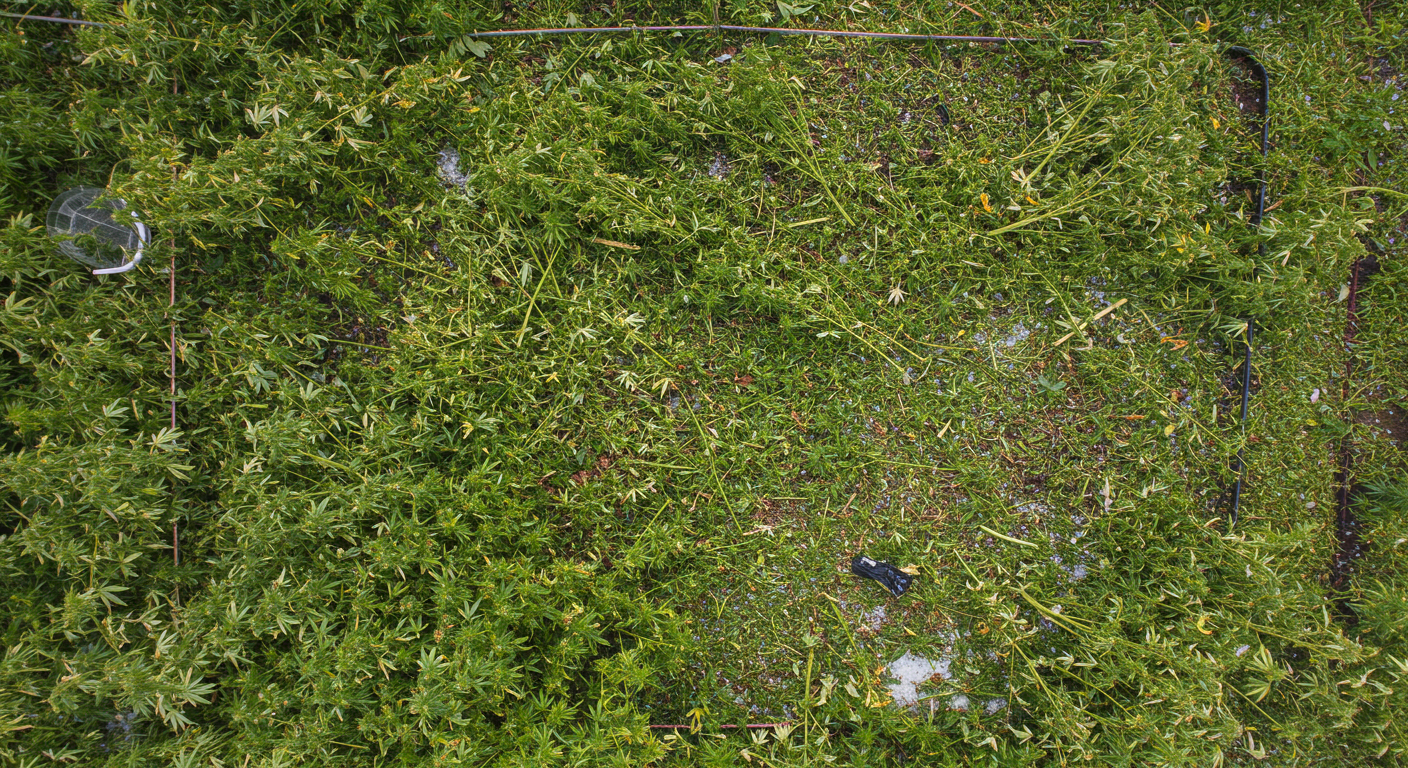
If damage is concentrated beneath one sagging net bay, fix the protection geometry. If damage is concentrated on an unprotected edge, reconsider coverage. If the whole plant shows random impact despite an intact net, the mesh or side exposure may not be adequate for the event you experienced.
Do not prune everything immediately after hail
Hail can make a plant look worse in the first hour than it will look several days later. Torn leaves may still contain useful green tissue. Bent stems may remain functional. On the other hand, severely crushed or completely detached tissue will not recover. Give the plant enough time to show which tissues remain viable unless a broken branch is creating an immediate structural or sanitation problem.
Research on hemp confirms that hail and wind can break branches and lodge plants, while recovery depends on remaining plant function and post-event conditions. Do not extrapolate one field-hemp recovery treatment into a universal cannabis recipe. The useful lesson is that water status, remaining tissue, and structural integrity should be evaluated before adding a foliar product or aggressive feeding program.
Stabilize split branches before chasing nutrition
If a branch is partially split but still attached and worth saving, support it mechanically so the damaged union is not moving in the wind. Use the existing branch-support system rather than the hail net. A structural wound is not a nutrient deficiency and extra fertilizer cannot reconnect wood fibers.
Monitor the repaired area for continued wilting, discoloration, soft tissue, odor, movement, or progressive splitting. If the branch deteriorates, remove damaged material cleanly according to your normal sanitation practice rather than leaving a failing heavy branch suspended inside the canopy.
Recheck at 24 hours, 3 days, and 1 to 2 weeks
The first inspection tells you what broke. Later inspections tell you what recovered. At 24 hours, check hydration, branch position, wet flower zones, and obvious tissue collapse. Around three days, look for new wilting, tissue discoloration, wound progression, or secondary disease risk. Over the following one to two weeks, assess new growth, branch stability, and whether the repaired hail system has maintained its geometry.
Do not judge the hail structure only by whether it stayed standing. A structure that survives but repeatedly touches flowers or creates water pockets still needs correction. Likewise, a plant that survives one hail event may carry weakened stems that are more likely to fail later under flower weight or wind.
Commission, Storm, and Recheck
- Confirm hail is a recurring risk during the part of the season you need to protect.
- Measure mature canopy height, width, branch movement, and inspection access.
- Keep the hail surface structurally separate from the cannabis branch-support system.
- Use agricultural hail netting with documented installation guidance.
- Use geometry that avoids persistent low pockets and maintains drainage.
- Check the full load path from mesh and clips to frame, anchors, and ground.
- Maintain clearance after reasonable net deflection, not only when the net is unloaded.
- Inspect anchors again after heavy rain or saturated soil conditions.
- Observe normal wind behavior before relying on the structure in severe weather.
- Record baseline photos of post alignment, anchors, connections, tension, and clearance.
- Recommission after major canopy growth or branch-support changes.
- Never enter under a visibly overloaded or leaning structure.
- After hail, inspect the structure first and the plant second.
- Map crop damage by canopy zone before deciding what needs correction.
- Recheck the plant at 24 hours, 3 days, and again over the next 1 to 2 weeks.
Know when the simplest correction is a smaller system
Home growers sometimes solve every weakness by adding more material: another pole, another rope, another net layer. Complexity can hide failure rather than remove it. If the structure has become difficult to inspect, difficult to remove, full of trip hazards, or dependent on many improvised connections, simplify it.
A smaller protected footprint over the most valuable flowering area can be safer and more predictable than an oversized roof covering the entire yard. Protection should remain understandable enough that you can inspect every critical connection before a storm.
What a successful hail system looks like after the season
At the end of the season, you should have more than an intact net. You should have records showing which storms occurred, whether the system sagged, where anchors moved, how the canopy clearance changed, where water drained, whether airflow remained adequate, and what the plant looked like afterward. Those records make next season’s design better.
The strongest conclusion is rarely “buy stronger net.” It may be “reduce the span,” “raise one bay,” “move the corner anchor,” “keep the net cleaner,” “remove it before snow season,” or “support late-flower branches independently.” Hail protection improves when each failure point is corrected at the mechanism that caused it.
Field Advice: A hail roof is successful when it makes the storm less important to the plant without making the structure more important than the storm.
Share this article
A quick overview of the topics covered in this article.
- Confirm the Hail Risk Before You Design the Structure
- Measure the Canopy, Clearance, and Structural Footprint
- Choose Netting and Geometry That Shed Load
- Build a Separate Load Path From Net to Ground
- Commission the System Before the First Severe Storm
- Diagnose Sag, Ponding, Uplift, and Anchor Failure
- Storm Response, Reinspection, and Recovery
Follow us
Latest articles

September 4, 2026
September 4, 2026
September 4, 2026
September 4, 2026