
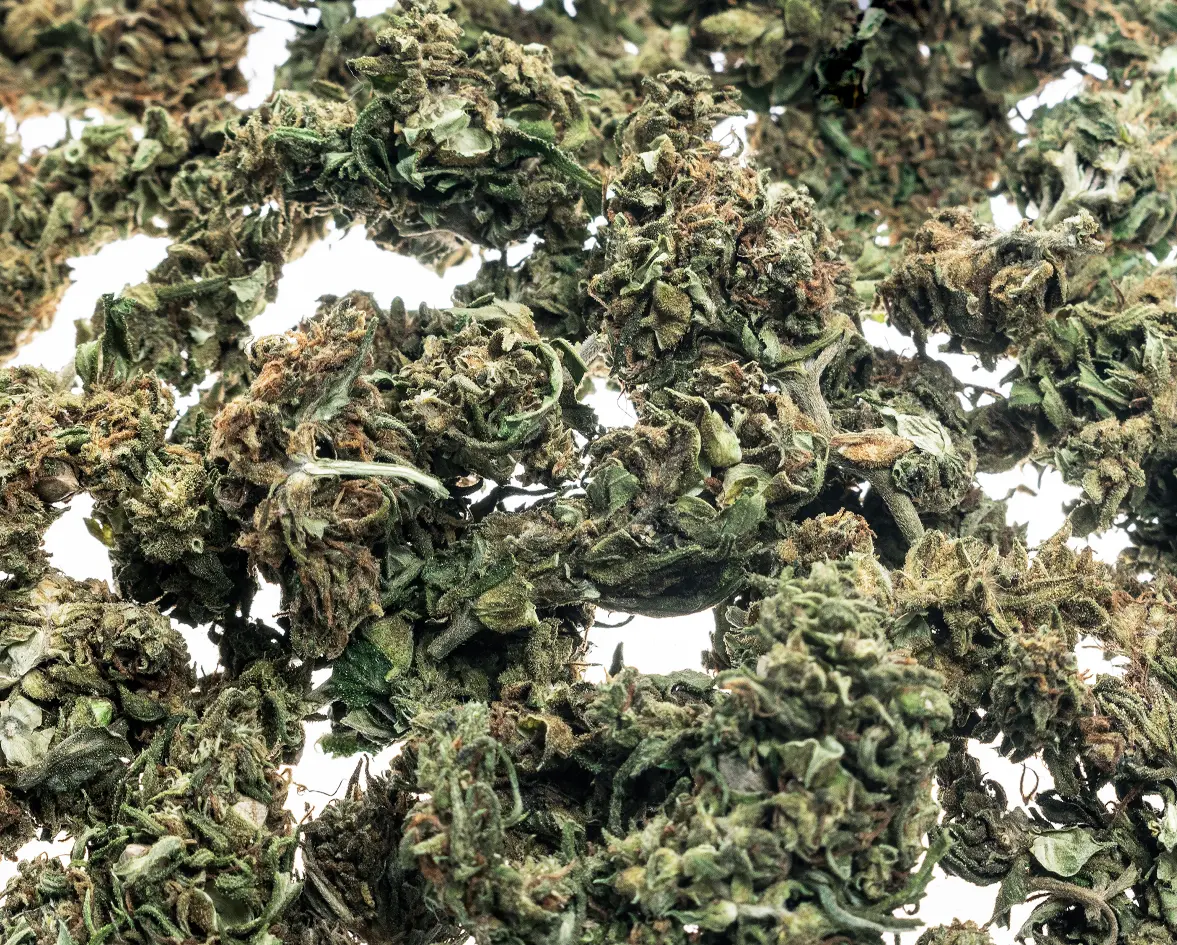
Harlequin
Harlequin is unusual because the number on the laboratory report can matter more than the number on the scale. The cultivar built its reputation around CBD-forward flower that retains enough THC to remain recognizably cannabis without behaving like a conventional high-THC strain. For the grower, that changes the definition of success. A heavy harvest is not enough if the selected plant no longer expresses the cannabinoid balance that made Harlequin worth growing in the first place.
Its ancestry is commonly described as a meeting of Colombian Gold, Thai, Swiss landrace material, and a Nepali indica influence. The result is generally sativa-leaning in structure and effect, but Harlequin does not always behave like a long-flowering tropical sativa. Historical clone descriptions repeatedly point to comparatively early flower set, moderate rather than extreme stretch, flexible branching, and flowers that can become surprisingly heavy late in bloom. Modern seed-derived plants carrying the name can vary more widely in height, flower density, cannabinoid ratio, and terpene expression.
That variation is central to the way Harlequin should be grown. You cannot identify a CBD-rich phenotype by leaf shape, smell, trichome color, or how calm the effect seems. The CBD-to-THC relationship is fundamentally a chemotype trait influenced by cannabinoid synthase genetics. Harvest timing can change total cannabinoid yield and flower maturity, but it does not reliably transform a THC-dominant plant into a CBD-dominant one. Anyone preserving Harlequin for a specific cannabinoid profile should therefore treat analytical testing and phenotype selection as part of cultivation, not as an optional step after harvest.
The second challenge is architectural. Harlequin can set flowers quickly, yet its productive branches may still need room to open and support before those flowers gain weight. Overtraining can waste the cultivar's relatively efficient transition into bloom, while undertraining can leave a tall center, shaded lower branches, and heavy tops leaning into one another. The best plants usually come from a simpler strategy: establish several strong branches, keep the middle breathable, allow the early flowers to form without constant stress, and install support before the colas begin to pull the plant outward.
Flavor is quieter than the cannabinoid story but deserves equal care. Harlequin is most often earthy, woody, herbal, and peppery, with pine, dry flowers, citrus peel, or a gentle mango-like sweetness appearing in some expressions. It is not a strain that needs exaggerated dessert language. Excellent flower tastes clean and layered. Average flower often becomes flat, grassy, or generically earthy when harvested too green or dried too quickly. For Weedth, the goal is therefore threefold: preserve the intended chemotype, finish the flowers structurally, and protect the subtle aroma that separates well-grown Harlequin from merely functional CBD-rich flower.
Strain Features
| Feature | Details |
|---|---|
| Strain Type | CBD-forward, sativa-leaning hybrid; exact cannabinoid balance varies by plant and source |
| Genetic Profile | Commonly described as Colombian Gold, Thai, Swiss landrace, and Nepali indica ancestry |
| THC | Often lower than modern THC-dominant cultivars; commonly reported from low single digits into the upper single digits, but batches vary |
| CBD | Frequently equal to or higher than THC; historical examples are often described as clearly CBD-forward, but laboratory confirmation is essential |
| Cannabinoid Ratio | Not fixed. A 5:2 CBD:THC relationship is historically associated with Harlequin, yet tested modern material can be closer to 2:1, 1:1, or otherwise different |
| Dominant Terpenes | Myrcene, pinene, and beta-caryophyllene recur often; secondary terpene order varies |
| Flavor / Aroma | Earth, dry wood, herbs, pepper, pine, light floral notes, occasional citrus or mango-like sweetness |
| Effect Character | Clearer and less intoxicating than typical THC-dominant flower; focused, relaxed, gently uplifted, and usually functional at moderate doses |
| Flowering Time | Commonly about 8 to 10 weeks; many historical clone reports cluster around roughly 60 to 70 days |
| Outdoor Harvest | Usually late September into early October in suitable Northern Hemisphere climates, phenotype and latitude dependent |
| Grow Difficulty | Moderate. The plant itself is manageable, but preserving the desired chemotype and finishing heavy flowers cleanly requires attention |
| Stretch | Moderate in many expressions; some historic reports describe surprisingly limited stretch for the sativa-leaning pedigree |
| Canopy Behavior | Flexible branching with useful lateral development; early flower set can reduce the time available for major structural correction |
| Bud Density | Medium to dense, sometimes surprisingly heavy late in bloom |
| Branch Support | Often useful late in flower, particularly on resinous, high-yielding expressions |
| Humidity Risk | Moderate. Dense tops and long drying behavior in some phenotypes require airflow and careful post-harvest handling |
| Phenotype Variation | Meaningful, especially in cannabinoid ratio, height, flower density, stretch, and aroma |
| Best Time of Use | Daytime through early evening for many users; strongly dose and THC dependent |
Genetic Lineage
Harlequin's genetic story is less about one famous two-parent cross and more about the combination of geographically distinct cannabis populations. The lineage most often repeated links Colombian Gold and Thai sativa material with a Swiss landrace and a Nepali indica. That broad background helps explain why Harlequin can show both narrow-leaf, upright tendencies and a more controlled flowering rhythm than its sativa percentage alone might suggest.
The Colombian and Thai side of the family is consistent with open branching, a mentally clear effect, and an aromatic profile that can carry dry herbs, wood, spice, and fruit rather than the heavy fuel or dessert notes common in many newer hybrids. The Nepali influence is often used to explain the cultivar's more grounded body effect, resin production, and the fact that some expressions finish with firmer, heavier flowers than a purely tropical sativa would suggest. The Swiss component is more difficult to assign to one visible trait because historical records describe it more as breeding material than as a standardized modern cultivar.
The greater genetic issue is not which ancestor contributed the mango note or the branch angle. It is chemotype. CBD-rich and mixed CBD/THC plants are not simply THC cultivars harvested early. The relative production of CBDA and THCA depends heavily on the plant's cannabinoid synthase genetics. Research on cannabis chemotypes has shown that CBD-dominant, THC-dominant, and mixed chemotypes can segregate genetically, and that mixed plants may pass distinct CBD-to-THC ratios through their offspring.
That is why the Harlequin name should not be treated as a laboratory guarantee. A preserved clone with a verified CBD-forward profile can be highly consistent from run to run. Seed-derived descendants or modern recreations can produce more variation. A plant may look exactly like the expected Harlequin, smell woody and sweet, finish in the correct time window, and still express a cannabinoid balance that differs substantially from the historical clone.
For a grower maintaining mother plants, this makes selection unusually important. The keeper should be chosen from both horticultural and analytical information: plant vigor, branch arrangement, flowering speed, flower quality, aroma, and a laboratory result that confirms the desired cannabinoid relationship. The most beautiful Harlequin phenotype is not automatically the most useful Harlequin phenotype if its chemistry has drifted away from the grower's goal.
Effect Breakdown
Harlequin is best understood by dose rather than by the usual indica-versus-sativa effect language. At a restrained dose from a genuinely CBD-forward example, many users describe a noticeable change in mood and body comfort without the abrupt intoxication associated with a high-THC cultivar. Attention may feel steadier, physical tension may soften, and conversation or routine tasks can remain accessible. The result is not the absence of an effect. It is a different balance between intoxication and functional awareness.
At a moderate dose, the mental character often becomes gently positive and focused. Music and sensory details may feel slightly more engaging, yet the effect usually stays closer to normal cognition than a strong sativa. Some users feel socially comfortable and lightly energized. Others experience a quieter form of calm. This variability partly reflects the actual THC content of the flower, personal tolerance, and the cannabinoid ratio of the individual batch.
The physical component usually develops without the heavy collapse associated with sedating THC-rich indicas. Muscles can feel less tense and the body may become easier to ignore while the user remains able to read, work at a desk, walk, cook, or hold a conversation. That functional quality is the main reason Harlequin is often chosen during the day.
Higher doses change the picture. CBD does not make THC disappear, and a Harlequin sample containing meaningful THC can still impair judgment, coordination, memory, and driving ability. Someone with low tolerance may feel clearly high from material another user describes as almost non-intoxicating. Dry mouth, dry eyes, lightheadedness, or anxiety are still possible, especially if the cannabinoid ratio is closer to balanced than expected.
The late phase is generally softer than the comedown from a high-THC sativa. Many users report a gradual return to baseline rather than a dramatic sleepy drop. Appetite can increase, but strong sedation is not a defining feature of a classic CBD-forward Harlequin. A batch that repeatedly causes heavy couch-lock may simply contain more THC, express a different terpene profile, or come from a different genetic version than the flower on which the strain built its reputation.
Flavor & Aroma Profile
Harlequin's aroma works better as a layered herb-and-wood profile than as a single dominant flavor. The base is usually earthy and dry, closer to forest floor, cut stems, and old wood than to wet soil. Pepper and herbal spice commonly sit above that base. Pine can sharpen the profile, especially when pinene-rich expressions are broken apart.
The sweeter side is more phenotype dependent. Some flowers carry a mild mango-like or ripe-fruit softness. Others lean toward citrus peel, dried flowers, or a syrupy herbal sweetness. These notes are usually accents rather than the main event. A Harlequin jar should not need to smell like tropical candy to be considered correct.
Freshly dried flower can be deceptive. When chlorophyll and internal moisture are still settling, the aroma may seem grassy and the sweet notes can be difficult to detect. After an even cure, the green edge should recede and allow the dry wood, herbs, pepper, and soft fruit to separate. This is one reason Harlequin can taste better after several weeks even when the jar does not become dramatically louder.
On inhalation, clean examples often begin with herbal wood and a slight sweetness. The exhale brings more pepper, earth, and pine. In vapor, the brighter notes are easier to identify because combustion does not cover them with smoke. In a joint or pipe, the profile can feel more rustic and hash-like, particularly when the flower is resinous and cured slightly longer.
Poorly finished Harlequin is easy to recognize because the flavor collapses into green hay, flat earth, or dry bitterness. The cultivar does not have a huge fuel note to hide mistakes. That makes harvest maturity and drying especially visible in the final taste. The quality difference is clarity, not loudness: premium Harlequin lets wood, herb, spice, pine, and gentle fruit remain distinct instead of blending into generic plant matter.
Dominant Terpenes
| Terpene | Aroma Role | How It Fits Harlequin | Scientific Caution |
|---|---|---|---|
| Myrcene | Earthy, herbal, musky | Fits the dry herbal base and appears frequently in tested Harlequin products | Its presence does not by itself predict sedation or medical benefit |
| Alpha-pinene | Pine needles, resin, fresh herbs | Can sharpen the woody profile and explain the bright conifer edge in some phenotypes | Human effects cannot be inferred reliably from aroma alone |
| Beta-caryophyllene | Black pepper, warm spice, dry wood | Matches the peppery exhale and has a well-established ability to interact with CB2 receptors | That receptor activity does not prove that Harlequin treats pain or inflammation |
| Limonene | Citrus peel, fresh sweetness | May support brighter lemon or fruit accents in some batches | Often secondary rather than dominant |
| Other minor terpenes | Floral, woody, green, or sweet nuances | Can account for the considerable batch-to-batch sensory variation | Minor profiles should be confirmed analytically rather than assumed from the strain name |
Harlequin is a useful reminder that a terpene list is not an effect formula. Myrcene, pinene, and caryophyllene recur often enough to describe the cultivar's aromatic center, but the cannabinoid ratio has a larger practical influence on how intoxicating the experience feels. Two Harlequin flowers with similar terpene rankings can still feel noticeably different if one contains substantially more THC than the other.
Indoor vs. Outdoor Growing
| Decision Point | Indoor | Outdoor |
|---|---|---|
| Chemotype verification | Easier to keep a tested clone under repeatable conditions and compare harvests | Chemotype remains genetic, but seasonal variation can change total cannabinoid concentration and yield |
| Stretch and shape | Moderate stretch is usually manageable with topping and branch redirection | Can develop more vertical and lateral size if started early; support becomes more important |
| Flower set | Often begins relatively quickly for a sativa-leaning cultivar | Seasonal onset can still vary with latitude and plant maturity |
| Canopy depth | Best kept moderately shallow so lower flower does not fall far behind | Sunlight from multiple angles can make more lower branches worthwhile |
| Humidity | Environmental control protects medium-dense tops and simplifies the long dry some phenotypes require | Rain, dew, and cool nights can make late flower and harvest handling more difficult |
| Branch support | Trellis or soft ties are easy to install before swelling | Cages and stakes should be established before wind and flower weight combine |
| Flavor | Stable late-flower temperatures and controlled drying help preserve herbal, pine, and fruit detail | Sun-grown plants can develop rich woody and herbal character, but heat and weather can flatten delicate notes |
| Best use case | Growers selecting a verified chemotype or working in a short/uncertain outdoor season | Growers with dry autumns, strong sun, adequate privacy, and enough room for a broader plant |
Indoor cultivation has one advantage that matters more for Harlequin than for many strains: repeatability. If the grower has a laboratory-verified mother plant, keeping temperature, light, nutrition, and harvest maturity relatively consistent makes it easier to compare one cycle with the next. This does not freeze the cannabinoid percentage at one exact number, but it removes much of the environmental noise that can complicate interpretation.
The plant is also physically easy to organize indoors when training begins early. Harlequin's sativa influence can create height, yet many expressions do not stretch as dramatically as a Haze. That makes it possible to top once, spread several laterals, and enter flower with a canopy already close to its final width. The error is waiting for a huge stretch that never arrives.
Outdoors, Harlequin can use more of its natural branching and does not need to be flattened aggressively. A sunny plant with open spacing can carry productive flower farther down the branch than the same plant in a shallow indoor light field. The difficulty comes at the finish. Dense or resin-heavy tops, morning dew, and cool autumn nights can create more risk than the plant's relatively early flowering reputation suggests.
For growers whose priority is preserving a particular CBD-to-THC relationship from a selected clone, indoor production is the more controlled research environment. For growers whose priority is larger plant size and a natural sun-grown expression, outdoor cultivation can be excellent where autumn weather remains dry. The decision should follow chemotype goals and harvest climate, not a generic indoor-versus-outdoor rule.
Strain-Specific Grow Guidance
Start With Chemistry Before You Start Chasing Yield
Harlequin should ideally begin with a known plant rather than a name on a packet. If cannabinoid balance matters to the grower, the most efficient workflow is to flower candidate plants, keep clones or mothers, and test the finished flower before deciding which plant deserves permanent space. Visual selection alone can identify vigor and flower quality, but it cannot confirm the CBD-to-THC ratio.
This is especially important with seed-derived material. Mixed CBD/THC chemotypes can segregate, and different seedlings may finish with ratios that are not interchangeable. A grower searching for a CBD-forward keeper should avoid assuming that every sibling will match the same therapeutic or psychoactive profile.
Once a keeper has been verified, clone-to-clone runs become much more useful. The grower can then focus on environmental consistency, aroma, yield, and the harvest window without wondering whether every plant has a different cannabinoid genotype.
Harlequin Can Flower Faster Than Its Sativa Look Suggests
A recurring historical observation is that Harlequin begins building visible flowers relatively early. That matters because the plant gives the grower less time than expected to correct major structural mistakes after the light cycle changes. If the canopy is still tangled or the lower third is full of weak shoots at flip, those problems can become embedded inside the flowering plant before the grower finishes cleaning it up.
Enter flowering with the main architecture already decided. The ideal plant has several strong tops at similar height, an interior that can be inspected easily, and lower branches selected according to whether they can reach useful light. Do not rely on transition stretch to repair a small or poorly spread plant.
The exact stretch varies. Some plants remain surprisingly compact with only modest vertical gain, while others show more conventional sativa movement. Watch the first two weeks rather than forcing a fixed stretch estimate onto every phenotype.
Topping and LST: Simple Training Usually Wins
Harlequin responds well to an early topping when healthy, and controlled low-stress training can turn the resulting branches into a balanced canopy. The goal is not to create the maximum number of tops. The goal is to keep enough strong branches that each can finish a meaningful flower without crowding its neighbor.
Repeated high-stress training is less attractive once flower set begins. Historical reports suggest that the cultivar can establish buds quickly, so late supercropping or repeated topping risks exchanging productive time for recovery. If a branch needs redirection after transition, soft ties or gradual bending are usually the cleaner option.
SCROG can work, but Harlequin does not need an aggressively filled screen to be productive. A lightly filled net is more valuable as branch organization and later support. Leave visual access between tops. This matters when checking mature flowers for moisture, pests, or uneven ripening.
Flower Weight Arrives Before Some Growers Expect It
One of the more useful historical grow observations is that resinous Harlequin tops can become heavy enough to require support late in bloom. The plant may look structurally comfortable in mid-flower and then begin leaning as calyxes and resin accumulate. This is especially true when a branch has been trained far away from the main stem.
Build support before the flowers demand it
Install a trellis, cage, or individual ties while branches are still easy to move. Support should hold the flower upright without squeezing colas together. Two heavy tops touching each other create exactly the humid contact point a grower should avoid.
Outdoors, branch support has to account for wind as well as flower mass. A branch that can hold itself on a still day may fail after rain or a gust loads a wet cola. Early cages are preferable to emergency staking near harvest.
Feed the Plant You Have, Not the CBD Reputation
Harlequin is sometimes described as easy to feed, but there is not enough cultivar-specific evidence to justify a universal heavy-feeding recommendation. A vigorous plant with strong roots may use a substantial nutrient supply. A compact or cool-rooted plant can still accumulate salts and show dark foliage or burned tips.
The sativa-leaning leaves can make mild nitrogen excess less visually dramatic than on a broad-leaf indica, so watch the full plant rather than one leaf shape. Continued dark, glossy foliage after flowers are established, slow dryback, and weak aromatic development are better reasons to question the feeding level than any generic schedule.
During late flower, avoid trying to increase CBD by pushing fertilizer, stress, or special bloom additives. Cannabinoid chemotype is not created by a late nutrient trick. Finish the plant cleanly and let mature flower mass, resin development, and genetics determine the result.
Root-Zone Rhythm Matters More Than Constant Wetness
Harlequin's open, sativa-influenced canopy can transpire strongly when conditions are warm and bright, but that does not mean the root zone should stay constantly saturated. A medium that remains wet for too long reduces root-zone oxygen and makes nutrient problems harder to diagnose.
Water thoroughly enough to wet the active root volume, then allow the medium to recover air before irrigating again. The exact interval should follow container size, medium, plant mass, and climate rather than a calendar. The important observation is whether the plant is drinking actively and returning to a predictable rhythm.
A plant that suddenly slows its water use in mid-flower deserves attention. Root-zone saturation, cool media, excess salinity, or declining root health can reduce flower filling even when the canopy still looks green.
Do Not Confuse Trichome Appearance With CBD Ratio
This is the harvest mistake most specific to Harlequin. Clear, cloudy, and amber trichomes are useful maturity indicators, but they do not tell the grower how much CBD exists relative to THC. A cloudy trichome is not a CBD trichome, and an amber trichome is not proof that the CBD window has been missed.
Research on cannabis shows that cannabinoid concentrations change across flowering and can peak or plateau at different times depending on genotype. Other work with CBD-dominant material shows that total flower yield may continue increasing even when cannabinoid concentration changes little. This means the best harvest date is a compromise among flower mass, resin maturity, aroma, disease risk, and the specific chemistry of the selected plant.
The common advice to harvest CBD cultivars automatically “early” is therefore too simplistic. If a grower needs a precise cannabinoid result, staged analytical sampling is more useful than a universal early-harvest rule. Harvest timing can optimize a verified chemotype, but it cannot replace chemotype verification.
Lower Flower Can Be Worth Keeping
Harlequin's lower branches should not be removed automatically. Indoors, the productive zone should still be kept reasonably shallow, but well-positioned laterals can finish useful flower if they reach the canopy edge or an open light lane. The plant's flexible branching makes this easier than on a very compact indica.
Remove shoots that remain buried in the middle, point directly inward, or produce only small shaded clusters after stretch has finished. Retain branches that have their own light and airflow. This approach improves premium flower percentage without turning the plant into an excessively stripped frame.
Outdoors, sunlight from changing angles can make lower branches more productive. Pruning should therefore be less aggressive and focused more on crowded interior shoots than on a fixed height from the soil.
Humidity and the Hidden Problem of Slow-Drying Tops
Harlequin is not usually described as an exceptionally mold-prone strain, yet its late flowers can become dense and resinous enough to hold moisture. Good room humidity does not guarantee that the center of a heavy cola is dry. Dead sugar leaves, tight branch junctions, and two touching flowers are the places that deserve inspection.
Air should move through the canopy rather than only across the top. Remove buried leaves that no longer receive light and any damaged tissue that could decay inside the flower mass. Avoid severe late defoliation simply to create airflow, because sudden leaf loss can stress a plant that is already allocating energy to flower.
Some historical Harlequin growers report that mature tops can take longer to dry than expected. The exact drying time should never be treated as a strain constant, but the warning is useful: a dense CBD-rich flower can feel dry outside while retaining internal moisture near the stem. That makes slow, even drying and careful moisture assessment more important than following a fixed number of days.
Weedth Bud Flavor Tips
Harlequin's flavor should be protected as a delicate herbal profile rather than a loud commercial aroma. The grower is trying to keep the distinction between dry wood, herbs, pepper, pine, and soft fruit. The easiest notes to lose are the brighter pine, citrus, floral, and mango-like accents. Once they disappear, the remaining earth can make the flower taste far more ordinary than it smelled on the plant.
Harvest only after the aroma has moved beyond fresh vegetation. A plant can display mature-looking trichomes on exposed sugar leaves while the flowers themselves are still adding calyx mass and aromatic depth. Judge the whole flower: swollen calyxes, reduced production of fresh pistils, stable resin, and an aroma that smells like the cultivar rather than crushed leaves.
Drying temperature matters. Controlled research on cannabis and hemp has shown that hotter drying accelerates terpene loss and changes cannabinoid chemistry. Harlequin does not benefit from a fast hot dry simply because the flower is being grown for CBD. CBD preservation and terpene preservation are separate quality goals, and both deserve a controlled post-harvest process.
Indoors, whole branches can work well when the room is cool, dark, and able to exchange air without blowing directly on the flowers. Very large or tightly stacked tops may need to be separated into manageable branch sections. The goal is to let internal moisture leave gradually without keeping the flower wet long enough for microbial growth.
Outdoor Harlequin deserves a more selective harvest-room inspection. Remove damaged material, insects, and any suspicious soft tissue before drying. A wet outdoor cola should not be packed into a slow drying space simply to preserve terpenes. Clean flower first, then slow the dry as much as safety allows.
During curing, expect the aroma to change rather than simply grow stronger. Green notes recede first. Pepper and dry wood become cleaner. Pine or fruit may reappear after internal moisture stabilizes. A well-cured jar should feel more coherent after several weeks. If the flower turns dusty and scentless, it was overdried. If it smells sour, ammonia-like, or feels cool and wet when compressed, it entered storage with too much moisture.
Long-term storage should minimize heat, light, oxygen, and unnecessary handling. Harlequin's cannabinoid profile is the reason many growers preserve it, but flavor still determines whether the finished flower feels carefully grown or merely medicinal. CBD-rich does not mean flavor-optional.
Weedth Bud Boost Tips
The most useful way to increase Harlequin's quality yield is to build a canopy that finishes evenly enough to harvest as one coherent crop. Uneven plants create a difficult choice: harvest the mature tops and sacrifice immature lower chemistry, or wait for the bottom while the top moves beyond its best aroma window.
Indoors, one early topping followed by branch redirection usually gives the grower enough control. Allow the selected laterals to establish before flower. A short vegetative phase can work with a vigorous clone, but seed-derived plants should not be flipped simply because the calendar says they are old enough. Enter bloom when the final branch framework is present.
Do not overcrowd a screen. Harlequin can set flower quickly and later gain substantial weight, so a canopy that looks comfortably full at the start of bloom can become difficult to access by the middle. Leaving small open lanes improves light distribution, inspection, and late-flower airflow.
Support is part of yield optimization. A cola that bends out of the light, cracks at a junction, or lies against another flower loses usable quality even when its wet weight remains impressive. Install support before the plant needs it.
The lower canopy should be edited according to light, not dogma. Removing weak interior shoots can increase the proportion of mature top-quality flower. Removing every lower lateral can waste productive structure, especially outdoors or under broad even indoor lighting.
For a CBD-focused grower, analytical selection can provide a larger practical improvement than any bloom additive. Keeping a verified high-CBD plant and discarding a visually similar but chemistry-inappropriate sibling protects the entire purpose of the crop. This is a form of yield optimization because it increases the percentage of harvested flower that actually meets the target.
Do not chase more cannabinoids with undocumented stress techniques, extreme light, prolonged darkness, heavy phosphorus and potassium, or late nutrient restriction. These practices are often repeated as grow lore but are not reliable Harlequin-specific tools. Stable photosynthesis, healthy roots, appropriate light, a clean canopy, and correct harvest maturity are more defensible ways to improve finished flower.
Outdoors, give the plant enough spacing to form a broad structure and dry after dew. A large Harlequin planted too close to another large plant may produce more total biomass but less clean flower because the inner sides never receive adequate sun or air. The target is verified chemistry multiplied by clean mature flower mass, not maximum biomass at any cost.
Medical Uses & Benefits
Harlequin is frequently chosen by medical cannabis users because CBD-forward flower can provide a gentler psychoactive experience than high-THC material. User reports commonly mention pain, tension, stress, and anxiety as reasons for choosing it, while daytime functionality is a recurring advantage. These reports should be treated as experience data, not as proof that the cultivar treats a disease.
Pain is the most common practical use associated with Harlequin. Some users report that it reduces the prominence of chronic aches while allowing them to remain mentally present. The scientific evidence for CBD alone in chronic pain is still mixed and incomplete, and whole cannabis flower adds THC and many other compounds that make direct comparison with purified CBD studies difficult.
Anxiety is another commonly reported reason for use. A lower-THC, CBD-forward flower may feel easier to tolerate than a potent THC-dominant sativa for some people. However, clinical evidence for cannabinoids in anxiety disorders remains limited, and a Harlequin sample with more THC than expected can still provoke anxiety in a sensitive user.
CBD has established medical value in specific prescription contexts, particularly certain seizure disorders, but that evidence comes from standardized purified CBD at controlled doses. It should not be used to claim that smoked or vaporized Harlequin flower treats epilepsy or that a jar of flower delivers a clinically equivalent dose.
The strain may also be chosen by people seeking less intoxicating daytime symptom management, but users should remember that Harlequin can contain meaningful THC. Driving, operating machinery, or performing safety-sensitive work after use can still be unsafe. CBD can also interact with medications. Anyone using cannabinoid-rich flower for a medical condition should discuss it with a qualified healthcare professional, especially when taking prescription drugs.
Ideal User Profile
Harlequin is particularly well suited to the user who wants to notice cannabis without surrendering the day to it. That may be someone who finds modern high-THC flower too intense, someone who wants a daytime option, or an experienced user deliberately reducing intoxication while keeping the ritual and flavor of flower.
It also suits people who value functional calm more than euphoria. The ideal setting is often ordinary life: reading, light creative work, walking, cooking, conversation, stretching, or relaxing after a demanding task without immediately becoming sleepy. The strain is less attractive to someone whose primary goal is a powerful recreational high.
Flavor preference matters. Harlequin is a better fit for users who enjoy earth, dry wood, pine, herbs, and pepper than for those searching for candy, cream, fuel, or intense fruit. Its best sensory qualities are subtle and become more obvious when flower is well cured.
New cannabis users may find a verified CBD-forward batch approachable, but they should not assume the name guarantees low intoxication. Laboratory data is more useful than reputation. A Harlequin sample with 8 percent THC can feel very different to a beginner than a sample with 2 or 3 percent THC.
For experienced THC users, Harlequin can feel understated when used alone. That is not a defect if the purpose is clarity, symptom management, or cannabinoid balance. It simply occupies a different role from a potency-focused evening strain.
Grower Notes and Feedback
The most consistent surprise in grow reports is how quickly Harlequin can begin looking like a flowering plant. Growers expecting a long sativa transition sometimes wait too long to finish canopy work. By the time they decide to thin, bend, or reposition aggressively, the plant is already putting energy into visible flower sites.
Another recurring observation is late support. Plants that appear structurally light in early flower can develop resinous tops heavy enough to lean. This is not universal, but it appears often enough that support should be planned rather than improvised.
Growers also disagree about stretch. Some historical clone reports describe limited extension, while modern seed-derived plants may be taller and more open. That disagreement is a useful warning against using pedigree percentages as a height prediction.
Aroma reports are similarly broad. Earth, wood, spice, and herbs are the most stable center, while mango, citrus, pine, floral sweetness, or hash-like depth appear more strongly in some plants than others. A grower hunting a keeper should therefore evaluate flavor as well as chemistry.
The biggest source of confusion remains cannabinoid ratio. Flower sold or grown under the Harlequin name has tested across a wide range. This does not make every report wrong. It shows why cultivar naming and chemotype are not interchangeable. Growers who need a particular result learn quickly that testing is more dependable than reputation.
Post-harvest observations also deserve attention. Some dense expressions dry more slowly than growers expect from a sativa-leaning cultivar. The outer bracts can feel dry while moisture remains deeper near the stem. Successful growers respond to the flower in front of them rather than forcing Harlequin into the drying schedule used for a different cultivar.
Weedth Editor's Note
The point where this plant reveals itself
The part of Harlequin I would take most seriously happens before the first flower forms: deciding what I actually want from the plant. If the objective is CBD-forward flower, I would rather spend money on one meaningful laboratory test than on a shelf full of late-flower additives. The test tells me whether the plant deserves to become a keeper. The additives cannot repair the wrong chemotype.
I also think growers can overcomplicate this cultivar because of the sativa label. I would not train it like a long tropical Haze unless the plant itself proves that it needs that level of control. I would top early, spread the main branches, keep the center readable, and then let it flower. Harlequin's relatively quick flower set is a reason to finish the architecture early rather than keep manipulating it.
The second thing I would watch is support. A good plant can look light and flexible for several weeks, then become much heavier as the flowers fill and resin develops. I would rather install a loose support net too early than discover in late flower that the best tops are leaning into each other.
Flavor is where I think Harlequin is underrated. It will not compete with the loudest fruit or fuel cultivars, but a slow, clean dry can produce a surprisingly complete herbal profile. The wood, pepper, pine, and soft sweetness feel appropriate to the strain. If that subtlety disappears, the flower can become medicinal in the least interesting sense of the word: useful, but bland.
My criticism is variability. The name can give growers too much confidence about chemistry. I would not recommend growing an untested seed-derived Harlequin crop for someone who requires a very specific CBD-to-THC result. For a hobby grower exploring the strain, that variation can be interesting. For a medical user depending on repeatability, it is a real limitation.
Overall, I value Harlequin because it forces the grower to think beyond THC percentage. It rewards plant selection, testing, restrained training, and careful finishing. That makes it more technically interesting than its reputation as an “easy CBD strain” suggests.
Weedth Score
Growing Experience 8.0/10 The plant is generally manageable and responds well to simple training. Points are deducted because chemotype verification and phenotype variation add work beyond normal plant care.
Bud Structure & Visual Appeal 7.9/10 Good examples become resinous and surprisingly substantial, but structure is not always as uniform or sculpted as modern display-focused hybrids.
Aroma Complexity 7.8/10 Wood, herbs, earth, pepper, pine, and occasional fruit create real depth, though the profile is usually subtle rather than explosive.
Flavor & Smoothness 8.1/10 A controlled dry and cure can produce a clean, gentle, layered smoke or vapor. Rushed flower becomes grassy quickly, so post-harvest quality matters.
Effects & High Experience 8.7/10 Its greatest strength is a functional, clear, relaxed experience with less intoxication than high-THC flower. Users seeking a powerful high may find it too mild.
Overall Satisfaction & Recommendation 8.4/10 Highly worthwhile for CBD-forward cultivation, daytime use, and growers interested in chemotype selection. Less compelling for those whose main goals are extreme potency or loud modern flavor.
Personal closer: Harlequin is the strain I would choose when the chemistry needs to serve the day instead of taking the day over.
FAQ
Is Harlequin really a high-CBD strain?
Historically, yes. Harlequin became known for CBD-forward mixed chemotypes, often with more CBD than THC. The name alone does not guarantee a particular ratio, so laboratory testing is the only reliable way to confirm a specific plant or harvest.
What is the typical CBD-to-THC ratio in Harlequin?
A roughly 5:2 CBD-to-THC relationship is frequently associated with classic Harlequin, but real samples vary. Modern material may be closer to 2:1, 1:1, or another ratio. Treat the historical figure as a strain identity clue, not a specification.
Can I tell whether a Harlequin plant is CBD-rich by looking at the trichomes?
No. Trichome color helps estimate flower maturity, not CBD-to-THC ratio. Clear, cloudy, and amber heads do not reveal which cannabinoid synthase genes the plant carries.
Should Harlequin be harvested early to preserve CBD?
Not automatically. Cannabinoid accumulation changes through flower and is genotype dependent. Harvesting early can reduce flower mass and aroma without guaranteeing a better CBD ratio. Use whole-flower maturity and, when precision matters, analytical testing.
How long does Harlequin flower indoors?
Many established reports place it around 60 to 70 days, or roughly 8 to 10 weeks. Individual lines can finish outside that range, so calyx development, pistil activity, resin maturity, aroma, and plant-specific history matter more than the calendar alone.
How much does Harlequin stretch after the flip?
Many expressions show moderate stretch, and some historic clone reports describe surprisingly little extension for a sativa-leaning plant. Seed-derived examples can be taller. Plan some vertical room but do not assume Haze-like doubling or tripling.
Does Harlequin respond well to topping?
Yes. One early topping is usually useful for creating several strong flowering branches. Repeated topping is often unnecessary because the cultivar can begin setting flowers quickly after transition.
Is Harlequin good for SCROG?
It can be, but the screen should be used to spread and support selected branches rather than create an extremely dense carpet. Open lanes improve light, inspection, and airflow.
Does Harlequin need branch support?
Many productive expressions benefit from support in late flower. Resinous tops can gain enough weight to lean even when stems look healthy. A loose trellis, soft ties, or outdoor cage is useful insurance.
Is Harlequin mold resistant?
It is not generally known as an extremely mold-prone cultivar, but dense flowers and slow internal drying can still create problems. Humidity, airflow, rain, dead tissue, and touching colas matter more than the strain label.
Why does my Harlequin smell earthy instead of like mango?
Earth, wood, herbs, and spice are core Harlequin notes. Mango-like sweetness is phenotype dependent. Drying temperature, harvest maturity, and storage can also reduce the brighter fruit and pine notes.
Is Harlequin suitable for outdoor growing?
Yes, especially in a sunny location with a reasonably dry finish to the season. Its flowering time is more practical than that of many long sativas, but autumn rain and dew still threaten dense late flowers.
Can Harlequin get you high?
Yes. CBD-forward does not mean THC-free. A batch with several percent THC can be clearly intoxicating for a low-tolerance user, while an experienced user may experience it as mild and functional.
Is Harlequin good for daytime use?
That is one of its most common roles. Verified CBD-forward flower is often described as focused, relaxed, and gently uplifting without strong sedation. Dose and actual THC content still determine how functional it feels.
Can Harlequin be used for pain or anxiety?
Many users choose it for those reasons, but strain-specific clinical evidence is lacking. Research on CBD for chronic pain and anxiety remains incomplete, and whole flower cannot be treated as equivalent to standardized medical CBD preparations.
How should I choose a Harlequin mother plant?
Keep clones of promising candidates, flower them, evaluate vigor, structure, flower quality, aroma, and finish time, then use laboratory testing to confirm the cannabinoid profile. Select the plant that meets both horticultural and chemical goals.
Similar Strains
ACDC: A strong comparison for users seeking CBD-rich flower with limited intoxication. ACDC is often even more CBD-dominant, while Harlequin commonly retains more THC and a slightly more noticeable psychoactive lift.
Cannatonic: Another classic mixed CBD/THC cultivar with functional effects. Cannatonic can vary widely in cannabinoid ratio and often has a more citrus-earth profile, while Harlequin tends toward dry wood, herbs, and pepper.
Pennywise: A direct Harlequin descendant commonly associated with a more balanced CBD-to-THC relationship. It usually produces a heavier, more indica-influenced physical effect and shorter plant structure than Harlequin.
Harle-Tsu: A CBD-focused relative built partly from Harlequin genetics. It is generally chosen when lower intoxication is the priority, while Harlequin usually offers a clearer sativa-like lift and more noticeable THC presence.
Sour Tsunami: A useful alternative for growers interested in CBD-rich chemotypes but wanting a sourer, more pungent flavor direction. Its structure and aroma are less woody and herbal than Harlequin.
Remedy: A low-THC, CBD-oriented alternative for users who want to minimize intoxication further. Harlequin is usually the better choice for someone who wants CBD dominance while still retaining a modest THC-driven mood lift.
Share this article
A quick overview of the topics covered in this article.
Follow us
Latest articles
September 9, 2026
September 9, 2026
September 9, 2026