
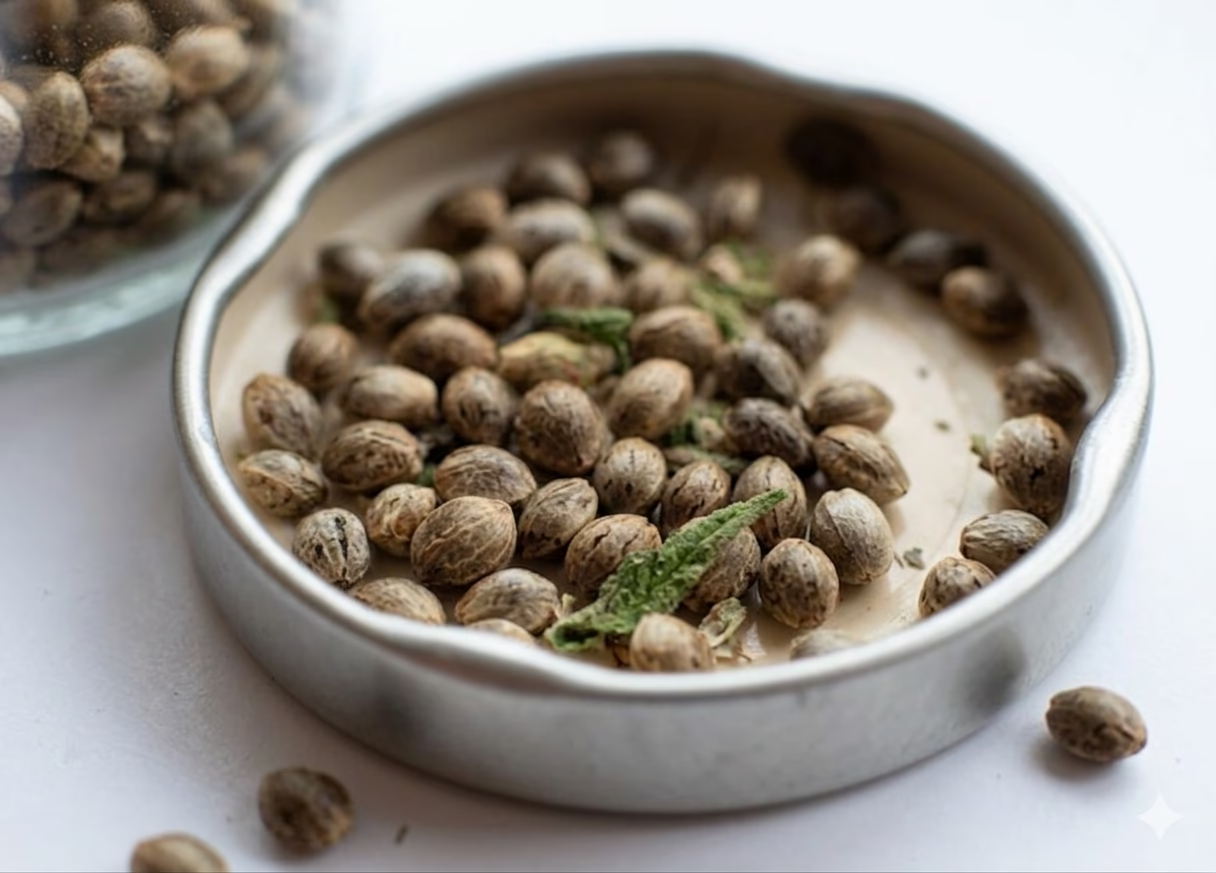
How to Read and Document a Cannabis Seed Listing
A cannabis seed listing is useful only when you separate what the seller is naming, what the breeder is claiming, what was actually measured, and what you can verify from your own plants. Product pages often compress parentage, generation, flowering time, plant size, yield, cannabinoid percentages, disease language, climate claims, photographs, and marketing adjectives into one block. Those fields do not carry the same evidence weight.
The practical goal is not to become suspicious of every listing. It is to turn the page into a record you can audit later. Before you buy or plant, you should be able to answer: What exact material is being sold? Which claims are tied to a defined population or lot? Which numbers came from a particular environment? What information is missing? What should be saved before the page changes? And which claims can only be confirmed after you grow, observe, and, where available or required, test the resulting harvest?
This resource stays focused on reading and documenting seed listings. It does not replace a complete breeding guide, a seed germination guide, or a climate-selection guide. For broader cannabis identity terminology, see What Is a Cannabis Strain?. If the seeds are already selected and you are moving into propagation, continue with Planting and Germination.
Separate Listing Facts, Claims, and Evidence Before You Judge the Seed
The fastest way to misread a seed listing is to treat every line as equally factual. A page may contain several different information layers: a cultivar or commercial name, a claimed cross, a seed type, a generation marker, a flowering range, an outdoor harvest estimate, a yield range, a cannabinoid target, aroma language, photographs, and claims such as “stable,” “resistant,” “beginner friendly,” or “high yielding.” Some of these fields may describe the actual seed population. Others may describe one selected parent, one previous trial, a marketing category, or a best-case result.
Read the page in four passes. First identify the material. Second identify the measurable claims. Third ask what evidence or conditions are attached to each claim. Fourth record what is absent. Missing context is not automatically proof of a bad product, but it changes how much confidence you should place in the description.
How to Read a Cannabis Seed Listing Critically
Start by copying the listing into a simple evidence grid rather than reading it as a sales paragraph. For every meaningful claim, write Claim, Context, Evidence, and Verification. If the page says “finishes in 8 weeks,” the context question is whether that means indoor flowering after a light-cycle change, total life cycle, or outdoor time from first visible flower. The evidence question is whether the seller gives trial conditions or merely a number. The verification question is what date or observation you would need to record in your own grow.
| Listing layer | How to read it |
|---|---|
| Name and source | Record the exact spelling, seller, breeder attribution if supplied, page URL, and date. Treat the name as an identity claim, not proof that material carrying the same name from another source is equivalent. |
| Parentage | Record the parents exactly as shown, including cuts, selections, reversal notation, or generation markers. Do not silently “correct” unfamiliar lineage wording. |
| Seed type | Record regular, feminized, autoflower/day-neutral, photoperiod-sensitive, or other explicit description. Do not infer sex ratio or flowering trigger from photographs or a cultivar name. |
| Generation | Preserve F1, F2, F3, S1, BX/BC, IBL, or other notation exactly. These labels describe breeding relationships or claims, not automatic quality grades. |
| Performance numbers | Capture flowering duration, harvest window, height, yield, chemistry, and environmental ranges together with the environment and measurement basis if given. |
| Qualitative claims | Translate words such as resistant, stable, vigorous, compact, easy, fast, and high yielding into questions that can be observed or measured. |
A listing is a source record, not a certificate of your future plant
A seed listing documents what a seller or breeder says about the material at a particular time. It may contain useful breeding history and trial observations, but it is not a laboratory certificate for every seed in the packet and it is not a guarantee that your environment will reproduce the same phenotype, flowering time, yield, or chemical concentration.
This distinction matters because commercial cannabis naming has documented consistency problems. Genetic studies have found that samples carrying the same commercial name can be genetically inconsistent, and seeds sold within named populations can show meaningful variation. That does not make names useless. It means source and lot should travel with the name if you want the record to remain useful later.
Separate the breeder page from the seller page
A reseller may copy a breeder description, shorten it, translate it, rewrite it for SEO, merge information from older and newer releases, or add its own category labels. That creates a source hierarchy problem. When both pages exist, save both and identify which claims came from which source. Do not assume the reseller wording is identical to the breeder’s current record, and do not assume the breeder’s current page is identical to the version that existed when your packet was produced.
For parentage, generation, reproduction method, and breeder-selected traits, the original breeder or producer page is usually the stronger documentary source when it can be verified. For the exact packet you received, however, the seller invoice, pack photograph, lot code, and date may be stronger evidence of what actually entered your collection. Source authority depends on the question you are asking.
Use an evidence ladder instead of a yes-or-no trust decision
Seed listings do not need to be either “trusted” or “untrusted.” Grade individual fields. A parentage statement repeated consistently on the breeder page, seed pack, and dated technical sheet deserves more confidence than a parentage mentioned only in a reseller paragraph. A flowering range supported by multi-location trials deserves more confidence than an unexplained single number. A lab report tied to a named sample and date deserves more confidence than a percentage shown inside a graphic with no test context.
A simple confidence ladder can be: documented, supported, claimed, and unknown. Documented means the source provides traceable supporting material. Supported means more than one credible source or repeated observation agrees. Claimed means the page states it but gives little context. Unknown means the field is absent or contradictory. This language keeps your record useful without pretending you have performed genetic authentication.
Remember: The listing is strongest when it tells you exactly what material was produced, how it was produced, what was observed, where it was observed, and how variable the population was. A long description is not the same as a well-documented description.
Read Parentage, Generation, and Seed Type Before Marketing Language
Parentage and generation are among the most valuable parts of a seed listing because they tell you how the seller says the population was created. They are also among the easiest fields to overinterpret. A cross written as Parent A x Parent B does not tell you whether those parents were verified clones, seed selections, broad populations, or similarly named material from another source. An F1 label does not automatically mean a commercial true hybrid produced from homozygous inbred parents. An S1 is not a clone in seed form. A backcross is not a perfect reconstruction of the recurrent parent.
Preserve the lineage exactly before you interpret it
Copy the parentage as shown on the page. Keep punctuation, cut names, phenotype numbers, parenthetical notes, and reversed-pollen information where provided. If the listing says “Selected A #4 x B” do not shorten the record to “A x B.” If it says “B reversed,” preserve that distinction. If the parentage is absent, record “not stated” rather than filling the gap from a forum, another seller, or your memory.
When multiple sellers carry the same named seed line, do not combine their descriptions into one synthetic lineage unless you have strong evidence they refer to the same reproduction. Cannabis naming research repeatedly shows that a shared name is weaker identity evidence than growers often assume.
Read F1, F2, S1, and BX as history, not ratings
Generation markers answer a breeding-history question. An F2 generally indicates a filial generation derived from F1 material. An S1 generally indicates a first selfed generation from a selected genotype. A BX or BC notation indicates a backcross toward a recurrent parent. Later filial or selfed numbers describe additional generations, but they do not tell you which individuals were selected, how large the breeding population was, or which traits were retained.
Modern cannabis breeding research makes the limitation especially clear. Cannabis is naturally variable and highly heterozygous, and true uniform F1 hybrid production requires unusually well-defined parental material. Recent proof-of-concept work has shown that more uniform cannabis F1s can be produced from homozygous parental lines, which also demonstrates why an ordinary catalog “F1” should not automatically be assumed to have the same genetic structure.
- Record the generation exactly as listed.
- Record what the seller says about selection and parental identity.
- Expect population variation unless evidence supports strong uniformity.
- Use generation notation to plan observation and recordkeeping.
- Treating F1 as a universal synonym for uniform.
- Treating S1 seeds as genetic copies of the source clone.
- Assuming later generation numbers automatically mean better quality.
- Inventing missing generation history from the cultivar name.
Do not let a breeding abbreviation hide missing parent identity
A generation marker can look precise while the parent material remains vague. “F2” is only as informative as the F1 population it came from. “S1” is only interpretable when the source genotype is identified with reasonable confidence. “BX1” is much more useful when the recurrent parent and the backcross direction are stated. If the listing gives a breeding abbreviation but omits the parental selections, record both facts: generation stated, parent identity incomplete.
This matters because two breeders can legitimately create different populations that share a broad commercial name and even similar shorthand. The label describes a relationship inside that breeder’s history. It does not create a universal genetic object shared by every catalog carrying the same words.
Read “stabilized” and “worked line” as claims that need a trait
Stability is not one number. A population can be relatively consistent for sex expression and cannabinoid ratio while remaining variable for height, aroma, color, branching, or finish date. When a listing says “stabilized,” ask: stable for what? The strongest descriptions identify the traits under selection and describe the observed range. The weakest use stability as a general quality adjective.
Similarly, “worked for several generations” tells you that selection has occurred only if the source explains what was selected and how the population was maintained. Generation count without selection history is incomplete breeding information.
Regular, feminized, autoflower, and photoperiod describe different things
Seed type should be separated from filial generation. “Feminized” describes how pollen was generated and the expected sex composition of the offspring, not whether the seeds are S1, F1, F2, or a backcross. “Autoflower” or day-neutral language describes flowering response, not sex type or uniformity. A listing can therefore be feminized and F1, feminized and S1, or feminized and another generation. It can be autoflowering and still show variation in plant size, maturity timing, architecture, and chemistry.
“If a listing says F1, can I expect every seed to grow almost identically?”
Question sent by: CedarRoute, via email.
No. F1 tells you a claimed filial relationship, but uniformity depends on the genetic structure and consistency of the parents. A true hybrid made from highly homozygous parental lines can be much more uniform than an F1 produced from heterozygous cannabis parents. Treat the generation marker as a reason to ask better questions, not as proof that the packet will behave like clones.
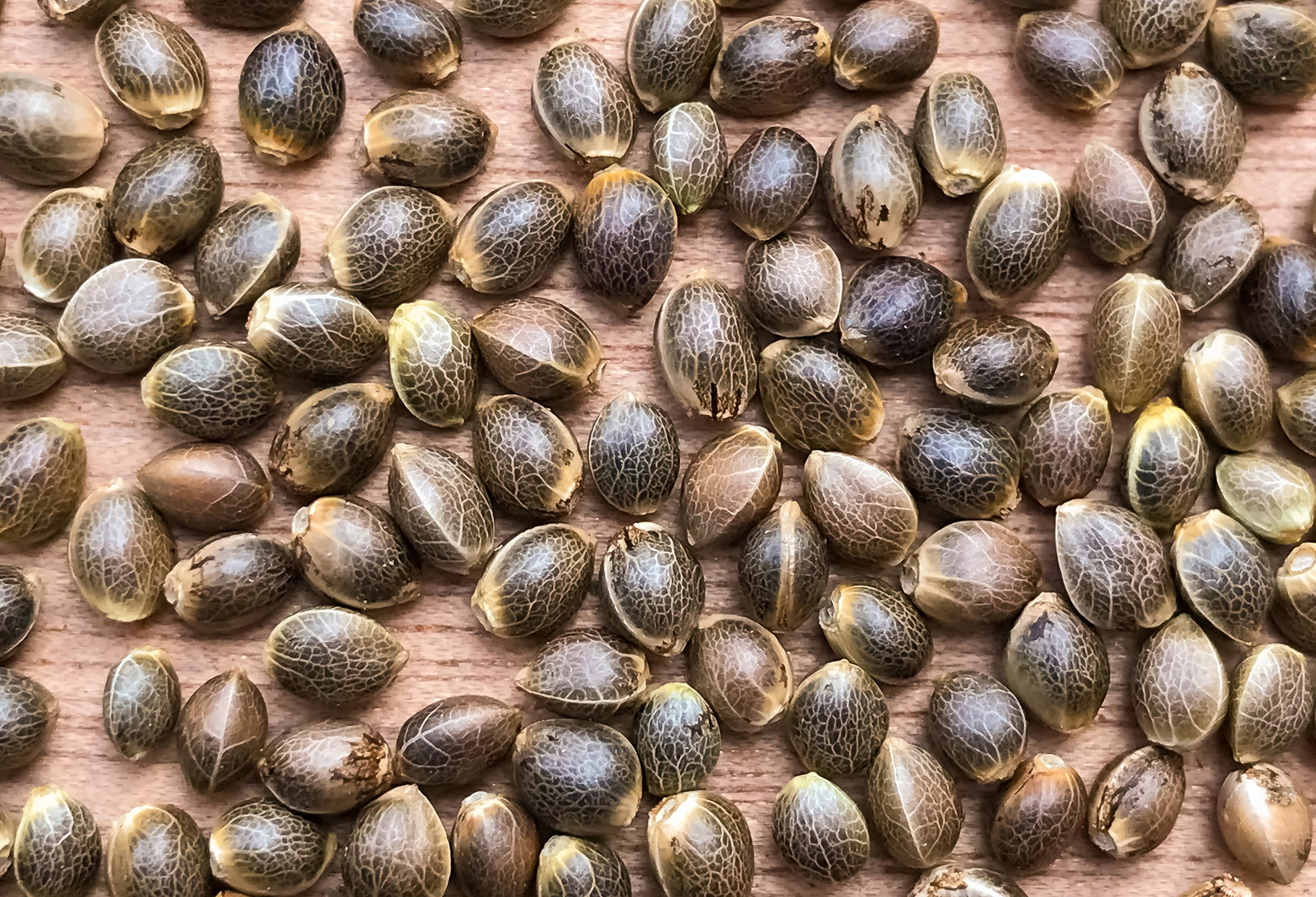
Translate Flowering, Yield, Chemistry, and Resistance Claims Into Testable Questions
Most seed listings become difficult when they move from identity into performance. A parentage statement is at least a claim about how the seeds were made. A number such as “8 weeks,” “600 g,” or “28% THC” is meaningful only when the measurement conditions are known. The critical reading skill is to convert every performance claim into a variable, an environment, and a verification method.
How to Read a Cannabis Seed Description
Read descriptive copy in two columns mentally: observable information and persuasive language. “Tall plant with strong lateral branching” can become a measurable architecture note. “Explosive vigor” is promotional until the page defines comparison conditions. “Early outdoor finisher” becomes useful if the listing gives latitude, approximate date, photoperiod behavior, or trial region. “Mold resistant” is weak unless the source says which disease, under what pressure, and compared with what.
Words such as “easy,” “elite,” “premium,” “legendary,” “stable,” and “commercial” may reflect a source’s reputation or intended positioning, but they are not measurements. Keep them out of the evidence column unless the listing attaches a specific observation.
Flowering time needs a starting point
When a listing gives flowering weeks, identify what starts the clock. Indoors, sellers often mean time after the flowering photoperiod begins, but visible flower initiation may occur later. Outdoors, the same cultivar responds to seasonal day length, latitude, twilight, local light pollution, temperature, and individual variation. An “8 week” indoor description therefore cannot be pasted directly onto an outdoor calendar.
For an outdoor listing, stronger evidence includes the region or latitude where the line was tested, first flower date, finish window, frequency of early or late phenotypes, and the weather pressure present during the trial. For indoor use, record the light schedule used to initiate flowering and whether the stated duration ends at harvest, breeder target maturity, or another endpoint.
Separate total life cycle from flowering duration in autoflower listings
Autoflower listings frequently use phrases such as “70 days,” “10 weeks,” or “seed to harvest.” That may describe an estimated total life cycle rather than flowering duration. A photoperiod listing may use a similar number to describe only the flowering phase. Put these numbers in different database fields. Otherwise two superficially identical “10 week” claims can refer to completely different biological timelines.
For day-neutral material, record emergence date, first visible reproductive development, and harvest date. For photoperiod-sensitive material, record the environmental trigger or indoor light-cycle change as well. This creates a timeline you can compare rather than a single ambiguous duration.
Photographs are phenotype evidence only when their context is known
Catalog photographs are useful for documenting the source’s visual claim, but ask what they show. Is it the seed parent, pollen parent, a selected offspring, a production phenotype, or an unrelated marketing image? Is the flower fresh, dried, heavily edited, or photographed under colored lighting? Is plant architecture visible, or only a trimmed flower?
If the listing labels the plant number or phenotype, preserve that identifier. If not, save the image as “source image, phenotype not specified.” This prevents a visually exceptional selection from becoming your assumed population average.
Yield claims require area, plant count, environment, and harvest definition
Yield is one of the least portable numbers on a seed page. Indoor grams per square meter depends on canopy density, light intensity and distribution, vegetative duration, root volume, plant count, environmental control, training, health, and whether the number describes dry trimmed flower. Outdoor grams per plant can be even more variable because plant size and season length can change by multiples.
Record the advertised figure, but do not use it as your expected harvest without context. A more useful field is “seller yield claim and stated conditions.” If the conditions are missing, mark them missing.
Cannabinoid percentages describe previous samples or breeding targets
A seed does not contain the future harvested flower percentage printed on the listing. Chemistry is influenced by genotype, environment, maturity, harvest timing, drying, storage, sampling, and laboratory method. A seller may be reporting a maximum, a range, an average, a parent result, or a selected phenotype. Unless the page explains the basis, you do not know which.
Record cannabinoid claims as source-reported chemistry. Attach laboratory documents only to the plant, batch, or sample they actually represent. Cannabis research has shown both genetic and chemical inconsistency under shared commercial names, which is exactly why a listing percentage should not become a permanent property of the name in your own database.
| Claim | Critical question to add to your record |
|---|---|
| 8-9 week flowering | From what starting event, in what environment, and to what maturity endpoint? |
| High yield | Per plant or per area, wet or dry, under what light/site conditions, with what plant size and duration? |
| 25% THC | Maximum, range, average, or one tested phenotype? Which sample and laboratory method? |
| Mold resistant | Which disease, what level of pressure, what flower architecture, and what comparison population? |
| Drought tolerant | Compared with what, in what root zone, and was reduced irrigation actually measured? |
| Beginner friendly | What failure mode is supposedly forgiving: watering, training, nutrition, temperature, timing, or recovery? |
Do not convert a catalog disease claim into a crop-protection guarantee
“Mold resistant” and similar language should not replace scouting, airflow, sanitation, weather management, or local disease knowledge. Resistance may be disease-specific, partial, environment-dependent, or based on limited observations. If the listing does not identify the disease and trial conditions, treat the claim as low-confidence until your own records support it.
Match the Listing to Your Actual Grow Instead of the Seller’s Ideal Scenario
A seed listing becomes useful when you stop asking whether the cultivar sounds good and ask whether the material fits your environment, legal limits, space, timing, and management capacity. The same listing can be a reasonable fit for one grower and a poor fit for another without either interpretation being wrong.
Build your requirements before you compare products
Write the non-negotiable constraints first. Outdoors, that may include latest acceptable finish date, expected autumn rain, frost risk, maximum visible height, security requirements, water reliability, disease history, and whether you can visit the site daily. Indoors, it may include ceiling height, canopy area, vegetative time available, lighting capacity, root-zone volume, climate control, and whether you need a short recovery cycle between runs.
Then read the listing against those constraints. This reverses the normal sales-page workflow. Instead of letting the page tell you which traits matter, you decide which traits matter before the page appears.
Separate must-pass criteria from preferences
A cultivar that cannot finish before your recurring cold rain is not rescued by an attractive aroma description. A line likely to exceed your legal plant or space constraints is not made appropriate by a high yield claim. A photoperiod-sensitive line that needs a long season may be a poor outdoor choice at your site even if it performs beautifully indoors.
Use two columns. Must pass contains finish timing, legal fit, plant size limits, flowering behavior, and the environmental risks that can destroy the crop. Preferences contains flavor direction, color, novelty, maximum yield, and other traits that matter only after the line can complete the grow successfully.
Field Advice: The most useful seed page is not the one with the most traits. It is the one that gives enough context to reject a poor fit before you spend a season discovering the mismatch.
Compare evidence from climates that resemble yours
“Outdoor tested” is too broad by itself. A line tested in a dry inland summer, a humid coastal autumn, a high-elevation garden, and a long subtropical season has faced different selection pressures. If climate-specific performance matters, look for temperature pattern, rainfall timing, humidity, latitude, frost window, wind, or disease context rather than the word outdoor alone.
If that evidence is not on the listing, your confidence should drop, not your standards. You may still choose the line, but document that the climate fit is unverified and treat the first season as a trial.
“A listing says the cultivar is good indoors and outdoors. Is that enough climate information?”
Question sent by: QuietLeaf, via contact form.
No. That is a broad compatibility claim. For outdoor planning you still need finish timing, photoperiod response, plant architecture, disease observations, and ideally trial information from a climate that resembles yours. “Indoor/outdoor” tells you where someone has grown it, not whether it solves your local limiting problem.
Save the Product Page and Build a Traceable Seed Record
Seed product pages change. A seller can edit a flowering range, replace photographs, alter parentage wording, update a generation marker, remove a laboratory report, change the breeder attribution, or delete the product entirely. If you want to compare your plants with the description months later, the page you read before planting has to survive independently of the website.
How to Save a Seed Product Page and Build a Grow Record
Save the page before purchase or planting using at least two formats. A full-page screenshot preserves layout and visible wording. A PDF or local print-to-PDF copy preserves searchable text. Store the exact URL and the date saved in the filename or record. If the page links to a breeder description, technical sheet, laboratory report, or downloadable specification, save those separately rather than assuming the links will remain live.
Do not rely on a bookmark. A bookmark preserves an address, not the historical content at that address. Third-party web archives can sometimes help later, but your own dated copy is more reliable for the version you actually used.
Give every saved page a version identity
A practical filename can include the cultivar name, source, and ISO date, for example line-name_source_2026-08-29.pdf. If the page changes later, save the new version rather than replacing the old one. Add a short version note: parentage changed, flowering range changed, photograph changed, generation added, or no material change noticed.
This is especially useful when you buy the same named line again after a year or two. The second packet may come from a later reproduction or a new lot even when the product URL is unchanged. Versioned source files let you ask whether the description changed at the same time as the plant population.
Store files so the record survives a platform change
Keep the archived page, pack photographs, order record, and plant notes in a folder you control rather than only inside a seller account, note-taking app, or social platform. Use ordinary file formats such as PDF, JPG/PNG, CSV, TXT, or DOCX that can be moved later. A sophisticated database is optional. Durable traceability is not.
Back up the record in at least one additional location. The goal is not cybersecurity theater. It is simply avoiding the situation where a phone failure, deleted account, or redesigned website erases the only link between a seed packet and the phenotype you are evaluating months later.
Photograph the physical pack before opening it
The physical packet may contain information that never appeared online: lot or batch code, pack date, seed count, generation notation, breeder mark, warning, storage instruction, barcode, importer/distributor information, or a slightly different cultivar spelling. Photograph the front and back in good light before the packet is damaged or discarded.
Keep the original pack until the run is documented. If each packet contains multiple seeds, assign the packet an ID and each plant an individual ID. A practical format is LINE-2026-01-P01, P02, and so on. The exact naming convention matters less than using it consistently.
Record lot identity when it exists
General seed regulation provides a useful principle even where drug-type cannabis rules differ: agricultural seed systems treat truth in labeling, varietal identity, purity, germination, treatment, and shipper information as meaningful buyer information. The U.S. Federal Seed Act, for example, is a truth-in-labeling framework for agricultural and vegetable seed shipped in interstate commerce. That does not mean every drug-type cannabis seed listing falls under the same federal framework. The useful lesson is that a seed lot is more traceable when identity and quality information travel with it.
When a cannabis pack provides a lot code, do not throw it away. When no lot exists, record the purchase date and order identifier privately in your grow record so you can distinguish one acquisition from another.
Create one seed record and one plant record
The seed record describes the source population. The plant record describes one individual. This separation prevents a common database problem where observations from one standout phenotype become permanent claims about every seed carrying the same name.
| Record | Fields worth preserving |
|---|---|
| Seed source record | Exact name, source, breeder attribution, URL, saved-page date, parentage, generation, seed type, lot/pack code, source claims, files, photographs, and legal/source notes. |
| Individual plant record | Plant ID, germination date, emergence date, sex where relevant, architecture, first flower date, finish date, health events, climate observations, harvest weight, phenotype notes, and laboratory result if available. |
| Season comparison record | Location/microclimate ID, grow system, container or root-zone details, major weather events, management differences, and which individuals were retained or rejected for future comparison. |
“Why save the page if I already have the seed packet?”
Question sent by: Hannah Cooper, via email.
Because the packet and listing often contain different information. The pack may preserve lot identity, while the page may contain parentage, flowering ranges, environment claims, photographs, or chemistry notes. Save both. Together they show what you were told about the material at the time you made the decision.
Spot Missing Context, Contradictions, and Marketing Shortcuts
A critical reading workflow should not become a game of finding reasons to distrust a seller. The purpose is to identify where a claim deserves high, medium, or low confidence. Some listings are short because the source does not publish much data. Others are long but still provide little verifiable information. Length is not evidence quality.
Red flag: precise numbers with no measurement context
A narrow THC percentage, exact height, exact harvest day, or large yield number can look scientific while remaining context-free. Ask whether the page explains sample number, range, environment, measurement endpoint, and whether the result refers to the whole population or one selected phenotype.
Red flag: contradictory parentage or generation across the same source
If the product title says F1 and the body says F2, do not decide which one is correct yourself. Save both versions and mark the conflict. If parentage differs between the breeder page and reseller page, record the sources separately. Use the original breeder/source documentation as stronger evidence when its identity is clear, but do not silently erase the conflict.
Red flag: resistance without a named problem
“Resistant to mold and pests” is too broad for serious planning. Botrytis, powdery mildew, root pathogens, mites, caterpillars, and other pressures involve different mechanisms. A line can show useful flower architecture in wet weather without being genetically resistant to every fungal disease. Translate the statement into the specific problem you need the plant to survive.
Red flag: one photograph presented as population identity
A flower photograph can document what one selected plant looked like under one environment and postharvest workflow. It does not show the range of sibling phenotypes in the packet. If photographs are useful for your record, save them, but label them as source images rather than expected outcomes.
Red flag: effects language used as cultivation evidence
Descriptions such as relaxing, energetic, creative, sedating, or uplifting do not tell you whether the seed line will finish in your climate, tolerate humidity, remain compact, or recover from transplant stress. Keep subjective consumption language separate from cultivation selection. Medical treatment claims also belong outside a cultivation record.
Do not treat a product page as proof that purchase, possession, germination, or cultivation is lawful where you live
Cannabis seed laws and home-grow rules vary by jurisdiction and can differ between possession, sale, shipping, germination, and cultivation. Check current official rules before acting. A seller’s ability to display or ship a product is not a substitute for your local legal verification.
Red flag: the page changes the meaning of the same number in different sections
Product pages are often assembled from templates, specification tables, translated copy, and older descriptions. One area may say “8 weeks flowering” while another says “8 weeks from seed.” One table may list a 150 cm maximum while the body says 250 cm outdoors. Do not average the contradiction. Capture it. Contradictory numbers are a documentation issue to resolve with the source, not a puzzle for the grower to solve by guessing.
Red flag: provenance is replaced by a famous parent name
A recognizable parent name can create confidence without identifying the actual parental plant. Ask whether the source specifies a clone, breeder selection, seed-derived parent, phenotype number, or acquisition history. “Parent A” may mean a verified preserved cut in one program and a seed-grown plant carrying the same market name in another.
This does not mean undocumented parentage is false. It means the confidence level is lower. Preserve the claim, preserve the source, and avoid upgrading it into verified provenance in your own records.
Missing information can be recorded without being invented
Use explicit blanks: parentage not stated, generation not stated, trial environment not stated, disease evidence not stated. This is better than filling a database with guesses that later appear factual. Unknown is a useful data state.
Master Advice: A disciplined grow record contains more “unknown” fields than a careless one. Unknown can be investigated. Invented certainty is much harder to remove later.
Verify the Listing Against the Plants and Keep Only the Claims That Survive
The final step is to turn the listing into a testable hypothesis. You are not trying to prove the seller right or wrong from one plant. You are building a local evidence record that becomes more useful over repeated plants, lots, and seasons.
Choose verification points before germination
Mark the claims that matter most to your decision and decide how you will verify them. If finish timing matters, record first reproductive signs and actual harvest date. If height matters, measure from the same reference point at consistent intervals. If disease response matters, record weather pressure and symptoms instead of simply writing “mold resistant.” If yield matters, define whether you are recording dry trimmed flower and use the same method across plants.
Do not rewrite the seed listing after seeing one phenotype
If one plant finishes early, write “Plant P03 finished early in this environment.” Do not change the source description to “this cultivar is an early finisher” unless repeated evidence supports that conclusion. The seed line is a population. Your plant is one sample from it.
Compare siblings before comparing the line with another cultivar
Within-packet variation tells you something important about predictability. If five siblings differ substantially in flowering onset, height, flower structure, or disease response, that is a different management problem from a population where all five cluster tightly. Record the spread, not only the best plant.
Recent cannabis seed-genotyping work reinforces why this matters: commercial seed populations can show meaningful within-line genetic variability, and some named varieties include samples that do not group as expected. The practical response is not panic. It is traceability.
Verify germination and early vigor without confusing them with genetic quality
Germination percentage and early vigor are useful lot-level observations, but they do not tell you whether the lineage, flowering claim, chemistry target, or disease claim is correct. Record how many seeds were started, how many germinated, emergence timing, and any obvious abnormalities. Then keep those fields separate from later phenotype quality.
A packet with uneven germination may have age or storage issues while still containing valuable genetics. A packet with perfect germination can still be highly variable for adult traits. One layer of quality should not stand in for another.
Update confidence, not history
When your evidence changes, do not edit the old source claim until it matches your new conclusion. Keep the original claim immutable and add a local assessment beside it. For example: “Source claim: 8-9 weeks. Local observation: P01 9.5 weeks, P02 10 weeks, P03 11 weeks under documented indoor conditions.” The history remains auditable and the new evidence remains visible.
This version-control habit is what turns casual grow notes into a useful long-term dataset. You can later compare source accuracy, population consistency, and environment response without wondering whether an earlier number was the seller’s statement or your own result.
Use a simple evidence grade after the grow
| Confidence | What it means in your record |
|---|---|
| Confirmed locally | The claim was measured repeatedly in your material under documented conditions, ideally across several individuals or runs. |
| Supported | Your observations were consistent with the listing, but sample size or environmental range is still limited. |
| Unverified | You did not create the conditions or measurements needed to test the claim. |
| Contradicted locally | Your documented observations repeatedly ran against the listing under the conditions tested. Keep the source claim and your result as separate fields. |
Revisit the saved page after harvest
Open the archived product page beside the completed plant records. Compare parentage, flowering, architecture, disease claims, yield language, and chemistry claims with what you actually measured. Note whether the live page has changed. If it has, keep both versions rather than overwriting the original.
This step turns a product page into a long-term cultivation tool. After several grows, your database can tell you which sources provide useful outdoor timing, which generation labels corresponded with broad or narrow phenotype ranges in your hands, and which marketing fields were poor predictors.
Before you buy, plant, or archive the listing
- I saved the exact product URL and the date I read it.
- I saved a screenshot or PDF rather than relying only on a bookmark.
- I recorded the exact cultivar/line name and source separately.
- I copied parentage and generation without silently correcting missing or conflicting information.
- I separated seed type from generation notation.
- I identified what starts any stated flowering-time clock.
- I recorded the context behind yield and chemistry claims, or marked that context missing.
- I translated “resistant,” “stable,” “easy,” and similar adjectives into testable questions.
- I compared the listing with my must-pass climate, space, timing, and legal constraints.
- I photographed the physical packet and preserved any lot or batch identifier.
- I created individual plant IDs so one phenotype cannot overwrite the seed-line record.
- I know which claims I will measure during the grow and how I will define success.
What the listing should become after one full grow
By the end of the run, the seed listing should no longer be the final authority in your notes. It should be the starting record sitting beside your actual plant data. Keep the seller’s original wording intact, then add your observations as a separate layer. That way the record remains honest even when the plant surprises you.
A good seed description helps you form expectations. A good grow record tells you which expectations survived contact with your environment. The combination is far more useful than either one alone.
Share this article
A quick overview of the topics covered in this article.
Follow us
Latest articles

September 4, 2026
September 4, 2026
September 4, 2026
September 4, 2026