Legal Outdoor Garden Security Without Dangerous Traps
Outdoor cannabis security should make a legal garden harder to enter, easier to monitor, and less obvious to people who do not need to know it is there. It should not turn the property into a hazard. You do not need hidden spikes, improvised electrical barriers, tripwires, razor wire around a home garden, or any device designed to injure someone. Those measures can create serious legal and safety problems while doing very little to improve day-to-day garden management.
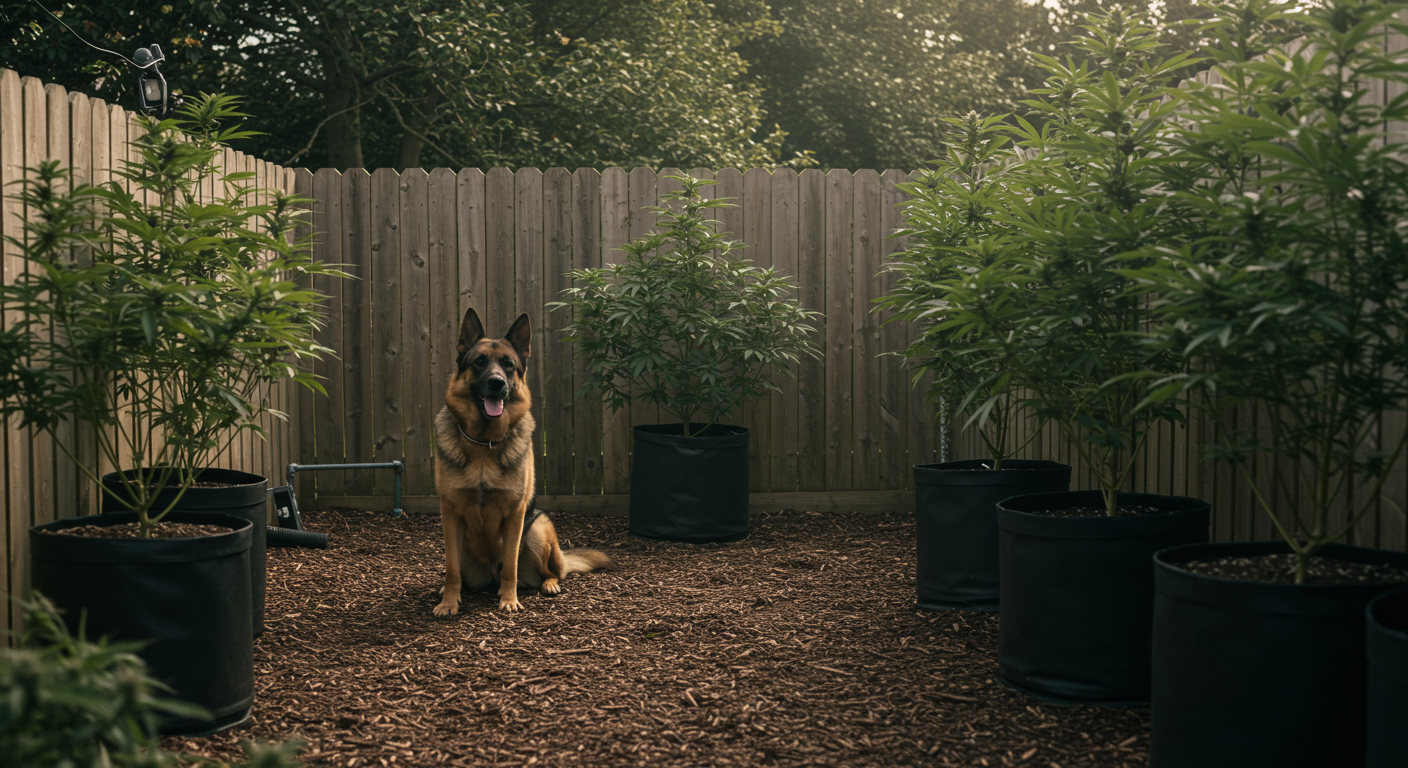
The better approach is layered and quiet. Start with the site. Reduce unnecessary visibility. Control normal access with a gate, lock, fence, enclosure, or existing building feature when those measures are legal and appropriate. Add lighting or cameras only where they genuinely improve awareness and do not interfere with the plant’s dark period, your neighbors, or local privacy rules. Keep children, pets, visitors, and wildlife in mind. Then decide how you will respond if something still goes wrong.
This resource is about that security decision. It does not repeat the full outdoor growing process. If you still need the wider framework for site selection, soil, watering, seasonal care, flowering, and harvest, use the complete outdoor cannabis growing guide as the parent resource.
Resource Navigation
In This Resource
- Define the outdoor decision in terms of site, season, climate, legal access, and plant risk
- Measure the site: sun path, shade, temperature, humidity, wind, drainage, water access, cold pockets, or contamination as relevant
- Seasonal timing: latitude, photoperiod, weather windows, and cultivar behavior
- Practical setup/response plan with materials, placement, inspection points, and a backup option
- Failure modes: stagnant air, trapped moisture, heat load, frost, wind damage, water shortage, security, or neighbor impact
- Legal/safety boundary without guessing local rules or recommending dangerous traps
- Pre-season and weekly checklist that turns the article into a repeatable field procedure
Define the outdoor decision in terms of site, season, climate, legal access, and plant risk
The first security question is not, “Which lock should I buy?” It is, “What am I actually trying to prevent?” A home garden beside a private back door has a different risk profile from a lawful rural garden near a public road. A small balcony plant has different access problems from a ground-level garden where children, dogs, deer, contractors, or visitors may pass through.
Before adding anything, define the purpose of security. You may need to prevent casual access. You may need to keep the plants out of public view. You may need a locked enclosure because local law requires one. You may need wildlife exclusion. You may simply need to stop a gate from being left open. Those are different problems, and they should not automatically receive the same solution.
Start with legality, because the legal rule can define the security design
Cannabis home-grow rules vary sharply by jurisdiction. Some places allow home cultivation but require plants to remain out of public view. Others require a locked or enclosed area. Some allow local governments, landlords, housing providers, or strata associations to impose additional restrictions. In other places, home cultivation itself is prohibited.
That is why “I saw someone online using a six-foot fence” is not a legal standard. The fence that works in one city may be unnecessary in another, too short in a third, or prohibited by a separate zoning rule. Before you design security, verify the current rule that applies to your exact property.
Health Canada, for example, explicitly tells home growers to follow relevant provincial, territorial, and municipal rules, and it recommends practical security measures such as limiting visibility, using a locking gate, and considering an alarm. British Columbia law requires non-medical home-grown cannabis plants not to be visible from a public place. Colorado’s current legislative guidance describes home cultivation as requiring an enclosed and locked space. These examples are useful because they show why there is no single worldwide home-grow security formula.
Important: Treat legal compliance as the first security layer. A hidden garden is not a legal garden merely because nobody can see it. Security measures should support lawful cultivation, not substitute for it.
Separate access control from concealment
Growers often treat privacy and security as if they are the same thing. They overlap, but they solve different problems.
A tall hedge may block a view but provide almost no controlled access. A chain-link fence may make access harder but still leave the plant visible. A locked shed or greenhouse may address access and visibility at the same time, but it can also change temperature, humidity, airflow, and light. A camera may document access without physically preventing it.
Think of the system in layers:
| Security function | What it is trying to accomplish |
|---|---|
| Privacy | Reduce unnecessary visibility from streets, public paths, neighboring viewpoints, or other locations that matter under local rules. |
| Access control | Limit entry with normal barriers such as doors, gates, fences, locks, or enclosed garden areas. |
| Detection | Alert you that someone entered or approached, using ordinary alarms, door or gate sensors, motion detection, or lawful cameras. |
| Delay | Make casual unauthorized entry slower and less convenient without creating an injury hazard. |
| Response | Define what you will do if access occurs, such as checking a camera alert, securing the area, documenting damage, or contacting the appropriate authority. |
No single layer is perfect. A locked gate can be left open. A camera can lose power. A privacy screen can blow down. A motion light can create nuisance glare. The purpose of layering is not to turn a backyard into a fortress. It is to make ordinary failure in one layer less important because another layer still works.
Layered security
Layered security uses several ordinary protective measures instead of depending on one extreme barrier. In a home garden, that might mean discreet placement, a legal fence or enclosure, a locked gate, a simple alert, and a response plan. The layers should reduce access and improve awareness without creating dangerous conditions.
Use the plant risk, not fear, to decide how much security is enough
It is easy to overspend or overbuild when the conversation starts with theft. A better method is to look at the actual exposure of the garden.
Can the plants be seen from a public road? Is the garden directly beside a shared access path? Do children use the yard? Do contractors or delivery workers routinely enter through the same gate? Are deer or other large animals common? Is the property vacant for long periods? Does the garden become obvious only late in flowering, when the plants are taller and more aromatic?
If the garden is already behind a lawful locked fence on private property, additional barriers may add little. If the property is open and the plants are visible from a public sidewalk, a more deliberate security plan may be necessary even if theft has never happened before.
I already have a fenced backyard. Do I need another fence around the plants?
Question sent by: Ethan Brooks, via email.
Not automatically. First check what your local rule actually requires. Then look at who can access the yard and whether the existing fence controls that access. A second fence may be useful when children, pets, tenants, workers, or visitors regularly use the same yard, but adding another barrier without a clear purpose can create shade, reduce airflow, complicate watering, and make routine inspection harder.
Security must remain compatible with growing
A garden can be secure and horticulturally poor at the same time. This is where good intentions cause problems. A grower encloses a sunny corner with solid privacy panels, then discovers that the same panels block morning light, trap hot air, and slow drying after rain. Another adds strong security lighting and unknowingly illuminates photoperiod-sensitive plants during the night.
The security system must work with the garden rather than against it. That means every barrier, light, camera, screen, gate, and enclosure should be checked for its effect on sunlight, airflow, drainage, access, and the dark period.
If a security measure solves one problem while creating two growing problems, redesign it.
Measure the site: sun path, shade, temperature, humidity, wind, drainage, water access, cold pockets, or contamination as relevant
Security planning becomes much easier when you stop looking at the garden as a dot on a map and start looking at the routes, sightlines, and environmental effects around it. You can do most of this without special equipment.
Walk the property during daylight. Then walk it again after dark. Use the route that a visitor, delivery worker, neighbor, child, pet, or wildlife animal would naturally use. Look back toward the garden from outside the growing area. The things you notice from those positions are often more useful than what you see standing beside the plant.
Map the sightlines before building privacy
Stand at the street, public footpath, shared driveway, neighboring access area, or other lawful viewpoint that may matter under local visibility rules. Can you see the future growing area? Remember that a plant that is 30 cm tall early in the season may later become taller than the fence or screen that hides it today.
Do the same check from different angles. A backyard can be completely hidden from the road and still visible through a side gate. A balcony can be invisible from ground level but obvious from the building opposite. A plant behind a fence may become visible when the branches rise above the top.
Do not solve this immediately by making everything taller. First identify the specific sightline. Often a small change in plant placement solves the problem with less shade and less construction.
Measure the shadow created by fences and screens
A privacy barrier is also a shade-producing object. Its effect changes with sun angle, season, orientation, and distance from the plant.
Before installing a solid screen, watch the proposed location through the day. If the plant is on the north side of a tall solid fence in the Northern Hemisphere, for example, that fence may cast substantial shade when the sun is lower. In the Southern Hemisphere, orientation reverses. The exact shadow changes with latitude and season, so direct observation is more useful than memorizing a generic rule.
If the barrier already exists, place a marker where the mature canopy is expected and record when direct light reaches and leaves that point. If you are planning a new screen, temporary poles and shade cloth can help you visualize the footprint before committing to a permanent structure.
Field Advice: Privacy works best when it blocks the relevant view without wrapping the plant in a dark box. Move the plant, redirect the sightline, or use a smaller targeted screen before assuming the entire perimeter needs to become opaque.
Check clearance around the mature canopy
Do not measure clearance around the young plant. Think about the canopy you expect later.
You should be able to reach the plant for watering, inspection, support, pest scouting, and emergency work. If a fence or enclosure leaves only a narrow slot around a mature plant, the inner canopy may become difficult to inspect and slow to dry.
There is no universal cannabis-to-fence distance that works for every garden. A narrow trained plant is different from a broad outdoor bush. The practical test is whether you can still move around the plant and whether air can move through the space when the canopy is full.
Watch how the barrier changes wind
A solid fence does not simply make wind disappear. Air is forced over, around, and through gaps in the structure. That can create a calm pocket close to the fence and stronger turbulence farther downwind.
University extension guidance on agricultural windbreaks emphasizes that wind protection depends on density, spacing, height, and design. Living windbreaks are useful partly because they filter airflow rather than behaving like a perfectly solid wall.
If wind protection is one purpose of your garden security, observe the site during actual wind. Look at leaves, grass, ribbons, or surrounding vegetation on both sides of the barrier. You want reduced damaging force without completely eliminating useful air movement.
Check heat and moisture after you add privacy
A privacy fence can make a garden warmer by reducing air movement or reflecting solar radiation. A plastic enclosure can increase the effect further. A structure that feels comfortable on a cool spring afternoon may behave differently in midsummer.
After installing or modifying a barrier, compare the growing area with the open garden. Check the afternoon temperature. Check how quickly foliage dries after rain or morning dew. Feel whether air moves through the lower and inner canopy.
If wet foliage remains damp much longer than surrounding plants, treat that as a design warning. Security should not create a disease-friendly microclimate around flowers.
Do not seal a cannabis garden inside improvised plastic for privacy
A tightly enclosed plastic barrier can trap heat and humidity, reduce air exchange, collect condensation, and become unstable in wind. If privacy is needed, design the screen around ventilation and access rather than wrapping the garden in an unventilated enclosure.
Map normal access points
Security often fails through ordinary behavior, not forced entry. A side gate is left unlatched. A gardener enters to mow the lawn. A delivery is brought through the backyard. A child visits with family. A dog pushes through a weak gate. Someone gives a spare key to a neighbor and forgets that the garden is now accessible.
List the doors, gates, paths, driveways, and shared spaces that lead toward the grow. Then ask who normally uses each one.
If a gate is the primary access point, it should close reliably and the lock should be easy enough to use that people do not prop the gate open. If a camera is used, place it where it can monitor the access route without unnecessarily recording private areas belonging to neighbors.
Check lighting from both directions
Security lighting has two jobs to balance. It should help you see an access point when needed, but it should not illuminate everything all night simply because more light feels safer.
For photoperiod-sensitive cannabis, repeated nighttime light can also matter biologically. A bright fixture aimed directly at the canopy can interrupt the dark period and contribute to irregular flowering responses in sensitive genetics.
Stand beside the plant at night and look toward the house, street, neighboring property, and security fixtures. Then stand at the property boundary and look back. Shielded, downward-facing, motion-activated lighting is often easier to manage than a powerful floodlight that stays on continuously.
Also check local outdoor-lighting and nuisance rules. Security lighting is still subject to property and municipal requirements.
Can I leave a bright motion light above the garden all night for security?
Question sent by: NorthSideMike, via email.
A motion light that stays off until it is triggered is different from a fixture that shines on the canopy all night. Keep the beam aimed at the access route rather than the plant and verify what the garden actually looks like after dark. If the fixture repeatedly lights the canopy, adjust the angle, shielding, sensitivity, or placement. You want useful visibility at the gate, not accidental supplemental lighting during flowering.
Include water, drainage, and emergency access in the security survey
A gate that makes the garden difficult to water will eventually be left open. A fence that blocks drainage can collect water along its base. A narrow enclosure can prevent you from carrying in a large container or reaching a broken branch after a storm.
Before calling the design finished, walk through normal garden tasks. Bring the hose through. Carry the tools you expect to use. Imagine removing a mature plant at harvest. Make sure emergency access remains practical.
The easiest security system to maintain is one that does not fight the work you need to do every week.
Seasonal timing: latitude, photoperiod, weather windows, and cultivar behavior
Security changes as the plant changes. A young plant may be almost invisible and have very little odor. Late in the season, the same garden can be taller, heavier, more aromatic, and more obvious from beyond the property. That means your security plan should not be judged only on planting day.
Visibility can change faster than expected
Outdoor cannabis can gain substantial height and width during vegetative growth, especially when roots have room and the season is long. A screen that hides a small plant in early summer may become useless once the canopy rises above it.
Check sightlines again as the plant reaches roughly half of its expected final size and again before flowering becomes dense. Do not wait until the top of the plant is visible from the street before noticing that the privacy layer has failed.
If the plant is growing toward a legal height or visibility limit, training and placement may be easier to adjust early than a permanent fence later.
Aroma changes the security picture
Privacy is not only visual. Flowering cannabis can produce a strong aroma, and the intensity can change dramatically between cultivars and through the flowering cycle.
Outdoors, odor control is limited compared with a sealed indoor environment. You cannot put a carbon filter on the wind. Site selection and distance from neighbors therefore matter more than trying to solve the problem after the flowers are already aromatic.
Walk the property boundary during flowering. If the odor is strong at a public or neighboring area, treat that as a neighbor-impact and security issue even if local law does not explicitly mention smell.
Photoperiod changes how you use lights at night
During vegetative growth, a brief accidental light event may have little practical consequence. During the reproductive phase, repeated or strong nighttime illumination becomes more relevant for photoperiod-sensitive plants.
That does not mean the garden must be completely dark in an absolute laboratory sense. It means you should avoid designing a security system that repeatedly shines a bright fixture directly into the canopy for long periods.
Test the system after the days begin shortening. Motion sensors can behave differently when insects, tree branches, pets, or wildlife trigger them. A light that was intended to turn on twice a week may activate dozens of times each night.
Storm season can expose weak security structures
Privacy screens, temporary fencing, shade cloth, camera mounts, and motion lights all become physical objects in the wind. If they are poorly anchored, they can collapse into the plant or become hazards around the property.
Before your region’s stormy period, inspect posts, hinges, latches, fasteners, and any fabric panel that catches wind. A security feature should not become the object that breaks the crop.
Do the same before frost or heavy rain. Some enclosures collect water or snow loads. Others restrict access exactly when you need to move quickly.
Harvest changes the value and movement around the garden
Late flowering and harvest are the periods when a garden may be most noticeable and the material has the greatest practical value. Security should become more attentive, not more aggressive.
Make sure normal access is controlled. Avoid advertising harvest dates publicly. Plan how cut material will move from the garden to the drying area without leaving gates open or material unattended.
If your local rules include possession, transport, storage, or harvested-cannabis requirements, verify those before harvest rather than assuming the growing rule covers everything that happens afterward.
Remember: The security requirement can change through the season even when the law does not. A small vegetative plant and a mature flowering garden create different visibility, odor, structural, and access problems.
My plants are hidden now, but they will probably grow above the fence. Should I raise the fence?
Question sent by: Olivia Carter, via contact form.
First verify whether public visibility is actually restricted where you live and from which viewpoints. Then look at the easier horticultural options. Moving the plants, training them wider, choosing a lower-profile cultivar in future seasons, or adding a targeted legal screen may solve the problem with less shade and wind load than raising an entire perimeter fence. If you do change a permanent fence, check local height, setback, permit, and property rules first.

Practical setup/response plan with materials, placement, inspection points, and a backup option
A useful security plan can stay simple. You are not designing a high-security facility. You are creating enough separation between the garden and ordinary unauthorized access while keeping the space safe and easy to manage.
The cleanest way to do that is to build from the inside out.
Layer 1: make the garden less obvious
Good placement often gives you the cheapest security improvement. A garden behind the house, away from public sightlines, and outside the normal route used by visitors is easier to manage than one placed beside a front fence simply because that spot gets good sun.
Natural landscape features can help, but do not use vegetation so dense that it blocks air around the canopy or creates a hidden access route where you cannot see what is happening.
Also be careful about what you share publicly. A photograph can reveal landmarks, house numbers, neighboring structures, or metadata that identifies a location. You do not need to announce where a legal home garden is located to prove that it exists.
Layer 2: control the ordinary entrance
For many home gardens, the gate matters more than the fence material. A tall fence with a gate that never latches is mostly visual theater.
Use a reliable gate and a normal locking method appropriate to the property and local rule. The lock should resist casual opening but remain practical for authorized adults. Keep keys or combinations controlled. If several people need access, decide who actually needs it instead of distributing access casually.
If the existing property fence already satisfies the legal and practical requirement, a second inner fence may not add much. If children or pets share the yard, however, an inner enclosure can create a useful separation between general yard access and the cannabis area.
Do
Use ordinary, visible access control
Use a lawful gate, lock, fence, enclosure, or existing property barrier that clearly separates the garden from normal traffic and can be inspected easily.
Avoid
Trying to surprise or injure an intruder
Do not use concealed spikes, tripwires, improvised electrification, traps, chemicals, spring-loaded devices, or other measures intended to harm someone who enters the area.
Layer 3: use lighting as a tool, not a flood
Security lighting is most useful where it helps you see an entrance, gate, walkway, or specific approach. More light is not automatically better.
Aim fixtures downward and away from neighboring windows. Keep the beam off the cannabis canopy where possible. Use the lowest output that provides useful visibility. Motion activation can reduce unnecessary nighttime illumination, but only after you confirm that the sensor is not being triggered constantly by wind, pets, or wildlife.
If the garden is near a public path or neighboring property, consider nuisance-light and privacy concerns before installation.
Layer 4: add detection where it is genuinely useful
A camera does not physically stop access. What it can do is show you whether an alert is caused by a person, animal, delivery, or moving branch. A gate sensor can tell you when the access point opens. A simple alarm can draw attention to unauthorized entry.
Keep the system proportional. One camera covering the lawful entrance can be more useful than several cameras aimed across the entire neighborhood. Check privacy and recording laws before capturing audio or areas outside your property.
Mount equipment securely, protect cables from normal weather and garden work, and verify that the image remains useful at night. A camera hidden behind summer foliage is not much of a camera.
Layer 5: protect children and pets deliberately
If children or pets can enter the yard, design security around that reality rather than assuming adults will remember every time.
A latch should not be easily pushed open by a dog. A child should not be able to reach harvested cannabis, tools, nutrients, pesticides, or electrical equipment. Store harvested material and garden chemicals separately and securely.
Health Canada specifically emphasizes preventing unwanted access and keeping cannabis secure from children and pets. That is a useful principle even outside Canada because it frames security as household safety, not only theft prevention.
Layer 6: use humane wildlife exclusion
Wildlife security is different from human security. A deer does not care about your padlock, and a raccoon may use the same privacy screen that hides the plant as climbing structure.
Use ordinary humane fencing, netting, or exclusion appropriate to the species and local wildlife rules. Avoid snares, poison, sharp hidden objects, or improvised traps.
If large wildlife pressure is serious, consult local agricultural extension or wildlife guidance because effective fence height and design depend on the animal. The correct deer barrier, for example, is much different from what is needed for a rabbit or dog.
Layer 7: plan the response before an alert happens
This is the layer growers often forget.
What will you do if the gate alarm activates at 2 a.m.? What if a camera shows an unknown person? What if you arrive and find a damaged fence or missing plant?
Your plan should avoid unnecessary confrontation. Secure yourself and other people first. Document damage when it is safe to do so. Contact the appropriate local authority when theft, trespass, or another reportable event has occurred. If your jurisdiction has cannabis-specific reporting obligations, follow them.
Do not chase someone over a plant. Do not escalate a property crime into a personal safety emergency.
The response plan is not a confrontation plan
Security is meant to reduce risk. If an intrusion occurs, prioritize people over plants. Do not design your setup around the expectation that you will physically confront an intruder. Use lawful reporting, documentation, and property-security measures instead.
A practical minimum security setup
For many lawful home gardens, a reasonable minimum can be very modest: discreet placement, a secure legal perimeter or enclosed garden area where required, a gate that actually latches and locks, controlled household access, and regular inspection. Add motion lighting, cameras, alarms, or a second inner barrier only when they solve a real problem.
| If your main problem is… | Start with… |
|---|---|
| Public visibility | Repositioning, legal targeted screening, or an enclosure that preserves sunlight and airflow. |
| Children or pets | A clearly separated locked or latched inner area and secure storage of harvested material and garden products. |
| Casual unauthorized access | A reliable gate, ordinary lock, and reduced visibility from the normal approach. |
| Theft concern | Layered access control plus lawful detection such as a gate alert, alarm, or camera. |
| Wildlife | Species-appropriate humane exclusion rather than human-security hardware. |
| Wind and privacy together | A barrier that screens the relevant view while allowing enough airflow and remaining structurally stable. |
| Nighttime access | Targeted shielded lighting at paths and gates, not continuous floodlighting of the canopy. |
Pro Tip: If a security measure takes more effort to use than the garden itself, it will eventually be bypassed. The best system is boring enough to use every day: close the gate, lock it, check the alert, inspect the perimeter, move on.
Failure modes: stagnant air, trapped moisture, heat load, frost, wind damage, water shortage, security, or neighbor impact
Security features become part of the outdoor environment. Once that happens, they can fail in two ways. They can fail as security, or they can fail as garden infrastructure.
A good inspection looks for both.
The privacy screen creates stagnant air
This is probably the most common horticultural tradeoff. The screen works perfectly from the street, but the space behind it becomes still and damp.
Watch the inner canopy after rain or dew. If the garden remains wet long after open vegetation nearby has dried, the enclosure may be too tight. Move the screen farther away, open safe ventilation paths, reduce unnecessary surrounding vegetation, or redesign the barrier.
Do not immediately strip the plant heavily just because the security structure created the problem. Fix the structure first where possible.
The fence creates a heat pocket
Solid dark fencing, masonry, and plastic can absorb or reflect heat. On a hot afternoon, the air and root zone beside these surfaces may be warmer than the general forecast suggests.
If the plant repeatedly shows afternoon stress only on the fence side, compare temperatures and radiant exposure. Increasing irrigation may not solve a heat-reflection problem when the root zone is already adequately moist.
The barrier fails in wind
Privacy cloth and temporary panels can create large wind loads. A weakly anchored screen can collapse onto the plant, damage neighboring property, or become airborne.
Inspect the structure before storms. Look for leaning posts, loose fasteners, stretched fabric, failing hinges, and gates that slam in wind. If a temporary panel cannot be secured safely, remove it before severe weather rather than gambling with the plant and the property.
The security light becomes a grow light
A fixture may be perfectly placed in spring and become problematic once the plant grows into its beam. Check again during flowering.
Stand at canopy level after dark and trigger the system. If leaves and flowers are brightly illuminated for extended periods, adjust the light. Keep the security target on the access route.
The camera sees the wrong area
Summer foliage can block a camera. A changed fence can create blind spots. A wide-angle view may record neighboring property that was not intended to be monitored.
Review the actual footage periodically rather than assuming the device still covers what it did on installation day.
The lock is secure but nobody uses it
This is a human-factor failure. The gate is inconvenient, so people prop it open. The key is hard to find, so the lock is never engaged. The latch catches badly, so somebody thinks it is closed when it is not.
Fix the usability problem. Security that depends on perfect behavior usually fails through ordinary behavior.
The enclosure blocks water or drainage
A new fence line can change how hoses move through the garden and where water drains. Solid edging can trap runoff. Gate thresholds can become muddy. Irrigation tubing can be pinched where people walk.
Check the area during a real watering event and after a heavy rain. Security infrastructure should not redirect dirty runoff toward a neighboring property or leave standing water around the garden.
The garden becomes more visible as it matures
This is a seasonal failure rather than a hardware failure. The plant simply outgrows the privacy plan.
Do not wait until flowering to solve it. Recheck height and sightlines regularly during vigorous vegetative growth. If local law limits visibility, verify compliance before the problem becomes obvious.
Odor creates attention even when the plant is hidden
A perfectly screened garden can still announce itself through aroma. Outdoor odor cannot be fully contained in the way indoor air can be filtered.
If odor becomes a significant neighbor issue, do not respond with hazardous chemicals, masking sprays on flowers, or improvised enclosures that trap humidity. Site planning, cultivar choice for future seasons, distance, lawful screening, and respectful neighbor management are more realistic tools.
Would razor wire or barbed wire make a home grow safer if theft is a problem?
Question sent by: Hannah Reed, via Facebook page.
For a home garden, I would not build the security plan around injury-producing perimeter hardware. It can create legal, property, child, pet, wildlife, and emergency-access problems, and local rules may restrict it. Use normal lawful access control, visibility management, locks, detection, and reporting instead. If theft risk is serious enough that ordinary residential security no longer feels adequate, get local professional and legal advice rather than escalating the garden into a hazardous perimeter.
Neighbor impact becomes the hidden failure mode
A security system can create conflict even when nobody enters the garden. Bright lights shine into a bedroom. Cameras point over a shared fence. A privacy wall blocks a view or violates a height rule. A gate slams at night. Runoff moves under a fence.
Before installation, look at the measure from outside your own property. Could it reasonably affect someone else? If yes, solve that in the design rather than defending the problem later.
Use a simple failure sequence
When something stops working, use the same sequence you would use for a plant problem: observe, verify, correct, recheck.
If the screen is causing moisture, verify drying time before cutting foliage. If the gate is found open, determine whether the latch failed or a person bypassed it. If a camera alert fires repeatedly, identify whether wind, animals, or people are causing it before turning sensitivity to maximum or adding more devices.
Security improves when you correct the actual failure instead of reacting to the feeling that the garden needs “more security.”
Legal/safety boundary without guessing local rules or recommending dangerous traps
The phrase “legal outdoor garden security” has two separate meanings. First, the cannabis cultivation itself must be legal. Second, the security measures you install must also comply with the rules that apply to the property.
A legal home grow does not give you permission to ignore fence codes, electrical codes, surveillance privacy rules, tenancy agreements, fire safety rules, or laws against hazardous devices.
Verify cannabis-specific requirements first
Check the current law at every level that can matter: national or federal, state or province, territory, municipality, and property or tenancy rules.
Look specifically for wording about:
- Whether home cultivation is allowed
- Plant limits
- Public visibility
- Locked or enclosed areas
- Access by minors
- Outdoor versus indoor cultivation
- Setbacks or prohibited locations
- Rental, strata, housing, or property restrictions
- Odor or nuisance rules
- Requirements that apply after harvest
Do not assume the national rule is the final rule. Health Canada, for example, explicitly directs growers to check provincial, territorial, and municipal requirements. British Columbia adds a visibility rule. Colorado requires an enclosed and locked space. Local rules can add more.
Check ordinary fence and structure rules separately
Even if cannabis law says the garden must be screened or enclosed, the structure itself may need to follow local height, setback, building, zoning, or permit requirements.
Do not assume cannabis rules override normal property rules. A municipality may allow home cultivation while still restricting fence height or structures near a boundary.
If you rent, check the lease and obtain any permission required before building or fastening anything to the property.
Do not improvise electrical security
Ordinary outdoor electrical safety applies to cameras, lights, gate systems, alarms, and any powered equipment near the garden.
Use equipment designed for outdoor conditions. Keep connections protected from water and irrigation. Follow local electrical codes. If permanent wiring or new circuits are needed, use a qualified professional where required.
Do not electrify ordinary wire, gates, metal fencing, or improvised barriers as a theft deterrent. Agricultural electric fencing is a separate regulated system designed for specific livestock or wildlife applications. It should never be improvised as a human-security trap around a home cannabis garden.
Do not use traps or concealed hazards
A trap is fundamentally different from a lock or fence. A lock delays entry. A camera observes. A gate controls access. A trap is designed to surprise, catch, injure, or harm someone or an animal.
Keep traps out of the system.
That includes concealed spikes, wires placed to trip people, spring-loaded devices, hidden pits, improvised electrification, irritant or chemical devices, weapons connected to gates or movement, and similar hazards.
Even apart from criminal law, these devices can injure people who had no intention of stealing anything: family, children, pets, emergency workers, utility workers, firefighters, neighbors, or you.
Never make the garden dangerous to enter
Your security system should deter, restrict, detect, or document unauthorized access. It should not injure whoever crosses the boundary. If the plan depends on surprise or physical harm, replace it with lawful access control and detection.
Respect camera and audio privacy
Surveillance law varies. A camera aimed at your own gate may be treated differently from one recording a neighbor’s private patio. Audio recording can have different consent rules from video. Shared buildings and rented properties can add another layer.
Keep cameras focused on your own legitimate security area, avoid unnecessary recording beyond the property, and check the rules that apply where you live. Do not publish footage casually simply because it came from your camera.
Keep emergency access possible
Fire, medical emergencies, storms, and utility problems do not care that the garden is secured.
Do not block exits. Do not build structures that prevent firefighters or emergency personnel from reaching part of the property. Keep gates operable. If the security system uses power, know what happens when power fails.
A safe garden can be secured quickly and opened quickly by an authorized person.
If theft happens, follow the reporting rule that actually applies
Reporting obligations vary. Some regulated medical cultivation systems have specific requirements for reporting theft or loss. Ordinary recreational home cultivation may instead fall under normal police reporting and insurance procedures.
Do not assume the process. Check the rule that applies to your authorization and jurisdiction.
When it is safe, preserve useful information such as the time, damaged access point, photographs, and relevant camera footage. Do not disturb a potentially unsafe scene simply to recover plants.
If home cultivation is legal where I live, can I just build whatever fence I want around it?
Question sent by: Sophie, via X.
No. Cannabis legality and property-construction rules are separate questions. A city can allow cannabis cultivation and still regulate fence height, setbacks, permits, lighting, surveillance, or structures. Rental and association rules may add more restrictions. Verify the cannabis rule first, then verify the fence or structure rule for the property before building.
Pre-season and weekly checklist that turns the article into a repeatable field procedure
The easiest way to keep security reasonable is to inspect it like any other garden system. You do not need to think about theft every day. You need a routine that tells you whether the layers still work as the plant grows and the season changes.
Pre-season: define the risk before buying anything
Start with the law and the property. Confirm that cultivation is allowed. Note any rule about public visibility, locked areas, minors, outdoor cultivation, or structures. Check lease, strata, HOA, housing, or local property restrictions when relevant.
Then walk the site and identify the actual exposure. Who can see it? Who can enter the yard? Which gate is used most often? Are there children or pets? Is wildlife a real problem? Does the garden need a separate inner enclosure, or does the existing property perimeter already do the job?
Write down the two or three risks that matter most. Do not build around ten imaginary risks.
Before planting: test the security without the plant
Close and lock the gate. Open it again. Carry a watering can or hose through. Walk around the future canopy. Trigger the motion light after dark. View the camera image. Stand outside the property and look back toward the grow position.
If something is annoying now, it will be worse when the plant is larger.
Correct the usability problem before planting.
Early season: watch growth against the security boundary
As the plant develops, look for new shade from the screen, branches growing into fencing, reduced airflow, and changing sightlines.
Check the gate and latch. Wind and soil movement can shift posts. Wooden gates can swell. Vegetation can interfere with closing.
If the security system includes electronics, test them instead of assuming they work because an indicator light is on.
Pre-flower: repeat the night inspection
Once natural days begin shortening, inspect the garden after dark.
Trigger security lights and see whether the canopy is illuminated. Check for neighboring lights that were not present earlier in the season. Review camera motion events for repeated false triggers.
This is also a good time to recheck public visibility before the plant gains more flower mass and aroma.
Flowering: inspect privacy, access, aroma, and structure weekly
Late in the season, a quick weekly security walk is enough for many home gardens.
Walk the boundary. Look at the plant from outside the grow area. Check gates, posts, fabric, hinges, and locks. Make sure cameras still have a clear view. Check that lights are not pointed into flowers. Notice whether aroma is becoming obvious beyond the property.
Then check the plant side of the security structure. Are flowers pressed against a screen? Is foliage staying wet? Is the barrier blocking wind too completely? Has the plant grown into a camera cable or gate path?
The garden and the security system should continue to fit each other.
Legal and Safe Garden Security Checklist
- Confirm that home cultivation is currently legal at the exact property.
- Check national or federal, state or provincial, local, and property-level rules where relevant.
- Identify any rule about public visibility, enclosure, locks, minors, or outdoor placement.
- Verify fence, structure, lighting, and permit rules separately from cannabis law.
- Map public and neighboring sightlines before choosing a privacy solution.
- Estimate the mature canopy height and width, not only the current plant size.
- Check how fences and screens change sunlight through the day.
- Leave enough space for airflow, watering, inspection, and emergency access.
- Confirm that privacy structures remain stable in local wind conditions.
- Use gates and locks that authorized adults will actually use consistently.
- Separate the cannabis area from children and pets when needed.
- Use humane, species-appropriate wildlife exclusion.
- Aim security lighting at paths and access points rather than the canopy.
- Test motion lights after dark during flowering.
- Keep cameras focused on legitimate areas of your own property and verify local privacy rules.
- Do not use traps, concealed spikes, improvised electrification, chemicals, or injury-producing devices.
- Inspect locks, latches, posts, screens, and camera views after storms.
- Recheck visibility as plants grow taller.
- Walk the property boundary during flowering and note odor or neighbor impact.
- Keep a safe response plan that does not depend on confronting an intruder.
- Verify the system again before harvest and plan secure movement to the drying area.
Use green, yellow, and red to keep the weekly check practical
Green means the garden remains lawfully placed, the access layer works, privacy is adequate where required, and the security equipment is not harming the growing environment.
Yellow means something is changing. The plant is approaching the top of the screen. The camera view is becoming blocked. The gate latch is sticking. A motion light is triggering repeatedly. Odor is becoming noticeable at the boundary. These problems deserve correction before they become failures.
Red means the security or safety boundary is already broken. The garden no longer meets a legal visibility or enclosure requirement. A dangerous electrical improvisation is present. A gate cannot lock. A barrier is unstable in wind. A camera setup clearly intrudes where it should not. Children can access harvested material. A trap or injury-producing device has been added.
Red problems should be corrected before the garden continues operating as normal.
Verify every change
If you add a privacy panel, return at the hottest part of the day and check heat and shade. Then inspect after rain and see how quickly the canopy dries.
If you add a motion light, trigger it from every likely approach and check whether the beam reaches the plant or neighboring windows.
If you adjust a camera, review the actual recording after dark.
If you change a lock or gate, make sure every authorized person can use it correctly without leaving it open.
If you add wildlife exclusion, inspect it after several nights and make sure it is not injuring animals or creating a new garden hazard.
A security change is not complete when the hardware is installed. It is complete when you have seen it work without creating another problem.
Keep the garden secure enough, not extreme
There is a point where adding more hardware stops improving a home garden.
A discreet lawful location, controlled access, a reliable gate or enclosure where needed, safe household separation, and a basic detection layer can provide a strong practical foundation. After that, the best security improvement may be better habits rather than more equipment.
Close the gate. Keep the location private. Inspect the perimeter. Do not publish unnecessary details. Keep children and pets out. Check the lights. Verify the local rule when it changes. Have a calm response plan.
Good outdoor garden security should make the grow less risky without making the property more dangerous. That is the line to keep.