
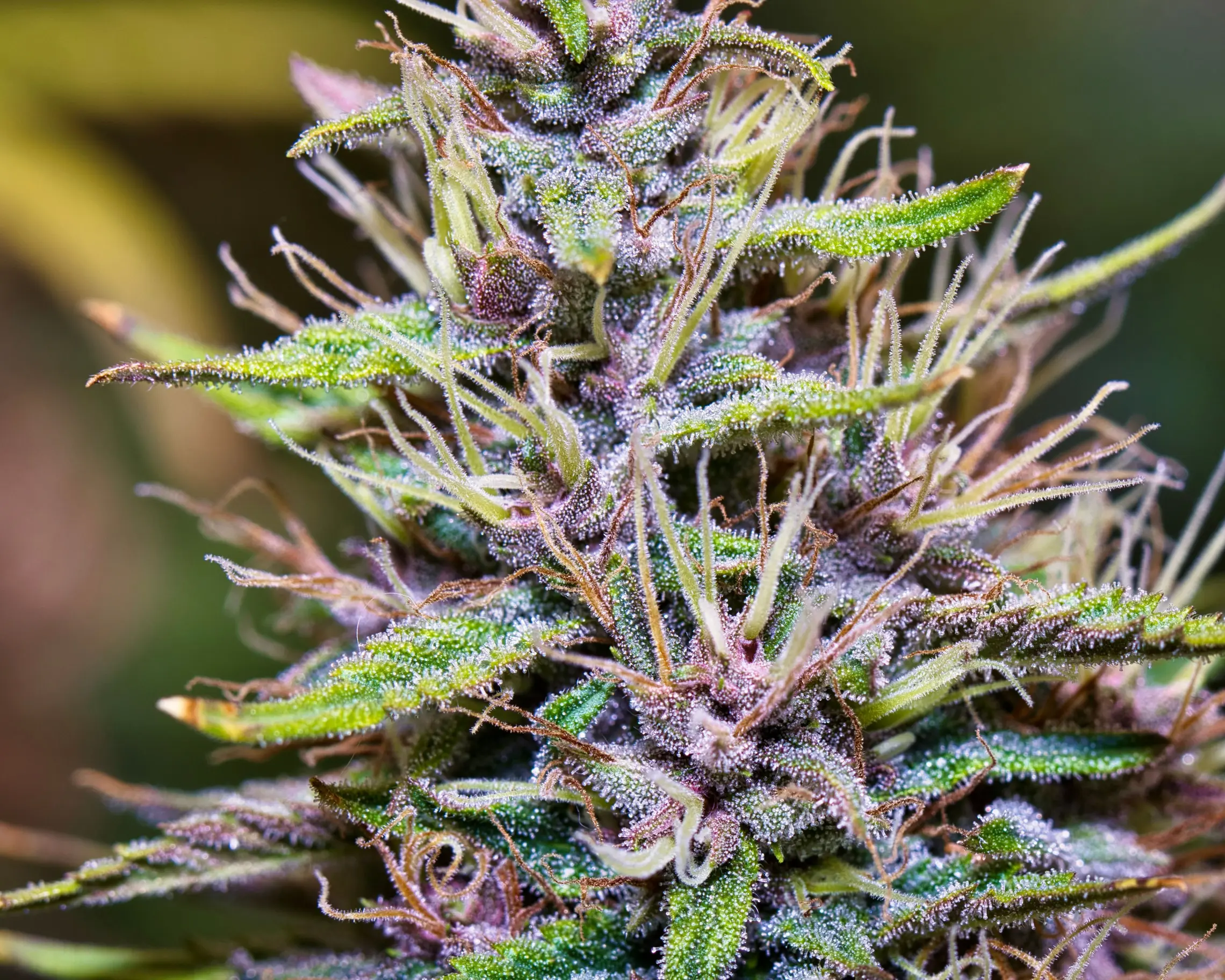
Nepal Jam
Nepal Jam is a compact highland-sativa hybrid built around a trait that matters more outdoors than headline potency: reliable maturity in difficult weather. It combines Nepalese highland genetics with a touch of Jamaica '85, then was stabilized back toward the compact Nepalese expression. The result is a small-to-medium, columnar plant that can finish in roughly eight to nine weeks indoors and around late September to early October outdoors while showing unusually strong resistance to cold, rain, powdery mildew, and botrytis.
That does not make Nepal Jam a strain for neglect. Its dense, resinous flowers and compact structure can still create local humidity if plants are crowded. The difference is that the cultivar begins with a wider safety margin than many warm-climate hybrids. For a grower in a short, cool, damp season, this can translate into a larger share of the theoretical crop actually reaching the drying room clean and mature. Weedth treats that as quality yield: usable premium flower after weather, not just grams promised under ideal conditions.
The flavor is equally distinctive. Sweet floral notes, cream, caramel, and honey form the core. Documented analysis shows very high beta-myrcene in the monoterpene fraction, with smaller pinene, camphene, and linalool traces, while nerolidol leads the sesquiterpene fraction ahead of beta-caryophyllene. The chemistry supports the warm, creamy, floral-resinous identity without turning the strain into a one-note earthy myrcene plant.
The grower's central question is how to use Nepal Jam's weather resilience without mistaking resistance for immunity or building such a dense columnar canopy that moisture is trapped where the plant cannot use its natural strengths. The best strategy is simple: moderate nutrition, open spacing, strong morning sun outdoors, a clean root zone, and harvest timing that takes advantage of the cultivar's early finish instead of leaving mature flowers outside merely to test how much bad weather they can survive.
Strain Features
| Feature | Details |
|---|---|
| Strain Type | Stabilized hybrid, commonly around 60% sativa / 40% indica |
| Genetics | (Nepalese × Jamaica '85) × Nepalese |
| Breeding Status | F7-F8 stabilized hybrid with low reported genetic variability |
| THC | Documented reference material around the mid-teens; actual batches vary |
| CBD | Usually low |
| Indoor Flowering | About 8-9 weeks |
| Outdoor Finish | End of September to early October in suitable Northern Hemisphere climates |
| Structure | Small-to-medium, compact, columnar highland-sativa architecture |
| Stretch | Low to moderate compared with most sativa-dominant cultivars |
| Bud Structure | Dense, resinous flowers on a compact framework |
| Feeding Behavior | Moderate nutrient levels are generally recommended throughout the cycle |
| Climate Strength | Strong cold, rain and fungal tolerance; especially useful in cool or wet temperate climates |
| Disease Resistance | High powdery mildew and botrytis resistance are documented, with good general robustness |
| Yield Identity | Moderate raw yield but potentially high usable clean yield in climates where later or denser cultivars lose flower to weather |
| Aroma / Flavor | Sweet flowers, cream, caramel, honey, soft resin and mild herbal/woody depth |
| Recurring Terpenes | Very high beta-myrcene; traces of pinene, camphene and linalool; nerolidol prominent in the sesquiterpene fraction with smaller beta-caryophyllene |
| Effect Character | Warm, clean, expansive, positive and relaxed without the immediate heaviness of a classic indica |
| Difficulty | Easy to moderate; particularly forgiving outdoors when site drainage and airflow are good |
Genetic Lineage
Nepal Jam starts with a compact Nepalese highland sativa selected for short flowering, resin, cold tolerance, and resistance to fungal pressure. A Jamaica '85 line was introduced to add vigor, color, yield, and a brighter positive sativa effect, then the breeding was directed back toward the original Nepalese behavior. This backcrossed architecture explains why the final plant remains more compact than its 60% sativa classification might suggest.
The Nepalese side provides the strongest cultivation fingerprint. Highland plants that complete reproduction under cool, wet, or rapidly changing conditions have different practical value from tropical sativas that assume months of warm weather. Nepal Jam retains a short cycle and columnar growth, allowing flower to mature before deep autumn becomes dominant in many temperate regions.
The Jamaican contribution is easier to recognize in vigor, occasional bluish coloration, and the emotional tone of the effect. The finished experience is commonly described as warm, expansive, happy, and clean rather than narcotic. The plant therefore combines an outdoor-hardy frame with a brighter psychoactive direction than many compact hash-plant cultivars.
Stabilization matters here. Nepal Jam is described as an F7-F8 hybrid with relatively low genetic variability. That does not mean every seed plant is identical, but it reduces the extreme phenotype spread seen in less worked polyhybrids. Growers can expect a more repeatable range of height, flowering time, and architecture, making the cultivar useful when uniform outdoor finish matters.
Color should not be used as proof of lineage or quality. Some plants may show blue, purple, or darker tones under cool conditions, but the main selection targets should remain health, finish time, aroma, resin, bud structure, and resistance. A green plant that finishes early with clean honey-cream aroma can be a better keeper than a colorful plant that yields poorly.
Effect Breakdown
Nepal Jam typically begins with a gentle mental lift rather than a sharp rush. A moderate dose can feel warm, open, and socially comfortable. The user may notice improved mood, greater interest in conversation or music, and a light sense of mental expansion without the frantic acceleration associated with some long tropical sativas.
As the effect develops, a relaxed physical layer appears. The body can feel easier while the mind remains present. This balance is useful for users who want to unwind without immediately becoming sleepy. The plant's compact growth may suggest an indica-like experience, but the Jamaican and Nepalese sativa influence keeps the effect more buoyant.
At higher doses, the relaxing side can become stronger and attention may turn inward. The effect is still not guaranteed to be sedating. Individual response depends on dose, tolerance, harvest maturity, and batch chemistry. THC-sensitive users can experience anxiety, dizziness, dry mouth, or increased heart rate despite the cultivar's generally warm reputation.
The effect is often described as relatively sustained rather than short and abrupt. That does not justify a fixed duration for every user. Inhaled dose, metabolism, frequency of use, and route of administration can change the experience significantly.
Harvest timing can tune the balance. Fully mature flowers with mostly cloudy trichomes and limited amber often preserve a clean, expansive character. A later harvest can feel rounder and heavier. The grower should not keep mature outdoor flowers in damaging rain solely to change the effect by a small amount. Clean mature flower is the priority.
Flavor & Aroma Profile
Nepal Jam's aroma is warm rather than sharp. Honey and caramel sweetness sit beside cream and floral perfume, creating a soft dessert-like impression without the cookie or fuel notes common in modern hybrids. Underneath is a resinous, lightly herbal base that keeps the flower from becoming sugary or artificial.
On the living plant, early flowering may smell mostly floral-green. As resin develops, the sweetness deepens. By maturity, the best flowers can smell like honeyed cream with dried flowers and soft caramel. Cooler outdoor nights may add a slightly darker resinous tone, but color and aroma are not mechanically linked.
After drying, the bouquet should become more coherent. Green leaf smell recedes and the creamy sweetness becomes easier to separate from the floral layer. Breaking a bud can release more resin, wood, and herb under the honey. A well-cured sample often feels rounded rather than aggressively pungent.
The inhale tends to begin sweet and soft. Cream, honey, and floral notes can appear first, followed by gentle resin and herb. On the exhale, caramelized sweetness and a mild woody-spicy background may become more noticeable. The aftertaste can remain honeyed without the bitterness of an over-dried flower.
Outdoor harvest conditions are a major flavor variable. A crop cut after several days of rain can enter the drying room with high internal moisture and surface contamination risk. The solution is not heat. It is careful inspection, removal of damaged material, generous branch spacing, and controlled air exchange. Hot emergency drying removes the delicate floral and honey top notes quickly.
The cure does not need to be dramatic. Several weeks of stable storage usually allow the flower to smooth out and the sweetness to integrate. Long warm storage can flatten the floral fraction and leave a more generic earthy-myrcene base. Keep cured buds cool, dark, and whole.
Dominant Terpenes
Nepal Jam has unusually useful documented terpene information. The monoterpene fraction is led strongly by beta-myrcene, while beta-pinene, camphene, alpha-pinene, and linalool appear at much lower levels. In the sesquiterpene fraction, nerolidol is prominent, followed by smaller beta-caryophyllene and trace guaiol. The exact proportions can change between plants and environments, so these are recurring analytical markers rather than a guarantee for every jar.
| Terpene | Aroma Role | Relevance to Nepal Jam |
|---|---|---|
| Beta-Myrcene | Herbal, earthy, musky, soft fruit | Forms much of the resinous base beneath the honey-floral sweetness |
| Nerolidol | Woody, floral, soft green, slightly sweet | Fits the creamy floral depth and is notable because it leads the documented sesquiterpene fraction |
| Beta-Caryophyllene | Pepper, wood, dry spice | Adds subtle structure to the sweet profile |
| Alpha / Beta Pinene | Pine, fresh resin | Present at low levels; can contribute freshness rather than dominate |
| Linalool | Floral, soft lavender | Trace amounts are consistent with the gentle flower-like top notes |
| Camphene / Guaiol | Resinous, woody, fresh | Minor contributors that can add complexity to the background |
A high myrcene reading does not mean Nepal Jam automatically causes sedation. Terpenes are far more reliable as aroma compounds than as single-variable predictors of subjective effect. The warm, expansive experience comes from the total chemistry and dose.
For growers, the analytical profile suggests a practical post-harvest priority: preserve both the lighter floral fraction and the heavier sesquiterpenes. A slow cool dry keeps the flower from becoming a flat earthy-myrcene sample and allows the honey/cream character to remain visible above the base.
Indoor vs. Outdoor Growing
| Aspect | Indoor Growing | Outdoor Growing |
|---|---|---|
| Main Advantage | Compact sativa character with a short 8-9 week finish | Exceptional fit for cool, rainy, mold-prone and short-season conditions |
| Structure | Columnar, small-to-medium, easy to fit under lights | Compact to medium with more branching in open soil |
| Stretch | Low to moderate | Moderate with larger roots and full sun |
| Best Training | SOG, one topping, LST, light cleanup | Early branch spacing, minimal topping, simple staking if needed |
| Disease Pressure | Easy to manage with standard late-flower humidity control | Strong natural resistance provides a real safety margin against cold and fungus |
| Feeding | Moderate | Moderate; rich native soil may require little additional nitrogen |
| Yield | Moderate but efficient | Moderate raw yield; excellent usable yield where weather would damage less adapted cultivars |
| Harvest | Fully controllable | Early finish allows the grower to harvest before severe autumn conditions in many regions |
Indoors, Nepal Jam is an easy way to grow a sativa-leaning plant without a tall room or a 12-week flowering commitment. The columnar structure makes it compatible with SOG, but the plant can also be topped once and widened. Because genetic variability is relatively low, a multi-plant canopy should remain more uniform than many seed-grown tropical hybrids.
Outdoors is where the cultivar has a special reason to exist. Cold, rain, fungal pressure, and short autumns can erase the theoretical yield advantage of more productive cultivars. Nepal Jam's earlier finish and resistance can turn an average yield rating into a very strong real-world harvest because more of the flower remains clean.
The grower should still choose a good site. High resistance cannot overcome standing water, deep shade, or days of saturated flowers. A sunny, airy location with fast-draining soil allows the genetics to work with the environment instead of constantly fighting it.
Strain-Specific Grow Guidance
Site Selection Is the First Training Technique Outdoors
For Nepal Jam, the outdoor site has more influence on final quality than elaborate branch manipulation. Choose a position that receives early morning sun so dew dries quickly. Avoid low pockets where cool damp air collects. If possible, use a slight slope or raised bed so heavy rain leaves the root zone instead of sitting around it.
A south-facing exposure in temperate northern climates extends useful light late in the season. The plant can tolerate cold better than many hybrids, but photosynthesis still slows as days shorten and temperatures fall. Good exposure helps the cultivar finish before environmental energy becomes the limiting factor.
Do Not Confuse Resistance with Immunity
Documented resistance to botrytis and powdery mildew is high, but resistance means lower probability under pressure, not impossibility. Dense flowers can still hold water after prolonged rain. Inspect the largest flowers, interior branch junctions, and any area where leaves remain trapped against buds.
Remove dead or damaged tissue immediately. A resistant plant still provides food for pathogens once tissue dies. After rain, allow natural sun and airflow to dry the crop. Violent shaking or high-powered blowers can damage resin and branches.
Indoors, use normal disease-prevention standards. Late-flower RH should be controlled and leaves should not remain packed between neighboring columns. There is no benefit in running high humidity just because the genetics are forgiving.
Compact Does Not Mean Crowding Is Safe
Nepal Jam's columnar form makes it tempting to place plants very close together. SOG can work well, but broad overlap between neighboring plants creates an artificial microclimate that the natural single-plant structure was not selected to handle.
Space the columns so air can pass between them. In a selection run, keep enough room to inspect each plant separately and record finish time. Once a uniform keeper is chosen, density can be optimized more aggressively.
Lower cleanup should be based on light. The plant's short internodes can hide shaded shoots close to the stem. Remove weak growth before mid flower if it will never receive useful light. Keep strong mid-level sites that are exposed; the goal is not a bare stick.
Moderate Feeding Is a Strength
Nepal Jam generally performs on moderate nutrition. This is useful outdoors because high-fertility soil is not required. In a prepared bed, compost and balanced mineral availability may support the full cycle without constant feeding.
More feed is not automatically more quality
Avoid excess nitrogen, especially in rich native ground. A dark, lush plant with excessive leaf mass may stay wetter after rain and delay clean flowering. The cultivar's weather advantage is partly its ability to finish; do not undo that with a vegetative nutrient regime deep into bloom.
Indoors, keep EC stable and respond to actual demand. Controlled cannabis research shows nutrient responses have an optimum. Increasing phosphorus beyond sufficiency does not guarantee more cannabinoids or better flower. Healthy roots and light distribution are more reliable yield levers.
Root-Zone Drainage in Wet Climates
High fungal resistance above ground cannot compensate for chronically waterlogged roots. In heavy clay or a site with poor drainage, use raised beds, mounds, or large well-drained containers. Incorporate clean aeration amendments where appropriate and avoid burying the root crown in a depression.
After heavy rain, inspect how quickly water leaves the site. If puddles remain near the stem for many hours, the location needs drainage improvement before the next cycle. Root hypoxia can reduce nutrient uptake, weaken stems, and slow maturation even if the leaves initially look healthy.
Indoor containers should also cycle moisture. The compact plant may use less water than a large tropical sativa, especially late in flower. Adjust irrigation frequency downward as demand falls rather than keeping a fixed schedule.
Training: Keep It Simple
Nepal Jam does not need aggressive training to become manageable. In SOG, minimal intervention is often best. One main leader with productive secondary sites uses the columnar architecture efficiently.
In a low plant-count indoor grow, one topping or early LST can create four to six strong leaders. Avoid repeated topping that adds veg time without a clear need. The plant's short flowering advantage is most valuable when the whole cycle remains efficient.
Outdoors, early branch spreading can improve sun penetration and reduce contact between flowers later. A simple cage or a few stakes provide enough support in most cases. Do not overtrain a weather-resistant plant into a dense horizontal mat that holds rainwater.
Light and Canopy Depth
Indoors, a compact uniform canopy can use strong light efficiently. Controlled cannabis studies show higher photosynthetic photon flux can increase inflorescence yield when the plant has adequate resources. The useful application is even intensity across all column tops.
Because the plant does not stretch dramatically, tops remain at similar distance from the fixture for much of flower. This makes lighting easy but also means excessive intensity is chronic rather than temporary. Watch for bleaching, leaf-edge stress, and stalled aroma development.
Outdoor full sun supports resin and flower density. In cooler climates, prioritize a site with unobstructed midday and afternoon light. A cultivar can resist cold but cannot replace missing solar energy.
Flower Density and Airflow
Nepal Jam's flowers are denser than many sativa-dominant plants. This is one reason the high botrytis resistance is valuable. It is also why the grower should continue preventive airflow instead of assuming the plant's structure is naturally airy.
Indoors, lower RH as flowers harden and keep dark-period spikes controlled. Air should move around the columns without blasting the same surface continuously. Outdoor plants benefit from branch spacing and morning sun.
Inspect the center of the largest flowers during the final weeks. The outside can look perfect while trapped plant material or an insect-damaged bract creates a starting point for rot. Resistance raises the threshold; inspection still catches problems early.
Greenhouse and Rain-Shelter Strategy
A simple roof can improve Nepal Jam in very wet climates, but a rain shelter must not become a humidity tent. Clear roofing keeps repeated rainfall off mature flowers, while open sides preserve cross-flow. If sidewalls are closed for warmth, monitor humidity because condensation can turn a supposedly protected plant into a wetter microclimate than the open garden.
Use shelter primarily during late flower rather than treating the entire season as greenhouse culture unless the structure is designed for active ventilation. Early in the season, natural wind helps build stems and keeps the canopy open. Near harvest, preventing direct saturation can protect resin and reduce the amount of water that must be removed in the drying room.
A roof also makes harvest timing more flexible. A mature plant can wait through a short rain event if the flowers remain dry and airflow is good. That is different from leaving wet colas exposed for days because the cultivar has a strong resistance rating.
Pest Pressure in an Outdoor-First Cultivar
Disease resistance does not cover every outdoor threat. Caterpillars, leaf-chewing insects, sap feeders, and mites can create damaged tissue that becomes a secondary infection point. Inspect flowers from the inside out, especially where an insect has bored or fed. A botrytis-resistant plant can still rot around dead caterpillar-damaged tissue.
Use integrated pest management before flowers become dense. Keep the garden clean, identify local pests early, and prefer preventive cultural methods compatible with legal food or crop-safety rules. Once mature resinous flowers are present, spraying anything onto them should be approached cautiously because residues can affect safety and flavor.
The compact canopy makes inspection easier than on a giant tropical sativa. Use that advantage. Check the underside of leaves, branch junctions, and the densest flowers routinely instead of waiting for visible damage from a distance.
Wind and Branch Strength
Nepal Jam is relatively sturdy, but exposed highland-style conditions can include wind as well as cold. Outdoor plants in containers are particularly vulnerable because the pot can tip even when stems are strong. Secure the container and add a simple cage or stakes before flowering weight changes the plant's center of gravity.
Support should not compress the canopy. Tie branches loosely enough that they can move slightly and strengthen, while preventing violent bending during storms. If several flowers are tied together, airflow decreases and rainwater drains more slowly. Each major branch should retain its own space.
After a storm, inspect branch forks for hidden splits. A partially torn branch can remain green for days while becoming a site for tissue death and infection. Repair or remove damaged material quickly according to severity.
Comparing Phenotypes in a Stable Line
Low genetic variability does not mean selection is pointless. Small differences in finish date, branch spacing, honey intensity, color, and flower density can matter greatly in a difficult climate. Label every seed plant and keep harvests separate through cure.
The best outdoor keeper is the plant that finishes cleanly in the local weather, not necessarily the plant that looks largest in midsummer. If one expression matures five days earlier and retains equal aroma, those five days can be a major advantage in a region where autumn storms arrive quickly. If a slightly later plant has exceptional flower but repeatedly catches bad weather, it may be better reserved for indoor cultivation.
Measure resistance by outcome. Record any powdery mildew, botrytis, pest damage, and weather exposure. A clean result after genuine pressure is more informative than assuming every plant is equally resistant because the cultivar has a strong reputation.
Outdoor Harvest: Use the Early Finish
The cultivar's main seasonal advantage is the ability to finish around late September or early October in many northern temperate locations. Do not waste that advantage by leaving fully mature flowers outside until late October simply because the plant still looks healthy.
Begin close trichome and calyx inspection before the expected window. Combine maturity with the forecast. If the plant is ripe and a week of cold rain is approaching, harvest. A few theoretical extra grams are not worth risking clean honey-floral flower.
If different branches mature at different rates, staged harvest can be useful. Take fully mature tops and allow sun-exposed lower branches additional days if the weather remains safe.
Indoor Harvest and Flavor Window
Indoors, the grower can wait for complete maturity without weather pressure. Around week eight, inspect bract swelling, pistil slowdown, trichomes on calyxes, and aroma. The honey/cream profile should feel developed rather than green.
A slightly earlier full-maturity harvest tends to preserve a brighter, more expansive effect. A later window can feel calmer and heavier. Do not confuse "early" with immature. The flower should still have completed its reproductive development.
Cold Color Is Optional
The Jamaican contribution can bring bluish or purple tones, especially in cool conditions. These colors are attractive but should not become a cultivation target. Deliberately chilling the plant can slow metabolism and reduce final quality.
If color appears naturally under healthy late-season nights, enjoy it. If a green phenotype smells stronger, finishes cleaner, and produces better flower, choose quality over appearance. Anthocyanin expression is not a potency meter.
Premium-Bud Percentage
Nepal Jam is a perfect cultivar for measuring usable clean yield. After cure, separate premium whole flowers, good secondary buds, and damaged or underdeveloped material. In a difficult outdoor season, compare that ratio with other cultivars grown beside it.
A strain that produces fewer theoretical grams but loses almost nothing to mold can outperform a heavier variety in actual jars. This is where Nepal Jam's weather adaptation becomes economically and practically meaningful.
Second-Run Refinement
If the first run finished cleanly, do not automatically increase feeding. The best improvement may be slightly wider spacing, a better morning-sun position, or earlier lower cleanup. If the crop was healthy but flavor flattened, change drying rather than soil fertility.
Record first visible flower, finish date, rainfall during the final month, disease observations, premium-bud percentage, live aroma, and cured aroma. These records reveal whether the genetics are truly solving the climate problem in the specific garden.
Final-Week Weather Decisions
The last seven to ten days should be managed with both a loupe and a forecast. If flowers are close but not fully mature and the weather remains dry, waiting can improve resin and aroma. If a long wet cold system is arriving, inspect whether the plant has already reached a satisfactory maturity window. The decision is not between "perfect" and "ruined." It is between the extra quality that additional days may add and the quality that severe weather may remove.
Do not harvest before sunrise while the entire plant is wet with dew unless conditions force it. When possible, allow surface moisture to evaporate before cutting. This reduces the initial water load entering the drying room. Conversely, do not leave a mature plant standing through an afternoon of hot direct sun just to harvest at a convenient hour. Choose a cool, dry window and move cut branches into shade promptly.
Post-Harvest Inspection of Dense Outdoor Flowers
Before hanging, inspect the largest flowers under good light. Look for dead interior leaves, insect damage, brown tissue, or a sour smell. Remove questionable material rather than allowing it to hang beside clean flower. Outdoor buds carry more environmental material than indoor buds, so sorting is part of quality control.
During the first several drying days, recheck the thickest colas. A problem hidden at harvest can become obvious as tissue changes. Early removal protects the rest of the batch. This extra inspection is worth the effort because Nepal Jam's dense, resinous flowers are exactly what the grower wants to preserve.
Weedth Bud Flavor Tips
The honey, cream, caramel, and floral profile is relatively delicate. Outdoor growers should harvest mature branches after surface dew has dried when possible, then move them immediately to shade. Do not leave cut plants in sun while processing the rest of the garden.
Wet-weather harvests need space, not heat. Remove damaged tissue, separate large branches, and use gentle indirect room exchange. A heater may solve surface moisture quickly but can remove the floral and creamy top notes at the same time.
Indoor growers should avoid late-flower canopy heat. The plant can remain healthy in cooler conditions, so there is little reason to run a hot final week. Protect volatile aroma and reduce respiration with stable, moderate temperatures.
Drying dense flowers requires patience. The outside can crisp while the center still holds moisture. Check the thickest buds before sealing the entire crop. If small flowers are ready earlier, separate them rather than overdrying them to match the largest tops.
During cure, the green smell should fade and the honey-caramel sweetness should become more coherent. Store stable flower cool and dark. High myrcene does not make the aroma indestructible; warm storage can still flatten the floral layer.
Weedth Bud Boost Tips
Outdoors, the biggest "boost" is placing the plant where its resistance can work. A draining site with strong sun and airflow turns weather tolerance into usable yield. A shaded waterlogged site wastes the genetics.
Keep nitrogen moderate. Excess leaf mass can increase wet surface area and slow drying after rain. A balanced plant with a clean open center often finishes more premium flower than a larger lush plant.
Indoors, use SOG or a simple one-topping structure. The compact architecture allows an even light plane without weeks of training. Spend the saved time on environmental consistency.
Strong light can increase yield when other resources are adequate, but do not push intensity past healthy leaf response. Nepal Jam's value is clean quality, not photostress. Added UV-B is not a guaranteed cannabinoid or resin booster and can reduce performance.
Supplemental CO2 can support high-light sealed environments, but it is unnecessary for achieving excellent home-grow quality. Ambient-CO2 plants with healthy roots and an even canopy can express the cultivar fully.
Medical Uses & Benefits
Nepal Jam is not clinically proven to treat any named condition. Its warm, positive, clean, and later-relaxing effect may appeal to people who prefer cannabis that lifts mood without beginning as a heavy sedative. Those are subjective preferences, not medical claims.
Consumers sometimes use similar THC-dominant flower for temporary stress relief, appetite, mood, or distraction from discomfort. THC can also cause anxiety, dry mouth, dizziness, impaired coordination, and increased heart rate.
Anyone using cannabis for a medical condition should consult a qualified clinician where legal. Laboratory-tested potency, dose, medications, and individual health history are more relevant than a strain name.
Ideal User Profile
Nepal Jam is ideal for outdoor growers in cool, rainy, or short-season temperate climates who have struggled to finish later cultivars cleanly. It also suits beginners because the plant is compact, stable, and moderately fed rather than demanding.
Indoor growers who want a sativa-leaning effect without large stretch will also appreciate it. SOG and simple low-stress training fit naturally.
Flavor-focused users who enjoy honey, cream, caramel, flowers, and soft resin will find it more interesting than consumers seeking fuel, candy, or extreme potency. The effect suits daytime through early evening for many people.
Measuring the Climate Advantage
A grower can quantify whether Nepal Jam is actually solving a local problem. Record total rainfall during flowering, number of nights below the preferred temperature range, first visible flower date, harvest date, and the percentage of flower discarded for weather or disease. Compare those numbers with other cultivars grown in the same garden.
This turns "weather resistant" from a reputation into local evidence. If Nepal Jam consistently finishes clean while later cultivars lose a meaningful share of their tops, the moderate raw yield is doing more real work than a theoretical high-yield rating. If the local climate is dry and warm, the same resistance may matter less and flavor or effect may become the main reason to keep it.
The exercise also helps with site selection. Two plants of the same cultivar can perform very differently if one receives morning sun and the other sits in a damp shaded corner. Genetics and microclimate should be evaluated together.
Grower Notes and Feedback
The most important feedback is that Nepal Jam's resistance has practical value. In a wet climate, a flower that stays clean can outperform a supposedly higher-yielding cultivar that loses tops to mold.
The second point is uniformity. Stabilization reduces extreme variation, making harvest planning easier. This is valuable outdoors where several weeks of phenotype spread can mean the difference between September sun and October rain.
Compact growth does not eliminate humidity risk. Dense plants placed too close can create a microclimate more humid than the surrounding garden. Give the cultivar enough air to express its resistance.
Moderate nutrients are sufficient. Growers who push rich soil often create more leaf and later maturation without improving premium flower. Let the genetics finish cleanly.
Finally, judge the crop after cure. The honey-cream profile can be subtle at harvest and much clearer after several weeks. A plant that keeps that sweetness through a wet-season harvest is a strong keeper.
Weedth Editor's Note
The point where this plant reveals itself
I would choose Nepal Jam when the weather is the main opponent. I do not need every outdoor plant to produce the biggest possible number. I need the flowers to reach the drying room clean, ripe, and aromatic. A cultivar that finishes before weeks of cold rain can give me more real quality than a later plant that looks more impressive in August.
I still would not abuse the resistance. I want morning sun, drainage, open branches, and a clean center. If the genetics are already giving me a safety margin, I would rather preserve that margin than spend it by overcrowding the plant.
The flavor is quiet in a good way. Honey, cream, flowers, and caramel are not as loud as fuel, but after a slow dry they make the flower feel complete. That is the jar I would keep: not the darkest purple plant, but the one that finishes early, stays clean, and still smells sweet after a month.
Weedth Score
Growing Experience 9.5/10 Stable, compact and unusually reliable in cool or wet conditions
Bud Structure & Visual Appeal 8.8/10 Dense resinous flowers with occasional cool-weather color
Aroma Complexity 9.0/10 Honey, cream, caramel, flowers and soft resin create a distinctive old-school sweetness
Flavor & Smoothness 9.1/10 Very pleasant after a slow dry; hot emergency drying removes its best details
Effects & High Experience 8.9/10 Warm, clean and expansive with a relaxed finish
Overall Satisfaction & Recommendation 9.3/10 Exceptional recommendation for growers who prioritize reliable quality in difficult outdoor climates
Overall Weedth Score: 9.3/10.
I would trust Nepal Jam in a garden where September weather matters more than laboratory hype; clean mature flower is the real yield.
FAQ
Is Nepal Jam easy to grow?
Yes. It is generally beginner-friendly because it stays compact, flowers relatively quickly, tolerates moderate feeding, and has strong resistance to cold and fungal pressure. The main requirement is normal good practice: drainage, spacing, sunlight, and mature harvest timing.
What are Nepal Jam's genetics?
The lineage is (Nepalese × Jamaica '85) × Nepalese. The backcross toward Nepalese preserves compact highland behavior while the Jamaican side adds vigor, color, and a brighter emotional effect.
How long does Nepal Jam flower indoors?
About eight to nine weeks is a reliable working range. Start close maturity checks near the beginning of that window and harvest when calyxes, trichomes, and aroma agree.
When does Nepal Jam finish outdoors?
It commonly finishes around late September to early October in suitable Northern Hemisphere climates. Latitude, planting date, phenotype, sun exposure, and seasonal weather still matter.
How much does Nepal Jam stretch?
Usually low to moderate for a sativa-dominant hybrid. Its compact columnar structure is one of its defining traits and makes it easy to fit indoors.
Is Nepal Jam mold resistant?
Yes. High resistance to botrytis and powdery mildew is documented. It is still not immune. Dense flowers should be inspected after prolonged rain, and indoor late-flower humidity should remain controlled.
Is it good for cold and rainy climates?
Yes. This is one of its strongest use cases. The combination of early finish, cold tolerance, rain tolerance, and fungal resistance makes it practical where longer warm-climate hybrids struggle.
Does Nepal Jam need strong feeding?
No. Moderate nutrients are generally sufficient through the cycle. Rich nitrogen-heavy soil can create unnecessary leaf mass and delay clean maturation.
What training works best?
SOG, one topping, light LST, or simple branch spacing. The plant does not need aggressive training. Outdoors, keep branches open enough for sun and drying air.
Should I force purple color with cold nights?
No. Color can appear naturally, but deliberately chilling the plant can reduce metabolism and quality. Use maturity, aroma, resin, and flower health to judge the crop, not anthocyanin expression.
What are the dominant terpenes?
Documented analysis shows very high beta-myrcene, with smaller pinene-family compounds and linalool. Nerolidol leads the sesquiterpene fraction, followed by beta-caryophyllene and trace guaiol. Exact amounts can vary by plant and environment.
When should I harvest for the best flavor?
Harvest when the flowers are fully mature and the honey-cream-floral aroma is developed. Outdoors, combine that maturity with the forecast. A ripe plant taken before prolonged cold rain often preserves more flavor than a plant left outside for marginal extra swell.
How should Nepal Jam be dried after a wet outdoor harvest?
Remove damaged material immediately, space branches generously, use cool darkness and indirect air exchange, and avoid high heat. Check the centers of dense flowers before sealing them for cure.
Is Nepal Jam high yielding?
Raw yield is usually moderate. Its advantage is usable clean yield in difficult climates. A high percentage of mature, mold-free flowers can make it more productive in practice than a heavier cultivar that suffers weather losses.
Is Nepal Jam suitable indoors?
Yes. Its compact structure, short flowering time, stability, and moderate feeding make it easy indoors. The main indoor concern is not stretch but overcrowding several columnar plants too tightly.
Similar Strains
Bangi Haze: Another excellent choice for cool or wet outdoor climates with a brighter, more energetic sativa effect and somewhat different floral-incense flavor.
Early Girl: Shares the strategy of finishing before deep autumn weather, though Early Girl is more indica-leaning and less honey-floral.
Sweet Purple: Similar in northern outdoor usefulness and weather tolerance, with a mintier herbal profile and larger potential outdoor size.
Purple #1: Another early northern cultivar with strong cool-weather color expression. Purple #1 is generally brighter and more purple-focused, while Nepal Jam emphasizes resin, honey and compactness.
Holland's Hope: A classic wet-climate outdoor option with strong weather resistance. Holland's Hope is more conventional indica-dominant in effect and flavor.
Jamaican Pearl: Shares Jamaican influence and outdoor practicality, but Jamaican Pearl grows taller, more sativa-like, and usually needs more canopy and branch management.
Share this article
A quick overview of the topics covered in this article.
Follow us
Latest articles
September 9, 2026
September 9, 2026

September 9, 2026