
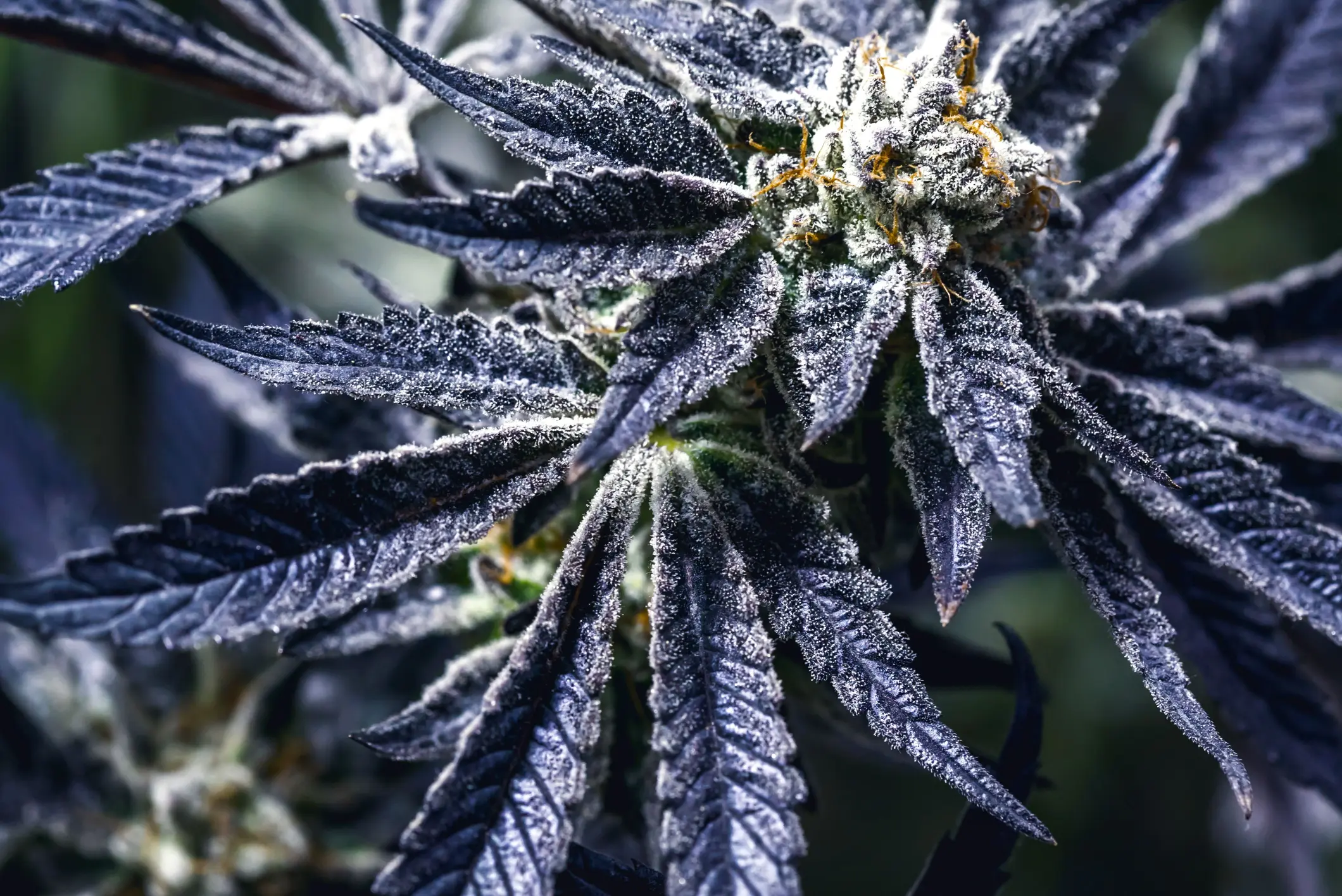
Purple Diesel
Weedth Strain Library
The Purple Diesel strain earns attention for a combination that is easy to describe but harder to grow at its best: sour diesel, grape skin, dark berry, sweet earth and fuel. Its reputation is often reduced to potency or a single flavor word, yet the cultivar becomes much more useful when you look at the plant as a complete system. Its architecture, transition stretch, flower density, finishing speed and drying behavior all influence whether the harvested buds actually deliver the profile growers expect.
For growers, the central question is not simply whether Purple Diesel can be cultivated indoors or outdoors. The better question is how to manage its specific growth habit so that dense colored flowers with visible resin and a clean interior rather than maximum darkness becomes the normal outcome rather than the lucky one. That means matching training to morphology, leaving enough air around developing flowers, reading maturity from the plant instead of from a calendar, and protecting the volatile compounds responsible for a true two-layer profile where sour fuel remains clear while grape and dark-berry sweetness survives the cure during harvest and cure.
Potency, yield and terpene percentages vary between phenotypes, grow environments and laboratory methods. The ranges used in this guide should therefore be treated as practical reference points rather than guarantees. The goal is to explain repeatable cultivation behavior and decision making, especially where growers are most likely to trade flavor quality for unnecessary density or yield.
Strain Features
| Feature | Weedth Notes |
|---|---|
| Type | Hybrid with a compact Kush side and a brighter Diesel influence |
| Genetics | Pre-98 Bubba Kush x Sour Diesel |
| Typical THC | Often reported in the mid-to-high teens or low 20s, depending on expression and batch |
| CBD | Usually low |
| Indoor Flowering | Around 8-9.5 weeks; 63-66 days is frequently reported for mature indoor plants |
| Outdoor Finish | Early-to-mid autumn in climates that allow full color and ripening |
| Difficulty | Intermediate |
| Plant Height | Short to medium; generally squat with long fan leaves and a broad stance |
| Yield Potential | Medium to large when the canopy is spread and lower shade is managed |
| Aroma / Flavor | Sour diesel, grape skin, dark berry, sweet earth and fuel |
| Primary Grow Risk | assuming the compact plant is automatically mold-proof; dark, tight buds can still hide moisture where leaves overlap |
| Best Training Fit | low wide training, selective leaf removal and a short SCROG are more useful than repeated height reduction |
These values describe the commonly reported behavior of Purple Diesel, not a guarantee for every seed, clone or environment. Use the table to plan the run, then let the plant's real morphology and finishing behavior override any estimate that does not match what you are seeing.
Genetic Lineage
Purple Diesel is commonly described as Pre-98 Bubba Kush x Sour Diesel. That family background matters because the parents do more than provide a name for the label. They explain why the plant tends to show squat and laterally capable, with broad leaves, relatively short internodes and dense colorful flowers that can finish dark under the right genetic and environmental expression. In practical cultivation terms, lineage helps predict how early training should begin, how much vertical room to reserve for transition, and which sensory traits are most vulnerable when the environment drifts out of range.
Lineage records in cannabis are not always equivalent to a modern agricultural pedigree. Clone-only plants can circulate under the same name for years, seed recreations may combine related but non-identical parents, and local selections can diverge after repeated propagation. For that reason, I would treat the accepted lineage as a map, not as a promise that every plant will express the same height, terpene balance or flowering speed.
The useful grower takeaway is to verify the plant in front of you. If a Purple Diesel phenotype shows more stretch, thinner leaves or a later finish than expected, adapt the canopy plan rather than forcing it into a stereotype. If it stays compact and begins stacking early, reduce the amount of late training and focus on air movement through the developing flowers. The lineage tells you what is plausible; observation tells you which part of that range you actually have.
A second reason lineage matters is sensory selection. A true two-layer profile where sour fuel remains clear while grape and dark-berry sweetness survives the cure is the target profile, but the relative strength of those layers can shift. Keeping notes on structure, aroma development and finishing time lets a grower identify the expression that best represents the strain rather than automatically keeping the tallest plant or the heaviest yielder. For a flavor-focused library, that distinction matters more than a single headline number.
Effect Breakdown
The effect profile of Purple Diesel is best understood as a progression rather than a fixed list of adjectives. Dose, tolerance, consumption method and personal sensitivity change the experience, but a three-stage pattern is commonly reported.
Early phase: Purple Diesel usually announces itself mentally before it feels heavy in the body, with a brighter and more playful opening than many purple cultivars. This opening is where users most often decide whether the strain feels mentally bright, neutral or immediately heavy. With Purple Diesel, the early impression should be judged before taking more, especially when the cultivar has a reputation for building slowly.
Middle phase: The middle phase can remain social and focused enough for low-pressure activity, while the Bubba side adds physical ease. This is usually the most representative part of the session because the initial novelty has settled and both cerebral and body effects are easier to separate. Activities that fit this phase depend heavily on tolerance, but low-pressure music, conversation, food and relaxed creative work are common choices for strains with this type of balance.
Late phase: Later, the effect becomes rounder and calmer, but it generally does not behave like a pure night-time indica unless the dose is pushed. The late stage is also where harvest timing can subtly change perception. Earlier-harvested flower may feel brighter and shorter, while a fully mature or slightly later harvest can feel rounder and heavier. Those differences are not caused by one cannabinoid alone, but maturity, terpene retention and dose all influence the overall impression.
The practical caution is simple: do not treat a strain name as a dosing instruction. Purple Diesel may be described as energetic, euphoric and social at first, with a softer physical calm underneath, but individual responses can differ sharply. New users and people who are sensitive to THC are better served by small amounts and enough time to evaluate the first phase before adding more.
Flavor & Aroma Profile
The defining sensory identity of Purple Diesel is sour diesel, grape skin, dark berry, sweet earth and fuel. Good flower should not smell like a single artificial flavor. The more convincing expression has layers: a fast top note when the jar opens, a heavier base when the flower is broken apart, and a slightly different sequence on the inhale and exhale.
The target I would use for quality control is a true two-layer profile where sour fuel remains clear while grape and dark-berry sweetness survives the cure. That target is useful because it forces the grower to protect contrast. If one layer overwhelms everything else, the flower may still be potent and attractive but the cultivar loses part of its identity. Excess nitrogen late in flower, high canopy temperature, stagnant humidity and a rapid post-harvest dry are common ways to make a nuanced profile feel generic.
Aroma also changes through the flowering cycle. Early resin often smells greener and less integrated. Mid-flower is when the recognizable signature starts to separate from ordinary plant scent. In the final weeks, the best plants usually become more specific rather than simply louder. That is the point where a grower should record which branches or phenotypes show the clearest profile and avoid unnecessary handling that damages trichomes.
After harvest, the main threat is chasing purple color with excessive cold or delaying harvest so long that the bright diesel top note fades. The dry should remove moisture steadily without turning the outside of the buds crisp while the interior remains wet. A controlled cure then allows harsh green notes to fade while the core aroma becomes easier to identify. The best test is not how intense the room smells on harvest day; it is how recognizable the strain remains several weeks later.
Dominant Terpenes
Dominant-terpene lists for named strains are best treated as recurring tendencies, not fixed chemical fingerprints. Different phenotypes and batches can change the order and relative amount of terpenes, and laboratory methods can also differ.
| Terpene | Flavor / Aroma Role | Potential Sensory Role |
|---|---|---|
| Myrcene | Earth, dark fruit and musk | Supports the berry depth and body calm inherited from the Kush side |
| Limonene | Bright citrus-sour lift | Helps sharpen the fuel profile and supports the more upbeat sensory impression |
| Beta-caryophyllene | Pepper, spice and dry fuel warmth | Adds bite to the diesel-heavy exhale |
In Purple Diesel, the terpene discussion is most useful when it explains why the aroma can move between sour diesel, grape skin, dark berry, sweet earth and fuel. A good cure should make those layers easier to separate. If the entire sample smells like one flat note, post-harvest handling or phenotype choice may have mattered more than the nominal terpene list.
Indoor vs. Outdoor Growing
| Aspect | Indoor Growing | Outdoor Growing |
|---|---|---|
| Height control | Plan for short to medium; generally squat with long fan leaves and a broad stance and shape early. | More vertical freedom, but wind exposure and branch loading increase. |
| Flowering / finish | Around 8-9.5 weeks; 63-66 days is frequently reported for mature indoor plants | Early-to-mid autumn in climates that allow full color and ripening |
| Main climate risk | assuming the compact plant is automatically mold-proof; dark, tight buds can still hide moisture where leaves overlap | Rain, cool nights and slow drying after dew can increase late-flower risk. |
| Training | low wide training, selective leaf removal and a short SCROG are more useful than repeated height reduction | Use wider spacing and structural support; avoid overcompacting a large plant. |
| Flavor control | More control over heat, humidity and drying conditions. | Potentially excellent complexity if the finishing weather stays dry and stable. |
Indoors, Purple Diesel gives the grower direct control over the variables that most affect its quality. The main advantage is the ability to plan canopy height around a plant that is short to medium; generally squat with long fan leaves and a broad stance and to reduce humidity as flowers become denser. The main disadvantage is that poor spacing becomes amplified. A healthy plant can still finish with mediocre buds if every branch occupies the same layer and air cannot move through the center.
Outdoors, the plant can express a larger root system and more natural branch development, but the suitability of the cultivar depends on the finishing window. Early-to-mid autumn in climates that allow full color and ripening. Growers in shorter or wetter seasons should evaluate the local autumn pattern rather than assuming that an indoor flowering number translates directly to an outdoor calendar date.
For flavor, indoor control usually offers the most predictable route because late-flower temperature and rain exposure can be managed. Outdoor plants can produce excellent aromatic complexity when nights cool gradually and flowers stay dry, but repeated rain followed by still air creates exactly the conditions that can damage mature resinous buds. The better environment is therefore the one where the grower can finish the plant cleanly, not the one that is automatically labeled superior.
Strain-Specific Grow Guidance
Architecture and the first training decision
Purple Diesel tends to be squat and laterally capable, with broad leaves, relatively short internodes and dense colorful flowers that can finish dark under the right genetic and environmental expression. The first training decision should follow that architecture rather than a fixed routine. A plant with naturally strong laterals benefits from early spreading because those branches can be turned into productive tops. A plant with longer internodes needs support and horizontal guidance before the transition accelerates. For Purple Diesel, the most reliable approach is low wide training, selective leaf removal and a short SCROG are more useful than repeated height reduction. The objective is an even canopy with visible air lanes, not a flat mass of leaves pressed together.
Stretch and transition management
Transition stretch is usually lower than a pure Diesel-style plant, making it easier to contain in short rooms. This is the phase where many otherwise healthy runs become difficult. If the flip happens after the canopy is already full, the plant spends the next two weeks stacking new growth on top of a structure that no longer has room. I would enter flower with open spaces intentionally left in the canopy, then use those spaces to absorb stretch. The final few adjustments should happen while stems are still flexible, not after heavy flowers have formed.
Leaf removal without stripping the plant
Defoliation should solve a real problem. On Purple Diesel, remove leaves that block multiple flowering sites, sit directly against developing flowers, or close the center of the plant to airflow. Keep healthy leaves that still receive light and have space around them. Heavy stripping can slow a plant that is already allocating energy to flower formation, and it can also expose previously shaded tissue to sudden light stress. A staged cleanup is safer than one dramatic event.
Root zone and feeding behavior
More feed is not automatically more quality
The safest feeding strategy is to read growth rate and leaf color instead of assuming that a famous strain must be a heavy feeder. During early vegetative growth, steady nitrogen supports branch development, but dark clawed leaves are a warning that the plant is receiving more than it can use. During transition, do not cut nitrogen abruptly while stretch is still active. Later, reduce unnecessary nitrogen so the plant can mature without carrying excessively leafy flowers into harvest.
Humidity and flower density
The primary environmental risk for this cultivar is assuming the compact plant is automatically mold-proof; dark, tight buds can still hide moisture where leaves overlap. Early flower can tolerate moderate humidity more easily because flowers are still open and air moves through them. As calyxes swell, the same room conditions can become risky. Late flower should feel dry enough that dense tops do not remain cool and damp after lights-off. Air should move around flowers, not blast them from one direction.
Branch support and load
Support is most useful when installed before branches are leaning. A soft trellis, stakes or ties can hold the canopy in its planned position while flowers gain mass. Waiting until a branch folds creates two problems: the branch may be damaged and the fallen top often ends up touching another flower, reducing airflow exactly when density is highest. The support system should keep every top separated enough that the plant can finish without becoming a single solid wall.
Flowering timeline and harvest reading
The commonly reported indoor flowering window is Around 8-9.5 weeks; 63-66 days is frequently reported for mature indoor plants, but the calendar is only a reference. In the last stage, look for slowed vertical growth, swollen calyxes, mature pistil behavior, fading rather than fresh vegetative push, and trichome development across multiple representative flowers. Do not judge only the top cola, which may ripen faster under stronger light. A staggered harvest can make sense when the canopy is uneven.
Failure mode to watch
The most common quality failure is not catastrophic plant death. It is a healthy-looking crop that finishes with muted flavor or inconsistent bud quality. For Purple Diesel, the warning signs are an overcrowded center, late dark-green leaves, warm flower surfaces, branches touching each other, and a harvest decision based only on the expected week number. Correcting those small issues early usually produces more improvement than adding another supplement.
Second-run optimization
After the first harvest, save the observations that matter: actual stretch ratio, days to full maturity, which branches produced the best flower, where humidity accumulated, how the aroma changed during the dry, and whether the plant wanted more or less nutrition than expected. On a second run, start with the same genetics and change only two or three variables. That is how a grower learns the cultivar rather than restarting the experiment every cycle.
Dialing In the Run
Early canopy plan: exploit the squat frame
Purple Diesel gives growers with limited ceiling height an advantage because the plant is usually more compact than a classic Sour Diesel. I would use that compact frame to build width early. Spread the main branches outward and expose interior sites before the flowering flip. There is no need to keep topping repeatedly just because the plant is short; too many tops can turn a compact phenotype into a dense mat. The target is a low canopy with distinct branches and enough space between them that each top can color and finish without touching its neighbor.
Transition: identify which parent is leading
The first two flowering weeks are useful for phenotype reading. Some plants stay very Bubba-like, with broad leaves and limited stretch. Others show more Diesel influence and lengthen enough to require additional tucking. I would use the observed stretch to guide the rest of the run rather than relying on the strain average. A shorter phenotype may need more selective leaf removal to open the center, while the more Diesel-leaning plant may need stronger branch support and a wider footprint. Treating both the same wastes the information the plant is giving you.
Mid-flower color: do not confuse purple with ripeness
Purple expression can become visible before the flowers are mature, especially when genetics, cooler nights and nutrient status favor anthocyanin development. I would never use color as the primary harvest signal. A dark flower can still be actively producing fresh pistils and swelling calyxes. Conversely, a greener phenotype can be fully mature. Use color as a visual trait, not a timer. The real quality target is a healthy dark or purple expression with intact aroma, not the darkest possible bud produced by unnecessary cold stress.
Aroma balance: protect both fuel and fruit
Purple Diesel is at its best when sour fuel and dark fruit are both identifiable. During late flower I would smell several branches rather than one top. If every flower is moving toward sweet berry with little fuel, that may simply be the phenotype. If the fuel was strong earlier and disappeared during a hot final week, the environment may have flattened the profile. Likewise, extending harvest too long to deepen color can reduce the brighter sour notes. Flavor-focused growing means accepting that the most visually purple harvest date is not always the best sensory harvest date.
Late-flower moisture: compact does not mean safe
The squat plant shape can encourage growers to assume Purple Diesel is automatically easy in humid rooms. The opposite can happen if broad leaves overlap dense flowers. I would inspect the interior of the canopy after irrigation and remove dying leaves caught between buds. Branches should be separated enough that air can pass around each top. If the room is cool at night, pay attention to the humidity rise that follows the temperature drop. Dense purple flowers can hide early damage extremely well.
Second run: decide whether you prefer Diesel-leaning or Bubba-leaning expression
A seed-grown population may offer more than one useful phenotype. I would not try to pretend there is only one correct Purple Diesel. A Diesel-leaning keeper may stretch more, smell sharper and produce a brighter effect. A Bubba-leaning keeper may stay shorter, show darker fruit notes and finish with more body relaxation. The better keeper depends on the goal. For Weedth-style flavor quality, I would choose the plant that keeps the strongest contrast between sour fuel and grape-dark-fruit character after cure while remaining manageable in the intended grow space.
Weedth Bud Flavor Tips
Flavor quality begins before harvest. For Purple Diesel, protect a true two-layer profile where sour fuel remains clear while grape and dark-berry sweetness survives the cure by keeping the final weeks stable. Avoid a late push of nitrogen simply because leaf color is fading. Natural maturation and senescence are not automatically deficiencies. The goal is to finish flowers cleanly while resin remains aromatic, not to keep every fan leaf dark green until harvest day.
Canopy temperature deserves more attention than room temperature. Warm flower surfaces can increase volatilization and make the most delicate top notes disappear before harvest. A grower does not need to chase unusually cold conditions, but avoiding repeated heat spikes in the final two weeks helps retain the profile. Strong light should also be balanced against stress; more intensity is not useful if upper flowers bleach or lose aroma.
Harvest handling should be gentle. Trichomes on mature flowers are brittle, and repeated squeezing or unnecessary trimming while fresh can remove resin and release aroma into the room instead of preserving it in the bud. Cut and move branches by the stem when possible. Keep harvested material out of direct light and begin drying promptly in a clean environment.
Drying too quickly is one of the easiest ways to erase strain identity. Chasing purple color with excessive cold or delaying harvest so long that the bright diesel top note fades. A slower, controlled dry allows internal moisture to migrate outward gradually. The target is not a fixed number of days because branch size, flower density and room conditions differ. The practical endpoint is evenly dry flower that is ready to cure without a wet center or a brittle exterior.
During cure, judge progress by aroma clarity and moisture equilibrium. The first days may still smell green or compressed. Over the next weeks, the defining notes should separate. If the jar aroma becomes sour in a wet, unpleasant way or the buds feel soft and cold inside, more drying is needed. If the buds become crisp and scent disappears immediately after opening, the dry was likely too aggressive.
Outdoor flavor protection requires one additional decision: weather. If a mature plant is facing repeated rain and cool nights, leaving it outside for a theoretical extra week can cost more quality than it gains. On the other hand, harvesting every outdoor plant early because rain is possible can prevent full aroma development. The decision should weigh actual flower maturity against the specific forecast and the density of the phenotype in front of you.
Weedth Bud Boost Tips
For Purple Diesel, yield should come from canopy efficiency rather than forcing the plant to carry oversized humid flowers. The first boost is simple: fill the usable light footprint with productive tops. Low wide training, selective leaf removal and a short scrog are more useful than repeated height reduction helps distribute growth before flowering so later energy goes into a wider set of high-quality sites instead of one dominant top and a shaded lower layer.
Remove weak interior shoots before heavy flowering. These small branches consume resources and often finish as airy material that is slow to trim and weak in flavor. A clean lower third is especially useful when the cultivar produces dense colored flowers with visible resin and a clean interior rather than maximum darkness. The point is not to strip the plant bare. It is to concentrate light and air on branches that can actually mature into worthwhile flowers.
Light intensity should increase only while the plant continues to respond positively. Stronger light can increase photosynthetic demand, but it also raises water use, nutrient demand and flower temperature. Watch leaf angle, upper-calyx color and aroma. If the top layer is pale, curled or noticeably less fragrant than the middle canopy, more light is not a yield strategy; it is a stress source.
Root-zone oxygen and irrigation consistency are often better yield tools than additional bloom products. Let the medium move through a healthy wet-dry rhythm appropriate to the substrate. Repeated saturation slows oxygen exchange and can make nutrient symptoms harder to interpret. Severe drought cycles are also counterproductive because a plant that is repeatedly wilting is spending time recovering instead of building flowers.
CO2 supplementation only makes sense in a sealed, well-controlled environment where light, temperature, nutrition and air conditioning are already matched to the higher photosynthetic demand. It is not a shortcut for a weak canopy. For most small grows, improving uniform light distribution, plant spacing and climate control offers a clearer return with fewer variables.
The final yield decision is harvest timing. A plant cut too early may look finished from a distance but still lack calyx swelling and final resin development. A plant left too long in a humid room can lose clean flower to internal breakdown. The most productive harvest is the one that preserves saleable or usable quality, not the one that records the heaviest wet weight.
Medical Uses & Benefits
People commonly report using Purple Diesel for temporary mood lift, stress relief and daytime-to-evening relaxation. Reported effects vary and should not be interpreted as treatment claims.
The effect profile described for Purple Diesel may explain why different users choose it at different times of day. A cultivar that begins brighter and finishes calmer can feel useful for decompression without immediate sedation, while a heavier late phase may make it better suited to evenings. However, personal response can vary with tolerance, dose, cannabinoid content and mental state.
Terpenes such as limonene, myrcene, pinene and beta-caryophyllene are widely studied as aromatic plant compounds, but a strain's terpene label should not be used as a medical prescription. The presence of a terpene does not guarantee a specific therapeutic outcome, and whole-flower effects involve many compounds plus individual biology.
Anyone using cannabis for a diagnosed condition, taking medication, pregnant, breastfeeding, or at elevated risk of adverse psychiatric or cardiovascular effects should discuss cannabis use with a qualified healthcare professional. High-THC flower can cause anxiety, dizziness, impaired coordination and short-term memory problems, especially at larger doses.
Ideal User Profile
The best match for Purple Diesel is a user who likes purple fruit notes but does not want a purely sedating purple strain, and a grower working with limited vertical height. That does not mean other users cannot enjoy it. It means the cultivar's strongest traits line up naturally with that profile, so the person is more likely to appreciate what the strain does rather than fighting against it.
For consumption timing, the reported effect pattern matters more than whether the strain is labeled indica or sativa. Energetic, euphoric and social at first, with a softer physical calm underneath. A small amount may fit a different part of the day than a large amount. Users who need sharp reaction time, driving ability or safety-sensitive coordination should not use intoxicating cannabis before those activities.
For growers, the ideal profile is someone willing to manage the plant's main structural issue: assuming the compact plant is automatically mold-proof; dark, tight buds can still hide moisture where leaves overlap. The cultivar does not need constant intervention, but it rewards the grower who plans ahead. Most of the work should happen before late flower, when the canopy can still be shaped without disturbing resinous buds.
Flavor-driven users are also a good fit because the strain rewards careful post-harvest work. If the goal is only maximum potency, some of the most distinctive qualities can be missed. A cultivar with a recognizable aroma is better judged by how clearly that identity survives through grinding, inhalation and the finish of the exhale.
Grower Notes and Feedback
A recurring grower observation with Purple Diesel is that the plant reveals its management needs early. The way it fills the pot during vegetative growth, the distance between new nodes and the angle of side branches all predict whether the flowering canopy will be easy or crowded. Growers who take notes during the first run usually make a much larger improvement on the second run than growers who simply change nutrients.
Another common theme is that flower quality and yield do not always peak under the same conditions. Pushing for maximum density can increase the risk of assuming the compact plant is automatically mold-proof; dark, tight buds can still hide moisture where leaves overlap. A slightly more open canopy may weigh a little less on paper but produce a larger proportion of top-grade, evenly dried flower. That difference matters more than gross harvest weight.
Growers also report that aroma becomes more trustworthy late in flower. Early scent can be exciting but misleading. The final expression should move toward a true two-layer profile where sour fuel remains clear while grape and dark-berry sweetness survives the cure. Plants that remain generic or purely green-smelling deep into the cycle may be less interesting selections even if they are vigorous. When working from seed, aroma notes are worth recording alongside yield and structure.
Most cultivation problems are easier to correct while they are small. A leaf touching a bud, a branch leaning into another top, or a humid pocket at the back of the canopy may look insignificant in week four. By week eight, the same issue can be buried inside a dense flower. Regular inspection from multiple angles is more useful than only looking at the top of the canopy.
The final grower lesson is not to copy another person's exact harvest day. Around 8-9.5 weeks; 63-66 days is frequently reported for mature indoor plants is a useful planning range, but the plant should decide the cut. Compare top, middle and lower flowers. Look for mature swelling and stable aroma, not just amber trichomes on the leaves. A strain-specific grow guide is most valuable when it helps the grower read the cultivar rather than obey a calendar.
Weedth Editor's Note
What matters after the headline numbers
I would judge Purple Diesel by contrast. If the final flower is only sweet and purple, the Diesel side was lost. If it is only fuel, the Bubba side was buried. The best run keeps both clearly recognizable.
If I were setting up the next run, I would keep the vegetative period only as long as needed to build a canopy that can absorb usually lower than a pure Diesel-style plant, making it easier to contain in short rooms. I would rather enter flower with a little empty space than spend the first three weeks constantly bending branches out of each other's way.
I would also treat late-flower humidity as a quality variable, not only a mold variable. Assuming the compact plant is automatically mold-proof; dark, tight buds can still hide moisture where leaves overlap can dull aroma before a visible problem appears. I want air moving through the canopy gently and continuously, with no flower pressed against another flower or a wall.
On the consumption side, the profile I would look for is a true two-layer profile where sour fuel remains clear while grape and dark-berry sweetness survives the cure. If the cured flower only delivers the heaviest base note, I would review the last two weeks of flower and the dry before blaming genetics. When a cultivar has a clear sensory identity, preserving that identity is the part of the grow that makes the harvest memorable.
Weedth Score
Growing Experience 8.3/10 Rewarding when low wide training, selective leaf removal and a short SCROG are more useful than repeated height reduction is planned early; the main challenge is assuming the compact plant is automatically mold-proof; dark, tight buds can still hide moisture where leaves overlap.
Bud Structure & Visual Appeal 8.7/10 Best examples achieve dense colored flowers with visible resin and a clean interior rather than maximum darkness.
Aroma Complexity 9.0/10 The strongest samples keep a true two-layer profile where sour fuel remains clear while grape and dark-berry sweetness survives the cure clearly layered.
Flavor & Smoothness 8.8/10 Excellent after a slow dry and patient cure; much less distinctive if rushed.
Effects & High Experience 8.6/10 Energetic, euphoric and social at first, with a softer physical calm underneath.
Overall Satisfaction & Recommendation 8.7/10 A strong choice for a user who likes purple fruit notes but does not want a purely sedating purple strain, and a grower working with limited vertical height.
Personal closing note: I would judge Purple Diesel by contrast. If the final flower is only sweet and purple, the Diesel side was lost. If it is only fuel, the Bubba side was buried. The best run keeps both clearly recognizable.
FAQ
Is Purple Diesel easy to grow?
Purple Diesel is best described as intermediate. The plant is not necessarily fragile, but the grower needs to plan around assuming the compact plant is automatically mold-proof; dark, tight buds can still hide moisture where leaves overlap and the fact that stretch is usually lower than a pure Diesel-style plant, making it easier to contain in short rooms. If those two issues are managed before late flower, the rest of the cycle is usually much easier.
How long does Purple Diesel flower indoors?
A practical planning range is Around 8-9.5 weeks; 63-66 days is frequently reported for mature indoor plants. Treat that as an estimate, not a harvest appointment. Phenotype, light intensity, root-zone health and environmental stress can move the actual finish earlier or later.
How much does Purple Diesel stretch after the flip?
For this cultivar, stretch is usually lower than a pure Diesel-style plant, making it easier to contain in short rooms. The safest strategy is to enter flower with some unfilled canopy space and guide the new growth into that space during the first part of transition.
What training method works best for Purple Diesel?
The best fit is low wide training, selective leaf removal and a short SCROG are more useful than repeated height reduction. The method works because the plant is squat and laterally capable, with broad leaves, relatively short internodes and dense colorful flowers that can finish dark under the right genetic and environmental expression. Training should create light exposure and air lanes, not simply produce the largest possible number of tops.
Does Purple Diesel need low humidity in late flower?
Yes, humidity discipline becomes more important as flowers gain mass because the main risk is assuming the compact plant is automatically mold-proof; dark, tight buds can still hide moisture where leaves overlap. Exact targets depend on temperature and airflow, but the practical goal is that dense flower interiors do not remain damp after irrigation or lights-off.
What should Purple Diesel smell like when it is good?
A strong expression should move toward a true two-layer profile where sour fuel remains clear while grape and dark-berry sweetness survives the cure. Individual phenotypes can emphasize one side more than another, but a cured sample should still have identifiable layers rather than only a generic sweet or earthy smell.
How can I preserve Purple Diesel's flavor during drying?
Avoid the main failure mode: chasing purple color with excessive cold or delaying harvest so long that the bright diesel top note fades. Keep harvested flower out of light, move it by the stem, dry evenly rather than aggressively, and begin curing only when moisture is stable enough that the center of the buds is not wet.
Should I harvest Purple Diesel exactly at the listed week?
No. Use the week range for planning and supply scheduling, then read the actual plant. Compare multiple flowers for calyx swelling, trichome maturity, pistil behavior and aroma development. Uneven canopies may benefit from a staged harvest.
Is Purple Diesel better indoors or outdoors?
Both can work. Indoors offers more control over the cultivar's main risk, assuming the compact plant is automatically mold-proof; dark, tight buds can still hide moisture where leaves overlap. Outdoors can produce excellent size and aromatic complexity when the season is long enough and late weather stays dry. The best choice is the environment that can finish the plant cleanly.
Who is Purple Diesel best for?
It is particularly well matched to a user who likes purple fruit notes but does not want a purely sedating purple strain, and a grower working with limited vertical height. New or THC-sensitive users should still start cautiously because strain labels do not predict individual response with certainty.
Similar Strains
Sour Diesel
Supplies the fuel-driven, energetic side of Purple Diesel but usually grows taller and stretches more.
Bubba Kush
A useful comparison for compact structure and deeper physical relaxation, with less tropical sweetness.
Purple Kush
A heavier, more compact purple option with less of the bright Diesel lift.
Headband
Shares fuel, hybrid balance and a clear cerebral-to-body progression.
Granddaddy Purple
Offers deeper grape sweetness and heavier evening effects, with less sour fuel.
Similarity does not mean interchangeability. The strains above overlap with Purple Diesel in genetics, flavor, effect direction or grow style, but each has its own morphology and finishing behavior. Use them as comparison points rather than substitutes.
Share this article
A quick overview of the topics covered in this article.
Follow us
Latest articles
August 15, 2026
August 15, 2026
August 15, 2026
August 15, 2026