
Cannabis Seed Types: Regular, Feminized, and Autoflower Compared
A seed listing can make regular, feminized, and autoflower sound like three versions of the same choice. They are not. Regular and feminized mainly describe the expected sex composition of the seed population, while autoflowering describes how flowering responds to photoperiod. That distinction changes the entire comparison.
A grower focused on seedless flower may want to minimize the chance of male plants. A breeder may want males on purpose. A short-season outdoor grower may care more about flowering behavior than sex format. A small indoor grower may value timing control enough to choose photoperiod plants even if an autoflower would finish sooner. The right seed format depends on the constraint you are trying to solve.
This resource compares the three labels as practical garden decisions. It does not attempt to replace the broader Weedth guide to cannabis seed types and breeding terms, which covers F1, S1, BX, landrace, fast-flowering, and other labels in more detail.
Resource Navigation
In This Resource
- These Three Labels Do Not Describe the Same Trait
- Compare What Each Option Changes in the Garden
- Regular Seeds: Keep the Male Possibility Only When It Serves a Purpose
- Feminized Seeds: More Predictable Sex, Not a Guarantee of Uniform Plants
- Autoflowering Seeds: A Different Flowering Clock
- Regular vs Feminized vs Autoflower Seeds
- Match the Seed Format to the Constraint You Actually Have
- Make the Final Choice From Constraints, Not Marketing
These Three Labels Do Not Describe the Same Trait
The first useful step is to separate the labels into different biological questions. A regular seed population can include typical male and female offspring. Feminized seed is produced so female offspring are overwhelmingly likely. Autoflowering, by contrast, refers to a plant whose transition to flowering is relatively insensitive to the short-day trigger that controls flowering in conventional photoperiod cannabis.
That means the categories overlap. A seed can be feminized and autoflowering. It can be feminized and photoperiod-sensitive. Regular autoflower seed also exists. The familiar three-way comparison is still useful for shopping and planning, but only after you stop treating the labels as mutually exclusive genetic boxes.
Sex format and flowering format are separate axes
Regular vs feminized mainly answers, “What sex composition should I expect from this seed population?” Autoflower vs photoperiod answers, “How strongly does the plant depend on day length or uninterrupted darkness to initiate terminal flowering?” A single seed carries both kinds of information.
| Label | What the Label Actually Tells You |
|---|---|
| Regular | The seed population can produce typical male and female plants. In dioecious cannabis, cross-fertilized populations often approach a 1:1 male:female ratio over larger samples, but a small pack can deviate substantially by chance. |
| Feminized | The seed was produced using genetically female pollen so female offspring are expected at a very high frequency. It does not guarantee identical phenotypes, identical quality, or complete freedom from atypical sex expression. |
| Autoflowering | The plant carries flowering behavior that is relatively insensitive to photoperiod. It can begin terminal flowering without the conventional short-day trigger used by photoperiod-sensitive plants. |
| Photoperiod | The plant responds more strongly to day length and night length as part of flowering induction. Indoors, the grower can normally control when strong flowering induction begins by controlling the light schedule. |
Important: If a seller offers “feminized autoflower” seed, that phrase is not contradictory. It describes two traits at once: female-biased sex outcome and photoperiod-insensitive flowering.
The same separation helps with other labels. F1, F2, S1, and BX describe breeding history. Cultivar or strain names describe a claimed genetic identity or population. None of those automatically tells you whether the seed is regular, feminized, photoperiod, or autoflowering. If those terms are still blending together, the Weedth resource on what a cannabis strain actually means separates strain identity, seed population, phenotype, and breeding labels.
Compare What Each Option Changes in the Garden
The useful comparison is not “Which seed type is best?” It is “Which uncertainty do I want to remove, and which flexibility am I willing to give up?” Each format changes garden planning in a different way.
Regular seed keeps sex variation in the population. That is useful when male plants have a purpose, but inefficient when every legal plant position, container, square meter, or week of vegetative growth is intended for flower production. Feminized seed removes much of that uncertainty, but it does not freeze the rest of the plant’s genetics. Autoflowering changes the timing system, which can simplify light scheduling and shorten some outdoor windows, but it also reduces the grower’s ability to delay flowering while a plant recovers or fills a desired canopy.
Compare one trait at a time
First decide whether you need male plants. Then decide whether you want photoperiod control or a day-neutral flowering habit. After that, compare the actual cultivar, generation, finish window, vigor, and provenance.
Treat the three labels as complete plant descriptions
None of these words reliably predicts potency, flavor, mold resistance, yield, plant height, uniformity, or beginner suitability by itself.
That last point matters because seed marketing often bundles unrelated promises. “Autoflower” may be presented as “easy.” “Feminized” may be presented as “stable.” “Regular” may be presented as “stronger genetics.” Those are not definitions. A well-selected feminized population can be variable. A regular population can be highly uniform or highly segregating. An autoflower can be vigorous or sensitive. The label only answers the narrow question it was designed to answer.
Field Advice: Write down the limitation you are trying to solve before comparing seed listings. “I cannot risk male plants,” “my outdoor season is short,” and “I want to make crosses” lead to different choices even when the cultivar names look equally attractive.
“If I buy autoflower seeds, do I still need to check whether they are feminized?”
Question sent by: Nathan Parker, via email.
Yes. Autoflowering describes flowering behavior, not sex format. Many retail autoflowers are feminized, but that should be confirmed from the actual pack or seller information. If the seed is regular autoflower, male plants can still occur. Treat “autoflower” and “feminized” as two separate checkboxes.
Regular Seeds: Keep the Male Possibility Only When It Serves a Purpose
Regular cannabis seed is the most straightforward option biologically: the population retains the normal possibility of male and female offspring. Research on dioecious cannabis and cross-fertilized progeny supports an approximately 1:1 sex ratio over sufficiently large populations. That does not mean a ten-seed pack must produce exactly five males and five females. Small samples can skew strongly in either direction without anything unusual happening.
For a grower whose only goal is unseeded female flower, this uncertainty has a real cost. Space, substrate, irrigation, light, and time may be invested in plants that are later removed because they are male. Outdoors, those plants may occupy prime sun positions until sex becomes clear. Indoors, they can consume canopy area during the period when the grower is trying to build a full flower room.
Regular seeds become valuable when that male possibility is intentional. Breeding, preservation, population selection, pollen work, and projects that need both sexes are reasons to keep them in the decision set. A grower interested in making controlled crosses cannot replace a true male-selection program simply by buying feminized flower-production seed.
Remember: “Regular” does not mean more potent, more natural in quality, more vigorous, or genetically superior. It means the population has not been feminized to make female offspring overwhelmingly likely.
There is also a management question. If pollen would damage the goal of the garden, regular seed requires a plan for observation and removal or isolation. Cannabis males and females are not reliably distinguishable from seed appearance, and research has not supported casual seedling morphology as a dependable sex test. That means the decision to use regular seed should include the time and attention required to identify sex correctly.
Do not let an unwanted male remain in a seedless-flower garden
If the objective is sinsemilla flower, unnoticed pollen can seed female flowers and change the harvest. Regular seed is not unsafe or inferior, but it demands active sex management when pollination is not wanted.
The decision becomes more restrictive where plant counts are legally limited. A jurisdiction may count all living cannabis plants rather than only female plants, or may apply other rules to possession and cultivation. Never assume regular seed gives extra legal room for male plants. Check the current rules that apply where you grow.
Feminized Seeds: More Predictable Sex, Not a Guarantee of Uniform Plants
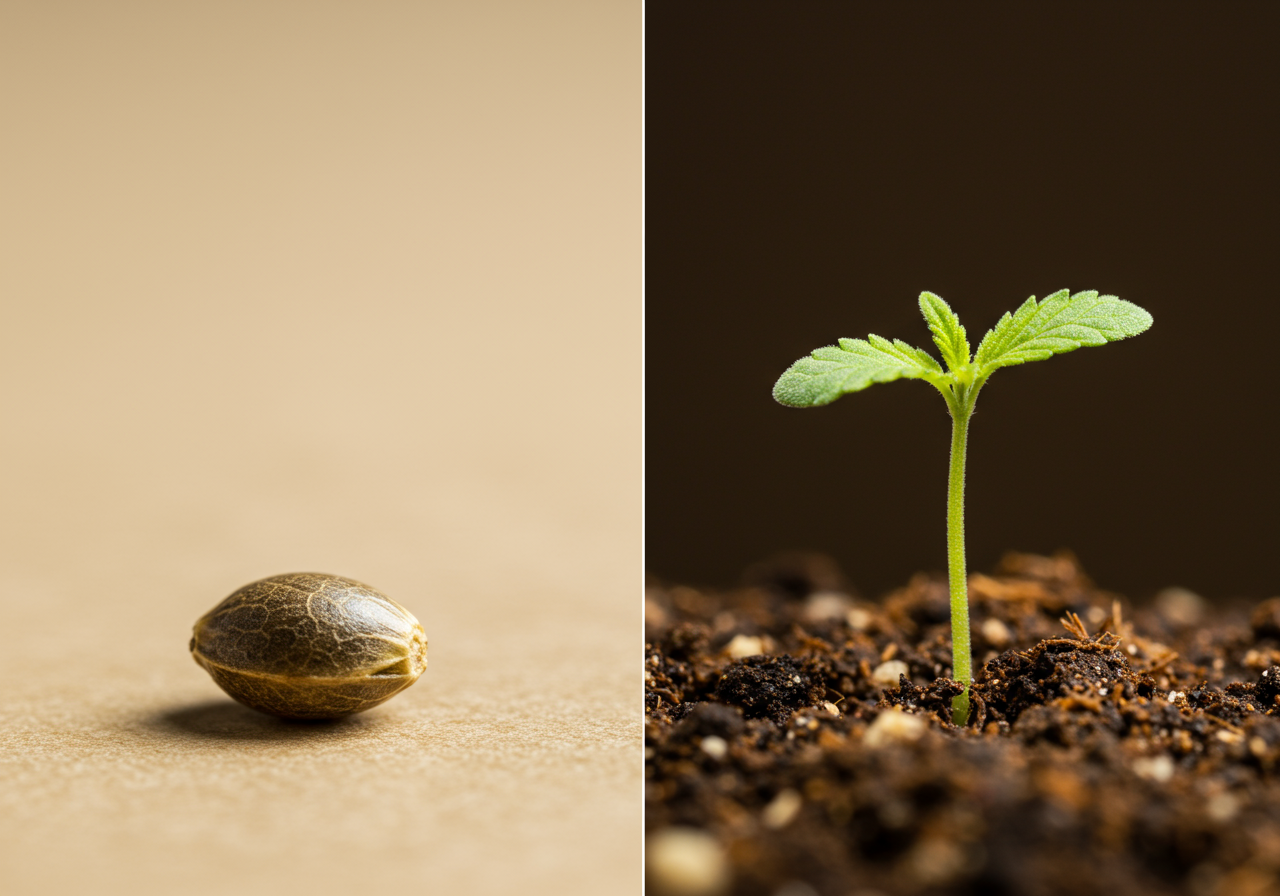
Feminized seed is produced so that female offspring are overwhelmingly likely. Cannabis typically uses XX female and XY male sex chromosomes in dioecious populations. Feminized seed production takes advantage of the fact that genetically female plants can be induced to produce functional pollen. When pollen from an XX plant fertilizes an XX female, the resulting seed lacks the normal Y-chromosome contribution associated with typical male offspring.
Peer-reviewed work has demonstrated feminized seed production using induced staminate flowers on genetically female cannabis, including work with silver thiosulfate. The biology is real, but the shopping conclusion should remain simple: feminized is a sex-probability tool, not a total genetic-quality certificate.
Feminized does not mean cloned
Feminized seeds are still sexually produced seeds. Each seed is a new genotype. The plants can vary in vigor, architecture, aroma, flowering time, cannabinoid expression, stress response, and other traits depending on the parents and breeding design.
For most home growers focused on female flower, the main advantage is efficiency. You can allocate containers, bed space, irrigation zones, and canopy area with much greater confidence that the plants will be female. This becomes especially useful when legal plant limits are low, indoor floor area is expensive, or a backyard has only a few positions with strong sunlight.
The limit is that feminized seed does not erase sexual plasticity. Cannabis sex expression is influenced by chromosomes, genetics beyond the sex chromosomes, hormones, development, and environment. Current research on hermaphroditic or intersex expression shows that sex behavior is more complex than a simple guarantee printed on a pack. A responsible grower still inspects flowering plants.
Pro Tip: Judge feminized seed by the quality and consistency of the population, not by the word “feminized” alone. Sex probability can be excellent while other traits remain variable.
“If feminized seeds are supposed to be female, can I stop checking flowers for pollen structures?”
Question sent by: Nina Weber, via contact form.
No. Feminization makes typical male offspring very unlikely, but it does not justify ignoring the crop. Inspect developing flowers normally. If a plant expresses unexpected staminate structures, treat what you can see as the current risk rather than arguing with the label on the seed pack.
Feminized Seeds Outdoors: Benefits and Limits
Outdoors, feminized seed can be especially efficient because a single plant may occupy a large root zone and a large amount of canopy space before reproductive sex becomes obvious. If the garden has only a few legal or physically suitable positions, filling those positions with seed expected to produce females reduces the chance that prime sites must be emptied later.
Feminized seed also simplifies planning when plants are large enough that removal is disruptive. Irrigation lines, support structures, training, and spacing can be planned around the expected final population rather than around extra plants that may be discarded. In a small backyard, this can be a larger advantage than it appears on a seed listing.
It does not solve outdoor flowering time. A feminized photoperiod plant can still initiate too late for a cold or wet climate. It can still grow too large for the site. It can still finish during autumn rain. It can still have dense flowers that remain wet too long. Feminization says very little about whether the cultivar fits the season.
Field Advice: Outdoors, make the decisions in this order: lawful site and season, finish window, flowering response, disease and weather fit, then sex format. A feminized plant that cannot finish safely is still the wrong outdoor choice.
If outdoor cultivation is the main goal, use the Outdoor Growing Basics resource for site, season, weather, and root-zone planning. Keep this page focused on the seed-format decision rather than using feminized seed as a shortcut for climate selection.
Autoflowering Seeds: A Different Flowering Clock
Autoflowering cannabis is best understood as photoperiod-insensitive or day-neutral flowering behavior. Most photoperiod-sensitive cannabis uses day length and uninterrupted darkness as major seasonal flowering signals. Autoflowering material can enter terminal flowering without waiting for the conventional short-day trigger.
Research has identified major-effect flowering loci associated with autoflowering behavior in cannabis, including Autoflower1, while other early-flowering loci influence timing without producing exactly the same phenotype. This matters because “early” and “autoflower” are not interchangeable. A photoperiod cultivar can be early. A fast-flowering cultivar can finish quickly after induction while remaining photoperiod-sensitive. An autoflower changes the flowering-response system itself.
Day-neutral does not mean the plant ignores light
Autoflowering means flowering induction is relatively independent of the short-day trigger. Light intensity and daily light exposure still influence photosynthesis, growth, heat load, and final plant performance.
The practical advantage is timing simplicity. Indoors, the grower does not need a 12-hour light schedule to initiate flowering. Outdoors, an autoflower can complete a life cycle without waiting for late-season nights to lengthen. That can be useful where autumn frost, rain, smoke, or declining light creates a hard seasonal deadline.
The tradeoff is reduced timing control. A photoperiod plant can often remain vegetative while the grower allows more root development, fills a canopy, takes cuttings, or corrects an early problem. An autoflower’s flowering clock continues. Severe overwatering, transplant shock, root restriction, nutrient injury, or other setbacks during early growth may consume a larger share of the plant’s limited vegetative window.
Tip: Choose autoflower because its flowering behavior solves a timing or scheduling problem, not because the word “auto” sounds easier.
Autoflower also does not define final size. Many modern lines are compact, but cultivar, container volume, root health, light, temperature, nutrition, planting date, and selection history all matter. Likewise, autoflowering does not guarantee low yield, weak potency, or inferior flavor. Those are cultivar and management questions, not definitions of photoperiod response.
“I have a short outdoor season. Should I automatically choose an autoflower?”
Question sent by: PatioGrower, via Facebook page.
Not automatically. An autoflower can avoid waiting for the late-season photoperiod trigger, which may help you finish before bad autumn weather. But an early photoperiod cultivar may also fit the window while giving you more vegetative recovery time. Compare the actual expected finish period, local weather deadline, plant size, and your ability to start at the right time.
Remember: Commercial autoflowers are often feminized, so the most useful comparison may be “feminized photoperiod vs feminized autoflower,” not “feminized vs autoflower.”
Regular vs Feminized vs Autoflower Seeds
The absorbed comparison intent belongs here because the three labels are often encountered together during buying decisions. The cleanest way to compare them is to ask what changes for the grower rather than trying to rank them from best to worst.
| Decision Factor | How Regular, Feminized, and Autoflower Differ |
|---|---|
| Need for male plants | Regular: keeps males in the population and is the natural choice when male selection is part of the project. Feminized: minimizes typical male offspring. Autoflower: does not answer this question unless the seed is also identified as regular or feminized. |
| Space efficiency for female flower | Regular: may use space on plants later removed as males. Feminized: usually improves planning efficiency for female-flower gardens. Autoflower: depends on whether the auto is regular or feminized. |
| Control over flowering start | Regular/feminized photoperiod: flowering remains strongly tied to photoperiod. Indoors, the grower can usually control induction timing. Autoflower: terminal flowering is relatively independent of the short-day trigger, so the grower has less control over delaying the transition. |
| Outdoor season fit | Regular or feminized photoperiod: can work well when the cultivar’s critical photoperiod and finish window match the location. Autoflower: can complete earlier in the calendar because it does not need to wait for the same seasonal trigger, but planting timing and local weather still matter. |
| Recovery after early stress | Photoperiod plants: can often be kept vegetative longer indoors or benefit from a longer natural vegetative period outdoors. Autoflower: has less scheduling flexibility because flowering continues according to its developmental program. |
| Breeding flexibility | Regular: directly supports selection of both male and female parents. Feminized: supports female-focused breeding strategies but does not replace every use of male plants. Autoflower: adds a flowering trait that breeders may select for in either regular or feminized populations. |
| Uniformity | None of the three labels guarantees uniform plants. Uniformity depends on breeding design, generation, parent selection, genetic diversity, seed production quality, and the traits being measured. |
| Potency, aroma, yield | None of the labels alone predicts these outcomes. Compare the actual cultivar or population, evidence, environment, and management rather than assigning quality to the seed format. |
Weedth Verdict: For most flower-focused home growers, the real decision is often feminized photoperiod versus feminized autoflower. Keep regular seed in the comparison when male plants, breeding, preservation, or population selection are actual goals.
This is also where “beginner” recommendations need context. Feminized photoperiod seed can be beginner-friendly because it removes most male-management work while preserving control over flowering timing indoors. Autoflower can be beginner-friendly when simple light scheduling and a short cycle matter, but its limited recovery window can punish early mistakes. Regular seed can be perfectly manageable for a beginner who wants to learn sex identification and has enough legal space, but it adds a task that many first-time flower growers do not need.
Match the Seed Format to the Constraint You Actually Have
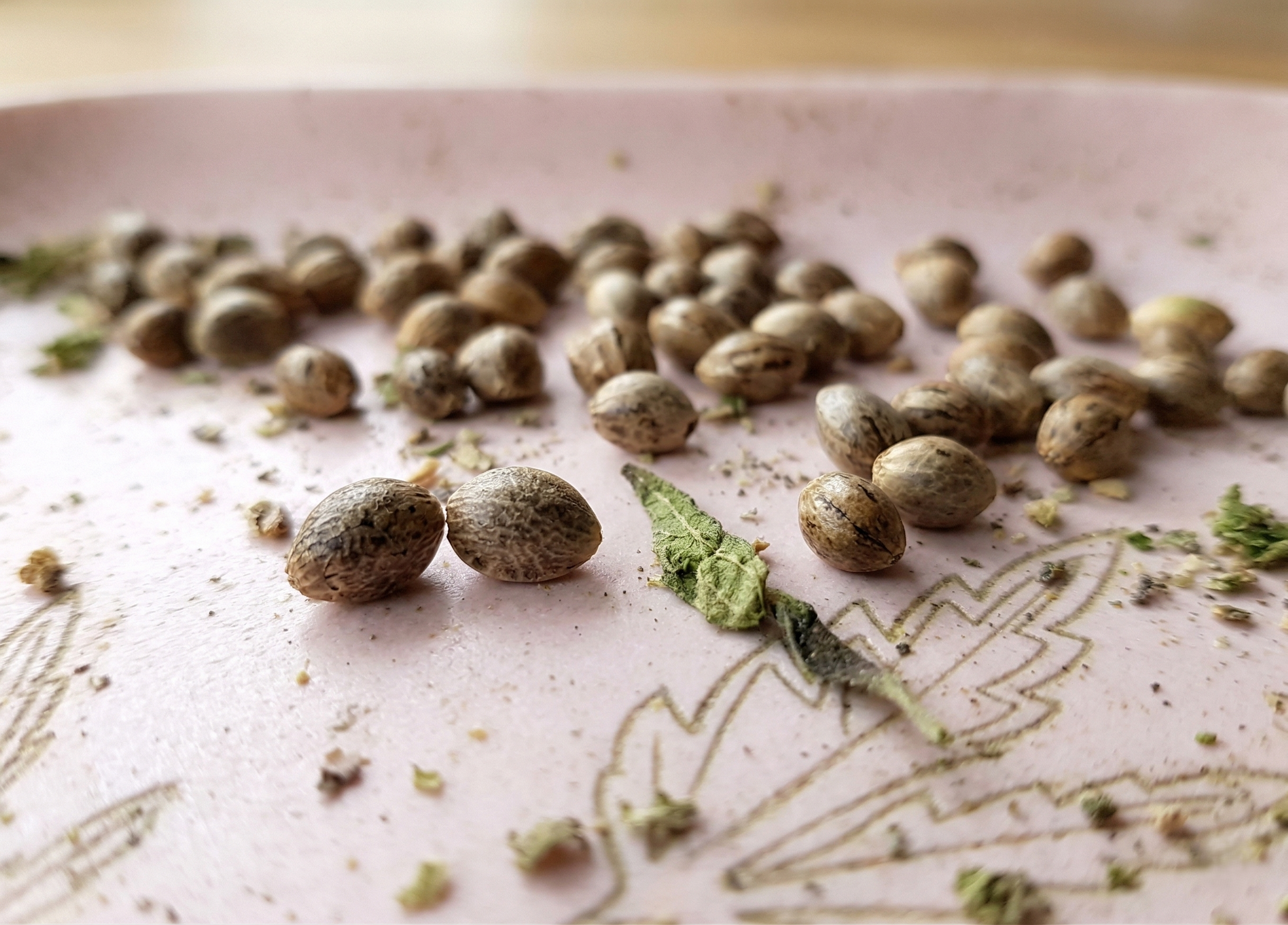
A practical selection system starts with must-pass constraints. Preferences such as cultivar fame, advertised potency, color, or catalog photography come later. If the seed format fails the garden’s real constraint, the rest of the listing cannot rescue it.
If your main goal is seedless flower with limited plant positions
Feminized seed usually makes the strongest first filter because it directs more of the available plant count and space toward expected female plants. Then choose between photoperiod and autoflower based on timing control, season length, and recovery flexibility.
If you want to breed with male plants
Regular seed keeps the male side of the population available. Plan the space and pollen control before sowing. Do not buy regular seed merely because someone claims regular plants are inherently stronger or higher quality.
If your outdoor season has a hard weather deadline
Compare actual flowering behavior and finish window. An autoflower may avoid the late-season trigger entirely, while an early photoperiod cultivar may still finish comfortably before the risk period. The answer depends on latitude, planting date, weather pattern, and the specific genetics.
If you need time to train, clone, or recover before flower
A photoperiod cultivar usually offers more scheduling control, especially indoors. You can delay flowering induction while a plant fills the intended canopy or recovers from a manageable early setback. An autoflower gives less control over this part of the calendar.
If you want the simplest first shopping decision
Choose a seed from a well-documented population that fits your real environment. For many new flower growers, that means feminized seed, then a deliberate choice between photoperiod and autoflower. The broader Cannabis Grow Basics guide can help if you are still deciding between indoor and outdoor cultivation rather than only choosing a seed format.
Choose the seed format after answering these questions
- Do I actually want male plants for breeding or selection?
- How many legal and physically useful plant positions do I have?
- Do I need control over when flowering starts?
- Does my outdoor season have a frost, rain, smoke, or daylight deadline?
- How much early recovery time do I want if a plant is stressed?
- Do I need to take clones or hold a plant in vegetative growth?
- Does the seller clearly state both sex format and flowering format?
- Is the actual cultivar documented well enough to judge finish time and garden fit?
Master Advice: Must-pass constraints first, preferences second. A cultivar that does not fit your season, space, flowering control, or breeding goal is the wrong seed choice no matter how attractive the marketing description looks.
Read Seller Claims Without Letting the Label Decide for You
After choosing the seed format, evaluate the actual material. A label such as feminized autoflower does not tell you whether the population is uniform, whether the flowering estimate is realistic in your environment, or whether disease claims were measured under comparable conditions.
Start with provenance. Record the cultivar name exactly as sold, seed format, stated generation if one is provided, pack or lot identifier, purchase or acquisition date, source page, and any specific flowering or disease claims. If the page later changes, your season notes still have a reference point.
Then separate evidence from advertising. “8 weeks” is incomplete without knowing what starts the clock. “Outdoor” does not tell you which latitude or weather pattern. “Mold resistant” needs a disease, environment, comparison, and observation method before it becomes strong evidence. “Beginner friendly” is usually a marketing summary rather than a measured plant trait.
Tip: Copy the claim before the grow, then test the claim after the grow. “Finished before the wet season in my site” is more useful local evidence than remembering that the listing called the cultivar “outdoor ready.”
Autoflower marketing deserves the same scrutiny. A life-cycle estimate may describe one environment, one container size, and one production style. The number should not be treated as a guaranteed harvest date. Likewise, feminized should not be converted into a promise that every seed will express exactly the same female phenotype.
If a seed listing mixes strain names, generations, sex format, and flowering type in confusing ways, use the broader Cannabis Seed Types Explained for Beginners page to decode the breeding terms before making a purchase decision.
Keep Enough Records to Judge the Seed Format After the Grow
A seed choice becomes useful knowledge only if you can connect the final plant back to the material you bought. Record the original pack or lot identifier when one exists, then give each plant an individual ID. Do not rely on a cultivar name alone. Several plants from one pack are siblings, not interchangeable copies.
For this comparison, the most useful records are simple: source, lot or pack, seed format, flowering type, sowing or start date, individual plant ID, sex expression, first clear flowering transition, harvest date, harvest reason, major stress events, and whether the result matched the claim you cared about.
Remember: A seed label is a prediction. Your plant record is the evidence of what that individual actually did in your environment.
If an autoflower began flowering earlier than expected, note the date and the plant’s condition rather than assuming the line is defective. If a feminized plant expresses unexpected pollen structures, record the observation and isolate the risk from the rest of the crop. If a regular pack produces a skewed male:female outcome in a small sample, record it without treating a handful of seeds as proof that the population ratio is wrong.
The planned Weedth resource on plant labels and lot records can carry the full traceability workflow. This page needs only enough recordkeeping to make the seed-format decision verifiable rather than anecdotal.
Common Shortcuts That Make the Comparison Worse
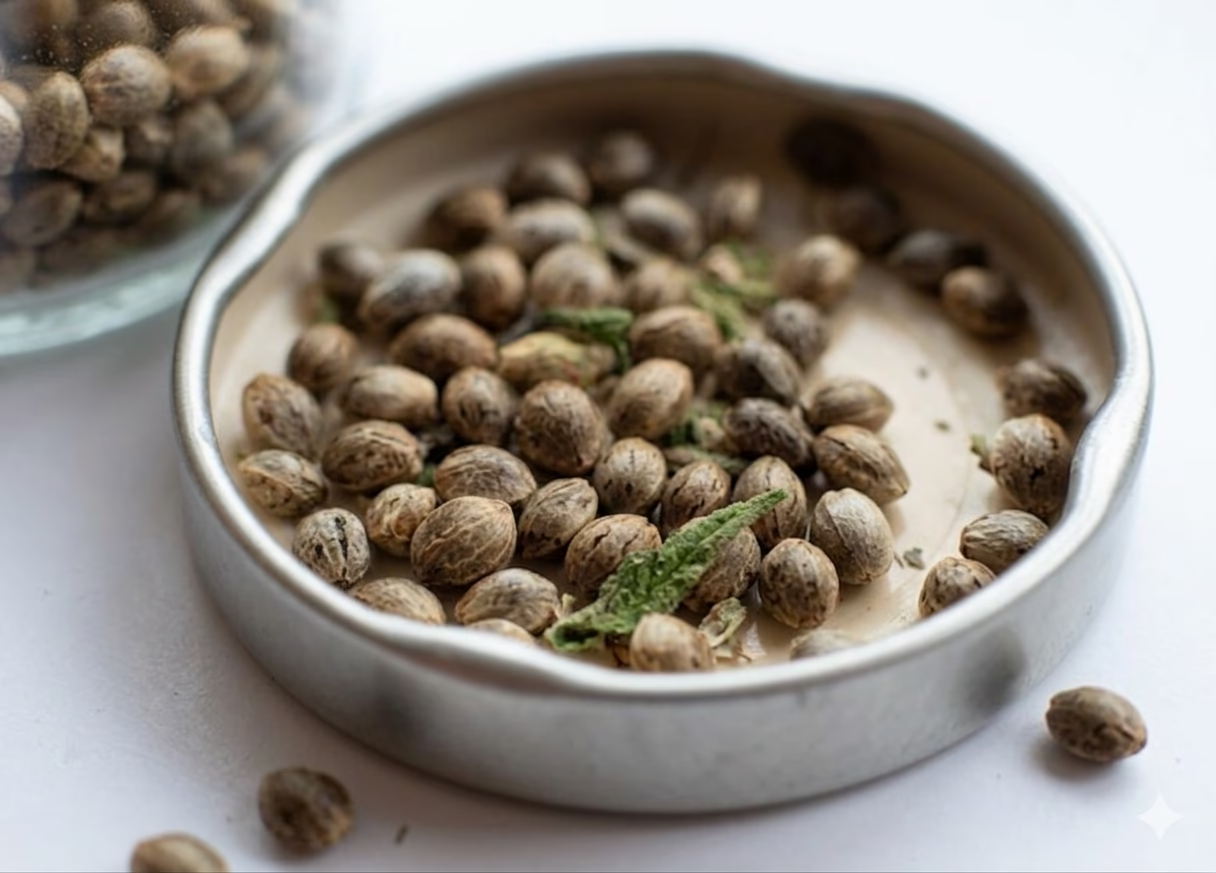
Several rules of thumb survive because they sound simple. They are poor selection tools when treated as universal facts.
“Regular seeds are stronger.” Regular seed retains male and female outcomes. It does not confer a universal vigor advantage. Vigor depends on the actual parents, genetic diversity, inbreeding, breeding design, seed quality, and growing environment.
“Feminized seeds are genetically unstable.” Feminization is a production method, not a diagnosis of instability. Poor parent selection can preserve undesirable traits, but feminized seed can also come from carefully selected material. Judge the line and evidence.
“Autoflowers are always easy.” They remove the need to trigger flowering with a short-day schedule, but a fixed developmental timeline reduces the opportunity to recover lost vegetative time.
“Autoflowers are always tiny.” Many are compact, but final size varies with cultivar and environment. Size is not the definition of the trait.
“Feminized means 100 percent female forever.” Good feminized seed makes typical male offspring very unlikely, but cannabis sex expression is biologically plastic enough that absolute promises are not responsible.
“Autoflower means ruderalis, so all autos behave the same.” Photoperiod-insensitive flowering has been associated with high-latitude cannabis material historically described as ruderalis, but modern autoflower populations have complex breeding histories. The autoflower trait does not define the rest of the genome.
Important: Do not use seed shell color, striping, size, or shape to decide sex, cultivar identity, potency, or autoflower status. Those traits cannot reliably reveal the labels you are comparing.
Make the Final Choice From Constraints, Not Marketing
The three labels become much easier once you stop asking them to predict everything about the plant. Regular keeps male and female possibilities. Feminized makes female offspring overwhelmingly likely. Autoflowering changes the flowering-response system. The first two answer a sex-management question. The third answers a timing question.
For a flower-focused home garden with limited space, feminized seed often removes an unnecessary source of uncertainty. The next decision is then photoperiod versus autoflower. Choose photoperiod when you value control over vegetative duration, training, cloning, or recovery. Choose autoflower when day-neutral flowering and a potentially earlier calendar finish solve a real scheduling or seasonal problem.
Keep regular seed when male plants are not a problem to eliminate but part of the project. Breeding, preservation, pollen work, or population selection can make the extra management worthwhile.
After that, return to the actual cultivar. Finish window, architecture, disease response, vigor, root-zone behavior, provenance, and observed performance matter more than the seed-format label for deciding whether a plant fits your garden. The best seed type is the one that removes the uncertainty you do not need without removing the flexibility you do need.
Frequently Asked Questions About Regular, Feminized, and Autoflower Seeds
Are feminized and autoflower seeds the same thing?
No. Feminized describes the expected sex outcome. Autoflower describes flowering response. A seed can be both feminized and autoflowering.
Can autoflower seeds be regular?
Yes. Autoflowering does not determine sex format. Regular autoflower seed can produce male and female plants, while feminized autoflower seed is produced to make female offspring overwhelmingly likely.
Are regular seeds always 50 percent male and 50 percent female?
Not in every small pack. Dioecious cross-fertilized cannabis populations often approach a 1:1 sex ratio across larger samples, but random sampling can produce a strongly skewed result in a small home grow.
Are feminized seeds better for outdoor growing?
They can be more space-efficient because the grower is less likely to invest a prime outdoor position in a male plant. They are not automatically better for climate fit. Finish window, flowering behavior, disease pressure, and autumn weather still decide whether the cultivar belongs in the location.
Are autoflowers better for short outdoor seasons?
They can be useful because flowering is relatively independent of the late-season short-day trigger, but an early photoperiod cultivar may also fit a short season. Compare the actual planting window and expected finish against local weather risk.
Do feminized seeds cause hermaphroditism?
The word feminized alone does not prove a line will be unstable. Sex expression in cannabis is influenced by genetics, hormones, development, and environment. Parent selection and breeding quality matter, so plants should still be inspected during flowering.
Share this article
A quick overview of the topics covered in this article.
Follow us
Latest articles

September 4, 2026
September 4, 2026
September 4, 2026
September 4, 2026