
Why a Small Amended Hole Can Become a Bathtub
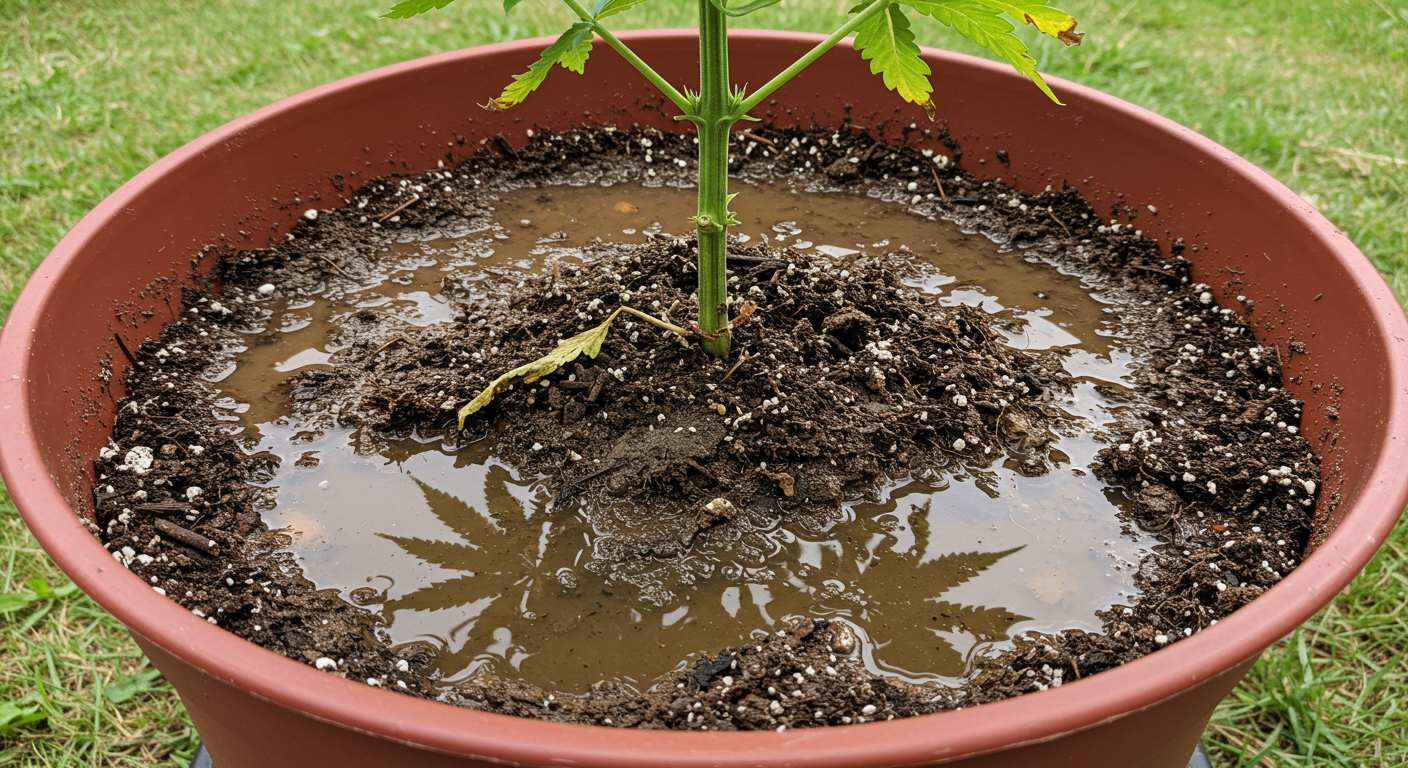
A small planting hole filled with compost-rich soil, potting mix, or another loose amendment can become wetter than the surrounding ground when water enters the amended pocket faster than the native soil can transmit it away. The effect is most likely where the surrounding soil is fine-textured, compacted, layered, or already slow to drain. The amended material is not literally a waterproof container, but the abrupt change in pore structure can slow water movement across the boundary enough for the rooting zone to stay saturated after rain or irrigation.
The practical lesson is not “never improve soil.” It is “do not confuse a better planting mix with a drainage system.” If the site cannot move excess water through or away from the rooting zone, replacing one small volume of native soil with a much looser mix does not remove the restriction. It can create a preferentially wetted pocket surrounded by soil that still controls the final drainage rate.
This resource stays focused on that mechanism. For the broader decisions around soil texture, organic matter, container media, pH, and amendments, use the Cannabis Soil and Growing Media guide. If you are planning the entire outdoor site rather than diagnosing one planting hole, the Outdoor Grow Comprehensive Guide covers the larger sequence from site choice through harvest.
Resource Navigation
In This Resource
- What the “Bathtub Effect” Actually Means
- The Soil Interface Controls How Water Leaves the Hole
- Know When a Small Amended Hole Is Most Likely to Fail
- Diagnose the Planting Hole Before You Change It
- Run a Repeatable Hole-and-Surrounding-Soil Check
- Correct the Root Zone Without Digging a Better Bathtub
- Manage Irrigation Across the Root-Ball and Native-Soil Boundary
- Verify the Fix Through the Next Wetting Cycles
What the “Bathtub Effect” Actually Means
The phrase “bathtub effect” is commonly used in horticulture for a planting hole that stays excessively wet because its backfill or planting mix behaves differently from the surrounding soil. University extension guidance most often discusses the problem in tree and shrub establishment, especially where a highly amended hole is surrounded by clay or compacted soil. The physics is relevant to cannabis grown in native ground for the same reason: water movement is controlled by pore size, continuity, hydraulic gradients, and the surrounding profile, not by the crop name.
Imagine a grower digging a relatively small hole in dense native clay and filling most of it with compost-rich garden soil or potting mix. The new material contains more large pores and accepts irrigation easily. Water can enter that pocket quickly. Once it reaches the sides and bottom, however, it encounters the original dense soil. If that surrounding soil transmits water slowly, the amended pocket can receive water faster than it loses it. The result is prolonged saturation around young roots.
The bathtub effect is a hydraulic mismatch, not a literal sealed bowl
A planting hole becomes “bathtub-like” when a sharp change between the amended rooting zone and surrounding soil slows water movement enough for the planted zone to remain wetter than intended. The native soil still passes some water; it simply may not pass it fast enough to match rainfall or irrigation entering the hole.
Why a cannabis plant can suffer even when the hole contains “better soil”
Loose amended soil may contain more organic matter, better tilth, and higher nutrient availability than the native ground. Those qualities do not protect roots from prolonged saturation. When water fills most of the air-filled pore space, oxygen diffusion through the root zone slows sharply. Roots continue respiring, and microorganisms continue consuming oxygen. A wet root zone can therefore become oxygen-limited even though nutrients and water are abundant.
Cannabis-specific controlled research supports the general waterlogging mechanism. A 2025 study exposed Cannabis sativa plants to waterlogging and water shortage at vegetative and reproductive stages and reported negative effects on growth and physiological performance, with longer stress affecting cannabinoid accumulation as well. Those experimental periods are not a field threshold for amended holes. A garden can become stressful sooner or recover faster depending on soil temperature, plant size, root density, pore structure, and how fully the hole remains saturated.
Important: A rich planting hole can still be a poor root zone. Nutrient content does not compensate for a lack of oxygen or a drainage restriction outside the hole.
A wet pocket can also become a dry pocket later
The interface problem is not limited to excess water. Extension guidance also notes that sharply different soils can exchange water poorly in the opposite direction. During hot, dry weather, a loose organic-rich root ball or amended pocket may dry differently from the finer native soil around it. Water held tightly in the surrounding clay may not move back into the coarser root-zone material quickly enough to match plant demand.
This is why the same planting setup can confuse growers. In spring rain, the hole seems waterlogged. In midsummer, the root ball can become unexpectedly dry while nearby clay still feels moist. The system is not contradicting itself. The boundary is affecting water movement under different moisture conditions.
Remember: “Bathtub effect” describes one wet-season failure of an interface. The same abrupt interface can contribute to uneven rewetting or root-ball drying later in the season.
“I dug a deep hole in clay and filled it with compost and potting soil. The mix is much lighter now, so why does it stay wetter after rain?”
Question sent by: SoilShelf, via email.
The lighter mix improved conditions inside the hole but did not change the clay that controls lateral and downward drainage. If rain and irrigation enter the amended zone faster than the surrounding clay can accept that water, the loose pocket becomes the collection zone. Compare moisture inside the hole with soil just outside it before adding more amendment.
The Soil Interface Controls How Water Leaves the Hole
Water does not simply fall through soil according to gravity. It moves through pores under the combined effects of gravity, capillary forces, soil-water potential, and the continuity of available pathways. A sharp change in texture or structure alters those pathways. Colorado State University Extension describes texture interfaces as boundaries where water and air move slowly compared with a more uniform soil profile.
Coarse or porous soil over denser soil can back water up
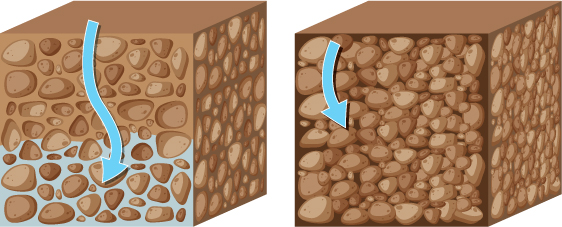
If a loose amended material sits above or inside denser clay or compacted subsoil, the wetting front may move rapidly through the larger pores and then slow when it reaches the smaller-pored soil. Water can accumulate above that transition until the pressure and saturation are sufficient to drive more flow into the denser material. In a small planting hole, that temporary accumulation occurs exactly where the transplanted root system is concentrated.
The effect is similar to a wide pipe feeding a narrow one. The narrow section is not completely blocked, but it sets the maximum rate at which water can leave. If inflow is greater than outflow, storage increases upstream. In soil, the “storage” is additional water filling pores that would otherwise contain air.
Do not interpret rapid infiltration into the amended mix as proof of good drainage
Water disappearing from the surface only tells you that it entered the hole. Drainage is not confirmed until excess water can move through and away from the entire rooting zone.
Vertical and lateral escape both matter
A planting hole loses water in more than one direction. Some moves downward. Some moves sideways into surrounding soil. Some returns to the atmosphere through evaporation and plant transpiration. The importance of each pathway changes with slope, soil layering, rainfall, plant size, and the position of the local water table.
A small amended hole on a gentle slope may drain laterally better than the same hole in a flat depression. A hole that reaches a compacted construction layer may drain worse than a shallower planting zone over intact topsoil. A hole in clay that is already near field saturation from several days of rain has little capacity to lose additional water into the surrounding soil.
Field Advice: When diagnosing a wet hole, look beyond the backfill. The real restriction may sit at the bottom of the hole, around its sidewalls, deeper in the subsoil, or across the entire landscape position.
Glazed sidewalls can strengthen the boundary
Digging wet clay with a smooth shovel or auger can smear the hole walls. The clay surface becomes slick and compressed, reducing macropore continuity at the very boundary roots and water must cross. Horticultural planting guidance commonly recommends roughening or notching glazed clay sidewalls rather than leaving them polished.
This does not turn clay into free-draining loam, but it removes an avoidable mechanical barrier. The larger lesson is that hole preparation can either soften or strengthen the interface. A beautifully amended center surrounded by smeared walls is still an isolated pocket.
Make the transition into surrounding soil easier
Roughen glazed sidewalls, preserve natural drainage paths, and improve a broader rooting area when the site allows it.
Build a smooth-sided pocket of unrelated soil
A narrow hole full of potting mix inside dense clay maximizes the contrast exactly where roots and water need to cross.
Root-ball media creates another interface inside the planting hole
Outdoor cannabis is often transplanted from a container filled with peat-, coco-, compost-, or bark-based media. That root ball may already have very different water behavior from both the amended backfill and the native ground. A grower can therefore create three hydraulic zones: the original container root ball, the amended planting hole, and the surrounding native soil.
Early after transplant, most active roots are still concentrated in the root ball. If irrigation wets the surrounding amended soil but does not fully rewet the root ball, the plant can wilt even while the hole feels wet. Conversely, if the root ball stays saturated and the surrounding native soil drains poorly, young roots may have little aerated volume available for expansion.
Pro Tip: During establishment, check moisture in the original root ball and in the surrounding backfill separately. One finger test in the amended soil does not describe both zones.
Know When a Small Amended Hole Is Most Likely to Fail
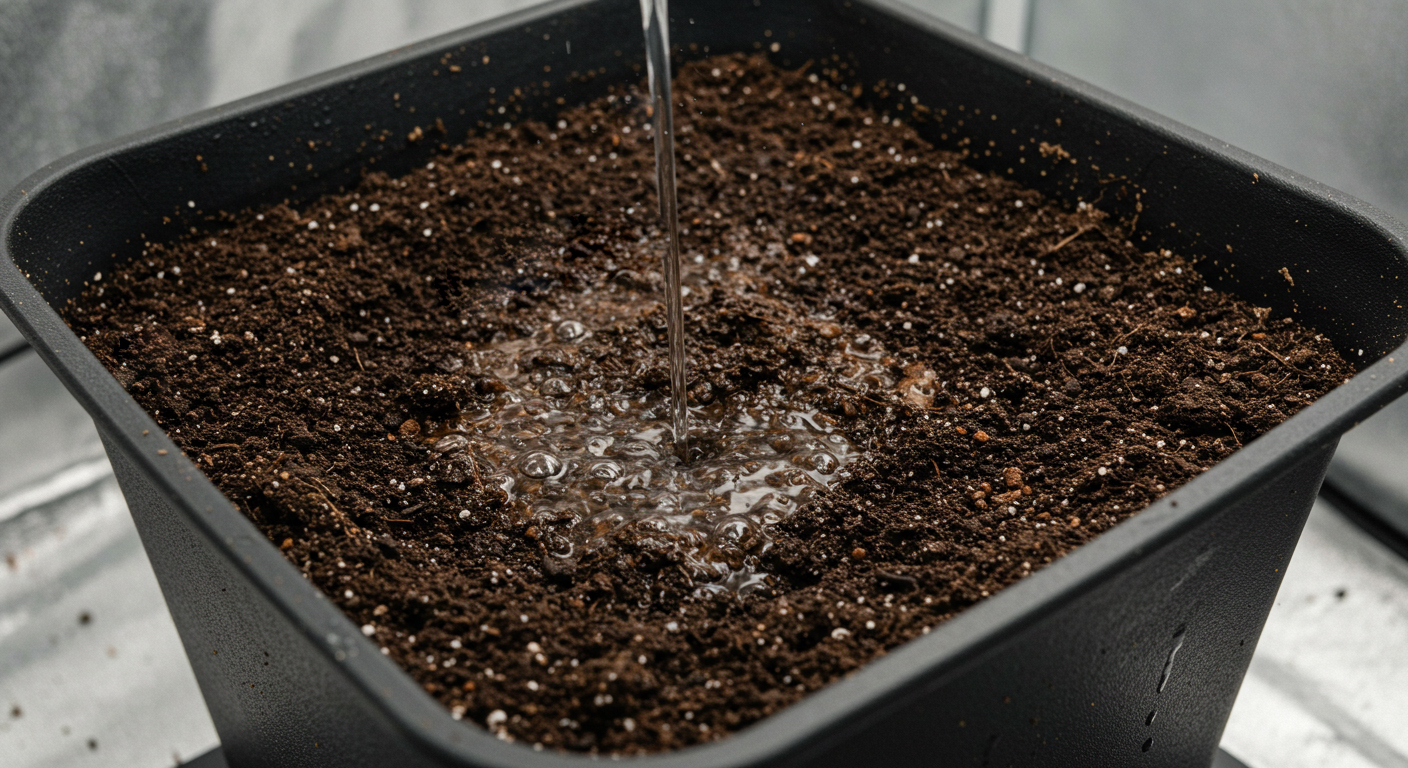
Not every amended hole becomes waterlogged. The risk rises when several conditions align: the amended area is small, the surrounding soil is fine-textured or compacted, the site receives substantial rainfall or irrigation, the planting hole is deeper than necessary, and there is no reliable route for excess water to leave. The stronger the contrast between the hole and its surroundings, the more carefully the interface should be managed.
| Condition | Why It Changes Bathtub Risk |
|---|---|
| Heavy clay around a loose amended pocket | The amended material may accept water faster than the clay can transmit it away, increasing saturation inside the planting zone. |
| Compacted or construction-disturbed subsoil | Downward percolation can slow abruptly even if the surface topsoil appears acceptable. |
| Flat low spot | Runoff and shallow subsurface flow can converge on the planting area while lateral drainage remains weak. |
| Hole deeper than the useful rooting zone | Water can collect below active roots in a zone with limited evaporation or root extraction, keeping the lower profile wet. |
| Large difference between root-ball mix and native soil | Multiple interfaces can create uneven rewetting and uneven dry-back during establishment. |
| Frequent irrigation independent of soil moisture | Repeated inflow can exceed the rate at which the site drains, so the hole never returns to an aerated state. |
| Raised mound or broad bed with a real outlet | Elevation can increase the volume of aerated soil above the restrictive native layer and reduce saturation around the main roots. |
The problem is not simply “clay”
A structured clay loam on a slope may drain better than a compacted sandy fill in a depression. A site with substantial clay can contain worm channels, old root pores, stable aggregates, and good topographic drainage. The bathtub risk comes from the complete water pathway, not the texture label by itself.
Likewise, a small amended hole can fail in compacted silt, urban fill, or layered soil. The most common example is clay because the contrast with organic backfill can be large and the native matrix can transmit water slowly, but the diagnostic method should still evaluate structure and landscape position.
Remember: Treat “bathtub effect” as a mechanism to test, not a diagnosis you apply automatically to every plant growing in clay.
High groundwater and perched landscape water are different problems
If a local water table rises into the root zone after storms, the planting hole may fill from below or from surrounding saturated soil even if the hole itself was not heavily amended. That is a broader site drainage problem. Changing the backfill cannot lower groundwater.
Similarly, a dense subsoil horizon can create perched water over a much larger area than the planting hole. If multiple holes, nearby test pits, or natural depressions all remain wet at the same depth, the problem is probably not isolated to one amended pocket.
Do not keep digging deeper to “find drainage” without knowing the profile
A deeper hole can intersect a denser layer, create more below-grade storage, or reach seasonal groundwater. Digging depth is not a substitute for identifying where water can actually leave the site.
Recent transplanting increases sensitivity
A newly transplanted cannabis plant has limited root distribution. Most water uptake still occurs near the original root ball, and root expansion into native soil is just beginning. Saturation during this period can reduce root-zone oxygen exactly where the plant has the least redundancy. A larger established root system may exploit shallower or more distant aerated zones that a new transplant cannot yet reach.
This does not justify a fixed “safe number of wet days.” Root-zone temperature, plant size, root health, and the degree of saturation all change the response. The useful comparison is whether the hole returns toward an aerated moisture state between wetting events.
Heavy rain exposes flaws that light irrigation may hide
A planting hole may appear to work for weeks under careful irrigation because the grower never applies enough water to saturate the surrounding profile. A long storm changes the test. Rain wets the entire surface, the native soil approaches saturation, lateral escape declines, and the amended pocket may become the easiest place for water to collect.
Master Advice: Evaluate the planting method against the wettest realistic part of the season, not only against a controlled watering can on a dry day.
Diagnose the Planting Hole Before You Change It
Wilting, pale leaves, slow growth, and stalled nutrient uptake can occur in a saturated root zone, but none of those symptoms proves that an amended planting hole is acting like a bathtub. Heat, drought, transplant shock, root disease, salt stress, pH problems, stem damage, or a poorly wetted root ball can produce overlapping symptoms. Diagnosis should begin with the water pattern.
Compare inside the hole with just outside the hole
Use a narrow trowel, soil probe, or careful hand excavation to compare moisture at similar depths inside the amended zone and in the surrounding native soil. The comparison is more informative than simply checking whether the surface is damp. You are looking for a persistent contrast: saturated or very wet amended soil beside native soil that accepts water only slowly, or a wet lower pocket that remains after the upper soil begins drying.
Repeat the comparison after a meaningful wetting event. One snapshot cannot tell you whether the root zone is recovering. The question is how quickly the profile changes over the following hours and days.
“My plant droops the day after rain, but the leaves perk up later. How do I know whether the hole is waterlogged or the plant is just reacting to weather?”
Question sent by: Marcus Bennett, via contact form.
Check the root-zone moisture pattern rather than the leaves alone. Compare the original root ball, amended soil, and nearby native soil at the same depth, then recheck the next day. If the amended zone remains saturated while surrounding conditions improve, and the same droop repeats after wetting, the evidence for a drainage-interface problem becomes much stronger.
Smell and root condition can support the diagnosis
A healthy mineral soil may smell earthy. Persistently saturated, biologically reduced zones can become sour, stagnant, or sulfurous. Roots in chronically oxygen-limited soil may lose healthy fine-root development and can become brown or damaged, but root color varies with media and age. Odor or root appearance should support other observations, not replace them.
If roots are already decaying, the immediate problem may no longer be only physical drainage. Root pathogens can exploit stressed tissue and prolonged wetness. At that point, simply allowing the hole to dry does not prove the root system is healthy again.
Field Advice: Record whether roots are expanding beyond the original hole. Root confinement along the amended boundary is evidence that the physical transition deserves attention even when the plant has not yet collapsed.
Separate a wet planting hole from a dry root ball
A common transplant mistake is to assume that wet backfill means the original container root ball is also wet. Peat-rich or bark-rich root balls can develop water-repellent dry zones. Water applied around the plant may follow the easier path through the amended backfill and bypass the dry core. The plant wilts, the grower probes the surrounding hole, finds moisture, and concludes the roots are waterlogged.
Check both zones. If the root ball is light, pulling away from the surrounding soil, or difficult to rewet while the outer hole remains damp, the problem is not a classic bathtub. It is uneven hydraulic contact and rewetting.
Diagnose the root ball and backfill separately
During establishment, compare moisture inside the original transplant media with moisture in the amended hole and native soil.
Call every wilt after rain “overwatering”
Wilt can reflect root hypoxia, a dry root ball, heat, disease, transplant injury, or other stress. Use the soil profile to separate them.
Check the landscape before blaming the planting recipe
Look uphill and around the bed. Roof runoff, compacted paths, irrigation from neighboring zones, retaining walls, driveway drainage, and natural slope can direct water toward one plant. If water is being delivered to the location from outside the planting hole, changing the backfill may have little effect until the site drainage is corrected.
This is also why two identically planted cannabis plants can behave differently. One may sit in a subtle depression or above a compacted utility trench while the other sits on slightly higher ground.
| Symptom | Possible Cause | How to Confirm | Corrective Action | Prevention |
|---|---|---|---|---|
| Hole stays saturated after rain | Interface plus slow surrounding drainage | Compare moisture inside and outside the hole over 24–72 hours. | Reduce irrigation, restore an aerated rooting zone, and correct site drainage or rooting geometry where feasible. | Avoid a small pocket of radically different backfill in slow-draining ground. |
| Plant wilts while backfill feels wet | Root hypoxia, root damage, or dry original root ball | Check original root-ball moisture and root condition separately. | Correct the actual moisture pattern rather than automatically adding or withholding water. | Monitor the transplant media and surrounding soil as separate zones during establishment. |
| Several nearby holes remain wet | Broader drainage restriction or shallow groundwater | Inspect multiple locations at the same depth after rain. | Use site-scale drainage, raised planting, or another root-zone strategy rather than fixing one hole. | Assess landscape drainage before planting. |
| Water disappears quickly but lower hole remains wet | Fast infiltration into amendment with slow percolation through native soil | Track moisture at several depths after the wetting event. | Reduce inflow and address the lower restriction. | Do not use surface disappearance as a drainage test. |
| Root ball dries while outer hole stays moist | Hydrophobic or poorly connected transplant media | Inspect root-ball moisture directly after irrigation. | Rewet the root ball gradually and improve hydraulic contact without flooding the hole. | Break severe circling or hydrophobic transplant patterns before planting and monitor establishment carefully. |
Run a Repeatable Hole-and-Surrounding-Soil Check
A good field check follows one wetting event from entry to recovery. It does not need to produce a universal drainage number. Its purpose is to determine whether the amended zone and the native soil are returning to a similar, workable moisture state or whether the hole stays disproportionately wet.
Step 1: record the starting condition
Before watering or before a forecast rain event, record whether the root ball, amended soil, and native soil are dry, moist, or already wet at the depths you plan to compare. If the whole profile begins near saturation, the next wetting event will tell you little about the planting-hole interface because the entire site already has limited storage capacity.
Tip: Use the same three observation points every time: original root ball, amended backfill, and native soil just outside the hole.
Step 2: measure the water input when you control it
If you are irrigating, record approximately how much water you apply and where it lands. Do not flood the hole simply to “test drainage” around a stressed cannabis plant. Use a normal irrigation event or a separate unplanted comparison hole if you need a more aggressive site test.
Rainfall is less controlled, so record the event amount when a reliable local gauge or weather station is available. The number is useful only as context. Soil antecedent moisture and rain intensity can change the response even when storm totals are similar.
Step 3: observe surface entry without stopping there
Note whether water ponds, runs off, or enters quickly. This is the infiltration stage. It does not yet tell you whether the hole drains. If the amended zone accepts water immediately while native clay ponds around it, that contrast is useful evidence that the pocket is receiving inflow faster than the surrounding surface.
Important: Surface infiltration is only the first checkpoint. The bathtub question is answered later, by what happens after water reaches the boundary and the site should begin draining.
Step 4: compare the profile after free drainage should have begun
Recheck the same locations several hours later and again the next day. Avoid a rigid hour cutoff because soil texture, weather, and site hydrology differ. Look for the direction of change. Is the amended zone becoming less saturated? Is the original root ball still waterlogged? Is the native soil outside the hole drying at the same rate, more slowly, or faster?
If the amended pocket remains nearly saturated while the upper soil and nearby native ground begin recovering, you have stronger evidence that the hole is functioning as a local storage zone. If every location remains wet, the restriction is probably broader than the hole.
Step 5: repeat after a second real wetting cycle
One event can be unusual. Repeat the observation after the next substantial irrigation or rainfall event, especially if the first event followed a long dry period. Clay shrinkage cracks, hydrophobic media, and antecedent moisture can make the first wetting cycle behave differently from later cycles.
Pro Tip: A repeatable pattern is more valuable than a dramatic single observation. If the same amended pocket remains the wettest zone after multiple events, the diagnosis becomes much more defensible.
“Can I fill the empty planting hole with water and time how long it takes to disappear?”
Question sent by: Clara Weber, via Facebook page.
You can use an unplanted hole as one site observation, but do not treat the emptying time as a universal cannabis drainage threshold. The test disturbs the soil, may saturate the hole more aggressively than normal irrigation, and combines infiltration, storage, sidewall flow, and deeper drainage. Pair it with profile observations and compare more than one location.
Keep a simple field record
A short log is enough: date, rainfall or irrigation input, starting moisture, hours until the amended zone is no longer saturated, plant response, and any intervention. Add notes for unusually cool weather because evaporation and transpiration are lower, or for heat because plant water extraction can accelerate dry-back.
The log prevents a common bias: remembering the one storm when the plant drooped but forgetting the three events when the hole recovered normally.

Correct the Root Zone Without Digging a Better Bathtub
Correction should target the actual restriction. If the native soil is capable of supporting roots but the amended pocket is too abrupt, the goal is a broader, more continuous rooting zone. If the site itself is chronically saturated, the answer may be elevation, drainage redesign, or containers rather than another amendment recipe.
Do not solve the problem by adding even more loose material to the same hole
If a small, highly amended pocket already holds too much water, increasing the contrast with more compost, peat, or potting mix can make the boundary more pronounced. Organic material also changes over time as it decomposes and settles. The volume and pore structure you build on planting day will not remain identical for the life of the plant.
Extension recommendations for woody plants often favor native-soil backfill or only modest amendment and emphasize preparing a broader area rather than a luxury pocket. Cannabis is not a tree, but the water-interface principle still applies to an in-ground annual transplant.
Weedth Verdict: Improve the root zone broadly enough that roots can leave the original hole. A perfect 40-liter pocket inside a hostile cubic meter of soil is still a site problem.
Widening and blending can be more useful than deepening
Where site drainage is fundamentally acceptable, a wider prepared area can reduce the abruptness of the transition and give roots more disturbed soil to explore. Avoid creating a deep sump beneath the plant. Cannabis roots do not need a narrow shaft of rich soil below them if the surrounding profile remains dense and wet.
Any broad amendment should still be evidence-based. Too much compost can alter salinity, nutrient balance, bulk density, and water-holding behavior. The objective is not to make native soil resemble commercial potting mix. It is to create a workable transition while preserving a drainage path.
Field Advice: Think in root-zone volume, not hole volume. The useful question is how much soil the root system can occupy without crossing a severe physical boundary.
Use a mound or raised bed when elevation addresses the real limitation
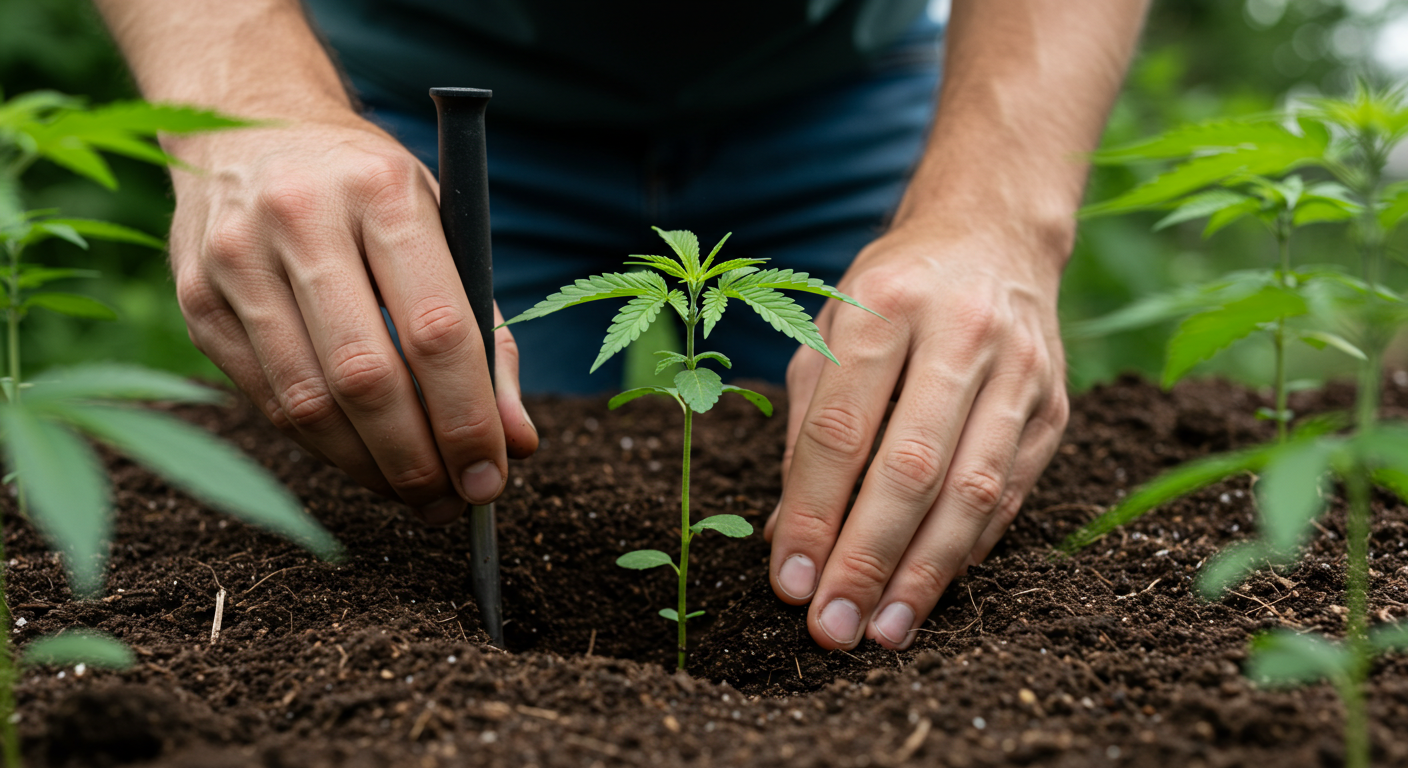
On flat, slowly draining sites, raising the main root crown and a meaningful portion of the rooting volume above native grade can reduce the time roots spend in saturated soil. A broad mound avoids concentrating all improved material below grade. A raised bed can provide even more controlled soil volume.
Elevation is not magic. Water still needs somewhere to go. A raised box built in a depression can receive runoff from all directions, and a sharp interface between imported soil and compacted ground can still influence water movement. Site grading and outlet conditions remain part of the design.
Raise or broaden the root zone when drainage is the limiting factor
Use a mound, broad bed, or properly designed raised bed when it creates a larger aerated rooting volume and fits the site.
Excavate a deeper bowl and fill it with richer soil
Greater depth below grade adds storage but does not create an outlet through slow native soil.
Do not put a gravel sump under the planting hole and assume drainage is fixed
Extension guidance repeatedly warns that gravel at the bottom of a planting hole does not correct poor internal drainage. A coarse layer creates another pore-size interface. Water in the finer soil above may need to approach saturation before it enters the larger pores below. The result can be a perched wet zone rather than a drier root zone.
A gravel layer is not a drain unless it connects to a real drainage outlet
Loose stone sitting beneath a closed planting hole does not remove water from the site. A functioning drain requires hydraulic continuity to somewhere the water can legally and safely discharge.
Do not install an improvised drain without understanding where the water will discharge
A pipe, trench, or French-drain concept only works when gravity, grade, soil conditions, and an appropriate outlet allow the collected water to leave. Sending water toward a neighboring property, foundation, septic area, unstable slope, or prohibited discharge point can create larger problems. Permanent drainage work may also intersect utilities or require local approvals.
For a home cannabis grow, containers or a raised root zone may be simpler and more predictable than redesigning site drainage. The right choice depends on the site, not on the desire to preserve an in-ground plan at all costs.
Safety Note: Before digging deep trenches or installing drainage, locate underground utilities and check local property, drainage, and cultivation rules.
Use containers when the native site cannot be made reliable
Containers remove the immediate planting-hole interface because the root zone is intentionally separated from native ground. They introduce different management costs: faster dry-back, heat around the pot wall, restricted root volume, and more frequent irrigation. They are nevertheless a rational solution when native drainage is poor, contamination is uncertain, or excavation would be excessive.
If the container route is chosen, use a medium designed for containers. Do not dig heavy native clay into the pot and recreate the same physical problem at a smaller scale.
Tip: A container is often cheaper than repeatedly excavating, re-amending, and replanting the same wet hole.
Manage Irrigation Across the Root-Ball and Native-Soil Boundary
Even a well-prepared planting area can become waterlogged if irrigation is scheduled by habit instead of root-zone response. During transplant establishment, the challenge is to wet the original root ball adequately while encouraging roots to move outward, without keeping the entire amended hole continuously saturated.
Use the same decision rule, not the same calendar interval
Weather, plant size, root expansion, and soil moisture change irrigation demand. Check moisture before repeating irrigation. A cool cloudy week may require far less water than a hot windy week. After substantial rain, suspend the normal irrigation schedule and re-evaluate the profile.
The target is not a bone-dry hole followed by a flood. It is a cycle in which the root zone receives enough water and then regains air-filled pore space before the next major wetting.
Pro Tip: If the root ball needs water before the surrounding hole does, target the root ball gently instead of saturating the entire amended zone again.
Match the application rate to what the native soil can accept
A high-flow hose can fill an amended basin quickly while the surrounding clay accepts water slowly. Lower application rates or divided irrigation events can reduce short-term ponding and give water more time to redistribute. This is irrigation management, not a cure for a fundamentally undrainable site.
If every reasonable application rate still leaves the root zone saturated for prolonged periods, the root-zone design needs correction. Do not solve a structural drainage problem by endlessly fine-tuning the timer.
Let moisture observations set the next irrigation
Check the root ball and amended zone separately, then water only when the plant and profile actually need it.
Water on schedule after heavy rain
A timer cannot see that the surrounding native soil has already lost most of its drainage capacity.
Mulch can reduce irrigation demand without fixing drainage
A clean surface mulch can reduce evaporation, limit crusting, and moderate root-zone temperature. That may reduce how often the grower needs to irrigate. It does not create an outlet for saturated subsoil. On a site that already stays too wet, very heavy mulch can also slow surface drying.
Use mulch as a moisture-management tool after the water pathway is understood, not as evidence that the planting hole has been corrected.
Remember: Every water-saving practice changes the dry-back side of the equation. Recheck irrigation frequency after adding mulch, shade, wind protection, or a larger canopy.
Fertilizer does not fix low root-zone oxygen
Waterlogged roots can show slow growth, pale foliage, and nutrient-uptake problems. Adding more fertilizer because the leaves look deficient may increase salt concentration without correcting the physical cause. First confirm whether the root zone is returning to an aerated condition.
If laboratory testing later identifies a true nutrient deficiency, correct it based on the test and the growing system. Do not diagnose chemistry from a symptom that appeared immediately after repeated saturation.
Master Advice: Correct water movement before chasing nutrient symptoms created by poor root function.
Verify the Fix Through the Next Wetting Cycles
A correction is successful when the planting area behaves better under the conditions that previously caused the problem. A newly amended bed may feel easier to dig, and a raised mound may look drier on the surface, but verification requires watching the same water pathway again.
Use the first 24 hours to confirm that water is leaving the active root zone
After a normal irrigation or meaningful rain event, inspect the root ball, amended zone, and nearby native soil. Look for standing water, saturated lower soil, and whether the plant remains in an obviously waterlogged pocket. Do not expect every clay soil to become dry in 24 hours. The checkpoint is about direction: is free water disappearing and air-filled pore space beginning to return?
Use 48–72 hours to identify persistent saturation or a broader site problem
If the amended pocket remains markedly wetter than neighboring soil several days after ordinary weather resumes, the local interface still deserves attention. If all surrounding soil is equally wet, investigate site drainage, a restrictive layer, groundwater, or runoff rather than rebuilding only the hole.
Field Advice: Compare corrected and uncorrected areas when possible. A side-by-side observation is stronger than deciding from memory that “it seems better.”
Use the next heavy rain as the commissioning test
The most valuable verification often comes from the next substantial storm. Check whether the rooting area ponds, how quickly it recovers, and whether repeated leaf droop or growth slowdown returns. A correction that works only during gentle irrigation but fails during seasonal rainfall has not solved the outdoor risk.
| Checkpoint | Plant Status | Main Task | Risk / Check |
|---|---|---|---|
| Before the next wetting | Root zone at a known starting moisture | Record root-ball, amended-zone, and native-soil moisture. | Starting from saturation can hide whether the correction improved drainage. |
| During irrigation or rain | Water entering the profile | Observe ponding, runoff, and where water preferentially enters. | Fast infiltration can still be followed by slow drainage. |
| Within 24 hours | Free drainage should be underway | Compare the three moisture zones and look for standing water. | A persistently saturated amended pocket suggests the interface still controls outflow. |
| 48–72 hours | Root zone should show a clear recovery trend under ordinary conditions | Recheck saturation, odor, root condition where visible, and plant posture. | If the whole site remains wet, the problem is likely broader than one hole. |
| Next heavy storm | System exposed to realistic seasonal load | Repeat observations and compare with the original failure pattern. | A fix that fails only during storms still leaves outdoor roots at seasonal risk. |
Track root expansion, not only leaf recovery
A plant can recover cosmetically while roots remain confined to the improved pocket. During later cultivation or after harvest, observe whether roots crossed the former hole boundary. Broad root spread indicates that the physical transition is workable. Dense circling or concentration within the amended zone suggests the surrounding soil still limits expansion.
Do not excavate aggressively around a living cannabis plant simply to inspect roots. Use visible roots near the surface, natural soil cracks, future bed preparation, and post-harvest observation when available.
Weedth Verdict: The best evidence is not that the amended soil looks good. It is that water moves through the root zone predictably and roots are no longer trapped inside the original planting pocket.
Before You Plant Into a Small Amended Hole
- Confirm that the surrounding soil can drain after realistic rain or irrigation.
- Check for compacted, smeared, or restrictive layers around and beneath the planting zone.
- Avoid replacing a small hole with a radically different potting mix.
- Keep the rooting area broad enough for roots to move beyond the transplant pocket.
- Do not add gravel at the bottom unless it is part of a real engineered drainage path with an outlet.
- Check the original root ball and surrounding soil separately during establishment.
- Reduce or pause irrigation after heavy rainfall instead of following the calendar.
- Use raised beds, mounds, or containers when site drainage is the real limiting factor.
- Verify the setup through more than one wetting cycle before calling the problem solved.
Questions Growers Ask About the Bathtub Effect
Does every amended planting hole in clay become a bathtub?
No. Risk depends on the surrounding soil structure, hole geometry, amendment contrast, rainfall and irrigation load, slope, restrictive layers, and the amount of water the site can transmit. A small hole filled with very different material in slow-draining soil is a high-risk pattern, not a guarantee of failure.
Can I fix the hole by drilling through the clay at the bottom?
Do not assume a narrow bore will create drainage. It may simply connect the hole to another restrictive or saturated layer, and deep digging can encounter utilities. A drainage path is useful only when you know where the water will move and where it can safely discharge.
Will gravel or stones at the bottom keep cannabis roots dry?
Not by themselves. A coarse layer under finer soil can create another hydraulic interface and may leave water perched above it. Gravel only functions as part of drainage when it connects hydraulically to a real outlet.
Should I use no compost at all when planting cannabis outdoors?
Not necessarily. Organic matter can improve soil structure, nutrient cycling, and water buffering when used appropriately. The problem is concentrating a large amount of radically different material in a small below-grade pocket. Broad soil improvement or modest, well-integrated amendment is different from filling a hole with potting mix.
Is a raised bed always safer than an amended hole?
A raised bed usually gives more controllable root-zone volume and can elevate roots above slow native soil, but it still needs appropriate media and site drainage. A raised bed placed where runoff collects can remain too wet, and an abrupt interface with compacted ground can still affect water movement.
Can I tell the bathtub effect from yellow leaves?
No. Yellowing is nonspecific. Check soil moisture distribution, drainage recovery, root-ball condition, root health, weather, pH, salts, and other stresses before assigning the symptom to waterlogging.
Build the Root Zone Beyond the Hole
The small amended-hole problem comes from treating a planting pocket as though it can operate independently from the surrounding soil. It cannot. Water eventually has to cross the boundary, roots eventually have to cross the boundary, and the native profile eventually determines whether the site stores, transmits, or traps excess water.
A successful in-ground cannabis root zone is not the richest soil you can fit into one hole. It is a continuous volume of soil that accepts water, releases excess water, regains oxygen, and lets roots expand beyond the transplant footprint. If the native site cannot provide that continuity, change the geometry with a broad mound or raised bed, or move the root system into a container rather than building a deeper pocket below grade.
Share this article
A quick overview of the topics covered in this article.
Follow us
Latest articles
September 3, 2026
September 3, 2026
September 3, 2026
September 3, 2026
