
Strawberry Cough
Strawberry Cough is a celebrated sativa-dominant strain renowned for a remarkably sweet, ripe-berry aroma and a sharply uplifting high. Its name reflects the strawberry-forward scent that hits immediately upon grinding – a pungent, candy-like berry sweetness that often causes novice smokers to cough in surprise. Genetically bred in California by cannabis legend Kyle Kushman, it blends a mysterious Haze lineage with an old New York indica called “Strawberry Fields” – the latter itself a strawberry-scented plant reportedly grown among real strawberry crops. The result is an energetic plant that looks and grows very much like a sativa: tall, airy, and vigorous, yet yielding buds that are notably fruity and dense when properly ripened. The overall effect is a daytime-friendly cerebral buzz – clear, talkative and creative – balanced by a gentle, calming undercurrent in the body. Below, we dig into every aspect of Strawberry Cough’s unique personality, from its growth habits to the subtleties of its strawberry-laced flavor.
Strain Features
| Feature | Detail |
|---|---|
| Genetic Profile | Sativa-dominant hybrid, commonly described near 80% sativa |
| Lineage | Haze × Strawberry Fields |
| THC Direction | High; commonly around 19–25%, with CBD typically below 1% |
| Flowering Time | Usually 9–10 weeks, although some phenotypes can extend toward 12 weeks |
| Outdoor Window | Mid-to-late October in suitable Northern Hemisphere climates |
| Plant Size | Often 1.2–1.8 m indoors and larger outdoors without training |
| Yield Potential | Around 400 g/m² indoors, with higher outdoor potential in a warm, dry finish |
| Grow Difficulty | Moderate; vigorous and trainable but demanding in height and late-flower airflow |
| Aroma Direction | Fresh strawberry, mixed berry, sweet herbs, spice and earth |
| Dominant Terpenes | Myrcene, caryophyllene and limonene |
| Best Use | Daytime, social, creative and confidence-oriented settings |
Genetic Lineage
Strawberry Cough’s ancestry is part legend. It was bred by veteran grower Kyle Kushman in California, and its lineage is a classic tale of odd bedfellows. The male side is an “unknown Haze” – essentially a tall, sativa-skewing hybrid descended from original Haze genetics. The female parent is Strawberry Fields, a New York indica rumored (per Kushman) to have developed its strawberry perfume from being grown next to real strawberry plants. Thus one parent provides the sativa vigor and cranial buzz, while the other (despite its indica roots) imparts the unmistakable berry aroma. Kushman himself selected and stabilized the cross, reportedly for a Cannabis Cup entry (it won Best Flower in 2013 ). The upshot is a cultivar with roughly 80% sativa genetics – explaining its lanky growth and cerebral high – but with the indica-derived strawberry-sweet scent that makes it so memorable. This genetic mix yields a plant that often shows hybrid vigor: it can express both traits.
Many cuts hold on to the Haze internodal spacing and branching, but the buds themselves often fill in more like an indica (thick calyces and tight nugs) once flowering matures. Overall, however, the sativa parentage dominates the phenotype. The lineage story is also somewhat speculative – the “unknown Haze” could carry other hybrid influences, and Strawberry Fields itself seems semi-mythical. Regardless, the consistent outcome is that Strawberry Cough reliably brings big sativa stretch and energy, with a sweet berry nose inherited from its namesake parent.
Effect Breakdown
The effect of Strawberry Cough unfolds much like other strong sativas, but with its own Berry-tinged signature. Initial onset is typically cerebral and energizing. Within minutes of inhalation, many users report a clear-headed uplift – a sense of euphoria and motivation that brightens mood. Creativity and talkativeness often spike during this phase. For example, a widely cited strain profile describes feeling “energized and lifted with a sense of creative motivation and sociability” as soon as the high kicks in. The name “Cough” comes from this head change: the thick, expansive smoke can tickle even experienced smokers, often provoking a cough which ironically signals the start of the buzz. After the initial cerebral lift, the effect typically peaks in intensity. This stage is marked by strong happiness and focus – a functional high. Users feel present and engaged, not sluggish. a widely cited strain profile reviewers commonly list the top experiences as “Uplifted,” “Energetic,” and “Happy”. Some describe it as a “burst of mental sunshine” that enhances social and creative activities.
Despite the name, it rarely induces paranoia or anxiety at moderate doses (though its high THC means novices should go slow). Instead, the peak phase can promote a clear, almost bubbly euphoria where even mundane tasks feel upbeat. Mid-to-late session (body phase): As the mental high sustains, a gentle body relaxation typically develops. Unlike heavy indicas, Strawberry Cough does not slam you into a couch; instead, muscles relax mildly as the head high softens. a widely cited strain profile notes that a “soothing body high will wash over you, helping to calm aching muscles without causing any sort of sedation”. In practice, you may notice tingling warmth in the limbs or a coating of calm on the mind, but without a strong sedation or couch-lock. If anything, the body effect simply adds comfort on top of the active high. One caveat: potent phenotypes (with very high THC) have been known to push even this strain toward a more sedating vibe if smoked heavily, so timing is key. Finally, the comedown is usually smooth. As the THC level slowly wanes, any minor paranoia or tension (if present) fades away.
Appetite is commonly stimulated, and a sense of hunger or “case of the munchies” may emerge. Some users report a dry mouth or dry eyes during this phase (common cannabis side-effects). Lasting power is often moderate: many say the main buzz holds for 3–4 hours, longer if multiple servings are consumed. In summary, Strawberry Cough’s progression is heavily head-focused with a latebody drift: stimulating and lively at first, with a gentle ease toward the end. Notes on dosing: Given its potency (often ~20–25% THC), beginners should start with a very small amount. Even moderate users find that just a puff or two can be quite energizing. Very high doses can eventually introduce sleepiness and slight paranoia in sensitive individuals. Titrating slowly avoids these issues. Lower doses yield a crisp, clear-headed high ideal for day use, while larger doses shift the experience more toward relaxation and eventual fatigue.
Flavor & Aroma Profile
Strawberry Cough lives up to its name with a flavor and aroma that centers on strawberry and mixed berries, but with a spicy twist. Out of the jar and in the bong, it smells like fresh strawberry candy or jam. Grower descriptions and lab reviews alike emphasize a sweet, ripe-berry scent as the dominant note. a widely cited strain profile enthuses that “Strawberry Cough has a super delicious sweet strawberry flavor” on inhale. In practice, when you grind the buds you’ll smell a bright, sugary strawberry (sometimes with hints of raspberry or other red berries) mingled with earthy, woody undertones. One user review noted “sweet and berry-forward with soft tropical notes” reminiscent of mango, so a few phenotypes can give off light mango or citrus hints, but strawberry is always front and center. Upon inhaling, the palate is met with an upfront burst of fruits – clear strawberry/jaminess with perhaps a touch of blueberry or grape. The smoke is relatively clean and not overly harsh. The exhale often brings out a peppery, herbal quality. a widely cited strain profile specifically mentions a “punch of spicy pepper upon exhale” that balances the initial sweetness.
In effect, the flavor journey is: sweet fruit on the inhale, then an earthy/spicy kick on the exhale. As one grower put it, the smoke tastes “like a strawberry milkshake” at first, finishing with an herbal/peppery aftertaste. There can also be a mild pine or citrus tang (from limonene and pinene) underneath the main berry note. Curing and consumption method can influence the profile. Properly dried and cured Strawberry Cough retains its fruity punch the longest. A slow cure often brings out richer honey or candy nuances behind the strawberry. Inhaling too hot or too harsh (overheating the flower) tends to flatten the flavor into more generic hashiness. According to connoisseurs, vaping at a lower temperature preserves the delicate strawberry esters best. For example, using a cooler vaporizer setting is said to release more “fresh-picked strawberry” sweetness, whereas scorching temperatures will burn off those volatile terpenes. Well-cured buds will smoke smoothly, leaving a lingering sweet berry aftertaste with only a faint herbal-perfume on the exhale. Overall, Strawberry Cough’s sensory signature is very consistent: loud and clean strawberry/berry notes with secondary herbal and spice layers.
Think ripe fruitforward top notes (berry candy, strawberry), with base notes of herbs, earth, and pepper. The smoke is medium-bodied – not as buttery as some indicas, but smoother than a pure diesel. In jars, the aroma itself is so memorable that many describe it as smelling “less like weed and more like a fruit snack”. This clarity of flavor is why growers prize the strain: if dried and cured carefully, the results are like smoking a sweet strawberry dessert with every puff.
Dominant Terpenes
Lab analyses of Strawberry Cough confirm the aroma observations above. The top terpenes consistently found are β-caryophyllene, d-limonene, and β-myrcene. – Myrcene (earthy, herbal, musky) forms the base note. It contributes a subtle green, almost mango-like sweetness underneath the fruit (think ripe mango or herbal undertones). Myrcene often dominates in sativas like this. – Limonene (citrusy) appears as well, adding a fresh lemon-pine brightness that can cut through the sweetness. It’s likely responsible for the faint citrus/mango hints noted by some users. – Caryophyllene (peppery, spicy) lends the noticeable spicy finish on the exhale. In practice, β-caryophyllene gives Strawberry Cough that woody, herbal-pepper bite that pairs with the sweet strawberry. Some testers also report appreciable pinene (pine) and terpinolene (floral/citrus) in smaller amounts, which add to the layered complexity. The general profile – a mix of fruity and spicy terpenes – matches the sensory experience: the berry top notes come from limonene and myrcene, while the warm herbal/ pepper tones come from caryophyllene and pinene.
It’s worth noting that while caryophyllene and limonene are sometimes linked with particular physiological effects in studies, their main proven role here is aromatic. We can say limonene’s brightness may help the “uplifted” perception, and caryophyllene’s pepperiness contributes to the bodytingle sensation, but such claims are speculative. In terms of aroma, these terpenes combine to create Strawberry Cough’s signature scent. Overall, the terpene profile supports the sweet berry smell: myrcene and limonene highlight the fruit, and caryophyllene/pinene add depth and warm spiciness.
Indoor vs. Outdoor Growing
| Aspect | Indoor Growing | Outdoor Growing |
|---|---|---|
| Height & Stretch | Tall, branchy and responsive to topping, LST and SCROG. | Larger sativa frame that needs spacing and early support. |
| Flowering | Usually 9–10 weeks; slower phenotypes may need longer. | Commonly mid-to-late October in the Northern Hemisphere. |
| Climate Risk | Keep the interior dry and ventilated as flower density builds. | Reasonably resilient, but persistent rain can still threaten mature tops. |
| Flavor Focus | Cool late flower and slow drying preserve the fresh berry edge. | Full sun can intensify aroma if heat and weather do not force a rushed harvest. |
Aspect Indoor Outdoor Requires long warm season. Ideally 10+ 9–10 wk flowering (controlled 12/12). weeks of flower in warm climates; in Season / Some phenos may need up to 11–12 cooler areas harvest may slip into late Flowering weeks. Entire crop autumn. Predictability depends on timing is predictable. region. Large but containable: plants can reach Very tall and bushy: outdoors easily 2– ~120–180 cm tall (4–6 ft) untrained 3 m (6–10 ft) with sprawling branches. Plant Size. Topping/SCROG Height is less problematic with open sky, often used to control height and open but requires space and support. canopy. ~400 g/m² (14–15 oz/m²) under strong Potentially much higher per plant lights and optimal care. Yields rise with extended veg Yield However, weather and short seasons can and techniques like SCROG (one reduce yields. Plants in ideal climates can SCROG grow yielded 150 g per plant) yield 1–2 lbs (~500–900 g) each.. Open environment – thrives in warm, dry Fully controllable environment – climates. Can be grown outdoors in temperature and humidity can be kept Climate summer. Overly humid or rainy stable.
Ideal: warm days (~24–28°C), Control conditions near harvest risk bud rot nights (~18–20°C). Odor control (despite decent resistance). Greater exposure to pests (spider mites, Lower risk if grown cleanly: indoor air aphids, etc.) and rot. Reports generally Disease/ control limits mold and pests. Still use note Strawberry Cough has good Pests good ventilation, as dense buds can resistance, but growers trap moisture. often guard against bud mold and mildew in damp weather. Aspect Indoor Outdoor Often necessary. Perform topping and Training less critical (plants can spread LST/SCROG to manage its stretch and naturally), but selective pruning and wind Training develop a flat canopy (especially under exposure help develop strong branches. Needs limited ceiling height). bud growth in very large plants. Sun-grown flowers may develop deeper Consistent quality and flavor in a stable resin and terpene complexity, but Quality environment. Controlled dry/cure inconsistent weather can stress the plant. Factors ensures maximum terpene retention. Outdoor buds might vary more in aroma from phenotype to phenotype. Indoor vs Outdoor Analysis: Strawberry Cough thrives under both regimes but for different reasons.
Indoors, you gain complete control: you can supply the long flowering time it needs (9–10 weeks) without worry of frost. The trade-off is space – an untrained plant can easily hit the ceiling. Indoor growers typically top or SCROG early to keep it bushy and allow multiple colas under the light. You also must manage its very strong odor (strawberry is famously pungent) with filters or ventilation. The indoor yield is moderate (400 g/m²) but of excellent flavor and trichome quality, since stable conditions preserve terpenes. Outdoors, Strawberry Cough can become enormous given enough room and a hot sunny season. In the right climate (Mediterranean/southern latitudes), it will easily stretch 2–3 meters and produce very heavy harvests per plant. However, this potential comes with risks: if the weather turns cool, wet or if the season ends early, buds may not fully ripen or could develop mold despite the strain’s general resistance. Outdoor buds can sometimes smell even fruitier under real sun, but they also tend to accumulate mildews if care isn’t taken. Who benefits from each environment?
In small indoor setups, Strawberry Cough allows growers to capitalize on its resin and flavor in a compact space (albeit with training). For outdoor growers in warm zones, the plant will deliver very high yields, but at the expense of needing months to finish and dealing with the elements. Essentially, indoor growing gives more control over quality (less mold risk, fixed climate, odor management), whereas outdoor growing can deliver enormous yields and vibrant terpene development if the season and climate cooperate.
Strain-Specific Grow Guidance
Growing Strawberry Cough successfully means managing its vigor while maximizing bud development and flavor. Its genetics drive a few key cultivation priorities:
Vegetative Phase
Strawberry Cough is vigorous. In veg, it grows quickly with large fan leaves and sturdy stems. To prepare for flowering, train early. Many growers top the main stem once (or twice) during veg to create an even, multi-cola canopy – especially if low on height. Because it rebounds well from topping, you can shape it aggressively at 4–6 nodes. Low-stress training (LST) and branch tucking in late veg will encourage lateral branching. Aim to finish veg with a roughly square canopy. Typically 4–6 weeks of veg under strong light is sufficient to achieve a good trellis-full of growth without letting the plants get wildly tall.
Flowering Transition
Expect a noticeable stretch during the first two weeks of 12/12. In practice, once you flip the lights, give your plants room or further training. If using SCROG, keep the net low so the stretch happens into it rather than busting through. By the end of week 2, height gains slow and bud set begins. Internodal spacing remains moderate; leaves are broad but not excessive, so light penetrates fairly well.
Bud Development
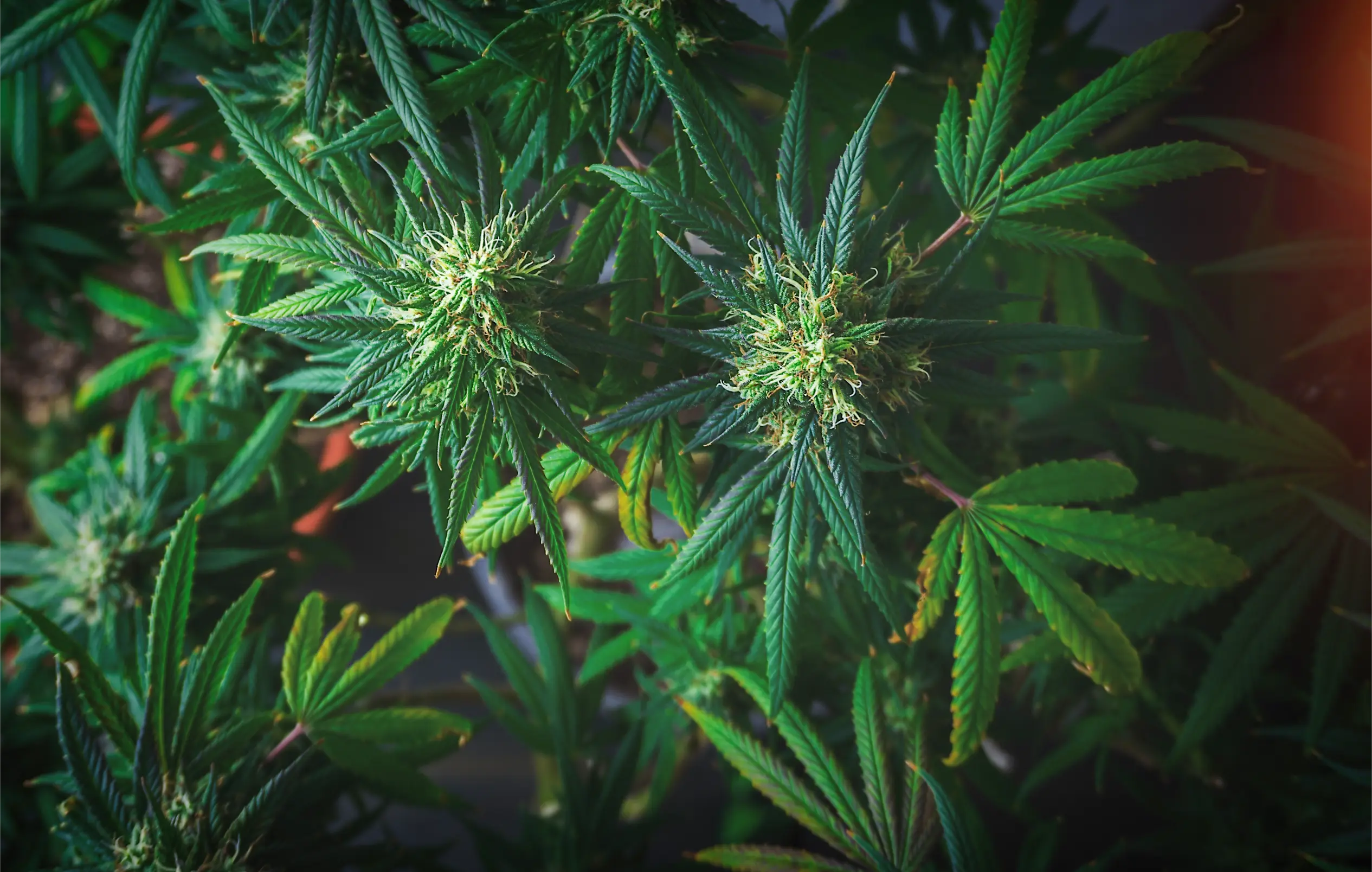
From week 3 onward, colas fill in densely. Bud sites form along every main and side cola. Strawberry Cough tends to stack buds evenly, developing fat, conical flowers. The calyx-to-leaf ratio is good, meaning buds have relatively few large leaves — this makes them easier to manicure later. Resin glands bloom mostly on the inner calyx surfaces; you’ll see a sticky coating forming inside the bud mass rather than heavily on the outer sugar leaves. By late bloom (weeks 7–9), expect heavy clusters of neon-green nugs studded with orange pistils and a lot of white trichomes. Some phenotypes will show blushes of purple at this time, especially if nights are cool.
Training Strategy
Given its height, SCROG or multiple toppings are highly effective for Strawberry Cough. In a 0.7–1.0 m² space, filling the canopy with 2–3 topped main stems under a screen will produce very high yields. If a tent is low, consider supercropping or additional LST to keep nodes in range. Because this plant isn’t extremely finicky, even risky training like mainlining can work – but the rewards for even a simple two-top strategy are quite good. Remove only small lower branches (lollipopping) to improve airflow; overall you don’t need aggressive defoliation since the plant naturally grows relatively “clean” budsites.
Nutrition
Strawberry Cough thrives in fertile soil. Many growers report excellent results on a typical organic soil regimen. It has a moderate appetite: feed generously in veg (higher N) but gradually taper nitrogen once flowering begins (like all sativas, excess late N can delay flowering). A high-phosphorus bloom nutrient schedule will help fatten up the flowers. Watch nutrient levels carefully: while the strain is sturdy, sativas in general can show nutrient burn if overfed. If you see tip burn or dark leaf edges, flush or reduce the feed strength. Overall, many growers find it “pest/mold resistant” and tolerant of different feeds, but they still usually use a balanced, complete fertilizer schedule.
Lighting
Provide strong light for this tall strain. If indoors, aim for intense light (at least 600W HPS or equivalent LED coverage) to bring out the best bud density. Because Strawberry Cough’s leaves are large, a vigorous light will allow good bud growth at all levels of the canopy. One caveat: too much extreme light late in bloom can push marginal foxtailing in the top flowers. If you see small popcorn foxtails forming, simply keep the lights at a reasonable height so you don’t fry the top cola.
Environment
Maintain a warm, stable environment. Ideal temps are around 24–27°C (75–80°F) day, 18–20°C night. Nighttime drops below 15°C may stress the plant. Relative humidity during bloom should be 40–50%. The plant’s dense buds can trap moisture, so keep fans running to prevent any mold. Even though the variety is known to resist mold better than many, stagnant air inside colas can still cause rot. Growers in humid areas often treat Strawberry Cough like any other sativa: generous airflow, no misting, and removing large interior leaves after stretch.
Flowering Observations
Watch the trichomes and pistils carefully. Most phenotypes are ready right around week 9–10. By this point, the buds will look and smell their sweetest: bright green with orange hairs (some purple) and a heavy frosty coating. At peak ripeness, Strawberry Cough’s aroma is at its most berry-forward. Harvesting slightly early (when about 70–75% of pistils have darkened) often gives the freshest strawberry aroma and heady effect. If you leave it too long, more amber trichomes accumulate, which increases sedation but may dull the flavor.
Trimming
Thanks to its good calyx:leaf ratio, trimming Strawberry Cough is relatively straightforward. You’ll encounter some fan leaves, but far fewer than many indica-heavy hybrids. Most of the bigger leaves will be gone by late flower on their own. When manicuring, just snip away the remaining large sugar leaves and use scissors to “shave” any stubborn bits from the buds. The result is neat, fluffy colas studded with crystal.
Harvest Signals
Because the plant has robust sativa genetics, it does not turn color or fade dramatically before harvest; rely on the usual cues. For best flavor, many growers harvest when most pistils have darkened but a few are still white, and trichomes are milky. If the actual strawberry scent is your goal, don’t rush – wait until the buds are very ripe and reeking of berry candy before cutting. Overall, the single most important cultivation question for Strawberry Cough is: How do I manage its height and preserve its flavor while not over-crowding the canopy? In practice, that means giving it room or screen-space to stretch (avoid canopy overcrowding), and being mindful of mid-flower airflow (good ventilation keeps scent and buds healthy). By the time you start flower, ensure that lower branches get light (either by pruning leaves or bending up stems) so that you don’t lose too many bud sites.
Grower experience shows that training for an even, well-exposed canopy is more rewarding than trying to push maximum nutrition, because letting the plant breathe and fill out evenly directly improves yield and aroma quality.
Why does Strawberry Cough smell sweet in the room but turn peppery and harsh in the jar?
Question sent by: Cameron Reed, via contact form
The sweet berry compounds are more fragile than the spicy base. Warm drying, strong direct airflow, overdrying or excess late fertilizer can leave caryophyllene and green plant material dominating the cured flower. Slow the dry, keep it dark and cool, and give the cure time to equalize internal moisture before judging the final balance.
Weedth Bud Flavor Tips
Strawberry Cough’s prized flavor can be fragile. To preserve its strawberry and berry notes, handle the harvest and cure with care. The first priority is the drying process: dry the buds slowly at a lower temperature (~18–20°C) and moderate humidity (~50–60%) to avoid “baking off” terpenes. Quick, hot drying will mute the berry esters, leaving a duller, hay-like scent. Once dry, cure the flowers in glass jars at about 60–65% relative humidity. Burp the jars daily for the first two weeks, then regularly after – a slow cure allows the nuanced sweet flavors to develop. Rush curing or overheated drying tends to convert volatile strawberry esters into generic spicy notes, so patience is key. Another tip is to minimize light and oxygen exposure during cure. Bright lights or prolonged opening of containers can degrade limonene and other volatile terpenes that give Strawberry Cough its signature. Keep cured buds in darkness and cool (room temp or slightly cooler) to maintain the bright aroma over time. When consuming, use lower heat if possible.
For example, vaporizing at a moderate temperature helps “gently warm” the flower so as not to burn off the delicate strawberry terpenes. Connoisseurs note that vaping or smoking slowly (rather than scorching) lets you actually taste the fruit notes. Indeed, one resource advises: “Using a vaporizer on a lower heat preserves the fragile terpenes that deliver that fresh-picked strawberry flavor”. Finally, be aware of storage. Even after cure, strawberry terpenes can gradually fade. Store buds in airtight jars, in the dark. Avoid leaving a jar open for hours – short aromas of humidity or dust can creep in and dilute the perfume. When done correctly, a well-cured Strawberry Cough will sparkle with real strawberry candy on the nose and taste. Done poorly, it will taste more like generic sweet grass or earth. In summary: slow dry, long cure, cool dark storage, and gentle vaping/smoking maximize the strain’s candy-berry character.
Weedth Bud Boost Tips
To maximize flowering yield and quality in Strawberry Cough, focus on canopy management and moderate feeding:
Training for Yield
As noted, screen-of-green (SCROG) methods work exceptionally well. In one grow report, fitting plants under a mesh yielded over 150 g per plant. By spreading the plant’s energy across many colas, you boost total bud sites. If SCROG isn’t an option, at least double-top each plant and tie down branches to force an even, multi-lateral canopy. Good horizontal structure means more flowers receive equal light, making the whole plant productive.
Veg Time
Don’t skimp on vegetative growth. Strawberry Cough benefits from a slightly longer veg (5–6 weeks or more) to fill out. The plant is known to recover quickly from topping or LST, so you can train aggressively early without stalling growth. The payoff is more nodes that flower. Conversely, a short veg will leave you with one or two monster colas and long gaps of nothing below, wasting potential yield.
Optimal Feeding
A steady, even nutrient supply produces big, healthy plants. Many growers find that strawberry cough prefers organic soil feeding. Use a balanced grow fertilizer (moderate N) in vegetative stage, and switch to a bloom formula when the plant flowers. Keep an eye on nitrogen levels: reduce N mid-bloom to avoid excess foliage that doesn’t turn into buds. Phosphorus and potassium should be ample in late flower to enhance bud density. Avoid nutrient lockout by flushing occasionally and using well-aerated soil (the plants did well in coco or potting soil). In general, this strain isn’t extremely sensitive – it doesn’t demand exotic nutrients – but moderate feeding (neither extremely weak nor overkill) yields the best results.
Light Intensity
Give Strawberry Cough lots of light, especially in the first half of bloom. Strong light encourages compact colas. Some growers swear that upping the light in late veg (higher wattage or closer lights) helps develop more secondary branches. However, avoid blistering the buds late in flower – very intense light can cause tiny foxtails if the power is too high in weeks 6– 8. A well-designed light schedule (12/12 at 550–600 W HPS equivalent) is usually sufficient.
Air Circulation
Good airflow is a “bud booster” for any strain with a tight calyx ratio, and SC is no exception. Use oscillating fans to move air through the canopy. This not only prevents mold, but helps thicken stems and strengthens buds. Some growers even point a small exhaust fan directly at heavy cola as buds fatten, to simulate gentle wind.
Support
Although stems are generally sturdy, fully loaded branches can sag. Provide stake support or trellis for heavy colas if needed to ensure they keep facing the light. A supported bud grows denser and you lose less to limb breakage.
Trimming
After harvest, an aggressive trim can leave only large, high-resin nuggets, improving final weight in the bag. During grow, light suckering (removing very small underdeveloped buds) can focus energy on big top flowers. But avoid cutting too much foliage in bloom, since Strawberry Cough already has a fairly open bud structure.
Avoid Overcrowding
As tempting as it is to cram plants together, remember Strawberry Cough grows tall and wide. Overpacking your canopy (especially indoors) can reduce individual yields. Spread plants or branches so each cola has space. In the 0.9 m² SCROG example, a single Strawberry Cough filled an entire screen with bud – it’s better to spread the crowding horizontally. In short, think quality yield: let every bud site thrive by giving it light and airflow, but don’t focus only on bulk over bud quality. This strain rewards balanced care: vigorous training and healthy feeding will boost total bud mass, but skipping those steps (or letting the canopy congest) will leave yield and flavor on the table.
The name describes character, not guaranteed flavor
Strawberry expression varies between phenotypes and environments. A healthy plant can lean toward herbs, earth or spice rather than fresh berry. Protect late-flower temperature and the dry, but do not force flavor with additives or harvest by aroma alone.
Medical Uses & Benefits
With its uplifting, mood-enhancing effects, Strawberry Cough is primarily chosen for mental and emotional relief. Its strong cerebral high and relatively low sedation profile mean it’s well-suited to conditions like chronic stress, anxiety, and depression. Medical guidance often notes that its ”highly-regarded sativa” effects can help alleviate stress, anxiety, and mood disorders. In practice, patients report that Strawberry Cough’s euphoric buzz eases worries and brightens mood without clouding the mind. Because it encourages creativity and social focus, some find it helpful in social anxiety or ADHD by making routine tasks feel more engaging. It can also aid physical discomforts to a moderate degree. The gentle body relaxation helps soothe mild aches and muscle tension, making it useful for stress-related pain. However, it is not primarily a painkiller – it rarely provides deep sedation or numbness. Users needing relief from chronic pain or insomnia might find it less ideal for night use, since it is so energizing. Instead, think of it as a mental therapy: it uplifts and clears the mind.
Other possible benefits include appetite stimulation (from its moderate THC content), making it useful for those dealing with nausea or lack of appetite. Some also report that it helps with fatigue, likely due to the energy boost. But remember: high THC means it could worsen anxiety in extremely sensitive users, so small doses are advised for medical patients. Its very low CBD means medicinal effects are essentially THC-driven. In medical terms, Strawberry Cough could be considered pseudo-daily use: patients who need something to keep them functional but happy often reach for it. It’s not a sedative so it won’t cure insomnia or severe pain, but it shines for mood and stress management. For example, someone with depression might use it to elevate mood during the day, while someone with chronic anxiety could use the clarity it provides to break cycles of worrying. It’s generally too stimulating for bedtime, and tolerance builds so it’s less suitable for constant, heavy dosing. As always, individual response varies: it’s another tool for conditions where boosting endorphins and creative focus is helpful, rather than a onesize-fits-all remedy.
Ideal User Profile
Strawberry Cough is best suited for daytime users with at least moderate cannabis experience who want a flavorful, uplifting high. Picture someone who enjoys fruit-flavored strains and needs a creative kick – for example, an artist or student seeking focus and inspiration. Its clear-headed euphoria makes it great for social outings, hiking, or chores (think of it as a sociable daytime smoke). A person dealing with stress, low mood or anxiety (who doesn’t get excessively anxious from THC) will likely appreciate Strawberry Cough’s mood-elevating buzz. It’s also good for those who want to keep functioning: the high keeps you active rather than glued to the couch. Not ideal for beginners or sleep-seekers. Because of its strong THC and sativa nature, newbies should approach cautiously (start very low). Someone who needs strong pain relief or deep sedation at night would find this strain too stimulating; it will energize rather than lull. Similarly, if you prefer an indica’s body stone or if you want to sleep soon after smoking, this isn’t the choice for that occasion.
Strawberry Cough is also a match for flavor enthusiasts: if you enjoy smokeable fruitiness (like tropical sativas or sweet hybrids), you’ll likely love this strain. Conversely, fans of diesel, pine or earthy flavors might see it as too “candy-like.” So in summary, choose Strawberry Cough if: you want a productive, uplifting high; you have the patience and skill to grow or source a properly cured batch; and you love pronounced berry sweetness in your cannabis. It’s less ideal if you need heavy relaxation, very high CBD, or have a low THC tolerance.
Grower Notes and Feedback
Real-world growers consistently highlight Strawberry Cough’s forgiving nature and iconic aroma. A recurring observation is that it recovers well from training. Growers often recount happily topping or supercropping and finding the plants bounce back quickly – branching vigorously in response. The plant’s vigorous growth means it generally withstands mistakes better than delicate hybrids. For instance, Leafwell notes it’s “resistant to pests and mold, a tolerant cultivar to grow” – which many hobbyists confirm. This makes it appealing for intermediates who may occasionally overwater or underfeed. Another pattern: the famous strawberry scent really does come through even in small-scale grows. Nearly every report mentions the potent berry nose in flowering. One user review said the grow room “smells like strawberry milkshake” once buds bulk up. The fragrance is strong enough that even outdoors it can broadcast. In flower rooms, expect to run odor control or risk that unmistakable sweet scent. On the challenge side, almost every grower notes the plant’s height. One common surprise is how quickly it can fill a large space.
People starting multiple SC plants in a tent often wish they hadn’t put all in one room, because they kept stretching. Solution: train early. Growers who topped at 3–4 nodes and installed a trellis report better outcomes than those who waited. Phenotypes do show up in feedback. Some crops produced light-green colas with creamy strawberry frosting (often in higher-elevation grows), while others turned pinkish-purple under cooler nights. However, the aromatics remained reliably fruity in every case. A few growers even describe receiving cuttings of different pheno of Strawberry Cough and noting distinct flavors (one “turpentine finish” vs one “liquorice twist”), underscoring that phenotype selection matters for effect nuance. Regarding feeding and water, reports are mixed but generally positive. Most do not flag any extreme hunger – a good balanced nutrient regimen (often organic) suffices. Some growers see tip burn if they go too heavy in bloom, suggesting moderate feeds are better. Watering is typical: it likes to dry partly between waterings (common to sativas). The main mistakes growers mention are related to flowering length and harvest timing.
A frequent note: “Don’t assume it’ll finish in 8 weeks.” Many have had buds that still looked immature at week 9, only to ripen by week 10–11. Over-cutting the cycle has led to airy, underripe buds. Conversely, we heard that waiting past peak in the name of potency tends to add sedation and degrade flavor. In other words, patience is rewarded – this strain often saves its best aroma and resin for the very end of bloom. In summary, grower feedback paints Strawberry Cough as a vigorous, straightforward plant with few surprises beyond its size and flavor. It plays out like a typical tall sativa but with a unique payoff: sweet smoke. Experienced cultivators appreciate its consistency (good resistance, no weird foibles), while novices like the intoxicating smell and ease of trimming (buds don’t hide behind tons of leaves ). The “gotcha” for many is underestimating its grow space needs: count on vertical room and plan for the stretch. But otherwise, the consensus is that this plant is gratifying to grow, especially if quality berries are the goal.
Weedth Editor’s Note
Strawberry Cough is one of those cultivars where flavor justifies the effort. In my experience, it stands out for smell and feel, not yield. When I’ve grown it, I paid more attention to the budstage aroma than the final scale weight – the room would literally smell of strawberry jam, and I found myself counting down the days to harvest just to taste it. However, I also learned not to get complacent: a strong strawberry scent can hide poor resins if I rushed the grow. In fact, I’d say the most important lesson I took from multiple runs is this: manage the height and the harvest timing carefully. For growers considering Strawberry Cough, I always emphasize preparation. Its stretch is not unreasonable, but it is real – I would not flip without at least one or two tops or a scrog. Indoors, I wouldn’t flip without a ceiling of 6–7 feet or serious bending. Outdoors, I gave each plant plenty of space and supported big branches in late summer storms.
The strain brags about being “easy” for newbies, and it is tolerant of neglect, but it’s not a mop corn plant. The resin and flavor only develop if you’re patient: I often let the plants ride just a tad longer than the calendar says (closer to week 10) to deepen the berry profile. I also push airflow during the final weeks because those compact, gooey colas I love can mold if I’m not careful. In fact, by the end I’m usually less concerned about yield numbers and more about dense bud maturation – if I see a few amber trichomes, I might harvest to lock in potency and prevent rot. In practice, that means quality over quantity. On a second run, I’d be more aggressive with SCROG, ensuring each plant has a broad canopy early on. I’d also probably experiment with a mild stress technique (like a light molasses feed or some gentle UV exposure) to see if it boosts trichome production without hurting flavor. But mostly, I’d repeat what works: treat it as a day-time workhorse.
In the end, what I love most about Strawberry Cough isn’t towering colas or tons of resin (those are decent but not unique) – it’s the unmistakable smooth strawberry zing. If you grow it well, it rewards you with a uniquely sweet bud that few other strains can match.
Weedth Score
Growing Experience – 8.3/10: Strawberry Cough is vigorous, trainable and reasonably resilient, but stretch, odor, late-flower support and moisture inside the finished flowers require planning.
Bud Structure & Visual Appeal – 8.7/10: Bright pistils, strong trichome coverage and elongated sativa flowers create attractive jars, though phenotype and environment affect final density.
Aroma Complexity – 9.3/10: Fresh strawberry, mixed berry, sweet herbs, spice and earth build a distinctive profile that becomes fuller when the flower is broken.
Flavor & Smoothness – 9.0/10: A slow cure protects the berry opening and reduces the peppery throat edge associated with the cultivar’s famous cough.
Effects & High Experience – 9.1/10: The social, uplifting and creative onset is the main event, followed by controlled physical ease rather than heavy sedation.
Overall Satisfaction – 9.0/10: Strawberry Cough balances recognizable flavor with a genuinely useful daytime effect, provided height and post-harvest temperature are managed carefully.
FAQ
Why is my Strawberry Cough stretching so much?
Strawberry Cough is naturally sativa-dominant and exhibits a significant stretch during the first 2–3 weeks of flowering. This means internodes can more than double in length early on. To manage this, finish training before the stretch hits. For example, top the plant and tie down branches in veg so that when the stretch starts, the canopy is already spread out. If your plants are still very small going into flower, the final height jump will seem extreme. In practice, plan for it by leaving extra vertical space or using SCROG to contain the height.
Does Strawberry Cough need a trellis or stakes?
Support is recommended for big plants or heavy buds. Under normal indoor conditions, stems are fairly sturdy, but when buds swell late in flower they can weigh down branches. A trellis (SCROG net) is actually a great idea: it both supports buds and forces them into the light. If you’re not SCROG’ing, simply stake any very fat colas so they don’t snap. Outdoors, strong winds or rain can bend branches, so either some LST earlier in grow or staking later is wise. Overall, it tolerates stakes well and often benefits from them in heavy crops.
Why are my Strawberry Cough buds airy?
Airy buds usually result from inadequate flowering time, lighting, or plant stress. With SC, check if you gave it enough light intensity and the full ~9–10 weeks flowering. Leaving plants in bloom too short will leave internal calyces loose. Also ensure your flowering nutrients were sufficient; underfeeding phosphorus/potassium can reduce bud density. Training also matters: overcrowded, shaded budsites produce fluff. Good airflow and light penetration (via defoliation or SCROG) in mid-flower will encourage denser colas. In summary: ensure strong bloom light, proper feed, and allow full ripening time.
Does Strawberry Cough tolerate topping?
Yes – and it often responds very well. Topping Strawberry Cough in early veg encourages more branches and colas, which is beneficial for yield and controlling height. Grow reports suggest it handles topping easily; one grow even used double tops per plant under a SCROG with great results. Just give it time to recover in veg. After topping, use LST to evenly space the resulting branches. In short, don’t hesitate to top – it’s one of the best ways to manage this strain’s vertical stretch and turn it into side growth.
When should I harvest Strawberry Cough for the best flavor?
For maximum strawberry flavor and potent head high, harvest around week 9 or when about 70–80% of the pistils have darkened (leaving some white). This timing ensures the terpenes are at peak “berry” brightness. If you wait much longer, more trichomes turn amber/CBN and the effect becomes heavier and more sedating. In practical terms, once you notice the fruitscent really dominating the room (often late flower), test a few buds: if they taste sweet and not hay-like, it’s prime time. Remember that curing (slow dry, cool dark cure) is as important as the harvest date in preserving flavor.
Does Strawberry Cough need heavy feeding?
It doesn’t have an unusually heavy appetite – moderate, consistent feeding works best. Overfeeding with nitrogen can actually hurt it, especially in late bloom when leaves can become too lush at the expense of buds. Most growers use an organic soil schedule or a balanced veg→bloom regimen. If you see tip burn or clawing leaves, ease back. Conversely, any slight deficiencies in bloom (like yellowing that doesn’t advance leaf necrosis) will slow bud growth. In short, feed enough to keep the plant dark green through flower, but don’t push to toxic levels. It prefers stability over extremes.
Is Strawberry Cough suitable for a small grow tent?
Caution is advised. In a very small tent (e.g. 2×2 ft, low ceiling), Strawberry Cough can outgrow it rapidly unless you limit growth. It often needs 5–6 feet of height to fully flower properly. However, with techniques like topping, SCROG, and keeping only 1 plant, it can be done in a moderate tent (e.g. 3×3 ft, 6–7 ft tall). In a cramped space, you must train aggressively and possibly trim heavily. If your tent is especially small, you might prefer a more compact cultivar. That said, the sweet payoff of flavors can make the effort worthwhile if you’re careful.
Can Strawberry Cough finish outdoors in a short season?
Probably not fully, if by “short season” you mean under 14 weeks of warm weather. In Northern climates, Strawberry Cough was observed taking a full 9–10 weeks after flowering plus a couple weeks of stretch. In an outdoor short season, you risk frost damage or incomplete bud development. It prefers a long season outdoors. If you have an early fall frost, consider a greenhouse or start very early. In contrast, growers in temperate zones often harvest by late October. A short-season grower might opt for an earlier-flowering variety instead.
How do I preserve its strawberry aroma?
The key is gentle post-harvest handling. As mentioned, slow drying and curing at lower temps preserves strawberry terpenes. Avoid big leaf fans blocking inner buds during flower (some surface defoliation can help airflow without scent loss). In bloom, don’t let temperatures exceed ~26°C too much, as heat can cause terpene evaporation. After harvest, a cool dark cure is crucial. Finally, consume at lower temperatures (e.g. vaporizer on low-mid setting). A still-smoking cigarette or hot pipe will burn off delicate notes. By keeping the plant stress-free through harvest and taking time with drying/curing, you’ll lock in that fresh-bakery strawberry profile for as long as possible.
Similar Strains
Maui Wowie: A classic Hawaii sativa with a tropical fruit nose. Similarity: Uplifting, energetic sativa effects and a very fruity aroma. Difference: Maui Wowie leans pineapple-citrus and tropical flavours rather than strawberry; it finishes a bit quicker (often 8–9 weeks) and grows slightly shorter. Maui Wowie’s effect is similarly clear-headed, but Strawberry Cough’s berry flavor is much more pronounced.
NYC Diesel: A potent sativa-hybrid known for its tangy citrus-pine aroma and strong cerebral buzz. Similarity: Both share a clear, energized high and artistic boost. Difference: NYC Diesel’s flavor is spicy diesel/lemon, not sweet berry, and it tends to be a bit more intense and narcotic at peak. Strawberry Cough is sweeter and slightly smoother in smoke, whereas NYC Diesel hits with that sharp diesel punch.
Somango: A tropical-fruit hybrid (Tangie × Mango) with a very sweet, mango-orange profile. Similarity: Sweet, fruit-forward flavor and a happy, creative high. Difference: Somango’s fruitiness is more mango-citrus, and it often has a bit more body-relaxation (due to some indica ancestry). Strawberry Cough’s berry-and-cream profile is its unique twist; Somango tastes more like a fruit salad. Flowering times are similar, but Somango can sometimes finish a bit faster.
Orange Bud: A classic sativa (Green Crack × something) with a bright orange-citrus aroma. Similarity: Both are zesty, sweet sativas that uplift the mood. Difference: Orange Bud’s flavor is citrus-orange and its effect is somewhat less intense and more stoney than Strawberry Cough’s pure head-high. Orange Bud usually has a stronger body buzz, while Strawberry Cough stays predominantly cerebral. Also, Strawberry Cough often delivers a larger harvest (with training) thanks to its fuller canopy. Each of these strains is recommended for someone who enjoys the energetic high and fruity flavor of Strawberry Cough, but they offer different twists in aroma and effects – for example, one might prefer citrus (Orange Bud) or tropical (Maui Wowie) instead of pure strawberry.
Share this article
A quick overview of the topics covered in this article.
Follow us
Latest articles
September 27, 2026

September 27, 2026
September 27, 2026

September 27, 2026