
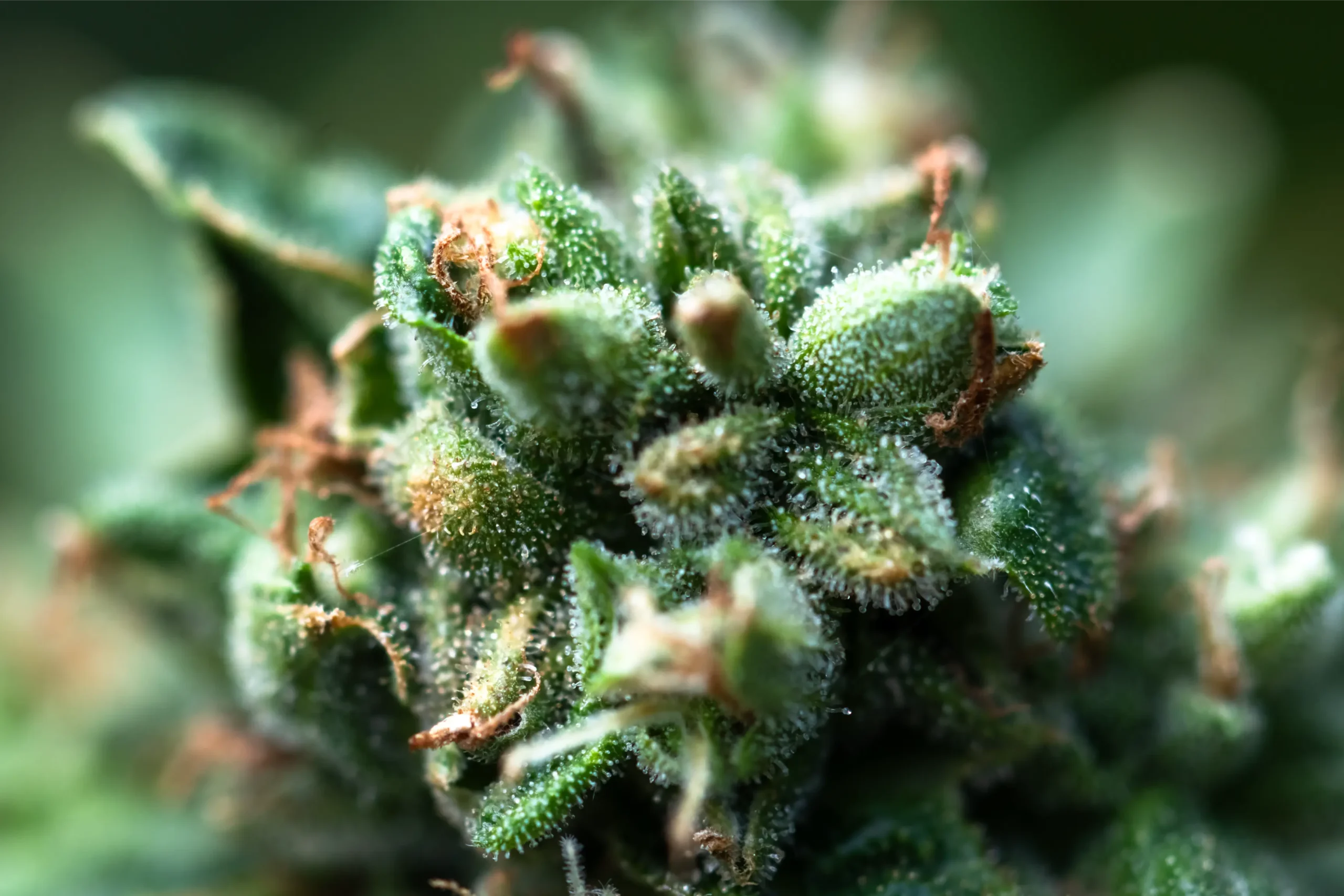
Utopia Haze
Brazilian-sativa stretch management, phenotype selection, citrus-mint flavor, and long-flower quality
Utopia Haze is a Brazilian-derived, strongly sativa-dominant cultivar whose most important trait is not a potency number or an award history. It is phenotype-dependent stretch. Across indoor grow reports, flowering behavior ranges from a manageable roughly 2x expansion to extraordinary examples that stretch many times their starting height. A multi-grower dataset places average stretch above 3x and flowering around eleven to twelve weeks on average, while individual plants have finished closer to ten weeks or continued far longer. That spread changes the entire grow strategy. Utopia Haze cannot be approached as a fixed-height hybrid with a predictable flip date.
The line is generally described as coming from Brazilian landrace material that was selected and stabilized without adding unrelated genetics. That heritage appears in long branches, strong apical drive, a high-temperature tolerance reported by several growers, and a cerebral effect that can feel uplifting, exhilarating, and psychedelic at higher doses. It is also repeatedly described as more mold-tolerant than many dense modern hybrids, although that should never be treated as immunity. The right grower uses those strengths to create a ventilated, horizontally distributed canopy instead of allowing the plant to race vertically.
Flavor varies from bright citrus, lemon, grapefruit, mint, pepper, and fresh herb to sweeter secondary notes such as nectar, vanilla, or dark fruit in some expressions. That broad aroma range is another sign that phenotype selection matters. For Weedth, the core challenge is simple: keep the plant inside the room long enough to finish properly without sacrificing its tropical branch structure, then preserve its high-note aromatics through a cool harvest and careful dry. Utopia Haze rewards patience, but only if the grow space is designed for its sativa behavior from the beginning.
Strain Features
| Feature | Details |
|---|---|
| Type | Strongly sativa-dominant, commonly described around 90% sativa |
| Lineage | Brazilian landrace-derived selection and stabilization |
| Potency | Usually reported as high-THC flower; individual batches vary |
| CBD | Generally low |
| Flowering time | Common descriptions around 70-80 days, but grow reports span roughly 65-120 days |
| Stretch | Very high and phenotype-dependent; multi-grower averages exceed 3x, with extreme outliers |
| Architecture | Strong, fast, often Christmas-tree or open sativa form with long vigorous branches |
| Bud structure | Ranges from moderately open to hard and compact; generally good bud-to-leaf ratio in stronger phenotypes |
| Aroma | Citrus, lemon, grapefruit, mint, pepper, fresh herb, with occasional nectar, vanilla, or berry nuance |
| Effect | Uplifting, energetic, cerebral, sometimes psychedelic and long-lasting |
| Training fit | Very good for a loose SCROG or early horizontal training; poor fit for late emergency height control |
| Feeding behavior | Variable by phenotype; reports range from modest needs to stronger appetite |
| Climate strengths | Frequently reported as heat tolerant and relatively resistant to mold/fungal pressure |
| Difficulty | Moderate to demanding indoors because of stretch variability and long phenotype range |
| Primary quality risk | Over-vegging, running out of vertical space, and harvesting long phenotypes before full aromatic maturity |
| Best suited for | Sativa-focused growers with height, trellising skill, and patience for phenotype selection |
Utopia Haze should be treated as a range of Brazilian-sativa expressions rather than a single clockwork plant. Its strongest recurring traits are stretch, vigorous laterals, cerebral effects, citrus-fresh aroma, and good environmental toughness. The most important numbers in the table are therefore the wide ranges, not the averages. A grower who designs only for the average plant can still be overwhelmed by the tall phenotype.
Genetic Lineage
Utopia Haze is most consistently traced to Brazilian landrace-derived genetics that were selected over multiple generations and stabilized through backcrossing within the same broad genetic family. That makes the cultivar different from a modern polyhybrid built from several named parents. Its identity comes from narrowing a regional sativa population toward desirable combinations of potency, aroma, vigor, yield, and manageable flowering.
Landrace-derived does not mean uniform. Regional populations contain diversity because they evolved and were selected under complex local conditions rather than being reduced immediately to one clone. That helps explain why modern Utopia Haze grow reports show a broad flowering range and very different stretch ratios. Some plants behave like manageable indoor sativas and finish near ten weeks. Others reveal a much more tropical expression, continuing vertical growth and taking substantially longer to ripen.
The Brazilian foundation is also a useful clue to climate behavior. Multiple growers report good performance under high temperatures and relatively low vulnerability to fungal disease. These are observations, not controlled cultivar trials, but the pattern is coherent with a plant selected from warm-climate sativa material. The same heritage means the grower should expect longer internodes, strong branch extension, and less natural compactness than an Afghan-heavy hybrid.
For mother selection, do not chase the tallest or fastest plant automatically. A valuable indoor keeper is the expression that combines controllable stretch, a complete finish, strong branch vigor, clear citrus-mint or spice aroma, and good resin. Outdoor or greenhouse growers may accept more stretch if the site has space and a long season. The best phenotype is the one matched to the intended environment.
WEEDTH GROWER NOTE: With a landrace-derived sativa, phenotype range is part of the genetics. Record what the plant actually does instead of treating variation as a mistake in the grow.
Effect Breakdown
Initial lift: fast mental expansion
Utopia Haze is usually described as cerebral, uplifting, and energetic. The first phase can feel bright and expansive, with increased interest in conversation, music, movement, or creative thought. For experienced sativa users, this can be highly functional at a moderate dose. For a low-tolerance user, the same mental acceleration may feel too intense because the strain is often reported as high in THC.
Peak: exhilaration can become psychedelic
At stronger doses, the effect is often described with language such as exhilarating or psychedelic. That should not be interpreted as a guaranteed hallucination. It usually refers to an immersive shift in perception, time, attention, and thought association. Sensory detail may feel amplified and ideas can connect rapidly. In the right setting, users may experience creativity or fascination. In the wrong setting, the same intensity can become anxious, scattered, or mentally tiring.
Physical layer: lighter than the mental effect
The body component generally remains secondary during the peak. Muscles may feel easier and the body can become comfortable, but the experience is not usually defined by immediate couch-lock. This makes Utopia Haze more appropriate for daytime or early-evening activity than for intentional sedation. Very high doses or the late phase can still reduce coordination and motivation, so users should not confuse lack of body heaviness with lack of impairment.
Duration and comedown
The high is often described as long-lasting. The mental intensity gradually loses its edge and can settle into a calmer, more reflective state. Dry mouth, dry eyes, dizziness, and anxiety are possible. Because high-THC sativa effects are especially dose-sensitive, new users should take a small amount and wait. Strain names cannot predict individual response with clinical precision, and phenotype chemistry can differ meaningfully within this line.
Flavor & Aroma Profile
Live flower: fresh citrus and sharp herb
Utopia Haze often develops a bright citrus-herbal aroma before harvest. Lemon, grapefruit, fresh mint, pepper, and green spice are recurring descriptors. The smell can feel sharper and cleaner than the heavy fuel or dessert profiles common in many modern hybrids. In some phenotypes, the citrus sits over sweeter nectar-like or berry-like notes; in others, pepper and herb dominate.
Jar aroma: phenotype becomes obvious after cure
The cure is where phenotype differences become easiest to compare. A citrus-forward plant may smell like grapefruit peel, lemon zest, and dry mint. A sweeter plant can add vanilla, nectar, or dark-fruit nuance. A spicier expression may emphasize pepper and resin. The common thread is high-note freshness over a sativa resin base, not one fixed flavor recipe.
Smoke and vapor
Vapor preserves more of the bright peel, mint, and herb character at the front of the session. Combustion shifts the balance toward spice, toasted resin, and pepper. A clean Utopia Haze cure should still leave citrus or fresh herb on the exhale rather than becoming generic smoke. If the flower is harvested immature, the flavor can lean green and grassy. If it is dried too warm, the top notes can disappear and leave a flatter pepper-resin profile.
This is a cultivar where postharvest temperature has a large sensory cost. Cannabis drying studies show that volatile retention changes substantially with drying conditions and that hotter regimes generally reduce total terpene retention. Utopia Haze is grown partly for its volatile sativa brightness, so a fast hot dry undermines the reason to choose it in the first place. Treat the drying room as the final stage of cultivation.
Dominant Terpenes
Public terpene data for Utopia Haze are less standardized than for mass-market modern cultivars, and individual batches can differ. Sensory reports repeatedly point toward a mixture of limonene-like citrus, pinene or terpinolene-like freshness, caryophyllene-like pepper, and minty or floral minor compounds. The responsible way to use that information is to connect it to aroma families rather than invent a universal terpene ranking.
| Likely terpene family | Sensory contribution | Cultivation relevance |
|---|---|---|
| Limonene-rich expression | Lemon, grapefruit, citrus peel | Bright high notes are vulnerable to heat and excessive drying. |
| Pinene / terpinolene family | Fresh herb, pine, lively green complexity | Supports the fresh sativa character and can differentiate a clean cure from a flat one. |
| Beta-caryophyllene | Pepper, dry spice, woody warmth | Fits the recurring pepper note and gives depth beneath citrus. |
| Myrcene and minor oxygenated terpenes | Herbal, floral, soft fruit, mint-like nuance | Can shift the profile from sharp citrus toward nectar, fruit, or aromatic herb depending on phenotype. |
Laboratory testing is the only way to know the actual terpene composition of a specific harvest. Even then, terpenes should not be used as deterministic effect labels. The same citrus-heavy flower can feel stimulating to one user and anxious to another because cannabinoids, dose, tolerance, and context dominate the psychoactive experience. For the grower, terpene knowledge is most useful as a reminder to protect volatile compounds from heat, oxygen, and rough handling.
Indoor vs. Outdoor Growing
| Utopia Haze decision | Indoor | Outdoor / greenhouse |
|---|---|---|
| Stretch | Main challenge. Early flip and horizontal training are essential. | Less restrictive, but plants can become very tall and conspicuous. |
| Phenotype range | Easy to compare several plants under one environment and select a manageable keeper. | Long phenotypes may be acceptable if the season is sufficiently long. |
| Flowering duration | A 10-12 week plan should include reserve for slower plants. | Needs a long autumn in cooler latitudes; greenhouse protection can extend the finish. |
| Heat | Good tolerance is frequently reported, but indoor tops can still overheat near lights. | Well suited to warm, sunny climates when irrigation and roots remain healthy. |
| Mold | Open sativa structure and reported resistance are advantages, but dense phenotypes still need airflow. | Potentially useful in humid regions, yet rain-soaked mature flowers still require inspection. |
| Training | Loose SCROG is highly useful because stretch can be converted into horizontal canopy. | Radial tying, cages, or branch spreading preserve sun exposure without excessive pruning. |
| Flavor | Climate control can protect citrus and mint top notes. | Sun can produce excellent aromatics, but hot harvest weather requires rapid transfer to shade and a cool dry. |
| Best fit | Experienced sativa growers with ceiling height and a trellis plan. | Warm-climate growers with space, or greenhouse growers who can extend the season. |
Indoors, Utopia Haze should be selected and shaped as early as possible. It can be grown successfully in a tent, but vertical reserve is non-negotiable. The cultivar's reputation for high stretch is supported by multi-grower data, including extreme outliers. A low room becomes much easier when the plant is flipped small and woven through a screen instead of allowed to form a full natural Christmas-tree structure.
Outdoors or in a greenhouse, the same vigor becomes an asset. Long branches can carry multiple exposed flower sites, and heat tolerance gives the plant a wider summer operating window. The limitation moves from ceiling height to season length. A slow phenotype that would be frustrating indoors may be excellent under a long warm autumn. In short-season climates, protected cultivation is valuable because it can keep late flowers dry while giving them more time to mature.
Strain-Specific Grow Guidance
The first run is a phenotype-mapping run
Do not assume one Utopia Haze plant can teach you the entire line. If possible, grow several plants and record flip height, height at the end of stretch, first obvious flower set, finishing date, branch length, and aroma. Those measurements create a practical phenotype map. A plant that finishes in ten weeks at 2x stretch needs a completely different strategy from a plant that takes sixteen weeks and stretches 6x.
Flip earlier than a compact hybrid
The safest indoor timing is to begin flowering while the plant still looks small. Let stretch fill the room. If you wait until vegetative growth occupies the desired final footprint, the canopy can become impossible to flatten without repeated high-stress intervention. Early flip is not a yield sacrifice when the cultivar naturally creates large amounts of flowering stem during transition. It is using genetic stretch as vegetative growth under the flowering schedule.
A loose SCROG turns the main weakness into a strength
Utopia Haze is well suited to a screen because long, flexible branches can be redirected horizontally. Use wider openings and fewer branches than you would with a compact Cookies-style hybrid. The objective is not to pack every square centimeter with a tip. It is to create long illuminated branch lanes with air between them. Continue tucking during early stretch, then let the tips rise once the screen is reasonably filled.
If a phenotype stretches exceptionally hard, supercropping may become necessary, but it should be a correction rather than the primary plan. Bend before flower clusters become large, support the crease, and avoid repeated damage to the same stem. Emergency supercropping late in bloom adds stress and can place resinous flowers against other branches.
Topping and pruning: use enough, not maximum
Early topping can help distribute growth when side branches are already vigorous. However, the cultivar's long natural laterals mean heavy multi-topping can produce more branches than the room can support. One clean top followed by screen training is often more efficient than building eight or sixteen symmetrical arms. Remove weak lower shoots that never reach the screen, but preserve strong branches with a clear path to light.
Feeding: phenotype variability argues for a response-based program
Grow reports disagree on nutrient demand. Some plants are described as low feeders, while others accept or require stronger nutrition. That is exactly why a fixed high EC target is inappropriate. Begin moderately and watch leaf color, tip condition, growth speed, and root-zone accumulation. Increase only when the plant shows sustained demand. A long-flowering sativa has time to suffer from chronic salt buildup, so avoid turning early vigor into late root stress.
Nitrogen should decline gradually as flower development becomes dominant. Long tropical expressions can keep growing vegetatively under excess nitrogen and long photoperiod signals. The goal is to support healthy leaves without encouraging endless new stem growth. In soil, avoid late heavy amendments that remain active beyond the desired finish. In coco or hydro, use runoff and plant response to keep the root zone stable.
Photoperiod and flowering commitment
Some experienced growers use slightly longer dark periods with tropical sativas to encourage flowering commitment and reduce re-vegetative behavior, but the exact schedule is not backed by cultivar-specific controlled trials. The safe principle is more important than the precise number: give long-sativa phenotypes a stable, uninterrupted dark period. Light leaks or inconsistent schedules can prolong the transition and make a stretchy plant even harder to manage.
Heat tolerance does not mean terpene indifference
Utopia Haze is repeatedly described as tolerant of high temperatures, which is useful for plant survival. Flavor quality has a lower heat ceiling than survival. A plant can remain green and productive while volatile citrus and mint compounds are being lost more rapidly. Keep canopy temperature as moderate as practical late in flower, especially during the dark-to-light transition when enclosed rooms can heat quickly.
Humidity and fungal management
Several grow reports describe low mold or fungal vulnerability. That is a valuable trait, especially in an open sativa canopy. Still, no cultivar is immune to wet flowers. Keep air moving through the long branch structure, remove dead leaves, and avoid overlapping colas. In greenhouses, exchange humid air after sunset and after irrigation events. Outdoors, inspect flowers after rain rather than relying on a resistance reputation.
Support and branch leverage
Long branches can be strong but still bend under late flower weight. A screen solves this indoors. Outdoors, use a cage or multiple support points rather than tying the whole plant to one central stake. Support each major branch near the zone where leverage becomes dangerous. This keeps flowers separated and prevents a split that can expose internal stem tissue to moisture and pathogens.
Recognize the long phenotype before it traps you
A plant that is still throwing fresh stem and loose flower well past the expected window may simply be a long expression, not a plant that needs more fertilizer. Check whether the flowers are gradually increasing resin and bract size. If the plant is healthy, the correct response may be patience and environmental stability. If the room cannot support the remaining time or height, that phenotype is a poor keeper for the setup even if the eventual flower is excellent.
Harvest from maturity and aroma
A ready Utopia Haze should show slowing fresh pistil production, matured gland heads on the bracts, fuller calyxes, and a clear shift from green plant smell to citrus, mint, pepper, or sweet resin. Do not harvest a long phenotype simply because the shorter sister plant is finished. Staggering harvests is better than sacrificing weeks of genetic potential.
Do not let the stretch make the decisions
The most expensive Utopia Haze mistake is over-vegging. Use its flowering stretch to fill space instead of building the final canopy before the flip.
Utopia Haze also benefits from root-space restraint as a height-management tool. This does not mean intentionally root-binding the plant. It means matching container volume to the room instead of giving a tropical sativa an enormous root zone and then trying to suppress the canopy mechanically. A healthy plant in an appropriately sized container can still yield very well when the screen is filled efficiently. Oversized containers encourage a longer vegetative runway and can make irrigation slow to correct when the plant is young. In a low room, moderate root volume, early flip, and horizontal training form a more coherent system than a giant pot plus repeated supercropping.
The phenotype range makes clone preservation before the first flowering run unusually valuable. If regulations and your setup allow vegetative cuttings, take and label them before the original plants are flipped. Once flowering reveals which plant stays manageable, finishes on time, and keeps the best aroma, the matching clone can become the repeatable production plant. Without a backup, the grower may discover an exceptional phenotype only after it is too late to preserve. Utopia Haze is exactly the kind of line where selection work can be more valuable than another round of seeds because the difference between a 10-week 2x-stretch plant and a 16-week extreme stretcher is operationally enormous.
During early flower, watch for continued stem initiation versus true floral commitment. A plant that is only lengthening and producing sparse preflowers may still be in transition, while a committed plant begins stacking repeated pistillate clusters along each branch. This distinction helps the grower decide when to stop tucking. Continue horizontal guidance while most new growth is stem. Once distinct flower clusters are forming at many nodes, allow the tips to rise and concentrate on support. Tucking too long can flatten mature floral zones under the screen and create congested sites. Stopping too early can leave several feet of uncontrolled vertical growth above it.
Long-flowering Utopia Haze also changes how you should think about equipment reliability. A ten-day malfunction is inconvenient in an eight-week cultivar; it can be devastating in a plant that may spend three or four months under 12/12. Check timers, irrigation emitters, drainage, environmental sensors, and trellis attachment before the flip. Keep spare critical parts on hand where appropriate. The cultivar does not demand exotic equipment, but it gives ordinary equipment more time to fail. A stable long run is built by reducing small operational risks before they become plant problems.
Finally, avoid trying to make the long phenotype behave chemically like the short phenotype. If a tall plant remains pale under the same feed that keeps a shorter sister green, it may genuinely be using resources differently. If another plant remains dark at a moderate concentration, it may require less. Uniform irrigation can coexist with phenotype-specific nutrition adjustments when necessary. The first seed run is not the time to force visual uniformity at all costs. It is the time to learn which expression naturally fits the program with the fewest corrections.
Utopia Haze growers should also distinguish productive foxtailing from heat-driven foxtailing. Long sativa genetics can continue building fresh towers of calyxes late in bloom as part of normal floral development. If the new growth appears across healthy branches, resin remains strong, and canopy temperatures are controlled, it may simply be genetic expression. If foxtails occur mainly on the hottest tops alongside bleaching, dry aroma, or stressed leaves, the environment is more likely responsible. Lowering light stress and improving canopy temperature is more appropriate than waiting indefinitely for every fresh pistil to darken. Harvest decisions should focus on the mature bulk of the flower, not the newest tip alone.
A second advanced point is staggered canopy release near the end of stretch. Instead of letting every branch rise from the screen on the same day, allow slower interior branches to gain a little extra vertical space while continuing to tuck the fastest perimeter shoots for several more days. This can equalize final top height without severe bending. The technique works especially well when one Utopia Haze plant contains several levels of branch vigor. It requires daily observation during transition, but it reduces the emergency supercropping that often happens when all shoots are treated identically. The result is a more even light plane and fewer overheated dominant tops.
Weedth Bud Flavor Tips
Utopia Haze's flavor preservation strategy is built around protecting the bright fraction. Citrus peel, mint, fresh herb, and peppery high notes are more fragile than the resinous background. Keep the late-flower tops away from excessive heat, harvest during a cooler part of the day when possible, and never leave cut material in direct sun.
The open sativa structure can make some branches dry faster than expected, while denser phenotypes may hold internal moisture. Sort the harvest by flower size if necessary. Large colas can remain on longer branch sections; smaller, airier pieces may need less time. Drying the entire crop according to one small sample risks overdrying the most aromatic flowers.
Use cool, dark, indirect airflow. Research on cannabis drying shows large differences in terpene retention between drying conditions and strong losses as heat increases. Utopia Haze does not need a special branded cure technique. It needs time, temperature control, air exchange, and patience. Those fundamentals protect the aromatic chemistry better than adding foreign material to the jar.
During cure, compare phenotypes by the clarity of their aroma. A keeper should become more defined, not merely louder. Lemon should separate from pepper; mint or herb should remain recognizable; sweeter plants should retain nectar or fruit rather than turning into generic sugar. Once stable, minimize repeated opening and store whole flowers in cool darkness.
FLAVOR TIP: If Utopia Haze tastes mostly pepper and smoke after drying, the missing citrus-mint layer may have been lost to heat or excessive airflow rather than absent from the live plant.
Weedth Bud Boost Tips
The main yield strategy is to convert vertical stretch into horizontal illuminated stem. A screen is ideal because every centimeter of branch redirected sideways can become a line of flower sites rather than unusable height. Start with fewer main branches than a compact hybrid. Utopia Haze can fill the gaps by itself during stretch.
Do not extend vegetative time just to create a bigger root ball. A small, healthy sativa flipped early can still produce a large final canopy. Longer veg increases the risk of crowding and forces more pruning later. The efficient approach is to fill perhaps a portion of the target footprint in veg and let transition growth complete the canopy.
Support the final flowers without compressing them. A second trellis layer can hold tall tops upright after the training screen has finished its job. This protects light distribution and keeps buds from leaning into one another. Outdoors, branch cages serve the same purpose and help the plant survive wind.
Stable nutrition across a long flower is more valuable than a heavy mid-bloom spike. Long phenotypes need healthy roots for weeks after a fast hybrid would already be harvested. Avoid salt buildup, prolonged saturation, and late overfeeding. The best bud boost is maintaining functional leaf area until the plant has actually finished, then allowing natural senescence instead of forcing it early.
Claims that extreme UV, long darkness before harvest, severe drought, or oversized phosphorus-potassium supplements automatically increase resin should be treated cautiously. Utopia Haze already has strong resin and potency potential. Stress can just as easily reduce photosynthesis or prolong an already long finish. Use experimental techniques only when the baseline environment is fully controlled and you can compare them against an untreated plant.
Medical Uses & Benefits
Users commonly describe Utopia Haze as useful when they want mood lift, energy, creative engagement, and a mentally expansive experience. Some may find those qualities helpful in the context of stress or low mood, but those are subjective reports. There are no clinical trials showing that Utopia Haze itself treats depression, anxiety, fatigue, pain, or other conditions.
The same cerebral intensity can be a disadvantage for people with panic sensitivity, racing thoughts, or low THC tolerance. High-THC cannabis can impair reaction time, memory, coordination, and judgment even when the body feels light. Terpenes associated with citrus, pine, pepper, or mint are chemically interesting, but they do not provide enough evidence to predict medical benefit from a specific flower.
Medical cannabis use should be discussed with a qualified healthcare professional, especially alongside prescription medications or in pregnancy, cardiovascular disease, or psychiatric conditions. For adult nonmedical consumers, begin with a small dose, allow the full onset to develop, and avoid driving or hazardous activity.
Ideal User Profile
Utopia Haze is best suited to experienced sativa users who enjoy a strong cerebral high and do not need immediate physical sedation. It fits creative work, music, conversation, walking, or a long afternoon when mental stimulation is welcome. Low-tolerance or anxiety-prone users should be especially conservative because higher doses can become psychologically intense.
The ideal grower enjoys phenotype hunting and has enough space to make a long branch structure useful. A person who wants identical short plants finishing on the same date will find easier options. Utopia Haze rewards someone who is willing to stagger harvests, compare stretch ratios, and select a keeper based on the room rather than the name.
Flavor-focused users should prefer fresh citrus, mint, herb, pepper, and resin over dessert profiles. The sweeter phenotypes can add fruit or vanilla, but the cultivar's central personality is bright and sativa-like. Its value is clarity and aromatic lift rather than creaminess or heavy gas.
Grower Notes and Feedback
The most important feedback is the enormous spread in flowering stretch. A multi-grower aggregate shows average expansion above 3x, while individual plants range from manageable 2x behavior to extreme reports around 7x. This is not a statistic to memorize; it is a reason to keep the first run small and trainable. A keeper from this line should be selected as much for geometry as for potency.
Flowering duration is similarly broad. Some plants finish around the familiar seventy-day range. Others continue far longer. A long plant is not necessarily unhealthy. If resin, calyx development, and aroma continue progressing, it may simply carry a more tropical flowering program. Growers who cannot accommodate that range should clone the manageable phenotype after the first run rather than repeatedly gambling on seed variation.
Grow reports frequently mention good mold tolerance and strong performance in heat. Those traits make Utopia Haze appealing for challenging summer rooms and warmer outdoor sites. Still, the quality target remains narrower than survival. A plant can tolerate high temperature without dying while its aroma becomes less complex. The best growers use heat tolerance as insurance, not as permission to ignore canopy climate.
Bud-to-leaf ratio is often favorable. Some phenotypes make compact, relatively easy-to-trim flowers despite the sativa frame. Others are more open. That difference can affect drying strategy and perceived yield. An open flower may look less dense but dry more evenly and resist mold; a compact flower may provide more bag appeal but needs more humidity discipline.
Aroma reports vary widely, which is part of the cultivar's attraction. Pepper, lemon, grapefruit, nectar, vanilla, and blackberry all appear in grower descriptions. The useful selection question is not which note is 'correct.' It is whether the plant produces a clear, persistent, and enjoyable profile that survives drying. Choose the phenotype whose aromatic identity remains strong after cure.
Effect reports also reinforce phenotype and dose sensitivity. Uplifting and psychedelic descriptions are common, but not every batch will feel identical. For an editorial strain library, it is more accurate to describe Utopia Haze as strongly cerebral with the potential for high-dose intensity than to promise one emotional outcome.
FIELD ADVICE: Clone before flowering if possible. If you find the rare plant that finishes on time, stays controllable, and keeps a clear citrus-mint aroma after cure, you will want the option to run that exact phenotype again.
Weedth Editor's Note
Where Utopia Haze earns its space
Utopia Haze is one of those strains I would never put into flower without first asking how much room I can lose to stretch. I would assume the plant can surprise me and flip earlier than feels visually satisfying. The screen would already be installed, the main branches would already be flexible, and I would leave empty canopy space on purpose.
I would not chase a universal feeding chart. The reported range is too broad. One phenotype may be perfectly happy on moderate nutrition while another grows hard enough to use more. I would start conservative, watch the leaves and root zone, and increase only when the plant shows real demand. Long-flowering sativas punish months of small mistakes more than fast hybrids do.
What I would protect most is the aromatic high end. I want lemon, grapefruit, mint, or fresh herb still present after drying. A live plant can smell spectacular and a jar can still end up flat if the drying room is warm. I would rather accept a slightly longer dry and keep those volatile notes than rush a crop that took eleven or twelve weeks to flower.
The effect is also why I would dose this one carefully. Utopia Haze is not a strain I would use when I want to disappear into the couch. I would reach for it when I want the mind engaged and the afternoon to feel larger. When the phenotype is right, the grow and the smoke share the same personality: expansive, bright, and unwilling to stay inside a small box.
Weedth Score
Growing Experience 7.8/10 Vigorous and environmentally tough, but phenotype-dependent stretch and flowering duration demand planning.
Bud Structure & Visual Appeal 8.5/10 Good resin and bud-to-leaf ratio; density varies, which can be an advantage for airflow.
Aroma Complexity 9.1/10 Citrus, mint, pepper, herb, and occasional sweet fruit create a vivid sativa profile.
Flavor & Smoothness 8.8/10 Excellent when top notes survive drying; noticeably diminished by warm postharvest handling.
Effects & High Experience 9.1/10 Long-lasting cerebral uplift with high-dose psychedelic intensity for experienced users.
Overall Satisfaction & Recommendation 8.6/10 Highly rewarding for serious sativa growers, less suitable for low rooms or growers demanding uniform finish times.
Utopia Haze scores highest where it should: aroma and cerebral experience. Its cultivation score is lower because the phenotype range has real consequences. A grower who selects a manageable plant can turn the line into a repeatable favorite. A grower who treats every seed as a seventy-day, medium-height hybrid may have a very different experience.
PERSONAL CLOSER: I respect Utopia Haze because it still behaves like a serious sativa. When it is given room and time, the reward feels bigger than the inconvenience.
FAQ
How much does Utopia Haze stretch?
Potentially a great deal. Multi-grower reports average above 3x after flowering begins, and individual plants range from roughly 2x to extreme outliers. Flip early and leave more headroom than you think you need.
How long does it flower?
Many descriptions cluster around 70-80 days, but grow reports span roughly 65 to 120 days. Treat the first run as phenotype mapping and harvest each plant by maturity.
Is Utopia Haze good for SCROG?
Yes. A loose screen is one of the best ways to turn long stretch into productive horizontal branch length. Keep spacing open enough for air and late flower access.
Should I top it?
One early top can be useful on a vigorous plant, but repeated topping can create too many long branches. LST and screen training are safer as the main height-control tools.
Does Utopia Haze need strong nutrients?
Reports conflict, so there is no responsible single answer. Start moderately and increase from plant response. Long flowering makes root-zone stability more important than a high feed number.
Is it heat tolerant?
Grow reports frequently describe good high-temperature tolerance. That helps plant health, but excessive canopy heat can still reduce flavor quality and stress tops near lights.
Is it mold resistant?
Relatively good fungal and mold tolerance is commonly reported, helped by the open sativa structure. Mature wet flowers can still rot, so airflow and inspection remain necessary.
What does Utopia Haze taste like?
Common notes include lemon, grapefruit, citrus, mint, pepper, fresh herb, and resin. Some phenotypes add nectar, vanilla, or berry-like sweetness.
What is the best indoor flip size?
There is no universal height because room dimensions and phenotype matter. The principle is to flip substantially earlier than a compact hybrid and use stretch to complete the canopy.
Can it be grown outdoors in a temperate climate?
Yes if the season is long enough or a greenhouse extends the finish. Slow phenotypes can run too late for short wet autumns.
How do I know a long phenotype is actually finishing?
Look for continued calyx swelling, increasing resin maturity, slowing fresh pistil production, stronger cultivar aroma, and reduced vegetative expansion. If those are progressing, patience may be appropriate.
What is the biggest Utopia Haze mistake?
Over-vegging. A plant that looks modest at flip can become several times larger. Empty space before flowering is not wasted space with this cultivar.
Similar Strains
Utopia Haze belongs beside cultivars that preserve serious sativa growth and cerebral intensity. The main differences are how much each line shortens the tropical flowering program and how compact the final flower becomes.
| Strain | Similarity and difference |
|---|---|
| Dr. Grinspoon | Shares extreme sativa geometry and a highly cerebral experience. Dr. Grinspoon is usually even more unusual in flower structure and can take longer. |
| Panama Red | Comparable for tropical-derived cerebral warmth and long branching. Panama Red is typically more old-school earthy-spicy and can finish later. |
| Super Silver Haze | Offers Haze-like stretch and cerebral energy with more standardized hybrid structure. It often has a stronger incense-citrus profile. |
| Malawi Gold | Shares tropical sativa vigor and intense mental effects. Malawi lines are usually longer-season and less indoor-friendly. |
| Cinderella 99 | A compact alternative for growers who want bright sativa effects without Utopia Haze's extreme stretch or phenotype duration. |
| Durban Poison | Comparable for energetic use and warm-climate vigor, but often faster and more consistent, with anise-spice rather than mint-citrus emphasis. |
If Utopia Haze's phenotype range feels intimidating, a faster stabilized sativa hybrid can deliver part of the experience with less geometry. If the range is exactly what interests you, the cultivar is a rewarding gateway into selection work and long-sativa cultivation.
Share this article
A quick overview of the topics covered in this article.
Follow us
Latest articles

August 21, 2026

August 21, 2026
August 21, 2026
August 21, 2026