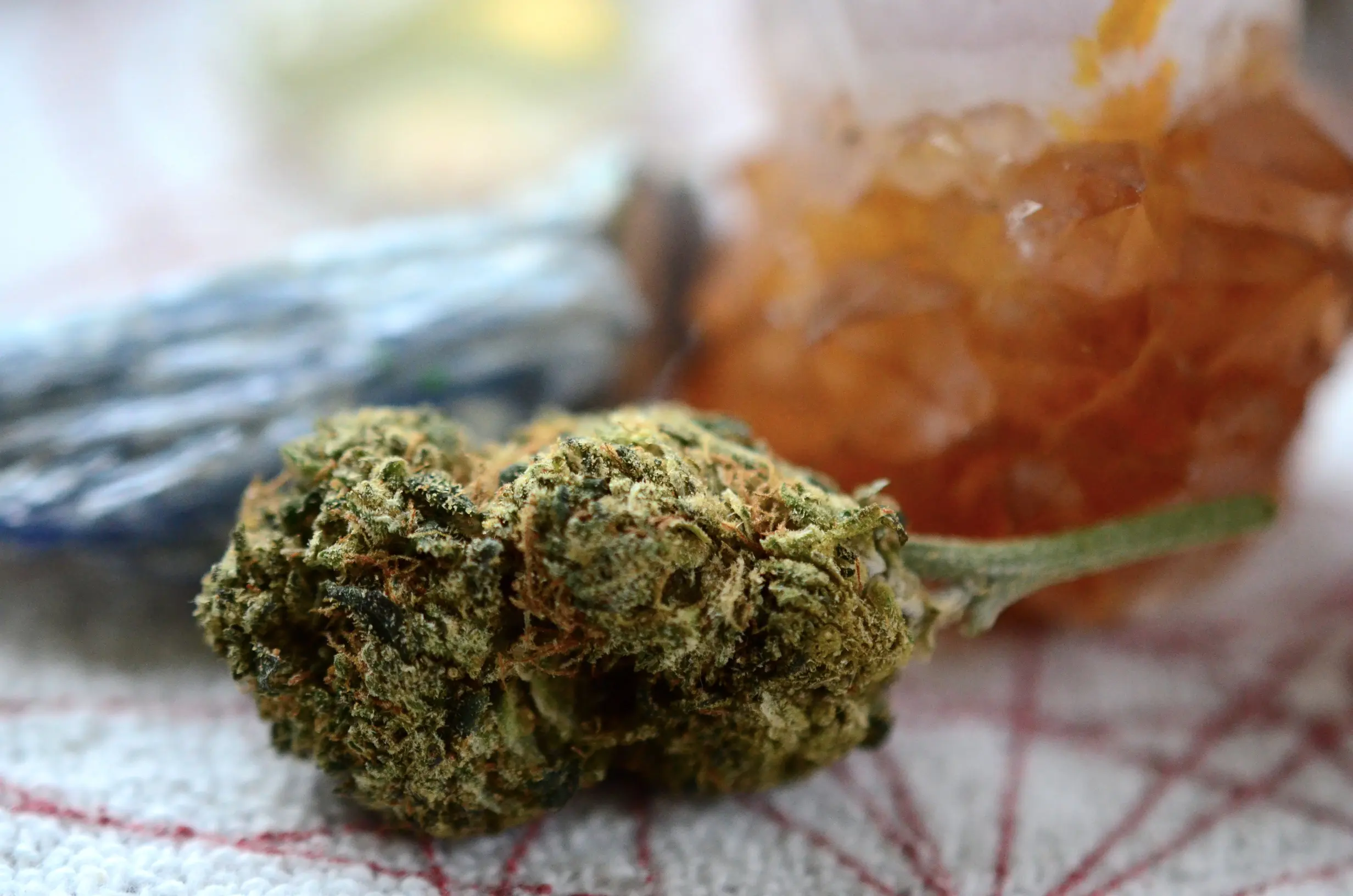
White Tahoe Cookies
White Tahoe Cookies is a compact resin cultivar with a clear tradeoff: exceptional frost and creamy fuel can arrive on a plant that stretches very little and does not automatically fill space. Growers who expect a vigorous transition may flip too early and finish with an underused canopy. Growers who compensate with excessive veg can create a dense, low interior that becomes difficult to illuminate and dry.
The cross combines The White, Tahoe OG, and Girl Scout Cookies. The White contributes extreme trichome coverage, Tahoe OG contributes pine-fuel Kush character, and Cookies adds sweetness, density, and a heavier dessert finish. The result is often short, branchy, and visually impressive, with smaller dense flowers that can look snowed over long before the plant appears finished.
The main cultivation question is how to build enough productive width before flowering while keeping the low, branchy interior open. White Tahoe Cookies is not a plant to flip small and hope for a dramatic stretch. It is better treated as a patient indoor resin project: establish roots, spread the laterals, remove weak interior growth, and protect compact flowers from late humidity. Yield may be moderate, but resin quality, creamy gas, and a strong evening effect can justify the extra vegetative time.
Strain Features
| Feature | Details |
|---|---|
| Strain Type | Indica-dominant hybrid with a euphoric opening and a heavy late physical phase. |
| Genetic Profile | The White × Tahoe OG × Girl Scout Cookies. |
| THC / CBD | Commonly high THC, often reported from the low 20s into the upper 20% range; CBD is usually minimal. |
| Dominant Terpenes | Often beta-caryophyllene, limonene, myrcene, and pinene. |
| Flavor / Aroma | Creamy fuel, cookie dough, pine, earth, lemon peel, hash, and mild floral sweetness. |
| Effect Character | Sneaky euphoria and sociability followed by strong relaxation, appetite, and possible sedation. |
| Flowering Time | Approximately 9-10 weeks in many reports; some selected cuts finish slightly earlier. |
| Stretch | Low. Minimal flowering stretch is one of the defining cultivation traits. |
| Plant Architecture | Short, squat, and strongly lateral; White-dominant plants can become leafy and dense. |
| Yield | Moderate. Quality and resin often exceed raw production efficiency. |
| Bud Structure | Small-to-medium dense flowers with very high trichome coverage. |
| Resin Production | Very high, including substantial coverage on nearby sugar leaves. |
| Training Compatibility | Best with early LST, one or two toppings, and a patient compact SCROG. |
| Defoliation Response | Selective defoliation is useful on White-dominant phenotypes; heavy stripping is not universal. |
| Mold Risk | Moderate to high inside low dense canopies and compact flowers. |
| Grow Difficulty | Moderate. |
| Best Time of Use | Evening and nighttime, especially at moderate or high doses. |
Genetic Lineage
The White is known less for a dramatic aroma than for extraordinary resin coverage. Its contribution is visible in the way White Tahoe Cookies coats calyxes and sugar leaves before the flowers have reached full mass. Tahoe OG adds the old-school Kush frame: pine, lemon, fuel, earth, and a physically heavy finish. Girl Scout Cookies contributes dough, sweetness, density, and additional potency.
The three-way combination does not produce one perfectly uniform architecture. White-dominant plants may remain very short, carry broad leaf, and require more interior thinning. Tahoe-leaning plants can show slightly longer internodes and more obvious fuel. Cookies-leaning plants often produce dense rounded flowers and sweeter dough.
A useful keeper balances lateral vigor with enough internodal space to avoid a sealed center. The frostiest plant is not automatically the best grower. Resin must be considered alongside branch placement, flower hardness, aroma, and the time required to fill the canopy.
Core tradeoff: More vegetative time increases canopy coverage, but too much time without branch separation creates a low humid thicket. Train for width and airflow at the same time.
Why the Three-Way Combination Grows Slowly but Finishes Loud
The White side is associated with exceptional resin and a tendency to make compact, visually pale flowers. Tahoe OG contributes pine, lemon, fuel, and a branch structure that can be reluctant early but heavy later. Cookies adds dough, spice, and dense calyx formation. Together, these traits explain a plant that may spend more time building a short frame than a vigorous production hybrid, then concentrates quality into a relatively shallow canopy.
Seed-derived versions can separate those influences. A White-dominant plant may be leafier and frost extremely early. A Tahoe-leaning plant may stretch slightly more and emphasize pine-lemon fuel. A Cookies-leaning plant may stay squat and form very dense round flowers. The ideal indoor expression produces enough lateral extension to fill space without losing the cream-fuel identity or the heavy resin that defines the family.
Effect Breakdown
A Quiet Climb
White Tahoe Cookies often begins more gently than its potency suggests. Mood improves, conversation feels easier, and the user may feel creative or amused. The onset can be deceptively social, especially in a small amount.
Gravity Arrives Later
The body phase builds with each inhalation. Shoulders soften, the face and eyes feel heavier, and sitting becomes more attractive. Appetite can increase strongly. At a moderate dose, the user may remain engaged with music, food, or a movie. At a heavy dose, physical relaxation can become dominant enough for sleep.
The progression is why the strain is easy to overconsume. A user who expects an immediate heavy effect may take more during the social opening and later experience dizziness, anxiety, or immobilizing sedation. High THC and low CBD make slow dosing especially important.
Duration
The physical finish can remain for several hours, particularly in late-harvest flower. The mental tone usually stays positive, but concentration becomes less reliable. White Tahoe Cookies is therefore better suited to an evening with few obligations than to detailed daytime work.
Flavor & Aroma Profile
Creamy Fuel
The defining aroma is a dense blend of gasoline, cream, dough, and earth. The fuel is softer and rounder than Chem 91, while the sweetness is less fruity than Gelato. Some flowers smell like a bakery located beside pine forest soil and a leaking fuel can.
Kush and Lemon Underneath
Grinding reveals pine resin, lemon peel, hash, pepper, and a faint floral note. Tahoe-leaning expressions are sharper and more citrus-fuel. Cookies-leaning plants are sweeter and doughier. White-dominant plants may be visually exceptional while remaining more neutral in aroma.
What the Smoke Reveals
The inhale often begins creamy and sweet. Fuel and pine move forward in the middle. The exhale brings earth, pepper, hash, and a dry cookie finish. A complete cure makes the cream and gas feel integrated. A rushed dry leaves hot earth and muted sweetness.
White Tahoe Cookies is not primarily a fruit cultivar. Growers should not chase berry or candy notes that are not present. The quality target is clean resin, creamy OG fuel, and a smooth transition from sweetness into pine and hash.
Dominant Terpenes
| Terpene | Aroma Role | Likely Contribution |
|---|---|---|
| Beta-caryophyllene | Pepper, spice, dry wood | Supports the cookie-hash exhale and grounded base. |
| Limonene | Lemon peel and bright fuel | Sharpens Tahoe OG character and the euphoric opening. |
| Myrcene | Earth, musk, ripe herbal depth | Fits the later physical heaviness and damp soil note. |
| Pinene | Pine needle and fresh resin | Creates the mountain-forest edge beneath cream and gas. |
| Linalool or humulene | Floral softness or dry herbs | Secondary variation in sweeter or more hash-like expressions. |
The cultivar’s aroma is produced by a mixture rather than one universally dominant terpene. Sample-specific laboratory data should be preferred. Terpenes can help explain the flavor architecture, but they should not be used to promise an identical effect in every user.
Indoor vs. Outdoor Growing
| Decision | Indoor | Outdoor |
|---|---|---|
| Canopy Filling | Extra veg and a compact screen compensate for low stretch. | A long season compensates naturally, but the plant may remain shorter than neighboring cultivars. |
| Interior Density | Defoliation and airflow can be controlled precisely. | Large low bushes can hide humid interior zones after rain. |
| Resin Quality | Stable light, temperature, and harvest timing protect frost. | Full sun supports resin, but wind, dust, and hot harvest weather increase handling loss. |
| Flowering Risk | Dense flowers require late humidity control. | Rain and dew are the central threat to compact buds. |
| Yield | Moderate per plant; efficiency improves with patient canopy design. | Moderate to high in a long dry season, but not usually a giant-tree cultivar. |
| Main Limitation | Underfilling the room or over-vegging a crowded center. | Insufficient season in cool regions and hidden moisture in a low bush. |
| Best Candidate | Quality-focused indoor growers with limited height and time for veg. | Warm dry regions where compact plants can finish without prolonged rain. |
White Tahoe Cookies is naturally suited to indoor cultivation. Its limited stretch, compact height, and high resin make it practical in short spaces, provided the grower accepts additional vegetative time. Indoor control also protects the dense flowers during the slow final weeks.
Outdoors, the plant can perform well in warm dry conditions, but it does not always use unlimited space as efficiently as a vigorous sativa hybrid. A protected container or raised bed may be more logical than committing a large ground area in a short, wet season.
Strain-Specific Grow Guidance
Do Not Flip a Small Plant
Minimal flowering stretch is the first fact the grower should design around. A plant that occupies half the intended area at the flip may finish with empty space. Build most of the final canopy during vegetative growth. Watch actual branch extension rather than expecting a generic doubling.
Spread Laterals Early
White Tahoe Cookies often produces strong side branches close to the main stem. Bend them outward while flexible. One topping can increase symmetry; a second can help a vigorous plant fill a larger screen. Repeated topping on a slow phenotype wastes time and creates too many short interior shoots.
A compact SCROG is useful because it fixes lateral position and keeps the low plant from stacking every flower in the center. Fill roughly three-quarters to nearly all of the screen before the flip, depending on the observed stretch.
Defoliate by Phenotype
White-dominant phenotypes may produce broad leaves that cover several close nodes. Remove selected fans that block the center and leaves that rest against flower sites. Cookies- or Tahoe-leaning plants with more open spacing need less intervention.
Do not treat defoliation as a scheduled ritual. A slow plant cannot replace leaf quickly. The goal is visible branch junctions and air pathways, not a bare frame.
Control Watering in a Short Canopy
The root zone can hide the first mistake
A compact plant may use water more slowly than a tall hybrid in the same container. Overwatering is common when the grower chooses a large pot to support a long veg. Use an aerated medium, monitor container weight, and avoid keeping the lower root zone wet simply because the top inch has dried.
Feed for Resinous Flower, Not Dark Leaf
The cultivar usually performs on moderate nutrition. Strong vegetative feeding can help fill the screen, but nitrogen should taper as flower set becomes established. Excess late nitrogen increases leaf inside already dense buds and can leave the smoke green and peppery.
A healthy plant may accept stronger bloom nutrition during swelling, but the response should be gradual. Burned tips are not proof of productive feeding. Resin is genetically strong and does not need to be forced with extreme concentration.
Keep Light Even Across a Low Surface
The compact canopy makes even lighting achievable. Use that advantage. An escaped top is not the main risk; shaded interior branches are. Spread the plant before flower, remove weak lower shoots, and maintain a shallow productive zone.
Support Is About Position, Not Only Breakage
Flowers may be smaller than those of high-yield hybrids, but dense resinous clusters can pull laterals inward or downward. A net keeps each branch separated and prevents touching buds. This reduces humid contact and preserves light across the surface.
Late Flower Requires Patience
The plant can look finished early because trichomes appear so heavily. Do not confuse frost with maturity. Calyxes must swell, pistil production must slow, and the aroma should develop from green pine into cream, fuel, and hash. Many expressions need close to nine or ten weeks.
Inspect the Low Interior
The highest humidity may be below the visible canopy where branches, leaves, and flowers are closest. Move air under the plant and inspect buds near the center. Room RH alone does not describe the microclimate inside a squat dense plant.
Most useful second-run change: Extend veg only while branches are being separated. Extra time without training adds density, not productive coverage.
Measure Vegetative Progress by Width, Not Height
A low plant can be developing successfully even when its vertical change appears slow. Track how many laterals have reached the edge of the container, whether new nodes are becoming larger, and how quickly the medium dries. Those signs show that roots and leaf area are expanding. Increasing feed because the plant is short often produces a darker, thicker version of the same short plant rather than a faster canopy.
Top Only When the Laterals Can Use the Opportunity
An early topping is useful once the lower branches are actively extending. If the plant is topped before that vigor exists, the two new leaders may grow while the lower frame remains static, creating little additional width. A second topping should be reserved for a clearly vigorous phenotype and enough remaining veg time. Most rooms gain more from patient LST than from repeated cuts.
Fill a Compact Screen Deliberately
Use a screen smaller than the one assigned to a high-stretch hybrid. Guide each lateral toward a nearby opening and fill most of the intended area before changing the light cycle. Leave a limited amount of space for the modest transition, but do not expect empty corners to disappear. Once flower set begins, stop forcing short rigid branches across long distances; support their existing positions instead.
Open the Center Without Removing the Plant
The low canopy places large fan leaves directly over branch junctions and developing flowers. Remove the leaves that create persistent contact or cover several sites, then reassess. A heavy strip can slow a cultivar that already invests cautiously in vegetative growth. The goal is to see light and movement through the center while retaining a functional outer leaf layer.
Use Dryback to Avoid the Slow-Plant Overwatering Trap
White Tahoe Cookies often occupies a large container less quickly than a vigorous sativa hybrid. Water only the active root zone early rather than saturating unused medium repeatedly. As roots expand, increase the wetted area. Later, irrigate thoroughly and allow a real dryback. Constant moisture reduces oxygen, slows lateral growth, and can be mistaken for the cultivar's normal compact pace.
In coco or automated systems, small frequent applications can work once roots have colonized the container, but runoff and root-zone oxygen still matter. A slow plant does not need a stagnant nutrient bath. Monitor how rapidly leaves respond to irrigation and whether the container becomes lighter between cycles.
Keep Feeding Proportional to Leaf Area
The plant can produce premium flower on moderate nutrition. Increase concentration only when growth, light, and irrigation justify it. Dark glossy leaves, burned tips, and downward claws are signs that input has exceeded demand. Reduce nitrogen after transition so the interior does not remain excessively leafy and the cream, pine, and dough can mature without a persistent green edge.
Plan Two Layers of Air Movement
Air should move below the low canopy and around the flower surface. A fan blowing only across the tops leaves the branch junctions still. Raise or thin the lower edge enough for air to enter, and keep flowers from touching one another as they swell. The risk is concentrated where dense buds sit close to the main stem, not only at the largest visible top.
Do Not Let Early Frost Decide the Harvest
Heavy trichome coverage can make the flowers look complete weeks before calyx expansion has ended. Follow the pistils and the shape of the buds. Mature flowers become firmer, the calyxes stand more distinctly from the sugar leaves, and the aroma moves from sharp pine toward cream, lemon fuel, hash, and dough. Check trichomes on the swollen calyxes at several levels rather than on the whitest leaf edge.
Support the Weight Where Branches Leave the Center
The plant may not need tall stakes, but a short heavy branch can split at its base when a dense flower pulls outward. A compact net or radial ties distribute that force. Support should maintain separation, not squeeze the whole bush inward. Outdoors, a cage is especially useful because the plant's low center can catch rain and wind-driven debris.
Efficiency warning: Extra vegetative time is justified only while it creates illuminated width. Once the center thickens faster than the perimeter expands, prune, reposition, or flip.
Weedth Bud Flavor Tips
White Tahoe Cookies is more forgiving of terpene loss than a delicate berry strain because fuel, pine, and caryophyllene-rich spice are relatively persistent. The creamy top note is more fragile. A hot dry leaves a harsh OG profile and removes the smooth cookie transition.
Dry Dense Small Flowers Slowly
Small flowers can still be very dense. Do not assume they will dry evenly because they are not giant colas. Hang branches with space, use indirect circulation, and allow the center to release moisture before the exterior becomes brittle.
Protect the Frost
Handle branches by the stem and avoid repeated inspection by squeezing. The White influence can produce resin on nearly every surface. Rough wet trimming removes both appearance and aroma. A careful dry trim is often worth the extra time.
Cure for Integration
The first jar may smell mostly pine, earth, and fuel. Over several weeks, cream and dough move forward and the smoke becomes less aggressive. Keep whole flowers cool and dark. The cultivar stores well when resin heads remain intact and oxygen exposure is limited.
Preserve Cream, Not Only Fuel
Pine and fuel are robust enough to survive a mediocre dry. Cream and dough are not. High heat, direct airflow, and brittle overdrying leave a sharp Tahoe-like flower while erasing the softer Cookies and White layers. Dry in darkness with indirect exchange and enough branch spacing that the centers release moisture gradually. The objective is not to suppress the OG base; it is to keep the palate wide enough that cream remains above it.
Small Dense Buds Can Hide Moisture
White Tahoe Cookies does not need enormous colas to create a drying problem. Compact golf-ball flowers can seal moisture around their stems. Test representative buds from the interior and exterior of each branch. If outside flowers are ready while inner flowers remain flexible and cool, improve spacing rather than increasing fan speed. Direct wind will overdry the exposed surfaces first.
Dry Trim Protects the Visual and Sensory Finish
The resin coating is easy to smear when wet. Hanging manageable branches and trimming after the exterior has set reduces contact with sticky calyxes. Remove only leaves that would trap moisture or are already damaged before drying. Keep the room clean and handle by stems. The discarded sugar leaf can be highly resinous, but it should be separated without scraping the finished flower.
Allow the Cure to Reveal the Dough
Early jars may be dominated by pine, lemon, and dry earth. Cream, vanilla-like dough, and hash generally integrate over several weeks. A mature cure should soften the throat without making the flower bland. If aroma disappears whenever the jar is closed for several days, the flower may have been overdried or stored too warm. Stable cool storage protects the quieter layers that justify the cultivar's complexity.
Store Resin Heads Intact
Whole flowers retain quality better than pre-ground material. Use containers that prevent crushing, divide the harvest into working portions, and minimize repeated air exposure. The strain's bag appeal depends on intact trichome heads, but those same heads also carry much of the aroma. Careless handling reduces both at once.
Weedth Bud Boost Tips
Indoor: Spend Time Before the Flip
White Tahoe Cookies creates yield by filling horizontal space in veg. Establish roots, top once or twice, and train each lateral into its own position. The additional vegetative time must produce useful width. If the center is simply becoming thicker, the plant is ready for pruning rather than another week of growth.
Use a shallow screen and remove weak shoots below it. Moderate plant count can improve room efficiency because each individual fills slowly. However, crowding several squat plants together can create the same humidity problem as one overgrown bush.
Outdoor: Use the Season for Branch Development
Start early enough that the compact plant builds a broad frame before days shorten. Use morning sun, good spacing, and a support cage. Avoid low wet soil. A container or raised bed with reliable drainage can outperform open ground in a humid location.
Quality Yield
Do not push extreme nitrogen or keep shaded inner sites for weight. The cultivar’s economic value is resin and flower quality. A slightly smaller harvest with clean cream-fuel aroma is a better result than a large amount of leafy lower bud.
Calculate Yield Over the Full Cycle
The cultivar may deliver premium flower but require more vegetative days. Evaluate efficiency by the entire room cycle, not harvest weight alone. A selected clone, a smaller screen per plant, or a slightly higher plant count may produce more quality flower per month than one oversized plant kept in veg until it fills a large area. The correct strategy depends on legal limits, propagation capacity, and available space.
Use Plant Count to Compensate for Low Stretch Carefully
Several compact plants can cover floor area faster than one, but their mature canopies must not merge into a solid wet mat. Assign each plant a defined zone and keep a visible channel between main stems. Remove inward-facing shoots early. Higher plant count works only when it reduces veg without sacrificing airflow.
Outdoor Roots Need Drainage More Than Maximum Volume
A raised bed or large aerated container can be preferable to deep wet ground. The plant's low frame keeps flowers closer to soil humidity and splash. Use mulch carefully so it moderates moisture without touching the stem or creating a permanently wet surface. Morning sun and a site open to breeze are more useful than the largest possible root hole in a shaded corner.
Reserve the Best Light for the Productive Shelf
The compact canopy forms a shallow shelf of flower. Keep that shelf level and remove lower shoots that cannot reach it. Strong uniform light across a small depth can produce exceptional resin and density. Increasing intensity beyond the room's climate and root capacity adds bleaching and foxtailing risk without correcting the cultivar's slower area fill.
Medical Uses & Benefits
Users commonly report choosing White Tahoe Cookies for stress, physical tension, appetite, mild pain, and sleep. The opening euphoria can improve mood before the body becomes heavy. The later phase may reduce restlessness and make food or rest more appealing.
The strain is high in THC and low in CBD. Large amounts may worsen anxiety, dizziness, or confusion, especially because the onset can feel lighter than the eventual body effect. Medical use should therefore emphasize dose control and personal response.
Its strongest practical fit is evening symptom management when reduced activity is acceptable. It is less suitable for users who need consistent daytime focus or immediate non-psychoactive relief.
Ideal User Profile
White Tahoe Cookies suits the user who wants creamy OG fuel, heavy frost, and a session that begins social but ends physically calm. It is best for intermediate or experienced consumers.
Ideal for indoor growers with limited height, enough time for vegetative training, and good late-flower humidity control.
Ideal for evening relaxation, appetite, music, movies, and sleep preparation.
Less ideal for fast-turn rooms, wet outdoor climates, or users who want energetic daytime effects.
Growers focused on extraction or resin may value it more than growers focused only on raw flower weight. The plant’s efficiency improves when the room is designed around low stretch from the start.
Grower Notes and Feedback
The most repeated practical observation is that the plant stays short. Growers who expect a normal hybrid stretch often finish with empty canopy. Those who compensate with patient LST and a compact screen report better coverage and more uniform flowers.
Another recurring theme is extraordinary frost. This can lead to premature harvest because the plant looks finished. Resin coverage appears early relative to final calyx swelling, so maturity should be confirmed through flower development and trichomes on the calyxes.
Growers also note that White-dominant phenotypes can become leafy and benefit from selective defoliation. Less leafy expressions may need almost none. This is a clear case where copying another grower’s calendar can be less useful than reading the actual plant.
Yield is often described as moderate. The flower quality, potency, and resin can compensate, but growers running strict production schedules should account for the extra veg and limited stretch.
Growers frequently report that the plant looks easier than it is because height never becomes threatening. The hidden workload is vegetative patience and interior organization. A short plant can still become overgrown horizontally, and its dense flower can create more late humidity risk than a taller open cultivar.
Another common discovery is that early trichome production changes expectations. The plant appears elite well before it reaches full weight, encouraging photographs and premature harvest checks. Growers who wait for completed swelling usually report a fuller OG-Cookies palate and a heavier, longer effect.
Phenotype selection can improve efficiency. A plant with slightly more Tahoe-like stretch may fill a screen faster while preserving enough White frost and Cookies cream. A completely squat, extremely leafy plant can produce beautiful flowers but consume too much veg time for a production-focused room. The best keeper depends on whether the priority is cycle speed, resin, flavor, or compactness.
Trim feedback is generally positive when the selected plant has a strong calyx-to-leaf ratio. White-dominant expressions can be much leafier, although the sugar leaves are highly resinous. Keeping phenotypes separate through dry and trim helps reveal whether the extra labor is justified by superior flower.
Weedth Editor's Note
What this cultivar asks from the room
I would plan White Tahoe Cookies from the vegetative room backward. The flowering room cannot fix a plant that entered the flip too small, because the cultivar does not provide a large stretch rescue.
My priority would be separated laterals and a visible center. The plant is short enough that every hidden shoot seems harmless, yet those shoots become the exact place where airflow, light, and trim quality decline.
The weakness is production speed. The strength is that the finished flower can look and feel exceptionally refined without needing a tall room. I value it more as a resin and evening-quality cultivar than as a volume cultivar.
I would recommend it to patient indoor growers. I would not flip it small, and I would not harvest it simply because it already looks white.
Weedth Score
Growing Experience 7.9/10 Manageable height and responsive lateral growth, with extra veg, dense interiors, and low stretch reducing efficiency.
Bud Structure & Visual Appeal 9.5/10 Exceptional trichome coverage, dense flowers, and possible purple highlights.
Aroma Complexity 8.8/10 Cream, fuel, pine, lemon, dough, earth, and hash create a polished profile.
Flavor & Smoothness 8.7/10 Excellent after cure; hot drying removes cream and leaves a harsher OG profile.
Effects & High Experience 8.8/10 Pleasant euphoric opening and strong relaxation, though overconsumption becomes very heavy.
Overall Satisfaction & Recommendation 8.7/10 A premium resin cultivar for patient indoor growers who accept moderate yield and a longer veg.
*White Tahoe Cookies rewards the grower who builds the canopy before asking the flowers to carry it.*
FAQ
How much does White Tahoe Cookies stretch?
Usually very little compared with a typical hybrid. Do not rely on flowering stretch to fill major gaps. Build most of the final width during vegetative growth.
Is White Tahoe Cookies good for SCROG?
Yes, but it requires patience. Use a compact screen and fill it mostly before the flip. The strong lateral growth is useful even though vertical stretch is limited.
Does it need defoliation?
White-dominant leafy phenotypes benefit from selective defoliation around the center. More open Tahoe-leaning plants may need less. Remove only leaves that block several sites or touch flowers.
Why are my plants staying so small?
Short stature and low stretch are genetic traits. Confirm roots, light, and temperature, but do not assume the plant is deficient simply because it grows more slowly than a vigorous sativa hybrid.
Does White Tahoe Cookies need heavy feeding?
Moderate feeding is usually enough. It can produce strong resin without extreme concentration. Reduce nitrogen as flower set becomes established and watch for dark clawed leaves.
Is it prone to bud rot?
Compact flowers and a low dense canopy create risk. Keep the interior open, reduce late humidity, move air under the canopy, and inspect flowers near the main stem.
When should it be harvested?
Wait for calyx swelling, reduced fresh pistils, and mostly cloudy flower trichomes. Heavy frost appears early and is not a reliable sign by itself. A later mature window usually deepens fuel, hash, and body effects.
Is White Tahoe Cookies suitable outdoors?
It can perform in a warm dry climate with a long season. It is less attractive in wet regions because the low bush and dense flowers hold moisture. Containers or raised beds may improve control.
How long should White Tahoe Cookies stay in vegetative growth?
Long enough to fill most of its assigned horizontal area, not a fixed number of days. Flip when healthy laterals occupy the compact screen and the center is still open. Extending veg after width has stopped improving mainly increases interior density.
Why does White Tahoe Cookies look ready so early?
The White influence can produce heavy resin before the flowers finish swelling. Frost is a quality trait, not a maturity clock. Wait for calyx expansion, declining fresh pistils, mature aroma, and mostly cloudy trichomes on the flower itself.
Should compact plants be grown in very large pots?
Not automatically. An oversized wet container can slow root-zone dryback and reinforce the plant's naturally cautious pace. Choose a volume the roots can colonize during the planned veg and manage irrigation around the active root zone.
How can I keep the creamy flavor from disappearing?
Avoid hot late flower, direct air during drying, brittle overdrying, and warm storage. Harvest after full maturity and allow several weeks of cure. Pine and fuel survive rough handling more easily than cream and dough, so post-harvest control determines whether the profile remains balanced.
Similar Strains
Tahoe OG: Shares pine, lemon, fuel, and evening physical weight. It usually stretches more and produces a more direct OG profile.
Girl Scout Cookies: Similar dough, spice, resin, and potency, but generally more stretch and less extreme frost.
MAC 1: Another slow, highly resinous quality cultivar with creamy citrus and moderate yield. It can be even slower in veg.
Oreoz: Comparable frost and dense dessert flower, with darker cocoa-cookie flavor and often less aromatic brightness.
Cap Junky: A more vigorous modern resin option with stronger fuel and higher production potential, but greater stretch.
Alien Cookies: Similar quality-over-throughput logic, low stretch, dense resin, and an evening effect with vanilla, tea, and gas.
Share this article
A quick overview of the topics covered in this article.
Follow us
Latest articles
September 9, 2026
September 9, 2026

September 9, 2026