
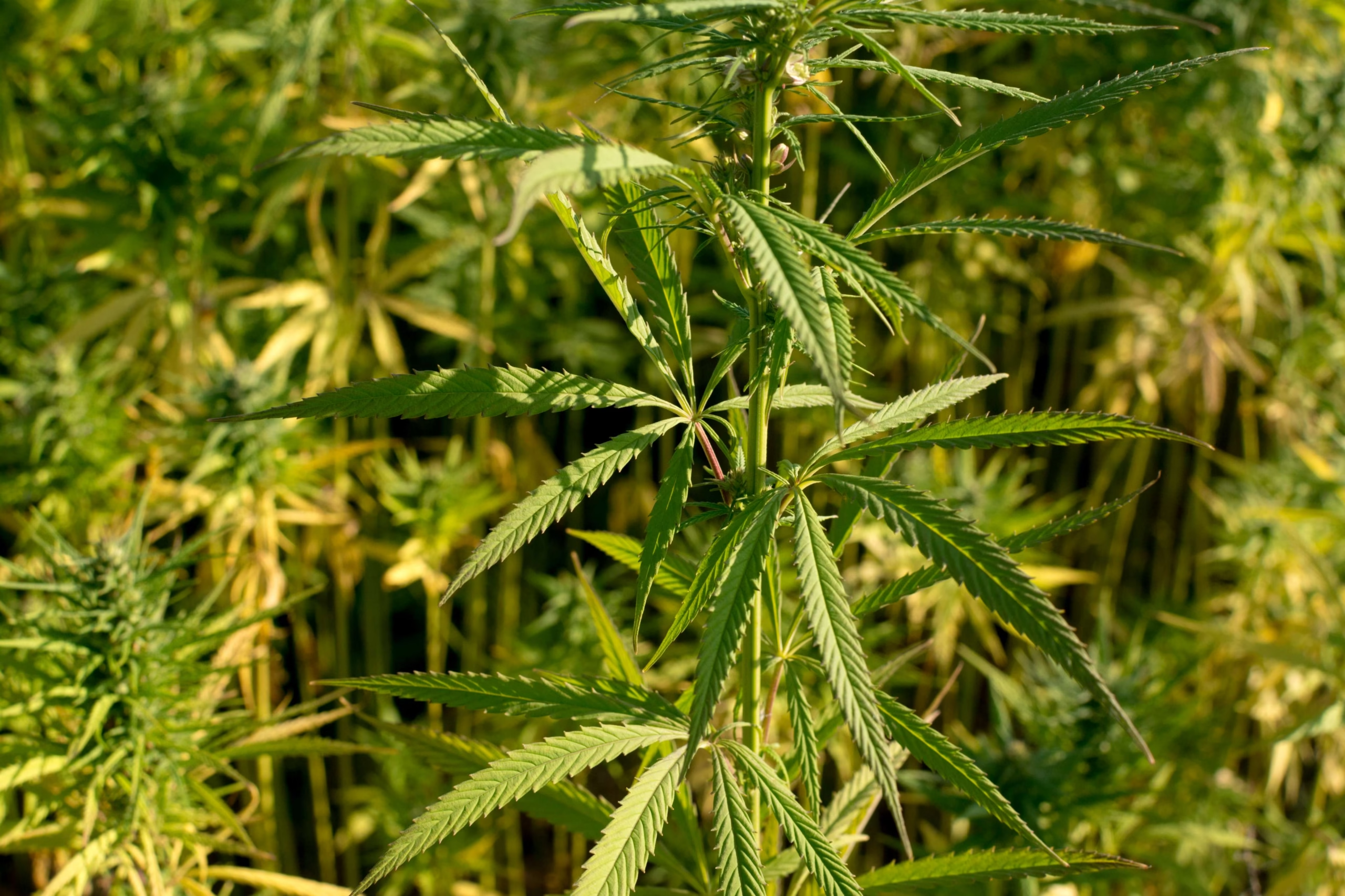
Outdoor Cannabis Training Timing and Recovery
A training method can be technically correct and still be the wrong decision for an outdoor plant. A flexible shoot may bend neatly while the root ball shifts underneath it. A healthy plant may recover from a modest adjustment during active vegetative growth but have little useful time to rebuild after a hard cut near flowering. A branch may appear to have recovered until wind loads the bend or a tie begins cutting into expanding tissue.
The practical question is not how many days old the plant is or which week a training chart recommends. It is whether the plant, the intended intervention, the approaching season, and the support system leave enough margin for a worthwhile response. Look at the whole system before choosing the technique, then verify the outcome before repeating it.
This resource gives one decision sequence for growers who already know the difference between topping, FIMing, low-stress training, and supercropping. It focuses on whether to start, continue, reduce, or stop outdoor training. For the full seasonal context, see the outdoor cannabis growing guide. Cultivate only where permitted and follow the applicable local rules.
Training Timing Is a Capacity Decision
Training changes the load carried by stems and branch unions and the placement of growing tips in the canopy. Some methods remove a growing point, some redirect an intact shoot, and some deliberately deform a stem. All of them must be judged against the same outdoor constraints: root function, structural integrity, current growth, future flower weight, weather, and the remaining season.
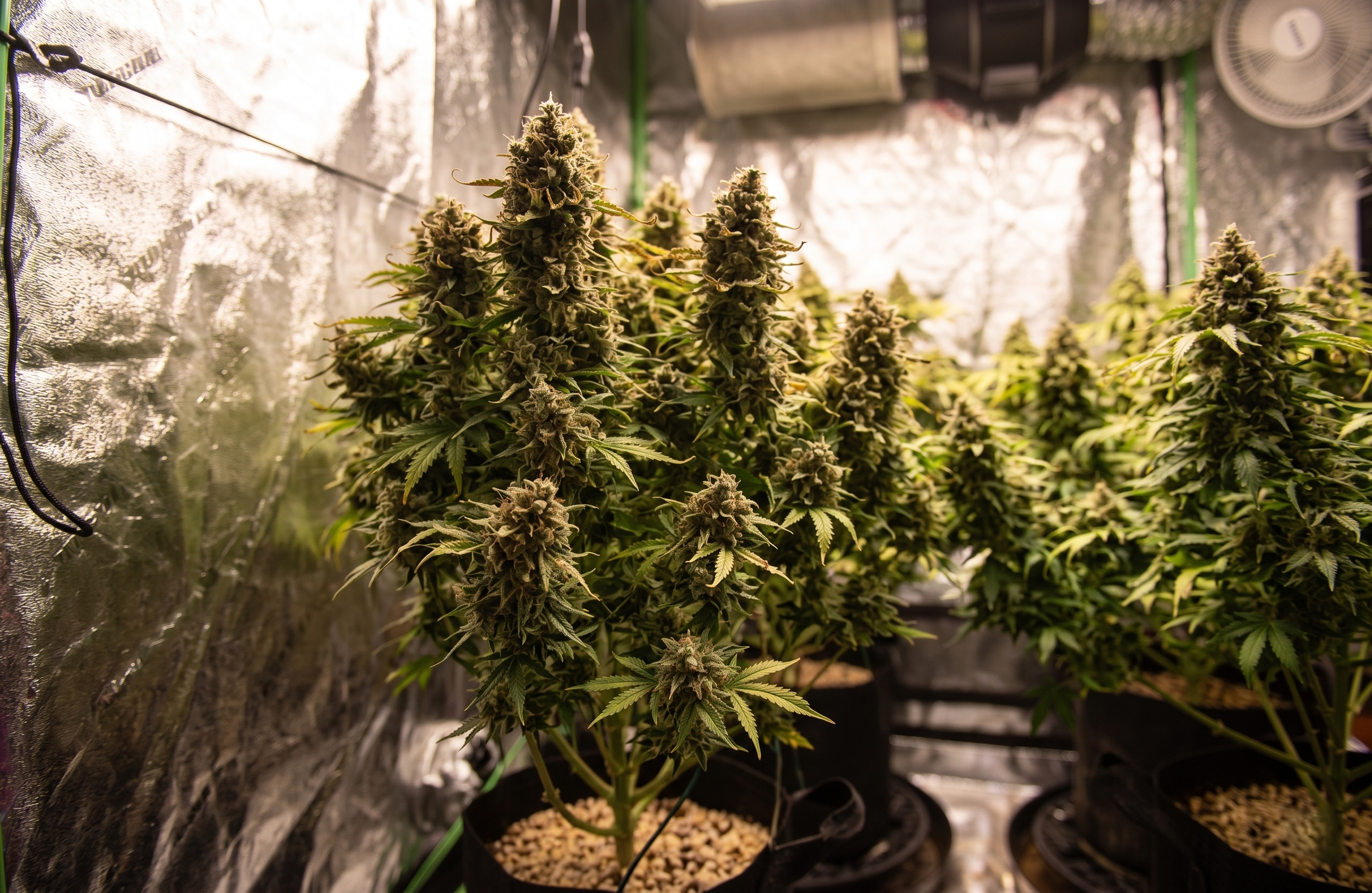
A favorable moment is not a single date. It is the intersection of a clear structural need and a plant capable of responding. If the canopy already has room for sunlight, inspection, and support, the next intervention may add risk without solving anything. If height, crossing branches, or access are becoming a problem, a modest early adjustment may be easier to manage than an aggressive late one.
Different techniques create different recovery obligations
Low-stress tie-downs preserve the shoot apex and normally avoid an intentional wound. Their main obligations are maintaining a stable anchor, preventing constriction, and revisiting branch placement as growth continues. Topping removes an apical meristem and creates a wound, so the grower must observe the cut site and subsequent branch development. FIMing partially alters the shoot tip, with an especially variable response that should not be reduced to a promise of four new tops. Supercropping deliberately stresses internal stem structure and calls for close monitoring of the bent section and tissue above it.
Those descriptions explain which risks to inspect, not a proven hierarchy of guaranteed outcomes. Direct outdoor cannabis experiments that isolate each technique and establish transferable recovery times are limited. General plant physiology supports the relevance of wound responses, mechanically induced growth, and changing branch architecture, but it cannot provide one universal cannabis clock.
Training benefit is a structural outcome, not a harvest percentage
Write down the actual problem before proceeding: an exposed vertical leader, two branches crossing, a hidden interior that cannot be inspected, a container that may overturn, or a future flower-bearing arm without support. Then ask which change solves it with the least disturbance. Spreading branches may improve visibility but may also increase wind leverage. Removing a tip can redistribute growth but leaves an injury and needs time for the new architecture to develop. Any claimed yield benefit must survive those tradeoffs and cannot be assumed.
Cannabis research shows that architecture treatments can influence flower distribution and other outcomes, yet pruning studies are not direct tests of every outdoor tie-down or bend. A result for a particular cultivar and production system is not a promise for a different plant in a windy garden.
Recovery window
The usable period after an intervention in which the plant can demonstrate stable structure and resumed development before another major demand, such as floral transition, heavy flower loading, or severe weather. It is assessed from observed response and the local season, not assigned a universal number of days.
Think of timing as a chain of gates
Before acting, pass through four gates in order. First, identify a real canopy or support problem. Second, verify plant health and stem or shoot suitability. Third, establish a safe root-to-anchor load path. Fourth, confirm that a meaningful recovery opportunity remains. If a gate fails, repair the limiting condition or choose support rather than escalation. This sequence also works when deciding whether to train again after a previously successful session.
Remember: A plant can be capable of surviving a training action without that action being useful. The goal is a better-managed outdoor structure, not proof that the plant will tolerate another bend or cut.
Read the Plant Before Training
Begin with a baseline inspection before touching the intended branch. Look at the canopy from a distance, compare newer and older foliage, inspect branch unions, check the root zone, and review upcoming weather. A plant’s height or number of nodes tells you much less about readiness than its current ability to keep growing and carry load.
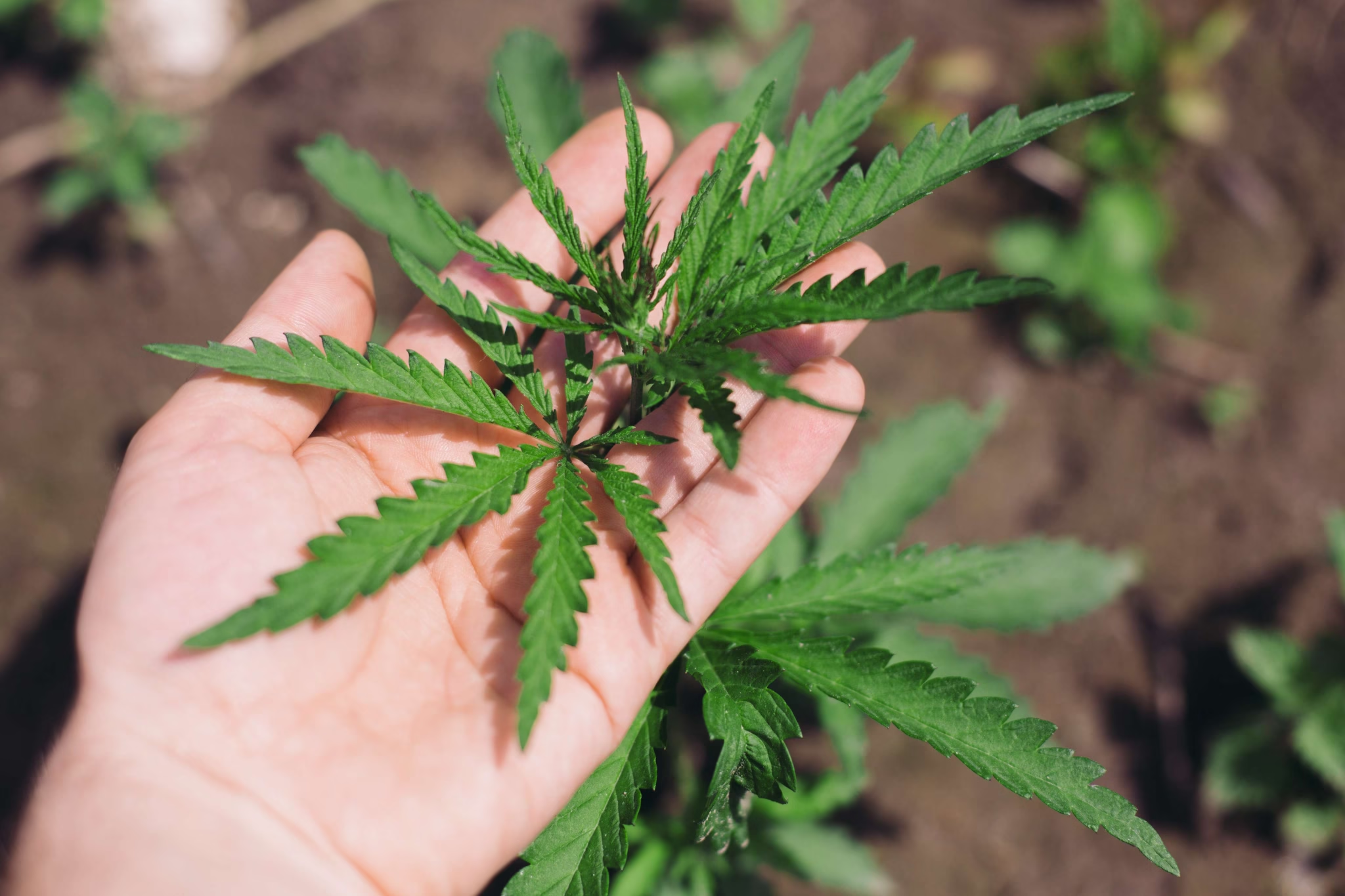
Confirm active growth rather than assuming vigor from color
Look for recent extension of healthy shoots and functioning leaves that generally regain normal posture after ordinary day-to-night changes. Compare the candidate branch with an untrained branch on the same plant. A branch that has stopped extending while nearby branches continue may have a local injury. A whole canopy that has stalled points to a larger environmental or root-zone problem.
Bright leaf color alone does not establish readiness. Excessive feeding, strong sunlight, or changing leaf age can modify color without telling you how the roots and stems are functioning. Likewise, vigorous appearance in the morning does not rule out repeated afternoon moisture stress. Inspect under conditions that reveal the normal pattern, and use a consistent photo position for the follow-up.
Check the root zone before treating droop as a training problem
Dry soil can reduce turgor, while an over-saturated root zone can impair uptake and also cause droop. The two conditions may look similar aboveground but demand different corrections. Assess moisture below the surface and consider drainage, recent irrigation, rain, container temperature, and transplant history. Do not deliberately leave a plant thirsty to make its stems seem easier to bend.
A recently transplanted plant may have leaves that look acceptable while the new root mass has not stabilized the surrounding medium. If the root ball rocks when the upper stem moves, the plant is not ready for a lever-like training pull. Stabilize it without compacting the root zone aggressively and postpone forceful manipulation.
Read existing injuries before creating new ones
Follow the candidate branch toward the main stem and look for cracks, previous training bends, damaged bark, softened tissue, discoloration, abrasion against stakes, and tight ties. A healed-looking swelling is not proof that the stem is safe to load further. A branch with fresh lesions or unexplained wilt needs diagnosis or support before another training decision.
Also look for pest or disease activity where training would bring leaves or flowers together. Opening a dense center may be useful, but touching several plants with contaminated cutting tools can create a separate problem. If cuts are unavoidable, apply a verified sanitation workflow; this timing article does not replace plant-to-plant tool disinfection guidance.
Weather changes the same intervention
A modest bend on a calm day becomes a different loading problem under strong gusts. Heavy rain can soften the growing medium, shift containers, and add weight to developing flowers. A hot, dry spell can reduce the plant’s ability to maintain leaf posture, while cold conditions may coincide with slow growth and a narrowing season. Check the forecast and the site itself. A sheltered courtyard, open field, and elevated balcony have different wind behavior even when a regional forecast looks identical.
Do not stack stress to meet a training schedule
If the plant is recovering from drought, saturated roots, transplant disturbance, a split stem, pest damage, or severe weather, postpone optional topping, FIMing, hard bending, and repeat interventions. First correct the identifiable problem and verify that normal growth or stable support has returned.
| Readiness observation | What it means for the next decision |
|---|---|
| Growing tips extend; leaves show normal posture | A useful sign of functioning growth, provided the root ball and target tissue are also stable. |
| Whole-plant droop or stalled new growth | Pause training and investigate root moisture, root health, temperature, and other causes before attributing the response to architecture. |
| A localized limp branch above an old bend | Inspect that injury and its support. Do not use whole-plant vigor to declare the branch repaired. |
| Root ball rotates or soil fractures when the stem shifts | Stop pulling. Stabilize the base, relocate anchors, or abandon the proposed geometry. |
| Approaching storm or rapid floral development | Prioritize support and low-disturbance maintenance over initiating a new architecture program. |
Check Stem Flexibility Without Turning It Into Damage
Flexibility is local. The soft, newly extended section of a shoot may move readily while a lower section of the same stem has thickened and resists bending. Nodes, earlier injuries, and branch junctions create changes in stiffness. A stem that can be moved safely at one point may split if the same force is transferred to its base.
How to Know Whether a Stem Is Still Flexible Enough
Inspect the actual section you intend to move. Look for a healthy surface, intact node junctions, and an existing natural arc. Support the stem close to the intended adjustment with one hand and guide the distal section with the other. Apply only a small, progressive change while watching both the bend and its connection to the main stem. There is no need to force the desired final position during this check.
A workable section changes direction smoothly under modest pressure without abrupt resistance, surface splitting, audible cracking, twisting at a node, or lifting at the root crown. If resistance rises sharply or the whole branch union starts moving, stop. The flexibility check is a conservative assessment, not a test of the stem’s breaking point. A grower cannot know the exact internal strain simply by how many degrees the shoot has moved.
Check again after releasing the light pressure. A small elastic return is normal and not evidence that the intervention failed. If the tissue remains collapsed, a crease opens, or leaves above the section suddenly lose normal posture, shift from training to injury assessment and support. Do not keep flexing the same point to establish whether the crack is real.
Choose a different section or a different method when the base is rigid
If a tall leader has developed a stiff lower stem, there may still be a more flexible upper shoot that can be gently repositioned. That does not make the lower branch suitable for a sharp bend. Moving the attachment point higher changes the canopy outcome and may leave the original height problem only partly solved. Decide whether the smaller adjustment is still worthwhile.
When no safe section exists, use external support or accept the existing architecture. Do not convert a failed low-stress flexibility check into deliberate crushing merely to reach a planned shape. Supercropping has a different damage-and-recovery profile and should not become an unplanned rescue technique.
Test a small change near the intended bend
Support both sides, watch the union, accept gradual repositioning, and stop before resistance becomes abrupt.
Use the final angle as a toughness test
Repeatedly forcing a rigid stem toward an arbitrary flat position can turn a timing decision into a split or compromised load path.
What a crease, crack, or sudden droop actually means
A surface crease may be localized deformation, but it cannot establish whether vascular tissue is intact. A visible crack establishes mechanical injury. Sudden wilt above a specific bend raises concern about interrupted transport or severe strain, though simultaneous heat or root-zone stress can complicate the picture. These observations should trigger a pause and closer examination, not a diagnosis of a particular internal injury from appearance alone.
Photograph the section and nearby leaves before adjusting support. Stabilize a compromised branch so wind cannot pull it farther apart. Keep soft materials from trapping water against exposed tissue, and avoid unnecessary repeated handling. If the entire plant also droops, inspect the root zone before treating it as an isolated stem problem. For persistent damage, the question is whether the tissue can remain supported and viable, not whether a dramatic swelling develops later.
“The branch bends near its tip but feels woody closer to the trunk. Should I keep pulling?”
Question sent by: Ethan Brooks, via email.
No. The lower section’s stiffness controls the risk at that point. A gentle adjustment farther up may still be possible if it solves a real problem, but do not transfer that movement into a rigid node or branch union. If the useful correction requires force at the woody section, stop training and plan support around the existing shape.
Field Advice: Record the exact bend location. “This branch was flexible last week” is less useful than knowing which section, at which junction, behaved safely and whether that same section remains stable now.
Counter-Ties, Anchors, and Root-Ball Stability
A tie-down pulls in one direction. Unless that force is balanced or supported, something else must resist it: the opposite stem side, a branch union, the root ball, the container, or the soil. That is why a bend can look safe at the target shoot while creating a hidden failure lower down. The anchor system must be evaluated before a branch is repositioned.
Counter-Ties and Root-Ball Stability
A counter-tie is a restrained opposing support that reduces the tendency of a bend to pull the main stem or root ball off center. Its purpose is to manage force, not clamp the trunk immovably. Use a broad, soft contact point and a dependable anchor. Position the restraint so the desired shoot can be guided without twisting the crown or dragging the whole plant across the pot.
Before tightening any training tie, have someone steady the container or observe its edge and the soil surface while you apply a very slight pull. Watch for pot tipping, topsoil heaving, movement between the root mass and surrounding medium, or a stem base rotating around the crown. If any appears, release the pull. A second tight tie cannot repair poor root establishment or an unstable container.
Do not confuse pot weight with root anchorage
A large or wet pot may resist tipping while the root ball is loose inside it. Conversely, a well-rooted plant in a light container may have excellent internal anchorage but still overturn as the canopy becomes wider. Check both mechanisms independently. Observe whether the medium shifts relative to the container, whether the entire container tilts, and whether the chosen stake is fixed firmly enough to take the expected load.
Avoid levering against a newly transplanted crown or repeatedly driving stakes through an established root mass. External frames, container-level anchors, and preinstalled supports can sometimes reduce root disturbance, but the design must be appropriate to the actual garden and local hazards. A fabric-pot handle or thin rim is not automatically rated to carry a large, flower-heavy branch in wind.
Make the tie stable without strangling the stem
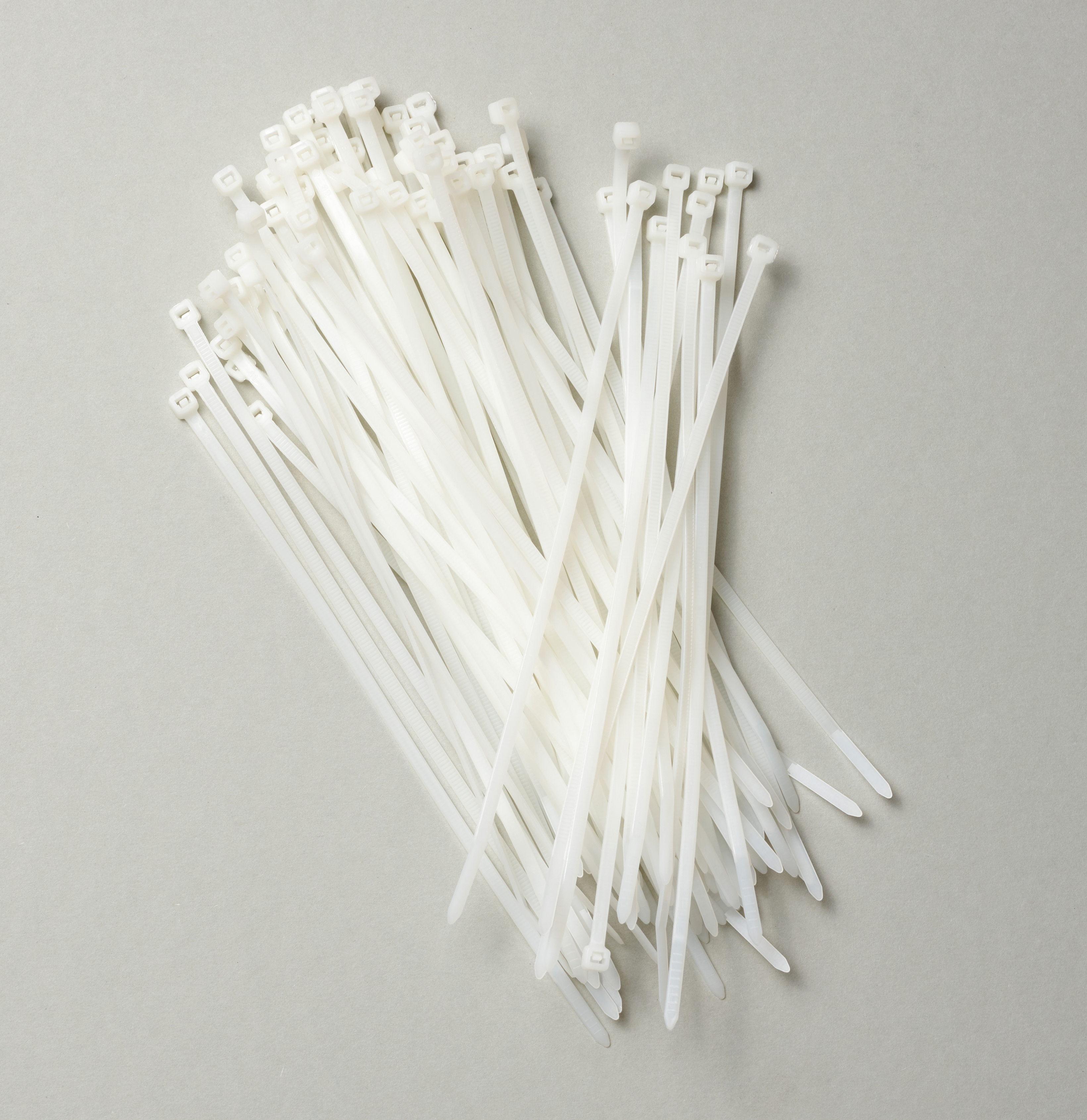
A sound tie is broad enough not to cut into living tissue, visible for future checks, adjustable, and strong enough not to slip when the branch moves naturally. Leave space for diameter growth. Bare wire and narrow cord can create localized pressure, abrasion, or girdling. Even soft material causes injury if it stays tight around a rapidly expanding branch.
Use separate loops for plant and support where practical rather than cinching them together in a single rigid noose. Place ties where you can inspect them after irrigation, wind, or rapid growth. Do not hide a constricting knot inside developing flowers. If an anchor must carry an increasingly heavy branch, move the function from shaping toward independent support rather than making a training tie progressively tighter.
A moving root crown is a stop sign
Release a tie if pulling the branch lifts soil, rotates the root ball, or shifts the stem base. Continuing can damage roots or destabilize the whole plant. Correct the anchorage problem first; if it cannot be corrected without further injury, abandon the intended bend.
Separate shaping ties from late-season supports
During early training, a tie positions a light shoot. During flowering, branches can become much heavier and respond differently to rain and gusts. The original training tie may now concentrate loads at the old attachment point. Add or reposition independent supports before the weight increases rather than waiting for a tear to reveal where support was missing.
For full planning of stakes, cages, trellis load paths, and storm response, use Outdoor Cannabis Branch Support and Storm Preparation. This resource concerns only the stability checks that determine whether a training action is safe and whether its existing ties need to be retired or converted into support.
“My branch moved exactly as planned, but the soil rose on one side of the stem. Is that normal?”
Question sent by: Julia Schneider, via contact form.
No. Soil heaving suggests the pull is reaching the root mass or crown. Release tension, look for damage and instability, and allow the plant to settle before considering a different anchor arrangement. Do not tighten the tie further because the canopy photograph looks good. Root stability has priority over branch position.
Build a Recovery Window Before Flowering

Recovery is not a calendar appointment. It is the interval in which a plant demonstrates that the intervention has stopped causing an ongoing problem and, when appropriate, has begun producing the intended new architecture. A light tie adjustment may need only a posture and anchor check. A cut requires a clean wound assessment and observation of subsequent shoot growth. A deformed stem requires local inspection of the injured section and the tissue it supplies. These different endpoints explain why one universal waiting period is misleading.
Training Recovery Window Before Flowering
Work backward from what the plant is actually doing, not from an assumed month of harvest. Is it still extending vegetative shoots? Are reproductive structures beginning to organize at the tips? Has your cultivar reliably begun flowering earlier than neighboring plants in past seasons? Is an early frost, wet autumn, or severe weather window expected to compress the useful growing period? These observations determine whether a planned change still has a reasonable opportunity to deliver its structural benefit before floral development becomes the dominant management concern.
For a fresh cut or deliberate stem injury, the recovery window must accommodate more than the disappearance of initial droop. The new branching or repaired section must become functional and stable in normal outdoor conditions. If the proposed architecture will not be established before flower-bearing shoots start gaining weight, its benefit is increasingly speculative. When the timeline is uncertain, reduce intervention severity rather than assigning more recovery days by wishful thinking.
Flowering timing varies by genotype and site
Research on cannabis and hemp flowering demonstrates cultivar differences in photoperiod response. Field latitude, seasonal daylight, local light exposure, and day-neutral genetics can change the apparent transition. The presence of solitary preflowers at nodes is not identical to a canopy already assembling terminal inflorescences. Looking only at an advertised flowering week can confuse these stages and create an unnecessarily late training decision.
Track actual top growth and reproductive structures on the same plant. An early-flowering cultivar and a later-flowering cultivar planted on the same day do not have the same opportunity for repeated pruning. A photoperiod-insensitive plant may also proceed toward flowering without waiting for the expected outdoor daylength change. None of these findings establishes an exact, universal number of days that cannabis needs to recover from training.
Separate technical survival from useful recovery
A topped plant may remain green with a closed-looking cut but still show little new branching. A supercropped branch may remain attached and develop a swelling while tissue above it repeatedly wilts under sun or wind. An LST branch may rebound without injury but pull the pot toward its anchor. These are different forms of incomplete success. A useful recovery must be judged against the original purpose, the condition of the affected tissue, and the stability of the whole plant.
If the branch returns to normal leaf posture, continues appropriate growth, and maintains its intended position without damaging its base or ties, you have a stronger practical signal than an arbitrary waiting interval. If flowering has already begun, that signal may justify maintaining the current structure, but it does not automatically justify beginning another demanding intervention.
Use a record to make the window visible
Take a whole-plant photograph from a marked viewpoint before work and record the date, plant identifier, growth stage, method, target branch, visible injury status, root-zone condition, forecast, and reason for intervention. Mark the affected branch without creating a tight ring. Take a close photograph of any wound or bend and a wider view showing the support and anchor. Repeat comparable images after the plant has experienced normal light and weather.
In the record, keep the observations separate from interpretations: “new leaf posture normal,” “tip extended,” “tie leaves a mark,” “root ball stable,” or “surface split widening” are observations. “Fully healed” or “ready for another supercrop” are conclusions that require several pieces of evidence. A simple log helps prevent one good morning from overruling repeated trouble in the afternoon.
“I see the first preflowers. Do I still have two weeks to top the plant?”
Question sent by: MapleGrower, via Facebook page.
Preflowers alone do not date the complete flowering transition, but they also do not establish a guaranteed recovery allowance. Compare the terminal shoots, recent growth, cultivar history, weather, and actual reason for topping. If the existing structure is manageable or the new branches would arrive too late to be useful, stop cutting and maintain support instead.
Important: A photoperiod study reporting a particular flowering response under its tested conditions is evidence of variability, not a universal outdoor cutoff for topping, FIMing, LST, or supercropping.
Separate Recovery Signs From Failure Signs
Do not decide success from one dramatic feature. A knuckle is not proof of unrestricted transport, a straightened tip is not proof that its tie is safe, and one drooping leaf is not definitive evidence of stem failure. Compare the injured area, tissue above it, the entire plant, and the root zone over time.
What a convincing recovery pattern looks like
For an intact tie-down, look for normal leaf posture above the bend, continued shoot extension, a stable branch union, an anchor that has not migrated, and no constriction or rubbing. You may need to loosen or move a tie as the shoot thickens, even when the canopy position remains useful. A healthy tip turning upward can be a normal growth response to altered orientation rather than a sign that the original training was wasted.
After topping or FIMing, check that the cut remains structurally sound, deterioration does not spread, and the plant resumes growth consistent with its current stage. Count developing shoots only after they can be identified. A partially cut apex can respond unpredictably; trying to fix it immediately by cutting again removes the opportunity to evaluate the actual outcome.
After supercropping, focus on the localized deformity and the tissue above it. Stable leaf posture, absence of a widening split, maintained transport under ordinary daytime demand, and continuing appropriate growth are more meaningful than the size of a callus-like swelling. If wind continually reopens the bend, recovery has not been secured even if tissue remains green.
Recognize local failure and whole-plant look-alikes
Sudden droop limited to tissue beyond a bend suggests a local problem; simultaneous droop across unaffected branches points toward a wider water, root, temperature, or environmental issue. Neither pattern alone identifies the precise cause. Check the chronology: did the symptom begin immediately after the intervention, after a hot afternoon, following irrigation, or only after a storm? Inspect the wound or tie and the root zone before making a correction.
Visible cracking, progressive blackening or softening at a wound, increasing collapse, persistent wilt above an injured section, fresh girdling marks, root-ball movement, and branches pulling away from their unions are escalation signs. One symptom may be ambiguous, but progressive loss of structural or physiological function deserves an immediate pause. Do not continue training while attempting to diagnose the same tissue.
Intervene once, then verify instead of repeatedly changing everything
If a tie is cutting into the stem, carefully release or replace it and document the tissue beneath. If the support has slipped, restore a stable load path without adding a stronger pull at the injured location. If drought or root saturation is suspected, check actual root-zone conditions and correct the verified issue rather than changing irrigation simply because the branch droops. For a split limb, stop the manipulation and provide non-constricting support while deciding whether the injured tissue remains viable.
Return to the same marked points and compare new damage, leaf posture, shoot development, and movement of stakes or ties. Old scars may remain. The meaningful test is whether damage stops progressing and the functional tissue remains supported. If symptoms spread, tissue decays, or the issue cannot be separated from disease or root failure, use an appropriate diagnostic pathway rather than treating the episode as a routine training delay.
| Symptom | Possible Cause | How to Confirm | Corrective Action | Prevention |
|---|---|---|---|---|
| Leaves beyond one bend wilt | Localized mechanical injury or interrupted transport; heat stress remains a look-alike. | Inspect bend and tissue above it, then compare with unaffected branches and root moisture. | Stop bending, stabilize the section, and correct only the cause supported by evidence. | Use modest force, support both sides, and recheck the exact bend. |
| Whole plant droops | Drought, saturation, heat, transplant or root stress. | Inspect deeper moisture, drainage, root stability, and timing of daily symptoms. | Correct the measured root-zone or environmental issue; postpone training. | Confirm plant readiness before adding mechanical load. |
| Stem shows an indentation under a tie | Constriction or abrasion from a restraint. | Inspect the attachment and compare tissue above and below the contact point. | Release or relocate the tie without further tearing; reassess support. | Choose broad adjustable contact points and inspect during growth. |
| Root crown rocks when branch is pulled | Lever action, poor root establishment, or unstable anchorage. | Observe crown, medium, pot, and anchor separately during only a minimal movement check. | Release tension and secure the system without forcing the root mass. | Check load path and counter-tie before positioning the branch. |
| Split widens after wind | Insufficient support or excessive loading of injured tissue. | Compare marked photographs and inspect movement at the damaged union. | Stop manipulation and provide independent support; escalate if tissue deteriorates. | Plan weather-exposed support before flower mass increases. |
Know When to Stop Outdoor Training
A stop decision is not an admission that the technique failed. It is often the last and most useful training decision: the canopy is already adequate, the branch can no longer move safely, flowering has begun, or maintenance is now more valuable than reshaping. A grower who keeps escalating after those conditions change can trade a finished structure for fresh damage.
When to Stop Training an Outdoor Plant
Stop initiating optional cuts or deliberately damaging bends when the plant has no convincing remaining period to establish the intended architecture. That condition may arrive before obvious flower clusters on an early cultivar, or later on a plant with substantial vegetative development remaining. The decision depends on actual shoot and floral development, the severity of the proposed action, weather, and whether the result would improve the final structure enough to justify the cost.
Also stop when stems have become too rigid for the intended correction, the root crown or container cannot resist the proposed force, the training creates rubbing or crowding, or existing injuries have not stabilized. If repeated sessions produce only short-lived changes while anchors and tissues become increasingly strained, continuing is not a recovery plan.
Distinguish new training from maintenance and emergency support
Stopping major training does not mean abandoning the plant. Soft ties may still need loosening. A heavy branch may need a new independent support. Crossing flower-bearing limbs may require careful separation, and a damaged union may need stabilization. These are maintenance or safety tasks, not a license to begin another round of topping, FIMing, or intentional stem deformation.
Support work should avoid forcing an established, flower-bearing branch into a radically different shape. The priority becomes preserving the existing load path, access for scouting, airflow through the canopy, and the ability to inspect flowers after weather events. If branches already touch wet ground, fix that hazard without turning the correction into a new experiment in canopy geometry.
Late flowering shifts the decision from shape to preservation
As flowers develop, the useful payoff from reshaping is generally less certain and the consequences of breakage, compression, and moisture entrapment become more serious. Keep existing ties visible, prevent abrasion, and check that supports carry the added load without closing the canopy into a wet bundle. This is particularly relevant in exposed gardens where rainwater and gusts can act together.
A flowering branch whose position is imperfect but stable may be safer than a newly bent branch in a visually perfect arrangement. If a plant already fills its accessible, supported space, accept that geometry. Do not cut or crush simply to follow a training calendar developed for a different cultivar or production system.
Retire training when the objective is met
Maintain visibility, loosen ties, inspect old bends, and add appropriate support as growth and weather change.
Schedule another injury because a week has passed
Calendar spacing cannot demonstrate tissue recovery, safe anchorage, remaining vegetative opportunity, or meaningful benefit.
Do not turn a structural correction into a yield claim
A wider canopy is not automatically a higher-yielding canopy. Training may expose previously shaded shoots, but it can also reduce leaf area, delay growth, weaken branch attachment, or increase the workload required to maintain an open structure. Cannabis research on pruning and architecture establishes that the results depend on treatment and crop conditions; it does not validate a universal percentage benefit from this timing protocol.
Evaluate what you can actually verify: usable canopy distribution, accessibility, stable new growth, manageable branch spacing, and a support system able to carry developing flowers. Yield can be recorded as a longer-term outcome for future comparisons, but it should not be used as an invented justification for a risky last-minute intervention.
The Final Go, Pause, or Stop Field Decision
Use this framework before the first session and again before every proposed adjustment. It prevents yesterday’s healthy response from becoming an automatic authorization for today’s new cut or bend. A brief observation record is more useful than remembering that a plant “usually bounces back.”
Go: all relevant conditions support a modest intervention
Choose Go only when a real structural problem remains, the plant is functioning normally, the target tissue can tolerate the specific action, the root and anchors are stable, the weather is suitable, and the likely remaining development time gives the result a practical purpose. Make the least invasive change that solves the problem. Record the baseline and identify exactly what improvement would demonstrate success.
Pause: something needs correction or confirmation
Choose Pause for ambiguous droop, uncertain root moisture, recent transplanting, an unexplained wound, a tie that has started constricting tissue, a shifting root ball, or questionable weather. Resolve or stabilize the actual problem. Reinspect before deciding whether the original intervention still makes sense; do not automatically resume it when the calendar says the pause is over.
Stop: further training adds risk without meaningful benefit
Choose Stop when the objective is already achieved, safe flexibility is gone, injury is progressing, support cannot be made reliable, flowering is consuming the remaining opportunity, or the proposed shape cannot be maintained through likely outdoor conditions. Shift to inspection, non-constricting support, and care of the existing structure. If a branch deteriorates or a suspected disease is involved, follow the relevant diagnosis process instead of repeating training.
Before and After Every Outdoor Training Decision
- State the specific height, spacing, access, or support problem that still needs solving.
- Compare the plant’s new growth and leaf posture with its own normal pattern.
- Check deeper root-zone moisture, transplant stability, and the crown before pulling.
- Inspect the exact target section and union for stiffness, scars, cracks, and rubbing.
- Confirm a stable anchor and counterforce without root-ball movement or pot tipping.
- Assess actual floral development and whether meaningful recovery opportunity remains.
- Choose Go, Pause, or Stop and document the reason before making the change.
- Photograph the plant, affected area, and anchor from repeatable positions.
- Recheck normal posture, new injury, tie pressure, support movement, and shoot response.
- Repeat training only if recovery is evidenced and a genuine objective remains.
The reliable endpoint is not a perfectly flat plant or a fixed number of trained branches. It is an outdoor canopy that remains functional as the season changes: stable roots, healthy tissue, accessible growth, secure supports, and no unexamined damage accumulating from repeated intervention.
Share this article
A quick overview of the topics covered in this article.
- Training Timing Is a Capacity Decision
- Read the Plant Before Training
- Check Stem Flexibility Without Turning It Into Damage
- Counter-Ties, Anchors, and Root-Ball Stability
- Build a Recovery Window Before Flowering
- Separate Recovery Signs From Failure Signs
- Know When to Stop Outdoor Training
- The Final Go, Pause, or Stop Field Decision
Follow us
Latest articles
September 26, 2026
September 26, 2026

September 26, 2026
September 26, 2026