
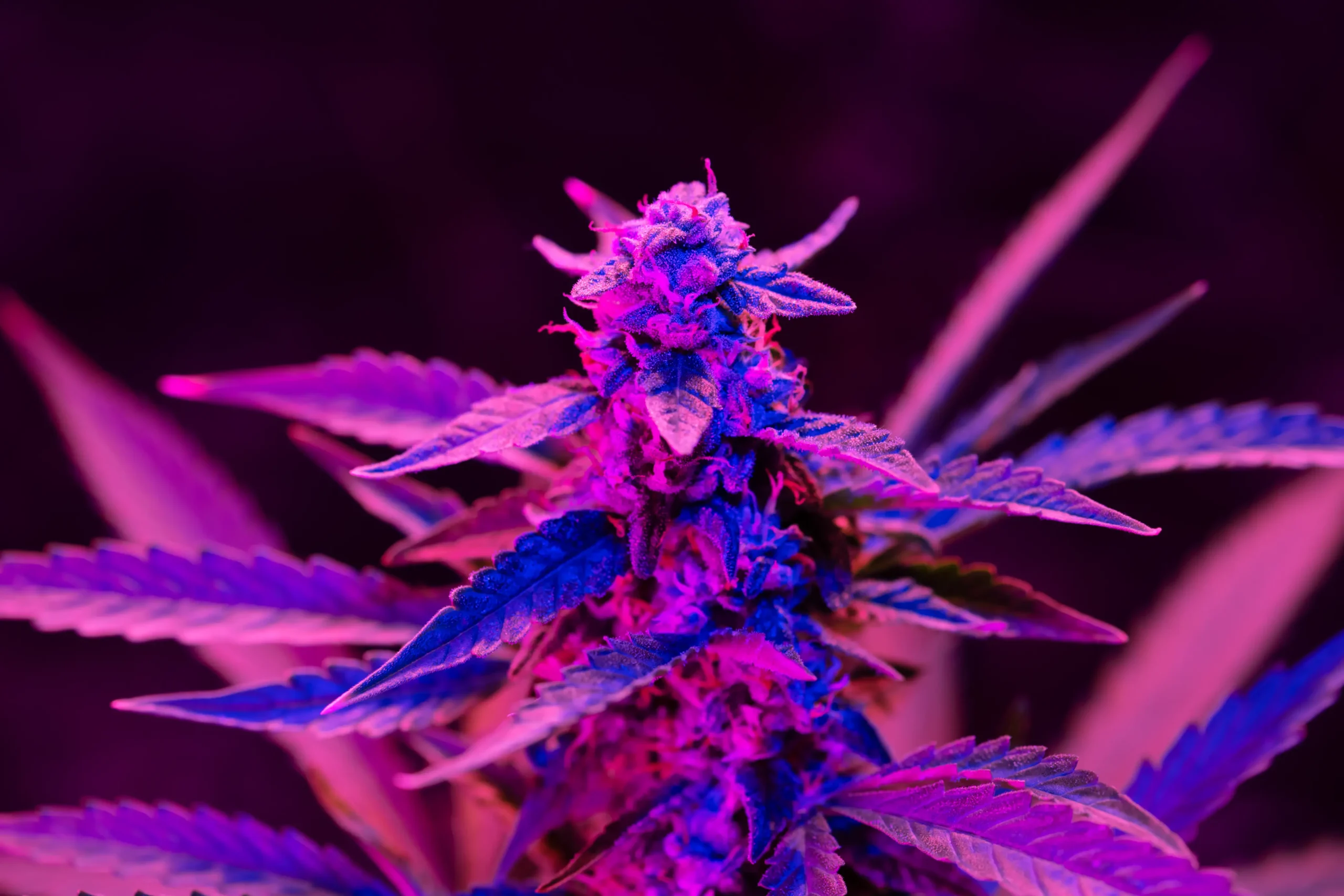
Alien OG
Alien OG is a compact-looking OG hybrid that can grow more aggressively than its finished flowers suggest. The lineage is most consistently described as Tahoe OG crossed with Alien Kush, and the plant combines OG lemon-pine resin with a stronger transition stretch and a more balanced cerebral-to-body effect than a purely sedating Kush.
Flowering is commonly reported around eight to nine weeks, with many examples finishing in roughly sixty to sixty-five days. The challenge is not duration. It is the sequence of events inside that relatively short cycle: fast early stretch, dense resinous flower, substantial late weight, and a canopy that can become humid quickly if every branch is allowed to rise through the center.
The central cultivation question is: how can a grower use Alien OG’s strong early stretch to build yield while keeping its dense spear-like flowers separated, supported, and lemon-forward through a fast finish? The best strategy is early branch selection, an open trellis, conservative late handling, and environmental control that protects dense buds without blasting them dry.
The plant is often described as difficult, but that label can be misunderstood. Alien OG does not necessarily require exotic technique. It requires timing. Training that would be easy in week two becomes messy in week six because the flowers are dense and resin-coated. The grower who organizes the structure early usually has a much simpler finish.
Flavor is classic OG but sharper: lemon peel, pine, earth, skunk, pepper, and mild gas. Potency can be very high in modern batches, which makes the clear cerebral opening deceptive. Alien OG often feels mentally bright first and physically heavy later.
Strain Features
| Feature | Details |
|---|---|
| Strain Type | Potent OG-family hybrid |
| Genetic Profile | Tahoe OG x Alien Kush |
| THC | Commonly strong to very strong, with substantial batch variation |
| CBD | Usually low |
| Dominant Terpenes | Limonene, beta-caryophyllene, myrcene and pinene commonly appear |
| Flavor / Aroma | Lemon peel, pine, earth, skunk, pepper, mild fuel |
| Effect Character | Euphoric, focused, relaxed, tingly, physically heavy at higher doses |
| Flowering Time | Usually about 8 to 9 weeks, often around 60 to 65 days |
| Stretch | Moderate to strong in early flower |
| Plant Architecture | Medium height with vigorous OG branching and a bushier finish after topping |
| Bud Structure | Dense, resinous, spear-like to chunky flowers |
| Yield | Moderate to high under controlled conditions |
| Training Compatibility | Topping, LST, trellis, SOG with uniform plants, open SCROG |
| Humidity Risk | Moderate to high because flowers finish dense |
| Support Need | Often benefits from trellis or soft branch support |
| Grow Difficulty | Moderate to advanced |
| Best Time of Use | Late afternoon to nighttime |
Genetic Lineage
Alien OG combines Tahoe OG with Alien Kush, connecting two resin-heavy lines with different structural tendencies. The Tahoe side contributes lemon-pine earth, OG stretch, and a strong body component.
Alien Kush adds additional resin, hybrid vigor, and a broader cerebral opening. The resulting plant often feels more balanced in effect than the dense flowers and OG name suggest.
Modern descriptions vary in exact flowering speed and yield. Some phenotypes finish very quickly, while others need closer to nine weeks. The line should therefore be treated as an eight-to-nine-week population rather than one fixed day count.
The most useful inherited trait for the grower is the combination of early vertical movement with later dense bud formation. This is why Alien OG can outgrow its space and then become humidity-sensitive within the same cycle.
A strong keeper should preserve sharp lemon-pine aroma and heavy resin while keeping branch angles open enough that the dense flower remains inspectable.
Effect Breakdown
Alien OG usually starts in the head. Euphoria, focus, sensory sharpness, and a feeling of mental lift can arrive before the body effect is obvious.
At a moderate dose, the strain can feel surprisingly functional for its potency. Conversation and creative attention may remain comfortable while physical tension begins to soften.
The body phase builds steadily rather than appearing all at once. Muscles feel heavier, movement becomes less urgent, and tingling can become more noticeable.
At higher doses, the cerebral clarity becomes less useful. The combination of very strong THC and rising body weight can create a powerful, disorienting session for inexperienced users.
Dry mouth and dry eyes are common. Dizziness or anxiety can occur when potency is underestimated.
The full arc works best from late afternoon into evening. Lower doses can feel balanced, but large doses move the strain firmly toward physical relaxation.
Flavor & Aroma Profile
Alien OG smells sharper than many dessert hybrids. Lemon peel, pine resin, earth, pepper, skunk, and light fuel create the core profile.
Breaking the flower usually increases the resin and gas while reducing the impression of clean citrus.
On inhale, lemon and pine tend to lead. The middle becomes earthy and peppery. The exhale can finish skunky, resinous, and slightly bitter.
The dense buds can preserve a strong room odor even after the lighter citrus has been damaged. Loud smell alone is therefore a poor measure of terpene quality.
Late canopy heat often shows first in the top notes. If the hottest flowers smell flatter and earthier than cooler side buds, environment may be reducing flavor before the plant looks visibly burned.
A careful cure should soften skunk and pepper while keeping lemon present. Excellent Alien OG should not taste like generic gas simply because it is potent.
The lemon can range from fresh peel to a sharper chemical-citrus impression. Pine and earth are usually more stable across phenotypes than the exact style of citrus.
Some plants carry stronger skunk or sour gas, especially when broken apart. The best profile still retains enough bright lemon that the dark base does not dominate completely.
A clean cure tends to make the pepper and earth smoother while leaving resinous pine in the aftertaste.
Dominant Terpenes
| Terpene | Aroma Role | Cultivar Relevance | Scientific Caution |
|---|---|---|---|
| Limonene | Lemon peel, citrus rind | Central to the bright OG top note | Does not guarantee energy |
| Beta-caryophyllene | Pepper, spice, wood | Supports the spicy resinous finish | CB2 activity does not prove strain-specific therapeutic benefit |
| Myrcene | Earth, herbs, musk | Rounds the heavy earthy base | Does not independently cause couch-lock |
| Pinene | Pine resin, fresh herbs | Fits the strong pine character found in many batches | Does not guarantee focus |
Alien OG’s lemon-pine-skunk identity comes from a broader volatile mixture than the four terpenes listed above. Fuel and sulfurous notes can be important even when they are not represented as dominant terpenes.
The effect progression should be kept separate from simplistic terpene explanations. Potency, dose, tolerance, and the complete chemotype are more useful predictors of intensity.
Indoor vs. Outdoor Growing
| Decision Point | Indoor | Outdoor |
|---|---|---|
| Primary Challenge | Using early stretch without allowing dense late flowers to merge into a humid OG canopy | Supporting dense flowers while protecting them from wet weather |
| Stretch | Moderate to strong and easiest to redirect during the first weeks | Height is less restrictive outdoors |
| Training | Topping, LST, trellis, open SCROG; uniform plants can suit SOG | Early topping plus perimeter support |
| Flower Duration | Usually 8 to 9 weeks | Relatively practical if autumn stays dry |
| Bud Density | Dense resinous flowers require separation | Rain and dew can become trapped internally |
| Feeding | Can use substantial nutrition under strong growth, but demand should be proven rather than assumed | Large roots support yield without requiring automatic high concentration |
| Support | Often useful before final swell | Stakes or cage support help in wind |
| Best Fit | Growers who can organize structure early and monitor late humidity | Warm, dry finishing climates |
Alien OG is naturally suited to indoor cultivation because the flowering window is relatively compact. The grower can shape the transition quickly and spend the second half of the cycle protecting dense flower.
The main indoor limitation is physical crowding. A plant that looks manageable after topping can still move strongly after the flip, and those branches later carry flowers dense enough to create their own microclimate.
Outdoors, the plant can produce heavier branch systems with less height pressure. The tradeoff is weather exposure around resinous flowers.
A greenhouse helps only when ventilation remains strong. Rain exclusion without air exchange can increase rather than reduce the humidity problem.
Strain-Specific Grow Guidance
Top Before the OG Stretch Becomes Vertical Crowding
An early topping creates several leaders and gives the grower a chance to move branch angles outward before flowering.
Do not wait until the plant is already stretching under a short-day schedule. The best structural work is completed while stems are still easy to guide.
Leave Transition Space in the Trellis
A screen that looks slightly underfilled at the flip can become correctly occupied after the first weeks.
A full vegetative screen usually produces too many overlapping leaders once Alien OG stretches.
Use the Stretch to Build Width, Not Extra Height
Redirect the fastest leaders sideways while they remain flexible.
The goal is a medium-height plant with several separated flower lanes, not a tall central funnel of OG branches.
Prune Interior Shoots After the Stretch Settles
Wait until the final light map is visible, then remove weak inward shoots that will never receive direct or strong side light.
Keep productive outer laterals even if they began low, because they can rise into useful positions during transition.
Feed From Root Demand, Not the Cultivar’s Reputation
Some grow descriptions call Alien OG a heavy feeder. That should be interpreted as possible appetite under vigorous growth, not permission for constant high concentration.
If foliage becomes overly dark, tips burn, or dryback slows, reduce the pressure rather than assuming the plant must tolerate more.
Watch Water Demand Change After Vertical Growth Stops
A plant can drink rapidly during stretch and then slow as flower becomes the main sink.
Continue irrigation from actual dryback so the root zone does not stay wetter in late flower than it did during transition.
Create Air Gaps Before the Buds Become Dense
Dense flowers should never depend on high fan speed alone for protection.
Branch separation is the first humidity control. Air movement then supports the physical space already built into the canopy.
Use Support Before Resin Makes Handling Expensive
A loose trellis or soft ties should be installed before the colas become fully sticky.
Late movement through tight netting can scrape trichomes and press neighboring buds together.
Do not let a fast finish hide internal flower risk
Alien OG can look healthy and heavily frosted while moisture is already lingering where a sugar leaf enters a dense spear. Inspect contact points by gently opening the flower with clean hands rather than judging safety from room RH or surface appearance alone. A single leaf that dies suddenly inside an otherwise healthy top, localized softness, grey-brown tissue or a change from sharp lemon-pine to a damp, muted smell deserves immediate inspection.
Do not answer this risk with direct fan blast. The better correction is separated branches, moving room air, controlled late-flower humidity and enough access to inspect the flower without crushing resin heads.
Protect the Highest Flowers From Local Heat
The upper canopy can lose lemon clarity before room-average temperature looks alarming.
Compare top and mid-canopy aroma. If the top becomes flatter or more earthy while cooler flower remains citrusy, reduce local stress.
Harvest From Complete Resin and Calyx Maturity
Roughly sixty to sixty-five days is common, but some phenotypes finish slightly earlier or later.
Wait for dense calyx completion, mature flower trichomes, reduced new pistils, and a full lemon-pine-earth profile. Potency alone is not a harvest signal.
Use Branch Angle to Avoid a Dense OG Funnel
Several upright OG leaders can converge toward the center even when the plant is not exceptionally tall.
Tie the primary branches outward during vegetative growth so the mature canopy keeps a visible center rather than forming a narrow funnel of dense buds.
Do Not Confuse Rapid Flowering With a License to Rush Veg
Alien OG can finish relatively quickly, but the branches still need enough vegetative thickness to support the later flower weight.
A weak thin leader created immediately before the flip may produce a good bud yet still become a mechanical problem near harvest.
Use Local Flower Temperature, Not Room Average Alone
Dense dark-green leaves and resinous tops can create warmer microclimates near the highest colas.
The room sensor can look acceptable while one top loses lemon or begins bleaching. Compare canopy zones and correct the local problem.
Do Not Add Supplements Because of OG Folklore
Spotting, yellowing, or weak growth should be diagnosed from roots, pH, irrigation, and actual nutrient balance rather than from assumptions about what OG plants supposedly always need.
The cultivar is easier to read when environmental causes are eliminated before another bottle is added.
Plan Harvest Breakdown by Bud Density
Top colas and smaller side flowers may not dry at the same rate.
If the largest branches remain wet internally, divide the harvest into similar-density groups rather than forcing every branch through one post-harvest timeline.
Weedth Bud Flavor Tips
Alien OG’s lemon is easier to lose than earth, pepper, and skunk. Late heat and hot drying can leave the flower loud but less distinctive.
Dense flowers should dry evenly from surface to center. Separate unusually thick branches if their moisture behavior differs from smaller side buds.
Avoid direct fan air. A dry outer shell around a wetter core is poor for both flavor and safety.
During cure, sharp skunk should become smoother while lemon and pine remain clear.
Keep phenotypes separate if one is brighter citrus and another is darker gas. Storage stability is part of keeper selection.
Do not repeatedly squeeze cured flowers to judge stickiness. Handling transfers trichomes and aroma away from the bud.
Cool airtight storage preserves the bright OG top layer better than frequent warm-air exposure.
A jar that smells lemony immediately after drying should be checked again a month later. The better keeper is the plant whose citrus survives storage, not the one with the loudest fresh flower.
If top-canopy flower loses lemon but side buds retain it, reduce late heat on the next run before changing the genetics.
Very dense Alien OG should not be sealed simply because the outside feels dry. Internal moisture must equalize before long-term storage.
Avoid repeated late handling. Resin-covered OG flowers lose both trichomes and volatile aroma every time they are squeezed, moved, or pushed through netting.
Alien OG should also be evaluated for smoothness after cure. Dense resin can make a rushed batch feel harsher than its aroma suggests, while an even dry allows lemon and pine to remain clear through the exhale.
If the cured flower becomes only peppery and skunky, compare the late canopy temperature and drying speed before concluding that the phenotype lacks citrus.
Weedth Bud Boost Tips
Alien OG already has the genetics for dense flower. The grower’s job is to distribute that density safely through the canopy.
One early topping plus controlled LST is usually more useful than repeated high-stress training.
Remove weak interior sites after stretch so the plant spends the short flowering window on flowers that can mature fully.
Support timing is a yield tool. A branch that leans away from the light in week seven loses quality even if it never breaks.
Wider spacing can increase premium dry yield by reducing contact and improving side-light exposure.
Do not chase density with excessive bloom inputs. General cannabis nutrition research shows that more potassium does not automatically increase flower yield.
The Alien OG target is mature lemon-pine resin on separated supported colas, not maximum late canopy congestion.
A clone with slightly less stretch can outperform a taller sister indoors if it produces the same resin and lemon without requiring extra canopy correction.
Use dry premium yield after trimming and any humidity losses, not wet branch mass, when comparing phenotypes.
If the densest plant repeatedly needs extreme airflow or branch separation to remain safe, a slightly more open keeper can be the better production choice.
The best second-run improvement is usually timing: earlier branch placement, earlier support, and fewer late corrections.
If one branch repeatedly produces excellent flower while the interior below it stays weak, preserve that branch lane and reduce the lower clutter on the next clone run.
A clean canopy can often improve both flavor and yield because fewer flowers spend the last weeks shaded or pressed against neighboring buds.
Medical Uses & Benefits
Alien OG is commonly chosen by users seeking stress relief, physical relaxation, mood elevation and pain distraction. These are user-reported patterns rather than clinical evidence, and the cultivar name cannot predict how a particular batch or person will respond.
Why the effect sequence matters
The bright mental opening may appeal to people who want euphoria before the body effect becomes stronger. That sequence is important: a modest amount may leave a useful interval for music, conversation or a quiet evening task, while a larger amount can shorten that interval and move quickly toward body weight and reduced coordination. Users seeking a purely clear daytime effect may therefore find Alien OG less predictable than its energetic first minutes suggest.
For physical discomfort, the attraction is usually not numbness alone. Users often describe a change in how urgently discomfort occupies attention as the body phase builds. That distinction matters because subjective relief is not the same as treating the cause of pain, inflammation, insomnia or anxiety.
Potency, tolerance and cautious use
High potency can make the strain difficult for low-tolerance users and may increase anxiety, dizziness or an uncomfortable sense of mental acceleration. Dry mouth and dry eyes are common, and impairment can outlast the most obvious euphoric phase. Most Alien OG flower is THC-dominant with little CBD and should not be treated as a low-intoxication medical option.
Batch-specific cannabinoid testing, a small starting amount and enough time before taking more are more useful than relying on the strain name. People prone to panic, cardiovascular symptoms or strong THC sensitivity should be especially cautious. Cannabis should not be combined casually with alcohol, sedatives or other substances that increase impairment.
Anyone using cannabis alongside prescription medication, during pregnancy or breastfeeding, or for a diagnosed condition should consult a qualified healthcare professional. Do not drive, operate equipment or make safety-critical decisions while impaired.
Ideal User Profile
Who is likely to enjoy the finished flower?
Alien OG suits users who enjoy strong lemon-pine OG flavor but want more cerebral lift than a purely sedating Kush. It fits late-afternoon creative activity, music, films, food and evening relaxation, particularly when the user appreciates an effect that changes character instead of remaining purely stimulating or purely heavy.
It is less suitable for someone seeking mild flower, a CBD-led experience or a dependable morning strain. Potent batches can make the first euphoric rise feel deceptively manageable before the body weight arrives. New users and people who dislike strong THC should approach the name as a warning about possible intensity, not as a promise of smooth balance.
Which grower is a good match?
For growers, Alien OG suits people comfortable with topping, trellising and humidity management around dense flower. The best match is an attentive intermediate grower who can read transition stretch, reserve open spaces in a screen and install support before resinous tops become awkward to move.
It is less suitable for very crowded rooms, humid finishing environments or growers who want to perform major training late in flower. The cultivar does not demand constant intervention, but it does demand that the important interventions happen early. A repeat clone run can become highly efficient because the flowering window is relatively short once stretch is understood and the correct flip height has been recorded.
A flavor-focused grower is also a better match than someone chasing only maximum EC or raw weight. Alien OG will usually make resin without extraordinary persuasion. The more interesting achievement is a crop in which the highest flowers retain lemon and pine, the center remains inspectable and every supported branch dries at a similar rate.
Grower Notes and Feedback
The most consistent grow information places Alien OG near a sixty-to-sixty-five-day finish, with some faster phenotypes.
Topping commonly improves bushiness and helps redirect OG vertical growth into multiple leaders.
Dense flowers make humidity control a recurring concern and explain why an otherwise fast plant can still be considered demanding.
Modern examples show some genetic and phenotype variation, so exact stretch and yield should be recorded instead of assumed.
Lemon, pine, earth, skunk, and strong resin are the most stable identity markers.
A second run should record flip size, final width, support week, dryback change after stretch, and whether top-canopy lemon survives the final weeks.
Alien OG’s short flowering window can create false confidence. The plant is fast, but the flowers become dense enough that the final weeks still require careful humidity management.
Growers commonly value topping because it improves width and yield, yet the real benefit is often access: several separated leaders are easier to inspect than one crowded OG center.
Potency is usually not the difficult trait to achieve. The harder work is preserving clean citrus, airflow, and even maturity across the canopy.
Another recurring OG-family lesson is that a compact final plant can still create a deep root demand during stretch. The container should support strong early water use without forcing the grower into constant rescue irrigation.
Alien OG can also appear finished early because the resin becomes visually impressive before the calyxes are fully mature. Frost should be treated as a quality trait, not a harvest clock.
A clone that finishes a few days later may still be worth keeping when those extra days clearly improve lemon intensity, calyx density, or branch stability. The shortest flowering time is not automatically the best production trait.
Alien OG is most efficient when late flower becomes maintenance rather than rescue. If the grower is still bending branches, adding emergency support, or opening a packed center near harvest, the next cycle should solve those problems earlier.
Compare premium yield, not only total weight
When two Alien OG phenotypes finish together, compare the weight and quality of trimmed top and middle flowers separately from small interior material. A taller plant may win gross weight yet lose time through extra tying, slower trimming and uneven drying. A slightly more open plant can be the stronger production keeper when a larger percentage of its harvest carries full lemon-pine aroma and finishes without questionable contact points.
The same comparison should continue after cure. Record whether each jar keeps its citrus top note, whether the smoke remains smooth and whether the effect preserves the intended cerebral-to-body progression. This prevents visual frost or one unusually heavy branch from deciding selection on its own.
Weedth Experience
What this cultivar asks from the room
Alien OG is not a plant I would leave structurally undecided after the flip. Its short flowering window creates a particular kind of pressure: the plant moves quickly enough to feel convenient, but not slowly enough to forgive a crowded first month. I would want the main branches chosen, their lanes visible and the support already waiting before the flowers become too resinous to handle comfortably.
The transition would be the most active part of my run. I would tuck or tie the stretch into an open screen, but I would resist the temptation to fill every square. Alien OG does not need a woven green wall to look productive. It needs several distinct leaders with air around the future spears. A little empty screen at the end of week one feels wasteful only until late flower shows what those gaps prevented.
After the architecture is set, I would deliberately make the room boring: stable irrigation, moving air, minimal handling and careful maturity checks. The plant already supplies visual excitement through resin. My job would be to prevent that frost from distracting me from the slower questions of calyx expansion, internal humidity and aroma maturity.
Using aroma as an environmental instrument
I would smell the top and side buds separately. Alien OG makes that comparison unusually revealing. If the highest flowers begin losing lemon while cooler side flowers still smell like fresh peel and pine resin, the environment is telling me more than the nutrient label ever will. The top may be too warm even when the leaf surface shows no dramatic bleaching.
The plant’s potency is comparatively easy to preserve because resin is naturally abundant. The more difficult job is preserving refinement inside that potency. A sticky flower that dries into generic earth and gas is still strong, but it is not the Alien OG result I would be proud of. I want the first jar opening to deliver citrus brightness before pepper, skunk and the darker resin notes gather underneath.
For that reason, I would not choose a keeper from harvest-day appearance. The keeper for me would combine manageable stretch, strong branch structure and a lemon-pine profile that survives a full cure. I would consider branch angle one of the first selection traits because a plant that naturally opens outward makes irrigation access, inspection, support and drying more consistent.
What I would accept and what I would reject
If I found a slightly less potent phenotype with clearly better lemon and structure, I would not dismiss it automatically. Alien OG is already strong enough that usability and flower quality matter more than winning a potency argument. I would also accept a few extra flowering days if those days produced denser calyxes, stronger lemon or a branch system that stayed upright without emergency ties.
I would reject a plant that repeatedly hides damp contact points inside an excessively leafy center, even if its gross weight is impressive. I would also reject a cut whose aroma collapses after drying. Those problems can sometimes be improved culturally, but a selection that requires extreme airflow or constant canopy repair is not necessarily the best long-term room partner.
The grow should become calmer as harvest approaches. If I am still bending branches, opening a packed center or adding emergency support in the final two weeks, I would rewrite the training plan before the next run. Late flower should feel like observation and protection, not construction.
The jar I would use as the benchmark
I would keep the first successful harvest as a reference for lemon intensity. Future runs should at least match that cured jar before I call a heavier cycle an improvement. I would record the day the lemon aroma becomes fully recognizable on the plant, then compare it with the aroma after ten days of drying and again after several weeks in storage.
The benchmark jar would open bright, almost sharp, then settle into pine, pepper, earth and mild fuel. The smoke or vapor would have weight without immediately erasing the first cerebral rise. Most importantly, it would smell like the structure promised: an OG-family plant that was allowed to stretch, organized before it hardened and finished without hot tops or damp interiors.
That is what makes Alien OG satisfying to me. It does not reward frantic technique. It rewards early decisions that let the final weeks become quiet. When the branch lanes are clear and the lemon survives cure, the plant feels both powerful and precise rather than merely strong.
Weedth Score
Growing Experience 7.8/10 Fast and productive, but early timing, dense-bud humidity, and support require discipline.
Bud Structure & Visual Appeal 9.0/10 Dense glassy resin and chunky OG flowers create strong visual quality.
Aroma Complexity 8.8/10 Lemon, pine, earth, pepper, skunk, and gas form a classic but layered OG profile.
Flavor & Smoothness 8.7/10 Excellent when the citrus survives heat and the dense flowers dry evenly.
Effects & High Experience 9.1/10 Strong cerebral lift plus deep body relaxation gives a powerful balanced arc.
Overall Satisfaction & Recommendation 8.7/10 A high-quality OG hybrid for growers who organize the canopy early.
Personal closer: I would keep the Alien OG that makes its potency easy to manage horticulturally, with open branches and lemon that stays bright after cure.
FAQ
What is Alien OG’s lineage?
The most consistently documented lineage is Tahoe OG crossed with Alien Kush.
Question sent by: Daniel R., via email.
How long does Alien OG flower?
Around eight to nine weeks is common, with many examples finishing in roughly sixty to sixty-five days.
How much does Alien OG stretch?
Moderate-to-strong early stretch is common and should be redirected before the canopy becomes crowded.
Does Alien OG respond well to topping?
Yes. Early topping is useful for turning OG-style vertical growth into several manageable leaders.
Is Alien OG good for SCROG?
Yes, especially a loose screen with reserve for transition stretch.
Is Alien OG suitable for SOG?
Uniform plants can work in SOG when each plant stays simple and enough space remains around dense tops.
Is Alien OG a heavy feeder?
Some plants can use substantial nutrition, but input should still follow water use, root health, and leaf condition.
Why are my Alien OG buds so dense?
Dense resinous flower is a cultivar strength, but it increases the need for branch separation and late humidity control.
Does Alien OG need support?
Often yes. A trellis or soft ties can keep late branches in their light lanes.
Why is my Alien OG losing lemon aroma?
Late heat, fast drying, or repeated warm-air exposure can remove citrus while earth and skunk remain.
Is Alien OG prone to mold?
Dense flowers can hold internal humidity when branches touch or room moisture remains high.
When should Alien OG be harvested?
Use complete calyx density, mature flower trichomes, reduced fresh pistils, and a full lemon-pine-earth aroma.
Can Alien OG grow outdoors?
Yes in warm climates with a relatively dry finishing period.
Is Alien OG beginner-friendly?
A careful beginner can succeed, but early training and late humidity management reward experience.
Is Alien OG a daytime strain?
Lower doses can feel focused and euphoric, but stronger doses usually become physically heavy.
Similar Strains
Tahoe OG: A close parent comparison with classic lemon-pine OG flavor and a somewhat more straightforward family structure.
Fire OG: Another dense lemon-forward OG with strong support and humidity needs.
Skywalker OG: A bushier OG hybrid with sweeter background flavor and similarly heavy late effects.
Death Star: A compact fuel-heavy alternative with more skunk and less bright citrus.
MAC 1: A resin-heavy hybrid with strong potency but a creamier floral profile and different canopy behavior.
OG Kush: The broader family reference with similar earth-pine-citrus but greater variation across cuts.
Share this article
A quick overview of the topics covered in this article.
Follow us
Latest articles
September 27, 2026
September 27, 2026
September 27, 2026
September 27, 2026