Does Training Increase Yield? What It Actually Changes
Training can increase cannabis flower yield under some conditions, but it does not create a predictable percentage gain and is not automatically better than leaving a healthy plant alone. A cut, bend, or tie first changes where shoots grow, how leaves intercept light, and how the plant distributes its limited resources. Whether that change becomes additional usable flower depends on the cultivar, the available growing season, the root zone, the original canopy, and what happens after the intervention.
There is a practical difference between seeing more flower-bearing tips and harvesting more dry, usable flower. A plant may exchange one dominant top for several smaller ones without increasing its total flower mass. Another plant may gain productive, well-lit branches but lose enough recovery time or leaf area to cancel the benefit. Outdoors, weather damage, disease losses, spacing, and support also affect what reaches the harvest scale.
The useful question is therefore not simply whether training works. It is what problem the training solved, what outcome changed, and whether that outcome was measured against an appropriate comparison. This resource explains those distinctions and gives you a repeatable way to decide whether a particular training strategy is earning its place in your outdoor garden. Cultivate only where the crop and your practices are lawful.
Define the Yield You Are Trying to Increase
The word yield appears straightforward until two growers compare results. One weighs whole wet branches, another weighs dried flowers with their stems removed, and a third reports a single spectacular cola. These measurements answer different questions. Before you decide whether training improved production, choose the outcome that matters to you and record how it will be measured.
Dry, usable flower is different from fresh harvest weight
Freshly cut flowers contain substantial water. A heavier wet harvest might simply have retained more moisture or included more stems and leaves. Record usable flower weight only after comparable drying and trimming, with the same treatment of small flowers and the same moisture endpoint. Avoid treating a particular drying duration or final moisture percentage as a universal instruction for every flower and climate. The comparison requires consistency and safe postharvest handling, not a convenient number on a calendar.
If a lot contains visibly moldy or otherwise unsafe material, separate and reject it. Do not include contaminated flowers as marketable or usable yield, and do not try to convert them into acceptable material through trimming, washing, drying, or curing. Record the loss separately so it remains visible in the performance assessment.
Per-plant yield and per-area yield can point in different directions
A wide, heavily trained plant may produce more flower than a smaller untrained plant, but it may also occupy the space that could hold another plant where local rules permit. The first question is dry flower weight per plant. The second is dry flower weight per unit of actual allocated growing area. Neither substitutes for the other. Define the plot footprint consistently, including the space required for safe access and support, before making a per-area comparison.
In research on plant density and architecture, increasing density reduced yield per plant while increasing inflorescence yield per area in most tested architecture treatments. That finding does not determine an ideal density for your outdoor garden. It demonstrates why choosing the wrong denominator can reverse an apparent winner.
Count productive flower sites, not just visible tops
Training often produces a photogenic canopy with many distinct tips. A tip count is an architectural observation, not a harvest weight. Some newly exposed sites may mature into useful flowers; others may remain small, shaded, damaged, or too late to finish properly. Record the number of sites only alongside flower mass and, if helpful, their position and condition.
Harvestable yield
The dry flower mass that meets the grower’s defined usability and safety criteria after comparable harvesting, drying, trimming, and rejection of unsuitable material. It is not identical to wet crop mass or total aboveground biomass.
Production, quality, and cannabinoid output are separate measurements
A training change may increase dry flower weight without raising cannabinoid concentration. Another treatment may raise concentration in a particular sampled location while lowering total flower biomass. Where lawful and relevant, laboratory-measured cannabinoid output combines the amount of analyte per mass with the total appropriately characterized flower mass. A label claim or a single top-flower sample is not a validated whole-crop estimate.
Aroma, terpene preservation, flower appearance, labor required, accessibility, and batch uniformity are also useful outcomes, but they need their own observations or testing. More yield, more potency, and better flavor are not interchangeable claims.
“I have twice as many colas after topping. Did I double my yield?”
Question sent by: Ethan Brooks, via email.
No. You have demonstrated a change in the number or distribution of flowering sites. Compare the total dry, usable flower from the entire trained plant with a suitable untrained comparison. Several smaller colas may replace one large one, and flower size, losses, or recovery can change the final total.
Choose a primary outcome before looking at the plant
If your aim is more usable flower per plant, write that down. If limited garden space is the constraint, use yield per allocated area as the primary outcome. If the main problem is breakage or inaccessible flowers, decide whether your priority is reduced loss or improved inspection access. These aims can coexist, but one should lead the decision. Otherwise it becomes easy to switch to whichever number flatters a treatment after harvest.
| Measurement | What it establishes and what it cannot establish |
|---|---|
| Number of tops | Shows a change in architecture. Does not prove more dry flower or cannabinoid output. |
| Dry usable flower per plant | Answers a per-plant production question when drying, trimming, and rejection rules match. Does not account for land or labor. |
| Dry usable flower per allocated area | Answers a footprint-based question when spacing and measured area are consistent. Does not show whether each individual plant benefited. |
| Whole-plant or fresh biomass | Useful for a biomass research question. Does not automatically measure dried smokable flower. |
| Cannabinoid concentration | Characterizes a representative, properly tested sample. Does not alone establish total cannabinoid mass per plant. |
| Usable fraction and losses | Shows whether potential crop became usable crop. Needs clear and consistent rejection categories. |
| Labor and damage | Reveals time, repairs, and losses that a flower-weight number misses. Not a substitute for weighing flowers. |
What Training Actually Changes in a Cannabis Plant
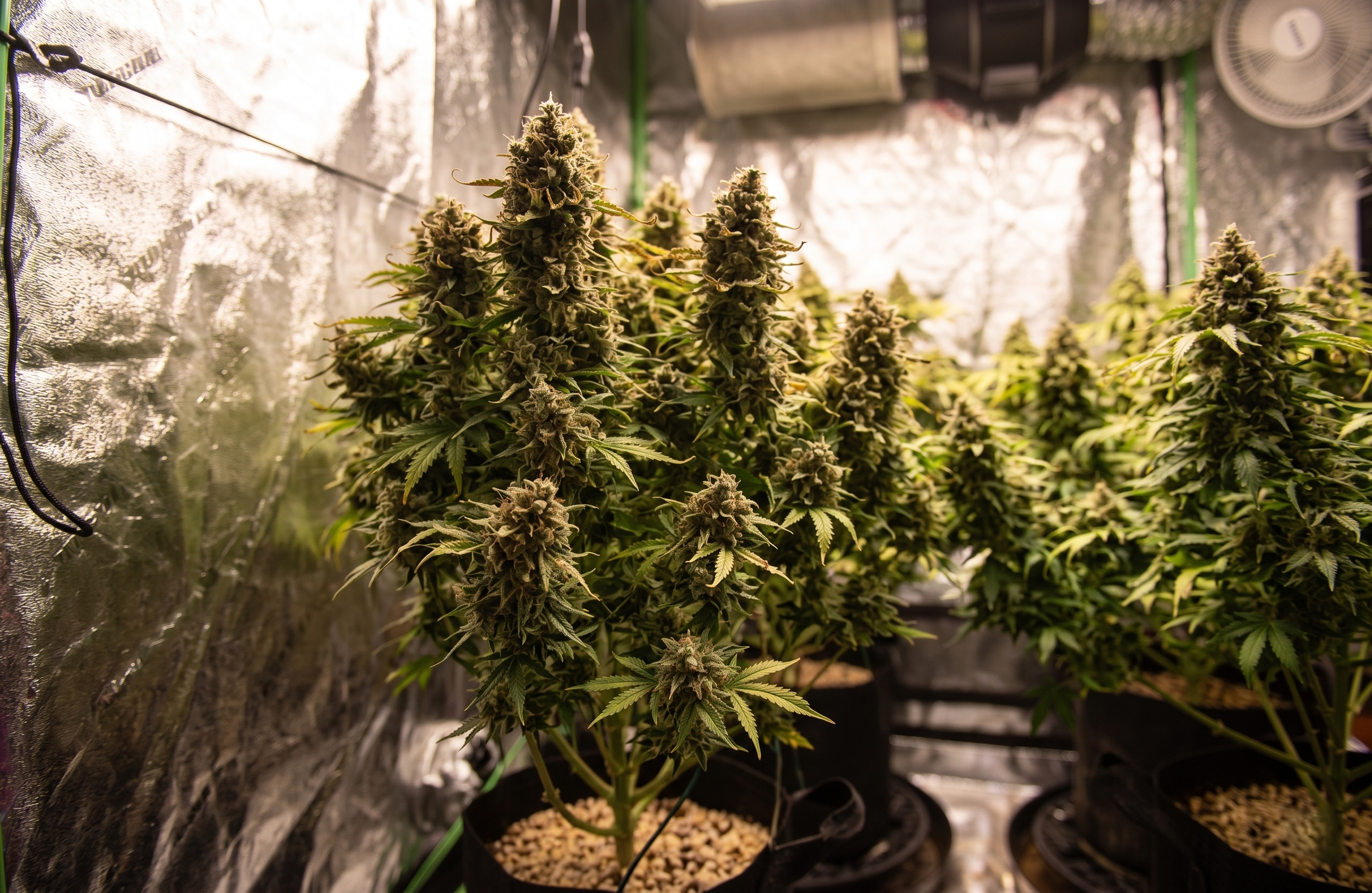
Training changes the arrangement of growing points and leaves within the available environment. Its effects begin with plant architecture, not an automatic multiplication of photosynthetic energy. More light can reach particular branches if the new shape relieves genuine shading, but the total outcome depends on whether leaves remain functional, the root zone can support growth, and the season provides time for the new shoots to develop.
Apical dominance determines which shoots receive growth priority
A dominant shoot tip influences the growth of buds below it through interacting hormone and resource pathways. Removing that tip, as explained in Topping Cannabis Outdoors, can release some lateral buds and produce a different branching pattern. FIMing partially damages the shoot tip and may create a less predictable response. Neither technique guarantees a specific number of mature colas. The plant’s genetic architecture, pre-existing branches, developmental stage, and recovery conditions shape what actually grows.
The dedicated training guides explain the mechanics of cutting and its consequences. Here the relevant measurement is whether the altered branches later produce additional usable flower compared with an otherwise comparable plant, not whether the cut looked textbook-perfect.
Bending can redistribute position without removing the growing tip
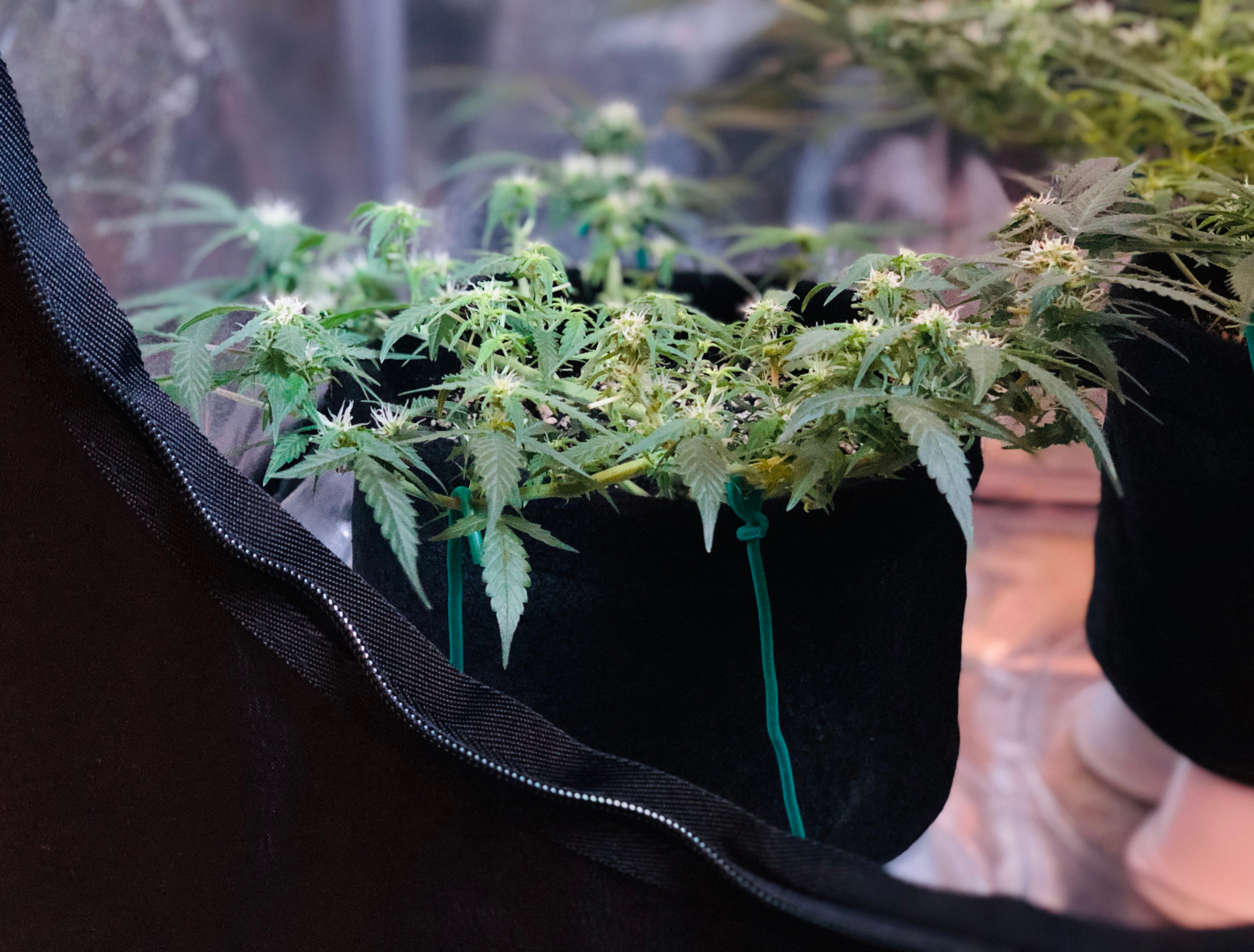
Low-stress training changes orientation and relative height while retaining the meristem. It may prevent one shoot from monopolizing the highest, brightest part of the canopy and may place other branches in more favorable light. Reorientation is a plant response, not proof of increased harvest. A branch can turn upward beautifully while its total flower mass remains unchanged.
A heavily flattened outdoor canopy may also cast new shadows onto neighboring branches, occupy more horizontal area, and hold moisture differently after rain. Observe the actual sun path and flower access instead of importing an indoor flat-canopy target into an open-air garden.
Selective pruning can improve one zone while removing productive tissue elsewhere
Removing a branch can open the canopy and change the light environment around surviving shoots. It also removes leaves that could photosynthesize and meristems that could have borne flowers. Cannabis experiments show both positive and negative responses to different pruning intensities. An impressive opening in the middle of a plant is not inherently productive; it is useful when the gains to retained tissue outweigh what was removed.
Light distribution is not the same as creating more sunlight
Training can move leaves from one position to another and reduce overlap. It cannot increase the sunlight available to the site or cancel neighboring tree shade. In a controlled cannabis light experiment, flower yield responded to canopy light conditions, while leaf-level photosynthesis alone was an unreliable predictor of whole-crop response. The study did not test outdoor training; its useful lesson here is that light must be evaluated at canopy scale and in context.
Where a canopy already captures useful sunlight without severe self-shading, extensive training may add little. Where tall leaders create a deep shaded interior, a carefully altered arrangement may give lower branches a better opportunity. Check whether the new sites actually develop; a brighter-looking photograph is not a measurement.
Remember: Moving a branch into light is a plausible mechanism. Turning that change into more dry flower requires additional growth and a harvest measurement.
Training changes access, support, and risk as well as photosynthesis
An opened plant may be easier to scout for insects, examine inside dense flowers, and dry after a wet event. The canopy access and inspection guide explains how to test that benefit separately. A trained plant may also spread the weight of multiple heavy branches into a larger footprint that requires new supports. These practical consequences influence retained harvest, especially outdoors, but there is no evidence that a particular training layout automatically prevents flower rot or storm loss.
For the full outdoor context, the outdoor growing guide covers seasonal conditions and overall training choices. The branch support and storm preparation resource explains the separate structural problem of carrying weight through wind and rain.
Describe the change precisely
Record height, width, light exposure, access, plant condition, and retained flower sites before claiming a benefit.
Equate canopy shape with yield
A symmetrical or densely branched plant is not automatically a heavier, safer, or more efficient harvest.
What Cannabis Research Shows and Does Not Show
The relevant literature does not support a single verdict that all training increases yield. Studies use different genetic material, plant sizes, densities, treatment definitions, harvest timing, and production goals. Some measure dried flowers; others report aboveground biomass or cannabinoid production. These details determine which questions each experiment can answer.
A large-plant architecture experiment found gains, neutral outcomes, and losses
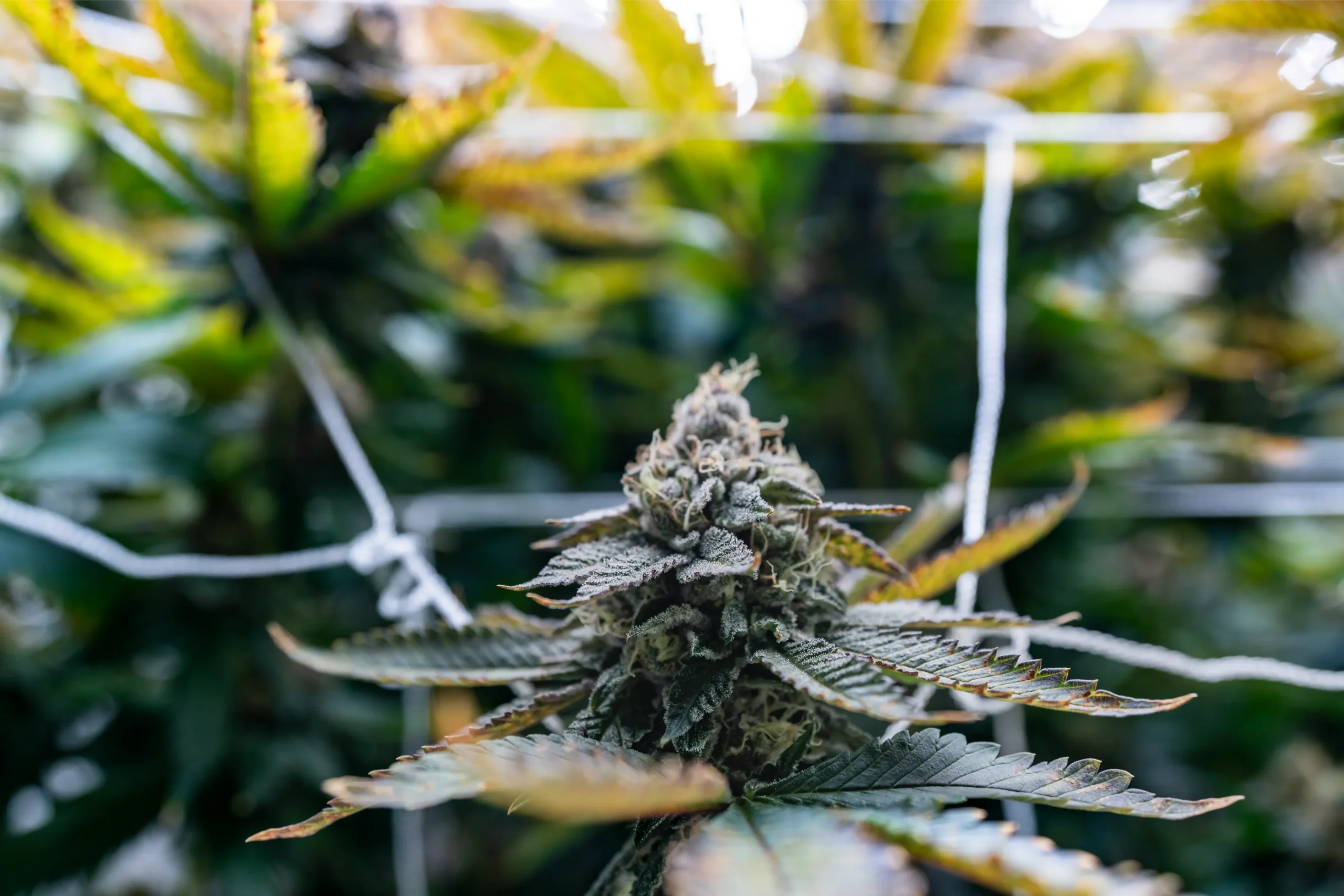
One study of large medical cannabis plants compared several architecture modifications with an untrained control. Double pruning increased inflorescence yield in that system, while the most severe primary-branch removal treatment sharply reduced it. Several other treatments did not significantly change flower yield compared with the control. The experiment also linked shading and plant position with differences in cannabinoid concentrations within the canopy.
This is stronger evidence than a photo showing four enormous colas, because the study included a control and measured crop outcomes. It is still not a universal outdoor recommendation: the plants were managed in a controlled system with a particular genotype, schedule, density, and treatment definitions. It does not isolate LST, FIMing, or supercropping as performed by every home grower.
A topping-versus-control study illustrates the difference between numerical trends and proof
In another medical cannabis experiment, topping increased some measures of inflorescence dry mass and lateral growth relative to other pruning treatments. Yet total CBD yield from topping was not statistically distinguishable from the unpruned control under the study’s overall comparison. The reported trend is interesting, but it does not justify telling readers that topping reliably produces a fixed percentage of extra CBD.
The finding also shows why the numerator matters. A treatment can change biomass distribution and still fail to produce a demonstrable gain in the chosen chemical-output metric. Reporting a favorable average without its statistical context creates more confidence than the research supports.
Plant density can reverse the apparent result
A separate density and architecture study found that increasing density reduced inflorescence yield per plant while increasing yield per cultivation area in most tested architecture treatments. At the same time, dense canopies showed greater chemical nonuniformity in lower inflorescences. This does not mean densely planting an outdoor crop is the right choice. It means a large per-plant harvest cannot be described as a land-efficiency gain without accounting for spacing, overlap, and the full production area.
Recent hemp topping work supports a response but not a universal node rule
A 2026 study investigated topping at different nodes in two monoecious industrial hemp cultivars grown in greenhouse pots. Topping reduced height, increased lateral growth, and raised some whole-shoot biomass measurements within the tested design. Its findings are useful evidence that cannabis architecture can respond strongly to topping. The studied cultivars, growing system, harvest definitions, and node treatments are not interchangeable with outdoor drug-type cannabis. Whole-shoot biomass should not be silently relabeled as dry, trimmed flower yield.
A 2025 defoliation study adds genotype and trade-off context
A study of two low-THC cannabis cultivars grown indoors under different LED spectra reported that defoliation reduced floral biomass while sometimes increasing cannabinoid concentration, with responses dependent on cultivar. It did not test every training method outdoors. It does demonstrate that a higher concentration or tidier plant can coexist with lower flower mass, and the result can differ between genetic lines.
Do not merge unlike treatments into one percentage
Topping, selective branch removal, defoliation, bending, and repeated pruning are not a single treatment. A study-specific benefit for one method, genotype, and system cannot be assigned to FIMing or LST or marketed as a universal outdoor cannabis yield increase.
How to read a positive or negative research result
Ask what the researchers harvested, which comparison they used, and whether differences were statistically distinguishable. A positive flower-mass response does not prove better quality, and a neutral average does not prove the technique is useless for height control or access. A dramatic negative result from extreme removal demonstrates that severity matters; it is not evidence that every small pruning cut is harmful.
Look for replication, genotype information, treatment timing, plant density, and whether output is per plant or per area. If the study used one cultivar, indoor lighting, or industrial hemp, state that limit before using it to guide an outdoor medicinal-flower decision.
| Evidence example | Responsible interpretation |
|---|---|
| Large medical plants: double pruning versus control | Flower yield increased under that tested architecture and schedule. Not proof that all repeated training or outdoor topping improves yield. |
| Large medical plants: severe primary-branch removal | Excessive removal can destroy productive potential. Does not define a universal safe pruning percentage. |
| Medical CBD genotype: topping and lollipopping | Pruning treatments affected allocation; topping did not demonstrate a statistically significant total CBD yield advantage over the unpruned control in the overall analysis. |
| Density and architecture trial | Per-plant and per-area outcomes diverged. Tested density levels are experimental conditions, not outdoor spacing prescriptions. |
| Two monoecious hemp cultivars: node-specific topping | Height, lateral growth, and whole-shoot biomass responded within a greenhouse design. Not a universal dry-flower or node recommendation. |
| Two low-THC cultivars: defoliation and spectra | Floral mass and concentration can move in opposite directions, depending on genotype. Findings do not establish outcomes for outdoor LST or FIMing. |
When Canopy Changes Can Become a Real Harvest Benefit
Training can be sensible even when the expected yield benefit is uncertain. The central question is whether the present plant has a constraint the intervention can actually change. A structural goal such as reducing excessive height is different from a yield goal, and both can be legitimate. Keeping them distinct makes it easier to recognize when an intervention has already done enough.
There must be a genuine limitation to solve
Look for an excessively dominant leader shading vigorous side shoots, branches that overlap so closely inspection becomes difficult, or a shape that cannot be supported through the local season. If the plant already has even access to sunlight, functional leaves, a stable root zone, and room to finish, another round of training may offer no useful opportunity. An untrained plant is a legitimate baseline, not a failed cultivation style.
Retained leaf area and time matter
Removing a tip or branch costs living tissue and can redirect growth into new sites. Those sites need time to develop and the existing leaves must still support them. A late intervention may produce fresh branching too close to flower initiation or unfavorable autumn weather to generate enough mature flower to compensate for the removed tissue. There is no universal recovery period or flowering-week cutoff that applies to every cannabis genotype and climate.
Assess vigor, growing tips, stem integrity, root-zone function, forecast risk, and observed reproductive development. Treat signs of persistent wilt, splitting, progressive yellowing after injury, or stopped growth as reasons to pause and investigate, not prompts to apply another training method.
Outdoor sunlight and plant footprint limit the opportunity
Lower branches exposed after training may receive more direct light at one time of day but not throughout the season. Track shadows during morning, midday, and afternoon. A broad trained canopy can shade its neighbor or become less space-efficient even as its own branches benefit. Account for access lanes and supports when comparing the total allocated footprint.
Environmental and disease consequences alter usable yield
A plant that produces more potential flower but loses several dense sites to mold or storm damage may deliver less usable harvest. Opening the canopy can make scouting easier, but it does not guarantee disease suppression. Conversely, spreading branches without adequate support may create low, wet flowers or break points that were not present in the original shape. Measure losses instead of assuming that airflow and structural claims automatically become yield gains.
Training has a cost even when the crop survives
Ties, supports, repeated adjustments, tool sanitation, and inspection time all consume resources. A grower who values ease and crop reliability may reasonably keep a natural canopy when extra trimming and tying achieve no measurable gain. Record labor and material costs if the decision will be repeated across future seasons.
“One plant is taller and heavier. Can I say the untrained method won?”
Question sent by: Julia Schneider, via contact form.
Not from that observation alone. Check whether the two plants have comparable genetics, root volume, sunlight, age, and allocated area. Measure dry usable flower at equivalent maturity and drying conditions. A difference can reflect the starting plants or microclimate rather than the training method, especially in a one-plant comparison.
Quality changes require their own evidence
Training might raise light penetration or even out flower exposure, and cannabis research has associated canopy position with differences in chemical concentration. That is a reason to investigate positional uniformity, not to promise sweeter aroma, more terpenes, higher THC, or better smoking experience. If quality is central, compare representative samples using the same analytical and sensory framework, and keep flower mass in view.
Field Advice: If you cannot identify a real constraint that training will solve, preserve the healthy leaves and recovery time you already have. No intervention is also a deliberate management choice.
How to Compare Trained and Untrained Plants Fairly
A home garden will rarely have the controls of a research greenhouse, but it can still produce useful records. The goal is not to manufacture scientific certainty from two plants. It is to design a comparison that is less vulnerable to obvious bias and makes future decisions more informed.
Step 1: State one claim that can be tested
Write a precise question: for example, whether early topping increases dry usable flower per allocated area compared with no topping under your lawful outdoor setup. Avoid testing five interventions and changing the scoring rule after seeing which plant looks best. Write the primary outcome and the observation schedule before touching a plant.
Step 2: Select the most comparable material available
Where legally permitted and safely sourced, genetically identical plants offer a cleaner comparison than unrelated seedlings, although plant health and propagation differences can still matter. When using seeds, record the cultivar, seed lot, germination dates, and initial vigor; sibling plants are not genetically identical. Never describe a comparison of two unrelated varieties as proof that one training technique outperformed another.
Step 3: Keep the environment and management consistent
Record container size or native-soil conditions, irrigation method, nutrition, sun exposure, transplant history, support, and pest pressure. Compare like locations or distribute comparable plants across sun and soil gradients without violating local plant-count restrictions. If the trained plant occupies the sunny edge while its control sits beside a wall, the comparison has a location confound. Photograph starting height, width, branching, and health before intervention.
Step 4: Change one training variable
For an interpretable test, compare one clearly defined treatment with an untrained control or one alternative, rather than combining topping, defoliation, LST, and supercropping on only the treated plants. If basic hygiene, support, or emergency disease removal is needed for plant welfare, use equivalent principles across groups and record deviations. Do not deliberately withhold essential support or disease management from a control to protect the experiment.
Step 5: Record recovery and architecture at consistent checkpoints
At the start, note date, crop stage, removed tissue if relevant, leaf condition, and intervention purpose. At subsequent checks, use a similar camera angle and repeat the same measurements: canopy height and width, functional shoot development, signs of damage, sun exposure, and tie or support condition. A return to active growth is useful evidence that the plant tolerated the intervention; it is not yet evidence that yield improved.
Step 6: Harvest using the same defined standard
Harvest at comparable physiological maturity when feasible, while responding responsibly to safety and weather hazards. Keep each plant’s harvest separately labeled. Dry and trim using consistent procedures, weigh usable dry flower, and record rejected flower and trim categories separately. If one plant is harvested early because of severe disease or frost, keep that event in the results rather than silently dropping it or claiming the plants experienced identical conditions.
Step 7: Compare the predetermined outcomes and uncertainty
Compare dry usable flower per plant and, where appropriate, per allocated area. Then examine quality observations, labor, loss, and damage as secondary outcomes. A difference from one pair of plants is a local observation, not a validated causal effect. If replicated plants are lawful and available, repeat comparisons across more than one position or season. If they are not, retain the uncertainty and use the records as a planning aid rather than a universal conclusion.
A practical comparison log
- Record the primary outcome and definition of usable dry flower.
- Identify each plant, genotype or seed lot, position, and allocated footprint.
- Photograph starting vigor, height, width, and light exposure.
- Record treatment type, date, tissue removed, and any later adjustments.
- Check recovery, new damage, support integrity, and development at consistent checkpoints.
- Record disease, breakage, weather, and any unequal management.
- Label harvest lots and apply the same drying, trimming, and weighing rules.
- Compare the original outcome first, then quality, losses, labor, and uncertainty.
Use a simple interpretation matrix rather than a victory photograph
If flower mass improved but labor doubled and the plant occupied more land, describe all three results. If mass was unchanged but height stayed inside a lawful and structurally manageable limit, training may still have met its non-yield objective. If the trained plant recovered slowly and produced fewer usable flowers, that outcome is useful too. The purpose of a trial is a defensible next decision, not a testimonial.
Misleading Yield Claims and Common Comparison Mistakes
Most exaggerated training claims start with a genuine observation and then extend it beyond what was measured. Recognizing the gap between the observation and the conclusion protects both beginners and experienced growers from spending a season chasing the wrong target.
“Twice the colas means twice the harvest”
More visible flowering tips can mean that growth was redistributed. It says nothing about the sum of individual flower masses. Compare all usable flower, not the number of dominant-looking sites in a photograph.
“Training increases potency”
Flower position and canopy environment can influence measured chemistry in some studies, but a plant’s genetic potential, environment, sampling, and timing all matter. A change in sample concentration is not proof of higher total cannabinoid output and does not establish a change in perceived effects, flavor, or safety. A leaf photo, frosty appearance, or marketing percentage cannot answer this question.
“The biggest plant always yields the most efficiently”
Per-plant harvest may rise as the plant occupies more ground, while yield per area stays equal or falls. If two plants share one space in one arrangement and a single large plant fills it in another, compare the total production from the same defined area and season. Local plant-count laws can make theoretical spacing options unavailable; do not recommend breaking them to create a comparison.
“Training is pointless because one experiment found no gain”
A neutral effect on one yield outcome does not erase height control, improved inspection, or a benefit observed with another genotype. The correct interpretation is narrower: the tested treatment did not demonstrate an advantage for that measurement under those conditions. Transferability is an open question, not an invitation to invent new percentages.
“A research percentage is my expected outdoor increase”
Even a statistically significant benefit belongs to the studied plants, treatment, and environment. A greenhouse hemp node trial, an indoor CBD pruning trial, and a large-plant medical cannabis experiment do not create one outdoor yield conversion factor. Read their endpoints and limits before using their findings.
“A successful recovery proves the treatment was worth it”
Healthy new growth shows that a plant continued developing. It does not show that the lost time, cut tissue, and additional labor were repaid. Keep biological recovery separate from the harvest comparison.
Compare matching endpoints
Use similar genetics, maturity, area, drying standards, and a previously chosen yield metric. Report important differences in conditions.
Choose the flattering metric afterward
Do not switch from dry flower to wet branches, top counts, or selected samples merely because the original outcome failed to improve.
Uncertainty should remain visible in small gardens
A single trained plant and a single untreated plant can suggest what to examine next, but differences in vigor, phenotype, weather, and position may explain much of the contrast. Avoid presenting a one-season observation as a percentage that every grower can reproduce. Record it faithfully and repeat the comparison when conditions and local law permit.
Verify the Result from Recovery Through Harvest
A complete evaluation has several stages. Early evidence shows whether the intervention caused avoidable harm. Middle-stage evidence shows whether the intended canopy change actually occurred. Harvest evidence shows whether it became a useful outcome. Skipping the last stage turns an architectural impression into an unsupported yield claim.
After intervention: confirm that the plant is functioning
At the first safe follow-up, inspect leaf posture, tissue integrity, branch support, and signs of newly expanding damage. Check the root ball if anchoring or bending may have moved the base. For cuts, confirm that adjacent tissue is not becoming progressively discolored or soft. Record conditions and use a repeat photograph. The supercropping recovery guide shows how to keep recovery evidence separate from a later yield claim. Do not demand that an old injury disappear; stable tissue and functioning new growth are better evidence of recovery.
During vegetative growth: confirm the target geometry
Measure the outcome you originally sought: excessive height reduced, formerly shaded shoots exposed, overlapping branches separated, or inspection routes opened. If the altered structure creates new shading, loose supports, girdling ties, or branches near wet ground, the design needs correction. Keep additional training proportional to the remaining season and plant condition.
At flower transition: compare productive potential without making a yield claim
Observe whether the branches you exposed remain vigorous and whether the canopy fits its support system. Record flower initiation and obvious differences in development across plant zones. Stop aggressive manipulations when the opportunity to recover is inadequate. A visually promising canopy is still an intermediate checkpoint, not a final verdict.
Through flowering: monitor retained crop and losses
Inspect flower interiors where accessible, branch unions, support points, and sections that remain wet after rain. Document breakage or suspect flower and respond using appropriate disease and safety procedures. Do not describe the absence of visible symptoms as proof of complete disease freedom. If material must be rejected, record its quantity and cause without inventing a diagnosis.
At harvest: calculate the outcome you defined
Apply the same harvest, drying, trimming, and weighing methods to each comparison lot. Use dry usable flower as the primary mass where that was the original goal. Sum every harvested branch of the plant, not only the impressive tops. If an area metric was planned, divide the total usable mass by the same previously defined allocated footprint. Do not retrospectively shrink a trained plant’s denominator to make its result look better.

After harvest: separate evidence, interpretation, and next action
Record three statements: what you measured, what you think might explain it, and what you will change or retain next season. For example, a higher dry flower total is a measured observation; the claim that training caused it is an inference that depends on how well the comparison controlled other factors. An unchanged yield with easier access might justify training for maintenance rather than production. Repeatability matters more than one extraordinary-looking plant.
“The trained plant was easier to inspect but weighed the same. Was training a failure?”
Question sent by: MapleGrower, via Facebook page.
Not necessarily. If your predetermined goal was more dry flower, that outcome did not improve in the comparison. If the intervention also had a documented access or height goal, it may have achieved that separate purpose. Report the results independently and weigh the extra labor or structural risk before repeating it.
Do not turn unsafe flower into a favorable yield result
Visible mold, suspected contaminated flowers, and material that fails applicable safety requirements must not be counted as usable simply because the trained plant produced more raw biomass. Yield accounting does not override lawful production, diagnostic uncertainty, or consumer safety.
A Training Yield Decision Checklist
Make the next decision using the same variables that governed the comparison. There is no universal requirement to train, and there is no single method that consistently outperforms natural growth across every genotype and outdoor environment. The appropriate decision is the one that fits the measured goal and the plant’s remaining capacity.
Keep the method when its intended benefit is demonstrated
Retain a practice when repeated, reasonably comparable observations support a useful gain, such as more dry usable flower per defined area, lower documented crop loss, or better inspection access at an acceptable cost. State which benefit was actually measured. If the evidence is based on one plant, keep the conclusion local and provisional.
Modify the method when architecture improves but harvest does not
If more sites formed without increasing dry flower, examine whether the original canopy was already productive, whether you removed too much functional leaf area, or whether the new branches had inadequate time or light. Consider a less severe intervention or no intervention in a future lawful comparison. Do not stack a second training technique as an automatic response to a disappointing first result.
Stop when the intervention creates more risk than benefit
Persistent injury, poor recovery, flower initiation, stiff stems, severe weather risk, unstable root anchoring, or support failure can close the useful training window. At that stage, stabilize and inspect the plant rather than trying to force a textbook canopy shape. The branch support guide addresses the separate problem of holding existing architecture safely through the season.
Run this check before claiming more yield
- Define whether the goal is flower per plant, flower per area, quality, lower loss, or easier access.
- Confirm that trained and comparison plants had reasonably similar starting conditions.
- Document which single training variable changed and why.
- Check that recovery and canopy geometry were observed rather than assumed.
- Count every usable flower lot and separate rejection and damage.
- Compare dry weight using matching harvest and postharvest methods.
- Account for allocated area, labor, and support when relevant.
- Separate a measured difference from a causal claim and disclose uncertainty.
- Keep, modify, or stop the method based on its real objective, not a headline promise.
The test is not whether training made the plant look more productive. The test is whether its measured outcome improved enough to justify the intervention. A naturally shaped plant that finishes cleanly may be the stronger result in one setting; carefully trained architecture may solve a real constraint in another. Both conclusions require observation rather than faith in a fixed yield multiplier.
Share this article
A quick overview of the topics covered in this article.
- Define the Yield You Are Trying to Increase
- What Training Actually Changes in a Cannabis Plant
- What Cannabis Research Shows and Does Not Show
- When Canopy Changes Can Become a Real Harvest Benefit
- How to Compare Trained and Untrained Plants Fairly
- Misleading Yield Claims and Common Comparison Mistakes
- Verify the Result from Recovery Through Harvest
- A Training Yield Decision Checklist
Follow us
Latest articles
September 27, 2026
September 27, 2026
September 27, 2026
September 27, 2026