
How to Increase Cannabis Light Intensity Safely: Acclimation, Dimming, and DLI Control
Increasing cannabis light intensity safely is not a matter of turning the dimmer up on a schedule. A stronger light setting changes the photon rate reaching the canopy, the daily photon dose, leaf energy balance, transpiration demand, and the pressure placed on the root zone and climate-control system. If several of those conditions change at once, it becomes difficult to tell whether the plant is using the extra light or simply tolerating stress.
The repeatable method is to measure the current canopy, calculate the current DLI, confirm that the plant and environment are stable, make one controlled light change, then verify the response before increasing again. The safe endpoint is not a universal PPFD number. It is the highest useful light level your particular canopy can support without progressive stress, unstable water demand, excessive leaf temperature, or declining growth quality.
This resource focuses on light acclimation and dimming decisions. For the broader foundation on PPF, PPFD, DLI, fixture types, spectrum, and placement, use the complete cannabis grow-light guide. If the room itself is still unstable, start with Indoor Cannabis Growing Basics before trying to push intensity.
What a Safe Light Increase Actually Means
A safe increase is one that the plant can absorb into its existing photosynthetic, hydraulic, nutritional, and environmental capacity without creating a new limiting factor. That is why a dimmer percentage is not a biological dose. Moving from 50% to 60% on one fixture may create a very different canopy change than the same control movement on another fixture.
The useful measurement is the change in PPFD at the canopy, followed by the change in DLI over the actual photoperiod. Even then, the number is only part of the decision. A plant with a healthy root system and stable climate may use more light productively, while a recently transplanted, drought-stressed, overheated, diseased, or poorly rooted plant may respond badly to the same photon increase.
There is no universal acclimation percentage
Do not treat a fixed dimmer increase, PPFD jump, or number of days as a universal cannabis protocol. Fixture response, cultivar, plant stage, prior light history, photoperiod, environment, root condition, and canopy geometry all change how much additional light is reasonable.
Safe does not mean zero response
Plants adjust when their light environment changes. Leaves can alter their photosynthetic machinery, pigment balance, protective energy dissipation, stomatal behavior, and structure over time. The goal is not to prevent all physiological response. The goal is to avoid pushing the plant faster than those adjustment mechanisms and the rest of the grow system can support.
This is also why one perfect-looking day after a dimmer change does not prove the new level is appropriate. Some problems appear as a trend. A top canopy may begin normally, then develop progressive chlorosis, bleaching, edge injury, excessive leaf temperature, or stalled new growth if the added light is not being used efficiently.
More light is useful only while another factor does not become limiting
Light drives photosynthesis, but photosynthesis also depends on carbon dioxide, temperature, water, root function, mineral supply, and healthy leaf tissue. Raising PPFD can increase the potential rate of carbon assimilation and can also increase water demand and heat load. If irrigation, root aeration, climate control, or CO₂ availability becomes limiting, the extra photons may deliver less additional growth than expected.
That does not mean high PPFD is inherently harmful. Controlled cannabis studies have produced strong yield responses under high light. It means those experimental treatments were part of complete managed environments. The upper treatment from one study should not become the automatic target for every room.
Master Advice: Treat higher light as a system test. Every increase asks whether the roots, leaves, air, water supply, and climate can support a higher energy load at the same time.
Why Cannabis Needs Time to Acclimate to Stronger Light
Leaves are built in response to the environment in which they develop. A leaf formed under moderate light is not identical to a leaf that develops under a stronger photon field. When light intensity increases, the plant can adjust both rapidly and more slowly, from protective energy dissipation within the photosystems to longer-term changes in leaf anatomy and photosynthetic capacity.
General plant physiology describes this as light acclimation. Cannabis-specific research also shows that plants respond over time when the light environment changes. In a controlled indoor cannabis study, plants were moved from a vegetative environment near 425 µmol/m²/s under an 18-hour photoperiod into flowering treatments spanning a very wide range of PPFD under a shorter photoperiod. The researchers observed evidence of physiological acclimation as the crop progressed. That experiment demonstrates plasticity, but it does not define a safe dimmer schedule for home cultivation.
What happens when absorbed light exceeds immediate demand
Photosynthetic tissues absorb photon energy continuously while the light is on. When the amount of absorbed energy temporarily exceeds what photochemistry and carbon metabolism can use, plants rely on protective mechanisms to dissipate part of that excess. One major mechanism is non-photochemical quenching, which converts excess excitation energy into heat before it can cause more serious damage.
If excessive excitation continues and protective capacity is overwhelmed, photosynthetic efficiency can decline through photoinhibition and photooxidative stress. The practical lesson is not that strong light should be avoided. It is that light-use capacity is dynamic. A plant that can use a certain PPFD after acclimation may respond differently if moved to that same PPFD abruptly from a much lower-light environment.
Light Acclimation
Light acclimation is the set of physiological, biochemical, and structural adjustments that help a plant function under a changed light environment. It can include short-term photoprotection as well as longer-term changes in photosynthetic capacity and leaf structure.
PPFD and DLI describe different parts of the light change
PPFD describes the photon rate arriving at a square meter of canopy each second. DLI integrates that exposure across the daily light period. Raising PPFD while leaving photoperiod unchanged raises DLI. Shortening the photoperiod while raising PPFD can increase instantaneous intensity while keeping the total daily photon dose similar.
This distinction matters during transitions between stages. A grower may see a higher PPFD after changing the schedule and assume the plant is receiving far more light. Depending on the photoperiod, the daily total may be similar, lower, or higher than before.
Daily Light Integral
DLI is the total photosynthetic photon dose received per square meter during a day. Under approximately constant electric lighting, DLI can be calculated from PPFD and photoperiod: PPFD x hours of light x 3,600 / 1,000,000.
Equal DLI does not mean identical plant response
DLI is extremely useful, but it does not erase photoperiod biology. Cannabis is photoperiod sensitive, so the duration and timing of light can influence developmental responses independently of the total photon dose. Research comparing 12-hour and 13-hour flowering photoperiods at the same PPFD found cultivar-dependent differences in flowering progression and maturation timing.
For that reason, you should not use DLI arithmetic to invent arbitrary flowering schedules. DLI helps quantify the photon dose. Photoperiod still has its own developmental role.
Root and climate capacity are part of acclimation
Higher light can increase transpiration and crop water use. It can also increase the amount of sensible and radiant energy interacting with the canopy. If the root zone is already cycling between too wet and too dry, or the room is already near its climate-control limit, increasing light can expose that weakness quickly.
The safest time to test stronger light is when the plant is growing normally, the root zone is predictable, irrigation is repeatable, and temperature and humidity are not drifting out of control. The safest light increase often begins with fixing everything except the light.
Build a Baseline Before Touching the Dimmer
A useful acclimation procedure needs a reference point. Without a baseline, you cannot tell whether a new symptom appeared after the light change, whether the canopy distribution became less uniform, or whether water use changed because the plant grew larger rather than because PPFD increased.
The baseline does not need to become a laboratory experiment. It needs to be repeatable enough that tomorrow’s measurement means the same thing as today’s measurement.
Measure a canopy grid, not one center point
Record PPFD at several representative canopy positions. Include the center, edges, corners, and any visibly high or low zones. Keep the sensor at approximately the same canopy plane and orientation each time. If the fixture height or canopy height changes, record that too.
The purpose is to track both the average condition and the spatial pattern. If only the center reading is measured, a grower can increase intensity while missing a high-light zone directly under one bar or a weak edge that still needs better distribution.
Field Advice: Mark your measurement positions in the grow log. Consistent points are more useful than a larger number of random readings.
Calculate the current DLI
Under a stable electric light, calculate DLI from the measured PPFD and actual photoperiod. If the map is uneven, you can calculate DLI for representative points or use a representative average for the canopy while still keeping the minimum and maximum visible in your notes.
The equation is:
DLI = PPFD x photoperiod hours x 3,600 / 1,000,000
If output changes during the day, or the lighting program ramps, pulses, or combines substantial variable sunlight with electric lighting, one instantaneous PPFD value cannot describe the full daily dose. In those cases, integrated measurement is more appropriate.
Record the plant state before increasing intensity
Photographs are useful when taken from the same general angle and under comparable white viewing light. Record whether the upper canopy already shows chlorosis, bleaching, edge curl, unusual leaf angle, tip injury, stalled growth, wilting, or localized heat stress. Do not assume every visible imperfection is caused by light. The purpose is to know which symptoms were already present.
Also note recent events that could confound the test: transplanting, heavy pruning, training, irrigation errors, root problems, pest pressure, nutrient changes, foliar spraying, large temperature shifts, or a major change in humidity. If the plant is already recovering from another intervention, it is usually a poor time to create another stress variable.
Record the environment and root-zone behavior
At minimum, note air temperature and humidity at canopy level, the irrigation pattern, and whether the root zone is behaving normally for that grow system. If you track leaf temperature, substrate moisture, EC, or CO₂, keep those measurements in the same log.
The point is not to create one universal environmental target. It is to confirm that the plant’s other major inputs are stable enough to interpret the light change.
“My fixture is at 60% power. Can I just move it to 80% if the plants look healthy?”
Not from the dimmer numbers alone. First measure canopy PPFD at 60%, calculate the current DLI, and confirm that the plant and environment are stable. Then make a smaller controlled change that you can measure. A 20-point dimmer movement can represent very different PPFD changes on different fixtures.
Question sent by: Ethan Brooks, via email.
Use the baseline to define the next question
The baseline turns a vague goal such as “more light” into a testable question: can this canopy accept a measured increase in PPFD while maintaining stable growth, temperature, hydration, and upper-canopy appearance?
That question is much easier to answer than asking whether a particular dimmer percentage is safe.
Step-by-Step Light Acclimation Workflow
The safest workflow changes one light variable at a time, keeps the measurement method consistent, and pauses whenever the plant or environment stops behaving predictably. The procedure is deliberately based on checkpoints rather than a universal calendar.
Step 1: Stabilize the canopy first
Begin only when the plants are actively growing and major environmental or root-zone problems are not unresolved. If the canopy has just been transplanted, heavily trained, defoliated, droughted, overwatered, overheated, or treated for a pest problem, allow that issue to become interpretable before adding another variable.
This does not mean a plant must be visually perfect. It means you should know what state it is in and why.
Step 2: Measure the starting PPFD distribution
Use the same grid positions you intend to recheck later. Record average, minimum, maximum, and any obvious hotspot. Also record fixture height and dimmer position. If you are using more than one fixture, note overlap zones because those areas may respond differently when output increases.
If your fixture data rely on advertised wattage rather than actual photon measurements, the actual wattage vs equivalent wattage guide explains why wattage alone is not a canopy intensity measurement.
Step 3: Calculate the current DLI
Do this before changing intensity or photoperiod. If the photoperiod will remain constant, any PPFD increase also increases DLI. If the photoperiod is changing at the same time, calculate the old and new daily photon dose before making the change.
This prevents a common mistake during stage transitions: seeing a shorter day, raising PPFD aggressively to compensate, and accidentally changing both instantaneous intensity and daily dose more than intended.
Step 4: Choose one control variable
If canopy distribution is already good and the fixture has a reliable dimmer, changing output is usually easier to interpret than changing height and output together. Dimming can change intensity while keeping fixture geometry and beam overlap more similar.
Changing fixture height can also be useful, especially if the canopy has grown into the light or the distribution needs adjustment. But height changes can alter uniformity as well as intensity. A lower fixture may raise center PPFD while changing edge falloff. Whenever height changes, re-map the canopy.
Change one lighting variable at a time
Adjust dimming or height, measure the new canopy map, and observe the plant before making the next lighting change.
Do not change intensity, height, and schedule together
Multiple simultaneous changes make the response difficult to interpret and can create a much larger DLI shift than the dimmer alone suggests.
Step 5: Make a measured increase, not a guessed increase
Raise output only enough that the canopy measurement shows a clear but controlled change. The correct size of that change depends on how stable the grow is, how large the previous light difference was, how responsive the dimmer is, and how close the canopy already is to its practical limit.
Do not force the procedure into a fixed percentage. A grower moving from a low-light propagation environment needs a different transition than a healthy flowering canopy already operating near its established high-light range.
Step 6: Re-measure immediately after the adjustment
Confirm what the dimmer or height change actually did. Recheck the same grid, especially the highest-intensity positions. Recalculate DLI if PPFD or photoperiod changed.
This is the first verification checkpoint. It confirms the physical light change before you begin interpreting biology.
Step 7: Observe both the plant and the system
Watch for progressive changes in the highest-exposure tissue, not just one dramatic symptom. Check whether leaf temperature, room climate, irrigation frequency, substrate behavior, and canopy hydration remain manageable. Compare the new state with the baseline rather than with a generic photo from the internet.
Do not use increased water use by itself as evidence that more light is beneficial. Higher light can increase transpiration, but greater water use does not prove that photosynthesis, yield, or quality improved.
Step 8: Decide to increase, hold, or reduce
Increase again only when the new light level is measured, the canopy remains stable, and no unresolved environmental or root-zone limit has appeared. Hold when the response is unclear, the room is drifting, or the plant is adapting after another intervention. Reduce when symptoms become progressive and correlate with the highest-light zones, or when the additional light pushes climate or irrigation beyond what the system can control.
This three-way decision is more useful than a calendar. The plant and the room decide when the next step is justified.
Remember: A light increase is not complete when the dimmer moves. It is complete when the new canopy PPFD is measured and the plant has demonstrated that the new condition is stable enough to keep.
Increase PPFD Without Suddenly Increasing DLI
One of the most useful lighting concepts is that PPFD and DLI can move independently when photoperiod changes. If the number of light hours becomes shorter, PPFD can rise while daily photon delivery stays similar.
This does not mean the two lighting schedules are biologically identical. It means the arithmetic allows you to separate instantaneous intensity from total daily photon dose.
Use the DLI equation in both directions
Under constant electric lighting:
DLI = PPFD x photoperiod hours x 3,600 / 1,000,000
You can also rearrange the equation to estimate the PPFD that corresponds to a chosen DLI and photoperiod:
PPFD = DLI x 1,000,000 / (photoperiod hours x 3,600)
This calculation is especially useful when the light schedule changes. It lets you see whether an increase in PPFD is merely compensating for fewer light hours or whether the daily photon dose is also rising.
| Illustrative PPFD | Light Hours | Calculated DLI |
|---|---|---|
| 500 µmol/m²/s | 18 h | 32.4 mol/m²/day |
| 600 µmol/m²/s | 15 h | 32.4 mol/m²/day |
| 750 µmol/m²/s | 12 h | 32.4 mol/m²/day |
These are mathematical examples only. They are not recommended cannabis photoperiod schedules. In a photoperiod-sensitive crop, a 12-hour, 15-hour, and 18-hour day can create different developmental signals even when the calculated DLI is identical.
Equal DLI does not make different photoperiods equivalent
DLI describes daily photon quantity. Cannabis flowering also responds to photoperiod. Use DLI to manage photon dose, but keep photoperiod decisions grounded in the cultivar and the developmental goal rather than in light-dose arithmetic alone.
How to Acclimate Cannabis Plants to Stronger Light during a schedule change
When a grow moves from a longer vegetative photoperiod to a shorter flowering photoperiod, the PPFD can often rise without the DLI rising by the same proportion. This creates a useful opportunity to increase instantaneous intensity without stacking two large changes in photon dose.
The disciplined approach is to record the old PPFD and old DLI, choose the new photoperiod for developmental reasons, then calculate what the new PPFD would mean for daily photon exposure. After that, increase intensity only as far as the plant and room can support.
Do not assume the mathematical equivalent is automatically the correct flowering intensity. The calculation is a dose-management tool, not a biological target.
“If I raise PPFD but keep DLI the same, does that mean the change cannot stress the plant?”
No. The leaf still experiences a higher instantaneous photon rate, and cannabis also responds to photoperiod as a developmental signal. Equal DLI is useful for controlling daily dose, but it does not guarantee identical leaf temperature, photosynthetic dynamics, transpiration, morphology, or flowering response.
Question sent by: Julia Schneider, via contact form.
Increasing PPFD without suddenly increasing DLI is most useful as a transition tool
The method is strongest when you are trying to understand what changed. If both PPFD and DLI jump sharply, a stressed response could be related to the instantaneous intensity, the larger daily dose, or the environmental consequences of both.
Holding DLI approximately stable during part of a transition can reduce one source of uncertainty. Once the plant is stable at the new photoperiod and intensity, DLI can be increased deliberately if the cultivation plan supports it.
Pro Tip: Keep a simple old-state and new-state record: photoperiod, average PPFD, maximum PPFD, DLI, fixture height, dimmer setting, canopy temperature trend, and irrigation behavior. That is enough to make most lighting changes understandable later.
Dimmable Grow Lights: When and Why to Reduce Output
Dimming is not a sign that the fixture is too large or that the grow failed. A dimmer is a control tool. A fixture with useful output reserve can be run below maximum when the canopy is young, recovering, temporarily heat-limited, or unable to use the full photon output efficiently.
The best dimming decision starts with the reason for reducing light. If the problem is uneven distribution, dimming alone may lower the entire map without fixing the pattern. If the problem is excessive intensity across an otherwise good map, dimming may be exactly the right control.
Dim when the canopy is smaller than the fixture’s productive footprint
A young canopy may occupy only part of the final grow area. Running full output can waste photons outside the productive leaf area and create unnecessary heat. As the canopy expands, output can increase while you continue measuring the actual occupied area.
This is more efficient than treating the maximum fixture setting as the default from the first day.
Dim during recovery from a root-zone or environmental problem
If the plant cannot maintain water uptake, temperature control, or normal stomatal function, strong light can increase demand when the plant has reduced capacity to respond. Temporarily reducing photon load can be a sensible part of stabilizing the system while the underlying cause is corrected.
Do not use dimming as a substitute for fixing the cause. If the root zone is oxygen-starved or irrigation is unreliable, lowering light may reduce demand, but the root problem still needs to be resolved.
Dim when high PPFD and canopy temperature rise together
Photon intensity and leaf temperature are related but not identical. Some fixtures deliver more radiant heat to the canopy than others, and room temperature, airflow, humidity, leaf size, and transpiration all affect leaf temperature. If increasing output causes the upper canopy to heat beyond what the room can manage, reducing output may be the fastest way to return to a controllable state.
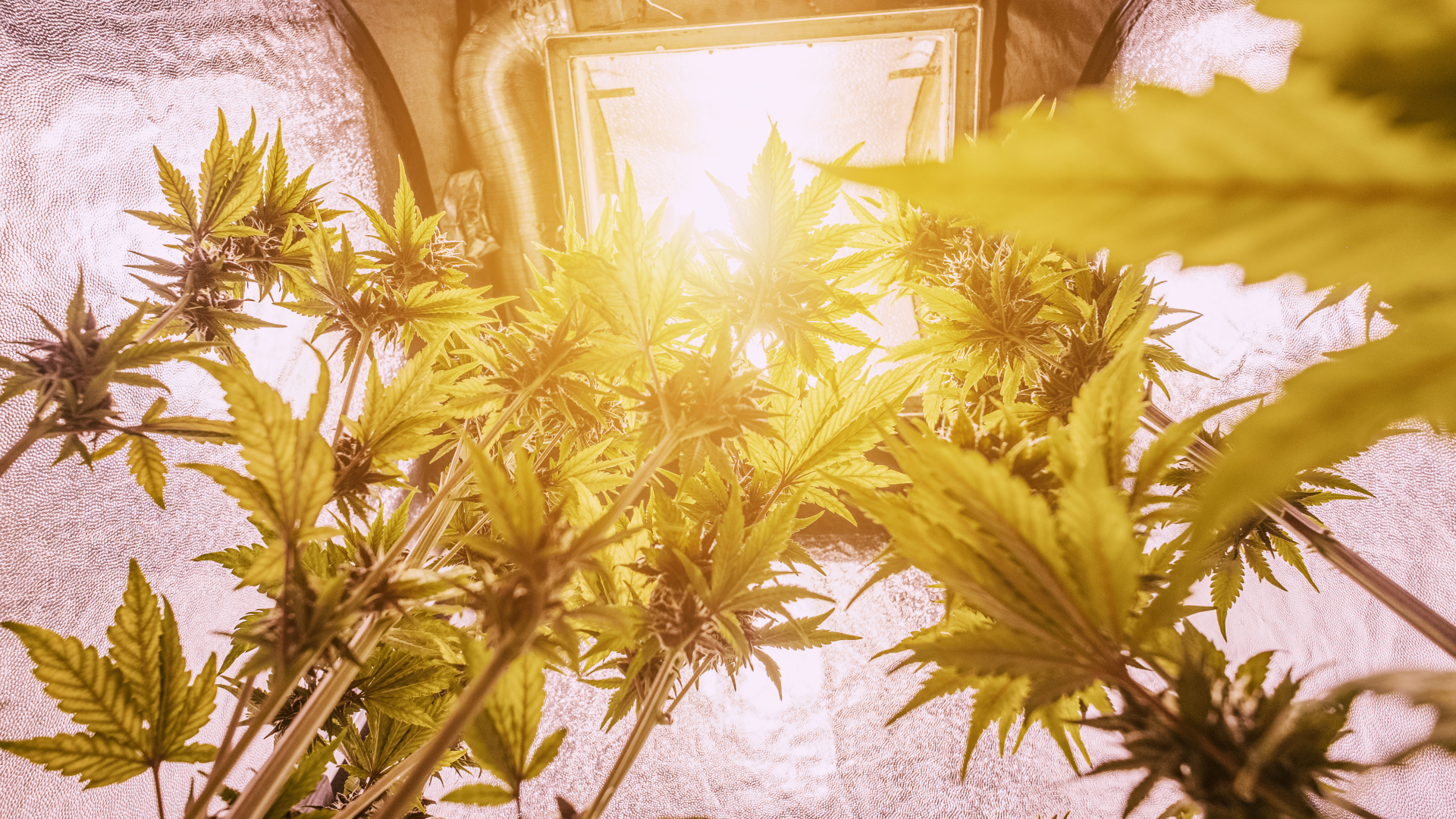
Do not treat a fixed leaf-temperature number as a universal dimming threshold. Compare the plant with its previous stable condition and interpret temperature together with humidity, airflow, water status, and growth response.
Dim when one environmental failure temporarily lowers light-use capacity
Examples include a cooling failure, irrigation interruption, severe humidity excursion, unexpected root-zone drying, or a malfunction that reduces CO₂ availability in a room that depends on controlled enrichment. The point is to prevent the lighting system from continuing to demand maximum crop performance while another essential input is temporarily compromised.
Dim to match current crop capacity
Reduce output when the crop is young, recovering, temporarily climate-limited, or receiving more PPFD than the current canopy can use consistently.
Do not dim blindly for every yellow leaf
Confirm the spatial pattern, measured PPFD, environment, and root-zone condition before assigning a symptom to excessive light.
Dimming versus raising the fixture
If the PPFD map is already uniform at the current hanging height, dimming is often the cleaner way to reduce intensity because it changes output without deliberately changing the optical geometry. Raising the fixture can improve blending between emitters in some designs, but it can also send more photons outside the productive canopy or alter edge performance.
Neither method is universally better. Measure the map after the adjustment. If the goal is to change intensity while preserving distribution, the method that produces the more useful measured map wins.
Do not use dimming to chase a single leaf posture
Leaf angle changes through the day and responds to circadian rhythm, water status, VPD, light direction, genetics, and plant age. Upward leaf posture is sometimes called “praying” and is often treated online as proof that the plant wants more light. It is not a reliable light meter.
A plant can display an upright leaf angle while already experiencing excessive intensity or unfavorable leaf temperature. Use measured canopy light and the full plant response instead of one posture cue.
Separate High-Light Stress From Look-Alikes
Light stress is easy to overdiagnose because many upper-canopy symptoms have other causes. Yellowing, curling, crispy margins, stalled growth, and discoloration can also come from heat, root problems, nutrient imbalance, spray injury, pests, disease, water stress, or combinations of those problems.
The strongest field clue is a measured spatial relationship: symptoms intensify where PPFD is highest or where the canopy is closest to the fixture, and the timing fits a recent increase in light exposure. Even that relationship should be checked against temperature and root-zone conditions.
What high-light stress can look like
Potential signs include progressive bleaching or pale tissue at the most exposed tops, upward cupping or edge roll in upper leaves, loss of healthy color in high-PPFD zones, and a decline in growth quality despite otherwise adequate resources. Severe excess can contribute to photoinhibition before a grower has an easy visual way to quantify it.
No single symptom proves excessive PPFD. Visual diagnosis should trigger measurement, not finish the diagnosis.
| Observation | Could Point Toward | What to Check Next |
|---|---|---|
| Pale or bleached upper tops concentrated under the strongest light | Excess light, heat interaction, nutrient issue, or previous spray injury | Map PPFD, compare leaf temperature, inspect lower tissue, review recent sprays and nutrition changes |
| Upward leaf curl near the fixture | High photon load, heat, low humidity interaction, water stress, or genetics | Compare PPFD, air and leaf conditions, root-zone moisture, and whether symptoms follow the light gradient |
| Whole plant droops after light increase | Water-supply limitation, root dysfunction, excessive transpiration demand, heat, or irrigation timing | Check root-zone water status and drainage before assuming PPFD alone is the cause |
| Only one corner shows stress | Local hotspot, airflow problem, irrigation difference, pest or root issue | Measure that exact zone and compare it with a healthy zone under the same fixture |
| Plant remains dark green and upright after a large increase | Possible tolerance, but not proof of optimal light | Verify PPFD, DLI, temperature, growth trend, irrigation demand, and whether upper tissue remains stable over time |
Heat stress can mimic excessive light
A light increase often changes both photon load and thermal load. If the canopy gets hotter at the same time, the visible response may be caused by the combination rather than by photons alone. This is especially important when comparing fixture technologies with different radiant characteristics.
Measure or at least track canopy-level temperature before and after the change. If the light is raised, dimmed, or moved and the symptom improves, that still does not prove which component mattered unless PPFD and temperature were recorded.
Root stress can make a previously safe PPFD become too demanding
A light level that worked last week can become difficult after overwatering, root disease, transplant damage, severe dryback, or an irrigation failure. The photons did not become more intense, but the plant’s capacity to support transpiration and carbon assimilation changed.
This is why acclimation is not only a one-way march toward maximum output. Sometimes the correct move is to temporarily reduce light until the root system and canopy regain stability.
“The leaves started praying after I increased the light. Does that mean I should turn it up again?”
No. Leaf angle by itself is not a reliable measure of unused light capacity. Check canopy PPFD, DLI, temperature, hydration, new growth, and whether the highest-exposure tissue remains healthy before making another increase.
Question sent by: MapleGrower, via Facebook page.
Do not treat CO₂ as a magic PPFD permission slip
Elevated CO₂ can raise photosynthetic capacity under suitable conditions, but there is no universal PPFD line above which supplemental CO₂ suddenly becomes mandatory or automatically makes more light profitable. Cannabis photosynthetic studies show interactions among PPFD, temperature, and CO₂, while production trials also show that whole-crop economics and environment matter.
If you use controlled CO₂ enrichment, manage it as part of a complete sealed or controlled system. If you do not, increase light only as far as the ambient-CO₂ room, plant health, and climate can support. Do not use a single internet threshold as a license to push the dimmer.
Do not chase the highest PPFD used in a research paper
A treatment such as 1,800 µmol/m²/s proves what happened in that experiment. It does not establish a universal cannabis target. Cultivar, photoperiod, CO₂, temperature, root-zone management, nutrition, canopy density, economics, and prior acclimation all change the practical answer.
Verify the New Light Level Before You Increase Again
The final step is the one most lighting advice skips. After changing intensity, you need a way to decide whether the result worked. Verification should combine the measured light field with the plant’s trend and the room’s ability to remain stable.
Success is not that the plant survived. Success is that the new setting is measurable, repeatable, and compatible with continued healthy growth.
Re-measure the same canopy grid
Confirm that the PPFD distribution is still what you think it is. Plants grow upward, branches move, training changes the canopy, and fixture overlap changes as the distance to the canopy changes. A dimmer setting recorded without a new map becomes less useful as the geometry changes.
Keep the same measurement positions when possible. If the canopy architecture changed so much that the old grid is no longer representative, establish a new baseline and note the reason.
Recalculate DLI whenever PPFD or photoperiod changes
DLI is not a value you calculate once for the grow. Any meaningful change in light output, fixture height, or photoperiod can change the daily photon dose. If PPFD is variable across the canopy, track representative zones rather than pretending one number describes every leaf.
For approximately constant electric lighting, the calculation is straightforward. For changing output schedules or mixed sunlight, integrated logging is the better method.
Look for stability in new growth, not repair of old damage
Old bleached or damaged tissue may not return to its original appearance. Do not use cosmetic healing of old leaves as the success criterion. Instead, look for whether new tissue develops normally and whether existing symptoms stop progressing after the light level is corrected.
This is a stronger verification method because it asks whether the plant is functioning under the new environment rather than whether already-damaged cells changed color.
Confirm that water demand remains manageable
Higher light can increase transpiration and irrigation demand. The useful question is not whether the plant drinks more. It is whether the root zone remains within a controlled wet-dry pattern for your growing system and whether the plant stays hydrated through the light period without requiring emergency corrections.
If every light increase creates increasingly unstable irrigation, the root system or watering strategy may be the limiting factor before photon supply is.
Confirm that the room remains controllable
The light setting is not truly usable if temperature or humidity becomes unstable every time the fixture runs at that output. A light can be biologically reasonable but operationally impractical in a room whose cooling or dehumidification capacity is already saturated.
This is where lighting and room design reconnect. The grow-room setup guide covers the broader relationship among lighting, electrical load, airflow, temperature, humidity, and service access.
Field Advice: Keep the setting that the room can reproduce, not the setting that works only on the coolest or easiest day of the week.
Advanced growers can verify photosynthetic stress more directly
Chlorophyll fluorescence and gas-exchange equipment can measure photosynthetic function more directly than visual inspection. Research uses parameters such as PSII efficiency, gas exchange, and stomatal conductance to understand high-light response and acclimation.
Most home growers do not need those instruments. A consistent quantum-sensor grid, DLI calculation, canopy-temperature trend, root-zone record, and growth log can answer the practical question well enough: did the measured increase create a stable improvement opportunity, or did it expose a new limitation?
Use increase, hold, and back-off checkpoints
A repeatable light-acclimation system can be reduced to three decisions:
- Increase: PPFD and DLI are known, the canopy is healthy, the environment is stable, the root zone is predictable, and the previous change produced no progressive high-light pattern.
- Hold: the plant is still adapting, another variable recently changed, the environmental trend is uncertain, or symptoms cannot yet be separated from a look-alike problem.
- Back off: progressive upper-canopy stress correlates with high-PPFD zones, the plant cannot maintain hydration, leaf or room temperature becomes difficult to control, or the new setting pushes another system beyond its capacity.
There is no need to force every grow toward the maximum dimmer setting. The correct endpoint is the setting that produces useful photon delivery without causing the crop or room to become less stable.
Light Acclimation Checklist
Use this before every meaningful increase in intensity
- Confirm the plant is actively growing and not recovering from an unresolved root, irrigation, pest, disease, or climate problem.
- Measure PPFD across a repeatable canopy grid.
- Record the average, minimum, maximum, fixture height, and dimmer setting.
- Calculate the current DLI from the actual photoperiod.
- Record canopy-level temperature and humidity, plus any root-zone metrics you already use.
- Photograph or note existing upper-canopy symptoms before changing the light.
- Change one light variable at a time whenever practical.
- Make a measured increase rather than relying on dimmer percentage alone.
- Re-measure PPFD immediately after the adjustment.
- Recalculate DLI whenever PPFD or photoperiod changes materially.
- Watch the highest-light zones for progressive symptoms rather than relying on one leaf posture.
- Confirm that irrigation and root-zone behavior remain predictable.
- Confirm that the room can hold a stable climate at the new output.
- Judge success from stable new growth and a non-progressing stress pattern, not from old damaged leaves healing.
- Increase again only when the previous setting has been measured and verified.
- Dim or raise the fixture when the new light level creates a measurable problem that the rest of the system cannot yet support.
If you remember one principle, make it this: increase measured photons only as fast as the plant and the room can prove they can use them. The dimmer is not the decision. PPFD, DLI, plant response, and system stability are the decision.
Share this article
A quick overview of the topics covered in this article.
- What a Safe Light Increase Actually Means
- Why Cannabis Needs Time to Acclimate to Stronger Light
- Build a Baseline Before Touching the Dimmer
- Step-by-Step Light Acclimation Workflow
- Increase PPFD Without Suddenly Increasing DLI
- Dimmable Grow Lights: When and Why to Reduce Output
- Separate High-Light Stress From Look-Alikes
- Verify the New Light Level Before You Increase Again
Follow us
Latest articles
September 29, 2026
September 29, 2026
September 29, 2026