
Revegetation Signs vs Stress-Deformed Leaves
A flowering cannabis plant begins pushing odd, narrow leaves. One looks like a single blade. Another twists sideways. Perhaps the flower beneath them appears to be opening into a leafy shoot. Is the plant returning to vegetative growth, or is something damaging its newest tissue?
Do not diagnose revegetation from leaflet count alone. The useful distinction is between a change in the plant’s developmental direction and an injury that distorts organs while the developmental program continues. Start with flowering history and light exposure, locate exactly where the unusual growth began, inspect for independent evidence of damage, then return to the same growth points to see what forms next. A plausible explanation after one visit is a working hypothesis, not a confirmed cause.
This guide is about that specific comparison. For the broader outdoor sequence from planting through flowering, use the outdoor cultivation guide. Here, the question is narrower: Which observations justify a revegetation diagnosis, which point toward a look-alike, and what should you do before changing the plant’s environment? Cultivate only where lawful and follow local requirements.
Revegetation or Damaged Leaves: The Direct Answer
Revegetation means a plant that has developed reproductive structures resumes vegetative-style shoot development. In photoperiod-sensitive cannabis, this can follow a change from flower-inducing short days to conditions that favor long-day growth. The most informative evidence is new shoot growth emerging from previously flowering structures, accompanied by progressive architectural change, rather than one oddly shaped leaf.
Stress-deformed leaves are different. Heat, pests, chemical exposure, uneven root function, and damage to a developing shoot can alter leaf expansion without proving that the plant has switched developmental direction. Some leaves already present inside a bud or shoot may emerge malformed even after the original stress ends. A damaged leaf cannot be expected to unfold retrospectively into a normal one.
Start with the three-way distinction
First, normal flowering itself can produce smaller and less complex leaves. Second, a genuine reproductive-to-vegetative transition can produce new shoots above or within established flower sites. Third, injury can cause strange leaves while flowering progresses normally or stalls for another reason. These possibilities are not mutually exclusive: a plant can experience a photoperiod disturbance and a mite infestation at the same time.
The practical answer is to place the plant provisionally in one of three categories: revegetation supported, stress or pest injury supported, or not yet distinguishable. Preserve that uncertainty until the next observations provide a stronger pattern.
Definition: Revegetation
A return toward vegetative shoot production after reproductive development has begun. It is a change in developmental behavior, not simply the presence of a leaf with one or three leaflets. The visible expression varies by genotype, stage, and the conditions that prompted the change.
What would strengthen the revegetation hypothesis?
A known flowering period followed by a documented light-schedule change is meaningful history. Then look for fresh, elongated shoots developing out of established flower positions, newly separated nodes where compact flower growth had been forming, and successive leaves associated with these shoots. When several growth points follow a similar trajectory, the argument becomes stronger. In a mature inflorescence, green shoots growing from within flowers are particularly informative, though their presence still deserves context.
What would make damage more plausible?
Consider injury when the newest tips are twisted, blistered, bronzed, necrotic, unevenly expanded, or stunted without a coherent progression toward vegetative shoots. A cluster of plants affected on the wind-facing side after a neighboring spray event differs from one photoperiod-sensitive plant that was recently moved from a short-day room to long summer days. Neither pattern is absolute; they simply direct the next check.
Remember: A single-bladed leaf tells you what that leaf looks like. A sequence of new organs tells you what the growth point is doing.
What this article does not diagnose
Leaf shape alone cannot identify a viroid, virus, specific mite, nutrient deficiency, or herbicide. Neither can it predict the eventual harvest date. If you need a general refresher on nodes, buds, bracts, petioles, and shoot tips before making comparisons, consult the cannabis anatomy reference. This article confines itself to separating a developmental reversal from deformed growth and deciding how to verify the difference.
Why Flowering Plants Change Their Growth Pattern
Flowering is a developmental program, not a leaf-shape switch
Photoperiod-sensitive cannabis responds to day and night signals, but the response is more complex than the statement that every plant flowers at exactly twelve hours of daylight. Adult plants can produce solitary flowers under long days. Short-day conditions encourage the formation of condensed compound inflorescences, with short internodes and numerous reproductive structures. The presence of a few pistils therefore does not automatically prove that a compact apical inflorescence has formed.
In controlled cannabis studies, changing established short-day plants back to long days has caused internodes within inflorescences to elongate and long-day growth patterns to resume. In later-flowering material, new shoots have also emerged from mature inflorescences. Those observations provide direct cannabis-specific support for revegetation as a real developmental process. They do not establish that every strange field leaf is caused by that process.
Why an old flower can produce a new shoot
A flower cluster is not an inert object. Its architecture contains developmentally organized units and meristematic regions capable of different growth responses. Under a suitable change in photoperiod, vegetative-style shoots can arise in positions formerly occupied by compact reproductive growth. The visible result may include more obvious shoot extension, leaves that seem to emerge from the flower, and a flower structure that loses its previous compact organization.
Record the position of the earliest abnormal growth. A vegetative-looking shoot rising from an existing flowering top has more diagnostic value than a solitary leaf near the lower canopy. Inspect gently. Repeatedly opening flowers, cutting their centers apart, or removing healthy tissue to search for an imagined growth point can create wounds and increase other risks.
Important: Do not dissect healthy flowers to prove a diagnosis. Use external observations, a clean photograph, and follow-up growth first. If a flower is genuinely discolored, soft, moldy, or decaying, follow a separate flower-health response rather than treating the problem as harmless revegetation.
The single-leaflet trap
A cannabis morphological study followed one cultivar through its life cycle and documented large shifts in leaflet number. Leaf complexity increased during vegetative development and decreased as flowering progressed, eventually reaching single-leaflet forms. Thus, the characteristic that online descriptions sometimes call the defining revegetation symptom can also occur during ordinary reproductive development.
This does not make leaflet count useless. A series of newly produced leaves changing shape while shoot architecture changes can contribute evidence. The mistake is treating the number of leaflets on one leaf as a standalone laboratory test. A normal small sugar leaf or a transitional flowering leaf must not be confused with an entirely new vegetative shoot.
Photoperiod change and light contamination are related but not identical
A deliberate switch from a short-day flowering room to much longer days provides a clear candidate trigger for reversion. Artificial light at night in an outdoor garden is a different exposure history. It may delay flowering, slow inflorescence development, encourage elongation, or disrupt a susceptible genotype without automatically producing full revegetation. Research on light pollution shows responses vary with cultivar, spectrum, quantity, and exposure pattern.
Record the actual history before blaming a streetlamp. Was the plant already flowering normally before the exposure? Is the same light visible every night, or was there one brief event? Is the illuminated side different from the dark side, and are nearby cultivars behaving differently? A visible glow is a reason to investigate, not proof that it caused the leaf phenotype.
Why injured leaves may imitate a phase transition
Leaf primordia develop inside young growing points. Damage to that tissue may appear only as the leaves expand later. Feeding by very small mites, exposure to growth-regulator herbicides, or disrupted growth conditions can produce narrow, curled, twisted, or strap-like leaves. A recent-looking abnormal leaf might therefore reflect an earlier exposure, while the newest unopened growth is already responding to a correction.
The difference is temporal: phase change is inferred from a coordinated succession of new organs. Injury is inferred from a matching exposure, damaged tissues, signs of an organism or chemical pattern, and the response of subsequent unaffected growth. Both require observations over time.
Field Advice: In photographs, include the entire flowering site and a nearby normal shoot. A detached unusual leaf loses most of the information needed for this comparison.
What Changes the Diagnosis
Genotype and photoperiod sensitivity
Cannabis genotypes differ in the day-length response that initiates and sustains flowering. Studies of multiple drug-type and hemp cultivars show substantial variation; some flower under longer days than the familiar indoor twelve-hour schedule. A day-neutral or autoflowering plant has a different regulatory background again. Consequently, a photoperiod rule observed for one cultivar cannot be assigned to every plant in the garden.
Ask whether the seed or clone was reliably identified as photoperiod-sensitive, day-neutral, or uncertain. Treat the seller’s classification as useful history but not perfect genetic verification. A plant labeled autoflower that repeatedly develops vegetative shoots inside established flowers warrants investigation, but its behavior alone cannot establish that the label was wrong.
Was the plant truly flowering beforehand?
Photograph or reconstruct the prior stage. Isolated pistils at nodes can occur before a full apical inflorescence develops. By contrast, a clearly formed flower top that later produces elongated vegetative shoots provides a much stronger case for a genuine reversal. Without proof of the earlier reproductive state, a report of “reveg” might actually describe normal maturation, delayed flowering, or a plant returning to ordinary growth after temporary stress.
Indoor-to-outdoor transfers and seasonal timing
A flowering clone or plant placed outdoors under significantly longer natural days presents a plausible reversion scenario. A plant that briefly flowers because of one set of conditions and then encounters a longer-day period may behave differently from one completing flowering as natural days continue to shorten. Record the transplant date, prior light/dark schedule, outdoor site, and first visible flower development.
Do not assume all outdoor days get shorter just because a calendar says “flowering season.” Day length changes with hemisphere, date, and latitude. Nor should natural seasonal progression alone be interpreted as a reversion trigger when a plant is simply forming smaller flowering leaves. Review the actual chronology, not a generic month-by-month chart.
Artificial light after dusk
Streetlights, security lights, porch lighting, and accidental greenhouse illumination deserve attention if they overlap the dark period. Examine from the plant’s position, with permission and without entering unsafe or restricted areas. Record source, direction, consistency, and whether light reaches the shoot tips. A photograph of the entire site at night can document a source, but automatic camera exposure can exaggerate brightness and is not a calibrated light measurement.
Plant-specific sensitivity varies and published light-pollution experiments use controlled exposure conditions. Avoid inventing an outdoor intensity threshold from those experiments or promising that one lamp is always enough to trigger revegetation. Where permitted, remove an unnecessary artificial source or change its direction before using opaque covers that could trap moisture, overheat flowers, or interrupt ventilation.
Root-zone and environmental stress
Check pot mass or soil moisture at an appropriate depth, drainage, recent irrigation, heat exposure, and root restriction. A saturated container can impede root oxygen and nutrient uptake; an extremely dry root ball can reduce leaf expansion. Salinity, nutrient imbalance, damaged roots, or abrupt environmental changes can alter new growth. They are potential alternatives when the evidence for a photoperiod change is weak.
A root-zone problem usually needs its own measurements and site context. Do not identify it from a curled leaf. When wilt, poor water use, or persistent whole-plant decline accompanies the deformation, the root rot versus overwatering guide addresses that different diagnostic question in detail.
Pest introduction and spray history
Recently purchased clones, shared garden tools, neighboring ornamental plants, and wind-exposed sites can alter pest risk. Broad mites and hemp russet mites are worth considering when deformed new growth occurs with stunting, bronzing, or evidence on shoot tips and undersides. A routine hand lens may be inadequate for identifying hemp russet mites; specialist microscopy may be needed.
Record every pesticide, herbicide, foliar feed, adjuvant, and cleaning product that could have contacted the plant or nearby vegetation. Include applications made to other crops and neighboring sites when known. An unverified suspicion of drift is not grounds for accusing a neighbor or applying counter-treatments.
“My flowering plant has three single-blade leaves near a bud. Should I switch its light immediately?”
Question sent by: Ethan Brooks, via email.
No. First confirm that the leaves belong to newly elongating shoots rather than ordinary flowering foliage. Reconstruct the actual light history and photograph the same bud site. If a stable, appropriate flowering environment already exists, changing it in response to three leaves could introduce the disturbance you are trying to investigate.
A Repeatable Inspection and Decision Sequence
Use the same sequence every time. The goal is to change one well-supported variable while preserving enough information to see whether growth returns to a coherent pattern. If a plant is rapidly collapsing or the flower has obvious rot, manage that urgent issue immediately; a revegetation comparison should not delay containment of deterioration.
Step 1: Establish the prior flowering baseline
Write down the plant identifier, genotype if known, source, propagation method, current stage, and date flowering was first confirmed. Record whether the earlier evidence was solitary pistils, visible terminal inflorescences, or mature flowers. Look for dated photographs. If the initial stage is unknown, mark it as unknown rather than reconstructing a flowering date from memory.
For a plant moved between spaces, note the last known light schedule in the original location and the first day in the new one. For outdoor plants, note artificial lights and any major recent relocation. These are historical observations, not retroactive proof of cause.
Step 2: Map affected growth points
Mark three representative locations when possible: the most unusual tip, a nearby less-affected tip, and a comparable normal tip on the same plant or an appropriate companion plant. Use identifiers such as A1, A2, and A3 in your notes. Record whether unusual tissue is at the main apex, lateral flower top, lower node, one exposed side, or nearly every growing point.
A single damaged shoot may reflect local injury. Multiple old flowers producing new elongating shoots after a shared light change fits a different hypothesis. Neither spatial pattern by itself resolves every case, so maintain the full record.
Step 3: Identify the actual organ
Before counting leaflets, determine whether you are looking at a small leaf within a flower, a bract, an expanding vegetative shoot, or a leaf emerging from a normal node. Trace its base visually without pulling on flower tissue. Photograph the leaf and its attachment point in one frame. Compare it with a similar growth point that has not changed.
Single leaves near mature buds can be normal. An elongating shoot carrying successive leaves from within a previously compact bud is more informative. When the attachment is concealed, record “not visible” instead of opening healthy flower tissue to force an answer.
Step 4: Record architecture before leaf shape
Describe the growth point’s behavior. Are new internodes separating? Is the tip elongating? Are leaves accumulating along a distinct shoot? Has the former flower apex stopped becoming more compact? Are several flowering sites making similar new stems? These observations test the developmental hypothesis directly.
Next describe leaf shape: leaflet count, narrowing, twisting, cupping, puckering, edge damage, color, and symmetry. Keep architectural observations in one column and leaf injury in another. That separation prevents a strange leaf from being reclassified as new vegetative growth before you have observed the shoot.
Step 5: Look for independent injury evidence
Inspect young tips, protected folds, leaf undersides, and adjacent plants with suitable magnification and clean handling. Look for living pests, eggs, feeding marks, bronzing, or damaged expansion. Broad mites may be hidden in tender tissue; hemp russet mite identification can require microscopy beyond an ordinary hand lens. If specimens cannot be found, record an unresolved pest hypothesis instead of declaring the plant pest-free.
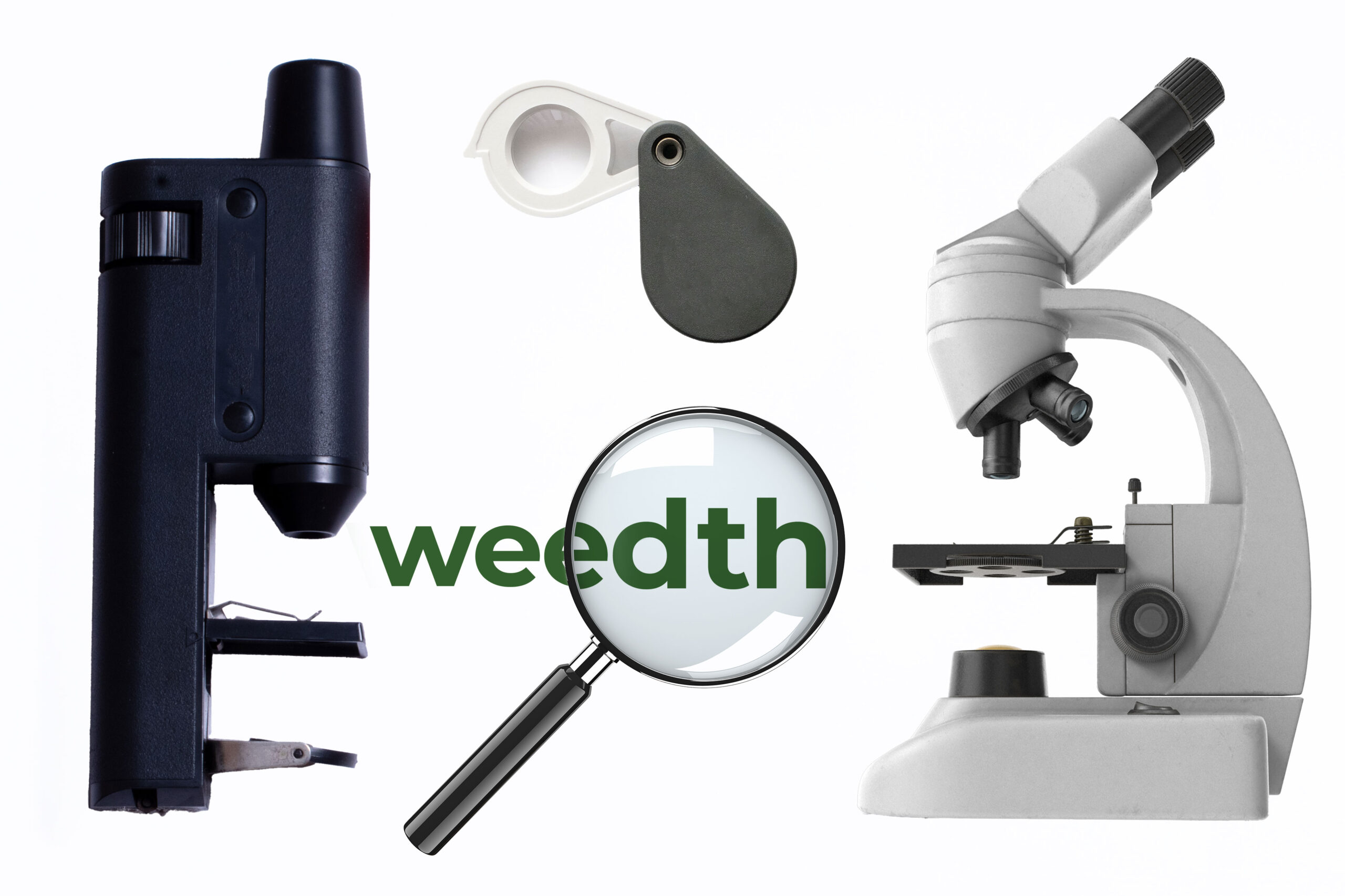
Check for spray droplets, drift direction, cupping across multiple susceptible plants, and the timing of any application. Compare root moisture, drainage, leaf posture, water consumption, and previous feeding changes. Do not spray a suspected pest or add nutrients solely because the leaves look abnormal.
Do: Log the location of new growth, light history, pest evidence, root-zone measurements, and symptom distribution before choosing a correction.
Avoid: Topping the abnormal shoot, stripping the flowers, applying several pesticides, changing the entire feed program, and rewriting the light schedule in the same afternoon. That makes both recovery and causation harder to evaluate.
Step 6: Use the evidence comparison
The following table lists patterns that change the probability of each explanation. None is an absolute diagnosis. A verified pest, a clear chemical exposure, or an unmistakable sequence of new shoots may greatly strengthen one hypothesis, but mixed problems remain possible.
| Candidate | Observation that supports it | Check before deciding |
|---|---|---|
| Revegetation | Previously formed flower produces elongating leafy shoots after a plausible photoperiod shift. | Compare successive new nodes and verify the light history; exclude local damage at the same growth points. |
| Normal flowering leaf form | Small or single leaflets occur within flower growth while compact inflorescences keep developing. | Track the same flower for shoot extension rather than judging one leaf. |
| Photoperiod disruption without established reversion | Flowering is delayed or uneven near repeated artificial light, but no new vegetative shoot sequence is evident. | Document light source and cultivar response; do not label all delayed flowering as revegetation. |
| Broad or hemp russet mites | Distorted young tips, stunting or bronzing, with confirmed mites or suitable laboratory evidence. | Inspect protected growth; escalate magnification if a hand lens is inconclusive. |
| Herbicide or spray injury | Cupping or twisting matches exposure timing and a plausible spray or drift distribution. | Document application records and nearby plant pattern; use professional diagnosis if consequences are significant. |
| Root-zone or environmental stress | Unusual growth accompanies measured moisture, drainage, salinity, temperature or root-function problems. | Correct the confirmed variable once and compare new tissue rather than expecting old leaves to straighten. |
| Systemic pathogen or unresolved disorder | Persistent decline, suspicious propagation history or repeated abnormal clones despite basic correction. | Contain propagation risk and use a relevant diagnostic test; appearance cannot confirm HLVd. |
Step 7: Assign a provisional category
Revegetation supported: prior reproductive development and a credible light change align with new shoot architecture. Stress or pest injury supported: a verified exposure, organism, or root-zone fault better explains deformity and no coherent return to vegetative shoots appears. Unresolved: the history is incomplete or two causes fit equally well. The unresolved category is a legitimate result; it prevents an impulsive correction.
Step 8: Make the smallest defensible correction
If a controllable light disturbance is documented, restore a stable, suitable schedule or remove an unnecessary night-light exposure where it is legal and safe to do so. Do not invent a universal outdoor blackout duration. Outdoor covers can trap humidity and heat, make access harder, or injure branches if used carelessly. If the issue is a measured watering or root-zone fault, correct that specific fault. If microscopy confirms pests, follow a separate pest-management plan suitable for the crop stage and local law.
For an unidentified cause, prioritize stable conditions and close observation. Avoid multiplying changes. You can record a provisional revegetation diagnosis without trying to force an immediate return to flowering through repeated photoperiod swings.
Step 9: Mark the follow-up before you leave
Take a wide photograph of the whole plant, a middle-distance photograph of the affected branch, and a close photograph of the exact growth point. Keep camera position and lighting similar on subsequent visits when possible. Note which tissue existed at baseline so you do not confuse old malformed leaves with new injury. Schedule the next check according to growth rate, risk, and weather rather than claiming a universal day count.
“A plant beside a security light has twisted leaves, but the dark-side branches look normal. Is that proof of revegetation?”
Question sent by: Julia Schneider, via contact form.
No. Side-specific exposure makes a light issue worth investigating, but leaf twisting can also follow localized feeding or spray contact. Compare the flowering-site architecture on both sides, record when and where light reaches the plant, and inspect young tissue for pests or injury. The next new shoots will tell you more than the original twisted leaves.
Common Look-Alikes and Misleading Shortcuts
Normal single-leaflet foliage inside a flower
Flowering leaves vary greatly in size and complexity. The lifecycle morphology study mentioned earlier observed a decrease in leaflet number during flowering even without a reported reversal. A small one-bladed leaf in an otherwise normally maturing flower is not an alarm by itself. Look for shoots with newly separated nodes and a repeated developmental pattern before elevating the diagnosis.
Early solitary flowers mistaken for completed flowering
Adult cannabis plants can form solitary flowers at nodes under conditions that do not produce a full terminal inflorescence. If the only initial observation was one or two pistils, later leafy growth might represent ongoing plant development rather than reversal from established flowering. Be precise about what was actually seen. The starting point matters as much as the current picture.
Foxtailing and other late-flower growth patterns
Some flowers continue producing protruding floral tissue or elongated-looking tips because of genetics and growing conditions. This is not automatically revegetation. Differentiate new floral units from a distinct leafy shoot with separated nodes. If the plant is near harvest, also inspect for heat damage and localized flower deterioration without trying to resolve the entire harvest decision from a single abnormal tip.
Broad mite damage concentrated on new growth
Broad mites can produce curled, strap-like, puckered, and stunted new growth; extension descriptions emphasize that damage may resemble growth-regulator herbicide injury, nutrient problems, or other abiotic stress. The mites favor protected, actively growing tissue, so a casual scan of large older fan leaves is a weak exclusion test. Use appropriate magnification and request diagnostic help if identifying eggs or mites is beyond your equipment.
Hemp russet mites without obvious webbing
Hemp russet mites can cause leaf-edge curling, bronzing, dull foliage, and stunting. They do not produce the characteristic webbing associated with heavy spider mite infestations. University diagnostic guidance warns that ordinary hand lenses are often insufficient; a dissecting microscope can be needed. No webbing and no visible moving dots do not exclude russet mites.
Warning: Avoid diagnosing or treating mites from deformation alone. Repeated blind sprays can injure flowers, interfere with beneficial organisms, create residue concerns, and destroy evidence. Escalate identification when the organism is too small to verify with available tools.
Herbicide drift, contaminated materials, and spray phytotoxicity
Plant growth-regulator herbicide exposure can cause abnormal twisting, leaf cupping, stem curvature, and new-growth deformation. A pattern across susceptible neighboring plants or an exposure gradient can support the hypothesis, but appearance alone does not identify a chemical. Drift may also be difficult to reconstruct after the event. Preserve photographs, dates, weather, application information, and a map rather than making an accusation from a malformed leaf.
Foliar product injury may produce irregular spots or damaged edges depending on formulation, concentration, weather, and the specific plant. Do not assume “organic” products are flower-safe, and do not apply another formulation to reverse suspected spray injury. Remove further exposure where possible and evaluate fresh growth.
Root hypoxia, salinity, and nutrient imbalance
Stagnant roots may reduce uptake even when nutrients are present. High soluble salts can affect water relations. A nutrient imbalance can alter new growth, but there is no credible way to identify an exact nutrient solely from one malformed leaf. Check measured medium and water conditions, irrigation history, and whether more than one plant connected to the same supply has changed. The correction belongs to the verified root-zone fault, not to a speculative list of symptoms.
Mechanical and environmental injury
Wind abrasion, a pinched stem, a tight training tie, hail, or a damaged emerging tip can deform the leaves that expand afterward. Check the location of the injury. If only one branch has a crushed growth point and all the other flowers follow normal development, that is not the same pattern as widespread shoot emergence from old flowers following a lighting transition.
HLVd and other systemic problems
Hop latent viroid can be associated with malformed leaves, poor vigor, stunting, reduced flower development, and weak rooting in cannabis. Infected plants can also look normal. A single-bladed leaf neither proves nor excludes infection. If connected clones decline repeatedly, mother-stock history is questionable, or several symptoms persist without an adequate environmental explanation, use a containment-and-testing approach rather than assigning a visual viroid diagnosis.
The dedicated HLVd guide for home growers explains exposure tracing, sample selection, and molecular testing. The current comparison only identifies when the disease hypothesis deserves separate investigation.
The dangerous rules of thumb
“One finger means reveg,” “all curled leaves are mites,” “pistils mean the plant has entered full flowering,” and “if a plant is green, the problem is solved” all compress a complex process into one unreliable observation. A useful diagnosis retains the timeline, the exact organ, the distribution, and the next growth response. The best shortcut is a consistent inspection method, not a memorized leaf silhouette.
Do: Separate the flowering-stage question from the leaf-injury question. Both can be investigated without deciding that either explains everything.
Avoid: Treating a photoperiod correction as a cure for mites, a nutrient adjustment as a cure for HLVd, or a pesticide as a solution to a legitimate developmental reversion.
How to Verify Revegetation or Confirm Another Cause
The follow-up should test what your explanation predicts. Revegetation predicts continuing vegetative-style shoot formation from reproductive positions under the relevant light history. A corrected localized injury predicts that new growth after the exposure may be healthier while existing deformed leaves remain deformed. A persistent pest predicts new feeding evidence or continued tip damage unless the pest is effectively managed. None can be reduced to a single fixed waiting interval.
Compare the same growth point, not two unrelated leaves
Return to the previously labeled A1, A2, and A3 positions. Record what appeared since the original photograph: a fresh node, new leaf, newly separated internode, additional flower material, or continuing deformation. A photograph of the plant taken from a different side may conceal the original growth point. Keep the evidence tied to place and time.
Distinguish architecture recovery from cosmetic recovery
When abnormality was due to an earlier injury, the newest leaf may expand normally while old distorted leaves remain unchanged. That is encouraging, but it does not prove the exact cause. If the plant previously shifted toward vegetative shoots, a stable flower-inducing environment may later support renewed inflorescence development. That transition depends on genotype, plant condition, and stage; it is not instantaneous and cannot be promised by a calendar.
If growth remains deformed after correcting a plausible root or light issue, do not automatically assume the correction failed. The leaves that were already developing during exposure may still emerge damaged. Observe later-initiated tissue and check whether your original measurement actually improved. If new injury keeps appearing, reopen the diagnosis.
Use a decision-based follow-up table
The table below links each working interpretation to the next evidence needed. The outcomes are deliberately observational rather than arbitrary day counts or guaranteed recovery predictions.
| Current interpretation | What to follow | Decision after reassessment |
|---|---|---|
| Revegetation supported | New leafy shoots from old flower sites, continuing internode separation, actual light history. | Keep conditions stable; assess whether later growth resumes reproductive development before planning harvest. |
| Normal flowering more plausible | Continued compact inflorescence formation without a new vegetative shoot sequence. | Avoid unnecessary light or feeding changes; continue normal monitoring. |
| Localized injury supported | Fresh tissue initiated after exposure ends, nearby unaffected tips, injury pattern. | Confirm the source has stopped; reopen diagnosis if new damage spreads. |
| Pest suspected or confirmed | Organism identification, new feeding signs, protected tip and underside samples. | Use the appropriate pest-management decision process rather than treating leaf shape as identification. |
| Unresolved systemic decline | Propagation lineage, plant-wide trend, laboratory guidance, suitable samples. | Contain suspect stock and pursue testing when the result changes management. |
What counts as good evidence of a real transition?
A credible timeline begins with documented flower formation, followed by changed photoperiod conditions, emergence of vegetative-looking shoots from reproductive positions, and continuing shoot architecture consistent with the new development. You do not need to prove every molecular step. You do need more than one leaf, a forum photograph, or a seller’s anecdote.
If previously elongated shoots later form compact inflorescences under suitable conditions, that later sequence further clarifies the developmental story. Nevertheless, a return to flowering does not guarantee the original harvest schedule or yield; the earlier transition may have consumed time and altered structure.
When a hand lens is not enough
Use magnification to inspect for observable pests, but know the tool’s limit. Broad mites can hide within compressed tips, and hemp russet mites may require a microscope for dependable identification. If a definitive pest diagnosis will determine whether valuable flowering material is sprayed or discarded, a diagnostic service can be more useful than repeated blind treatment.
When a plant diagnostic laboratory is appropriate
Escalate when the suspected organism cannot be confirmed, the pattern spreads across unrelated plants, connected clones show recurring weakness, or a systemic pathogen diagnosis would change quarantine and propagation. Ask the laboratory what tissue and test suit the actual question. A routine visual examination is not a molecular HLVd result. Likewise, a negative test for one pathogen cannot clear all other causes of distorted growth.
“The next leaf looks normal, but the three earlier leaves are still twisted. Did the plant recover?”
Question sent by: MapleGrower, via Facebook page.
Possibly. Existing leaves generally do not remodel into perfect replacements after an earlier injury. Compare growth that initiated after the suspected exposure with the marked earlier tissue. Check whether the original root, light, pest, or spray problem was actually resolved. One normal leaf is improvement, not proof of the cause or clearance of a systemic infection.
Three outcomes that deserve different language
Confirmed evidence of developmental reversion: use when history and repeatable new architecture support it strongly. Injury with improving new growth: use when an independent injury is established and subsequent tissue is healthier. Unresolved abnormal growth: use when signs overlap or the necessary test has not been done. These labels are deliberately different from “plant cured,” “disease-free,” or “safe to clone.”
Master Advice: Write down what observation would change your mind. If no possible follow-up can falsify the diagnosis, the diagnosis is probably just a label.
The Final Diagnosis and Correction Checklist
Two plants may both carry narrow leaves but need completely different responses. A flower that resumes vegetative growth after a verified light change should not be treated as a mite infestation without pest evidence. A plant with confirmed microscopic mites should not be told to wait for photoperiod correction while feeding continues. A healthy flowering plant with a few ordinary small leaves may need no intervention at all.
Before you decide
Revegetation vs deformation: decision checklist
- Confirm cultivation is lawful and the site can be inspected safely.
- Identify whether the plant previously made solitary flowers or established inflorescences.
- Record the dates and evidence of earlier flower development.
- Document the actual photoperiod or relocation history, including artificial night lighting.
- Confirm whether the unusual leaf belongs to a new shoot, a flowering leaf, or an unverified organ.
- Look for fresh internode separation and vegetative-style growth from old flower positions.
- Compare the most affected growth point with less-affected and normal positions.
- Check young tissue for mites and inspect at suitable magnification; escalate if identification is uncertain.
- Review spray and herbicide exposure, including adjacent plants and drift patterns.
- Measure the relevant root-zone and environmental variables rather than guessing a nutrient deficiency.
- Do not diagnose HLVd or another systemic disease from leaf shape alone.
- Choose revegetation supported, stress/injury supported, or unresolved as a provisional result.
- Correct only a verified, controllable source of disruption; avoid repeated light-schedule swings.
- Mark affected growth points and photograph the same locations on follow-up.
- Judge new organs separately from old leaves that may remain malformed.
- Reopen the diagnosis if new injury appears, the plant declines, or expected growth does not develop.
- Use microscopy or laboratory testing when it will alter treatment, quarantine, or propagation decisions.
- Do not promise a fixed recovery date, harvest date, yield outcome, or clean-stock status from visual improvement.
The final decision
If the evidence converges on revegetation, stabilize the relevant light environment when a lawful and practical correction exists and follow the sequence of new growth. If normal flowering foliage explains the appearance, avoid intervention. If injury or pests have independent supporting evidence, address that separate cause and inspect new tissue. If the evidence remains mixed, preserve records and seek an appropriate diagnostic test rather than inventing certainty.
Use the next section to turn the related background into a specific follow-up decision.
Share this article
A quick overview of the topics covered in this article.
Follow us
Latest articles
September 28, 2026
September 28, 2026
September 28, 2026
September 28, 2026