
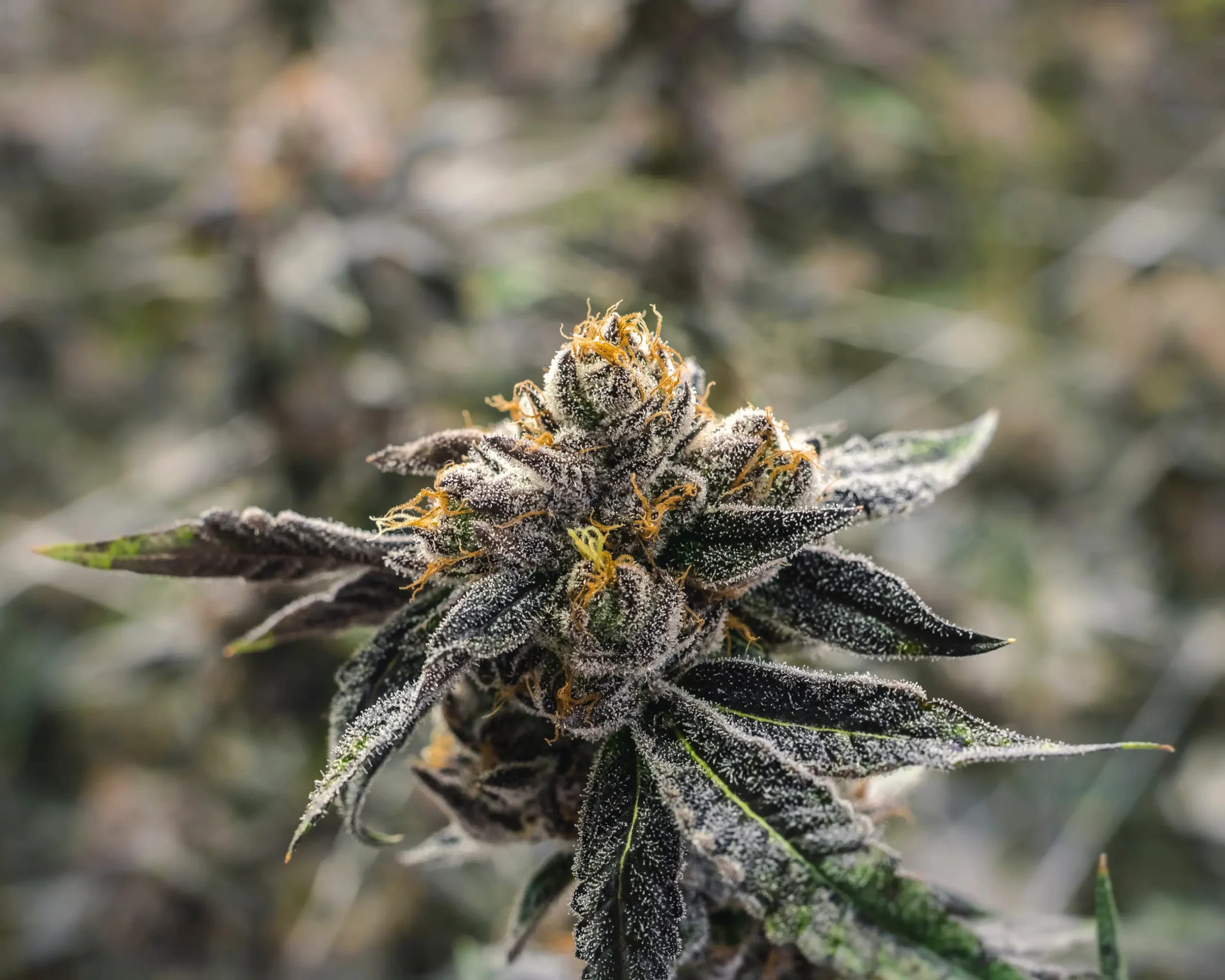
Blueberry Muffin
Blueberry Muffin is a modern indica-dominant cultivar built around unusually stable dessert aroma and a very fast flowering window. The plant is widely associated with a multi-generation line derived from Purple Panty Dropper and Razzle Berry, although simplified descriptions sometimes reduce the parentage to Blueberry crossed with Purple Panty Dropper. The practical identity is more consistent than the naming dispute: uniform plants, purple-flecked resinous flowers, rapid maturation, and an aroma that can resemble baked blueberry, vanilla, butter, and dried chamomile.
The cultivar’s speed is both its greatest advantage and its main trap. Some selected lines are described as finishing in roughly forty-five to fifty-five days, while other modern examples are closer to seven or eight weeks. A grower who assumes the plant is almost finished as soon as the room smells like blueberry muffins can harvest before the calyxes and interior flower moisture are ready. The aroma often arrives early; biological maturity still has to be read independently.
The central cultivation question is: how can a grower use Blueberry Muffin’s fast, uniform flowering behavior without crowding a compact-to-medium canopy or losing its fragile blueberry, dough, vanilla, and chamomile profile during the final weeks and drying stage? The answer is a simple early structure, restrained late nitrogen, enough space for dense frosty tops, careful maturity checks, and a drying process built around aroma preservation rather than speed alone.
Modern descriptions disagree on final height. Some lines stay compact and highly uniform, while some clones or less-stabilized versions can grow taller and respond well to a screen. That uncertainty should not be hidden. The correct first-run approach is to leave moderate transition reserve, record the actual clone, and avoid using one commercial height number as a universal fact.
The finished experience is usually relaxed, happy, tingly, and gently euphoric, with some users remaining creative or energetic before the body becomes calmer. The flavor is the reason the strain deserves a detailed guide. Excellent Blueberry Muffin should remain recognizably blueberry and baked-dough-like after cure, not merely smell sweet during flower and then collapse into ordinary earth and spice.
Strain Features
| Feature | Details |
|---|---|
| Strain Type | Indica-dominant photoperiod hybrid |
| Genetic Profile | Most specifically reported as Purple Panty Dropper x Razzle Berry; simplified descriptions may use Blueberry x Purple Panty Dropper |
| Breeding Character | Highly stabilized multi-generation line in many modern releases |
| THC | Commonly moderate to strong; exact potency varies |
| CBD | Usually very low |
| Dominant Terpenes | Tested batches vary; beta-caryophyllene, myrcene, limonene, terpinolene, pinene and bisabolol may appear |
| Flavor / Aroma | Blueberry, baked muffin, butter, vanilla, chamomile, earth and mild wood |
| Effect Character | Relaxed, happy, tingly, euphoric, sometimes creative or energetic before a calmer finish |
| Flowering Time | Fast; commonly about 45 to 55 days in selected lines, with some examples extending toward 7 to 8 weeks |
| Stretch | Low to moderate in compact lines; some taller expressions occur |
| Plant Architecture | Generally uniform, branchy and indica-leaning, with compact-to-medium internodes |
| Bud Structure | Frosty, dense, recognizable colas with purple flecks or darker calyxes in some plants |
| Yield Potential | Moderate to high when the fast canopy is not overcrowded |
| Training Compatibility | Early topping, LST, low SCROG and uniform multi-plant systems |
| Primary Grow Risk | Mistaking early aroma and frost for full maturity, then drying the fruit layer too quickly |
| Best Time of Use | Late afternoon to evening, with dose-dependent daytime potential |
Genetic Lineage
Blueberry Muffin’s detailed lineage is most often reported as Purple Panty Dropper crossed with Razzle Berry. Some strain databases simplify the fruit side to Blueberry, which is understandable because Razzle Berry is itself closely connected to blueberry-type genetics. The more specific parentage is useful, but the grow guide should acknowledge both descriptions rather than present the discrepancy as settled fact.
The Purple Panty Dropper side contributes color potential, compact resinous flowers, and a softer body effect. The Razzle Berry or Blueberry-associated side contributes the intense fruit aroma and the tendency toward a sweet, baked, creamy sensory profile.
The line is notable for multi-generation stabilization. In practical terms, many plants from a well-developed modern line can show unusually similar flower timing, bud form, and aroma compared with unstable first-generation hybrids. That uniformity is valuable for a room, but it should not be exaggerated into a promise that every clone or every modern reproduction is identical.
The range in reported height and flowering duration likely reflects different versions, clones, and grow environments. Compact plants can finish extremely quickly, while taller expressions may need additional training and a slightly longer finish. The grower should treat the first run as a measurement cycle even when the line is described as stable.
A useful keeper combines the full blueberry-dough aroma with a structure that finishes evenly. Strong purple color is welcome, but the best plant is the one that preserves fruit through cure, keeps a high premium-bud percentage, and does not require rushed environmental manipulation to meet a short calendar claim.
Effect Breakdown
A soft euphoric opening
Blueberry Muffin often begins with happiness and a warm, pleasant head change rather than a sharp cerebral rush. At a light dose, the user may feel more sociable, curious, or creatively engaged without an immediate loss of physical motivation.
Some users describe the cultivar as energizing, while others feel relaxed almost immediately. This difference can reflect dose, tolerance, phenotype, and product form rather than one contradictory strain identity.
Tingling and body relaxation build gradually
At a moderate dose, physical comfort becomes more obvious. Tingling, a softer body, and reduced mental tension can develop while the mood remains positive.
The experience can still fit early evening activity, conversation, or creative hobbies because the strain does not always create immediate couch-lock.
Higher doses can become sleepy or heavy
A larger amount can produce stronger body weight, hunger, and sleepiness. Some users also report dizziness or headache, especially when a potent batch is consumed too quickly.
Dry mouth is common. The sweet flavor can encourage repeated use before the full effect has developed, so dose pacing remains important.
The complete arc is best described as relaxed euphoria with dose-dependent functional range. A small amount may remain clear enough for creative activity, while a larger amount is better suited to evening rest.
Flavor & Aroma Profile
Blueberry and warm baked dough
The cultivar’s signature is not simply blueberry fruit. The most distinctive flowers combine ripe blueberry with warm muffin dough, butter, vanilla, and a faint yeasty or baked sweetness.
The intact jar can feel almost pastry-like when the fruit and creamy notes are preserved. This aroma is unusually specific and makes the strain easy to recognize when the genetics and post-harvest are both successful.
Chamomile, wood and earth beneath the dessert layer
A dry chamomile or herbal-tea note can appear beneath the fruit, especially in selected batches. Mild wood, earth, and spice prevent the profile from becoming pure sugar.
Grinding the flower usually makes the herbal and woody side more noticeable while the intact bud presents more blueberry and vanilla.
Inhale, exhale and storage
The inhale can begin with blueberry, cream, and sweet dough. Butter or vanilla appears through the middle. The exhale often adds earth, chamomile, wood, and a gentle spice finish.
The fruit is vulnerable to heat and dryness. A rushed crop can remain frosty and attractive while tasting mostly earthy. A proper cure should keep the blueberry recognizable from jar to aftertaste.
Blueberry Muffin is a strain where aroma stability is a legitimate keeper trait. The plant that smells strongest in week seven is not automatically the plant that tastes best after six weeks in storage.
Dominant Terpenes
| Terpene | Aroma Role | Cultivar Relevance | Scientific Caution |
|---|---|---|---|
| Beta-caryophyllene | Pepper, dry spice and wood | Appears in many tested samples and supports the baked earthy base | CB2 activity does not prove strain-specific medical outcomes |
| Myrcene | Earth, herbs and ripe fruit | Can support the blueberry depth and relaxing aromatic base | Does not independently create sedation |
| Limonene | Citrus peel and brightness | May lift fruit sweetness and keep the profile from feeling heavy | Does not guarantee euphoria |
| Terpinolene / Ocimene / Pinene | Fresh herbs, flowers, fruit and pine | Reported in some modern line descriptions and can explain brighter phenotypes | Terpene order is not universal |
| Bisabolol and minor volatiles | Chamomile, soft flowers and sweet herbs | A plausible contributor to the unusual chamomile-pastry impression | Standard panels may not capture the complete blueberry and baked-dough aroma |
Blueberry Muffin has unusually inconsistent terpene summaries across tested products and strain descriptions. That variation should be stated openly. The sensory profile is more stable than any one claimed dominant terpene.
The cultivar also demonstrates why flavor names cannot be inferred from three terpene percentages alone. Blueberry, butter, muffin dough, vanilla, and chamomile emerge from a broader mixture of volatile compounds and from human sensory association.
Indoor vs. Outdoor Growing
| Decision Point | Indoor Growing | Outdoor Growing |
|---|---|---|
| Primary Advantage | Very fast flower and often uniform plant behavior simplify room scheduling | Early outdoor finish can reduce late-season weather exposure |
| Main Limitation | Early aroma and frost can encourage premature harvest; compact canopies can still crowd | Tall or vigorous versions need enough spacing and support |
| Stretch | Usually low to moderate, but version-dependent | Outdoor plants can become larger than the indica label suggests |
| Training | One early topping, LST and a low open screen | Early topping and broad branch spacing |
| Flowering Time | Commonly 45 to 55 days in fast lines, sometimes closer to 7 to 8 weeks | Often mid-September to early October depending on line and climate |
| Bud Density | Dense frosty colas need even airflow and drying | Early finish helps, but compact buds can still trap dew or rain |
| Flavor Control | Indoor temperature and drying precision strongly protect blueberry and dough | Hot dry weather can flatten fruit before visible plant damage |
| Best Fit | Growers who value fast scheduling, uniformity and terpene preservation | Sunny sites with enough warmth and a relatively dry early finish |
Blueberry Muffin can be exceptionally efficient indoors because the flowering phase is short and plant behavior is often consistent. That advantage is lost when the grower carries too many branches into bloom or uses the short cycle as a reason to rush root and canopy development.
Compact lines fit a low screen well, while taller versions may need more aggressive early spreading. The first run should preserve moderate headroom and record actual stretch instead of assuming every version stays below one fixed height.
Outdoors, the relatively early finish is valuable because the crop can mature before persistent autumn weather. The flower still needs protection from dew and rain, and a tall outdoor phenotype should not be placed so close to neighboring plants that side airflow disappears.
Indoor cultivation offers the strongest control over the cultivar’s defining aroma. Outdoor sunlight can produce excellent flower, but hot finishing conditions can reduce the blueberry-pastry layer long before leaves show severe heat stress.
Strain-Specific Grow Guidance
Use the fast line without rushing the plant
The costly mistake to avoid with Blueberry Muffin
A short flowering phase does not mean the plant should enter bloom with weak roots or thin leaders. Build a stable vegetative framework first, then use the fast finish to save room time.
The cultivar’s efficiency comes from rapid floral development, not from skipping the work needed to support mature colas.
Read the phenotype before you standardize the room
Blueberry Muffin is often described as unusually uniform, but that does not make the first run a formality. I would still label every plant or clone position and record stretch, days to visible flower, time of peak aroma, irrigation slowdown and the date when calyx expansion truly stops. A compact pastry-forward plant and a taller fruit-herbal plant can both be legitimate expressions, yet they should not receive identical canopy or harvest decisions.
| Observed Expression | What It Usually Changes | Best First-Run Response |
|---|---|---|
| Compact, short-internode plant | Creates a dense central canopy quickly and may finish at the faster end of the range | Use one early topping, spread the strongest laterals and thin only weak inward growth |
| Taller, more open plant | Needs more transition reserve and may carry the fruit aroma over a slightly longer finish | Use a low screen or soft ties, then stop major bending once flower stacking begins |
| Dark or purple-flecked expression | Improves visual contrast but does not prove stronger blueberry flavor or maturity | Judge the keeper after cure, not from color photographs in late flower |
| Early-aroma expression | Can smell like baked blueberry before the interior calyxes have completed swelling | Separate aroma assessment from harvest assessment and inspect protected flower trichomes |
| Heavy pastry and vanilla expression | May show the most fragile top notes during a warm or rapid dry | Dry in smaller, clearly labelled lots and compare aroma retention after several weeks |
| Herbal or chamomile expression | Can appear less sweet at first yet gain complexity after cure | Do not discard it at harvest; compare the finished jar beside the louder fruit plant |
This notebook matters because speed compresses the correction window. In a ten-week cultivar, a grower may have time to adjust irrigation or redistribute branches before the main bulking phase. Blueberry Muffin can move from early pistils to serious flower mass quickly. The safest first run is therefore observational: establish a clean framework, leave a little unused canopy space, and let the plant reveal which version is actually in the room.
Top once and observe the natural uniformity
Many Blueberry Muffin plants respond well to one early topping and gentle branch spreading. This creates enough leaders without hiding how the plant naturally branches.
Repeated topping can create unnecessary interior sites and reduce the practical advantage of a stable fast line.
Leave reserve for version-dependent stretch
Some plants remain compact, while other clones or reproductions can become significantly taller. A first run should not begin with a completely full screen.
Use the first two flowering weeks to finish branch placement, then record the selected clone so future runs can be tighter.
Protect the center from short-internode crowding
Dense branching can place several tops near the middle even when total plant height is modest. Redirect strong leaders outward and remove weak inward shoots after stretch.
The mature canopy should remain readable from above and from the side, with visible lanes between dense frosty flowers.
Do not let early aroma become the harvest clock
Blueberry Muffin can smell finished before the flower is biologically complete. The pastry aroma may be intense while calyxes are still expanding and fresh pistils remain active.
Use flower trichomes, calyx swelling, pistil slowdown, and the selected line’s known finish. Aroma is a quality signal, not a complete maturity test.
Keep late nitrogen from hiding the dessert profile
A very dark leafy finish increases trim work and can surround the dense buds with green flavor. Maintain healthy foliage without forcing vegetative color through the last weeks.
Fast flowering leaves less time to recover from severe overfeeding, so gradual input changes are safer than aggressive bloom-stage escalation.
Adjust irrigation as the plant matures quickly
Water demand can rise rapidly during transition, then slow soon afterward because the entire flowering phase is compressed.
Follow actual dryback closely. A schedule that was correct one week can leave the medium too wet only several days later in a fast line.
Use branch support before the colas harden
Uniform plants can still produce heavy resinous tops. A low net or soft ties should hold branches in their lanes before late flower becomes sticky.
Support should preserve physical separation rather than press several purple-flecked colas into one surface.
Treat color as secondary to flower completion
Purple flecks and darker calyxes can appear naturally, but pigmentation is not required for blueberry aroma or maturity.
Do not use severe cold to force color in a cultivar whose main value is volatile flavor. Healthy roots and aroma preservation matter more.
Plan drying by density, not by the fast flower calendar
A plant that flowered in forty-five to fifty-five days does not necessarily dry faster than another dense indica. Post-harvest timing depends on branch size, bud density, and room conditions.
Separate heavy tops from lighter side branches when needed and judge internal moisture rather than relying on one fixed day or stem snap.
A compressed flowering calendar needs earlier decisions
Fast flowering changes the order of operations. Structural cleanup should be substantially finished by the end of stretch because there may be only a short interval between branch placement and dense resin production. I would remove weak lower shoots when their failure to reach the canopy is obvious, not wait for a calendar date borrowed from a slower cultivar. Once the flowers become sticky and aromatic, the priority shifts from shaping the plant to preserving leaf function, air lanes and undamaged gland heads.
The same compressed logic applies to feeding. Blueberry Muffin does not have much time to recover from an aggressive late nitrogen correction or an oversized bloom input. A healthy, moderate color through transition is more useful than forcing a deep green finish. Watch the rate of dryback, the posture of new leaves and the pace of calyx expansion together. If water use falls while the medium remains heavily charged, do not keep feeding from habit simply because the printed schedule says another bulk week remains.
Harvest each expression by completion, not reputation
The famous short flowering claim is a planning range, not permission to harvest by day number. On the fastest plants, the last meaningful changes may happen over only several days: fresh pistil production slows, calyxes round out, the raw green edge recedes and the blueberry-dough aroma becomes less sharp and more integrated. On a slower plant, those same signs may arrive a week later. Check trichomes on the flower itself rather than relying on sugar leaves, which can amber early under strong light.
If the upper canopy appears ready before the shaded branches, a selective harvest can protect both quality and dry-room uniformity. Remove the completed tops, keep the remaining plant healthy and allow the lower flowers a short finishing interval. This is more defensible than leaving mature aromatic tops in a warm room merely to make the entire plant fit one harvest date.
Weedth Bud Flavor Tips
Blueberry Muffin’s blueberry, vanilla, butter, and chamomile layers are all more fragile than earth and spice. The cultivar can remain visually impressive after those top notes have been damaged, which makes aroma comparison across canopy zones especially useful.
Keep late flower temperature moderate. If cooler side branches smell more like blueberry pastry than the highest tops, reduce local heat or light stress before changing the feeding program.
Do not use blueberry products, sugar, fruit juice, flavoring agents, or terpene sprays. Authentic baked-fruit aroma comes from genetics, full maturity, and preservation.
Dense tops should dry evenly. Direct fan air can harden the outside while the center remains moist and the fruit becomes harsh.
During cure, the raw sweetness should become more integrated. Blueberry should remain obvious while butter, vanilla, chamomile, and earth become easier to distinguish.
Keep differently structured plants or versions separate because drying speed may vary even when the aroma is similar. Uniform genetics do not guarantee identical branch density in every environment.
Use a small evaluation jar and keep the main batch sealed once stable. Blueberry and pastry notes are easily simplified by repeated warm oxygen exposure.
Weedth Bud Boost Tips
Blueberry Muffin quality yield depends on using the short flowering schedule without overbuilding the canopy. A limited number of strong leaders can finish more uniformly than a crowded bush.
Once the clone’s actual stretch is known, plant count and veg time can be set very precisely. This is where a stable line becomes especially efficient.
Preserve branches that consistently produce dense fruit-forward middle-canopy flower. Remove only the sites that prove weak in the actual room rather than following a generic lower-third rule.
Fast lines benefit from stable root conditions because there is little time to recover from severe overwatering, salt buildup, or major pruning after the flip.
Support heavy tops early enough that every flower remains in its intended light lane. A branch that leans during a short finish can lose quality quickly because there are few weeks left to compensate.
Compare premium dry flower, trim efficiency, and aroma after storage. A slightly lower-yielding plant with stronger blueberry persistence can be the more valuable keeper.
The ideal Blueberry Muffin crop is a uniform, fast, open canopy of mature blueberry-pastry flowers, not the earliest possible harvest or the darkest possible purple color.
Medical Uses & Benefits
Blueberry Muffin is commonly chosen for relaxation, mood elevation, stress distraction, appetite, and evening comfort. These are user-reported patterns rather than clinical evidence that the cultivar treats anxiety, depression, pain, or insomnia.
The gentler happy opening may appeal to users who want relaxation without an immediate heavy collapse. Larger doses can still become sleepy or impairing.
Tingling and physical comfort are commonly reported, but those subjective effects should not be presented as proof of a unique medical mechanism.
Dry mouth, dizziness, headache, and dry eyes are possible. Potency varies, and the sweet flavor can encourage users to consume more quickly than intended.
Most flower is THC-dominant with little CBD. A relaxed or creative effect does not make safety-sensitive activity appropriate.
Anyone using cannabis for a diagnosed condition or alongside prescription medication should consult a qualified healthcare professional.
Ideal User Profile
Blueberry Muffin suits users who value a true dessert aroma but prefer blueberry, butter, vanilla, and baked dough over candy gas.
It fits late-afternoon creativity, music, food, relaxed social time, and evening unwinding. Dose determines whether the experience remains active or becomes sleepy.
For growers, it is attractive to anyone who values a short photoperiod flowering cycle and relatively uniform plants. The line rewards careful scheduling rather than advanced high-stress technique.
It is less ideal for growers who assume every version is the same height, or who use the forty-five-day reputation as a reason to cut before real maturity.
Flavor-focused growers should retain plant identity through cure. The most valuable plant is the one that stays unmistakably blueberry-muffin-like after storage.
Grower Notes and Feedback
The most repeated modern traits are unusually fast flowering, uniform bud structure, purple-flecked resinous flowers, and a strong baked-blueberry aroma.
Reported flowering duration varies from roughly forty-five days to seven or eight weeks. This likely reflects different versions, clones, environments, and definitions of finish, so the selected plant should remain the final authority.
Height descriptions also conflict. Some lines remain compact, while other clones can become tall enough to benefit from a screen. First-run headroom and clone-specific measurement are therefore important.
Aroma can appear very early and very strongly. Growers should not allow scent to replace calyx and trichome maturity when deciding harvest.
Effects reports range from energetic and creative to relaxed and sleepy. The common center is happy, tingly, and calming, with dose and phenotype shifting the balance.
A second-run journal should record flip height, actual stretch, exact mature day, support timing, top-versus-side aroma, drying duration by branch density, and blueberry intensity after one month.
Blueberry Muffin is also a useful example of why a stabilized line should still be observed rather than assumed. Uniformity reduces variation, but environment can still change height, water demand, color, and finishing speed enough to affect the canopy plan.
The best production note is not simply the first day the room smells like muffins. Record when the aroma appears, when the calyxes stop expanding, and how much blueberry remains after cure. Those three moments separate early scent from finished quality.
Weedth Experience
Blueberry Muffin is one of those cultivars that can make a room feel finished before it actually is. The aroma arrives with such confidence that it changes the grower’s sense of time. When the air begins to smell like warm berry pastry, the instinct is to believe the plant has already shown everything it has. I have learned to distrust that excitement just enough to keep looking. The nose can announce the destination early; the calyxes, trichomes and water use still decide when the plant has arrived.
What I enjoy most is the contrast between its orderly growth and its almost theatrical scent. A good run does not demand endless manipulation. I want one clean topping, laterals opened into their own lanes and a center I can inspect without pushing through a wall of leaves. When that structure is right, the plant feels composed rather than managed. The fast flower then becomes useful instead of stressful because each top has room to swell and I am not trying to correct architecture while resin is already building.
The moment that matters most to me comes during the final maturity checks. I crush no flowers and chase no dramatic color change. I move from top to top, compare the protected trichomes, look for the end of fresh pistil production and notice whether the aroma has become rounder. The best Blueberry Muffin loses the raw sharpness of young fruit and gains something warmer, closer to blueberry folded into buttered dough. That shift is subtle, but once you recognize it, a calendar becomes much less persuasive.
I also keep phenotypes separated after harvest. This strain has taught me that the loudest plant in the room is not always the most complete jar. A darker plant can photograph beautifully yet soften into ordinary sweet earth, while a greener or quieter expression can preserve the exact blueberry, vanilla and chamomile combination that gives the cultivar its name. I label every drying lot and resist making keeper decisions until the cure has had time to settle.
Drying is where I feel the most protective of this flower. I do not want a fan aimed at the branches, and I do not want the outside of a dense top to become crisp while the center is still moving moisture outward. I would rather wait, handle the buds less and open several small storage units than repeatedly expose one large jar. The reward is not simply stronger odor. It is continuity: the jar, the grind, the inhale and the aftertaste all tell the same blueberry-pastry story.
As smoke, its best expression feels friendlier than its dessert name suggests. The first phase can be cheerful and lightly creative, almost conversational, before tingling body comfort begins to pull the experience toward evening. I like that it does not need to be either a bright daytime fruit strain or a heavy nighttime indica. Dose gives it range. A restrained amount can accompany a quiet project; more of the same flower can turn the room softer and make the day feel properly closed.
If I had to reduce the entire grow to one lesson, it would be this: do not let speed make the decisions for you. Blueberry Muffin is valuable because it can finish quickly while still producing a very specific sensory identity. The grower’s job is to protect both sides of that promise. Build the plant before flowering, read the actual phenotype, harvest the flowers rather than the marketing number, and give the volatile fruit layer a slow path into the jar.
Weedth Score
Growing Experience 8.8/10 Fast and often uniform, with maturity timing and aroma preservation more important than difficult training.
Bud Structure & Visual Appeal 9.1/10 Frosty recognizable colas and purple flecks give excellent modern bag appeal.
Aroma Complexity 9.4/10 Blueberry, baked dough, butter, vanilla, chamomile, earth and wood create a remarkably specific profile.
Flavor & Smoothness 9.2/10 Exceptional when fruit and pastry survive an even dry; heat can flatten it quickly.
Effects & High Experience 8.6/10 Happy, tingly relaxation with dose-dependent creative or sleepy directions.
Overall Satisfaction & Recommendation 9.0/10 A standout fast dessert cultivar for growers who prioritize terpene stability over calendar bragging rights.
Personal closer: I would rerun Blueberry Muffin only after keeping the plant IDs separate through cure, because the clone that finishes fastest is less important than the clone that still tastes like blueberries, butter, vanilla, and warm dough a month later.
FAQ
Why does my Blueberry Muffin smell sweet in flower but mostly earthy after cure?
The blueberry, butter and vanilla side is more vulnerable than the earthy and spicy base. Warm drying, direct fan air, overdrying and repeated jar opening can remove the most distinctive top notes while leaving the flower potent and visually attractive. Slow the dry, avoid air blowing directly across the buds, separate dense tops from lighter branches when their drying rates differ and judge the jar only after internal moisture has equalized.
Question sent by: Mara K., via e-mail.
How long does Blueberry Muffin flower?
Fast selected lines are commonly described around forty-five to fifty-five days, while some examples extend closer to seven or eight weeks. Harvest the actual plant from maturity.
Is Blueberry Muffin always compact?
No. Many lines are compact and uniform, but taller clones and reproductions exist. Leave moderate headroom on a first run.
How much does Blueberry Muffin stretch?
Usually low to moderate in compact lines, though taller versions can stretch more and respond well to a screen.
Does Blueberry Muffin respond well to topping?
Yes. One early topping and LST usually create enough leaders without overcomplicating the fast flowering structure.
Is SCROG good for Blueberry Muffin?
Yes, especially for a taller version or a small number of plants. Keep the screen open enough for dense mature tops.
Why does Blueberry Muffin smell ready so early?
The blueberry-pastry aroma can develop before full biological maturity. Use calyx swelling, flower trichomes and pistil slowdown in addition to scent.
Why did my Blueberry Muffin lose its berry smell?
Late heat, direct fan air, fast drying, or overly dry storage can remove fruit and pastry while earth and spice remain.
Is Blueberry Muffin a heavy feeder?
It should be fed from actual demand. The short flowering cycle leaves less time to recover from overfeeding, so gradual changes are safer.
Does Blueberry Muffin need branch support?
Dense frosty tops can benefit from a low net or soft ties, especially on taller expressions.
Is Blueberry Muffin prone to mold?
Dense flowers can retain internal moisture even when the line has a reputation for general resilience. Keep mature tops separated and dry evenly.
Should Blueberry Muffin be made cold for purple color?
No. Color is secondary to plant health and aroma. Severe cold can slow root activity without improving flavor.
When should Blueberry Muffin be harvested?
Use complete calyx development, mature flower trichomes, reduced fresh pistils, and an integrated blueberry-dough aroma rather than the earliest advertised day.
Can Blueberry Muffin grow outdoors?
Yes. Its relatively early finish can be useful outdoors, but plant height and exact harvest timing vary by line and climate.
Is Blueberry Muffin good for beginners?
It can be very approachable because of speed and uniformity, provided the grower does not overwater, overfeed, or harvest only from the aroma calendar.
Similar Strains
Blueberry: The classic fruit-family reference with a more old-school structure, longer selection history, and less baked-dough emphasis.
Strawberry Banana: A sweeter fruit hybrid with stronger tropical candy and usually a longer, more vigorous canopy.
Blue Magoo: Shares blueberry and floral complexity but grows more irregularly and can be slower in vegetative development.
Sunset Sherbet: A creamy fruit comparison with citrus and berry, but more Cookies-style bushiness and a different effect arc.
Wedding Cake: Offers vanilla and baked dessert character with more spice, density, and heavier late body effects.
Shishkaberry: A more old-school berry indica with Afghani earth and a stronger happy-to-sleepy transition.
Share this article
A quick overview of the topics covered in this article.
Follow us
Latest articles
October 22, 2026
October 22, 2026
October 22, 2026
October 22, 2026
