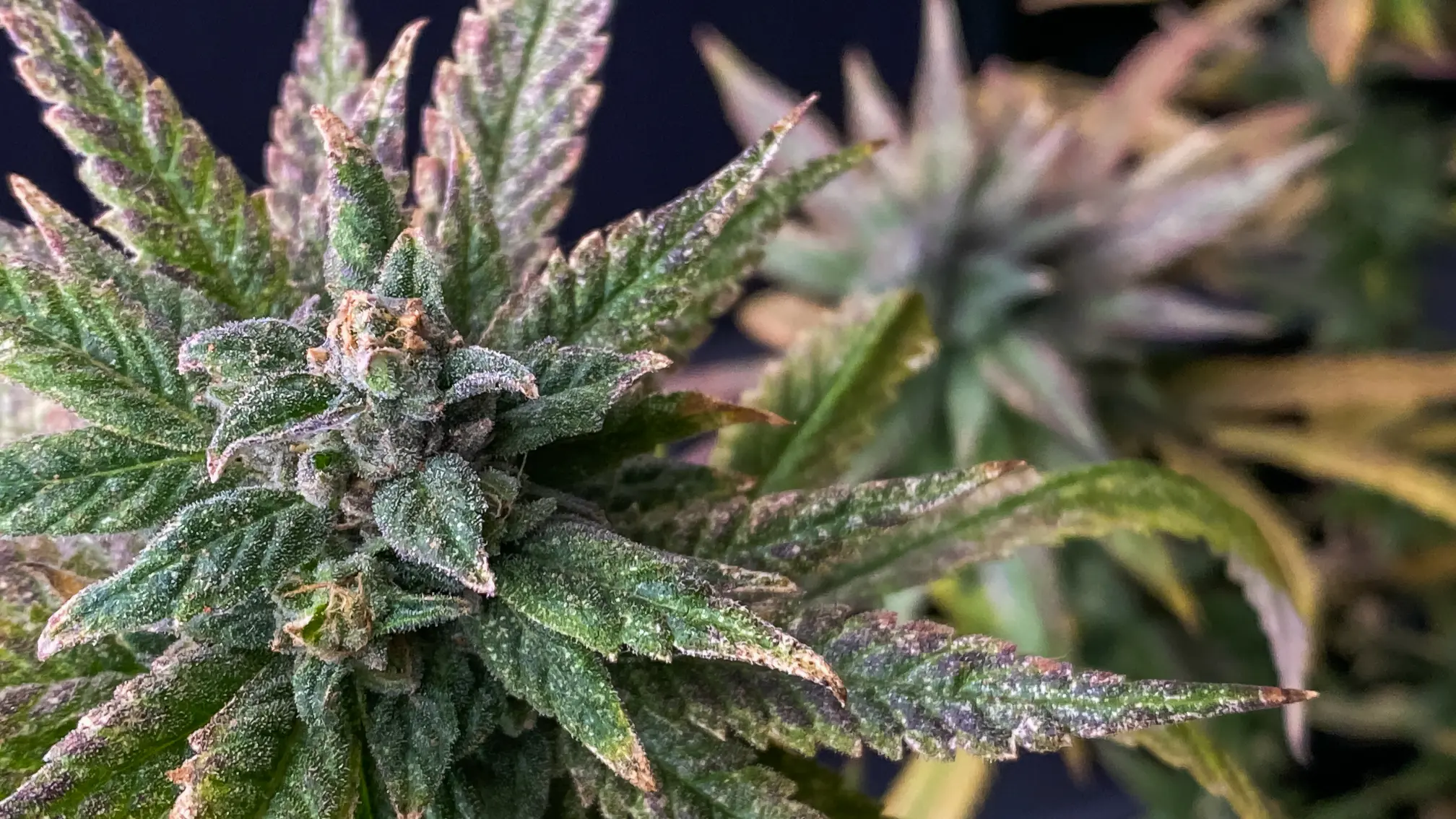
Black Cherry Punch
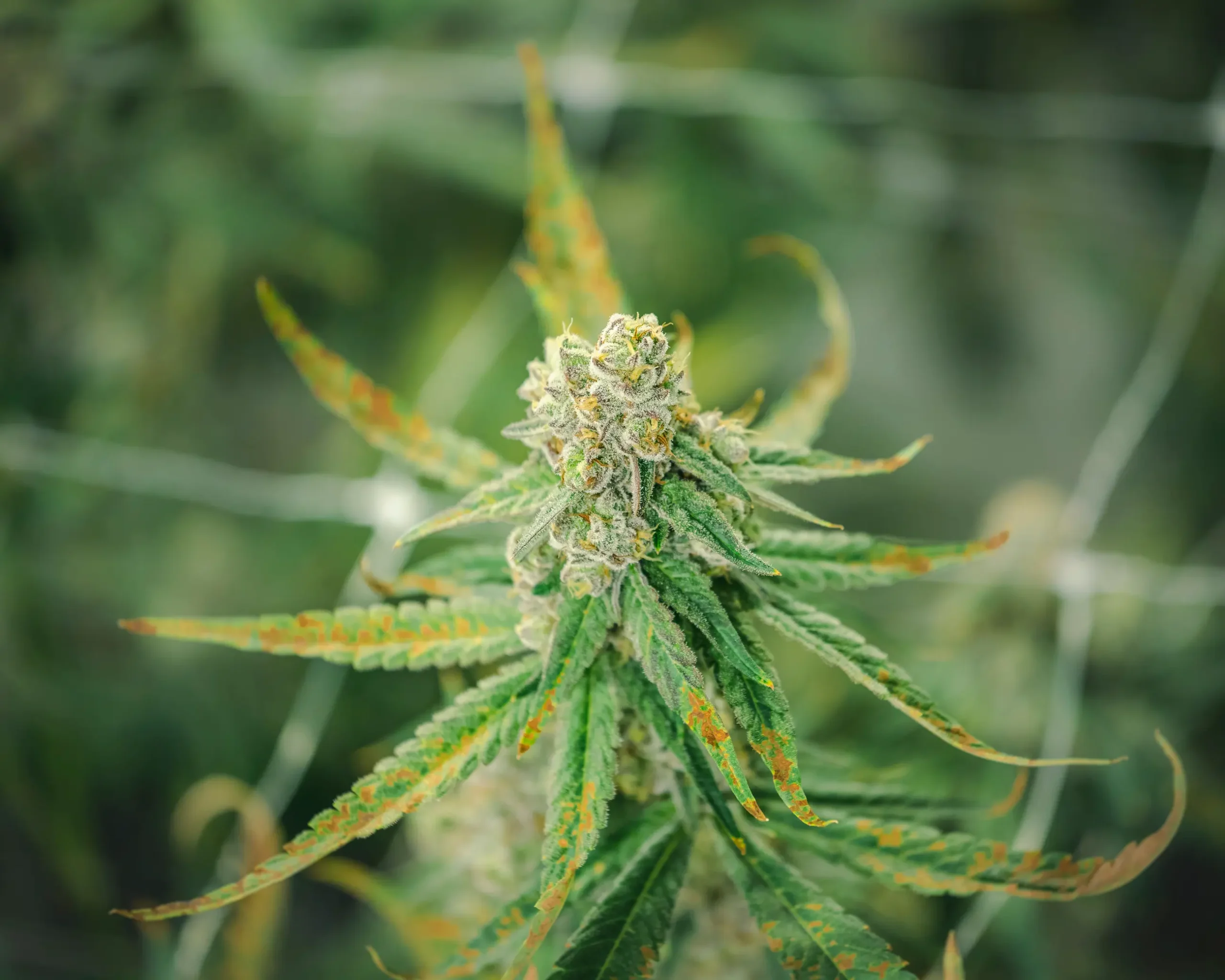
Black Cherry Punch is a dark-fruit hybrid known for cherry skin, blackberry, floral sweetness, spice and earthy dough. The plant is usually easier to control vertically than many modern gas hybrids, but its branching can become broad and dense after the flip. Purple coloration and orange pistils make the flowers look finished early, even when the calyxes still need time to swell.
The cultivar is most commonly documented as Purple Punch crossed with Black Cherry Pie. Some separate commercial lines use different cherry and blackberry parents under the same name, so exact genetics should be verified. The profile here follows the widely recognized Purple Punch x Black Cherry Pie version.
The central cultivation question is how to protect dense, dark flowers through the final humid weeks without harvesting by color. Black Cherry Punch rewards an open center, moderate branch count and careful stem-side inspection. A purple cola can look pristine from the front while moisture is already collecting near the main stem.
Should I harvest Black Cherry Punch when the flowers turn purple?
No. Treat purple color as a phenotype and temperature response, not as a maturity clock. Wait for completed calyx swelling, a clear slowdown in fresh pistils and mostly cloudy trichomes on the calyxes. Inspect the stem side of the darkest tops before extending the finish because purple tissue can hide early moisture damage.
Sent by: Lena via e-mail
Strain Features
| Feature | Details |
|---|---|
| Strain Type | Indica-dominant hybrid |
| Genetic Profile | Purple Punch x Black Cherry Pie |
| THC | Commonly reported around 18% to the mid-20% range; batch dependent |
| CBD | Usually very low |
| Dominant Terpenes | Myrcene, limonene and beta-caryophyllene are frequently reported |
| Flavor / Aroma | Black cherry, blackberry, floral fruit, vanilla, spice, hops and earth |
| Effect Character | Tingly mental relaxation followed by physical calm and possible sleepiness |
| Flowering Time | Approximately 8 to 10 weeks |
| Stretch | Low to moderate in many expressions, though a broad branch network can expand strongly |
| Plant Architecture | Short to medium, bushy and multi-branched |
| Bud Structure | Chunky to tapered dense flowers with dark color potential |
| Grow Difficulty | Beginner to intermediate |
| Primary Quality Risk | Late humidity hidden inside purple flowers and premature harvest based on color |
Genetic Lineage
Purple Punch contributes grape, dessert sweetness, compact flower and a heavy physical finish. Black Cherry Pie contributes cherry, blackberry, floral aroma, branching and darker fruit complexity. Together they create a plant that usually remains manageable in height while building many similar-sized tops.
The cultivar can express broad leaves and a compact frame, but some phenotypes develop medium internodes and a surprisingly wide canopy. This is why the plant may not require much early defoliation, then suddenly need a serious cleanup by the third week of flower.
Aroma varies between sweet cherry, fermented red fruit, floral vanilla and earthy spice. The best flower retains cherry skin and floral fruit after cure. Purple color is visually valuable, but it is not a substitute for flavor or clean interior flower health.
The name also needs careful handling. The Purple Punch x Black Cherry Pie description is the most useful reference point for this profile, but related commercial versions have been documented with Blackberry Kush and Cherry Pie influence. Those versions can overlap in dark-fruit aroma, purple color and evening effects while behaving differently in height, flower shape and finish time. A grower working from seed should therefore identify the actual source and treat the first run as a phenotype evaluation rather than assuming every plant will reproduce one famous photograph.
Purple Punch-leaning plants often show broader leaves, shorter internodes, rounder flowers and an earlier physical heaviness. Black Cherry Pie-leaning plants may carry more lateral branching, a clearer cherry-skin aroma, floral spice and a slightly brighter opening effect. The distinction is not absolute, but it gives the grower a useful way to read a mixed group before the flowers are mature.
| Selection Signal | Purple Punch-Leaning Expression | Black Cherry Pie-Leaning Expression |
|---|---|---|
| Vegetative form | Shorter internodes, broader leaves and a compact center | More lateral reach, medium internodes and a wider outline |
| Flower shape | Rounder, denser clusters with early purple color | Tapered or spear-like tops with more visible pistils |
| Aroma direction | Grape dessert, vanilla, earth and soft spice | Black cherry skin, floral fruit, wood and sharper pepper |
| Likely management need | Earlier airflow planning and conservative nitrogen | More branch support and room for lateral expansion |
| Keeper question | Does the dense flower remain clean and flavorful? | Does the cherry profile remain clear after drying and cure? |
Keeper selection should continue after harvest. Dark color and resin are easy to score while the plant is standing, but they do not reveal whether the dried flower retains cherry, whether the inner buds cure evenly or whether the smoke becomes dominated by generic earth. Record branch strength, stretch, finish time, stem-side humidity, live aroma, dry aroma and jar aroma after four weeks. That record is more useful than choosing the darkest plant on harvest day.
Effect Breakdown
Tingling relaxation begins in the head
The onset often feels soft, tingly and mentally calming rather than highly stimulating. Mood improves and attention becomes less urgent.
The body settles without immediate shutdown
Physical relaxation builds gradually. Moderate doses can remain social and comfortable, especially when tolerance is established.
Late doses become sleep-oriented
Larger amounts may produce heavy eyelids, appetite and reduced coordination. Dry eyes and dizziness are common negative reports.
The progression matters because the first phase can be misleading. A modest amount may feel cheerful, sensory and conversational before the physical portion becomes obvious. Redosing during that brighter window can turn a comfortable evening into a much heavier session thirty or forty minutes later. Users with low tolerance should leave enough time to understand the batch rather than treating the soft onset as proof that the flower is mild.
Different harvest windows can shift the emphasis without changing the cultivar into a different plant. A slightly earlier, fully mature harvest may preserve more of the lively floral opening, while a later harvest with more amber trichomes usually feels heavier and less task-friendly. The difference should not be exaggerated into medical certainty, but it is useful when deciding whether a keeper belongs in a social evening rotation or a sleep-oriented one.
The effect also reflects batch chemistry rather than the label alone. Public flower datasets show a broad THC range instead of one permanent number, and laboratory terpene order changes between samples. A limonene-forward batch may feel brighter at the beginning, while a myrcene-heavy batch may settle sooner. These are tendencies, not guarantees, and they reinforce the value of starting low with an unfamiliar harvest.
Flavor & Aroma Profile
The jar can smell like black cherry, blackberry and overripe berry skin. Broken flower releases floral sweetness, vanilla, hops, wood and damp earth. Some batches add a lightly fermented or wine-like note.
The inhale is fruity and soft. Cherry and berry appear first, followed by vanilla. The exhale becomes spicier and earthier, with a faint bitter hop or wood finish.
Rapid drying removes floral cherry before earth and spice. The flower may still smell sweet, but the palate becomes flat. A controlled cure allows the dark fruit to remain clear without turning the smoke sugary or harsh.
The intact jar, broken flower and exhale should be evaluated separately. A closed jar may present overripe blackberry and grape first. Breaking a bud should reveal the sharper cherry-skin, violet, vanilla and woody interior. On the exhale, pepper, dry earth and a hop-like bitterness often arrive after the fruit. When all three stages repeat the same generic berry note, the flower may be pleasant, but it is not showing the full complexity associated with the better expressions.
The cherry note is darker than hard-candy cherry. It is closer to ripe black cherry, fermented skin or the dry edge of red wine. That distinction is useful during selection because very sweet plants can lose definition after cure, while a phenotype with a slightly bitter skin note may develop more convincing depth in the jar. The goal is not maximum sweetness. It is a clean contrast between fruit, flowers, vanilla and the earthy-spiced base.
Smoke texture exposes finishing errors quickly. Excess nitrogen can leave the palate green and dense, while accumulated salts may create a hot mineral finish that hides the fruit. An over-dry batch can still smell loud when squeezed but deliver little flavor because the most volatile floral portion left during the first days after harvest. Black Cherry Punch benefits from a clean late root zone and a slow moisture transition precisely because its identity depends on quieter top notes.
Dominant Terpenes
Terpene rankings vary across phenotypes, environments and laboratory batches. The table summarizes recurring patterns rather than a fixed chemical formula.
| Terpene / Volatile Group | Likely Role in Black Cherry Punch |
|---|---|
| Myrcene | Often supports ripe berry, earth and the physically relaxing finish. |
| Limonene | Adds brightness to cherry and floral fruit and may support the lighter mental opening. |
| Beta-Caryophyllene | Provides pepper, spice and a dry earthy backbone. |
| Secondary floral compounds | Linalool and other minor volatiles may contribute violet, vanilla and perfume-like notes in selected samples. |
Published batch data does not support one universal terpene order. Some tested flowers are limonene-led, others place myrcene or beta-caryophyllene first, and individual samples have shown measurable linalool, alpha-pinene, beta-pinene, humulene or guaiol. One batch may therefore smell brighter and more floral, while another emphasizes ripe berry, earth and pepper. The strain name describes a family expression, not a guaranteed analytical formula.
This variation is especially important when comparing commercial flower with a home-grown plant. Lighting, root-zone balance, harvest maturity, drying temperature and storage all change the measured and perceived profile. A laboratory result belongs to the tested sample and cannot be copied onto every Black Cherry Punch plant. The useful lesson is the recurring relationship: light citrus and floral compounds lift the cherry, myrcene anchors the dark fruit and earth, and caryophyllene or humulene supplies the dry spice that prevents the aroma from becoming simple candy.
Terpenes also do not explain every odor by themselves. Fermented fruit, wine skin and hop-like bitterness may involve volatile compounds outside a short commercial terpene panel. Use terpene information to compare batches and protect likely aroma directions, not to make medical promises or claim that a four-compound list is the complete smell of the cultivar.
Indoor vs. Outdoor Growing
| Decision Point | Indoor Growing | Outdoor Growing |
|---|---|---|
| Plant size | Indoor height is generally manageable, but width requires planning | Outdoor plants can form broad shrubs that need branch separation |
| Color and maturity | Indoor observation helps separate pigmentation from true ripeness | Natural cool nights may deepen color before the flower is mature |
| Humidity risk | Interior airflow protects dense dark colas | Rain, dew and cool nights can hide moisture near the stem |
| Training | One topping and branch spreading usually work well | Early widening creates several manageable main flowers |
| Harvest control | Indoor growers can wait for complete calyx swelling | Outdoor weather may force selective branch harvests |
| Best fit | Growers seeking colorful dessert flower without extreme height | Warm dry climates with a protected autumn finish |
For Black Cherry Punch, the indoor advantage is the ability to control the cultivar's defining weakness before it damages premium flower. Outdoor plants can express more size and seasonal complexity, but the finishing climate must match the stretch, flower density and aroma sensitivity described above.
Indoors, the cultivar fits rooms where vertical height is limited but lateral service space is available. That difference matters. A grower may see a short plant and place several containers close together, only to discover that the side branches merge during transition. Fewer plants with visible lanes between them are easier to inspect, irrigate and support than an overcrowded canopy of individually manageable plants.
Outdoors, early morning sun and moving air are more valuable than a sheltered-looking corner. The broad plant can use full-season root volume well, but a wall, dense hedge or low pocket may hold dew around the inner flowers long after the rest of the garden dries. Install support before the stems harden and guide the main arms outward so the center receives light from more than one direction.
A greenhouse protects the flowers from direct rain but can trap the exact humidity that threatens them. Sidewall ventilation, horizontal circulation and enough space between plants are essential. If the greenhouse remains sealed during cool nights, the roof may prevent rain while condensation and saturated air collect around the purple tops. Weather protection is only useful when moisture can also leave the structure.
Container choice should follow the planned branch count. A very large container kept constantly wet beneath a compact young plant can slow root oxygenation. A small container beneath a broad flowering shrub can create sharp swings in water content and root-zone EC. Choose enough volume to support the intended canopy, then let measured daily demand determine irrigation frequency.
Strain-Specific Grow Guidance
Let the natural branch pattern appear before heavy pruning
The plant often forms several useful side branches without complex training. One early topping or bend is usually enough. Remove only the branches that clearly lack a path to strong light.
Expect width even when height looks manageable
Low-to-moderate vertical stretch can hide strong lateral expansion. Leave space between plants so the side branches do not merge into one humid canopy.
Perform the main interior cleanup near the end of stretch
Some plants look open in vegetative growth and become dense during the first three weeks of flower. Remove small inner shoots and selected overlapping leaves before flowers harden.
| Growth Stage | Training Decision | Black Cherry Punch Reading |
|---|---|---|
| Rooted seedling or clone | Build roots and observe natural symmetry | Do not top a slow plant simply because the broad leaves make it look mature. |
| Early veg | Top once or bend the main stem | Select outward-facing laterals and remove only shoots with no realistic light lane. |
| Late veg | Spread the branch fan | Leave gaps between plants; width often increases faster than height after the flip. |
| Flower weeks 1-2 | Tuck flexible branches and identify the productive layer | Watch the center refill before deciding how much leaf to remove. |
| End of stretch | Complete lower cleanup and final structural thinning | Preserve exposed fan leaves while removing weak interior flower sites. |
| Mid to late flower | Support and inspect rather than reshape | Keep purple tops separated and avoid heavy pruning once resin and density rise. |
The preferred pruning window is late veg through the end of stretch, not deep into full flower. This timing allows the grower to see which branches actually reached the canopy before removing the lower third. It also prevents repeated handling of sticky dark flowers later. Late pruning should be limited to a real airflow obstruction or damaged tissue, not performed because a generic calendar demands another strip.
Avoid overwatering the broad compact root zone
A short plant in a large container may stay wet longer than expected. Use container weight and plant demand rather than a fixed watering schedule.
Keep nitrogen moderate through transition
Excess nitrogen creates broad dark leaves and delays a clean flower fade. It also makes stem-side humidity worse as the buds become dense.
Black Cherry Punch is better approached with moderate feeding after the root system is established. There is no peer-reviewed cultivar-specific EC curve, so a rigid number would create false precision. The practical rule is to increase strength only when water use, leaf color and continued growth justify it. Dark glossy leaves, hooked tips, soft stems and slowing irrigation demand are stronger warnings than the reputation of the cultivar.
| Stage | Priority | What to Watch | Adjustment |
|---|---|---|---|
| Early veg | Root development and balanced nitrogen | Slow dryback, pale new growth or constantly wet media | Correct oxygen and root temperature before increasing feed. |
| Late veg | Strong laterals without oversized leaves | Very dark foliage, clawing and a sealed center | Hold nitrogen and improve spacing rather than adding more inputs. |
| Transition | Stable calcium and magnesium availability during branch expansion | Interveinal paling, weak petioles or rising runoff EC | Verify pH and source water before supplementing. |
| Mid flower | Consistent delivery through flower bulking | Burned tips, stalled drinking or edge curl | Reduce concentration or frequency; do not chase density with salts. |
| Late flower | Clean finish and functioning leaves | Wet media after the usual interval, delayed fade or harsh mineral aroma | Follow declining demand and avoid unnecessary late additives. |
Match light to the open canopy
Once the branch fan is established, Black Cherry Punch can use firm flowering light, but top intensity cannot compensate for a sealed middle. Build a shallow productive layer first, then increase intensity while monitoring leaf angle, canopy temperature and irrigation demand. The exact target depends on room control, carbon dioxide, medium and phenotype.
For an ambient-carbon-dioxide room, a practical operational range may begin around 350-500 PPFD for rooted young plants, 500-700 PPFD in established veg, 650-850 PPFD during transition and roughly 800-1000 PPFD after stretch if temperature and irrigation remain stable. These are Weedth working ranges, not Black Cherry Punch trial results. Stay in the lower half when the room is warm, root volume is limited or upper leaves show edge curl and bleaching.
Purple color does not make the flower immune to excess light. A dark top can still run hot, lose volatile floral notes and develop dry margins. Compare the aroma and posture of exposed tops with slightly protected flowers. If the upper layer smells flatter and the leaves point away from the fixture, reducing load may improve the finished jar even without obvious burn.
Manage climate as density increases
Early flower can tolerate moderate humidity, but the target should move downward as the colas harden. Roughly 50-55% RH during transition, 45-50% through bulk and 40-45% near finish is a practical starting progression when temperature and airflow support it. These are adaptable operating ranges, not guarantees against mold.
Use several gentle air paths instead of one fan aimed directly at the tops. Air should enter below the canopy, cross the branch layer and leave above it. Direct fan blast can harden the visible surface while the stem-side core remains damp. Branch spacing and lower cleanup solve the underlying problem more reliably.
Read the flowering window by development
Most descriptions center around eight to nine weeks, but related lines and seed phenotypes can move outside that range. Treat the calendar as a scheduling tool and the plant as the harvest authority.
| Flower Period | Likely Development | Grower Priority |
|---|---|---|
| Weeks 1-2 | Moderate stretch, widening laterals and early pistils | Finish the branch layout without filling every gap. |
| Weeks 3-4 | Center closes and flower positions become clear | Complete lower cleanup, thin only real overlaps and install support. |
| Weeks 5-6 | Berry-floral aroma rises and purple color may begin | Hold root-zone stability and lower humidity as density increases. |
| Weeks 7-8 | Calyxes stack, resin increases and stem-side moisture risk peaks | Inspect dark tops from behind and protect canopy temperature. |
| Weeks 9-10 | Later phenotypes complete the final swell and cherry profile | Harvest by maturity and flower health, not by color or date alone. |
Inspect purple flowers from behind
Color can arrive before maturity
Deep purple leaves and calyxes can make Black Cherry Punch look finished while the flowers are still swelling. Confirm maturity with calyx development, pistil behavior and trichomes, then inspect the stem side of dense tops before giving a colorful plant extra days in a humid room.
Dark tissue can hide brown or gray damage. Check the stem-facing side of the largest colas after humid nights, irrigation spikes or rain. A healthy outside surface does not guarantee a healthy core.
Harvest by calyx swelling, not purple color
Wait for reduced fresh pistils and mostly cloudy trichomes on calyx tissue. An early colorful harvest often lacks the final cherry depth and density.
Grower Note: Use these strain-specific observations as a decision framework rather than a fixed recipe. Medium, container size, climate, plant maturity and the exact phenotype can change stretch, feeding and finish time.
Weedth Bud Flavor Tips
Protect floral cherry and vanilla with a cool, dark drying environment. Outdoor branches should be harvested after surface moisture dries and moved away from sunlight immediately.
Dense tops may need to be divided into medium branches, especially after humid outdoor weather. Direct fan air can harden the outside before the dark core is safe.
Several weeks of cure usually improve black-cherry clarity and soften the hop-like spice. Store the finished flower in smaller containers and avoid repeatedly opening the entire harvest.
Treat the cultivar as a floral dark-fruit plant, not as a gas-heavy hybrid whose loudest notes survive any post-harvest treatment. The lighter cherry, violet and vanilla fraction is the first part to flatten under heat, oxygen and abrasion. A batch may retain potency and a strong earthy smell while losing the exact contrast that makes the flower recognizable.
My preferred operational dry is large-branch hanging in darkness around 16-19°C and 55-60% RH with indirect room circulation. Ten to fourteen days is a useful target when branch size and room control allow it, but the endpoint matters more than the calendar. Dense tops must lose moisture evenly; they should not become crisp outside while the core remains cool and soft.
Use minimal wet trimming. Protective sugar leaves slow the surface and reduce unnecessary contact with resin heads. Once the flower is evenly dry, perform a careful dry trim and begin curing in containers small enough to monitor without exposing the entire harvest. The first week may smell predominantly earthy or fermented. By the third to sixth week, the cherry-skin, floral and vanilla layers should become clearer if they were preserved.
| Post-Harvest Stage | Target Reading | Black Cherry Punch Risk |
|---|---|---|
| Harvest handling | Cool branches moved gently out of light | Warm piles and compression bruise resin and trap field moisture. |
| Early dry | Slow, even surface moisture loss | Direct fan air hardens the outside before the purple core is safe. |
| Dry-trim point | Small stems beginning to snap while larger stems retain slight flex | Trimming too wet increases handling; trimming bone-dry sheds resin and fruit. |
| Early cure | Stable internal moisture with brief, measured air exchange | Sealing a damp dense top can create hidden microbial risk. |
| Long storage | Cool, dark, airtight containers with limited headspace | Repeated opening removes floral cherry before the heavier earth and spice. |
Divide the finished flower into a working jar and reserve jars. The working portion can be opened normally while the reserve remains stable. This is especially valuable for Black Cherry Punch because the most delicate floral-fruit notes disappear before the heavier earthy-spice base. Long storage in one frequently opened container makes the cultivar progressively less distinctive.
Protect the cherry-floral top layer
Dry slowly, trim gently and let the cure integrate black cherry, vanilla, wood and spice.
Judging preservation by loud earth alone
A strong jar can still be incomplete when heat or oxygen has removed the quieter fruit and flowers.
Weedth Bud Boost Tips
Indoors, a broad canopy of several medium colas usually produces more premium flower than one untouched central plant. Keep the interior clean and the productive zone shallow.
Outdoors, support the branch network and protect the final weeks from repeated rain. Selective branch harvesting is preferable to losing an entire plant while waiting for one immature top.
Color should not be treated as a yield metric. The best harvest is clean, fully swollen and flavorful, not simply the darkest plant in the room.
The largest improvement usually comes from canopy geometry, not a stronger bottle. Select a manageable number of outward-facing branches, keep the productive layer shallow and remove low interior sites before they consume time and humidity. This converts the plant’s natural branching into several supported tops instead of a crowded collection of small flowers.
Support should preserve separation. A low net can hold the branch fan open during transition, while a second layer or individual ties can stabilize flowers as they gain weight. Pulling every top toward the center defeats the purpose. Outdoors, a wide cage installed early gives each main arm its own lane and makes selective branch harvest possible if weather deteriorates.
Do not force purple color with severe cold. Cooler nights may deepen pigmentation, but a cold root zone slows water use and can raise relative humidity around dense flowers. Color is a secondary expression. Healthy calyx expansion, clear aroma and clean interior tissue matter more than producing the darkest photograph.
The most important bud-boost sentence for this cultivar is this: Black Cherry Punch responds better to a separated branch fan than to maximum plant count. If neighboring plants merge during stretch and the stem side cannot be inspected, more nutrients will not rescue the premium flower hidden in the middle.
Medical Uses & Benefits
Reported use includes evening stress, physical discomfort, low mood and sleep preparation. Moderate doses may feel mentally calm without immediate couch-lock.
High THC can cause dizziness, dry eyes and excessive sedation. Reported experiences do not establish treatment for any medical condition.
Use reports are not medical proof
Cannabis responses vary by dose, tolerance, product chemistry and individual physiology. Reported experiences do not replace medical advice and do not prove that a cultivar treats disease.
The tingly opening and later body calm may suit some adults seeking an evening transition, but the sequence is not universal. A low dose can feel emotionally light, while a larger dose may bring dizziness or sleepiness before the user expects it. People who are sensitive to high-THC products should use particular caution with an unfamiliar batch.
Strain names are not standardized medicines. Two products sold as Black Cherry Punch can differ in THC, minor cannabinoids, terpene order and duration. Reported help with stress, discomfort or sleep should therefore be treated as subjective experience data, not as proof that the cultivar diagnoses, prevents or treats a condition.
Ideal User Profile
Black Cherry Punch suits users who enjoy dark fruit and floral dessert flavors with a calm evening progression. It also suits growers who want strong visual color without extreme plant height.
It is less suitable for humid autumn climates without protection or for growers who judge harvest readiness by color alone.
The ideal user values depth more than bright candy. Black Cherry Punch is a better fit for someone who enjoys ripe fruit, floral perfume, wood and pepper than for someone expecting a sharp sour-cherry confection. Its later phase also favors evenings, quiet social settings and unhurried activities over demanding daytime work.
The ideal grower has enough space to read width as well as height. The cultivar does not necessarily require advanced techniques, but it rewards inspection, measured watering and a willingness to delay harvest until the calyxes finish. A grower who prefers to pack many compact plants tightly together may find the lateral branch habit more demanding than expected.
Grower Notes and Feedback
Grow reports commonly describe a short-to-medium plant that becomes wider during transition. Defoliation may seem unnecessary early, then become useful once the side branches have filled the center.
Dark coloration and sweet aroma appear before full maturity in many expressions. Growers who wait for complete calyx expansion generally report better density and a more defined cherry finish.
Another recurring observation is that the plant can look easier than it is. Vertical control is rarely dramatic, so the canopy feels orderly in early flower. The problem develops sideways as similar-sized branches and broad leaves occupy the same interior space. The best runs do not fight that habit late. They anticipate it with wider spacing and one decisive cleanup near the end of stretch.
Growers also note a gap between live-plant aroma and cured flavor. The room may smell intensely sweet and floral, yet a fast dry leaves mostly earth, berry and pepper. This is not always a genetic failure. It often shows that volatile fruit and flowers were lost while the heavier base survived. Evaluating a keeper before a complete cure can eliminate the plant that would have been the most distinctive.
A practical phenotype record should include vertical stretch, lateral reach, branch strength, the date color begins, the date calyxes complete their swell, visible moisture pressure and aroma at three stages: live flower, dry flower and four-week cure. That information reveals whether the plant is merely attractive or genuinely repeatable.
Weedth Editor's Note
The realistic Black Cherry Punch scenario is not a dramatic nutrient failure. It is two humid nights near harvest. The cola still looks purple and clean from the aisle, but one stem-side bract feels softer than the rest. I would open that area carefully, inspect the interior and harvest the affected branch immediately if tissue has begun to break down.
I would rather lose one top than wait for a darker photograph and risk the entire plant. On the next run, I would create a little more space between the main colas before week four. That decision is more specific to Black Cherry Punch than repeating a generic promise to top once and cure slowly.
What draws me to Black Cherry Punch is the way the plant changes the meaning of ripeness. Many cultivars become visually tired near the end. This one can look theatrical too early: purple leaves, bright pistils and a dark-fruit smell that suggests the work is finished. I have to ignore that invitation and look closer at the calyxes, the fresh pistils buried inside the top and the trichomes on flower tissue rather than sugar leaves.
I would build the plant outward, not upward. A fan of five or six strong arms gives the flowers room to express their color without turning the center into a sealed bouquet. I would rather see light between branches at the flip and let transition close part of the gap than enter flower with a perfect green carpet that becomes impossible to inspect.
The jar is where I would finally decide whether the run succeeded. On day three, dark berry and earth may dominate. After several weeks, the better harvest should become more articulate: black cherry skin, a floral edge, vanilla behind it, then dry wood and pepper after the exhale. That slow separation is more interesting to me than sweetness alone because it proves the flower kept its structure through drying.
If I grew it again, I would not chase a colder finish or a darker plant. I would chase a cleaner interior and a more patient cure. The memorable version is not simply purple. It is the version where the color, cherry perfume and calm evening effect all arrive together without the flower ever feeling damp, rushed or one-dimensional.
Weedth Score
Growing Experience: 8.5/10
Manageable height and strong branching, with late humidity as the defining challenge.
Bud Structure & Visual Appeal: 9.3/10
Dark, colorful and dense with excellent bag appeal.
Aroma Complexity: 8.8/10
Black cherry, floral fruit, vanilla, hops and earth create good depth.
Flavor & Smoothness: 8.6/10
Rich after controlled drying; floral fruit disappears quickly when rushed.
Effects & High Experience: 8.4/10
Tingly, calming and increasingly sleep-oriented at higher doses.
Overall Satisfaction & Recommendation: 8.7/10
A rewarding dark-fruit cultivar for indoor growers and dry outdoor climates.
I would run Black Cherry Punch again for the cherry-floral finish, but I would treat every humid night near harvest as an inspection event rather than a reason to keep admiring the color.
FAQ
What is Black Cherry Punch's lineage?
The widely recognized version combines Purple Punch with Black Cherry Pie.
How much does Black Cherry Punch stretch?
Vertical stretch is usually low to moderate, while lateral branches can expand strongly.
Does Black Cherry Punch need defoliation?
Selective interior thinning is useful near the end of stretch, especially when side branches close the center.
Why did my Black Cherry Punch turn purple early?
Pigmentation can appear before full maturity. Color is influenced by genetics and temperature.
Is Black Cherry Punch prone to bud rot?
Dense dark flowers can hide moisture near the stem, so humid finishes require inspection.
When should Black Cherry Punch be harvested?
Wait for complete calyx swelling, fewer fresh pistils and mostly cloudy calyx trichomes rather than using color alone.
Similar Strains
Purple Punch – Shares grape dessert flavor and evening calm, but usually has less cherry and floral complexity.
Cherry Pie – Provides red fruit and balanced relaxation with a brighter, less heavy structure.
Black Diamond – Matches dark color and evening effects, with more grape, earth and pine.
Forbidden Fruit – Offers dark fruit and relaxation, but leans toward grapefruit and cherry rather than vanilla.
Educational content. Always follow local laws and regulations.
Share this article
A quick overview of the topics covered in this article.