Cannabis Micronutrients Explained: Iron, Manganese, Zinc, Boron, Copper, and Molybdenum
While primary and secondary macronutrients dominate fertilizer discussions, cannabis health and metabolic efficiency depend entirely on trace micronutrients: Iron (Fe), Manganese (Mn), Zinc (Zn), Copper (Cu), Boron (B), Molybdenum (Mo), and Nickel (Ni). Although these trace elements comprise less than 0.5% of total plant dry matter, they serve as indispensable prosthetic groups, catalytic cofactors, and electron carriers in critical enzymatic pathways including Photosystem II water photolysis, chlorophyll synthesis, indole-3-acetic acid (auxin) biosynthesis, and nitrate reduction. In controlled environment agriculture, micronutrient deficiencies and toxicities are rarely caused by an absolute lack of mineral ions in the reservoir; rather, they stem from root-zone pH drift, chelate degradation, and severe electrochemical ion antagonisms governed by Mulder’s Matrix. This comprehensive engineering guide explores the biochemistry of micronutrient assimilation, examines chelation stability dynamics across pH spectrums, provides definitive clinical diagnostic matrices, and details step-by-step remediation protocols for commercial cannabis facilities.
Biochemical Mechanisms: Why Cannabis Requires Trace Elements
To maintain high metabolic rates under high-PPFD LED arrays, cannabis requires a continuous supply of essential mineral elements. While macronutrients such as nitrogen, phosphorus, and potassium form the structural building blocks and bulk osmotic fluids of the plant, micronutrients operate primarily as catalytic activators and electron shuttles.
Trace metals feature variable oxidation states and flexible d-orbital electron configurations. This atomic architecture allows elements like iron, copper, and manganese to accept and donate electrons reversibly during cellular respiration and photosynthesis. Without adequate micronutrients, fundamental physiological reactions stall:
- Photosynthetic Light Reactions: Manganese and iron form the core electron transport chains of Photosystem II and Photosystem I, shuttling solar energy to generate NADPH and ATP.
- Enzyme Activation: Over 300 plant enzymes require a metallic cofactor to achieve catalytic structural confirmation, including RNA polymerases, super oxide dismutases (SOD), and carbonic anhydrases.
- Hormonal Regulation: Zinc governs the biosynthesis of tryptophan, the direct biochemical precursor to indole-3-acetic acid (IAA, auxin), which drives apical dominance, root branching, and cell elongation.
- Cell Wall Structural Integrity: Boron cross-links rhamnogalacturonan II polysaccharides in the pectin matrix of expanding cell walls, determining tissue mechanical strength and floral elasticity.
- Antioxidant Photoprotection: High-PPFD LED arrays generate intense photon flux that frequently exceeds the capacity of the dark biochemical reactions. Excess excitation energy generates toxic Reactive Oxygen Species (ROS) such as superoxide radicals (ext{O}2·-) and hydrogen peroxide (ext{H}2 ext{O}2). Superoxide dismutase (SOD) enzymes utilize copper, zinc, and manganese metallo-cores to dismutate these free radicals into harmless water and oxygen, shielding thylakoid membranes from photo-oxidation.
Under high-intensity indoor cultivation exceeding 900 to 1,200 μ ext{mol}/ ext{m}2/ ext{s} PPFD with elevated carbon dioxide supplementation (1,200 to 1,500 PPM CO2), photosynthetic enzymatic turnover accelerates by 35% to 50%. This heightened metabolic velocity dramatically increases the turnover rate of catalytic micronutrients. If trace element supply is inadequate, the photosynthetic machinery encounters an immediate enzymatic logjam, dissipating excess photon energy as non-photochemical quenching (NPQ) or suffering photodamage that permanently impairs bud yield.
The term “micronutrient” does not imply lesser importance. A deficiency of 0.05 PPM boron or 1.5 PPM iron will shut down biomass accumulation and floral development just as severely as a total lack of nitrogen. However, because cannabis requires these elements in parts-per-million or parts-per-billion concentrations, the margin between sufficiency and fatal toxicity is razor-thin.
Iron Chemistry: Oxidation States and Chelation Stability Curves
Iron (Fe) is the most heavily demanded micronutrient in cannabis production, typically supplied between 1.5 and 4.0 PPM in hydroponic fertigation solutions. Iron serves as the mandatory catalytic cofactor for 5-aminolevulinic acid dehydratase (the rate-limiting enzyme in chlorophyll biosynthesis) and forms the active heme and iron-sulfur clusters in cytochromes and ferredoxin.
In aqueous environments, unchelated inorganic iron exists in two oxidation states: ferrous (Fe2+) and ferric (Fe3+). In well-oxygenated, aerated irrigation reservoirs, ferrous iron rapidly oxidizes to ferric iron. When root-zone pH rises above 5.8, ferric ions react instantaneously with hydroxyl ions (OH–) and orthophosphates (H2PO4–), precipitating as completely insoluble ferric hydroxide (Fe(OH)3) and ferric phosphate (FePO4):
Fe3+ + 3OH– longrightarrow Fe(OH)3 ↓ (Precipitates out of solution at pH > 6.0)
To keep iron soluble and bioavailable across varying pH conditions, commercial agronomists utilize synthetic chelating ligands (organic molecules that wrap around the iron ion like a claw):
- Fe-EDTA (Ethylenediaminetetraacetic acid): The least expensive iron chelate. Highly stable in acidic solutions, but begins dissociating rapidly at pH 6.2. At pH 6.5, over 50% of Fe-EDTA precipitates; at pH 7.0, it is virtually useless. Best suited for strictly controlled acidic recirculating rockwool systems (pH 5.5 to 5.8).
- Fe-DTPA (Diethylenetriaminepentaacetic acid): The commercial standard for indoor hydroponics and coco coir. Remains chemically stable and fully soluble up to pH 7.0 to 7.2. Provides reliable protection against iron lockout during temporary alkaline root-zone spikes.
- Fe-EDDHA (Ethylenediamine-N,N’-bis(2-hydroxyphenylacetic acid)): An ultra-stable iron chelate featuring an intense dark red/purple color. Chemically stable from pH 4.0 all the way to pH 10.0+. Essential for alkaline soils, hard tap water systems, and outdoor living soils with limestone buffers.
- Fe-HBED (Hydroxybenzyl ethylenediamine): A cutting-edge commercial synthetic chelate possessing extreme affinity for ferric iron with near-zero photodegradation under UV sterilization or intense lighting, remaining stable up to pH 12.0.
- Amino Acid and Organic Polyhydroxy Chelates (Iron Glycinate / Fulvates): Natural organic chelates bind iron via carboxylic and amino functional groups. While possessing lower stability constants than synthetic EDTA or DTPA at high pH, amino acid chelates penetrate leaf cuticles rapidly during foliar feeding and are absorbed directly through root peptide transporters without requiring chemical dissociation.
The Biophysics of Strategy I Iron Uptake in Cannabis
As a dicotyledonous angiosperm, cannabis utilizes Strategy I iron acquisition. Because roots cannot directly absorb bulky ferric chelates or insoluble ferric oxides, epidermal cells execute a three-step biochemical extraction process at the root-soil interface:
- Rhizosphere Acidification: Plasma membrane ext{H}+-ATPases pump protons into the apoplast and boundary moisture layer, reducing rhizosphere pH locally by 0.5 to 1.0 units to increase ferric ion solubility.
- Enzymatic Reduction (Ferric Chelate Reductase): The membrane-bound enzyme Ferric Chelate Reductase (FCR) accepts electrons from intracellular NADPH, reducing ext{Fe}3+ to bioavailable ext{Fe}2+ while breaking the chelate bond.
- Transmembrane Transport (IRT1 Transporter): The high-affinity Iron-Regulated Transporter 1 (IRT1) protein shuttles the newly reduced ext{Fe}2+ ion across the plasma membrane into root cytoplasm.
When the root zone is cold (below 18 °C / 64 °F), over-saturated with water, or buffered to high pH, both proton pumping and enzymatic reduction collapse, inducing immediate iron deficiency even in solutions containing abundant iron.
All synthetic iron chelates, especially Fe-EDTA and Fe-DTPA, undergo rapid photochemical oxidation when exposed to ultraviolet radiation and intense visible light. Transparent reservoirs, translucent poly tubing, and inline UV sterilizers break down the organic chelate ligand within hours, freeing ferric ions to precipitate as rusty sludge at the bottom of the tank. Always use opaque, light-blocking reservoirs and install UV sterilizers only on unfertilized raw water lines.
Question: We are in week 3 of veg under high-intensity LEDs in 70/30 coco/perlite. The youngest top leaves have turned vivid fluorescent yellow between the veins, almost looking bleached white, but the lower leaves look healthy. Our input pH is 5.8 and EC is 1.6. We added extra Cal-Mag, but the yellowing got worse. What is causing this?
Your canopy is exhibiting classic apical iron chlorosis induced by root-zone alkaline drift and cation antagonism. Adding Cal-Mag worsened the lockout because Cal-Mag contains high calcium, which further suppresses iron uptake and raises media EC.
When you tested your runoff leachate, you likely found the runoff pH had drifted to 6.6 or higher. In coco coir, when nitrate nitrogen (NO3–) is absorbed rapidly, roots excrete hydroxyl (OH–) ions, pushing the root-zone pH up. At pH 6.6, standard Fe-EDTA iron chelates break down completely, precipitating iron out of solution. Because iron is immobile, the newest top leaves cannot synthesize chlorophyll and turn stark fluorescent yellow.
To fix the issue: flush the coco with a mild 1.0 mS/cm feed adjusted to pH 5.6 to drive root-zone pH back down to 5.8. Switch your iron source from Fe-EDTA to Fe-DTPA or Fe-EDDHA, which remain completely stable at higher pH. Apply a single foliar spray of Fe-DTPA (0.5 g/gal) at lights-off. New apical foliage will green up within 48 to 72 hours.
The Heavy Metal Catalysts: Manganese, Zinc, and Copper
Manganese (Mn), Zinc (Zn), and Copper (Cu) function as an interdependent enzymatic triad within cannabis cellular physiology:
1. Manganese (Mn2+): Water Photolysis and Enzyme Activation
Manganese is the structural cornerstone of the Oxygen-Evolving Complex (OEC) in Photosystem II. Within the photosynthetic membrane, a cluster of four manganese atoms (Mn4CaO5) coordinates the photolytic splitting of water molecules:
2H2O overset{hnu}{longrightarrow} O2 + 4H+ + 4e–
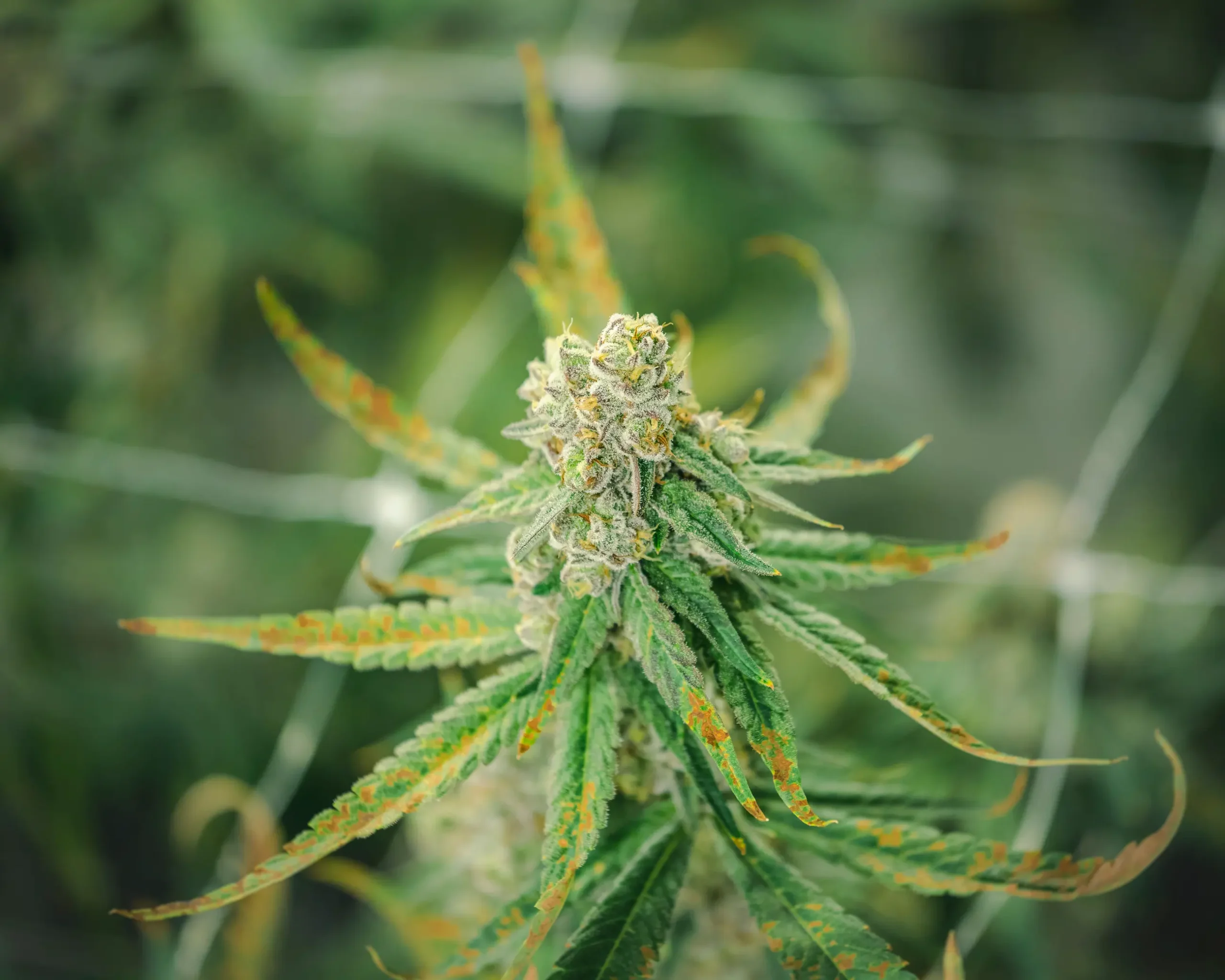
This reaction supplies the electrons that power all biomass generation. Furthermore, manganese activates decarboxylases and dehydrogenases in the citric acid cycle. Manganese deficiency manifests as mottled interveinal chlorosis on middle-tier fan leaves, accompanied by tiny checkered necrotic specks along secondary veins.
2. Zinc (Zn2+): Auxin Synthesis and Internodal Stretching
Zinc is required for the catalytic activity of carbonic anhydrase, which accelerates the conversion of dissolved carbon dioxide into bicarbonate for carbon fixation. More crucially, zinc is mandatory for the synthesis of tryptophan, the essential amino acid precursor of auxin (indole-3-acetic acid, IAA).
When zinc is deficient, auxin production collapses. Because auxin drives cellular expansion and stem stretching, zinc deficiency causes severe internodal compaction known as “rosetting” or “little leaf syndrome”. Emerging leaflets remain stunted, narrow, and twisted, displaying bleached interveinal chlorosis with dark necrotic margins.
3. Copper (Cu2+): Electron Transport and Lignification
Copper functions as the central metallic atom of plastocyanin, a water-soluble copper-protein complex that shuttles electrons from cytochrome b6f to Photosystem I during photosynthetic light reactions. Copper is also an essential cofactor for polyphenol oxidase and diamine oxidase, driving the synthesis of lignin in xylem vascular cell walls. Copper deficiency causes stems to become soft and limp, with young fan leaves curling downward into limp “spoon” shapes accompanied by a dull, dark bluish-green hue.
Boron: Cell Wall Cross-Linking and the Narrow Toxicity Window
Boron (B) is unique among essential plant nutrients because it is absorbed primarily as an uncharged, non-dissociated boric acid molecule (B(OH)3) rather than an ion. Boron is an immobile structural micronutrient that performs critical physical tasks in cannabis architecture:
- Pectin Matrix Cross-Linking: Boron forms diester borate complexes with rhamnogalacturonan II (RG-II) monomers within primary cell walls. This cross-linking glues cellulose microfibrils together, determining cell wall tensile strength, porosity, and expansion rate.
- Meristematic Cell Division: Boron is mandatory for DNA and RNA synthesis in actively dividing shoot and root meristems. Without boron, mitotic cell division halts abruptly within 6 hours.
- Pollen Tube Growth and Floral Development: Boron regulates calcium deposition during floral stretch, ensuring sturdy petiole attachments that prevent heavy late-stage colas from snapping.
Crucially, boron possesses the narrowest therapeutic window of any plant nutrient:
- Deficiency Threshold (< 0.2 PPM): New shoot tips become thick, brittle, and distorted. Terminal bud meristems die back (resembling tip rot or broad mite damage), lateral branches attempt to take over, and root tips turn dark brown, clubbed, and stunted.
- Target Sufficiency Window: 0.3 to 0.7 PPM elemental B in hydroponic and coco fertigation solutions.
- Toxicity Threshold (> 1.5 to 2.0 PPM): Boron toxicity causes severe marginal leaf scorch, starting as bright yellow halos along serrated edges of older fan leaves that rapidly turn into brown, necrotic crispy margins. Continued over-application causes total defoliation and plant death.
Never add standalone solubor or boric acid supplements to your cannabis nutrient solution unless lab tissue testing explicitly confirms a deficiency. Most tap water supplies contain 0.1 to 0.4 PPM of background boron. When combined with commercial base fertilizers, adding even 1 gram of boric acid per 100 gallons can push boron concentration past the 1.5 PPM toxicity threshold, inflicting irreversible leaf scorch across your entire crop.
Question: My plants are in week 5 of flower. The serrated edges of my upper fan leaves are getting brittle and curling upward like little burnt spoons, and the internodes look unusually bunched up and tight. Could this be light burn or a micronutrient issue?
Your symptoms match Zinc deficiency combined with early Boron toxicity. The compressed internodes (“rosetting”) and spoon-shaped curling indicate that zinc levels are depressed, halting auxin-mediated stem expansion. If you recently applied a trace mineral booster or heavy bloom stimulator, high phosphorus levels in the bloom booster may have precipitated zinc into insoluble zinc phosphate (Zn3(PO4)2).
Simultaneously, if the booster contained supplemental boron, boron levels may have exceeded 1.5 PPM, causing the brittle, burnt serrated leaf margins. Immediately stop all supplemental trace boosters. Leach the root zone with a clean baseline blooming formula (pH 5.9, EC 1.8 mS/cm) containing verified 0.4 PPM zinc and 0.5 PPM boron. Ensure your light hanging distance matches PPFD targets (800 to 900 μmol/m2/s) to rule out thermal photon stress.
Nitrogen Metabolism Mediators: Molybdenum and Nickel
Molybdenum (Mo) and Nickel (Ni) are ultra-trace micronutrients required in tiny concentrations (0.01 to 0.08 PPM Mo; 0.001 to 0.01 PPM Ni), yet their absence halts nitrogen assimilation entirely:
1. Molybdenum (MoO42-): Nitrate Reductase Cofactor
Cannabis absorbs nitrogen predominantly in the oxidized nitrate form (NO3–). However, before nitrate can be incorporated into amino acids and proteins, it must be reduced to ammonium (NH4+). The rate-limiting enzyme in this biochemical cascade is nitrate reductase, which requires a molybdenum-pterin complex (Moco) as its active electron-transfer core:
NO3– + 2H+ + 2e– xrightarrow{Nitrate Reductase (Mo)} NO2– + H2O
If molybdenum is absent or locked out, nitrate accumulates to toxic levels within leaf vacuoles while the plant starves for protein nitrogen. Symptoms of molybdenum deficiency appear on middle and older fan leaves as pale chlorosis with striking orange, pink, or reddish necrosis along margins, followed by inward curling known as “whiptail”.
2. Nickel (Ni2+): Urease Activation
Nickel is the essential catalytic metal in urease, an enzyme that hydrolyzes urea into bioavailable ammonium and carbon dioxide. Cultivators utilizing foliar urea sprays, organic fish hydrolysates, or compost teas require trace nickel to prevent urea toxicities that manifest as necrotic apical leaf tips.
Root-Zone pH and Solubility: Why Micronutrients Precipitate
In controlled environment cannabis cultivation, true micronutrient deficiencies are almost never caused by an absence of trace minerals in the fertilizer bottle. Modern professional hydroponic fertilizers contain ample quantities of all essential trace elements. Instead, over 95% of micronutrient lockouts are caused by root-zone pH drift and electrochemical precipitation.
The solubility of heavy metal micronutrients (Iron, Manganese, Zinc, Copper, and Boron) is inversely proportional to substrate pH. For every 1.0 unit increase in root-zone pH, the solubility of unchelated cationic micronutrients decreases by a factor of 100 to 1,000 fold:
- Hydroponics and Coco Coir (Target pH 5.6 to 6.2): In this optimal acidic range, iron, manganese, zinc, and copper remain fully ionized and chelated in aqueous solution. Root epidermal cells absorb them smoothly across plasma membranes.
- Alkaline Lockout Zone (pH > 6.5 in Hydro/Coco): When root-zone pH drifts above 6.5, synthetic chelates begin dissociating. Iron and manganese collide with hydroxyl ions and orthophosphates, forming insoluble solid precipitates that settle out of the water film. Plants rapidly exhibit severe apical iron chlorosis.
- The Molybdenum Exception: Uniquely among micronutrients, molybdenum exists as an oxyanion (molybdate, MoO42-). Its solubility behavior is the exact opposite of cationic metals: molybdenum becomes less soluble as pH drops below 5.5. In overly acidic substrates (pH < 5.4), molybdenum is tightly bound by iron and aluminum oxides, inducing classic whiptail deficiency.
Transition metal micronutrients compete directly for the same natural root membrane transport proteins (such as ZIP family zinc-regulated/iron-regulated transporter proteins). Excessive iron applications suppress manganese and zinc absorption; excess phosphorus precipitates iron and zinc as insoluble metal phosphates; and excess copper locks out iron. Never attempt to cure a leaf symptom by dumping isolated trace metal supplements into your reservoir without diagnostic testing.
Clinical Diagnostic Matrix: Identifying Foliar Deficiencies
Accurately diagnosing micronutrient disorders requires understanding phloem mobility. Immobile elements display symptoms on the newest apical foliage, whereas mobile elements show initial symptoms on the oldest basal leaves:
| Micronutrient | Vascular Mobility | Initial Foliar Location | Deficiency Symptoms | Toxicity Symptoms | Primary Antagonists |
|---|---|---|---|---|---|
| Iron (Fe) | Immobile | Newest apical shoot leaves | Severe interveinal chlorosis; leaf blades turn vivid neon-yellow to bleached white while veins remain sharp green; stunted shoot expansion | Rare in hydro; manifests as bronze leaf spotting and induced manganese or zinc deficiency due to competitive uptake inhibition | High pH (> 6.3 in hydro), excess Manganese, excess Zinc, excess Phosphorus (PO43-) |
| Manganese (Mn) | Immobile | Upper to mid-canopy leaves | Checkered, mottled interveinal yellowing with tiny brown or grey necrotic specks along veins; veins retain wide green borders | Dark brown or purple pustules and necrotic flecks on older leaf petioles; induced iron chlorosis on shoot tips | High pH (> 6.5), excess Iron, excess Calcium, high Silicon |
| Zinc (Zn) | Moderately Immobile | New shoot tips and upper leaves | “Little leaf” rosetting; shortened internodes; leaf blades twist, narrow, and display bleached white-to-yellow interveinal bands with brown edges | Extreme chlorosis and leaf drop; induces severe copper and iron deficiencies through transporter competition | High pH (> 6.5), high Phosphorus, excess Iron, high Copper |
| Copper (Cu) | Immobile | Young emerging foliage and floral tips | Permanent wilting of young leaf margins while substrate is moist; leaves curl into downward “spoons” with dull blue-green color; limp stems | Severe root stunting, blackened root tips, and catastrophic iron lockout across apical meristems | Excess Zinc, excess Iron, excess Phosphorus, high Nitrogen |
| Boron (B) | Immobile | Apical shoot tips and root meristems | Shoot tips curl, become brittle, and die back; petiole snapping; hollow or cracked stems; clubbed, swollen, blackened root tips | Marginal leaf scorch; serrated tips turn bright yellow, then crispy brown necrotic; premature defoliation from bottom up | Extreme high or low pH, excess Calcium, severe drought stress |
| Molybdenum (Mo) | Moderately Mobile | Middle and older fan leaves | Pale yellow chlorosis resembling nitrogen deficiency; leaf margins turn bright orange, pink, or reddish with inward curling (“whiptail”) | Extremely rare in cannabis; foliage develops golden-yellow coloration without tissue necrosis | Acidic pH (< 5.5 in soil/soilless), excess Sulfate (SO42-) |
Target Elemental PPM and Commercial Chelate Formulation
In professional commercial facilities, nutrient solutions are balanced to exacting elemental parts-per-million targets. Below are the verified industry elemental concentration ranges for high-intensity indoor cannabis cultivation:
| Element | Preferred Commercial Source | Vegetative Target (PPM) | Flowering Target (PPM) | Safety Toxicity Limit (PPM) |
|---|---|---|---|---|
| Iron (Fe) | Fe-DTPA (7% Fe) or Fe-EDDHA (6% Fe) | 2.0 – 3.5 PPM | 2.5 – 4.0 PPM | > 8.0 PPM |
| Manganese (Mn) | Mn-EDTA (13% Mn) or Manganese Sulfate | 0.5 – 1.0 PPM | 0.5 – 1.0 PPM | > 3.0 PPM |
| Zinc (Zn) | Zn-EDTA (14% Zn) or Zinc Sulfate | 0.2 – 0.5 PPM | 0.3 – 0.6 PPM | > 2.0 PPM |
| Copper (Cu) | Cu-EDTA (14% Cu) or Copper Sulfate | 0.03 – 0.08 PPM | 0.04 – 0.08 PPM | > 0.5 PPM |
| Boron (B) | Solubor (Na2B8O13· 4H2O) or Boric Acid | 0.3 – 0.5 PPM | 0.4 – 0.7 PPM | > 1.5 PPM |
| Molybdenum (Mo) | Sodium Molybdate (Na2MoO4· 2H2O) | 0.03 – 0.06 PPM | 0.03 – 0.06 PPM | > 0.2 PPM |
| Nickel (Ni) | Nickel Sulfate (NiSO4· 6H2O) | 0.005 – 0.015 PPM | 0.005 – 0.015 PPM | > 0.05 PPM |
Systematic Correction Protocol: Substrate Flush vs Foliar Remediation
When micronutrient deficiency symptoms appear across a cannabis canopy, growers must execute a disciplined diagnostic and corrective workflow:
- Step 1: Test Root-Zone Leachate pH and EC: Capture midpoint runoff using the pour-through method. If leachate pH is > 6.4 in coco or rockwool (or > 6.8 in soil), the root cause is alkaline precipitation. If runoff EC is > 1.0 mS/cm above input, high salinity is driving osmotic lockout.
- Step 2: Substrate pH and Salinity Reset: Irrigate the media with a mild, fully balanced nutrient solution mixed at 1.0 mS/cm with calibrated input pH of 5.7 (coco/rockwool) or 6.2 (peat/soil) at 30% to 50% container volume until leachate pH and EC normalize within target ranges.
- Step 3: Emergency Foliar Rescue Spray (Vegetative Only): Because root-zone corrections take 4 to 7 days to manifest in apical shoot tissues, acute iron or zinc chlorosis can be reversed within 48 hours using a gentle foliar drench:
- Dissolve 0.5 to 0.75 grams of Fe-DTPA chelated iron per gallon of warm RO water (target approx. 15 to 20 PPM foliar Fe).
- Add 1 to 2 drops of non-ionic yucca surfactant to eliminate surface tension and prevent foliar water droplets from magnifying light.
- Spray during lights-off or 30 minutes before sunrise to allow leaf stomata to absorb chelated ions without light scorching.
- Caution: Never apply foliar sprays onto flowering cannabis after week 2 of flower to prevent bud mold (Botrytis) and trichome degradation.
- Step 4: Check Chelate Photodegradation in Storage Tanks: If using clear or translucent batch reservoirs, replace them with light-tight black tanks to stop ultraviolet light from destroying iron chelates.
To master scientific testing methods for measuring substrate pH, electrical conductivity, and leachate extraction, explore our comprehensive technical guide: Cannabis Root Zone pH and EC Testing: Runoff, Pour-Through, and Media Extraction.
Practical Commercial Case Studies and Troubleshooting
To illustrate real-world micronutrient management, examine these two diagnostic grower scenarios:
Final Decision Checklist and Operating Standards
Follow this standardized engineering checklist to maintain pristine micronutrient balance across all developmental stages:
Scientific References
- Marschner, H. (2012). Marschner’s Mineral Nutrition of Higher Plants (3rd ed.). Academic Press.
- Epstein, E., & Bloom, A. J. (2005). Mineral Nutrition of Plants: Principles and Perspectives (2nd ed.). Sinauer Associates.
- Broadley, M., Brown, P., Cakmak, I., Rengel, Z., & Zhao, F. (2012). Function of nutrients: Micronutrients. In Marschner’s Mineral Nutrition of Higher Plants (pp. 191-248). Academic Press.
- Zheng, Y. (2021). Handbook of Cannabis Production in Controlled Environments. CRC Press.
- Bugbee, B. (2004). Nutrient management in recirculating hydroponic culture. Acta Horticulturae, 648, 99-112.
- Sonneveld, C., & Voogt, W. (2009). Plant Nutrition of Greenhouse Crops. Springer Science & Business Media.
- Bernstein, N., Gorelick, J., Zerahia, R., & Koch, S. (2019). Impact of environmental conditions on secondary metabolite production in cannabis. Industrial Crops and Products, 139, 111467.
- Lucena, J. J. (2003). Fe chelates for remedying iron chlorosis in plants. In Iron Nutrition in Plants and Rhizospheric Microorganisms (pp. 37-56). Springer.
- Kirkby, E. A., & Römheld, V. (2004). Micronutrients in plant physiology: Functions, uptake, and mobility. Proceedings of the International Fertiliser Society, 542, 1-32.
Share this article
A quick overview of the topics covered in this article.