Autoflower Nutrient Guide: Ruderalis Metabolic Demands, EC Schedules, and Light Cycle Transpiration
Autoflowering cannabis cultivars diverge fundamentally from photoperiod strains in their genetic heritage, hormonal triggers, and nutritional assimilation biophysics. Originating from high-latitude Cannabis ruderalis populations adapted to short, intense Siberian growing seasons, autoflowers transition from vegetative growth to reproductive flowering strictly based on chronological biological age (typically between day 20 and day 28 from germination) rather than changes in photoperiod night length. Because autoflowers operate on an unalterable biological countdown, they possess zero vegetative recovery buffer: any acute nutrient toxicity, root salt accumulation, or severe pH shock in the first three weeks permanently stunts canopy architecture and slashes final yield potential by 50% to 80%. Furthermore, because autoflowers are typically cultivated under extended 18-hour, 20-hour, or continuous 24-hour photoperiods, their cumulative daily transpiration volume is 30% to 60% higher than photoperiod crops on 12/12 flowering cycles. Consequently, feed electrical conductivity (EC) must be calibrated downward by 25% to 40% to prevent fatal osmotic salt toxicity. This comprehensive agronomic guide explores ruderalis nutritional physiology, models extended light-cycle water flux, details media-specific feeding strategies, and provides clinical weekly EC schedules for precision indoor cultivation.
Ruderalis Genetics: The Inflexible Metabolic Clock and Absence of Recovery Buffers
To cultivate modern autoflowering hybrids successfully, growers must understand the evolutionary biology of Cannabis ruderalis. Native to the harsh continental climates of Central and Eastern Europe and Russia, wild ruderalis evolved to thrive in environments characterized by short, unpredictable summers and long summer daylight hours. Under these selective pressures, ruderalis abandoned photoperiod-dependent flowering.
In photoperiod cannabis (Cannabis sativa and Cannabis indica), the floral transition is governed by phytochrome photo-equilibrium in leaves. The inactive phytochrome red (Pr) converts to the active phytochrome far-red (Pfr) under red light. During extended unbroken dark periods (12 hours of darkness), Pfr slowly reverts to Pr or degrades, releasing the epigenetic repression on the FLOWERING LOCUS T (FT) gene and initiating floral meristem development.
In sharp contrast, autoflowering cultivars carry a homozygous recessive mutation in their photoperiodic sensory cascade. Phytochrome status does not control floral initiation; instead, flowering is triggered autonomously by internal ontogenetic signals linked to chronological age and nodal maturity. By day 20 to 28 after germination, regardless of whether the light runs 12, 18, 20, or 24 hours per day, the plant initiates floral primordial development.
The Zero-Buffer Agronomic Reality
This autonomous genetic programming creates a fundamental operational difference between photoperiod and autoflowering cultivation:
- Photoperiod Flexibility: If a photoperiod mother or clone experiences severe root tip burn, nutrient lockout, or transplant shock, the cultivator can simply maintain an 18/6 vegetative photoperiod for an additional two or three weeks until roots regenerate, canopy biomass recovers, and structural branching reaches target dimensions before flipping to 12/12.
- Autoflower Inflexibility: An autoflower possesses zero timeline elasticity. The biological clock ticks relentlessly from day one. If an autoflower seedling suffers osmotic root burn or micronutrient deficiency between day 7 and day 21, cell division halts during the exact critical window when vegetative branching, root architecture, and main stem caliber must be established. The plant initiates flowering at whatever diminished size it has reached, resulting in permanently stunted, single-cola “bonsai” plants yielding a fraction of their genetic capacity.
Evolutionary Adaptation to High-Latitude Permafrost Soils
Wild Cannabis ruderalis populations evolved in Central and Northern Eurasian biomes characterized by shallow, nutrient-poor permafrost soils with short summer windows lasting only 8 to 10 weeks. In these native habitats, organic matter decomposition by soil microbes is exceptionally sluggish due to low ground temperatures. Consequently, wild ruderalis adapted to survive on very low baseline mineral concentrations, developing high root uptake efficiency for trace nitrogen and phosphorus.
Modern commercial autoflowering cultivars are complex polyhybrids created by cross-breeding wild ruderalis with high-THC indica and sativa landraces through four or more generations of filial inbreeding (F4+ or backcrossing). While modern autoflowers have inherited the massive floral yield and dense cannabinoid production of tropical sativas and Afghan indicas, they have retained the delicate, low-salinity root biophysics of their ruderalis ancestors. Bombarding their root systems with aggressive hydroponic nutrient concentrations triggers cellular shock and root tip necrosis far earlier than in photoperiod genetics.
Because the autoflower vegetative timeline cannot be extended, transplant shock represents the single greatest threat to final yields. Root tips hitting the bottom of solo cups quickly become bound, triggering hormonal ethylene signals that stall vegetative growth. Always sow germinated autoflower seeds directly into their final permanent containers (3 to 5-gallon / 11 to 19-liter fabric pots) or transplant within the first 7 to 10 days before root branching contacts container walls.
Extended Light Cycles and Transpiration Biophysics: 18/6, 20/4, and 24/0 Schedules
The most common operational mistake in autoflower nutrition is applying standard photoperiod fertilizer recipes to plants grown under 18, 20, or 24 hours of daily illumination. Fertilizer dosing cannot be calculated in a vacuum; it must be coupled directly to Daily Light Integral (DLI) and cumulative transpirational water flux.
Cumulative Transpiration Volume Modeling
In photoperiod flowering canopies operating on a 12/12 photoperiod, stomata remain open and transpire actively for 12 hours per day. During the 12-hour dark period, stomata close, canopy transpiration drops by 85% to 95%, and root water uptake slows to minimal nocturnal maintenance levels.
In contrast, an autoflower cultivated under a 20/4 schedule transpires actively for 20 hours per day, and plants cultivated under continuous 24/0 light transpire around the clock. Consider the physical mechanics of nutrient assimilation:
- Roots absorb dissolved mineral ions through two mechanisms: active transport across root cell membranes via proton symporters and passive mass flow carried in the transpirational water stream.
- Under 20 to 24 hours of continuous photon flux, a cannabis plant transpires approximately 40% to 70% more total water volume per day than an identical-sized plant under 12 hours of light at equal Vapor Pressure Deficit (VPD).
- If the irrigation solution contains 2.2 mS/cm EC (approx. 1,100 PPM on the 500 scale), the plant absorbs 50% more total mineral ions per 24-hour cycle. The plant cannot metabolize this sudden influx of salts into cellular biomass fast enough. Mineral salts accumulate inside leaf tip margins and vacuolar reservoirs, triggering acute marginal necrosis (“nutrient burn”), intracellular osmotic dehydration, and severe stomatal shutdown.
Daily Light Integral (DLI) Modeling: 20/4 vs 12/12 Schedules
To understand why nutrient concentrations must be scaled downward under extended photoperiods, calculate the Daily Light Integral (DLI), which measures the total moles of photons delivered to a square meter of canopy per day:
ext{DLI } ( ext{mol}/ ext{m}2/ ext{day}) = ext{PPFD } (μ ext{mol}/ ext{m}2/ ext{s}) imes ext{Photoperiod Hours} imes 0.0036
Consider a practical commercial comparison between a photoperiod bloom room and an autoflower room:
- Photoperiod Canopy on 12/12: Running 900 μ ext{mol}/ ext{m}2/ ext{s} for 12 hours delivers: 900 imes 12 imes 0.0036 = mathbf{38.88 ext{ mol/m}2/ ext{day}}.
- Autoflower Canopy on 20/4: Running a moderate 650 μ ext{mol}/ ext{m}2/ ext{s} for 20 hours delivers: 650 imes 20 imes 0.0036 = mathbf{46.80 ext{ mol/m}2/ ext{day}}.
Even under lower instantaneous light intensity (650 vs 900 PPFD), the autoflower receives over 20% more total daily photosynthetic energy. This photon volume accelerates stomatal conductance and transpirational water turnover. If the nutrient concentration is maintained at a dilute 1.3 to 1.5 mS/cm, the plant assimilates mineral ions at a steady, uninterrupted velocity, matching the rapid carbon fixation driven by high DLI without ever suffering root-zone salt accumulation.
As the daily photoperiod increases from 12 hours to 20 or 24 hours, the required concentration of dissolved mineral salts (EC) must decrease proportionately. Plants do not eat fertilizer; they drink water containing dissolved ions. Under extended light schedules, plants pull vastly more water through their vascular xylem; therefore, that water must carry a gentler, more dilute mineral concentration to avoid salt intoxication.
The Rule of Scaled Conductivity: Why Full-Strength Schedules Burn Autoflowers
Most commercial nutrient feeding charts provided by fertilizer manufacturers are engineered specifically for photoperiod varieties grown under 12/12 flowering cycles in high-volume, drain-to-waste systems. Feeding an autoflower according to standard bottle recommendations is a recipe for crop failure.
Commercial agronomists utilize the “Rule of Scaled Conductivity” when formulating nutrient solutions for autoflowering cannabis:
- The 50% to 65% Scaling Factor: For any commercial fertilizer program, start autoflower fertigation at 50% of the manufacturer’s recommended concentration. Only in late vegetative growth and peak floral bulking should conductivity be cautiously elevated to 65% or 75% of full photoperiod strength, provided plants display zero tip clawing or darkening.
- Absolute EC Ceilings: In soilless substrates (coco coir and peat), the maximum peak fertigation electrical conductivity for an autoflower should never exceed 1.6 to 1.8 mS/cm (800 to 900 PPM 500 scale). In deep water culture (DWC), the peak ceiling is even lower: 1.2 to 1.4 mS/cm (600 to 700 PPM 500 scale).
- Root-Zone Accumulation Physics: Because autoflowers are constantly transpiring under long light cycles, substrate dry-backs occur rapidly. Between irrigation events, water evaporates from the medium, leaving behind unabsorbed fertilizer ions. If input EC is too high, root-zone EC spikes exponentially between waterings, resulting in localized root-zone EC exceeding 3.5 mS/cm even if input feed was only 1.8 mS/cm.
Question: My autoflowers are at Day 16 from seed in 70/30 coco/perlite under 20 hours of LED light. The first true leaves have turned dark green and curled downward into severe claws, and the plants have barely grown in 5 days. I followed the nutrient bottle chart at full strength (EC 1.8). Are they permanently stunted?
Your seedlings are suffering from acute nitrogen toxicity and osmotic root shock. At Day 16, an autoflower has an embryonic root system capable of handling only 0.8 to 1.0 mS/cm EC. By feeding a full-strength photoperiod recipe of 1.8 mS/cm under 20 hours of continuous light, the excessive nitrogen flooded tender root cells, causing cellular turgor collapse and extreme downward clawing.
Because you are at Day 16, you have approximately 5 to 7 days before autonomous floral initiation begins. You must act immediately: flush the coco with a gentle, balanced 0.8 mS/cm nutrient solution (pH 5.8) at 50% container volume to wash out the concentrated nitrogen salts. Do not use plain RO water, which collapses coco cation exchange sites. Keep your light intensity moderate (300 to 400 μmol/m2/s PPFD) to reduce transpiration stress. The downward clawing will relax within 48 hours, allowing the plants to resume vegetative branching before the floral stretch commences.
Medium-Specific Feeding Dynamics: Living Soil, Peat, Coco Coir, and DWC
Autoflower feeding protocols diverge sharply based on the physical and biological characteristics of the growing medium:
| Growing Medium | Cation Exchange Capacity (CEC) | Peak Target Feed EC | Irrigation Frequency | Primary Nutritional Risk |
|---|---|---|---|---|
| Living Soil / Organic Super Soil | High (100 – 150 meq/100g) | Dechlorinated water only (EC < 0.3) | Moderate (maintain 60% – 70% container capacity) | “Hot” amended soil burning delicate seedling taproots in weeks 1 – 2 |
| Peat-Based Soilless Mix (e.g. Pro-Mix) | Moderate (60 – 100 meq/100g) | 1.2 – 1.5 mS/cm (Peak Bloom) | Every 2 – 3 days (allow 30% – 40% dry-back) | pH crashes below 5.5 as peat decomposes and lime buffers dissolve |
| Coconut Coir (70/30 Coco/Perlite) | Moderate to High (60 – 90 meq/100g) | 1.3 – 1.6 mS/cm (Peak Bloom) | Daily to multi-feed (10% – 20% runoff) | Calcium starvation due to unbuffered exchange sites stripping Ca2+ |
| Deep Water Culture (DWC) | Zero (Inert aqueous solution) | 1.0 – 1.3 mS/cm (Peak Bloom) | Continuous root immersion (weekly reservoir dump) | Instant root tip burn; water temperature rising above 21 °C causing pythium |
The Layered Soil Technique for Organic Autoflowers
When cultivating autoflowers in organic living soil or pre-amended “super soil,” hot organic amendments (such as blood meal, fresh compost, and high-nitrogen guanos) release high levels of ammonium and soluble salts that instantly incinerate the delicate taproot of a 4-day-old seedling. To eliminate this hazard, commercial organic growers implement the Layered Soil Method:
- Fill the bottom 60% of the 5-gallon fabric pot with rich, heavily amended super soil.
- Fill the top 40% of the container with a mild, low-EC seedling mix or unamended light peat/coco blend (EC < 0.5 mS/cm).
- Plant the germinated seed directly into the top seedling layer. The seedling establishes its fragile primary root system in the gentle upper medium. By day 18 to 22, as the taproot expands downward and enters the rich bottom layer, the plant is structurally mature enough to consume the heavy organic nutrients precisely as floral initiation begins.
Question: I cultivate autoflowers in living organic soil. Should I top-dress dry organic bloom amendments in week 4, or will top-dressing burn the roots? Some growers claim autoflowers should never receive top-dressed organic fertilizers.
You can successfully top-dress autoflowers in living soil, but you must account for microbial mineralisation latency. Solid organic amendments (such as bat guano, kelp meal, bone meal, or crustacean meal) are not water-soluble salts; they require soil microorganisms (bacteria and mycorrhizal fungi) to enzymatically break down organic polymers into bioavailable mineral ions. This biological digestion takes 10 to 14 days before nutrients become available to roots.
If you wait until week 5 or 6 to top-dress bloom nutrients, the mineral ions will not be released until week 7 or 8, completely missing peak floral bulking and flooding the root zone with unneeded nitrogen during late ripening. Therefore, the optimal window for organic top-dressing is Day 21 to Day 25 (the very onset of pre-flowering). Apply a gentle top-dress of slow-release bloom amendments (high phosphorus and potassium, low nitrogen) at half the standard container dosage, scratch it gently into the top inch of soil, and water with compost tea or dechlorinated water. The nutrients will mobilize between days 35 and 55, fueling explosive bud development without burning tender feeder roots.
Master Weekly Autoflower Feeding Schedule: Day 1 to Harvest
Below is the verified, clinical fertigation schedule for autoflowering cannabis in hydroponic and soilless media (coco coir, peat, and rockwool). All values are calibrated for an 18/6 to 20/4 light schedule under high-efficiency LED arrays (700 to 900 μmol/m2/s PPFD):
| Timeline | Developmental Stage | Target Input EC | PPM (500 Scale) | Target pH (Coco / Soil) | Nutritional Emphasis & Additives |
|---|---|---|---|---|---|
| Days 1 – 7 | Germination & Early Seedling | 0.4 – 0.6 mS/cm | 200 – 300 PPM | 5.8 / 6.3 | Pure RO water reconstituted with Cal-Mag (0.3 mS/cm); light mycorrhizae |
| Days 8 – 14 | Early Vegetative Expansion | 0.8 – 1.0 mS/cm | 400 – 500 PPM | 5.8 / 6.3 | Quarter-strength balanced base fertilizer; 5 PPM monosilicic acid for cell wall support |
| Days 15 – 21 | Late Vegetative / Canopy Pre-Stretch | 1.0 – 1.2 mS/cm | 500 – 600 PPM | 5.9 / 6.4 | Half-strength base feed; elevate calcium (80 PPM Ca) to support lateral shoot branching |
| Days 22 – 35 | Pre-Flower & Floral Stretch | 1.2 – 1.4 mS/cm | 600 – 700 PPM | 5.9 / 6.4 | Transition window; maintain vegetative nitrogen while introducing bloom phosphorus and potassium |
| Days 36 – 50 | Early Floral Bulking | 1.4 – 1.6 mS/cm | 700 – 800 PPM | 6.0 / 6.5 | Peak nutritional demand; bloom formula with elevated potassium (180 PPM K) and sulfur (60 PPM S) |
| Days 51 – 65 | Late Floral Swell & Resin Production | 1.3 – 1.5 mS/cm | 650 – 750 PPM | 6.0 / 6.5 | Taper nitrogen; add 0.5 g/gal Epsom salt (magnesium sulfate) to sustain photosynthetic greening |
| Days 66 – Harvest | Senescence & Clean Finish | 0.5 – 0.8 mS/cm | 250 – 400 PPM | 6.0 / 6.5 | Mild leaching solution or low-strength baseline; allow natural senescence without starving roots |
Macronutrient Ratios: Managing Nitrogen Taper, Calcium, and Potassium Surges
Because autoflowers transition rapidly between vegetative growth and floral bulking in a matter of days, managing elemental ratios requires proactive nutritional shifting rather than abrupt bottle changes:
1. The Nitrogen Taper Dilemma
Novice cultivators frequently make the catastrophic mistake of completely cutting off nitrogen fertilizer the moment they observe the first white pistils on day 21. While an autoflower has initiated reproductive development, the plant will stretch and triple in height over the subsequent 14 days.
Eliminating nitrogen during weeks 3 and 4 halts cell division during the floral stretch, resulting in premature lower canopy yellowing, stunted flower sites, and small colas. Maintain full vegetative nitrogen through day 35. Only after vertical stretching ceases (around day 40 to 45) should nitrogen concentration be gradually reduced in favor of potassium and phosphorus.
2. Calcium and Magnesium Demand Under Continuous Light
Cultivating autoflowers under 20 or 24 hours of light accelerates cell wall turnover and chloroplast synthesis. Calcium and magnesium demand is exceptionally high:
- Continuous Calcium Supply: Maintain 80 to 110 PPM of bioavailable elemental calcium throughout weeks 2 through 6. Calcium strengthens the rapid cellular expansion of floral stretch, preventing hollow stems and petiole breakage under cola mass.
- Magnesium Chlorophyll Support: Because chlorophyll operates 20 hours per day capturing photons, magnesium turnover is continuous. Supplying 35 to 45 PPM of elemental magnesium (supplemented with Epsom salts) prevents mid-bloom interveinal chlorosis.
Essential Micronutrient Demands During the Accelerated 70-Day Lifecycle
Because an autoflower compresses seedling, vegetative, stretch, bulking, and ripening phases into a compact 70 to 80-day window, trace micronutrient assimilation must operate with zero interruptions:
- Iron (ext{Fe}) and Chelation Stability: Under continuous 20-hour photon bombardment, chlorophyll turnover is rapid. Supplying 2.0 to 3.0 PPM of chelated iron (preferably Fe-DTPA) prevents bright yellow apical chlorosis during the furious floral stretch between days 21 and 35.
- Zinc (ext{Zn}) for Internodal Stretch: Zinc is the critical cofactor for auxin (IAA) biosynthesis. Maintaining 0.3 to 0.5 PPM zinc ensures sufficient internodal spacing, preventing buds from crowding into dense, airless clusters that harbor mold.
- Boron (ext{B}) for Petiole Strength: Boron cross-links cell wall pectins during floral elongation. Dosing 0.3 to 0.5 PPM boron ensures robust floral stem attachments capable of holding dense, resinous colas without snapping.
Never dump heavy commercial “PK boosters” (high phosphorus and potassium salts like 0-50-30) into autoflower reservoirs. Autoflowers have a delicate root architecture and cannot tolerate sudden surges of monopotassium phosphate. Extreme PK dosing spikes root-zone EC, precipitates calcium and iron out of solution, and induces immediate tip scorch. Use mild, balanced bloom formulations with elemental potassium capped at 180 to 200 PPM.
Question: I am at Day 45 with my autoflowers in peat moss. The buds are starting to swell, but the bottom fan leaves are turning bright yellow and dropping off rapidly. Should I add a heavy nitrogen booster, or is this natural end-of-life yellowing?
This is premature nutritional senescence caused by premature nitrogen starvation, not natural harvest fading. At Day 45, an autoflower still has 25 to 35 days of active flower bulking and resin production ahead. If lower leaves are rapidly yellowing and dropping off now, the plant is cannibalizing structural nitrogen from vegetative foliage to build floral bracts. Losing your lower solar panels this early will drastically reduce final cola density and yield.
To arrest the chlorosis: do not dump heavy vegetative salts; rather, provide a balanced mid-bloom nutrient solution at 1.4 mS/cm (pH 6.3) that retains 80 to 90 PPM of nitrate nitrogen alongside elevated potassium (180 PPM K) and magnesium. In peat moss, verify your runoff pH; peat naturally acidifies as it decomposes, and a runoff pH below 5.8 will lock out magnesium, mimicking nitrogen starvation. Correcting input pH and maintaining baseline nitrogen will halt the leaf drop and sustain vigorous floral swelling through harvest.
Diagnostic Analysis: Common Deficiencies, Salt Burn Look-Alikes, and Root Stunting
Accurately diagnosing foliar issues on fast-moving autoflowers prevents reactive mistakes that permanently damage yields:
- “The Claw” (Nitrogen Toxicity): Dark, forest-green leaves with tips curving downward into sharp claws. Caused by over-feeding high-nitrogen base nutrients during early floral transition. Flush with a 1.0 mS/cm balanced solution to prevent permanent bud stunting.
- Crispy Yellow Margins (Salt Scorch): Serrated leaf margins turn bright yellow and dry to a brown, crispy texture, starting from the tips inward. Caused by high feed EC combined with 20-hour light transpiration. Check runoff EC; if runoff is > +0.8 mS/cm above input, reduce feed strength immediately.
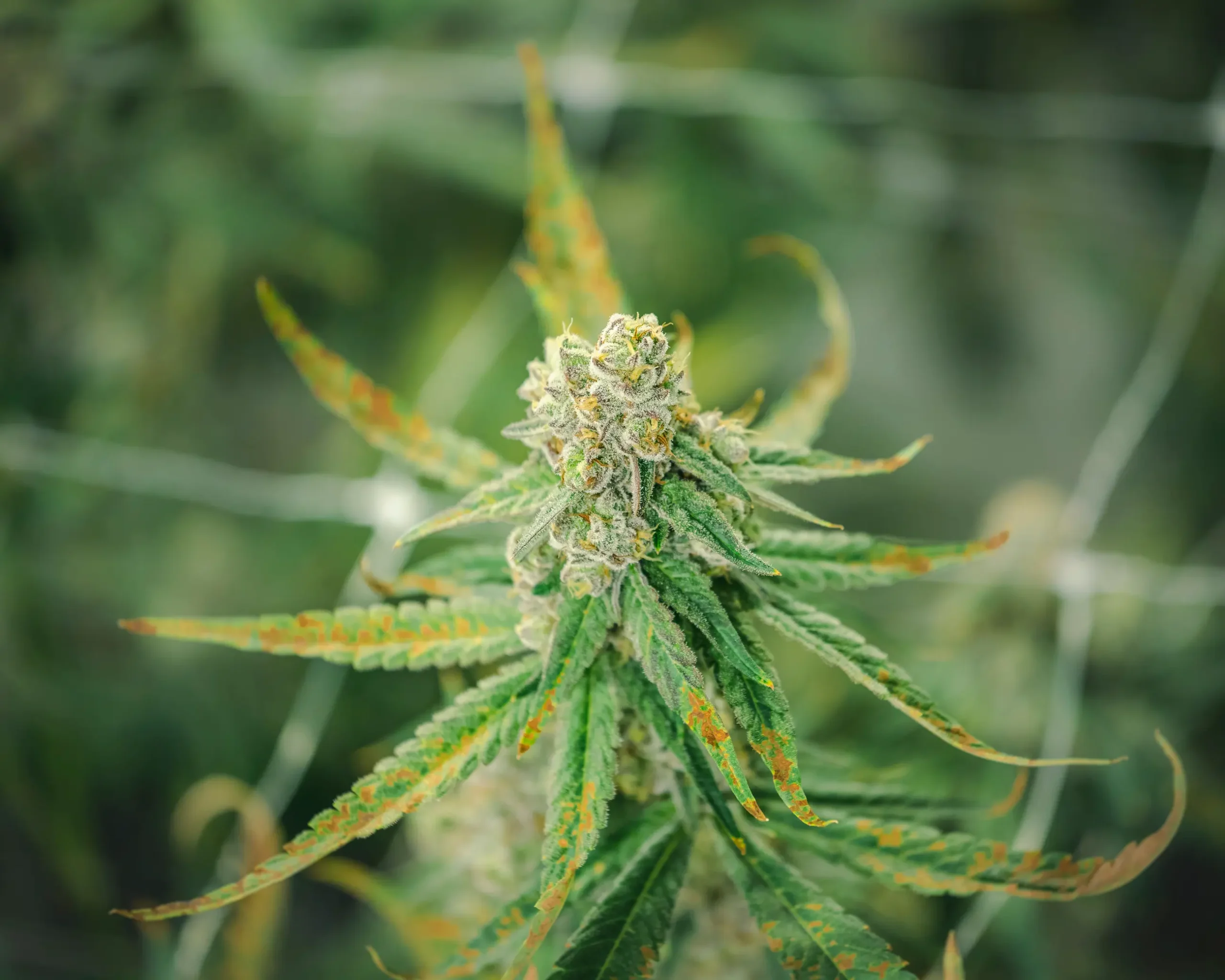
- Rusty Necrotic Spots (Calcium Lockout): Small golden-brown spots on upper fan leaves exposed to high LED intensity. Frequently misdiagnosed as fungus; caused by substrate pH crashing below 5.7 or low room temperature slowing xylem transpirational mass flow.
- Interveinal Yellowing on Lower Leaves (Magnesium Deficiency): Golden yellow chlorosis between dark green veins on oldest fan leaves. Caused by heavy potassium competition or cold root zones. Correct with 0.75 g/gal Epsom salts in the reservoir.
To master fertigation frequency, runoff testing, and root-zone EC management in coco coir setups, explore our companion comprehensive technical guide: Coco Coir Watering and Fertigation: Frequency, Runoff, EC, and Feeding.
Final Standard Operating Checklist and Next Related Guide
Follow this standardized engineering checklist to master autoflower nutrition across every cultivation cycle:
Scientific References
- Small, E. (2015). Evolution and classification of Cannabis sativa (marijuana, hemp) in relation to human utilization. The Botanical Review, 81(3), 189-294.
- Zheng, Y. (2021). Handbook of Cannabis Production in Controlled Environments. CRC Press.
- Marschner, H. (2012). Marschner’s Mineral Nutrition of Higher Plants (3rd ed.). Academic Press.
- Bugbee, B. (2004). Nutrient management in recirculating hydroponic culture. Acta Horticulturae, 648, 99-112.
- Epstein, E., & Bloom, A. J. (2005). Mineral Nutrition of Plants: Principles and Perspectives (2nd ed.). Sinauer Associates.
- Taiz, L., Zeiger, E., Møller, I. M., & Murphy, A. (2015). Plant Physiology and Development (6th ed.). Sinauer Associates.
- Bernstein, N., Gorelick, J., Zerahia, R., & Koch, S. (2019). Impact of environmental conditions on secondary metabolite production in cannabis. Industrial Crops and Products, 139, 111467.
- Sonneveld, C., & Voogt, W. (2009). Plant Nutrition of Greenhouse Crops. Springer Science & Business Media.
Share this article
A quick overview of the topics covered in this article.