
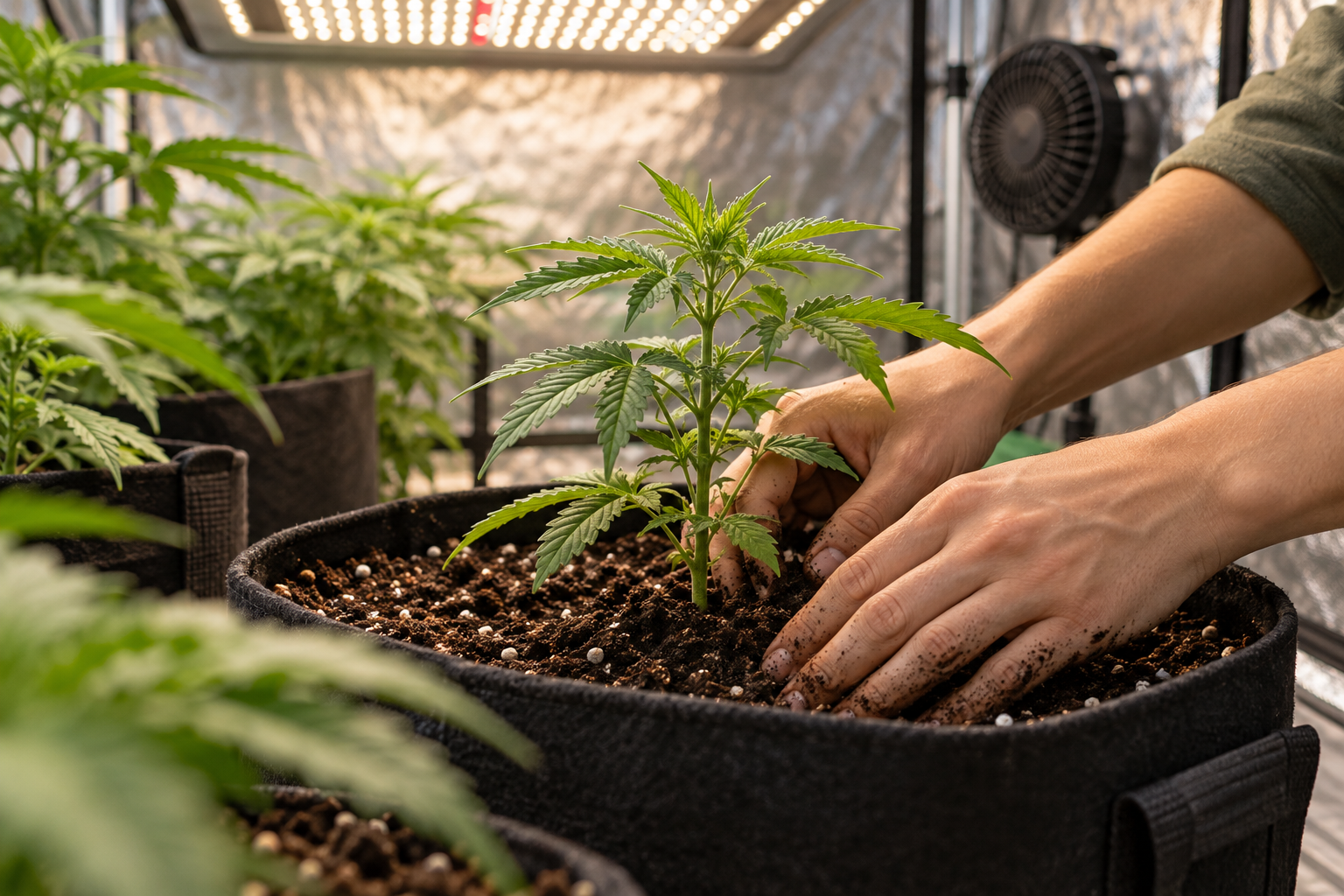
Cannabis Vegetative Stage Explained
The cannabis vegetative stage is the structural foundation of the entire cultivation cycle, spanning the period between the emergence of the first full five-fingered fan leaves and the transition to reproductive flowering. During these three to eight (3 to 8) weeks indoors, the plant directs nearly all assimilated carbon and mineral nutrition toward expanding root mass, thickening vascular xylem and phloem pathways, and multiplying the meristematic nodes that will later become flower sites.
Every environmental, nutritional, and architectural decision made during vegetative growth sets the ceiling for final harvest weight because a plant cannot build new structural branches once post-stretch flowering begins. This guide covers exact developmental markers, photoperiod and PPFD targets, VPD progression, nitrogen-dominant nutrition, container up-potting, high-and-low-stress training windows, and calculating the exact moment to initiate the 12/12 photoperiod.
Anatomical Markers of the Vegetative Phase
The transition from fragile seedling to true vegetative growth is defined by anatomical shifts in leaf morphology, root hydraulic capacity, and internodal phyllotaxy rather than an arbitrary calendar date.
Recognizing the End of the Seedling Stage and Start of Rapid Veg
A cannabis seedling officially enters the vegetative stage roughly 14 to 21 days after germination, marked visually when the third or fourth node unfolds a true fan leaf bearing five to seven serrated leaflets and the primary taproot plus secondary lateral roots reach the walls of the starter cup. Once this root-to-shoot threshold is crossed, daily water uptake accelerates rapidly and new nodal pairs emerge every 2 to 4 days under warm indoor conditions.
During early and mid-vegetative growth, leaves emerge in decussate (opposite) phyllotaxy, meaning two fan leaves and two axillary branch shoots grow directly across from each other at every node along the main stem. As the plant approaches sexual maturity around weeks six to eight from seed, phyllotaxy naturally shifts from opposite pairs to alternating single nodes, and tiny pre-flowers appear behind the stipules at the fourth to sixth upper internodes.
How Photoperiod Versus Autoflower Genetics Dictate Veg Duration
In photoperiod-dependent cultivars, the vegetative stage is indeterminate: as long as the plant receives more than 14.5 to 15 hours of daily light (typically 18 hours on and 6 hours dark indoors) and uninterrupted short nights, phytochrome photoreceptors suppress floral initiation indefinitely. You can veg a sea-of-green (SOG) clone for just 10 to 14 days in a 1-gallon pot, or train a single screen-of-green (ScrOG) plant for 8 to 10 weeks in a 10-gallon bed to fill a 4×4 tent.
In contrast, day-neutral autoflowering cultivars (bred with Cannabis ruderalis lineage) trigger flowering solely by chronological age, transitioning into pre-flower between days 21 and 28 from sprout regardless of whether the light timer is set to 18/6, 20/4, or 24/0. Because autoflowers provide an immutable three-to-four-week vegetative window, avoiding root-bound starter cups, cold substrates, or early overwatering is mandatory to achieve full stature.
Phyllotaxy Shift and Sexual Maturity: Seed-grown cannabis begins vegetative life with opposite (symmetric) node pairs and shifts to alternating (staggered) nodes at weeks 5 to 7; this structural transition signals that the plant is hormonally mature and ready to respond rapidly to a 12/12 photoperiod flip.
Practical questions from home cultivators often center on how these thresholds behave in real-world tents and small rooms.
“Can I keep a photoperiod cannabis plant in the vegetative stage for as long as I want, or does it eventually get too old to flower properly?”
Question sent by: CascadeGrower_p2_82_1, via email.
You can maintain a photoperiod cannabis plant in the vegetative stage for months or even years as long as it receives 18 hours of daily light, periodic root pruning or up-potting, and balanced nitrogen-forward nutrition. Commercial nurseries routinely keep elite mother plants in vegetative growth for 6 to 18 months to harvest hundreds of genetic clones. For a home production tent, however, a 4-to-6-week vegetative phase from rooted clone or post-seedling stage is the sweet spot before woody stems and large root balls offer diminishing returns.
If you ever veg a single plant for 8 to 10 weeks to fill an entire 4×4 tent by itself, use a 7-to-10-gallon container and weave branches through a horizontal trellis net so lower woody stems stay supported.
Lighting, Photoperiod, Temperature, and VPD Targets in Veg
Vegetative cannabis thrives under warm, moderately humid conditions that maximize stomatal aperture and cell turgor pressure for rapid leaf blade expansion.
Comparing 18/6, 20/4, and 24/0 Photoperiod Schedules
For photoperiod cultivars in an indoor grow tent, an 18-hour light / 6-hour dark (18/6) schedule is the industry gold standard. An 18-hour photoperiod provides ample time to hit optimal Daily Light Integral (DLI) targets at moderate LED wattages while granting a 6-hour dark period during which plants translocate starches, synthesize root-promoting auxins, and allow root zones to cool and re-oxygenate.
Running 20/4 or 24/0 on photoperiod plants increases electricity costs by 11% to 33% without increasing structural growth rate once DLI exceeds 35 mol/m2/day, and eliminates the dark respiration window that supports beneficial rhizosphere microbes. The primary exception is autoflowering cultivars or cold basement tents in winter, where a 20/4 schedule helps maintain warm root-zone temperatures and maximizes DLI within a short 25-day veg window.
Scaling PPFD and Daily Light Integral From Early to Late Veg
Rather than blasting young vegetative plants with 100% LED output, ramp Photosynthetic Photon Flux Density (PPFD) smoothly alongside root development. During early veg (weeks 1-2 after seedling transition), deliver 300 to 450 umol/m2/s at canopy height, which under an 18-hour photoperiod equals a DLI of 19.4 to 29.2 mol/m2/day.
In mid-to-late veg (weeks 3-6+), step your LED dimmer or hanging height to deliver 450 to 650 umol/m2/s (29.2 to 42.1 mol/m2/day DLI). Full-spectrum white LEDs enriched with 12% to 18% blue wavelengths (400-500 nm) suppress excessive gibberellin-driven stem elongation during this phase, keeping internodal spacing tight (1 to 2.5 inches) and producing thick, leathery fan leaves.
Maintaining Optimal Vegetative Temperature and Vapor Pressure Deficit
Because modern LED fixtures emit very little forward infrared radiation compared to legacy HPS lamps, vegetative cannabis performs best at slightly warmer ambient air temperatures of 76 to 82 degrees Fahrenheit (24.5 to 28 C) during lights-on and 68 to 74 degrees Fahrenheit during lights-off. Keep root-zone substrate temperatures above 68 F using pot risers so phosphorus and magnesium uptake remain unhindered.
Pair that 76-82 F daytime air temperature with 60% to 70% relative humidity in early veg (targeting a VPD of 0.8 to 1.0 kPa) and 55% to 65% relative humidity in mid-to-late veg (targeting 1.0 to 1.2 kPa VPD). This moderate vapor pressure gradient keeps guard cells wide open for maximum CO2 assimilation without forcing the young root system into evaporative water stress.
| Vegetative Sub-Phase | Target PPFD (umol/m2/s) | 18/6 DLI (mol/m2/day) | Day Temp & RH (Target VPD) |
|---|---|---|---|
| Early Veg (Nodes 3-5 / Wks 1-2) | 300 – 425 umol/m2/s | 19.4 – 27.5 mol/m2/day | 77-82 F & 65-70% RH (0.8-0.95 kPa) |
| Mid Veg (Active Training / Wks 3-4) | 425 – 550 umol/m2/s | 27.5 – 35.6 mol/m2/day | 76-81 F & 60-65% RH (0.95-1.10 kPa) |
| Late Veg (Canopy Fill / Wks 5+) | 550 – 650 umol/m2/s | 35.6 – 42.1 mol/m2/day | 75-80 F & 55-60% RH (1.10-1.25 kPa) |
| Pre-Flip Transition (Final 3 Days) | 600 – 700 umol/m2/s | 38.8 – 45.3 mol/m2/day | 75-79 F & 52-58% RH (1.15-1.30 kPa) |
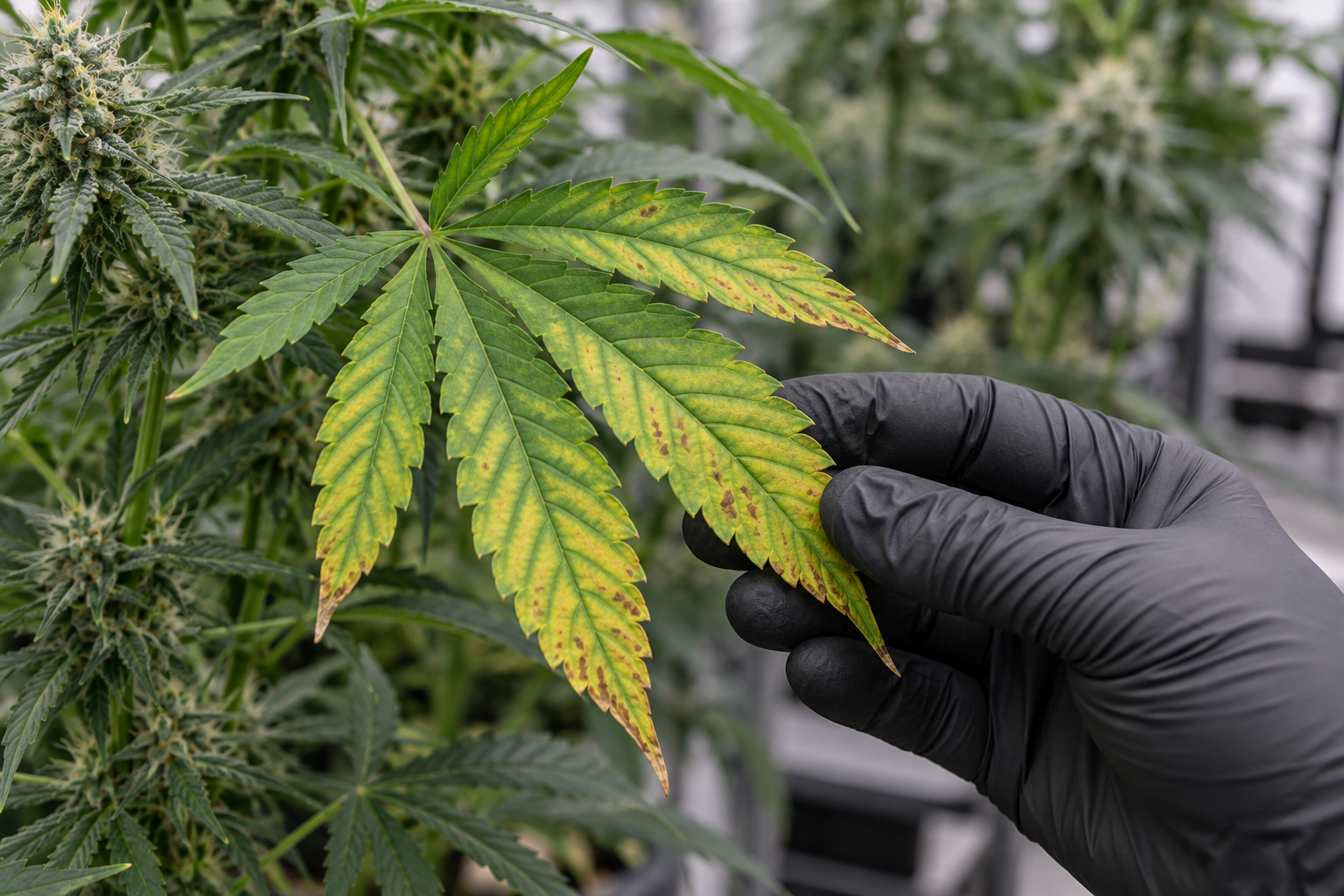
High rates of photosynthetic carbon fixation under 450-650 umol/m2/s of light can only convert into new stems and fan leaves if the root zone supplies balanced mineral nutrition and oxygen.
Vegetative Nutrition, Irrigation Dry-Backs, and Up-Potting
Vegetative growth is an amino-acid and protein-building marathon driven primarily by nitrogen, calcium, and magnesium, supported by aerobic wet-to-dry irrigation cycles.
Macronutrient Ratios and EC Progression Across Veg
During vegetative growth, cannabis requires a nitrogen-forward NPK profile (typically around a 3-1-2 or 2-1-2 elemental ratio) alongside robust calcium and magnesium levels. Nitrogen serves as the central atom in chlorophyll molecules and Rubisco enzymes, calcium cross-links pectin in every newly dividing cell wall at the root and shoot tips, and magnesium sits at the core of the chlorophyll porphyrin ring.
In hydroponic, coco coir, or soilless peat feeds, scale total electrical conductivity (including starting water and Cal-Mag) from 0.8 to 1.1 mS/cm in early veg up to 1.2 to 1.6 mS/cm in mid-to-late veg, maintaining pH at 5.7 to 6.1 in coco/hydro and 6.2 to 6.7 in peat/soil. Watch leaf color closely: healthy vegetative leaves display an even, vibrant emerald green, whereas dark, glossy forest-green leaves with downward-hooked tips warn that nitrogen EC is too high.
Using Controlled Dry-Backs and Staged Transplants to Build Dense Roots
Roots grow in search of moisture and require gaseous oxygen dissolved in pore spaces to drive ATP synthesis for mineral uptake. In soil and peat mixes, saturate the full container slowly until 10% to 15% runoff appears, then wait until the container loses 50% to 60% of its saturated weight before watering again; in coco-perlite, maintain higher moisture frequency (watering once daily in mid-veg) while ensuring 15% to 20% runoff to refresh root-zone oxygen and prevent salt buildup.
Rather than planting a tiny seedling directly into a massive 7-gallon container where uncolonized wet media turns anaerobic, up-pot in staged increments: move from a solo cup (0.25 L) to a 1-gallon pot at day 14, and into your final 3-to-5-gallon fabric container roughly 2 weeks later once white feeder roots lightly frame the outer soil ball. Always allow 7 to 10 days of recovery in the final container before flipping to 12/12.
Do
- Maintain an 18/6 light schedule for photoperiod vegetative plants with canopy PPFD scaled from 350 umol/m2/s in early veg to 600 umol/m2/s in late veg.
- Keep daytime vegetative temperatures between 76 and 82 F with 58% to 68% RH so VPD stays in the sweet spot of 0.8 to 1.2 kPa.
- Top photoperiod plants above the 4th or 5th node and use low-stress training (LST) ties to build a flat, even horizontal canopy table.
- Flip to 12/12 when the canopy covers 75% of the horizontal floor space and reaches 45% to 50% of your maximum usable vertical plant height.
Avoid
- Waiting until the vegetative plant fills 80% of the vertical height of your grow tent before flipping, which guarantees colas will grow into the LED.
- Planting tiny seedlings directly into 5-to-10-gallon containers and keeping them saturated daily, which creates hypoxic, slow-growing roots.
- Topping, supercropping, or heavily defoliating autoflowering cultivars after day 20, or training any photoperiod plant that is actively sick.
- Flipping a plant to 12/12 within 48 hours of a heavy transplant or aggressive pruning session without allowing 7 days of vegetative recovery.
Once a vigorous root system is established in its final container and pushing out new nodes every 48 hours, you can shape the plant’s horizontal architecture to maximize indoor light interception.
“Does running a 24/0 constant-light schedule in veg make photoperiod plants grow 25% faster than an 18/6 schedule?”
Question sent by: CascadeGrower_p2_82_2, via reader Q&A form.
No, running 24 hours of uninterrupted light rarely increases biomass accumulation over an 18/6 schedule once your Daily Light Integral (DLI) reaches 30 to 40 mol/m2/day, and it consumes 33% more electricity. Cannabis utilizes the 6-hour dark window to cleave and transport leaf starches synthesized during the day down to the root zone and growing tips, while allowing rhizosphere dissolved oxygen and cellular repair enzymes to reset.
If you want faster vegetative growth on an 18/6 schedule, focus on keeping root-zone temperatures at 72-76 F and VPD at 0.9-1.1 kPa rather than eliminating the dark period.
Canopy Training Windows: Topping, LST, and Selective Defoliation
Left untrained under a flat indoor LED fixture, cannabis grows like a single-stem Christmas tree where the top cola receives 900 umol/m2/s while lower branches starve at 150 umol/m2/s.
Breaking Apical Dominance With Topping and Low-Stress Training (LST)
The primary apical meristem produces indole-3-acetic acid (auxin), a plant hormone that flows downward through the phloem and suppresses the growth of lateral side branches. Once a healthy photoperiod plant develops 5 to 6 full nodes during early-to-mid veg, sterilize a sharp blade with 70% isopropyl alcohol and excise the newest terminal shoot right above the 4th or 5th node (leaving a 3-to-5 mm stem stub above the lateral branches to prevent stem splitting).
Removing the main apex breaks apical dominance and redistributes root-derived cytokinins equally into the two opposing lateral shoots below the cut, creating two symmetrical main colas. Pair topping with Low-Stress Training (LST) by gently bending and anchoring the tallest branches horizontally to the container rim using soft rubber-coated plant ties, flattening the canopy into an even table where eight to twelve tops sit at the exact same distance from the LED.
Strategic Vegetative Pruning Versus Over-Defoliation
During the first four weeks of vegetative growth, fan leaves act as the plant’s solar panels and amino-acid storage banks; stripping away half the foliage on a young plant severely reduces total photosynthetic surface area and stunts root growth for a week. Limit early-to-mid veg leaf removal strictly to tucking large upper fan leaves beneath emerging lateral shoots or snipping two to four inward-facing fan leaves that directly block primary branch tips.
Save structural lower pruning (‘lollipopping’ the bottom 25% to 30% of weak, shaded interior shoots and lowest fan leaves that will never reach the top canopy plane) for 5 to 7 days before flipping to 12/12. Giving the plant a full week to heal after pre-flip pruning ensures hormone balances and root pressure are firing at 100% when reproductive transition begins.
| Training Technique | Ideal Vegetative Timing | Physiological Mechanism | Required Recovery Before 12/12 Flip |
|---|---|---|---|
| First Topping / FIM | Node 5-6 present (Early-Mid Veg) | Removes primary auxin source; stimulates dual lateral dominance | 7 – 10 days minimum |
| Low-Stress Training (LST Ties) | Continuous from Node 4 through Flip | Redistributes auxin away from bent apex toward lower side shoots | 0 – 2 days (minimal trauma) |
| Supercropping (Stem Pinching) | Mid-to-Late Veg on overly tall stems | Crushes inner xylem/pith without breaking bark; builds knuckle callus | 5 – 7 days |
| Pre-Flip Lollipop & Trellis Net | 5 to 7 days prior to 12/12 switch | Redirects root resources from shaded lower larf to upper meristems | 5 – 7 days |
| Autoflower LST Only | Days 15-26 from sprout (Avoid topping) | Opens lateral branches without pausing the fixed 25-day veg clock | N/A (Auto transitions automatically) |
Even with flawless environment, nutrition, and canopy training, growers frequently run into minor vegetative hiccups that are simple to correct when caught early.
Cultivation Warning
High-stress training techniques require vigorous root hydraulic pressure and active cell division to heal quickly; topping or stripping leaves from a plant suffering from pH lockout, overwatering, or pest pressure can stall growth for 14+ days and trigger intersex stress responses after flip.
Practical questions from home cultivators often center on how these thresholds behave in real-world tents and small rooms.
“Should I switch from my vegetative nutrient formula to my bloom nutrient formula on the very first day I flip the lights to 12/12?”
Question sent by: CascadeGrower_p2_82_3, via grow journal submission.
Do not cut off vegetative nitrogen on day one of the 12/12 flip. During the first 10 to 14 days of 12/12 (the flowering transition and stretch phase), the plant undergoes its fastest burst of vertical stem elongation and foliar expansion of the entire life cycle, which consumes massive quantities of nitrogen, calcium, and magnesium. Continue feeding your vegetative base nutrient (or a 50/50 transition blend of Veg and Bloom) for the first 10 to 14 days after flip until vertical stretch slows and visible white pistil clusters (‘button tops’) form.
Switching prematurely to a low-nitrogen, high-PK bloom formula on day one of 12/12 is the number-one cause of mid-canopy yellowing during week three of flower.
Troubleshooting Common Vegetative Growth Bottlenecks
Most vegetative slowdowns trace back to cold or over-saturated roots, magnesium/calcium demand spikes under LEDs, or subtle nitrogen imbalances.
Resolving Slow Growth From Overwatering or Cold Root Zones
When a young vegetative plant sits in a large container that stays wet for seven days at a time, or sits directly on a cold 62-degree concrete basement floor, root respiration drops below the threshold needed to actively pump nitrate and phosphate across root membranes. Visually, the plant exhibits pale lime-green new growth, puffy down-curled leaf blades between veins, stiff purple petioles, and nodes that barely advance over an entire week.
Before adding extra fertilizer, elevate all containers on plastic drainage grids or foam insulation boards to bring substrate temperatures up to 70-75 F, increase oscillating airflow across the fabric pot walls, and wait until the container feels genuinely light before the next irrigation. Once root oxygen returns, leaf posture lifts within 36 hours without any change to your nutrient formula.
Fixing Early Magnesium Striping and Lower-Leaf Nitrogen Fade
Under high-efficiency white LEDs, vegetative plants consume magnesium and calcium rapidly to support high chlorophyll synthesis rates. If mid-tier fan leaves develop pale yellow interveinal striping while the leaf veins themselves remain sharp green (resembling a fishbone pattern), confirm that root-zone pH has not dropped below 5.7 in coco or 6.1 in soil, and supplement with 1 to 1.5 grams per gallon of magnesium sulfate (Epsom salt) or a balanced Cal-Mag product.
If the oldest bottom five-fingered fan leaves turn uniformly pale yellow from tip to base while upper growth stays green, the plant is cannibalizing mobile nitrogen faster than your current feed supplies it. Step your base vegetative nutrient EC up by 0.2 to 0.3 mS/cm on the next irrigation to halt upward yellowing.
Simply lifting fabric pots two inches off a cold tent floor onto slotted plastic risers frequently raises root-zone temperatures by 4 to 5 degrees Fahrenheit, cutting dry-back times by a full day and doubling weekly vegetative node production.
Once your trained vegetative canopy is growing vigorously and free of deficiencies, the final strategic decision is choosing the exact day to flip your light timer to 12/12.
Calculating When to Flip to 12/12 Based on Flowering Stretch
Cannabis does not stop growing vertically when you switch the lights to 12/12; during the first 18 to 24 days of flowering, stems undergo a hormonal stretch that doubles or triples plant height.
Headroom Math: Accounting for Pot Height, Light Hanging Clearance, and Stretch
To calculate your maximum safe vegetative flip height, start with your total tent ceiling height and subtract every fixed vertical offset. In a standard 4×4 tent that is 80 inches (6.6 feet) tall, subtract 12 inches for the container and riser, subtract 8 inches at the top for the inline fan/filter and LED ratchets, and subtract 16 inches for the minimum safe photon clearance between the LED diodes and top colas: `80 – 12 – 8 – 16 = 44 inches` of maximum usable plant height.
Because most modern hybrid cultivars stretch by 1.8x to 2.2x after the 12/12 flip (broad-leaf indica-leaning cultivars stretch 1.3x-1.6x, while narrow-leaf sativa-leaning lines stretch 2.2x-3.0x), divide that 44-inch maximum finished plant height by 2.0. That math reveals you must flip your vegetative plants to 12/12 when the canopy sits just 20 to 22 inches tall above the rim of the pot.
Horizontal Footprint Fill and Pre-Flip Readiness Verification
In addition to vertical height, look straight down at your horizontal trellis grid or tent floor. You should initiate the 12/12 photoperiod when the vegetative canopy covers 70% to 80% of the horizontal tent footprint, leaving the final 20% to 30% of open perimeter and grid squares to be filled by lateral branch expansion during the first two weeks of flowering stretch.
Never flip a plant to 12/12 to ‘fix’ an unresolved vegetative problem; flowering amplifies existing root or pest stress while removing your ability to spray most contact miticides or re-veg branches. Verify all five readiness checkpoints below before resetting your timer from 18/6 to 12/12.
Field Verification Checklist
- Confirm that vegetative plants have filled 70% to 80% of horizontal tent space and sit at or below 50% of maximum usable vertical height.
- Verify that all transplants, topping cuts, and pre-flip lower-branch pruning were completed at least 5 to 7 days ago and new tips are growing actively.
- Measure runoff pH and EC to confirm the root zone is balanced (pH 5.8-6.2 coco / 6.2-6.7 soil; runoff EC within +0.2 mS/cm of input).
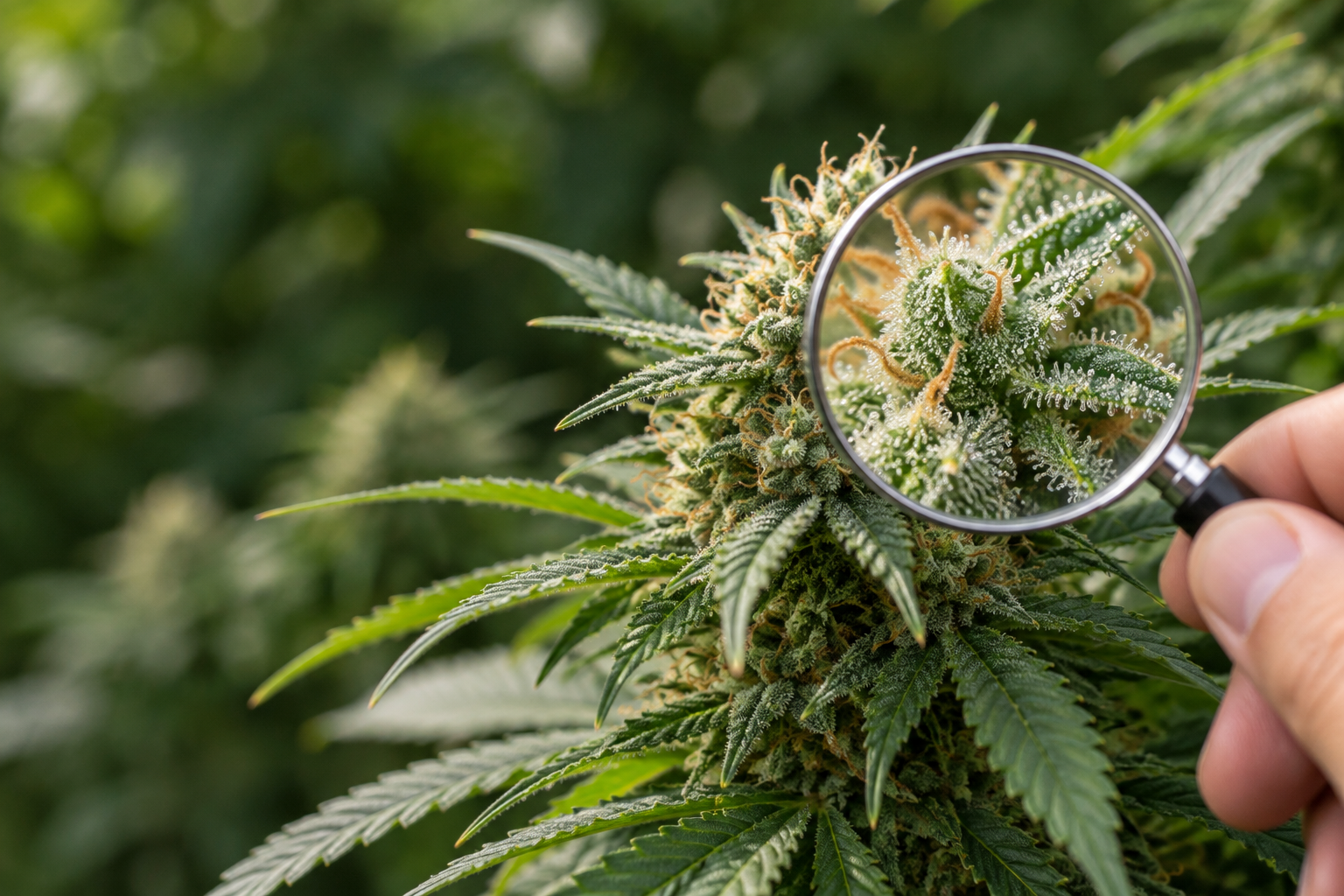
- Perform a 40x-60x loupe inspection of lower leaf undersides and apical tips to ensure zero spider mites, thrips, or powdery mildew enter flower.
- Test your tent for absolute dark-period light tightness by standing inside with the zipper closed and exterior room lights turned on.
Confirming each of these five benchmarks before switching to 12/12 guarantees that your plants enter the flowering stretch with maximum vigor and ample vertical headroom.
“How many times should I top an indoor photoperiod plant during a standard 4-to-5-week vegetative cycle?”
Question sent by: CascadeGrower_p2_82_4, via email.
For a standard 4-to-5-week vegetative phase with three to four plants in a 4×4 tent, topping once at node 5 (around day 18-21) and optionally topping the resulting four main lateral branches a second time 10 days later is plenty. One or two toppings paired with low-stress tie-downs produces 8 to 16 uniform main colas per plant without extending your veg time by weeks.
Save three or four sequential toppings (‘mainlining’ or ‘manifolding’) for single-plant tent runs where you plan to veg for 7 to 8 weeks.
Scientific References
- Rodriguez-Morrison, V., Llewellyn, D., & Zheng, Y. (2021). Cannabis yield, potency, and leaf photosynthesis respond differently to increasing light levels in an indoor environment. Frontiers in Plant Science, 12, 646020.
- Saloner, A., & Bernstein, N. (2020). Response of medical cannabis (Cannabis sativa L.) to nitrogen supply under long photoperiod. Frontiers in Plant Science, 11, 572293.
- Moher, M., Jones, M., & Zheng, Y. (2021). Photoperiodic response of in vitro and indoor-grown Cannabis sativa plants. HortScience, 56(1), 108-113.
- Bevan, L., Jones, M., & Zheng, Y. (2021). Optimization of nitrogen, phosphorus, and potassium for soilless production of Cannabis sativa in the vegetative stage. HortScience, 56(6), 705-712.
Share this article
A quick overview of the topics covered in this article.
Follow us
Latest articles
November 9, 2026
November 9, 2026
November 9, 2026
November 9, 2026
