
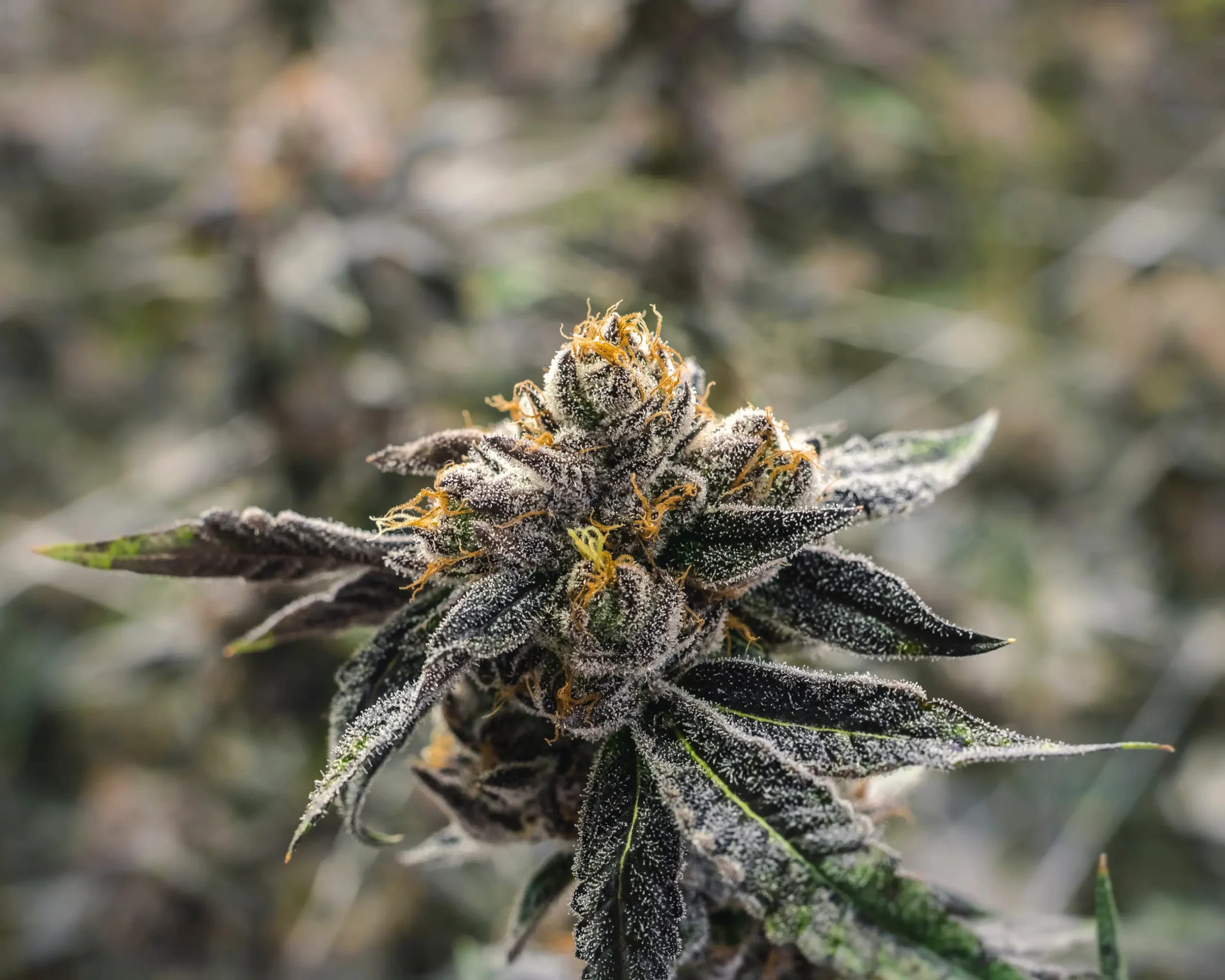
Animal Tsunami
Animal Tsunami is a powerful indica-leaning hybrid most consistently documented as Animal Cookies crossed with Caramel Tsunami. The flower can combine caramelized sugar, vanilla, nutty dough, tropical fruit, pine, diesel and woody spice. Some market descriptions conflict about the second parent, so exact cut verification matters more here than with a long-standardized classic.
Available cut data describes tight internodes, strong branches, dense flowers and stretch ranging from moderate to roughly double or more. The same plant can look compact in vegetative growth and then rise rapidly after the flip. Dark green, blue and purple flower colors can hide early moisture damage inside the colas.
The central cultivation question is how to manage a dense, high-potency plant whose stretch and lineage labels vary by source. Animal Tsunami rewards early interior cleaning, conservative canopy fill and close late-flower inspection. Color and frost should never replace calyx maturity or bud-health checks.
Strain Features
| Feature | Details |
|---|---|
| Strain Type | Indica-dominant hybrid |
| Genetic Profile | Most consistently documented as Animal Cookies x Caramel Tsunami |
| Lineage Note | Some market records use alternative descriptions, so the exact cut should be verified |
| THC | Commonly reported in the mid-to-upper 20% range; some batches test near 30% |
| CBD | Usually very low |
| Dominant Terpenes | Beta-caryophyllene, limonene and myrcene are frequently reported; pinene may be prominent |
| Flavor / Aroma | Caramel, vanilla, nutty cookie, tropical fruit, pine, diesel and woody spice |
| Effect Character | Lifted cerebral calm followed by deep body relaxation and possible sedation |
| Flowering Time | Approximately 8 to 10 weeks |
| Stretch | Moderate to strong; cut descriptions range from about 50% to more than 100% |
| Plant Architecture | Medium to large with tight internodes and sturdy branches |
| Bud Structure | Dense, colorful and heavily coated in resin |
| Grow Difficulty | Intermediate |
| Primary Quality Risk | Overfilled transition canopy, hidden moisture inside dark flowers and lineage inconsistency |
Genetic Lineage
Animal Tsunami is most often documented as Animal Cookies crossed with Caramel Tsunami. Animal Cookies contributes cookie dough, vanilla, dense flower, color and a heavy body effect. Caramel Tsunami adds caramelized sweetness, pine, tropical fruit and additional structural vigor.
Some listings attribute the cultivar differently, including alternative Animal-family or OG-related descriptions. Because the market is not centralized, growers should treat the exact clone or seed source as part of the identity. The guidance here follows the Animal Cookies x Caramel Tsunami version supported by the strongest recurring records.
Phenotypes can vary in stretch and aroma. Some plants remain cookie-caramel dominant and compact. Others develop more diesel, pine and stronger vertical growth. The keeper should be evaluated after cure, when caramel and vanilla must remain visible beside the gas.
Why cut identity matters more than the name
Animal Tsunami is a useful example of the difference between a cultivar name and a repeatable horticultural object. A label can travel through markets faster than a verified clone. Two flowers sold under the same name may share a broad sweet-gas direction while differing in stretch, finish time, terpene balance and late water use. The correct first-run posture is therefore observational: treat the supplied plant as an uncharacterized cut until its behavior has been recorded through a complete cycle.
The strongest recurring cut description points to tight internodes, sturdy branches, high resin and a large transition stretch. Those traits are not contradictory. A plant can remain compact between nodes while each branch extends rapidly after photoperiod change. That combination produces many closely spaced flower sites along lengthening stems. It is productive when the canopy is open and risky when the grower fills every square centimetre before the flip.
Animal Cookies influence is easiest to see in flower density, resin, pastry sweetness and the tendency toward dark coloration. Caramel Tsunami is the less standardized side of the story, but the recurring description suggests caramelized sugar, pine, woody freshness and extra vigor. The most convincing Animal Tsunami expression does not taste like a generic cookie strain. It preserves a toasted or caramel edge and lets a sharper woody-gas note arrive behind it.
For selection, I would separate plants into three practical groups rather than force them into one description. The dessert-leaning group stays lower, carries broader leaves and emphasizes vanilla, toasted sugar and nutty dough. The fuel-leaning group extends more strongly, smells of pine resin and diesel earlier, and may finish with a drier exhale. The balanced group keeps caramel and cream in the intact flower but releases pepper, pine and fuel when ground. That third group is usually the most complete expression for a flavor-focused keeper.
Color is another phenotype variable, not a quality guarantee. Purple, blue-black and deep green flowers can all appear. Dark tissue makes the resin visually dramatic, but it also reduces the contrast that normally helps a grower notice bruising, dead sugar leaves or the first grey interior damage. A keeper decision should include cured aroma, flower health and water-use predictability, not only color and frost.
A serious phenotype comparison should be made under the same root volume, canopy position and harvest criteria. Record stretch percentage, days to first formed flower, late dryback, branch angle, calyx-to-leaf ratio, aroma at harvest, aroma after fourteen days of cure and the proportion of flower that remains clean and premium. These observations are more useful than an inherited claim that every Animal Tsunami plant is compact or every cut finishes in exactly eight weeks.
Effect Breakdown
Lifted calm
Animal Tsunami often begins with a noticeable mental lift that feels euphoric, clear or emotionally quiet rather than frantic. Some users report focus despite the indica-leaning classification.
Physical wave
A strong body effect follows, reducing tension and creating a warm, heavy sensation. Appetite and stillness may increase.
Potency limit
Larger doses can become sedating and cognitively heavy. Dry eyes, dry mouth and headache are reported. The strain is better suited to experienced users.
Onset and mental direction
The onset can be faster than the heavy indica label implies. A small inhaled amount may produce a sudden sense of emotional distance from stress, followed by brighter sound and a mild pressure around the forehead or eyes. The mental tone is often calm and elevated rather than aggressively energetic. This is the window in which some users describe focus: distractions feel less important, while one chosen activity becomes easy to stay with.
That focus should not be confused with reliable productivity. The same narrowing of attention that works for music, drawing or a film can make task switching clumsy. At moderate potency the mind may remain articulate, but time estimation and short-term sequencing can soften. The cultivar is more convincing as a relaxed creative strain than as a dependable work strain.
Middle phase and body load
The physical phase usually builds rather than arriving all at once. Jaw, shoulders and lower back may release first, followed by a warm heaviness in the limbs. The body remains usable at a modest dose, especially in a brighter limonene- or terpinolene-present batch. Myrcene-, linalool- or nerolidol-rich batches may feel softer and more settling even when the label and THC percentage are similar.
Appetite can rise as the body phase becomes established. Food aroma and texture may feel more pronounced, which makes the strain easy to overconsume in social settings: the sweet flavor invites another inhalation before the first dose has completed its transition. Waiting through the full onset is more important than chasing an immediate heavy effect.
Late phase, duration and dose threshold
The late phase is where Animal Tsunami earns its indica-leaning description. The head becomes quieter, the body feels denser and remaining plans may lose urgency. A lower dose can finish as calm contentment. A higher dose can produce couch-lock, heavy eyelids and sleepiness. The shift is dose-dependent enough that two users can describe the same batch very differently.
High-potency flower also increases the cost of poor pacing. Dry mouth and dry eyes are common. Headache, dizziness, unease or an unpleasant sense of mental compression can occur after excessive use. New users and anyone sensitive to THC should begin far below the amount an experienced user considers normal and allow time before taking more.
Harvest maturity can move the experience. A slightly earlier harvest, once calyx trichomes are predominantly cloudy, tends to preserve the clearer mental opening. More amber development and a longer late-flower finish usually strengthen the body phase and make the ending sleepier. The plant should still be harvested for complete flower maturity and health; “early for energy” is not an excuse to cut immature, unswollen flowers.
Flavor & Aroma Profile
The jar may open with caramel, vanilla cream, nutty cookie and tropical sweetness. Breaking the flower releases pine, diesel, woody herbs and pepper.
The inhale can feel sugary and creamy. Caramel and vanilla appear first, followed by tropical fruit. The exhale becomes drier, with pine, nutty earth and gas.
A warm rapid dry removes tropical and caramel notes before pine and diesel. The dense flowers also require slow internal moisture equalization. Proper curing turns the profile from separate sweet and woody elements into a smoother caramel-cookie gas.
Jar aroma, broken flower and the first inhale
The intact jar should open with a rounded sweetness rather than plain sugar. Good batches suggest browned caramel, vanilla cream, toasted nut and a soft tropical note that may resemble overripe pineapple or mango skin. The aroma is dense and warm. It should feel closer to pastry and resin than bright citrus candy.
Breaking the flower changes the centre of gravity. Pepper, dry pine, woody herbs and fuel emerge from the interior. In balanced flower, these darker notes do not erase the caramel; they frame it. A purely diesel sample may be a fuel-leaning phenotype, an overheated crop or a batch whose fragile sweet volatiles were lost during drying.
The first inhale often carries cream, toasted sugar and nutty dough. Tropical sweetness may appear as a high note rather than a literal fruit flavor. The exhale becomes drier and more structural, moving through pepper, pine wood and diesel. A patient cure allows a faint caramel return in the aftertaste. That return is one of the best quality indicators because it shows that the sweet fraction survived both drying and combustion or vaporization.
How cultivation changes the profile
Late nitrogen makes this profile especially muddy. Animal Tsunami already contains earth, wood and dense pastry notes; excess green material can turn those qualities into a heavy vegetal taste. A plant that remains glossy and clawed deep into flowering may still look impressive, but its smoke often lacks separation between caramel, nut and gas.
Root-zone concentration matters for the same reason. When water use slows and feed strength does not, salt stress can create a hot, mineral edge. That harshness is sometimes misread as powerful diesel. Genetic fuel has aromatic shape: pine, pepper and solvent-like sharpness. Root stress feels flatter, hotter and less fragrant.
Canopy heat removes the upper layer first. Caramel, tropical fruit and vanilla become less distinct while pepper, humulene-like wood and fuel remain. A crop can therefore smell strong yet no longer smell complete. Protecting flavor means controlling leaf temperature and irrigation stability before relying on any finishing additive.
Outdoor flower may lean more resinous, woody and herbal, especially in large plants exposed to strong sun and cool nights. Indoor flower usually makes the dessert contrast easier to preserve because temperature and finish humidity are controllable. Neither environment is inherently superior; the better result is the one that reaches maturity without heat damage, repeated wetting or a rushed post-harvest process.
Dominant Terpenes
Terpene rankings vary across phenotypes, environments and laboratory batches. The table below summarizes recurring patterns rather than a fixed chemical formula.
| Terpene / Volatile Group | Likely Role in Animal Tsunami |
|---|---|
| Beta-Caryophyllene | Supports pepper, cookie spice and the warm woody base. |
| Limonene | Adds tropical brightness and may contribute to the lifted opening. |
| Myrcene | Deepens fruit, earth and the heavy physical phase. |
| Pinene | Can reinforce pine, woody freshness and a clearer herbal top note in selected batches. |
| Terpinolene | Appears prominently in some tested batches and may add herbal brightness, fresh wood and a more lifted aromatic opening. |
| Humulene | Supports dry hops, wood and the toasted, less-sugary side of the finish. |
| Linalool / Nerolidol | Vary sharply by batch; they can soften the profile with floral cream, fresh wood and a slower, heavier aromatic base. |
Why a single “dominant terpene” label is misleading
Animal Tsunami has produced meaningfully different laboratory profiles. One flower sample was led by beta-caryophyllene with terpinolene and humulene clearly present. Another later batch placed limonene and myrcene ahead of linalool and humulene. Other high-terpene batches have shown unusually strong nerolidol beside caryophyllene and limonene. These are not small ranking changes. They can alter whether the flower reads as peppery-woody, citrus-fruit, floral-soft or deeply resinous.
Beta-caryophyllene is the most consistent structural candidate. It supplies black pepper, dry spice and part of the cookie-gas base. Humulene often travels beside it and makes the finish more woody, hoppy and toasted. Together they help explain why the sweetness can feel like browned caramel rather than fruit syrup.
Limonene brightens the profile without always creating an obvious lemon flavor. It can sharpen tropical fruit, give caramel a cleaner edge and support the more elevated first phase reported by users. Myrcene adds ripe fruit, musk and weight. When myrcene is high, the same cultivar may feel less crisp and more physically enveloping.
Terpinolene deserves special attention because it is absent from many simplified profiles yet substantial in at least one analyzed flower sample. In that expression, the aroma may feel fresher, more herbal and slightly more Haze-like at the top, even though the plant remains physically heavy. Pinene can reinforce this impression but should not be assumed dominant without batch evidence.
Linalool and nerolidol are another reason not to predict experience from THC alone. Linalool can add floral cream and aromatic softness. Nerolidol can smell woody and green-floral, and a nerolidol-heavy batch may feel slower and rounder than a limonene-led batch at the same cannabinoid potency. These associations remain tendencies, not guarantees of a particular effect.
The grower cannot order a terpene ranking from the plant, but can preserve the expression the phenotype is capable of making. Stable late-flower temperatures, healthy roots, complete maturation, gentle handling and slow drying protect the relationships among volatile compounds. Chasing one terpene through stress is less useful than keeping the whole profile intact.
Indoor vs. Outdoor Growing
| Decision Point | Indoor Growing | Outdoor Growing |
|---|---|---|
| Stretch control | A partially open screen allows the cut to reveal its transition behavior | Early topping and broad spacing reduce a tall central structure |
| Interior density | Indoor pruning is essential around tight internodes | Natural wind helps, but the center still needs opening |
| Flower health | Controlled humidity protects dense dark colas | Outdoor autumn moisture can hide inside blue-purple flowers |
| Support | Sturdy branches benefit from a net as flowers gain weight | Cages or ties should be installed before bloom |
| Lineage verification | Known cuts allow repeatable planning | Unverified plants should be documented individually |
| Best fit | Intermediate growers comfortable with dense potent hybrids | Dry climates with strong airflow and a reliable finishing season |
For Animal Tsunami, the indoor advantage is the ability to manage the cultivar’s defining weakness before it damages premium flower. Outdoor plants can express more size and seasonal complexity, but the finishing climate must match the stretch, flower density and aroma sensitivity described above.
Indoor decision points
Indoors, the first decision is how much empty screen to leave at the flip. A cut that stretches 100% can turn a half-filled net into a complete canopy. A cut that approaches 200% can overrun the same plan. On the discovery run, fill less than feels necessary, keep the first support layer low enough to guide lateral growth and preserve vertical space for a second layer that will carry weight rather than reshape stems.
Plant count should reflect node density. Animal Tsunami does not need many closely packed plants to create flower sites. Fewer plants with several well-spaced leaders are easier to inspect and less likely to merge into one humid surface. A short vegetative period can work in a sea-of-green layout only when the cut is already known and the lower sites are cleaned early.
Indoor flower quality depends more on microclimate than average room humidity. A sensor in open air can read safely while two touching dark colas hold still, moist air between them. Air should travel horizontally through the canopy and return beneath it. Fans should move foliage gently, not blast one top until its surface dries faster than the interior.
Outdoor decision points
Outdoors, early topping and wide branch angles reduce the risk of one oversized central cola. A cage installed before flowering provides attachment points without forcing late bending through hardened stems. The plant should be spaced far enough from walls and neighboring shrubs that morning sun and wind can dry the interior.
Large outdoor root volume can turn the cultivar into a broad, heavy plant. That potential is valuable only when the site has a long, dry finish. Repeated rain and dew can enter dense flowers faster than they leave. Temporary rain protection should remain high and open-sided; a low enclosed cover may stop direct rain while creating worse humidity.
Outdoor harvest may need to be staged. Upper, exposed flowers can mature and become weather-sensitive before protected lower branches. Removing ready tops creates air and gives the lower flower more time. A staged harvest is better than sacrificing clean mature tops while waiting for every branch to match.
Strain-Specific Grow Guidance
Verify the plant before treating the name as a recipe
Record the exact cut, stretch and flowering time. Conflicting market lineage makes firsthand observation especially important.
Measure the plant at the flip and again at the end of each transition week. Photograph the same canopy angle and mark individual leaders. This simple record reveals whether the cut stretches evenly or sends a few dominant branches above the rest. It also prevents a common error: remembering the plant as “compact” because its internodes were short while forgetting how far the complete branches actually travelled.
Top early and leave transition space
One topping or main-stem bend can create several sturdy branches. Flip before the canopy is full because some cuts can double or more during the first weeks.
Top only after the root system is actively moving water and the new growth is symmetrical. A stressed or recently transplanted plant gains nothing from immediate high-stress training. After topping, guide four to eight strong leaders outward and remove branches that grow directly into the centre. The purpose is not maximum top count. It is a canopy whose flowers remain individually visible from above.
A screen is most useful when it changes branch direction during stretch and supports weight later. Continue gentle tucking through the early transition, then stop once stems begin hardening and flower clusters are clearly forming. Forcing branches under the net too late can crack tissue, compress nearby sites and create exactly the dense contact points the grower is trying to avoid.
Clean tight internodes before flowers harden
Remove weak inward-facing shoots and the lower growth with no path to strong light. Tight node spacing can hide small branches and stale air near the main stem.
My preferred pruning window is late vegetative growth through the end of stretch. Clean the lower quarter to third only after the plant has revealed which branches will reach the canopy. Remove weak interior shoots, tiny nodes packed against the main stem and leaves lying directly on the substrate. Once the plant is building dense flowers, pruning should become corrective rather than routine.
Late over-pruning can reduce the leaf area supporting a large branch system and trigger unnecessary stress during the period when aroma and resin are developing. If late humidity forces a choice, remove a small number of blocking leaves or an unhealthy flower site, not an arbitrary percentage of the whole canopy.
Use measured defoliation
Remove selected large leaves around the end of stretch where they block multiple sites. A lighter second pass may be useful if the center closes again. Avoid severe stripping.
Defoliation decisions should be based on function. A leaf that shades one small site but remains exposed to light may be more valuable than the site it covers. A leaf pressed against a forming cola or sealing a central air lane is a better removal candidate. Animal Tsunami’s broad, dark leaves can overlap heavily, so rotating the plant or inspecting from below often reveals congestion that is invisible from the aisle.
Keep the root zone oxygenated
Dense broad-leaf plants can look heavy even when healthy, making overwatering easy to miss. Use container weight and recovery after irrigation rather than leaf width alone.
During vigorous transition, a healthy plant may dry rapidly and encourage frequent irrigation. That rhythm can change after stretch when vertical growth slows and the flowers begin hardening. Continuing the transition schedule automatically can keep the lower root zone wet. Watch dryback duration, not yesterday’s clock.
In container media, water thoroughly enough to wet the root ball evenly, then allow an appropriate return of air before the next event. In coco or automated systems, use smaller, measured events and verify that total daily volume matches actual transpiration. Leaves that remain heavy through the first hours of the light period, rising root-zone concentration and a suddenly slow container are reasons to inspect irrigation before adding nutrients.
Reduce nitrogen before the bulking phase
Dark leaves and tight internodes create a humid canopy when nitrogen remains high. Transition nutrition on time and monitor clawing, tip burn and slow water use.
Animal Tsunami is better treated as a moderate feeder whose demand changes with growth rate than as a permanently hungry high-THC plant. It may accept firm nutrition while building its branch system, but heavy nitrogen after stretch encourages leaf mass inside already dense flowers. The visual result can look lush while the smoke becomes greener and the canopy harder to dry.
Calcium and magnesium demand depends on water source, medium and light intensity. Do not turn a generic “Cal-Mag” recommendation into a standing dose. Pale interveinal tissue can reflect actual mineral shortage, excessive root-zone concentration, saturation or pH-related uptake failure. Check irrigation behavior and new growth before stacking another supplement onto a stressed root zone.
| Growth Phase | Animal Tsunami Priority | What to Watch |
|---|---|---|
| Rooted clone / seedling | Build roots under gentle nutrition and moderate light | Slow dryback, soft new growth and transplant readiness |
| Early vegetative | Establish branch strength before topping | Symmetry, stem response and even moisture use |
| Late vegetative | Spread leaders and remove obvious interior waste | Actual canopy footprint rather than height alone |
| Transition | Support rapid extension without overfilling the screen | Stretch percentage, daily water use and nitrogen excess |
| Early flower | Finish tucking, clean the lower zone and stabilize climate | Overlapping leaves and sites packed against main stems |
| Bulk | Maintain balanced nutrition and uninterrupted dryback | Tip burn, slow containers, flower contact and hidden humidity |
| Ripening | Reduce unnecessary input and protect aroma | Natural fade, calyx swelling, disease and falling water demand |
Light response and canopy distance
Animal Tsunami’s dense node pattern can create a misleading light problem. The top leaves may receive plenty of intensity while inner flower sites remain shaded by overlapping tissue. Before increasing fixture output, correct canopy geometry. Better spacing frequently improves useful light distribution more than another increase at the top.
Raise intensity gradually after the stretch is controlled. A newly flipped plant that is extending rapidly is already spending water and minerals at a high rate. Pushing maximum light at the same time can magnify irrigation mistakes and create brittle, tacoed leaves near the fixture. Once leaders are separated and roots are cycling predictably, the plant can use stronger flowering light more effectively.
Watch the highest dark leaves for bleaching, upward curl and loss of the normal waxy surface. Dark phenotypes can absorb heat strongly even when the room feels acceptable. Leaf-level temperature and the plant’s posture are more useful than distance rules copied from another garden.
Inspect dark flowers from the stem side
Purple and blue tissue can conceal early rot. Gently inspect the center of the largest flowers and the points where buds contact leaves or neighboring colas.
Inspection should be systematic. Begin with the fattest tops, flowers near walls, sites directly below overlapping leaves and any cola whose sugar leaf has died unexpectedly. A single wilted interior leaf can be an early moisture warning. Pulling hard on the flower is unnecessary; part the surface gently and look toward the stem under neutral white light.
Humidity targets should tighten as density rises. Early flower can tolerate a moderately comfortable environment when air is moving and the canopy is open. During bulking, aim for a drier microclimate and avoid large night-time spikes. Near finish, stable low-to-mid 40% relative humidity is a sensible operational goal for dense indoor flowers, adjusted for temperature and actual dew-point risk.
Harvest after full calyx expansion
Wait for fewer fresh pistils and mostly cloudy trichomes on calyx tissue. Earlier harvest may preserve more focus. Additional maturity deepens the body effect and caramel-pine finish.
Do not judge maturity from sugar-leaf trichomes; they often cloud and amber before the calyx glands that matter. Check several flowers at different heights. A ready balanced phenotype should show enlarged calyxes, receding fresh pistil production and a mature aroma that no longer smells merely green-sweet.
| Flower Window | Expected Development | Main Decision |
|---|---|---|
| Weeks 1-2 | Strong extension, changing branch angles and first pistil clusters | Tuck and measure; do not let the screen close completely |
| Weeks 3-4 | Stretch slows, sites stack closely and resin begins showing | Finish lower cleanup and establish final air lanes |
| Weeks 5-6 | Flowers round out, dark color may begin and water use can peak | Support leaders and monitor nutrient concentration |
| Weeks 7-8 | Density rises, caramel-gas aroma develops and dryback may slow | Inspect interiors and reduce avoidable stress |
| Weeks 9-10 | Later cuts complete swelling and the body-heavy profile deepens | Harvest by calyx maturity, health and desired effect, not color alone |
Grower Note: Use these strain-specific observations as a decision framework rather than a fixed recipe. Medium, container size, climate, plant maturity and the exact phenotype can change stretch, feeding and finish time.
Weedth Bud Flavor Tips
Protect caramel, vanilla and tropical fruit by controlling canopy temperature late in flower. Outdoor branches should be cut after dew dries and moved immediately into shade.
Dry medium branches with indirect circulation. Dense dark colas should be separated enough that the core does not remain wet after the surface becomes dry.
Several weeks of cure usually improve the connection between sugary cookie notes and woody gas. Use smaller storage containers and minimize repeated opening.
Preserve the sweet fraction before harvest
Flavor work begins while the plant is alive. Keep late-flower irrigation consistent enough to avoid repeated wilt-and-flood cycles. Severe drybacks may increase visible stress without adding desirable aroma, and repeated saturation can suppress root function at the moment the plant is finishing volatile production. The target is a predictable rhythm that lets the plant mature cleanly.
Do not keep increasing feed because the flowers look capable of taking more. The caramel-cookie profile becomes clearer when the plant reaches the final weeks without excessive nitrogen or root-zone concentration. A modest natural fade is different from a rapid collapse. Preserve enough healthy leaf area for maturation while allowing the plant to stop carrying unnecessary green mass.
Harvest timing should be based on complete calyx swelling and mature aroma. Animal Tsunami can look finished early because dark color and heavy resin create instant visual impact. Cutting at that stage may preserve sharp pine but leave caramel and tropical sweetness thin. Give later phenotypes the additional time they need if flower health and weather allow.
Dry by branch thickness, not by calendar
Medium branches usually create a safer compromise than individual wet-trimmed buds or one enormous whole plant. They slow the process without trapping all moisture in a massive dark canopy. Remove only damaged leaves and the largest fans before hanging. Sugar leaves help protect the flower surface and can be dry-trimmed with less disturbance to resin.
A cool, dark drying space around 16-19°C and roughly 55-60% relative humidity is a practical operational range, not a promise that every room will finish on the same day. Thick branches and dense colas may take longer than smaller tops. Evaluate aroma, surface feel and the moisture behaviour of representative flowers rather than waiting for every stem to make a dramatic snap.
Direct fan air is especially damaging here. It can harden the outside while the centre remains wet, then strip caramel and vanilla while the grower waits for internal moisture to equalize. Circulate room air around the hanging material, not through one fixed face of the buds.
Cure for integration, not just storage
After the dry, move flower into clean containers only when surface moisture and core moisture are close enough to equalize safely. The first week of cure should be monitored closely. A jar that rises rapidly in humidity needs more open-air time; sealing it and hoping the reading settles invites microbial risk.
The early jar may smell woody or gaseous before the dessert notes return. That does not automatically mean the fruit is gone. Over several weeks, the separate caramel, nut, pine and diesel layers can become more coherent. Smaller containers protect the batch from repeated oxygen exchange and let the grower isolate any unit that behaves differently.
Long-term storage should be cool, dark and airtight after a stable cure. Avoid repeatedly opening one large container for daily use. Divide flower into working and reserve portions so the most aromatic material is not exposed every time a small amount is removed.
Weedth Bud Boost Tips
Indoors, premium yield comes from a partially open net and a clean lower zone. Tight internodes already create many sites, so not every shoot needs to remain.
Outdoors, strong branches can support large flowers, but branch separation and late weather protection remain essential. Several medium colas are easier to inspect than one oversized central top.
Do not chase color with harmful cold. Pigmentation is phenotype-dependent. Clean mature flower with preserved caramel and pine matters more than maximum purple.
Build usable sites rather than the highest site count
Animal Tsunami already places flower sites close together. Yield improvement comes from deciding which of those sites deserve light, space and vascular support. A branch with several evenly lit nodes can produce more premium flower than two crowded branches carrying twice as many shaded sites.
Keep a small amount of vertical variation in the finished canopy. An absolutely flat surface can cause rounded colas to meet shoulder-to-shoulder. A tiered canopy with separated leaders uses the plant’s strong branches while preserving inspection paths. The second support layer should hold flowers apart, not squeeze them into identical squares.
Support before weight changes branch position
Install nets, stakes or cage ties before the heavy bulking phase. Strong stems can still lean when dense flowers gain mass away from the main trunk. Correcting a collapsed branch late usually means touching resinous flower and pressing one cola against another. Early support preserves orientation and reduces handling.
Outdoors, give each main branch its own attachment point. Tie loosely enough for stem expansion and inspect contact points after wind. A broad plant can act like a sail; the support system must stabilize the framework without creating abrasions that become disease entry points.
Use light and climate as the real “boosters”
Once the screen is set, increase flowering light only as fast as irrigation and leaf temperature remain stable. Strong light can improve flower mass, but it cannot compensate for a saturated root zone or sealed canopy. The most expensive lighting still produces soft lower flower when branch geometry blocks useful photons.
The most important bud-boost sentence for Animal Tsunami is simple: do not confuse density with success until the flower is dry and clean. A slightly smaller cola with intact caramel aroma and no hidden damage is worth more than an oversized top that dries unevenly or must be discarded.
Medical Uses & Benefits
Reported use includes stress, nausea, physical tension and situations where strong relaxation is desired. The initial mental lift may feel calming before the body effect becomes dominant.
The cultivar’s high THC can cause headache, anxiety or excessive sedation. Reported experiences do not establish treatment for any medical condition.
The costly mistake to avoid with Animal Tsunami
Cannabis responses vary by dose, tolerance, product chemistry and individual physiology. Reported experiences do not replace medical advice and do not prove that a cultivar treats disease.
Ideal User Profile
Animal Tsunami suits experienced users who enjoy caramel-cookie sweetness with pine and diesel, followed by deep relaxation. It fits evenings and low-pressure settings.
It is less suitable for low-tolerance consumers or growers unwilling to verify cut behavior. Dense late flowers require attentive humidity management.
For consumers, the best fit is someone who wants a strain that starts socially pleasant but is comfortable allowing the evening to slow. It can suit music, food, familiar company, quiet creative activity or the transition from a demanding day into rest. It is a poor choice before driving, complex work or any setting where dose timing and attention must remain precise.
Flavor-focused users should look for a batch that names more than potency. A good sample should retain caramel or vanilla above its gas rather than presenting only generic sweetness. Batch terpene data can be useful because Animal Tsunami has shown meaningful chemical variation; however, aroma, cure quality and personal response remain more informative than one headline percentage.
For growers, the ideal match is an intermediate cultivator who enjoys observation and canopy design. The plant rewards someone willing to measure stretch, compare dryback and inspect dark flowers individually. It is less suited to a “fill the room, feed hard and check again at harvest” approach.
Grower Notes and Feedback
The most useful recurring cut data describes tight internodes, strong branches, high yield and stretch that may range from moderate to roughly double or more. This makes conservative canopy fill the safer first-run choice.
A second recurring issue is identity. Different lineage descriptions circulate. Growers should document their exact plant rather than assuming every product with the name is genetically identical.
The most revealing grower pattern is the gap between internode length and overall stretch. Reports of tight nodes can lead people to expect a short plant. In practice, the complete branches may extend dramatically while keeping those nodes close together. This creates long, densely populated flowering stems rather than sparse Haze-like spears.
Another repeated observation is that branch strength reduces but does not eliminate the need for support. Stems can appear self-sufficient through mid-flower and then change angle as rounded flowers harden. A net installed before that shift keeps tops in their intended air lanes and avoids late tying through sticky tissue.
Growers also notice that the most colorful flower can be the hardest to inspect. Dark calyxes and sugar leaves make early grey or brown damage less obvious. Clean indoor air and a dry outdoor finish matter, but neither replaces opening the canopy and checking the stem side of large tops.
Aroma reports become more consistent after post-harvest quality is considered. Warm or fast-dried batches lean woody, peppery and diesel-heavy. Slower, cooler batches are more likely to retain vanilla, caramel, nut and soft tropical fruit. That difference explains why two examples with similar resin and color can feel unrelated in the jar.
Feeding feedback varies because vigorous transition plants can use substantial nutrition, while finishing plants may slow quickly. The practical consensus is not “feed light” or “feed heavy.” It is to reduce inputs when water use and new growth no longer justify the previous concentration.
Weedth Experience
The plant that made me distrust the word “compact”
Animal Tsunami is the kind of plant that changes the meaning of a familiar word. In vegetative growth, tight internodes and broad leaves can make it look compact, almost self-contained. Then the photoperiod changes and the branches begin travelling. The nodes remain close, but the plant is no longer small. That distinction is what I remember most clearly: compact spacing does not guarantee compact final architecture.
I would not run an unknown Animal Tsunami cut into a full net again. I want empty squares at the flip and enough headroom to watch the plant reveal itself. The first transition week tells me very little; the second tells me whether the side branches are going to meet; the third tells me whether I left enough air for the flowers that have not yet gained real diameter. It is a strain that punishes certainty more than inexperience. The grower who admits “I do not know this cut yet” usually makes the better first decision.
The pruning window feels equally specific. I like to establish the main leaders early, then wait until the stretch has exposed the hierarchy. Only then do I clean the lower interior. Removing every small branch before the plant moves can erase a leader that would have reached the canopy. Waiting until the buds are dense creates the opposite problem: the grower is now cutting through a resinous, interconnected structure that should have been left alone. Late veg through the end of stretch is the useful middle.
What tempts me with Animal Tsunami is its visual generosity. Dark flowers, pale resin and short gaps between developing buds make the plant look productive before it has truly finished. That beauty can become a distraction. I have to remind myself that a purple top is not automatically mature, a frosty sugar leaf is not the correct trichome sample and a thick cola is not automatically healthy inside.
I inspect this cultivar from the stem outward. I look where a sugar leaf disappears into the flower, where two tops lean together and where the darkest tissue receives the least moving air. A dead interior leaf gets my attention immediately. The color palette that makes Animal Tsunami attractive also removes some of the visual warnings that are obvious in bright green flower. The inspection has to be deliberate rather than casual.
The aroma tells a parallel story. On the plant, the first impression can be warm and sweet: vanilla, toasted sugar, nutty dough. A moved branch or rubbed stem releases the other half: pine resin, pepper and a sharper fuel edge. I do not want one side to defeat the other. When only sweetness remains, the flower can feel generic. When only diesel remains, I start asking whether heat, root stress or drying speed stripped the caramel layer.
This is also why I resist aggressive late feeding. A dark, resinous plant creates the illusion that more input will produce more of everything. In reality, the cultivar can carry too much nitrogen into the exact period when its flavor should become cleaner. If water use slows, I want the feeding rhythm to acknowledge that change. I would rather finish with healthy function and a controlled fade than glossy leaves buried inside every cola.
The drying room is where Animal Tsunami becomes honest. Fresh flower can be loud enough to make almost any harvest feel successful. After a warm or hurried dry, the same batch may collapse into pepper, wood and indistinct gas. When the dry is cool and gradual, the caramel returns during cure and begins to sit between vanilla and pine instead of floating separately above them. That integration is the result I care about.
I prefer medium branches and minimal wet trimming for this strain. The flowers are dense enough to need patience, but not so forgiving that I want a huge wet plant holding moisture in the centre. I separate branches by thickness, keep circulation indirect and let each group reach its own endpoint. The crop does not owe me a single drying date.
As flower, Animal Tsunami feels similarly layered. The opening can be calm, bright and more conversational than expected. The body arrives gradually, then becomes difficult to ignore. I enjoy the moderate-dose middle: music gains weight, the shoulders loosen and the evening feels simpler without becoming empty. A larger amount changes the agreement. Focus narrows, movement loses appeal and the Animal Cookies heaviness becomes the main event.
What I value most is not the highest THC result or the darkest photograph. It is the moment after exhale when toasted sweetness returns behind dry pine. That small return tells me that the plant matured, the root zone stayed under control and the post-harvest process protected something fragile. Animal Tsunami can produce enormous visual confidence, but its real quality lives in details that are easy to erase.
If I could leave one note beside an Animal Tsunami tray, it would be this: document the cut, leave more transition space than its vegetative shape suggests, and judge the harvest after cure. The strain is most rewarding when the grower refuses to let the name, color or frost make decisions on the plant’s behalf.
Weedth Score
Growing Experience 8.0/10 Animal Tsunami is vigorous, trainable and capable of carrying heavy flower on strong branches. Its score is limited by uncertain cut behavior, potentially large stretch and the need to inspect dark, dense flowers carefully.
Bud Structure & Visual Appeal 9.3/10 The contrast between purple or blue-green tissue and a silvery resin layer can be exceptional. Tight stacking creates impressive tops, although the same density raises drying and disease risk.
Aroma Complexity 8.8/10 Caramel, vanilla, nutty dough, tropical fruit, pine, pepper and diesel can form a distinctive progression. Batch variation is real, and some examples lose the dessert layer and become simpler woody gas.
Flavor & Smoothness 8.5/10 A controlled crop and slow cure produce a satisfying toasted-sweet inhale and dry pine finish. Excess nitrogen, root-zone salts and warm drying are easy to taste, so execution matters more than the attractive fresh aroma suggests.
Effects & High Experience 8.8/10 The movement from clear calm into a strong body wave gives the cultivar a useful evening arc. High potency and a narrow dose threshold reduce its suitability for new or THC-sensitive users.
Overall Satisfaction & Recommendation 8.6/10 Recommended for intermediate growers and experienced users who value dark resinous flower with a caramel-pine contrast. It is less compelling when the cut is unverified or the finish cannot be kept dry and controlled.
I would grow Animal Tsunami again for the caramel-pine contrast, but I would verify the cut and inspect the dark cola interiors before trusting the strain name or appearance.
FAQ
What is Animal Tsunami’s lineage?
Question sent by: Mateo, via e-mail.
The strongest recurring documentation identifies Animal Cookies crossed with Caramel Tsunami. Animal Cookies explains the cookie-dough sweetness, resin and body weight; Caramel Tsunami is associated with caramel, pine and additional vigor. Alternative market descriptions exist, so growers should preserve the exact clone or seed-source record rather than assuming every plant carrying the name is identical.
How much does Animal Tsunami stretch?
Available cut records range from moderate stretch to roughly double or more. Leave room on the first run.
How long does Animal Tsunami flower?
Most records place it around 8 to 10 weeks.
Is Animal Tsunami prone to mold?
Its dense, dark flowers can retain moisture and hide early damage. Late humidity and interior inspection are important.
Does Animal Tsunami respond well to topping?
Yes. One early topping and a partially open screen can control the transition effectively.
Why does my Animal Tsunami smell more like pine than caramel?
Phenotype, cut identity, heat and drying speed can shift the balance toward woody gas.
Similar Strains
Animal Cookies – Shares dense cookie flower and a heavy body effect, with less caramel and tropical fruit.
Animal Face – Provides potency, resin and strong gas, but is more OG-forward and less creamy.
God’s Gift – Offers colorful dense flower and deep relaxation, with more grape and earth.
Lava Cake – Matches dessert sweetness and body heaviness, but leans toward grape, mint and cocoa.
First Class Funk – Provides dense resin and gas, with more garlic and chemical intensity.
Share this article
A quick overview of the topics covered in this article.
Follow us
Latest articles
October 26, 2026
October 26, 2026
October 26, 2026
October 26, 2026
