
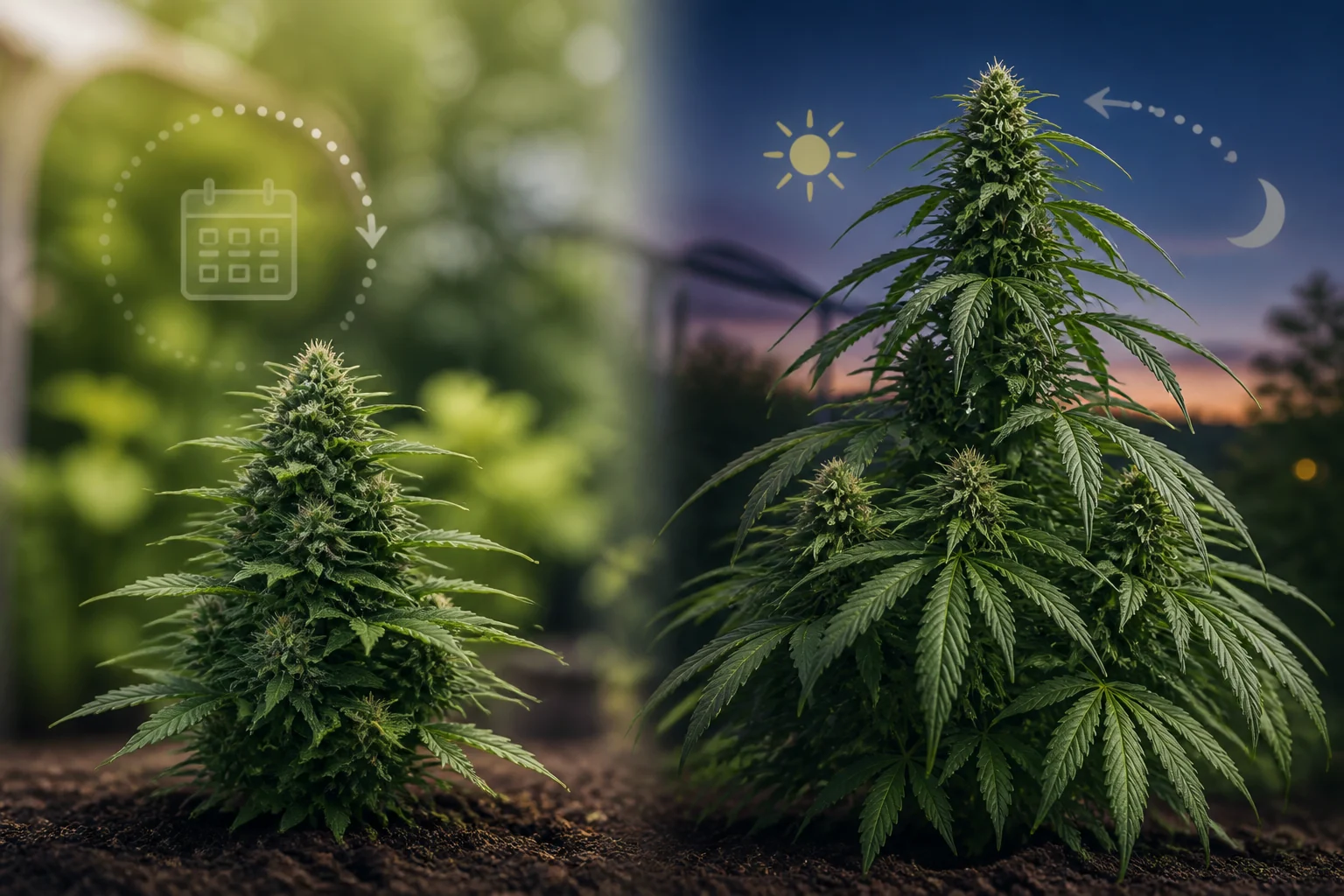
Autoflower vs Photoperiod Cannabis: Indoor, Outdoor, Timing, Control, and Beginner Fit
Autoflower and photoperiod cannabis can both produce healthy, high-quality plants, but they organize the grow around different clocks. An autoflowering cultivar moves toward reproductive development largely without waiting for a specific shortening of day length, while a photoperiod-sensitive cultivar gives the grower or the season much more influence over when full flowering develops. That difference changes far more than the light schedule. It changes how much time you have to recover from a slow start, how useful transplanting and training are, how outdoor latitude affects the finish window, how easily indoor plant size can be managed, and how much control a beginner really has after making a mistake.
The useful comparison is therefore not “Which one is better?” It is “Which flowering system fits this site, schedule, room, risk tolerance, and level of control?” Autoflowers can simplify flowering timing and can be valuable where outdoor seasons are short or indoor simplicity matters. Photoperiod plants can demand more planning around day length, but they also offer a larger management window before flowering and much more flexibility when the grower wants to control plant size, recovery time, propagation, or the moment the crop enters its main reproductive phase.
This resource keeps the comparison in one place. It covers outdoor use, indoor use, timing, control, recovery margin, beginner fit, common claims, and a repeatable decision process. For the complete production workflow after you have chosen a type, continue with the Outdoor Grow Comprehensive Guide or the Complete Indoor Cannabis Growing Guide.
Start With the Biological Difference: Day-Neutral vs Photoperiod-Sensitive
The comparison makes more sense when you stop treating “auto” and “photo” as product categories and start treating them as different flowering responses. Most photoperiod-sensitive cannabis responds to the relationship between day length, uninterrupted darkness, physiological age, and genotype. Autoflowering material is selected for much weaker dependence on day length, allowing reproductive development under long days that would normally maintain or delay the full flowering response of photoperiod-sensitive plants.
That does not make autoflowers independent of light. Leaves still need photosynthetically useful radiation. Daily light integral still affects how much light the plant receives over a day. Long cloudy periods still reduce carbon gain. Excess heat under strong light still creates stress. Indoors, a longer light schedule still changes electricity use and total light exposure. The word day-neutral is about the flowering trigger, not about making light irrelevant to plant growth.
Photoperiod-sensitive and photoperiod-insensitive flowering
Photoperiod-sensitive cannabis changes reproductive development in response to day-length and dark-period signals, with thresholds that vary by genotype. Photoperiod-insensitive, commonly called autoflowering or day-neutral, describes material able to proceed into flowering without requiring the same short-day signal. Neither term predicts final quality, potency, disease resistance, or yield by itself.
Autoflowering is a flowering trait, not a complete plant description
Modern autoflowers are often discussed as though all of their characteristics come from a single wild “ruderalis” ancestor. The real biology is more complicated. Peer-reviewed mapping work has identified multiple loci associated with photoperiod-insensitive flowering in Cannabis sativa, including Autoflower1 and Autoflower2, and newer genomic work continues to identify additional flowering-time regions. Researchers have also found variation among commercial populations sold as cultivars, including populations that segregated for the autoflower trait.
The practical consequence is important: do not infer the whole plant from the word autoflower. Autoflowering tells you something useful about flowering behavior. It does not automatically tell you how tall the plant will become, how early it will finish, how uniform the seed population will be, how dense the flowers will be, whether the roots tolerate overwatering, or whether the plant is suited to a humid autumn.
Photoperiod cannabis does not have one universal flowering threshold
The opposite oversimplification is to say that every photoperiod plant stays vegetative above 12 hours of light and flowers only at 12/12. Twelve hours of light and twelve hours of darkness is a common indoor flowering schedule, but controlled research has shown substantial cultivar variation. Drug-type cultivars in one study initiated flowering under photoperiods as long as 14 hours, and some initiated under 15 hours without completing normal floral development under that treatment.
Outdoors, this variation helps explain why two photoperiod cultivars planted in the same garden can begin visible flowering at different points in summer. Latitude, twilight, local light pollution, physiological age, and genotype all interact with the response. A grower choosing between auto and photo should therefore compare verified flowering behavior, not just the label.
Age still matters in cannabis development
Cannabis development is not controlled by a single switch. Research on cannabis and hemp has described a juvenile or basic vegetative phase during which young plants are not yet developmentally ready for the full reproductive transition. Solitary flowers can also appear with age under long-day conditions without the same compact inflorescence development produced under a short-day flowering regime.
This matters because “autoflowering starts by age” should not be interpreted as a stopwatch with an identical day count for every seed. Seed vigor, genotype, temperature, root development, stress, and overall growth rate can alter what the plant looks like when reproductive development becomes obvious. Use breeder timing as a planning estimate, then verify the actual plant.
Remember: Autoflowering reduces dependence on a seasonal or artificial short-day trigger. It does not remove genetics, plant age, environment, light quantity, root health, or management from the equation.
The most useful question is how much control you want over the transition
A photoperiod plant gives you a larger lever. Indoors, you can normally maintain a long-day schedule while the plant develops and then change the photoperiod when you want the main flowering phase to proceed. Outdoors, nature controls the changing day length, so your latitude and cultivar response determine more of the schedule.
An autoflower removes much of that flowering-trigger decision. That can be convenient, but it also means the plant does not wait patiently for you to solve every early problem. If growth is slow because the root zone stayed saturated, a transplant was rough, temperatures were poor, or early light was weak, the calendar continues moving. That shorter recovery margin is one of the most important practical differences between the two systems.
Compare flowering behavior and management window
Ask when the plant transitions, how much control you have over that transition, and how much time remains to recover from early mistakes.
Use “auto” or “photo” as a quality ranking
Neither flowering type guarantees better potency, flavor, yield, resilience, or beginner success.
Compare Timing, Control, and Recovery Margin
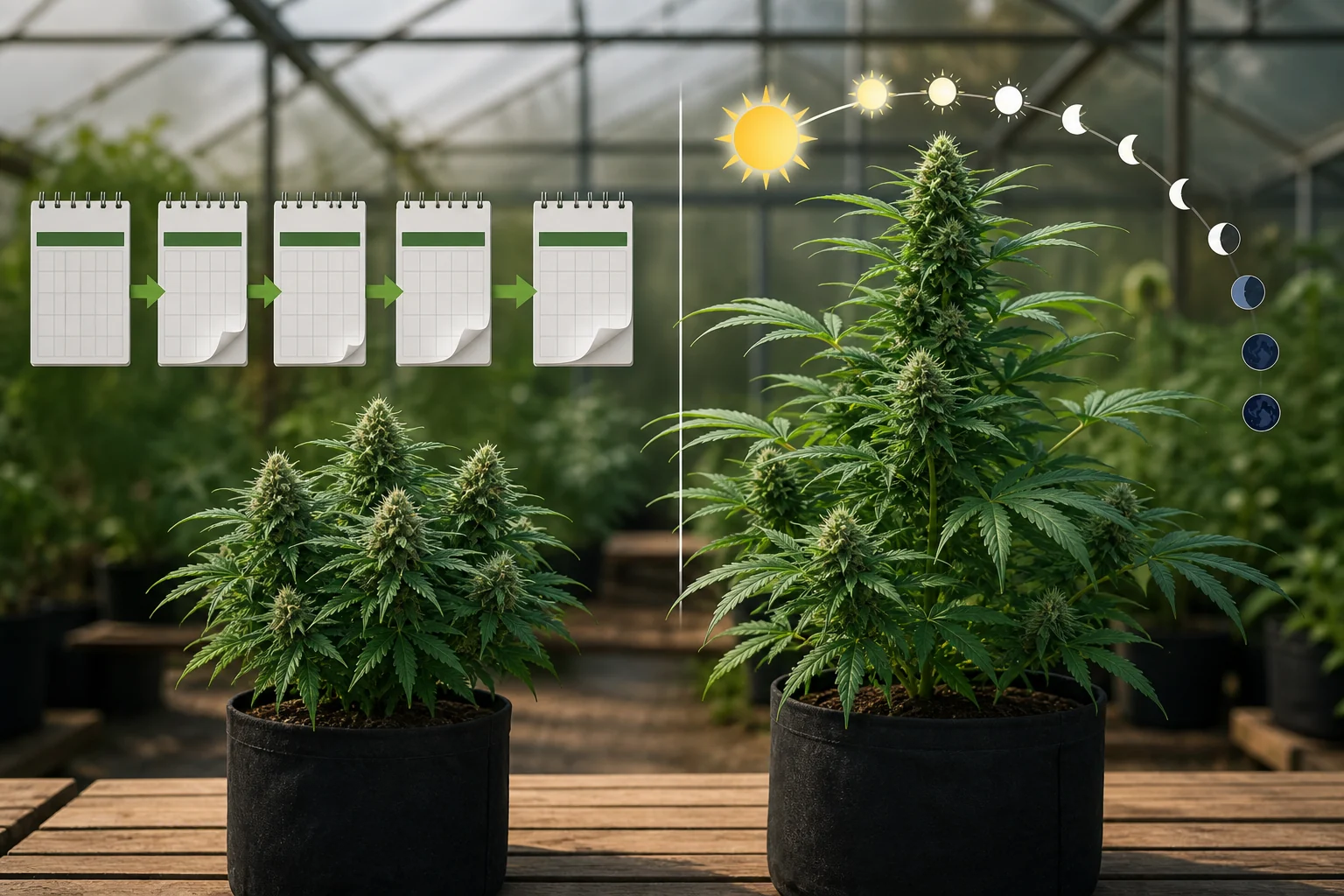
Timing is where the two systems feel most different in practice. Autoflowers are often chosen because they move through the life cycle without waiting for a seasonal reduction in day length or an indoor flowering flip. Photoperiod plants are often chosen because the grower can keep them in a long-day environment while building roots and canopy, then initiate or encourage full flowering later.
Neither system is automatically faster in every real grow. A fast autoflower can finish much earlier than a large outdoor photoperiod plant, but a small indoor photoperiod plant can be given a short vegetative period and flowered relatively early. The meaningful comparison is not the fastest theoretical seed-to-harvest number. It is the timeline that fits your production goal while leaving enough margin for healthy development.
Autoflowers trade calendar flexibility for flowering independence
Once an autoflower has entered its reproductive trajectory, you cannot simply return it to a long vegetative period by restoring longer days. That makes the early root and canopy phase valuable. A week of poor establishment may represent a larger fraction of the plant’s total developmental window than the same week would in a photoperiod grow where flowering can be delayed.
This is why the phrase “autos are fast” can be misleading. Speed is useful when the site has a short season, when a discreet smaller crop is desirable, or when you want a predictable succession of compact plants. Speed is less useful if it forces flowering before the plant has filled the intended space or recovered from a preventable stress event.
Photoperiod plants can buy recovery time indoors
Indoors, the grower can generally maintain a photoperiod-sensitive plant under a long-day schedule while correcting an early issue. If a transplant slows growth, the root zone needs adjustment, or training temporarily reduces canopy expansion, the plant can often be given additional vegetative time before the flowering schedule is changed.
That flexibility has a cost. More vegetative days require space, light, electricity, irrigation, inspection, and continued environmental control. A plant that is kept vegetative too long can outgrow the room or make the later stretch difficult to manage. Photoperiod flexibility is only an advantage when the grower uses it intentionally.
Outdoors, photoperiod timing shifts control from the grower to the season
A photoperiod plant outdoors does not wait for your preferred harvest date. The local day-length trajectory, cultivar response, twilight, and temperature pattern shape when flowering advances. A cultivar that finishes comfortably at one latitude may enter flowering later at another and collide with autumn rain, cold nights, frost, or declining sunlight.
Autoflowers can reduce that particular seasonal dependency. This is one reason photoperiod-insensitive genetics are useful in high-latitude or short-season production. The tradeoff is that an autoflower started during a poor weather window can begin its life cycle under weak conditions and cannot extend vegetative growth simply because spring stayed cold or cloudy.
Recovery margin is more useful than asking which type is forgiving
“Forgiving” is a vague word. Break it into time and reversibility. A photoperiod plant usually gives the grower more opportunity to delay the main flowering transition indoors. Outdoors, that recovery margin depends on how much useful season remains. An autoflower typically gives less calendar freedom because flowering proceeds according to its internal developmental program.
That does not mean autoflowers are fragile. A well-established autoflower can handle ordinary environmental variation. It means that a significant early setback has fewer weeks in which the plant can replace lost growth before reproductive allocation becomes dominant.
“If autoflowers finish faster, does that automatically make them easier for a first grow?”
Question sent by: QuietGrowRoom, via email.
No. They can simplify flowering timing, especially because you do not need to decide when to flip the photoperiod, but the shorter management window can make early mistakes more expensive. A photoperiod plant adds another scheduling decision, yet it can also give you more time to correct slow growth before flowering. Beginner fit depends on which kind of mistake you are more likely to make.
Build the timeline from checkpoints instead of advertised total days
Record germination or emergence, first strong root-zone establishment, active vegetative expansion, first visible sexual maturity, clear terminal flowering, and the beginning of the realistic finish window. These checkpoints tell you much more than “70 days” or “8 weeks.”
For photoperiod plants, also record the indoor flip date or, outdoors, the period when terminal flowering becomes obvious. For autos, record the first unmistakable shift from vegetative expansion into reproductive growth. After one complete cycle, these records become far more useful than generic category claims.
| Timing question | Autoflower tendency | Photoperiod tendency |
|---|---|---|
| What starts full flowering? | Primarily internal developmental programming with reduced dependence on short days. | Genotype, maturity, and a sufficiently inductive photoperiod or dark period. |
| Can flowering be delayed indoors? | Only to a limited degree through general growth conditions; long days do not create an indefinite vegetative hold. | Usually yes, by maintaining an appropriate long-day vegetative photoperiod for that cultivar. |
| Effect of early setback | Often larger because a fixed developmental window continues moving. | Can often be partly recovered by extending vegetative time indoors. |
| Outdoor latitude sensitivity | Flowering trigger is less dependent on day length. | Can be strongly affected by cultivar-specific photoperiod response and latitude. |
| Schedule simplicity | Fewer flowering-trigger decisions. | More timing decisions, but more control when those decisions are available. |
Choose Between Autoflower and Photoperiod Outdoors
Outdoor selection should begin with the season rather than with a preference for one flowering type. Ask how long the site remains genuinely usable, not just how many frost-free days are listed for the region. Late-season rain, fog, dew, wildfire smoke, tropical storms, heat, wind, or security restrictions can create a practical finish deadline before the first frost.
Then compare the flowering system against that deadline. An autoflower can reduce dependence on shortening days and may finish before the most dangerous part of autumn. A photoperiod plant can use a long summer to build a much larger framework, but only when its flowering response and finish window fit the site.
Autoflower vs Photoperiod Outdoors
For a short outdoor season, an autoflower can be a powerful scheduling tool. The plant can flower under long summer days and may complete before a late-finishing photoperiod cultivar has reached maturity. At high latitude, this can be especially useful because summer days stay long while the autumn risk window approaches quickly.
For a long, favorable season, photoperiod plants can use the extended vegetative period to produce a larger root system, wider branch structure, and greater total canopy. That potential comes with more exposure time. A larger plant also needs more water, support, inspection access, and space. If flowering begins late, the extra summer growth can become a liability when dense flowers enter cold or wet weather.
Use a short season as a reason to investigate autos, not as proof you need them
Early-finishing photoperiod cultivars can also work very well in short seasons. Some photoperiod-sensitive cannabis begins flowering under day lengths longer than the simplistic 12/12 rule would suggest, and flowering thresholds vary substantially among genotypes. That means the real comparison may be between a proven early photoperiod cultivar and a proven autoflower, not between “all photos” and “all autos.”
If reliable local records show an early photoperiod cultivar finishing with margin before your cold or wet season, the photoperiod option may offer more plant-size flexibility without creating finish risk. If local records are weak, an established autoflowering line may reduce one source of uncertainty, but source stability still matters.
Choose the sowing window around growth conditions, not just the calendar
An autoflower started too early in cold soil or several weeks of weak spring light can spend a meaningful part of its limited vegetative window growing slowly. Starting later into warmer, brighter conditions may produce a stronger plant even if the calendar says you “lost” weeks.
Photoperiod plants can often absorb a slower spring more easily because they may remain in vegetative development until seasonal signals become inductive. However, extremely early starts can create oversized plants, transplant complications, or premature flowering/revegetation problems when indoor-raised plants are moved outside under inappropriate day-length conditions. The correct outdoor start depends on the cultivar and the real light transition.
Run multiple outdoor harvest windows when the law and space allow
Autoflowers can be useful for staggered outdoor scheduling because several batches may be started at different times through a sufficiently long warm season. That can reduce the amount of flower exposed to one late-season weather window. It can also spread workload.
Do not assume every location supports repeated auto cycles. Temperature, rainfall, pest pressure, water restrictions, legal plant-count rules, and decreasing late-season light can make the second or third cycle much weaker than the first. Count legal plant numbers by the rule that applies where you live, not by the number of harvests you hope to achieve.
Outdoor plant size can be an advantage or a liability
Photoperiod plants can become very large when given an early start, strong roots, and a long season. That can be useful where plant count is limited but space and water are abundant. The same size can become difficult in a visible backyard, windy site, container garden, balcony, or location with limited water.
Autoflowers often remain smaller and complete faster, but “auto” is not a guarantee of a tiny plant. Modern breeding has produced substantial variation. Use source-specific height, architecture, and root-volume observations rather than assuming all autos fit small spaces.
“My summers are bright but autumn turns wet very quickly. Is an autoflower automatically safer?”
Question sent by: FrostLineGrower, via contact form.
It can reduce late-season timing risk if it reliably finishes before the wet period, but verify the actual cultivar and sowing window. A poorly timed autoflower can still flower through rain, and an early photoperiod cultivar may also finish safely. Compare proven local finish windows, flower structure, disease observations, and the amount of weather margin left before your wet season.
Do not ignore outdoor light just because the plant is day-neutral
An autoflower can begin flowering under long days, which is useful at high latitude, but those long days only help if the site actually receives useful light. Shade from buildings, trees, smoke, or a narrow balcony reduces daily light. A plant can be perfectly capable of flowering and still produce weak growth because the canopy does not receive enough radiation.
Photoperiod plants have the same light-quality problem plus an additional timing problem. A shaded site may limit growth while nearby artificial light at night interferes with the dark period. Choose the site first, then the flowering type.
Choose Between Photoperiod and Autoflower Indoors
Indoors, the comparison changes because the grower controls the light schedule. The central advantage of a photoperiod plant is not that it “needs 12/12.” It is that the grower can normally keep the plant under a long-day regime while building the desired canopy and then move to an inductive flowering schedule. The central advantage of an autoflower is that the flowering transition does not depend on making that schedule change.
This means the indoor decision is mostly about control, space utilization, electricity, propagation strategy, and tolerance for a fixed developmental timeline.
Photoperiod vs Autoflower Cannabis Indoors
Photoperiod plants fit growers who want to decide when the canopy is ready to flower. A small plant can be given more vegetative time. A large plant can be flipped earlier. A trained canopy can be allowed to recover before flowering. This makes photoperiod plants especially adaptable to rooms where the grower is learning how quickly a specific cultivar stretches and fills the available light footprint.
Autoflowers remove the flowering-flip decision. Many growers run them under a long daily photoperiod from early growth through harvest because the plant does not require a short-day trigger. The exact light duration and intensity should still be designed around daily light integral, cultivar response, temperature, and electricity cost. “More hours” is not automatically better if the plant is already receiving more light than it can efficiently use.
Photoperiod plants give more control over canopy occupancy
In a fixed indoor footprint, canopy occupancy matters. A photoperiod grower can watch how quickly plants fill the room and start flowering before horizontal space or height becomes difficult. With experience, this makes crop scheduling highly repeatable.
Autoflowers require more prediction. If the plant remains smaller than expected, you cannot simply add another month of vegetative growth to fill the empty canopy. If it becomes larger than expected, flowering is already underway while you solve the spacing problem. Plant count, container size, cultivar uniformity, and early growth quality therefore matter greatly.
Longer light schedules have a real operating cost
Autoflower discussions sometimes treat long light schedules as free because no flowering flip is required. Indoors, every additional lighting hour consumes electricity and usually adds heat that the environment must remove. The relevant measure is the total daily light delivered and the cost of maintaining the room, not the cultural habit of using one schedule.
Photoperiod flowering schedules typically use fewer lighting hours per day than long-day vegetative schedules, although research has shown that the traditional 12-hour flowering photoperiod is not necessarily optimal for every cultivar. If experimenting with longer photoperiods, use cultivar-specific evidence and measured DLI rather than internet rules.
Photoperiod plants support a different propagation workflow
Photoperiod-sensitive cultivars fit mother-plant and clone-based workflows because selected genetics can be maintained under long-day conditions and propagated repeatedly. That can improve uniformity once a specific phenotype has been evaluated.
Autoflowers are primarily used from seed in ordinary home cultivation because their age-linked reproductive program makes conventional mother-plant scheduling impractical. Specialized tissue culture and breeding techniques exist, but they are a different production system and do not turn the normal autoflower into a convenient long-term vegetative mother.
Do not copy a light schedule without calculating the daily load
A 20-hour autoflower schedule and a 12-hour photoperiod flowering schedule cannot be compared by hours alone. PPFD, DLI, heat, electricity, cultivar response, and environmental capacity all matter. Long exposure to excessive light is still excessive light.
Indoor control does not make photoperiod genetics automatically harder
Changing a timer is simple. The harder part is understanding when the plant is ready, how much stretch to expect, and how the room will handle a flowering canopy. Once those decisions are understood, photoperiod cultivation can be highly controllable.
Autoflowers simplify one major choice but increase the importance of a clean start. The best system is the one whose failure modes you can detect and correct before they become expensive.
Decide Which Type Fits a Beginner’s Error Budget
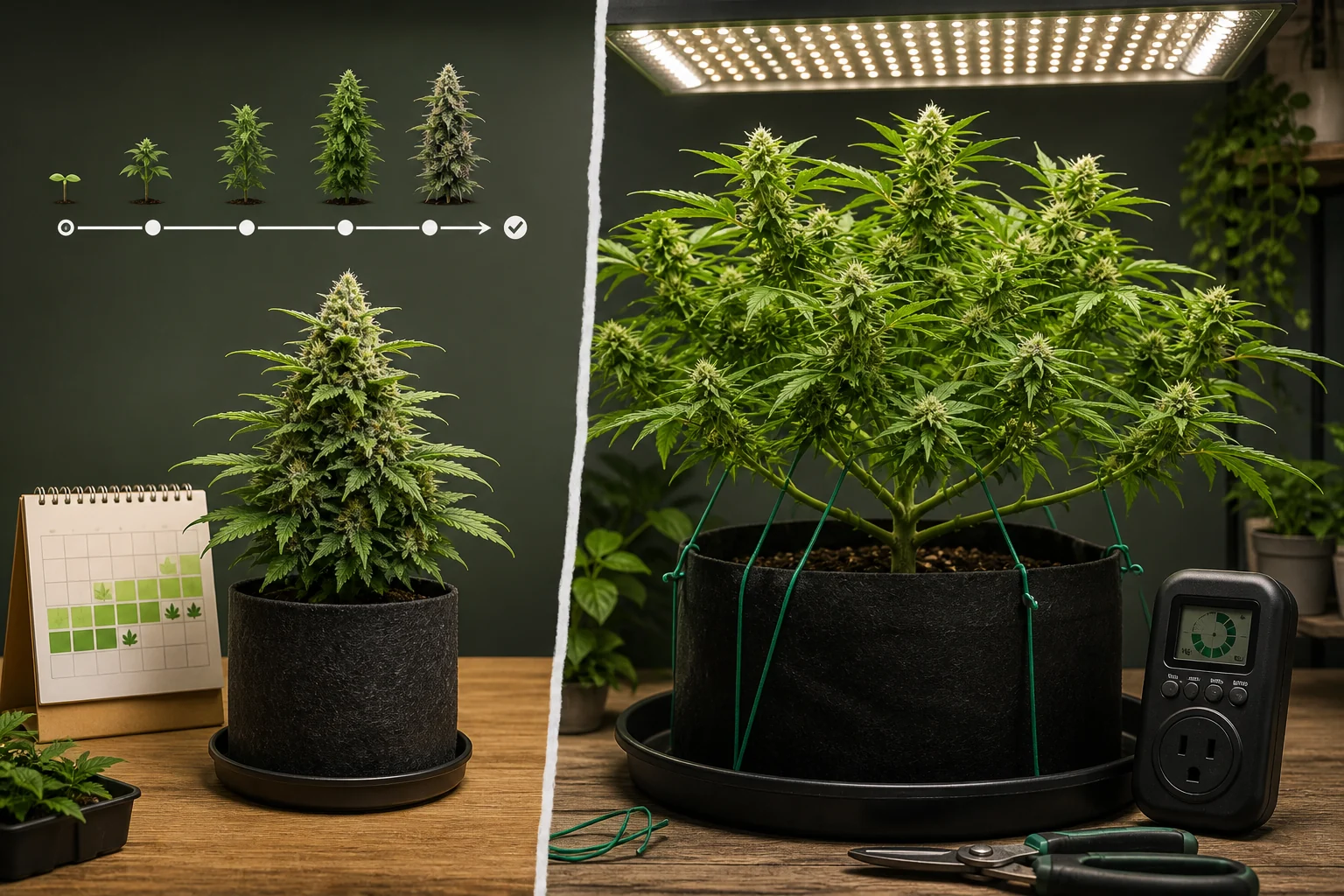
Beginners are often told that autoflowers are easier because there is no flowering light switch. The opposite claim says photoperiod plants are easier because they can be kept vegetative until mistakes are fixed. Both contain some truth, which is why neither is a useful universal rule.
A better concept is the error budget. Ask which mistakes your setup is most likely to create and whether you need simplicity or recovery time more.
Autoflower vs Photoperiod Cannabis for Beginners
An autoflower can be a sensible first choice when the grower wants a compact timeline, understands basic watering, has a stable environment ready before germination, and does not want to manage a separate flowering trigger. It can also be useful outdoors when the season makes a long photoperiod finish risky.
A photoperiod plant can be a sensible first choice when the grower expects to learn slowly, wants time to practice watering and training, has an indoor space where the vegetative period can be extended, or wants more direct control over final plant size. The extra photoperiod decision is usually easier to learn than trying to recover lost early growth after an autoflower has already committed to flowering.
Watering mistakes favor recovery margin
Overwatering is common in first grows because a small root system is placed in a large volume of wet medium and watered as though the container were already full of roots. If this slows early growth, a photoperiod plant indoors can often be given additional vegetative time after the root zone recovers.
An autoflower can recover biologically, but it cannot refund the lost calendar. That makes root-zone preparation, container drainage, irrigation volume, and early observation especially important. Do not respond by keeping autos unusually dry. The goal is correct root-zone moisture, not stress avoidance through chronic underwatering.
Training mistakes are easier when the schedule is adjustable
Low-stress training, topping, pruning, and canopy shaping all consume plant time. Photoperiod plants let the grower wait for healthy recovery before initiating flowering indoors. Autoflowers can also be trained, but the intervention should fit the cultivar’s vigor and developmental speed. Heavy or poorly timed intervention can use a larger share of the remaining vegetative window.
For a first autoflower grow, structural support and gentle positioning may be more useful than trying to apply every training technique seen online. Let the plant’s growth rate determine how much intervention it can absorb.
Transplanting should be judged by root condition, not autoflower folklore
Autoflowers are often described as plants that can never be transplanted. The better rule is that any transplant capable of causing significant root disturbance or growth delay is more consequential when developmental time is limited. A clean transplant from a well-rooted but not root-bound container can be very different from tearing apart a compacted root ball.
If you want to minimize the variable, start in the final container when that system is easy to water correctly. If you transplant, prepare the receiving medium, match moisture reasonably, protect the root ball, and avoid combining the move with several other stresses.
Environmental instability makes a fast clock less attractive
A beginner whose room still overheats, whose outdoor site has not been mapped, or whose irrigation routine changes every few days may benefit from solving those fundamentals before relying on a fast cycle. Speed rewards stability.
Conversely, a beginner with a short legal outdoor season may find a large photoperiod plant difficult simply because the environment will not give it enough time. Beginner fit is therefore a property of the grower plus the site, not the seed category alone.
“I am completely new and only have one small tent. Which type gives me the better chance to learn?”
Question sent by: BalconyBotanist, via Facebook page.
If the tent environment is already stable, either can work. Choose an autoflower if you value a simpler flowering schedule and accept a tighter recovery window. Choose a photoperiod if you want to learn watering, training, and canopy control with the option to extend vegetative growth before flowering. For many first-time indoor growers, that extra recovery time is more useful than saving one timer change.
Use one plant cycle to improve the next decision
Record emergence date, container size, first transplant if any, major training dates, first flower, height at flowering, final height, irrigation pattern, major stress events, and finish date. Your second decision should be based on what actually limited the first grow.
If the first photoperiod plant became too large because you delayed flowering, you may not need an autoflower. You may simply need an earlier flip. If the first autoflower stayed small because the root zone was wet for two weeks, the lesson is not necessarily that autos are low yielding. The lesson may be that early root management was the limiting factor.
Separate Size, Yield, Training, and Quality Claims From Reality
Autoflower vs photoperiod discussions attract absolute claims because both systems have obvious visual differences. Photoperiod plants can be kept vegetative for a long time and become very large. Autoflowers often mature faster and many remain smaller. Those tendencies are real enough to influence planning, but they should not be converted into universal quality rankings.
Autoflowers are often smaller because the vegetative window is constrained
Reviews of cannabis cultivation commonly describe photoperiod-insensitive cultivars as rapidly maturing and generally shorter, with lower biomass than photoperiod-dependent types. That is a population-level tendency, not a ceiling for every modern auto.
Plant size still responds to genetics, root volume, light, temperature, nutrition, water, density, and early vigor. A strong modern autoflower can become much larger than an old stereotype suggests, while a photoperiod plant flowered early indoors can remain compact.
Per-plant yield and yield per unit time are different questions
A large outdoor photoperiod plant may produce far more flower per plant because it has months to build structure before flowering. An autoflower may produce less per plant but finish earlier, occupy less vertical space, and potentially allow staggered scheduling where legal limits and climate permit.
Indoors, the comparison becomes even more system-dependent. Plant density, veg time, canopy fill, DLI, electricity use, and crop turnover all affect the useful production metric. Do not compare a single small auto with a photoperiod plant that was vegetated for two months and call the result a genetic yield test.
Training redistributes structure; it does not create free biomass
Topping, low-stress training, trellising, and branch positioning can improve canopy distribution and access, but they work by changing architecture. Each intervention also has a recovery cost. Photoperiod plants give the grower more freedom to wait for recovery before flowering indoors. Autos require greater attention to timing because the reproductive clock is less adjustable.
Choose the lightest intervention that solves the actual problem. If branches already occupy the light footprint evenly, training for the sake of training adds risk without a clear purpose.
Potency is not determined by flowering type
Autoflowering and photoperiod sensitivity are flowering-time traits. Cannabinoid and terpene expression depend on genetics plus environment, maturity, plant health, light, nutrition, and postharvest handling. A modern autoflower can carry high-cannabinoid genetics, and a photoperiod cultivar can be weak or poorly finished.
Compare source-specific chemotype data and independent testing where available. Do not treat “ruderalis,” “auto,” “photo,” “indica,” or “sativa” as a potency score.
Uniformity depends on breeding quality, not category
Peer-reviewed work has identified commercial cannabis populations segregating for autoflower loci. That is a reminder that a name on a pack is not enough. A well-bred autoflower line can be highly useful because flowering behavior is predictable. A poorly stabilized population can produce plants with different timing and architecture, which complicates a single-room or short-season grow.
The same warning applies to photoperiod cultivars. Buy from a source that describes the range of phenotypes and flowering behavior rather than only the best photographed plant.
| Decision factor | Autoflower may fit better when… | Photoperiod may fit better when… |
|---|---|---|
| Outdoor season | You need flowering that is less dependent on shortening days and an earlier finish is valuable. | A proven cultivar reliably flowers and finishes inside your local season. |
| Indoor canopy control | You prefer a simpler flowering schedule and can predict the cultivar’s size reasonably well. | You want to decide when the canopy is ready to flower. |
| Recovery from early mistakes | Your environment and root-zone routine are already stable. | You want the option to extend vegetative time after a setback. |
| Plant size | Smaller or faster plants fit the site better. | You want to build a larger plant or fill a specific canopy before flowering. |
| Propagation | You are comfortable starting production plants from seed. | You want to maintain selected mother plants and repeat a clone-based phenotype. |
| Beginner priority | You value fewer flowering-schedule decisions. | You value a larger correction window. |
Quality comparisons must control for maturity and environment
If one plant is harvested too early, stressed during flowering, grown under weak light, or dried poorly, the final flower will not tell you whether the flowering category was superior. Compare plants grown well, harvested at appropriate maturity, and handled similarly.
The correct conclusion is rarely “autos are better quality” or “photos are better quality.” The useful conclusion is that a specific cultivar and management system produced a result that fits your priorities.
Make the Final Choice With a Repeatable Decision Checklist
The final decision should be made before germination, when you can still change genetics without wasting a growing window. Use a short sequence that eliminates poor fits before you compare attractive traits.
Step 1: Define the hard constraint
Choose the constraint that can end the grow or make the system unmanageable. Outdoors it may be frost, autumn rain, latitude, plant visibility, legal plant count, water availability, or a short period of safe access. Indoors it may be height, electricity, heat removal, canopy footprint, or the need to maintain a specific clone.
If one flowering type clearly solves the hard constraint, give that decision more weight than marketing traits. A beautiful late photoperiod cultivar is not useful when your garden becomes cold and wet six weeks before it matures.
Step 2: Decide whether you need flowering control or flowering independence
Choose photoperiod when being able to decide or delay the main flowering phase is a meaningful advantage. Choose autoflower when reducing dependence on that decision or on seasonal short days is more valuable.
This single question often resolves the comparison more effectively than yield claims.
Step 3: Score the recovery margin
Ask whether the environment is already stable. Have you tested irrigation? Is the final container ready? Is the indoor room holding temperature and humidity? Has the outdoor site been mapped for sun, wind, drainage, and access? If not, a system with more adjustable vegetative time may be valuable.
If the environment is proven and the goal is speed or an early outdoor finish, the tighter autoflower timeline becomes less risky.
Step 4: Verify the exact cultivar rather than the category
Look for source-specific flowering data, phenotype range, final height, outdoor finish reports, disease observations, and whether the seed population is known to segregate. For autos, verify that the line is consistently photoperiod-insensitive. For photos, verify outdoor flowering and finish behavior at a comparable latitude or controlled indoor response where possible.
Save the product page, seed lot, purchase date, and any technical sheet. The source is part of the record.
Step 5: Write the expected timeline before planting
For an autoflower, write the expected establishment window, likely transition period, and broad finish range. For a photoperiod indoor grow, write the intended vegetative checkpoint, approximate flip criteria, expected stretch, and finish window. For a photoperiod outdoor grow, write the expected first-flower period and latest defensible harvest window.
These are hypotheses, not promises. Update them when the plant gives you better information.
Autoflower or photoperiod?
- I know the legal plant-count and cultivation rules that apply to my grow.
- I have identified the hard constraint: season, space, height, schedule, recovery margin, or propagation.
- I know whether I value flowering independence or flowering control more.
- I have checked the exact cultivar’s flowering and finish behavior, not only the auto/photo label.
- I have a realistic root-zone, container, irrigation, and light plan ready before germination.
- For outdoor growing, I have compared the finish window with local late-season weather risk.
- For indoor growing, I have checked canopy height, electricity, DLI, and environmental capacity.
- I understand that autoflowers generally provide less calendar time to recover from an early setback.
- I understand that photoperiod plants provide more timing control only if I actually manage the photoperiod and canopy correctly.
- I will record the real timeline so the next cycle is based on my own evidence.
Use a three-option decision instead of forcing a false binary
Your answer does not have to be “always auto” or “always photo.” A short-season outdoor grower may use autoflowers for an early harvest and an early-finishing photoperiod cultivar for a later harvest. An indoor grower may prefer photoperiod plants for a repeatable clone-based room but run an autoflower separately when simplicity or timing suits the space.
The important boundary is to avoid mixing systems without understanding their different clocks. A single room of plants that require different photoperiod strategies can complicate lighting and canopy management. Plan the room around the flowering behavior of the plants actually sharing it.
Verify the decision after the first cycle
At harvest, compare the actual result with the reason you chose the flowering type. If you chose an auto to finish before autumn rain, did it finish with enough weather margin? If you chose a photo for indoor control, did you use the vegetative flexibility effectively or simply let the plant become too large? If you chose an auto for simplicity, did the fixed timeline reduce decisions or make early mistakes harder to recover from?
That review turns the first grow into a local trial. The next seed choice can then be based on real timing, space, labor, water, and recovery data rather than the same internet debate.
Share this article
A quick overview of the topics covered in this article.
- Start With the Biological Difference: Day-Neutral vs Photoperiod-Sensitive
- Compare Timing, Control, and Recovery Margin
- Choose Between Autoflower and Photoperiod Outdoors
- Choose Between Photoperiod and Autoflower Indoors
- Decide Which Type Fits a Beginner’s Error Budget
- Separate Size, Yield, Training, and Quality Claims From Reality
- Make the Final Choice With a Repeatable Decision Checklist
Follow us
Latest articles

September 4, 2026
September 4, 2026
September 4, 2026
September 4, 2026