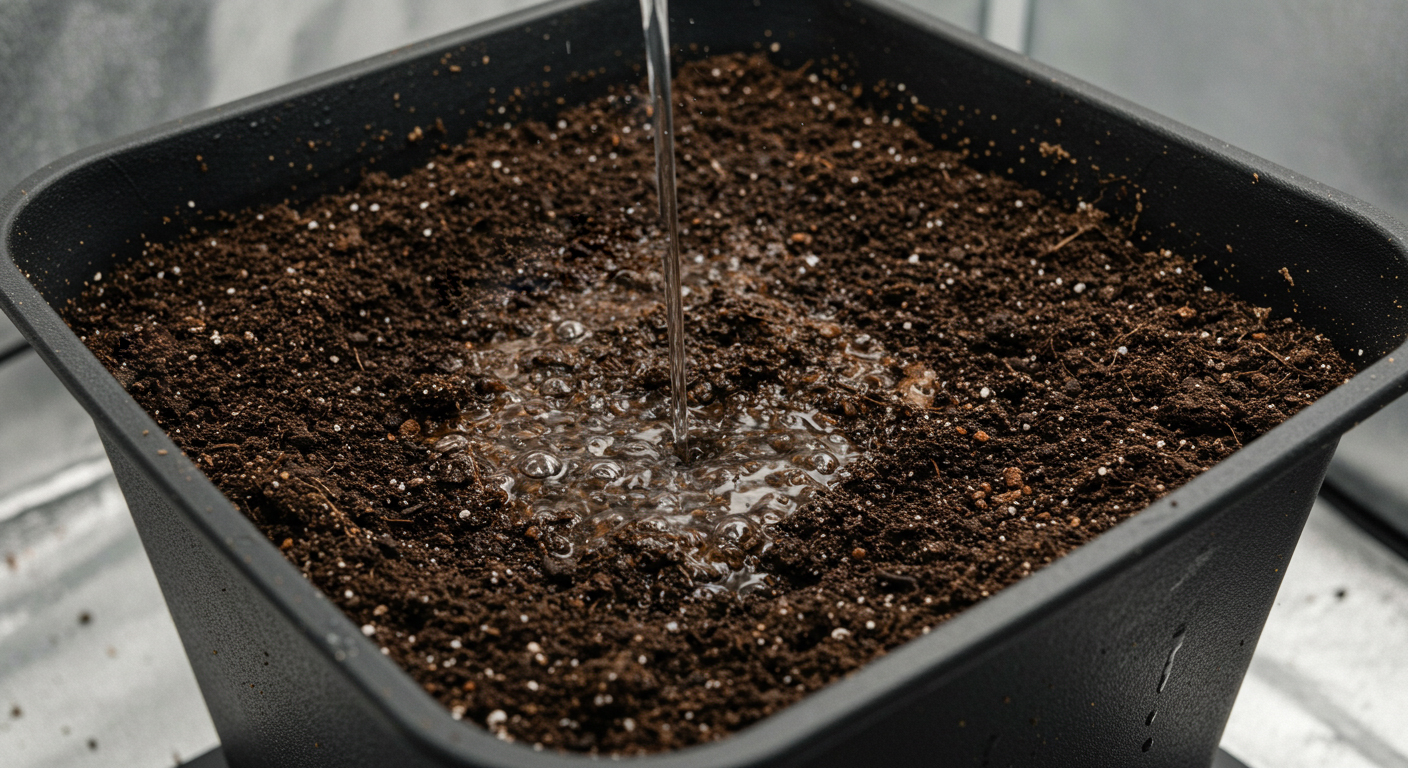
Flood-and-Drain Systems for Cannabis: Tray Hydrodynamics, Substrate Wicking, and Reservoir Cycling
Flood-and-drain hydroponics, historically known in commercial horticulture as ebb-and-flow, represents one of the most mechanically robust, productive, and oxygen-rich cultivation methodologies in controlled-environment agriculture. While top-drip fertigation systems rely on dozens of micro-emitters that can clog with mineral salts or biofilm, and deep water culture (DWC) systems leave roots permanently submerged in liquid reservoirs where pump failures cause instant hypoxic drowning, flood-and-drain combines the simplicity of bulk fluid movement with exceptional root aeration. In a flood-and-drain setup, plants sit in specialized ABS plastic flood trays positioned above an insulated nutrient reservoir. At scheduled intervals, a submersible utility pump rapidly fills the tray with nutrient solution from below, submerging the lower two-thirds of the substrate. As the water rises, it dissolves accumulated mineral salts and refreshes interstitial moisture films via capillary wicking. Once the pump switches off, gravity pulls the solution rapidly back down into the reservoir through the pump intake and overflow standpipe. This rapid drainage creates a powerful physical vacuum known as the piston effect, sucking thousands of liters of fresh, oxygen-rich atmospheric air directly into the root core. However, achieving consistent commercial yields in ebb-and-flow requires mastering the hydrodynamics of substrate capillary rise, flood velocity, cycle duration, and reservoir biochemical drift. This comprehensive guide details the fluid dynamics, plumbing architectures, substrate selection criteria, and operational cycles required to master flood-and-drain systems for cannabis, integrating directly with our master guides on cannabis dry-back and VWC targets, leaching fractions and runoff dynamics, and cannabis watering frequency and volume.
Sub-Irrigation Physics: Hydrostatic Buoyancy, Tray Fluid Dynamics, and Root Capillarity
To engineer a high-performance flood-and-drain installation, cultivators must understand the physical forces governing bottom sub-irrigation:
- Capillary Rise and the Jurin Equation: When water enters the base of a container from below, it ascends against gravity through substrate micropores via capillary pull. The maximum height of capillary rise (h) is governed by Jurin’s law: h = (2 γ cos θ) / (ρ g r), where γ is surface tension, θ is contact angle, and r is the effective pore radius. In fine media (such as coco coir or rockwool blocks), pore radius is microscopic, generating strong capillary suction that pulls water 4 to 6 inches upward in minutes. In coarse media (such as 8-16 mm expanded clay pebbles), pore radius is massive, resulting in minimal capillary rise (<1.0 inch). Understanding substrate capillary rise determines exact flood height requirements.
- Hysteresis in Capillary Wetting and Drainage: The moisture content of a porous medium at a given matric suction is higher during drainage (desorption) than during wetting (sorption). This thermodynamic phenomenon, known in soil physics as hydraulic hysteresis, occurs because narrow pore throats restrict drainage while wider pore bodies restrict capillary advance (the “ink-bottle effect”). In flood-and-drain, hysteresis ensures that after the tray rapidly empties, a substantial volume of capillary water remains trapped inside micropores coating root hairs, providing hours of hydration while drained macropores facilitate oxygen diffusion.
- The Hydrostatic Piston Effect: The true power of flood-and-drain lies not in the flooding event, but in the rapid gravitational drainage. As water rises in the tray, it displaces stale, carbon-dioxide-laden air upward through the top of the medium. When the pump shuts off and water recedes back down the drain, the descending water column functions like a hydraulic piston in an engine cylinder: it creates a negative pressure vacuum that pulls fresh, oxygen-saturated air down from the canopy directly into the root zone macropores. This continuous air recharge keeps dissolved oxygen in root cortical tissues near atmospheric equilibrium (21% O2), completely eliminating hypoxic conditions.
- Hydrostatic Buoyancy and Container Floatation: Water exerts upward buoyant force equal to the weight of the fluid displaced (Archimedes’ principle). In lightweight dry substrates (such as loose perlite or dry coco coir pots), rapid flooding can cause containers to float, tip over, and spill. Cultivators must size flood velocities and container ballast to prevent hydraulic floatation during initial ramping cycles.
Because water enters from the base and recedes downward, fertilizer salts that evaporate at the very top surface of the medium are rarely flushed downward as they are in top-drip systems. Cultivators must account for top-surface salt crusting when managing long vegetative cycles, applying an occasional top-drench flush to dissolve surface crusts.
The Agronomic Physics: The Aeration Power of the Hydrostatic Piston
In standard top-drip fertigation, water percolates downward slowly under gravity, relying on passive diffusion to pull air into the medium. In flood-and-drain, the rapid evacuation of 50 to 100 gallons of liquid from a 4×8 ft tray in under 5 minutes generates active pneumatic suction. This physical piston effect forces fresh atmospheric air into every macroscopic crevice of the root ball, raising dissolved oxygen availability at the root hair surface to levels that rival aeroponics while retaining the thermal stability and mechanical buffering of a solid medium.
Substrate Selection and Capillary Wicking Speeds: Expanded Clay, Rockwool, and Coco Croutons
The choice of substrate dictates how quickly water ascends, how long moisture is retained, and how many times per day the system must be cycled:
- Expanded Clay Pebbles (Hydroton / LECA): Porous ceramic balls fired in rotary kilns at 1200 °C. Expanded clay possesses exceptional macroporosity (air-filled porosity exceeding 65% at full saturation) but virtually zero capillary wicking. Water drains instantly from pebble surfaces, retaining moisture only in surface tension contact points. When growing cannabis in expanded clay, the flood water must rise to within 1.5 to 2.0 inches of the top surface to wet root crowns, and trays must be flooded 4 to 8 times during the photoperiod. Clay pebbles are completely reusable and immune to overwatering.
- Horticultural Rockwool Blocks (Grodan Delta / Hugo Blocks): Spun basalt stone wool blocks possess extraordinary capillary suction and water retention (holding up to 80% volumetric water content). In rockwool, the flood water needs only rise 0.75 to 1.0 inch up the block base: rapid capillary action wicks moisture throughout the entire 4-to-6-inch block within 5 minutes. Flooding rockwool requires strictly restricted frequencies (typically 1 to 2 floods per day in vegetative growth; 2 to 3 in flower) to enforce proper dry-backs and prevent root drowning.
- Coarse Coco Croutons / Chunky Coco Chips: Chunky coconut husk chips provide an exceptional middle ground between expanded clay and fine peat. Coco chips maintain 30% air-filled porosity while capillary wicking pulls water 3 to 4 inches upward. Coco croutons provide high cation exchange capacity (CEC), buffering plant roots against temporary nutrient swings while supporting 3 to 5 flood cycles daily.
- Perlite and Vermiculite Soilless Blends: A classic commercial soilless blend for flood-and-drain net pots is a 70/30 ratio of coarse horticultural perlite to exfoliated vermiculite. Coarse perlite creates permanent, non-compacting aeration macropores, while vermiculite provides high cation exchange capacity and exceptional capillary wicking. In perlite-vermiculite pots, flood water needs only rise 1.5 inches to hydrate the root zone. Cultivators must line net pots with fine mesh root socks or paper filter discs to prevent fine perlite granules from washing into the flood tray and clogging the submersible pump impeller.
Selecting the optimal substrate requires balancing automated flood cycle frequency with crop scheduling. Cultivators must ensure that container bases possess abundant bottom drainage perforations: standard nursery pots with only 4 small bottom holes restrict both rapid inflow and gravitational outflow, resulting in sluggish wicking and trapped perched water.
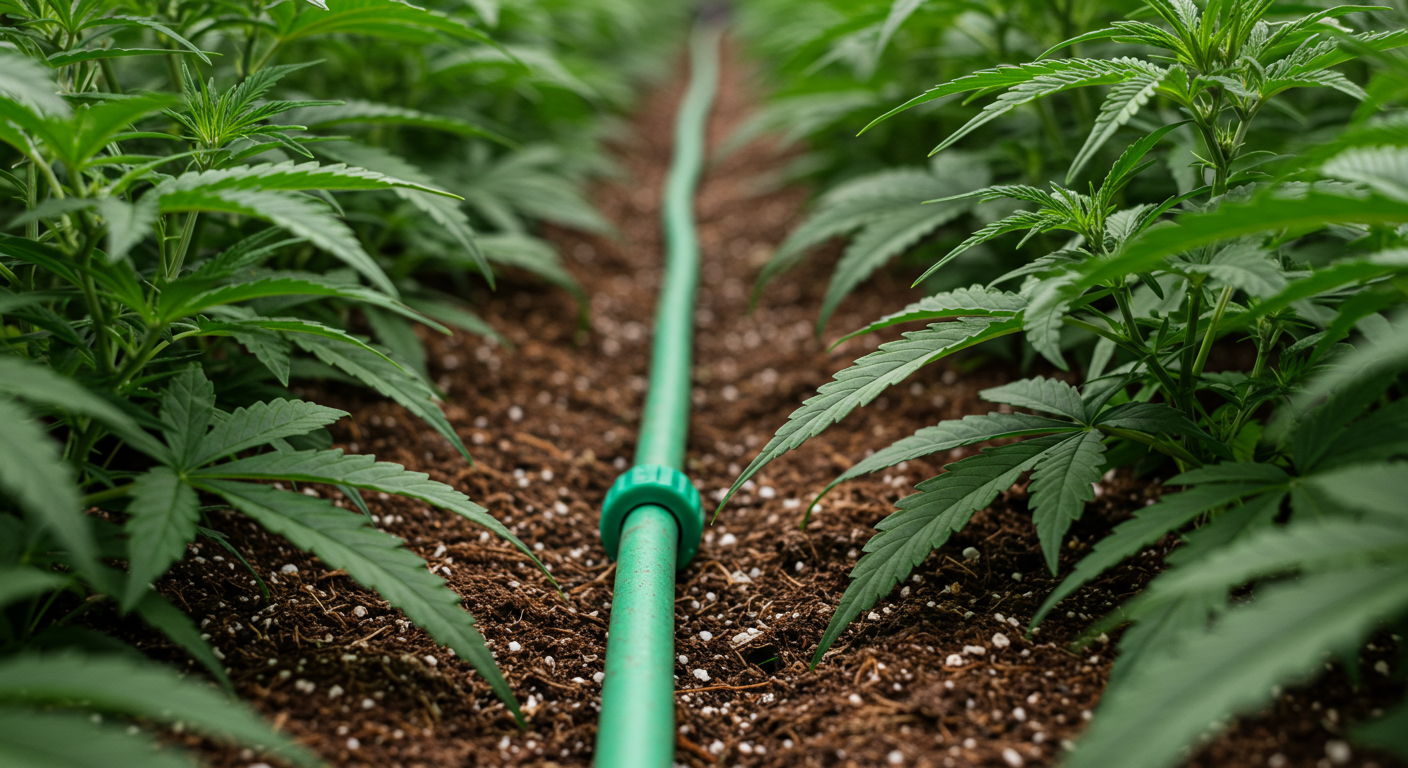
High-flow fill line and bulkhead drain fittings installed in commercial ebb-and-flow hydroponic table.
The Automated Flood-and-Drain Operational Cycle: Flood Velocity, Soak Windows, and Drainage
To operate an ebb-and-flow system reliably, controllers (such as digital cycle timers or environmental computers) must execute a precise three-phase hydraulic sequence:
Phase 1: The Fill Phase (5 to 10 Minutes)
The submersible utility pump (sized to deliver 500 to 1000 GPH depending on tray area) activates, pushing nutrient solution through the bottom inlet bulkhead. Water rises steadily across the tray channels, displacing stagnant air upward. Sizing the pump properly ensures the tray reaches target flood depth within 5 to 8 minutes; filling too slowly (taking over 15 minutes) prolongs root submergence unnecessarily, while filling too violently creates turbulent container displacement.
Phase 2: The Soak and Overflow Window (2 to 5 Minutes)
Once the water reaches design height, excess solution spills into the overflow standpipe fitting, cascading back down into the reservoir. This short soak window ensures that capillary action has sufficient time to draw liquid upward into the root core. The soak window should never exceed 5 minutes: extended submergence provides zero additional hydration while depleting dissolved oxygen around submerged cortical tissues.
Phase 3: The Rapid Gravitational Drain Phase (3 to 6 Minutes)
The timer de-energizes the pump. Water drains back down through the pump impeller housing and drainage channels under the force of gravity. High-flow tray designs incorporate sloped drainage grooves molded into the ABS tray floor, ensuring that 100% of standing water exits the tray into the reservoir without leaving stagnant puddle zones beneath container bases.
| Hydroponic Substrate Type | Capillary Wicking Velocity | Optimal Flood Height (Tray Depth) | Typical Daytime Flood Frequency | Nighttime (Lights-Off) Cycle Rule |
|---|---|---|---|---|
| Expanded Clay Pebbles (LECA) | Extremely Low (<1.0 inch rise) | Deep: 3.0 – 4.5 inches (near top of pot) | 4 to 8 floods per photoperiod (every 2-3 hrs) | 1 flood mid-dark cycle (prevent desiccation) |
| Rockwool Blocks (4 to 6 Inch) | Extremely High (wicks 5+ inches in minutes) | Shallow: 0.75 – 1.25 inches (base only) | 1 to 3 floods per photoperiod | Zero nighttime floods (enforce oxygen dry-back) |
| Chunky Coco Chips / Croutons | Moderate (wicks 3 to 4 inches) | Moderate: 2.0 – 3.0 inches | 3 to 5 floods per photoperiod | Zero nighttime floods; holds adequate moisture |
| Perlite / Vermiculite (70/30) | High capillary rise; low ballast | Shallow: 1.5 – 2.0 inches (prevent floatation) | 2 to 4 floods per photoperiod | Zero nighttime floods |
The parameters in Table 1 emphasize how substrate capillarity dictates flood depth and frequency. When growers fail to match flood height to medium wicking properties, they frequently submerge the root crown unnecessarily, raising serious pathogen concerns.
How high should water rise in the tray during flood cycle, and will submerging the root crown cause stem rot?
Question sent by: Russell Drake, via email.
“I am setting up a 4×4 ebb-and-flow table with cannabis plants in 6-inch rockwool blocks. My flood tray is 7 inches deep. Should I adjust my overflow standpipe so the water fills almost to the top of the block, or will submerging the root crown cause Pythium and stem rot?”
You should never flood water all the way to the top of a rockwool block or container: keep flood depth strictly to the lower 1.0 to 1.5 inches.
The root crown: the critical junction where the main stem transitions into root tissue: is exceptionally sensitive to moisture and fungal infection. Submerging the root crown under liquid fertilizer during repetitive flood cycles strips the protective epidermal bark, inviting opportunistic Fusarium crown rot and Pythium stem cankers. Furthermore, the top 1.5 inches of a container are exposed to ambient room light; keeping the top saturated promotes thick green algae crusts that harbor fungus gnats and shore flies.
Because horticultural rockwool possesses immense capillary wicking suction, water does not need to touch the top of the block. When the bottom 1.0 inch of the block is submerged for 5 minutes, capillary suction draws water upward through vertical stone fibers, hydrating the entire block up to within 1.0 inch of the crown. The top inch remains dry, aerated, and pathogen-free. Adjust your overflow standpipe riser so that water rises exactly 1.0 to 1.25 inches above the tray floor, ensuring rapid wicking without crown submergence.

Vigorous hydroponic canopy transpiring actively following rapid oxygen exchange in flood-and-drain substrate.
Reservoir Management and Chemical Dynamics: Dissolved Oxygen, Temperature, and EC/pH Drift
Because flood-and-drain is a closed-loop recirculating system, the reservoir solution is exposed to air, root exudates, and media residues on every single cycle:
- Diurnal Dissolved Oxygen (DO) Depletion: When 50 gallons of water return from a flood tray to the reservoir, the turbulence naturally entrains atmospheric oxygen. However, as root biomass expands in late flower, roots consume dissolved oxygen rapidly during the flood event. Maintain continuous aeration in the reservoir using high-output air pumps and micro-porous air diffusers, keeping dissolved oxygen strictly above 8.0 to 10.0 mg/L.
- Temperature Regulation and Water Chillers: Recirculating reservoirs placed beneath hot grow lamps (HPS or high-wattage LED fixtures) absorb massive radiant heat. When reservoir solution exceeds 22 °C (72 °F), dissolved oxygen carrying capacity plummets while Pythium zoospore germination accelerates by over 400%. Install an active titanium water chiller (such as Hailea or EcoPlus) to lock reservoir temperatures at 18 °C to 20 °C (64 °F to 68 °F).
- Electrical Conductivity (EC) Concentration Drift: In hot, dry grow rooms with high vapor pressure deficit (VPD), plants transpire pure water molecules far faster than they absorb mineral ions. Over several days, reservoir water volume declines while dissolved fertilizer salts remain behind, causing reservoir EC to spike from 1.8 dS/m up to 2.8+ dS/m. Commercial operators install automated reverse-osmosis (RO) top-off float valves that continuously replace transpired water with pure water, keeping EC stable. Completely drain, sterilize, and reset the nutrient reservoir every 7 to 10 days.
The Engineering Rule: Dual-Bulkhead Plumbing and Fail-Safe Overflow Protection
A flood tray must always feature two separate plumbing penetrations: a screened bottom fill/drain bulkhead (typically 1/2-inch or 3/4-inch) connected to the pump, and a larger dedicated overflow bulkhead (typically 1.0-inch or 1.25-inch) fitted with an adjustable standpipe riser. The overflow standpipe must have a larger inside diameter than the fill line to ensure it can evacuate liquid faster than the pump can deliver it. If an expanded clay pebble or detached root plug rolls over the primary drain, the oversized overflow standpipe prevents hundreds of gallons of nutrient solution from spilling onto the cultivation facility floor.
Engineered overflow standpipes provide vital mechanical flood insurance for commercial operations, preventing plumbing overflows even during pump control malfunctions. In addition to plumbing fail-safes, cultivators must select appropriate digital timing hardware. Traditional mechanical pin timers operate with minimum 15-minute switching intervals; for fast-wicking substrates like rockwool, a 15-minute flood submerges root blocks for three times longer than necessary. Professional facilities utilize digital repeat cycle timers with second-level resolution (allowing precise 4-minute flood and 2-minute soak windows) or central environmental computers (such as Argus, TrolMaster, or Priva) that trigger flood cycles based on cumulative solar radiation sums (joules/cm2). However, cultivators often struggle to establish appropriate watering frequencies when switching between different substrate types, particularly during the explosive flowering transition.
How often should I flood my expanded clay pebbles versus coco blocks during flowering?
Question sent by: Valerie Kim, via email.
“I am running two flood-and-drain tables in flower. One table has plants in 2-gallon net pots filled with expanded clay pebbles. The other table has plants in 6-inch coco blocks. Can I run both tables on the same timer schedule, or do their watering frequencies need to be completely different?”
You cannot run expanded clay pebbles and coco blocks on the same timer schedule: doing so will either severely dehydrate your clay pebbles or drown your coco blocks.
Expanded clay pebbles and coco blocks possess opposite hydraulic retention properties. Expanded clay pebbles have an air-filled porosity of over 65% and hold virtually zero capillary water. Ten minutes after the tray drains, clay pebble surfaces are already drying down. In peak flower under intense lighting, plants in clay pebbles need to be flooded every 2 to 3 hours during the photoperiod (5 to 7 times daily) to prevent moisture stress.
Coco blocks, on the other hand, are composed of fine coconut coir fibers that hold up to 60% volumetric water content against gravity. A 6-inch coco block retains sufficient plant-available water to sustain a flowering cannabis plant for 8 to 12 hours. If you flood a coco block 6 times a day like clay pebbles, the medium will remain perpetually saturated at 70%+ VWC, macropores will never drain, and root cortical cells will suffer severe oxygen deprivation, resulting in leathery leaf clawing and root rot.
Place each table on an independent digital cycle timer. Program your expanded clay table for 5 to 7 floods spaced 2.5 hours apart during lights-on, with each flood lasting 8 minutes. Program your coco table for 2 to 3 floods daily (e.g., 1 hour post lights-on, midday, and 4 hours before lights-off). This guarantees that both crops achieve their optimal volumetric dry-back curves without hydraulic conflict.

Flowering cannabis tops developing dense, resinous floral calyxes rooted in recirculating ebb-and-flow containers.
Hydrodynamic Failure Modes: Algal Biofilms, Stagnant Tray Perching, and Siphon Locks
When maintaining recirculating flood-and-drain systems, cultivators must anticipate and diagnose these specific mechanical and biological failure modes:
- The Siphon Lock Phenomenon (Reverse Siphoning): If the fill tubing connects from an elevated pump down to a lower reservoir, an accidental siphon can form when the pump shuts off, pulling water out of the reservoir or, conversely, continuously draining the tray when unintended. Always drill an anti-siphon siphon-break hole (1/8-inch) in the supply line above the maximum reservoir water level to immediately break suction when the pump turns off.
- Stagnant Tray Puddling (Perched Water Films): If flood trays sag in the center due to inadequate table frame support, water cannot drain freely toward the bulkhead. Puddles 1/2-inch deep remain stagnant on the tray floor for days. Roots that grow out of bottom container holes sit permanently in this stagnant, un-aerated pool, rotting rapidly and spreading Pythium spores throughout the reservoir. Ensure flood tables are supported by heavy-duty steel frames with a gentle 1/8-inch per foot slope toward the drain bulkhead.
- Algal Crusts and Fungus Gnat Vectors: Uncovered white ABS plastic trays exposed to 1000+ μmol/m2/s PPFD grow thick green algae sheets within 14 days. Algae consume dissolved nitrogen, shift reservoir pH drastically upward, and provide abundant food for fungus gnat (Bradysia species) larvae. Cover bare tray surfaces with opaque black-and-white panda plastic or custom ABS lid covers to block 100% of light penetration into tray channels.
| Hydroponic Cultivation Method | Root Zone Dissolved Oxygen Dynamic | Mechanical Clog Vulnerability | Power Outage Failure Buffer Window | Commercial Scalability & Labor Demand |
|---|---|---|---|---|
| Flood-and-Drain (Ebb-and-Flow) | Extremely High: pneumatic piston effect recharge | Virtually Zero: uses large 3/4″ – 1″ bulkheads | Moderate: 6 to 12 hours depending on medium | High: single pump controls 50+ plants on one tray |
| Top-Feed Precision Drip | High: continuous unsaturated capillary flow | High: 0.5 GPH micro-emitters clog easily | Moderate: depends on container volume | Extremely High: standard for commercial stone wool |
| Deep Water Culture (DWC / RDWC) | Moderate to High: relies 100% on air pumps | Low: open recirculation plumbing | Critical (<2 hours): roots drown if aerator stops | Low: immense water volume; difficult to scale |
| Aeroponics (High Pressure) | Maximum: roots suspended in 50-micron mist | Extreme: misting nozzles clog with mineral salts | Fatal (<30 minutes): roots dehydrate instantly | Very Low: high maintenance; technical failure risk |
Comparing Flood-and-Drain to Top-Drip and DWC: Operational Tradeoffs and Yield Realities
While flood-and-drain delivers extraordinary root vigor and pristine canopy health, commercial growers must weigh its unique agronomic tradeoffs against top-drip fertigation:
- Elimination of Individual Emitter Maintenance: In a 10,000-square-foot facility running top-drip, thousands of individual drip stakes must be inspected daily for clogs, detached microtubing, and salt crusting. A single clogged emitter kills a plant in 48 hours. In flood-and-drain, a single industrial magnetic-drive pump floods an entire 4×8 ft tray holding 32 plants simultaneously through a 1-inch bulkhead. Emitter clogs are physically impossible, slashing facility plumbing labor by over 80%.
- Integration with Commercial Rolling Benches: Flood trays are uniquely compatible with rolling table hardware. By mounting 4×8 ft or 4×16 ft ABS trays onto rolling galvanized steel benches, commercial facilities eliminate fixed access aisles, rolling benches laterally to create a single floating aisle. This structural innovation increases usable canopy footprint from 60% up to 85% of total warehouse floor area, maximizing canopy photon capture under expensive LED grow lights.
- Canopy Trellising and Structural Support: Because plants sit directly on flat tray surfaces rather than in heavy soil pots, mature flowering canopies develop massive floral tops that can easily tip over as calyxes swell. Cultivators must integrate double-tiered SCROG trellis netting mounted directly to rolling bench corner uprights. Rigid trellising anchors heavy colas securely in place, ensuring plants maintain perfect spacing above flood channels without dislodging during high-volume drainage cycles.
- Closed-Loop Water and Nutrient Conservation: Unlike drain-to-waste systems that discard 15% to 25% of their daily nutrient water down municipal sewer lines, flood-and-drain recirculates 100% of non-transpired solution. In drought-prone cultivation regions with strict wastewater discharge regulations, closed-loop ebb-and-flow systems cut total water and fertilizer consumption by up to 40% compared to open run-to-waste installations.
- Recirculating Pathogen Vectors: The primary agronomic risk in flood-and-drain is shared recirculation. If a single plant in the tray develops Pythium ultimum root rot, the returning flood water carries millions of flagellated zoospores back into the central reservoir, inoculating every other plant on the table during the subsequent cycle. Commercial operators must integrate continuous sub-micron filtration and in-line ultraviolet (UV-C) water sterilizers (delivering 30,000 μW·sec/cm2) or dissolved ozone treatment on recirculating return manifolds.
Flood-and-Drain Engineering and System Setup Checklist
Audit these essential technical checkpoints before commissioning a commercial or personal ebb-and-flow hydroponic table:
- ABS plastic flood tray is supported by a rigid frame with a 1/8-inch per foot slope toward the drain bulkhead.
- Dual bulkhead fittings are installed: 3/4-inch fill/drain fitting and an oversized 1.0-inch or 1.25-inch overflow standpipe.
- Overflow standpipe height is adjusted to submerge only the bottom 1.0 to 1.5 inches of the container (protecting root crowns).
- An anti-siphon siphon-break hole (1/8-inch) is drilled in the supply line above the maximum reservoir liquid level.
- Submersible utility pump is sized to achieve full target flood height within 5 to 8 minutes.
- Substrate capillarity matches flood frequency: 1 to 2 floods daily for rockwool; 4 to 7 floods daily for expanded clay.
- Reservoir temperature is locked at 18 °C – 20 °C (64 °F – 68 °F) using an active titanium water chiller.
- Continuous reservoir aeration maintains dissolved oxygen strictly above 8.5 mg/L via high-output air diffusers.
- Trays are covered with opaque lids or panda plastic to block light penetration and prevent algal crusts.
- Reservoirs are drained, sanitized, and refilled with fresh nutrient solution every 7 to 10 days.
Scientific References
- Bugbee, B. (2004). Nutrient management in recirculating hydroponic culture. Acta Horticulturae, 648, 99-112.
- Hillel, D. (2004). Introduction to Environmental Soil Physics. Academic Press, San Diego, CA.
- Kramer, P. J., & Boyer, J. S. (1995). Water Relations of Plants and Soils. Academic Press, San Diego, CA.
- Marschner, H. (2012). Marschner’s Mineral Nutrition of Higher Plants (3rd ed.). Academic Press, London.
- Raviv, M., & Lieth, J. H. (2008). Soilless Culture: Theory and Practice. Elsevier Science, Amsterdam.
- Resh, H. M. (2012). Hydroponic Food Production (7th ed.). CRC Press, Boca Raton, FL.
- Taiz, L., Zeiger, E., Møller, I. M., & Murphy, A. (2015). Plant Physiology and Development (6th ed.). Sinauer Associates, Sunderland, MA.
- Zheng, Y. (2021). Handbook of Cannabis Production in Controlled Environments. CRC Press, Boca Raton, FL.
Share this article
A quick overview of the topics covered in this article.