
Long-Term Cannabis Flower Storage: Light, Heat, Oxygen, Moisture, and Containers
Store fully dried, stable cannabis flower in clean, well-sealed, light-protective containers in a consistently cool location, and keep the reserve closed until it is needed. This arrangement reduces unnecessary light exposure, temperature stress, air exchange, moisture movement, and physical damage. It slows change; it does not stop aging, sterilize contaminated material, or guarantee a particular shelf life.
The hardest storage decision is often not which jar to buy. It is deciding whether the flower was suitable for storage in the first place, what quality you need to preserve, and which failure would matter most in your circumstances. A batch that starts too wet needs correction before long-term sealing. A dry but aromatic batch may mainly need protection from heat, repeated opening, and crushing. Medicinal material must also remain within its tested specifications and any applicable expiry or retest conditions.
This resource begins after drying and monitored curing. For the earlier decision about when a flower can first be sealed, use How Dry Should Buds Be Before Jarring. For the full cultivation context, the Cannabis Grow Basics guide covers harvest through storage. Here, the narrower task is to keep finished flower stable over subsequent weeks or months without mistaking attractive packaging for verified product quality.
What Should Long-Term Cannabis Flower Storage Actually Preserve?
A useful storage plan protects several independent qualities at once: chemical composition, aroma, physical integrity, microbiological acceptability, identification and secure access. Those qualities can decline at different rates. A flower might retain a similar total cannabinoid test while losing some of its characteristic aroma. Another might smell convincing but have unacceptable microbial results. Do not let one good-looking metric stand in for all the others.
Long-term means a defined period with an intended use
For someone opening a working jar every evening, storage may mean the next several weeks. A reserve container intended to remain closed for several months has a different exposure history. A licensed producer, dispenser or medical supply chain may need an evidence-backed stability program with release specifications, retained samples, documented conditions and assigned expiry or retest dates. The available research spans different time windows, chemovars and packages, so there is no research-supported universal expiration date for every cannabis flower stored at home.
Define the period that matters to you, the initial condition of the material and how frequently it must be accessed. The longer the planned interval, the more valuable a sealed reserve and a baseline become. A package that has been opened fifty times cannot be assumed to behave like an identically filled package that remained closed for months.
The five outcomes that need separate evidence
| Quality attribute | What may change | Useful evidence | What the evidence cannot prove |
|---|---|---|---|
| Cannabinoids | Individual acidic and neutral compounds can change through reactions or losses. | Comparable, validated laboratory profiles from the same defined batch. | A single THC percentage does not describe aroma, safety or a full degradation pathway. |
| Aroma | Volatile compounds escape, oxidize or change in relative proportions. | Documented sensory observations; laboratory terpene or volatile profiles when justified. | A strong jar smell does not prove that original terpenes were retained or product is safe. |
| Moisture state | Water activity can shift with ingress, redistribution or package failure. | Representative, calibrated water-activity readings and packaging inspection. | Acceptable water activity cannot prove absence of pre-existing contamination. |
| Physical integrity | Flowers crumble or flatten and resin-rich structures can be lost in handling. | Visual inspection against baseline photographs and gentle handling notes. | Appearance alone cannot establish potency or microbial compliance. |
| Microbiological acceptability | Pre-existing contamination may remain; an unsuitable moisture environment can permit growth. | Validated testing and appropriate lot sampling where release is required. | A closed jar, humidity pack or clean odor is not a sterilization step. |
Long-Term Cannabis Storage: Light, Heat, Oxygen, and Moisture
These four words describe the central environmental pressures, but they are not four interchangeable knobs. Light can trigger photochemical change even in a cool room. Temperature affects reaction rates and volatility while also creating condensation risk during transfer. Oxygen can participate in oxidative pathways, yet replacing air with another gas is not automatically useful for every analyte. Water activity constrains microbial growth and physical texture, but a very low value does not preserve aroma by itself.
Packaging connects all four: a transparent jar admits light unless it is stored in darkness, a poor seal permits atmospheric exchange, a permeable wall may admit water vapor, and the whole package follows the temperature of its surroundings. The packaging decision must therefore be made together with the storage location. A costly opaque pouch left in a hot vehicle has not solved the main environmental problem.
Remember: A sealed package can prevent exchange with the room only to the degree that its material, closure and handling actually allow. It cannot reverse chemical loss or microbial contamination that occurred before sealing.
Set a baseline before calling anything preserved
At minimum, identify cultivar or batch, harvest and packaging dates, container type, approximate amount, starting moisture assessment and intended storage location. Record a brief description of aroma and condition without claiming to have measured specific terpenes by smell. If the material is tested professionally, preserve the certificate and method details with its batch identity.
Without a baseline, the sentence “it stayed potent” often means only that the user remembers it feeling similar. Sensory impressions depend on preparation, exposure, dose and context. Chemistry is measured through appropriate analytical methods, while personal impressions describe the experience rather than substitute for those methods.
How Light, Heat, Oxygen, Moisture and Handling Change Stored Flower
Once flowering tissue is harvested and dried, its secondary metabolites are no longer held within a living plant that continually replaces them. Chemical reactions, physical loss and environmental exchange continue. Their rates vary with the compounds present, the original material, packaging and temperature. The practical aim is to reduce exposure without introducing an even larger risk through unsafe chilling, unsuitable rehydration or excessive compression.
Light: protect the product even when the room feels cool
Light can contribute to photochemical transformations of cannabinoids and aromatic compounds. The effect depends on wavelength, intensity, exposure duration, compound and packaging. A sunny shelf is therefore a poor storage location even if the jar itself is attractive. Ordinary room lighting is not equivalent to intense sunlight, but there is no preservation benefit in leaving a reserve displayed under constant illumination.
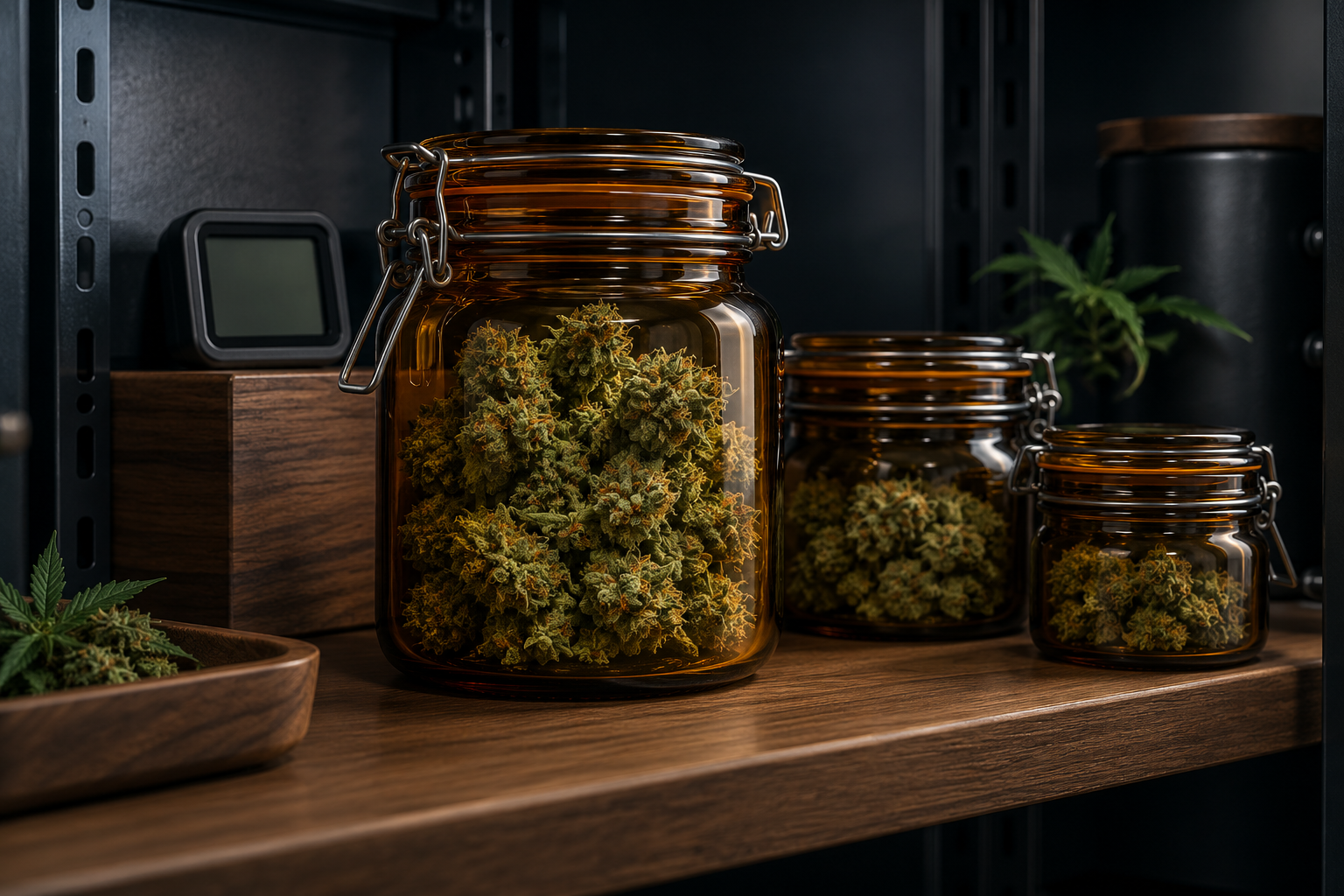
Amber glass reduces transmission of some wavelengths but does not eliminate all light. Clear glass performs well as a chemically inert contact surface, provided it is kept inside a dark cabinet or other light-blocking enclosure. Opaque packaging may combine containment and light protection, but opacity says nothing by itself about the oxygen barrier, moisture barrier or seal.
Heat: look at the temperature history, not one comfortable reading
Higher temperatures can accelerate particular cannabinoid transformations and alter volatile-compound retention. Heat also increases vapor pressure of many aroma compounds, giving them more opportunity to move into the package headspace or escape when the closure opens. A storage location that is cool most of the day but becomes hot every afternoon may be less protective than its average temperature suggests.
Measure near the actual container rather than trusting a thermostat elsewhere in the room. A shelf beside a window, heating appliance, roof or electrical cabinet can experience excursions not captured by a distant wall thermometer. Recording a representative maximum and minimum over the relevant period is more informative than taking a single reading when the room happens to feel comfortable.
The scientific literature supports cooler controlled conditions for certain stability outcomes, but not a universal home-storage temperature that automatically optimizes cannabinoid composition, terpene retention, texture, microbial status and practical access simultaneously. Keep the limitations of each study in mind when choosing between ordinary cool storage and more demanding refrigeration.
Oxygen: reduce unnecessary exposure without promising oxygen-free preservation
Oxygen participates in some oxidation reactions, while sealing changes the amount of fresh oxygen and volatile compounds exchanged with the surrounding air. The effect of oxygen removal depends on the material, available residual oxygen, package barrier, headspace and duration. A standard sealed jar still contains air above and between flowers; that does not mean it is an unusable container.
Do not equate every oxidation reaction with the simple claim that all THC becomes CBN at a predictable rate. The chemistry includes multiple reactions and products, and analytical studies often observe a decline in one compound without a matching rise in a single expected product. CBN may be useful contextual information, but a CBN value alone is not a validated clock that dates any arbitrary home-stored flower.
Opening a large reserve container for each small serving repeatedly replaces headspace air and releases aromatic vapor. A more practical way to limit this cycle is to separate an active-use portion from sealed reserves. The precise oxygen exposure saved will depend on package size, fill, opening frequency and headspace; the operational benefit is reduced disturbance of the untouched material.
Moisture: water activity is not the same as room RH or moisture percentage
Moisture content measures how much water is present. Water activity, written aw, expresses how available that water is in relation to pure water at the same temperature. At equilibrium, a product with an aw of 0.60 corresponds to approximately 60% equilibrium relative humidity in a sealed headspace. The relative humidity of the room outside a sealed package is a different reading. None of these values tells you whether the flower was already contaminated before testing.
ASTM D8197-22 specifies an aw range of 0.55 to 0.65 for dry cannabis flower intended for human or animal use; USP expert-panel considerations similarly discuss 0.60 ± 0.05. These are storage-quality specifications, not a universal proof of microbiological clearance. A sample above the specified limit needs appropriate corrective action and risk assessment, whereas a sample that is too dry may become fragile and suffer handling losses. Follow any tighter applicable product or jurisdictional standard.
A home jar hygrometer can be useful for tracking headspace trends after equilibration, but it is not the same as a calibrated water-activity instrument operated under a validated procedure. One jar reading also cannot represent hidden variation among dense and small flowers or a large commercial lot. If the batch is suspected of contamination, do not use a reassuring humidity reading to override that concern.
Water activity versus equilibrium RH
Water activity is a ratio measured on a sample at a stated temperature. Equilibrium RH is the relative humidity of the air in equilibrium with that material, expressed as a percentage. The approximate numerical conversion is aw multiplied by 100 at equilibrium. Neither is interchangeable with ambient room RH, and neither is a retrospective microbial test.
Handling: preserve structure and avoid making the surface area larger
Grinding increases exposed surface area and changes the physical state of the flower. Repeated crushing and transfer can break brittle tissues and dislodge resin-bearing structures. Research comparing whole and ground inflorescences found that sample preparation affected terpene retention during storage; it does not follow that every whole flower is perfectly protected, only that grinding a reserve in advance adds an avoidable variable.
Keep flowers whole when practical, allow enough space that they are not forcibly compacted, and handle only the material you need. Vacuum techniques can change gas exposure but may also compress delicate inflorescences unless the package and process protect them. Never interpret a tightly flattened product as inherently fresher merely because less air appears to be present.
Control exposures together
Start with verified dry flower, suitable barriers, a cool dark location, modest handling and separate sealed reserves.
Chasing a single perfect number
Do not treat the room’s RH, an attractive seal or one temperature setting as proof that every safety and quality attribute is protected.
What Controlled Storage Studies Actually Show
Experimental findings are more useful when their material, storage period, analytes and comparison groups remain attached to the result. “Cold is best” is not an adequate summary of a study that compared two chemovars under four temperatures while also measuring whole and ground material. “Vacuum wins” is equally misleading when the winning treatment also received a different intervention before harvest. The table below separates selected observations from the claims they cannot support.
| Study and conditions | Reported observation | What you may infer | What not to infer |
|---|---|---|---|
| Milay et al., 2020: two medical chemovars, whole/ground flower, dark storage at 25, 4, -30 and -80°C for one year. | 25°C caused the greatest cannabinoid-profile changes. Terpenes declined under all conditions; very low temperatures and grinding were unfavorable for terpene retention in the comparison. | Cool controlled storage and keeping flower whole can be useful quality choices. | Do not claim every household refrigerator or freezer provides the same environment or that 4°C is mandatory for every product. |
| 2024 three-variety volatile-profile comparison: six months at 18°C, dark chamber; open tray, HDPE box, brown glass. | All storage conditions altered the volatile profile. Glass retained aspects of the initial profile better than the alternatives, but showed comparatively more change from acidic to neutral cannabinoids. | Container type affects different quality dimensions differently. | Do not claim glass freezes chemistry or that all plastic packages perform like the specific tested HDPE box. |
| Lumu et al., 2024: one floral-hemp cultivar at two moisture contents under differing light, temperature and packaging over six months. | Total CBD, total THC and total CBDV did not significantly change with the tested lighting, temperature and material conditions; some individual cannabinoids did. | Measure individual and total compounds separately, and consider starting moisture. | Do not translate the study’s two moisture percentages into universal cannabis aw targets or apply a single hemp cultivar to all high-THC flower. |
| Birenboim et al., 2024: high-THCA material, four months at 4°C in darkness; sealed air versus vacuum, with or without a pre-harvest treatment. | THCA declined across treatments, with the combined pre-harvest treatment and vacuum group retaining the most. Monoterpenes responded differently from sesquiterpenes. | Gas management can matter under particular conditions and initial material influences outcomes. | Do not attribute the combined treatment’s entire advantage to vacuum or recommend an unapproved pre-harvest chemical intervention. |
| MacLaughlin and MacDonald, 2024: five chemovars, air versus nitrogen-modified atmosphere, 18-74 days. | No overall significant preservation advantage for total measured cannabinoids or volatiles; selected individual compounds changed differently. | Lower oxygen does not guarantee broad improvement across all analytes. | Do not assume the result covers years, all package types or every chemovar. |
| Muvcheska Paneva et al., 2026: four batches from two strains; nine months at 25 ± 2°C and 60 ± 5% room RH. | Nitrogen-flushed aluminum laminate bags retained THC within the chosen specifications; one ambient HDPE batch failed at month nine. | Barrier design plus atmosphere can affect performance in a commercial system. | Single-sample time points and different packages prevent isolation of nitrogen’s effect or a universal nine-month expiry. |
Why the two nitrogen studies do not cancel each other out
The 2024 experiment compared two atmospheres over 74 days while using the same general commercial canning system and five chemovars. Its negative finding on total measured compounds is informative for that particular treatment and time window. The 2026 study compared a nitrogen-flushed multilayer aluminum laminate with an ambient-air HDPE jar over nine months. Gas atmosphere, packaging material and barrier performance changed together, and each time point was represented by single-sample testing. It cannot isolate the nitrogen effect with the same confidence as an otherwise identical package comparison.
A measured benefit under one combined commercial process can coexist with little advantage in a shorter, differently designed experiment. For a home user, this does not justify improvised gas-flushing equipment, inert-gas purging or do-it-yourself oxygen removal. The defensible baseline remains a clean, suitable seal and minimal unnecessary openings; industrial modified-atmosphere systems require their own validation.
Why “total THC stayed stable” can conceal individual changes
Lab reports may list THCA and delta-9 THC separately as well as a calculated total THC potential. In some studies, acidic cannabinoids declined while neutral forms increased, and the calculated total changed little. In others, concentrations and individual volatile compounds shifted through different pathways. Reported percentages can also be affected by changing water content, sampling and analytical methods.
For any before-and-after comparison, use the same lab or validated comparable methods, consistent reporting units and matched sampling. Decide in advance whether your interest is total THC potential, acidic versus neutral fractions, selected terpenes, total volatile profile or a formal specification. Without that decision, two technically correct reports may be made to answer different questions.
Why a laboratory finding cannot become a home expiry date
Research samples typically have controlled starting material and precisely documented conditions. A home batch may have an unknown initial microbial load, variable flower density, an inconsistent seal or a cabinet that heats up at particular times. Commercial shelf life additionally depends on validated specifications and the exact finished packaging system.
The four-year forensic storage study found extensive THC changes in particular light/temperature combinations; it does not mean every product loses an identical fraction each year. Conversely, a six-month study reporting no significant change in total measured cannabinoids does not certify that any consumer jar remains unchanged or safe for six months. Time is a review trigger, not a substitute for inspection and valid data.
Important: When papers disagree, compare study design before choosing a convenient conclusion. The user-relevant result is a protection strategy with documented uncertainty, not a ranking built from incomparable experiments.
Cannabis Flower Storage: Light, Heat, Moisture, and Containers
A container has four jobs: prevent uncontrolled air and water-vapor exchange, shield or allow shielding from light, avoid problematic contact with the product and protect delicate flowers from crushing. It must also close consistently after legitimate access and remain secure from children, pets or unauthorized people. The best choice depends on the entire system, not a photograph of a jar or a label promising maximum freshness.
Glass with a sound closure: a useful baseline, not a magic material
Clean glass is a relatively inert, low-permeability contact material that makes it easy to inspect flowers without transferring them. A correctly fitted lid and intact gasket are just as important as the glass wall. A damaged seal, residue caught in the threads or a lid that never fully engages undermines the package. Clear glass needs a dark location; brown glass still benefits from protection against prolonged light exposure.
The six-month volatile-profile study comparing a brown glass bottle, HDPE box and open tray found differences in their effects on the original volatile profile, with the glass condition performing comparatively well for some aroma measures. Yet acidic and neutral cannabinoid forms shifted differently in the glass treatment, and no condition preserved the starting volatile profile unchanged. That is a reason to consider material and closure together, not to claim that glass always wins every metric.
Choose a size that accommodates intact flowers without packing them tightly. Modest headspace can reduce unnecessary enclosed air volume, but a filled-to-the-brim jar that crushes the contents or damages the seal creates another failure. The available studies do not establish a universal percentage of headspace or jar-fill level applicable to every flower and package.
Opaque, high-barrier multilayer pouches
A properly specified multilayer pouch can provide light protection and, depending on its structure, meaningful oxygen and moisture barriers. Commercial packages may combine several materials because each has different functions. A pouch that looks metallic, however, is not automatically made with a continuous aluminum layer, and heat-seal quality, pinholes, folds and closures all affect performance.
The 2026 nine-month study reported better THC-specification retention in nitrogen-flushed aluminum-laminate pouches than in ambient-air HDPE jars under its tested conditions. This was a comparison of two complete packaging systems, not a clean test of nitrogen alone or aluminum alone. Use verified material specifications and a suitable closure if selecting a pouch for a real product. Do not assume every zipper pouch has the same barrier as a tested heat-sealed laminate.
Flexible packaging can be convenient for protected reserves but may provide less resistance to external crushing than rigid containers. Store pouches where they will not be pressed under heavier objects, and avoid repeated folding at the same point. A compromised seal or puncture matters more than the packaging’s appearance.
Rigid plastics: judge their actual performance and compatibility
Food-contact suitability, permeability, wall thickness, closure and cleanliness vary among plastics. HDPE containers may work for certain purposes, but the specific HDPE package in a controlled study is not proof that every plastic jar has an identical oxygen or volatile barrier. Thin household bags, loosely sealed sandwich bags and unlabeled recycled containers are poor substitutes for specified long-term packaging when their suitability is unknown.
Plastic selection also involves contact compatibility with aromatic compounds and the duration and temperature of use. Do not assert that all plastic inevitably transfers a taste, absorbs the same proportion of terpenes or becomes unsafe after a fixed number of days. The supported advice is narrower: prefer suitable materials with known contact and barrier performance, and avoid questionable packaging with strong foreign odors, damage or unknown prior contents.
Vacuum packaging, modified atmospheres and oxygen absorbers
Vacuum packaging changes gas volume and can limit oxygen availability, yet some systems compress flower or fail to maintain the intended vacuum. A home vacuum sealer is not a validated equivalent of the controlled conditions used in a laboratory. If the vacuum crushes dense flowers, its chemical advantage, if any, must be weighed against physical damage. A vacuum also cannot dry an unsafe batch or remove mold contamination.
Commercial nitrogen-modified atmosphere packaging requires appropriate equipment, oxygen measurement, compatible packages and process validation. The 2024 and 2026 studies report different findings for different designs, so a blanket instruction to replace all air with nitrogen is not justified. Similarly, loose consumer oxygen absorbers may create an uncontrolled package system and may not be approved or suitable for direct contact with a particular inhalable product. Do not introduce unvalidated gas or absorber methods into a home jar as if they guarantee safety.
Humidity-control packs: maintenance after safe drying, not restoration
A purpose-designed humidity pack can help buffer ordinary moisture exchange inside a compatible, sufficiently sealed package. It cannot establish that the batch entered the container dry enough, remove pre-existing microbes or reverse lost terpenes. A humidity pack’s nominal RH refers to the manufacturer’s designed behavior under specified conditions, not to the precise aw of every flower in an unequal batch.
A pack also adds another material that must be suitable for the intended product and packaging. Check its condition and manufacturer’s instructions, prevent rupture and do not use one to hide persistently rising moisture. If a sealed container shows high rebound or uneven wet centers, move back to the validated drying and risk-assessment process. Prolonged burping or a larger pack does not turn unfinished drying into safe long-term storage.
Do not put improvised moisture sources into the package
Fruit peels, bread, wet paper, fresh herbs and direct water sprays create uncontrolled wet spots or introduce foreign material. They cannot reconstruct compounds that have already evaporated and may increase contamination risk. A package that has become moldy or is known to be contaminated cannot be cleared by changing humidity.
Compare container systems rather than choosing by one feature
| System | Potential advantages | Main uncertainty or drawback | Practical selection check |
|---|---|---|---|
| Glass jar with intact gasket or lined lid, stored in darkness | Inert contact surface, rigid protection, easy inspection, low-permeability wall. | Lid leakage, light exposure when displayed, large repeatedly opened headspace. | Verify closure, cleanliness, capacity and separate reserve from working stock. |
| Specified opaque multilayer pouch | Combined light, oxygen and vapor barriers where construction supports them. | Barrier varies with material; zipper, seal and puncture failures; compression. | Confirm product compatibility, barrier data and closure integrity. |
| Suitable rigid plastic package | Light weight, impact resistance and manageable handling. | Permeability, aroma interactions and closure performance differ across materials. | Identify material, approved intended use, seal and available performance data. |
| Vacuum or modified-atmosphere commercial system | May reduce oxygen exposure under validated conditions. | Cost, compression, equipment needs, gas verification and conflicting evidence. | Use only as a validated complete system, not as a home safety fix. |
| Loose bag, open tray or reused unknown container | Convenient for brief transfers, not dependable long-term preservation. | Uncontrolled air, moisture, light, crushing or contact contamination. | Replace with known clean and suitably sealed storage packaging. |
Is an expensive vacuum pouch automatically better than a glass jar?
Question sent by: Olivia Bennett, via E-mail.
No. Compare the real seal, material specification, light protection, storage temperature and how often it will be opened. The published vacuum and nitrogen studies show that effects depend on the complete experimental system, while some do not find an overall advantage for every measured compound. A clean jar protected from light may be a practical baseline; a commercial pouch needs its own performance evidence and must avoid crushing the flower.
The secure outer enclosure is part of the storage system
Child-resistant packaging is not equivalent to locked storage. Cannabis should remain in its original labeled child-resistant retail package where applicable, then be kept out of sight and reach in a locked enclosure. A plain glass jar may be a practical internal storage vessel for lawful home-grown flower where permitted, but it should not be mistaken for an inherently child-resistant or legally compliant retail package. Follow your local packaging and possession requirements.
Protect identifying information as carefully as the physical package. Retain the product label, batch number, any laboratory report, packaging date and applicable expiration or retest instruction. If a flower moves into a different authorized container, preserve traceability rather than creating an anonymous jar. Avoid storing cannabis where someone may mistake it for tea, culinary herbs or normal food.
Should Cannabis Flower Go in a Cupboard, Refrigerator or Freezer?
Temperature selection involves a tradeoff between slower chemical change and greater handling complexity. A consistently cool dark cupboard is simple, dry and easy to protect. A dedicated, controlled refrigerator can be useful for a well-sealed reserve, but the household fridge may introduce access, odor-transfer and condensation hazards. A freezer is not a universal upgrade for aromatic whole flower, even though lower temperatures slow some chemical reactions.
Cool cupboard or cabinet: the low-complexity reference
Choose an interior location away from direct sun, heaters, windows, radiators and repeated temperature spikes. It should be secure and free from leaks, high humidity and obvious contamination. Check the location during its warmest routine period, not merely the first cool morning when you set up the storage system. If the space is habitually warm or unstable, the correct response is to improve or change the location rather than trusting an airtight lid to block heat.
For relatively short access cycles, a secure cupboard also avoids the problem of repeatedly carrying a chilled container into a warmer, humid room. That convenience does not establish parity with a laboratory-controlled cold room for every chemical outcome. Describe it as a defensible practical option when its actual environment is stable, not as a proven universal optimum.
Refrigeration: a possible stability advantage with operational conditions
The one-year controlled study by Milay and colleagues identified 4°C among favorable conditions for overall post-harvest chemical preservation in its experimental comparison, while 25°C produced the largest changes in cannabinoid profiles. A separate 2024 four-month study also chose 4°C in darkness. These are study conditions, not a command that a normal domestic refrigerator is the right solution for every user’s flower.
Refrigeration is more defensible for long-term reserves when the temperature is stable, the package has an appropriate vapor barrier and reliable closure, the storage compartment is secure and the product will remain largely undisturbed. A refrigerator shared with food may create contamination, child-access and accidental-consumption risks. Where the product is regulated, use its labeled storage instructions over an improvised interpretation of a research paper.
Condensation occurs at the cold-to-warm transition
Warm, humid air may deposit moisture on a sufficiently cold surface. If a cold container is opened immediately in a warm room, the flower and inner surfaces may be exposed to that air while still cold. Condensation depends on dew point and surface temperature; it is not guaranteed on every opening, but it is a credible hazard that a room RH reading alone cannot resolve.
When removing an intact, sealed reserve from cold storage, let the closed container approach the intended handling-room temperature before opening it. This reduces direct exposure of cold flower to warm room air. Inspect the closure and package for leaks or moisture before use. If condensation is seen inside the container, or a batch appears wet, soft, musty or abnormal, isolate it and assess rather than simply warming, drying or consuming it.
Field Advice: Avoid turning the same cold reserve into a daily-use jar. Keep a separate working portion at a suitable stable temperature, and leave the sealed reserve undisturbed until it is needed.
Freezing: colder is not automatically better for aroma or structure
The Milay study assessed -30°C and -80°C among its experimental temperatures. Although cooler conditions can slow particular reactions, terpene losses occurred under all conditions, and temperatures below -20°C were among the less favorable conditions for retaining the measured terpenoids. The study also found whole flower preferable to ground material for its broader interpretation. It does not validate a universal claim that all frozen cannabis is ruined, nor does it support freezing as the default method for preserving premium flower aroma.
Freezing adds handling concerns: possible fragility, temperature cycling, moisture ingress and cold-to-warm condensation. The actual impact depends on the material and procedure. If a professional operation uses freezing, it requires a suitable protocol, validated packaging and its own quality measurements; the results for extracts, fresh-frozen biomass and seeds must not be transferred to finished dried flower.
Why studies of seeds, oils and extracts cannot set flower-storage rules
Cannabis seeds are living propagules, not finished inflorescences. Extracts may be dissolved in oil, alcohol or other media, and those solvents change oxidation, solubility and measurement. Fresh-frozen plant material contains far more water and undergoes a different process. A low-temperature condition that suits seed conservation or a particular oil extract is therefore not evidence that it is equally suitable for intact dried flowers.
Keep the product matrix attached to every claim. It is legitimate to discuss shared chemical principles, but the practical storage specification must be tied to the tested finished material. This prevents well-meaning advice from importing a result from another product simply because both contain cannabinoids.
How to Sample Stored Flower and Recognize Quality or Safety Problems
Long-term monitoring should produce information without exposing every package more often than necessary. Establish the baseline with representative material and use a designated working or retention sample where feasible. Keep a reserve’s closure intact rather than opening every container just to confirm that nothing changed. A serious concern is different: suspected contamination warrants immediate isolation and an appropriate assessment, not passive monitoring.
Define the batch before choosing samples
Do not combine flowers with different drying histories and call the mixture one homogeneous storage lot. A dense top flower, small lower bud, separately dried branch and remediated material may have different initial moisture and exposure. Retain batch IDs and record which material went into which package. For larger operations, a qualified sampling plan must match the lot’s variability and the intended laboratory method.
When establishing baseline moisture, sample across meaningful density and size differences rather than only selecting the driest-looking small buds. Use calibrated water-activity measurement where product assurance justifies it, and follow the instrument or laboratory protocol for temperature, sample preparation and equilibration. A single jar hygrometer offers useful trend information but cannot validate all material in a large batch.
Check the room and the product as separate systems
Log the location’s temperature and significant fluctuations. Monitor for light exposure, leaks, direct sun, accidental heater use and access breaches. Ambient RH indicates the surrounding air, not the aw of sealed flower. To assess the product, rely on its own validated moisture measurement or a properly interpreted headspace trend, plus package integrity and physical inspection.
Temperature also affects RH readings and moisture equilibration. Compare readings under consistent conditions instead of reacting to a number collected immediately after moving a cold jar into a warm room. If readings conflict or the sensor may have drifted, verify with calibrated equipment rather than inventing a precise correction factor.
Visual and sensory observations are a screen, not a chemical assay
Examine a designated sample in clean, neutral lighting. Look for visible fungal growth, abnormal internal discoloration, unexpected dampness, clumping, condensation, insect material or damage to the packaging. Compare the material against photographs and notes from the beginning of storage. Handle suspect material cautiously; do not deliberately inhale a suspicious odor or taste it to confirm safety.
A duller aroma may indicate loss or a shift in volatile compounds, but it cannot identify which terpenes disappeared or why. A sharp, musty or otherwise abnormal odor is a warning, while absence of odor does not clear contamination. Color change likewise has several potential causes and does not by itself establish a specific cannabinoid reaction.
When laboratory re-evaluation is justified
Laboratory work is appropriate for regulated release or retest, medical specifications, contested quality claims or a batch with uncertain status that must be handled according to a defined quality system. Ask which tests are needed: water activity, cannabinoid profile, selected terpenes, microbial testing or another validated contaminant panel. Use methods validated for the matrix and the specific question. No single test answers all possible concerns.
Even an apparently favorable result must be interpreted through sampling. One clean subsample does not automatically clear a heterogeneous batch with visible contamination elsewhere, and an older cannabinoid certificate does not guarantee today’s composition. A professional plan needs a defined lot, documented sampling and rules for disposition. A home grower should not use laboratory ambiguity as a reason to consume visibly moldy flower.
The jar still reads 60% RH after three months. Does that mean the flower is unchanged?
Question sent by: Ethan Miller, via contact form.
No. A stable headspace humidity observation suggests the moisture environment has not changed dramatically under the measurement conditions. It does not measure THC, THCA, terpene retention, microbial contamination or physical damage. Check the package history and product condition separately, and use appropriately matched laboratory testing if an analytical claim matters.
Distinguish a quality decline from a product-rejection signal
A less vivid aroma, mild color shift or drier handling texture may indicate quality loss and justify adjusting future packaging. Visible mold, known contamination, persistent unexplained wetness, major package leakage or other evidence of compromised product requires isolation and may require rejection or professional testing under applicable rules. These are not equivalent outcomes, and a quality problem must not be disguised as a safety certificate.
Visually trimming an infected flower does not prove the remaining material safe. Mold can extend beyond the visible patch, and a better storage container cannot restore contaminated flower. Isolate affected material and follow an appropriate disposal or professional testing process rather than returning it to normal storage.
A Repeatable Long-Term Flower Storage Workflow
A workable procedure has a defined starting condition, packaging choice, location, inspection plan and response to deviations. There is no need for a universal calendar of daily jar openings after the material has completed a stable cure. Repeated opening can itself become an exposure source. Base the workflow on the purpose of the batch and the evidence available.
Step 1: confirm readiness and exclude suspect material
Begin only with material that has completed controlled drying and curing and is appropriate for storage. Confirm that the moisture state is stable using a suitable method, and segregate different batches or substantially different flower sizes when they have not been verified together. Record visible condition and any credible contamination history. If the flower is moldy, musty with concerning signs or known to have failed a relevant safety assessment, do not package it as a clean reserve.
For a commercially released product, the required testing and acceptance criteria come from the relevant quality system and law. For a noncommercial batch, visual checks may be practical screening, but they are weaker than validated testing. Do not write “microbial test passed” in your notes unless a relevant test actually occurred.
Step 2: choose the storage period and use pattern
Specify whether the package is an active-use portion or a mostly untouched reserve. Divide the material into clean, traceable units suited to the planned access pattern without imposing a universal gram-per-jar rule. Keep cultivar or batch identities separate, especially where labeling, traceability or odor transfer matters. A distinct small working container limits disturbance of the larger reserve.
Choose enough capacity to prevent compression and to close cleanly. If a package will be opened frequently, ease of reliable resealing may matter more than the theoretical performance of an industrial package that cannot be resealed to its validated specification once opened.
Step 3: inspect and prepare the package
Use a suitable food-contact or otherwise product-compatible container consistent with the intended legal use. Inspect surfaces, threads, gaskets, heat seals, closures and any interior lining. The package should be clean and completely dry before filling. A lingering foreign odor, residue, torn lining or damaged closure is reason to choose another package rather than transferring the risk to the flower.
Consider light protection at both the primary-package and room levels. A clear glass container can go in a locked opaque cabinet. A validated opaque pouch can provide direct light exclusion but may still need a protective outer box against crushing. Avoid mixing incompatible materials or products with the flower.
Step 4: select and verify the location
Place the package where it will remain consistently cool, dark, secure and protected from leaks or high humidity. Record actual temperature behavior near the intended storage spot, including routine warm periods and unusual excursions. A stable cabinet is generally simpler than a refrigeration strategy that requires frequent opening and warming, while a properly managed dedicated cold space may offer a chemical-stability benefit for an appropriate reserve.
If cold storage is selected, plan how the closed package will reach handling temperature before it is opened. Keep the material separate from food and inaccessible to children and pets. Never store flower where household members could confuse it with an ordinary edible ingredient.
Step 5: document a usable baseline
Record packaging date, batch ID, container or pouch type, closure condition, location and initial moisture evidence. If lab data are available, record the sampling date, method and units along with cannabinoid and terpene results. Photograph a representative sample, noting that images cannot document invisible microbial status or molecular content.
Use a simple description of baseline appearance and aroma, avoiding false precision. This record allows future comparisons of the same batch. If a problem emerges, it also helps locate other packages with the same source and storage history without assuming every unrelated container is affected.
Step 6: close reserves and limit unnecessary openings
Keep reserve packages closed under their intended conditions. Take working material from the separate access container; replace its lid promptly when finished. If material must be transferred, use clean hands and tools, minimize crushing, and preserve the identification. Do not repeatedly grind an entire reserve or shake jars as a freshness ritual.
Check external package integrity and room conditions without opening the material. A transparent jar can be inspected through the wall where conditions allow, though opening may be needed for a designated sample when there is a legitimate question. For commercial stock, follow the formal inspection and stability schedule instead of inventing a home routine that overrides it.
Step 7: respond according to the type of deviation
| Observation | Meaning or limitation | Next action | Verification |
|---|---|---|---|
| Storage area is warmer than intended. | Greater potential reaction and volatile-loss exposure; actual outcome unmeasured. | Move unopened stock to a more stable suitable location and document the excursion. | Confirm new temperature history; test product if specifications require. |
| Clear jar repeatedly exposed to direct light. | Potential photochemical stress; no universal dose-to-loss formula. | Move into darkness and reduce further exposure. | Check ongoing light exposure and relevant quality data if available. |
| Damaged lid, puncture or poor seal. | Unknown oxygen and moisture exchange. | Quarantine if integrity or moisture is uncertain; assess material and repackage only if appropriate. | Verify new seal and moisture state; investigate exposure period. |
| Water activity above the applicable acceptance criterion or persistent unexplained wetness. | Storage readiness failed; contamination may be present or risk may rise. | Do not continue normal sealed storage; isolate and follow validated correction or disposal process. | Reassess aw and safety under appropriate methods. Drying does not clear established mold. |
| Visible mold or credible contamination. | Hard safety concern, not ordinary staleness. | Remove from use and isolate affected material for appropriate disposition. | Do not use good aroma or later aw reading as clearance. |
| Aroma becomes flatter; no other safety signs. | May reflect volatile-profile loss but not a microbiological diagnosis. | Review temperature, light, seal, headspace and opening history for future stock. | Compare baseline notes; use lab profiles if chemical retention must be demonstrated. |
| Cold jar opened while still chilled; condensation suspected. | Possible localized moisture exposure. | Stop normal handling and evaluate affected material; change warm-up protocol. | Inspect actual product and package condition; test if warranted. |
Step 8: reassess the product before redistribution or use
At the intended end of the storage period, compare the product with its baseline and inspect a designated sample under clean conditions. Confirm the package remained intact and that no credible moisture or contamination event occurred. A commercial product’s release status, expiration and retest requirements remain controlling. Do not assign a new shelf life simply because one jar still looks appealing.
If the product has a quality issue, document what changed and decide whether it is merely less desirable or fails the requirements of the intended use. If safety is doubtful, keep it out of use. Learn from the package and environment without attempting to rehabilitate the material with heat, flavorings, oxygen removal or rehydration.
Common questions about long-term storage
How long can properly stored flower last?
No single duration is validated for every chemovar, starting condition, closure and safety specification. Published studies provide results over weeks, months and up to several years under particular controlled conditions. Use defined product specifications and condition records rather than automatically declaring all flower good for one year or unusable after a fixed date.
Is an airtight jar enough without a humidity pack?
It can be sufficient for some properly dried, stable material if its package and environment perform as intended. A pack may buffer moisture exchange but is not required merely because storage is called long-term. If the material enters storage too wet or has an unreliable seal, the underlying problem must be corrected rather than masked by a pack.
Can I store cannabis in the freezer for a year?
A freezer can slow some chemical processes but is not a proven universal strategy for maintaining the aroma and physical condition of finished whole flower. Controlled research found very low temperatures unfavorable for the measured terpenoid outcomes in its comparison. Without suitable packaging, temperature stability and a condensation-safe transfer protocol, freezing may add risks instead of solving them.
Should I burp long-term storage jars every week?
Not as an automatic requirement after moisture-stable curing is complete. Burping belongs to the active management of residual moisture when needed, and a sealed stable reserve has no demonstrated need for ritual opening. Unnecessary opening brings air exchange and volatile loss. If a jar is becoming wet or suspect, isolate and assess it; a scheduled brief opening cannot substitute for correcting the cause.
Can a low-odor jar still have acceptable cannabinoids?
Yes, chemical composition and aroma do not necessarily change in parallel. Some controlled studies found stable total cannabinoids while individual volatiles shifted. Low odor is not an assay of potency, just as strong odor cannot establish safety or potency. Use comparable laboratory methods when a quantitative claim matters.
Is dark glass always better than opaque plastic?
Not universally. Brown glass performed relatively well for aspects of the volatile profile in one particular comparison, but chemical changes still occurred and the comparator was a specific HDPE box. A high-barrier opaque multilayer package and a poorly sealed plastic box are not the same thing. Choose by tested contact, material barrier, seal, light protection and use pattern.
Protect the Reserve, Verify the Batch and Know When to Stop
The strongest long-term system is one you can explain from start to finish: suitable initial product, a known package, controlled location, limited access, meaningful records and a response when conditions change. Laboratory storage studies do not select one permanent winner for every cannabinoid, terpene and package; they show why protection against several stressors and honest interpretation of evidence matter.
Give microbial and physical safety first priority, then preserve aroma and chemical composition as well as the available resources and intended use allow. A lower temperature, humidity pack, vacuum seal or attractive glass jar can be a useful part of a system, but none is a substitute for starting with acceptable material and verifying the actual conditions. If a batch is visibly moldy or its safety is unresolved, stop treating it as a storage optimization problem.
Before sealing and at each meaningful review
- Confirm that the flower has completed drying and stable curing and is not visibly contaminated.
- Identify the batch, intended use and realistic storage period.
- Preserve any required original labeling, test records and applicable expiry or retest information.
- Check representative moisture evidence; do not confuse room RH with flower aw.
- Select a clean, compatible container and inspect its lid, gasket, seams or heat seal.
- Protect the product from light without assuming an opaque wall guarantees a good vapor barrier.
- Choose a consistently cool, secure location and check for recurring warm excursions or leaks.
- Separate a working portion from reserves and avoid unnecessary openings and pre-grinding.
- Prevent crushing and keep children, pets and unauthorized people from accessing the material.
- If using refrigeration, keep reserves sealed and allow a closed container to warm before opening.
- Record dates, starting condition, location, package, baseline observations and important deviations.
- Inspect package integrity and designated samples without disturbing every reserve on a ritual schedule.
- Quarantine suspect wet, moldy, contaminated or compromised material instead of hiding the issue with packs, heat or re-drying.
- Verify any quantitative shelf-life or potency claim with suitable sampling and analytical methods.
- Use observed failures to improve the next storage cycle rather than promising that an old batch can be restored.
Share this article
A quick overview of the topics covered in this article.
Follow us
Latest articles
October 27, 2026
October 27, 2026
October 27, 2026
October 27, 2026
