
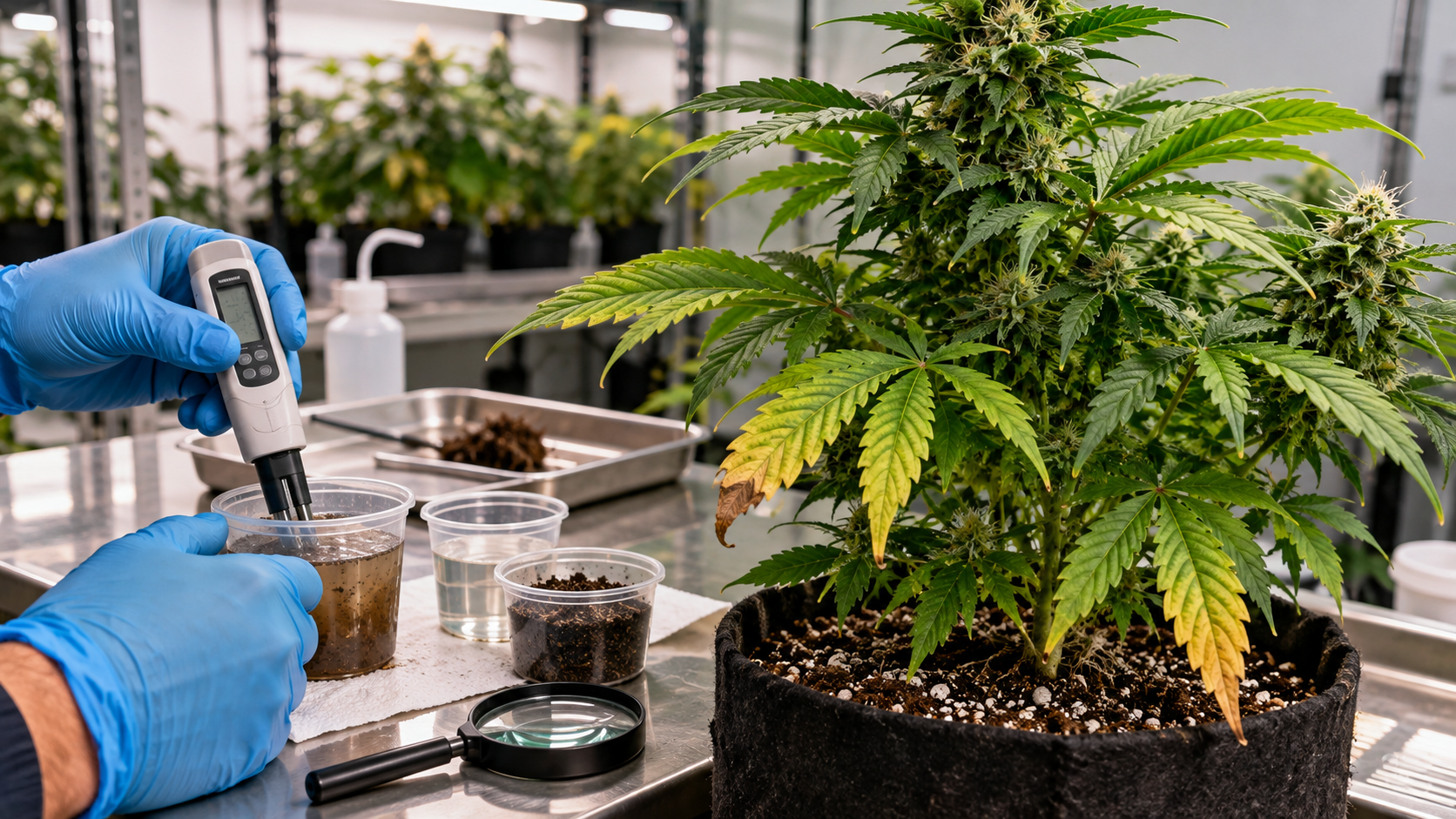
Cannabis Plant Problems A-Z: Pests, Diseases, Deficiencies, and Stress
Cannabis problems are easier to navigate when every symptom, pest, disease, root-zone failure, and unusual growth pattern has a clear place. This A-Z directory is designed as a reference map. It helps you name the possibilities, recognize the category you are dealing with, and choose the next useful check without pretending that a photograph or one damaged leaf proves a diagnosis.
Start with the pattern, not the product. Record where the problem began, which tissue is affected, how quickly it changed, and what happened in the growing environment beforehand. Then use the directory to narrow the field. If you are still at the symptom stage, begin with the Common Cannabis Plant Problems symptom-first guide.
How to Use the A-Z Directory
This directory includes four kinds of entries: biotic problems caused by living organisms, abiotic problems caused by the growing environment or handling, nutrition and root-zone problems, and developmental or genetic traits. Those categories can overlap in appearance. Yellowing may reflect nutrition, root dysfunction, water stress, disease, or normal leaf aging. Twisted growth may point toward mites, herbicide exposure, environmental stress, a virus, or an unusual phenotype.
Directory rule
An entry is a possibility to investigate, not a diagnosis made from appearance alone. The name becomes useful only when the plant pattern, physical evidence, growing history, and appropriate test support it.
Each entry below gives a short orientation rather than a complete treatment program. Dedicated problem guides can later cover look-alikes, confirmation, correction, prevention, and recovery in depth. Until those pages are live, use the linked Weedth resources for the closest verified diagnostic workflow.
Five Checks Before You Choose a Diagnosis
- Map the pattern. Note whether the issue affects one plant, one cultivar, one irrigation zone, a light-facing edge, a low wet area, or the entire crop.
- Locate the first affected tissue. Old leaves, new growth, roots, crown, stems, and flowers point toward different groups of causes.
- Inspect for signs. Look for insects, eggs, webbing, frass, honeydew, boring holes, fungal growth, soft tissue, lesions, root sloughing, or internal flower decay.
- Reconstruct the timeline. Review irrigation, feed, pH, EC, sprays, transplanting, temperature, humidity, light, storms, and equipment changes.
- Measure before correcting. Verify the variables that fit the pattern. Do not stack fertilizer, flushing, spraying, watering, and lighting changes into one unreadable rescue attempt.
Important: Physical evidence carries more diagnostic weight than color alone. Eggs, feeding injury, spores, mycelium, cankers, damaged roots, or laboratory results can narrow a case. A yellow leaf cannot do that by itself.
“The leaf chart looks exactly like my plant. Is that enough to start treating it?”
Question sent by: CannaNerd91, via contact form.
No. Use the chart to build a shortlist, then check tissue age, distribution, root-zone behavior, recent changes, and physical evidence. Several unrelated problems can produce the same color and shape.
Cannabis Plant Problems A-Z
The index is intentionally broad, but it does not imply that every entry is common in every grow. Production method, climate, geography, cultivar, crop stage, and plant source all change the likely causes. Where a term is mainly descriptive, rare, or dependent on laboratory identification, the wording below says so.
A · B · C · D · E · F · G · H · I · L · M · N · O · P · R · S · T · U · V · W · X · Y · Z
A
- Accidental re-vegging: Flowering growth returns to vegetative development after an interrupted or lengthened dark cycle, often producing single-bladed or twisted leaves.
- Air pollution stress or ozone damage: Oxidant injury can create stippling, bronzing, premature aging, or reduced vigor; distribution and local exposure matter more than a single leaf.
- Albinism: Fully white tissue lacks functional chlorophyll and should be separated from ordinary chlorosis, nutrient deficiency, and stable variegation.
- Alfalfa mosaic virus (AMV): A systemic virus associated with mosaic, mottling, distortion, and uneven vigor; laboratory confirmation is stronger than symptom matching.
- Alternaria bud rot: Alternaria-associated flower decay can resemble other bud rots, so contaminated tissue and growing conditions need closer examination.
- Alternaria leaf blight: Expanding necrotic lesions and loss of healthy leaf area suggest disease rather than a uniform nutrition pattern.
- Alternaria stem canker: Dark or sunken stem lesions may weaken transport and the branch above them; inspect whether the lesion is expanding or girdling.
- Anthracnose: A broad fungal disease label associated with dark, sometimes sunken lesions on leaves or stems; exact identification may require a diagnostic laboratory.
- Aphids: Soft-bodied sap feeders often cluster on tender tissue or leaf undersides and may leave honeydew, distorted growth, and cast skins.
- Arabis mosaic virus (ArMV): A reported viral possibility associated with systemic mottling or poor growth; do not infer it from leaf color alone.
- Armyworms: Caterpillars that chew foliage and can move rapidly through a crop; identify the larva and inspect at the times it feeds.
- Aspergillus post-harvest mold: A harvested-flower contamination and safety concern, not a cosmetic storage defect. Compromised material should not be treated as recoverable flower.
- Australian Bastard Cannabis mutation: A stable, unusual leaf morphology that can look damaged to an unfamiliar grower but is not itself a disease.
B
- Bacterial blight: Water-soaked, greasy-looking, or rapidly necrotic lesions raise bacterial disease as a possibility, especially where splash and wet handling occur.
- Bacterial crown and root rot: Soft, declining crown or root tissue can disrupt the entire plant; inspect below the canopy before changing feed.
- Bacterial wilt: Inappropriate or persistent wilt may reflect internal vascular disruption rather than dry media, but laboratory diagnosis is usually needed.
- Barnacle scales: Immobile-looking scale insects attach to stems or leaves and can be mistaken for plant tissue; check for honeydew and living colonies.
- Beet curly top virus (BCTV): Curled, distorted, stunted growth can be associated with this vector-borne virus, but mites, herbicides, and abiotic stress remain look-alikes.
- Beet webworm: Webbing plus chewing injury points toward caterpillar activity; search inside folded or webbed foliage.
- Beetle grubs: Soil-dwelling larvae may feed on roots. Their importance depends on species, density, root injury, and local field conditions.
- Bipolaris leaf spot: A fungal lesion diagnosis that belongs in the leaf-spot differential, not in a nutrient chart alone.
- Black dot: A specialist pathology term for dark fungal structures or disease-associated tissue; it should be interpreted with the organism and tissue named by a laboratory.
- Boring beetles: Holes, sawdust-like debris, frass, internal galleries, and branch failure are more useful clues than wilting alone.
- Boring caterpillars: Larvae inside stems or branches can remain hidden while tissue above the tunnel weakens or breaks.
- Boron deficiency: Meristem injury, brittle or distorted new growth, and poor root development can occur, but root stress and pH-related availability must be checked first.
- Botrytis bud rot or gray mold: Dense flowers may decay internally before the outside looks severe. Dead sugar leaves, gray growth, and soft brown tissue demand immediate inspection. Use the Cannabis Bud Rot guide for diagnosis, containment, removal, prevention, and harvest verification.
- Broad mites: Microscopic mites can cause twisted, hardened, blistered, or stalled new growth. Magnification and expert identification are often necessary.
- Broomrape: A parasitic plant problem of field systems. Confirm attachment to host roots before treating weak growth as a cannabis nutrition issue.
- Brown blight: A descriptive label for spreading brown disease injury, not a complete organism-level diagnosis.
- Brown leaf spot: Discrete, progressive lesions should be separated from uniform marginal burn, spray spotting, and normal senescence.
- Brown stem canker: Expanding brown stem lesions can compromise transport and structure; inspect the tissue above and below the injury.
C
- Calcium deficiency: New growth may distort or develop localized necrosis, but calcium delivery also depends on roots, water movement, and environment.
- Calcium toxicity: Excess calcium is more often a root-zone balance and antagonism problem than a distinctive leaf pattern.
- Cannabis aphid: A cannabis-associated aphid found on leaf undersides and flowers; colonies, honeydew, cast skins, and sooty mold help confirm it.
- Cannabis cryptic virus (CanCV): A laboratory-detected virus whose field significance may be subtle or mixed; symptoms alone cannot establish its role.
- Cannabis root rot: An umbrella term for declining roots. Inspect texture, fine-root loss, crown condition, progression, and shared pathways rather than relying on color alone.
- Caterpillars: Chewed foliage, frass, silk, entry holes, or damaged flowers help distinguish larval feeding from disease lesions.
- Cercospora leaf spot: A fungal leaf-spot possibility requiring lesion-pattern assessment and, where necessary, laboratory identification.
- Chaetomium fungus: More relevant to contamination or specialist fungal diagnosis than to a distinctive field symptom. Interpret it in the sampled tissue and environment.
- Charcoal rot: Root, crown, or lower-stem decline associated with darkened tissue and stressed plants; confirmation should go beyond canopy wilt.
- Chimera: Genetically distinct tissue sectors can produce sharply divided color or growth patterns that resemble variegation or disease.
- Chlorine deficiency: A rare crop diagnosis under ordinary inputs. Verify water, substrate, tissue analysis, and stronger alternatives before assigning it.
- Chlorine toxicity: Excess chloride may contribute to marginal injury and salinity stress; water and tissue testing carry more weight than leaf matching.
- Cladosporium stem canker: A fungal canker possibility when stem lesions expand and weaken tissue; exact identification is specialist work.
- Cold stress: Chilling can slow uptake, discolor foliage, damage exposed tissue, and create wilt-like symptoms even when water is present.
- Collar rot: Dark, soft, constricted, or collapsing tissue at the soil line threatens the connection between roots and shoot.
- Copper deficiency: Distorted young growth, loss of vigor, or dieback can have multiple causes; confirm availability, roots, and analysis before supplementing.
- Corn earworm: Larvae can feed on maturing flowers and seed heads, leaving frass and injury that increases secondary rot risk.
- Cotton square borer: A region-dependent caterpillar entry. Confirm the insect rather than assigning the name to generic flower feeding.
- Creeper phenotype: A stable low, sprawling growth habit should be distinguished from a plant that has recently collapsed or stretched.
- Crickets: Chewing at seedlings, leaves, or stems may matter locally, but direct observation or trapping should support the diagnosis.
- Crown gall: Tumor-like swellings near the crown or lower stem must be separated from callus, stem thickening, fasciation, and ordinary injury.
- Crown rot: Necrosis or collapse at the stem-root transition can cause whole-plant decline and deserves immediate root and crown inspection.
- Cucumber mosaic virus (CMV): Mosaic, distortion, and stunting are compatible but non-specific; testing is needed for a confident virus diagnosis.
- Curvularia leaf spot: A fungal leaf-spot name that requires true lesion behavior and preferably diagnostic confirmation.
- Cyst nematodes: Microscopic root parasites whose relevance depends on species and testing; weak growth above ground is not sufficient evidence.
D
- Damping-off: Seeds fail to emerge or young stems constrict and collapse near the medium surface, often under wet, poorly aerated propagation conditions.
- Deer: Torn or browsed tops and missing foliage often show an irregular bite pattern, tracks, or repeated outdoor access.
- Dodder: A parasitic vine that wraps around hosts and forms feeding connections; remove and identify it before it spreads through a field site.
- Downy mildew: An oomycete disease favored by moisture. It is biologically different from powdery mildew and should not be treated as the same problem.
- Drought stress: Insufficient available water causes loss of turgor and slowed function; confirm moisture at root depth and wetted distribution.
E
- Earwigs: Mostly nocturnal insects that may chew tender tissue but can also be incidental; inspect at night before assigning blame.
- Ectoparasitic nematodes: Root-feeding nematodes that remain outside roots. Soil or root-zone analysis is needed to identify them.
- Eurasian hemp borer: A hemp-associated borer capable of tunneling into stems; geography and insect identification are central to the diagnosis.
- European corn borer: Stem galleries, entry holes, frass, and breakage support this diagnosis more strongly than general wilt.
F
- False chinch bug: A small sap-feeding field insect that may aggregate in large numbers; confirm the species and actual plant injury.
- Fasciation: Flattened, ribbon-like, widened, or fused growth can be developmental, injury-related, or occasionally associated with disease.
- Flea beetles: Small beetles that create numerous shot-hole feeding marks, especially on young leaves.
- Flooding: Saturated roots lose oxygen, uptake slows, and plants may wilt or yellow despite abundant water.
- Foxtailing: Elongated stacks of new floral growth may be genetic or encouraged by excessive canopy heat and light.
- Four-lined plant bug: Feeding can produce rounded brown spots and distorted expanding leaves; finding the insect helps separate it from leaf disease.
- Fungus gnats: Adults indicate wet organic media, while larvae can feed in the root zone. Sticky cards alone do not measure root injury.
- Fusarium bud rot: Fusarium-associated flower decay is a differential for rotting buds, not a diagnosis to make by color alone.
- Fusarium crown rot: Crown necrosis, internal discoloration, and progressive decline require isolation and diagnostic attention.
- Fusarium foot and root rot: Lower-stem and root decay can mimic overwatering and nutrient failure; tissue integrity and progression matter.
- Fusarium head blight: A field pathology term involving reproductive tissue; distinguish it from other flower rots through proper diagnosis.
- Fusarium rot: An umbrella label that should be narrowed by affected tissue and laboratory identification.
- Fusarium stem canker: Stem lesions and dieback may be associated with Fusarium, but several fungi and injuries can produce a similar canker.
- Fusarium wilt: Vascular infection may produce persistent wilt and internal discoloration even when the root zone contains water.
G
- Gall midges: Tiny flies whose larvae can distort plant tissue or form galls; species-level relevance varies by region.
- Girdled roots or root circling: Roots trapped around the container wall can restrict exploration, create uneven wetting, and reduce resilience.
- Grasshoppers: Irregular chewing and missing leaf tissue are most convincing when the insects or fresh feeding are observed.
H
- Heat stress: Excess tissue or root-zone temperature can cause curling, bleaching, wilt, stalled growth, and increased water demand.
- Heavy metal toxicity: A contamination and uptake issue that cannot be diagnosed reliably from leaf appearance; substrate, water, and tissue testing are needed.
- Hemp canker: A general stem-canker term used in hemp pathology. Determine the affected tissue and causal organism before choosing a response.
- Hemp root rot: A broad field label for root decay; it should be narrowed with crown inspection, root condition, environment, and testing.
- Hemp russet mites: Extremely small mites associated with bronzing, curling, stalled tops, and flower damage. Microscopy may be needed when a hand lens is inconclusive.
- Hemp sawfly: A region-dependent insect entry. Identify the larva and feeding pattern before assuming it is responsible.
- Hemp streak virus (HSV): A reported viral diagnosis associated with streaking or systemic decline; use validated testing.
- Herbicide damage: Drift, contaminated amendments, carryover, or accidental contact can twist new growth and create field-edge or exposure patterns.
- Hermaphroditism: Pollen sacs or exposed anthers on a flowering female plant create pollination risk and require prompt crop-level assessment.
- High humidity stress: Weak transpiration, slow drying, edema-like responses, and increased disease opportunity can develop when humid air remains stagnant.
- Hop latent viroid (HLVd): Reduced vigor, abnormal branching, poor rooting, and weak flower performance can occur, but healthy-looking plants may also test positive. Laboratory testing is essential.
I
- Inchworms: Looping caterpillars that chew leaves; direct identification and fresh frass or feeding damage support the diagnosis.
- Iron deficiency: Interveinal chlorosis of young tissue can occur when iron is unavailable, but roots, pH, moisture, and competing elements must be checked.
L
- Leaf buds: Unusual floral structures emerging from leaf tissue are a developmental curiosity rather than a standard disease symptom.
- Leaf-cutter ants: Cleanly cut leaf sections and ant trails distinguish this outdoor pest from caterpillar chewing.
- Leaf miners: Larvae feeding between leaf surfaces create pale tunnels or mines with characteristic tracks.
- Leaf Septoria or yellow leaf spot: Discrete lesions, dark centers, progression, and canopy distribution help separate Septoria from uniform deficiency.
- Leafhoppers: Mobile sap feeders may cause stippling, distortion, or hopperburn and can also matter as vectors in some systems.
- Lesion nematodes: Migratory root parasites that require root or soil analysis; above-ground weakness is non-specific.
- Lettuce chlorosis virus (LCV): A reported virus possibility associated with chlorosis and systemic symptoms; vector context and laboratory testing matter.
- Light burn or light stress: Bleaching, upward leaf posture, curling, or stalled tops usually follow the brightest canopy zones and recent lighting changes.
- Loopers: Caterpillars with a looping gait that remove leaf tissue; inspect both foliage and nearby hiding places.
- Low humidity stress: Excessive atmospheric demand can accelerate water loss, curl leaves, and expose weak root delivery.
- Lygus bugs: Tarnished plant bugs can feed on developing leaves and flowers, leaving distorted or ragged growth.
M
- Magnesium deficiency: Older leaves may develop interveinal chlorosis because magnesium is mobile, but root-zone pH, salinity, and balance remain part of the diagnosis.
- Magnesium toxicity: Usually a nutrient-balance concern rather than a unique visual syndrome. Confirm inputs and analysis before correcting.
- Manganese deficiency: Interveinal chlorosis and speckling can affect relatively young tissue, but similar patterns have multiple causes.
- Mechanical stem damage or broken stems: Wind, ties, handling, animals, or heavy flowers can split tissue and create secondary infection points.
- Mealybugs: Cottony colonies on stems, nodes, or roots may produce honeydew and weakening; inspect hidden crevices and root balls.
- Mice: Seed loss, gnaw marks, disturbed media, droppings, and nighttime activity support rodent involvement.
- Mole crickets: Tunneling and root or seedling injury occur in some outdoor soils; confirm with trapping or direct observation.
- Molybdenum deficiency: Rare under many growing programs and easily over-assigned. Check pH, roots, and analytical evidence before supplementing.
N
- Nitrogen deficiency: Older leaves usually pale first as nitrogen is remobilized, but wet roots, low feed, pH, and normal late-flower senescence must be separated.
- Nitrogen toxicity: Excessive dark green growth, downward clawing, soft tissue, and delayed flowering may occur, but confirm the feeding and root-zone record.
O
- Olive leaf spot: A pathology term for a particular leaf-spot presentation; use lesion evidence and diagnostic identification rather than the color name alone.
- Ophiobolus stem canker: A specialist fungal diagnosis for stem lesions. It should not be assigned without organism-level support.
- Over-watering: Irrigation arrives faster than the root zone can use and aerate, leaving containers persistently heavy and plants drooping after watering.
P
- Painted lady: This butterfly’s caterpillars may feed on foliage and use silk to shelter on leaves; identify larvae before choosing control.
- Pavement ant: Ants may be incidental or attracted to honeydew-producing pests. Trace what they are tending before treating the ants as the main problem.
- Penicillium bud rot: A flower-decay differential requiring careful contamination handling and, where needed, laboratory identification.
- Penicillium post-harvest mold: Mold on stored flower is a quality and safety failure. Review drying uniformity, storage humidity, condensation, and sanitation.
- Pepper spot: A descriptive spotting term rather than a sufficient causal diagnosis; separate true lesions from spray residue and feeding injury.
- Phomopsis stem canker: Cankers and branch decline may be associated with Phomopsis-related fungi, but exact identification requires diagnostic support.
- Phosphorus deficiency: Slow growth, dark foliage, or discoloration can occur, but cool roots, pH, root injury, and stage-related changes can look similar.
- Phytoplasma proliferation: Abnormal branching, witches’ broom, floral changes, or stunting may be associated with phytoplasmas and require molecular testing.
- Pink rot: A descriptive rot category whose color is not enough to establish the pathogen. Treat affected flower as compromised while identifying the cause.
- Planthoppers: Sap-feeding insects whose importance varies by species and region; direct identification and injury patterns are needed.
- Plant-parasitic nematodes: A broad group of microscopic root feeders. Soil and root assays determine whether a relevant population is present.
- Pocket gopher: Missing roots, toppled plants, mounds, and underground feeding distinguish this outdoor vertebrate problem from root disease.
- Polyploidy: Extra chromosome sets can change morphology, but unusually large or thick growth is not proof. Genetic or cytological evidence is needed.
- Potassium deficiency: Older leaves may develop marginal chlorosis and necrosis, yet salinity, drought, root damage, and pH can produce similar edges.
- Potassium toxicity: Excess potassium more often disrupts nutrient balance than creates a unique visual signature. Confirm inputs and root-zone chemistry.
- Potato leafhopper: Feeding may produce curling, yellowing, and edge burn known as hopperburn; insect presence and regional timing support the diagnosis.
- Potato virus Y (PVY): A virus reported in cannabis-related host discussions. Systemic symptoms require validated testing and pathway investigation.
- Powdery mildew: White superficial fungal growth often begins in protected canopy zones. Confirm that it is growth, not residue, dust, or dried spray. Use the Cannabis Powdery Mildew guide for diagnosis, containment, lawful control decisions, and verification.
- Pythium root and crown rot: An oomycete disease associated with damaged roots, crown decline, and water-mold spread pathways. Overwatering can favor risk but does not prove Pythium.
R
- Rabbit: Cleanly clipped shoots, pellets, tracks, and repeated low-level feeding support rabbit damage outdoors.
- Rat: Gnawing, missing seeds or plant material, droppings, and nighttime disturbance indicate rodent access.
- Rice root aphid: Root-feeding aphids may be confused with other small soil organisms. Inspect roots and use magnification for identification.
- Root bound: Dense circling roots and a small effective root volume can produce rapid dry-down, uneven wetting, and stalled growth.
- Root maggots: Fly larvae may damage roots in some systems. Confirm larvae and injury rather than diagnosing from wilt above ground.
- Root rot: A symptom category, not one pathogen. Use the Root Rot vs Overwatering diagnostic guide to compare disease evidence with oxygen-limited roots.
- Root-zone heat stress: Hot containers or nutrient solution can suppress root function and oxygen availability even when the canopy temperature seems acceptable.
- Root-knot nematodes: Characteristic root galls plus nematode testing separate them from crown gall, callus, and ordinary root swelling.
- Rust fungi: Rust-colored pustules or spores must be distinguished from nutrient spots and necrotic tissue; microscopy may be needed.
“My plant has brown roots and droops in a wet pot. Does that prove Pythium?”
Question sent by: GreenhouseGary, via email.
No. Organic inputs, media staining, root age, low oxygen, and several pathogens can darken roots. Pythium becomes more plausible when tissue integrity declines, fine roots disappear, disease progresses, a shared water pathway exists, or testing identifies the organism.
S
- Salt damage or salinity stress: High root-zone salt concentration can restrict water uptake and burn margins or tips. Measure EC in a method appropriate to the medium.
- Saltmarsh caterpillar: A hairy caterpillar that may feed broadly on foliage; species and local occurrence should be confirmed.
- Scale insects: Attached insects on stems or leaves may resemble bumps or scabs and often produce honeydew.
- Scentless seed bug: A region-dependent true bug associated with seeds and plant material; determine whether it is causing measurable crop injury.
- Sclerotinia bud rot: Flower infection associated with Sclerotinia belongs in the bud-rot differential and may produce white fungal growth or hard survival structures.
- Seed infection or latent seed-borne disease: Seeds can carry some pathogens without obvious external clues. Clean sourcing and diagnostic testing matter more than appearance alone.
- Self-topping or missing growth tip: The apical meristem may divide or disappear after subtle injury or developmental change, creating spontaneous branching.
- Silicon deficiency: Silicon is generally treated as beneficial rather than universally essential for cannabis. Weak structure alone does not establish a deficiency.
- Slugs: Irregular holes, rasped surfaces, slime trails, and night activity identify slug feeding.
- Snails: Similar to slugs but with visible shells; inspect damp hiding places and nighttime movement.
- Sooty mold: Dark surface fungal growth develops on honeydew. The underlying sap-feeding insect is usually the management target.
- Southern blight: Crown and lower-stem collapse in warm conditions may include white fungal growth and small survival structures; isolate and confirm suspicious plants.
- Spider mites: Fine stippling, eggs, mites, and later webbing often begin on leaf undersides. Inspect with magnification before widespread damage develops.
- Spotted cucumber beetle: Adult chewing injury and beetle presence support the diagnosis; seedlings may be more vulnerable than established plants.
- Stem canker: A general term for localized dead stem tissue. The lesion’s depth, expansion, and causal organism determine the real risk.
- Stem nematodes: A specialist diagnosis involving nematodes in above-ground tissue; laboratory confirmation is required.
- Stem rot: Softening, discoloration, constriction, or collapse can result from several organisms and environmental conditions.
- Stemphylium leaf spot: A fungal leaf-spot possibility that belongs in a laboratory-supported lesion differential.
- Stink bugs: Piercing-sucking insects that may damage leaves, stems, or reproductive tissue. Find the insect and fresh feeding sites.
- Stringy cannabis: Thin, stretched, underfilled growth is an outcome that may reflect genetics, weak light, root limitation, or chronic stress.
- Sulfur deficiency: Pale younger tissue and reduced growth can occur, but sulfur shortage is not established by appearance alone.
T
- Termites: Structural or root-zone feeding may occur in some locations, especially around wood, but direct evidence is needed.
- Thrips: Slender insects scrape plant cells, leaving silvery scarring, black specks, distorted tissue, and characteristic feeding tracks.
- Tobacco mosaic virus (TMV): Mosaic-like symptoms are not proof of TMV. Cannabis attribution requires validated testing and cautious interpretation.
- Transplant shock: Temporary wilt or slowed growth follows root disturbance or an abrupt environment change; recovery should appear in new growth.
- True bugs: A broad insect group with piercing-sucking mouthparts. Identify the family or species before assuming the damage mechanism.
- Twig blight: Progressive death of small shoots or branch tips can have fungal, vascular, environmental, or mechanical causes.
- Twin seedlings or polyembryony: Two seedlings may emerge from one seed. It is a developmental event, not an infection.
U
- Under-watering: The root zone lacks enough available water for current demand. Verify moisture at depth, not only the dry surface.
- Upright phenotype: Strong vertical posture may be a stable architectural trait, while sudden upward curling or praying can reflect environment.
V
- Variegated cutworm: A nocturnal caterpillar that may cut seedlings or chew foliage. Inspect at night and around the medium surface.
- Variegation: Stable cream, white, yellow, or pale sectors can be developmental. Distinguish them from spreading chlorosis, viral mosaic, and injury.
- Verticillium wilt: A vascular wilt diagnosis that may cause one-sided or progressive decline; laboratory confirmation separates it from other wilts.
- Vine-like cannabis: Persistent trailing or weakly self-supporting growth may be a phenotype, while newly collapsing structure signals stress or damage.
- Vole: Runways, gnawing near the crown, missing roots, and burrow activity point toward this outdoor rodent.
- VPD stress: A mismatch between air temperature and humidity can drive excessive or inadequate transpiration, but VPD is context, not a diagnosis by itself.
W
- Water stress: An umbrella for insufficient, excessive, unavailable, or unevenly delivered water. Determine which mechanism is operating.
- Webbed leaves or Ducksfoot: Partly joined leaflets are a known morphology trait, not automatically herbicide, virus, or nutrient injury.
- Weevils and curculios: Adult notching or larval root feeding varies by species. Identify the insect and life stage.
- White leaf spot: Pale lesions need to be distinguished from bleaching, spray deposits, feeding scars, and powdery fungal growth.
- Whiteflies: Adults fly from disturbed foliage while scales and nymphs remain underneath leaves; honeydew and sooty mold may follow.
- Wind burn: Exposed foliage may curl, tear, dry, or develop edge damage that follows fan position or prevailing wind.
- Witches’ broom: Dense abnormal shoot proliferation is a symptom pattern with several possible causes, including phytoplasmas and developmental disorders.
- Whorled phyllotaxy: More than the usual number of leaves or branches emerges around a node. A stable pattern can be developmental rather than pathological.
- Woodchuck or groundhog: Heavy outdoor browsing, burrows, tracks, and missing plant material distinguish vertebrate feeding.
X
- Xanthomonas leaf spot: A bacterial leaf-spot diagnosis that may involve water-soaked or necrotic lesions; splash history and laboratory support matter.
Y
- Yellow woollybear: A hairy caterpillar that can remove foliage; identify the larva and confirm active feeding.
Z
- Zebra caterpillar: A striped leaf-feeding caterpillar. Direct identification and fresh chewing damage support the diagnosis.
- Zinc deficiency: Small, distorted young leaves, shortened internodes, or interveinal chlorosis may occur, but roots and pH-related availability must be checked first.
Evidence Boundaries: Common, Possible, and Unconfirmed
An exhaustive directory needs restraint as much as breadth. Aphids, spider mites, corn earworm, powdery mildew, Botrytis, Septoria, root rots, nutrient disorders, and water stress are well-established areas of cannabis or hemp production. Other pathogens and pests may be documented only in certain regions, production systems, cultivars, or isolated reports. A name appearing in a pathology list does not establish how common it is in a home grow.
Some entries are not diseases at all. Fasciation, variegation, polyembryony, unusual leaf morphology, and stable growth habits belong here because they are frequently mistaken for disease. Post-harvest molds are included because diagnosis does not stop when the plant is cut. Vertebrate pests are included because outdoor damage can otherwise be misread as insects or structural failure.
Do
Use the directory to create a ranked shortlist based on pattern, evidence, environment, crop stage, and local occurrence.
Avoid
Choosing the rarest matching name from a photograph and treating it as confirmed.
Field Advice: Common explanations deserve attention first, but a common explanation that fails the evidence should not be protected from reconsideration. Escalate the quality of observation before escalating the treatment.
When to Isolate, Remove, or Escalate
Isolation is most useful when the suspected problem could move through plant contact, air, water, tools, vectors, or propagation. Separate suspicious new stock, restrict shared runoff and tools, and inspect the plants that were closest to it. Isolation is also appropriate when pollen sacs or exposed anthers create a reproductive risk.
Remove tissue when it is actively rotting, heavily infested, structurally dead, trapping moisture, or contaminating nearby flowers. Do not turn defoliation into a substitute for diagnosis. A stressed plant still needs functional leaf area, and removing every marked leaf can erase the pattern you need to understand.
Contaminated flower is not a rescue project. Visible internal mold, advanced bud rot, or post-harvest fungal contamination changes the decision from cosmetic cleanup to containment and disposal. Do not inhale, consume, or sell compromised flower.
Escalate to a diagnostic laboratory or qualified plant-health specialist when symptoms progress despite a corrected environment, when vascular or crown disease is suspected, when a virus or viroid would change propagation decisions, when an organism cannot be identified with suitable magnification, or when the result affects multiple plants through a shared production pathway.
“Should I spray first and identify the pest later if damage is spreading?”
Question sent by: GrowinWithDan, via email.
Identification still comes first. The wrong spray may miss eggs or hidden life stages, harm beneficial insects, leave residues on flowers, and make the original evidence harder to read. Stabilize the situation, isolate where practical, document the damage, and choose only lawful controls that match the confirmed target and crop stage.
How to Verify a Correction
Old damage usually remains damaged. A correction is working when the process causing injury slows or stops. Mark the edge of a lesion, photograph the same branch, record affected-plant counts, and compare new growth at a defined interval. For root-zone problems, watch whether moisture use, posture, fine-root development, and new growth normalize. For pests, repeat the same inspection route and count or rate the same plant parts.
| Problem type | Useful verification | Misleading expectation |
|---|---|---|
| Nutrition or root-zone stress | Healthier new growth and stable moisture use | Dead leaf tissue turns green again |
| Foliar disease | Few or no new lesions; incidence stops rising | Existing lesions disappear |
| Arthropod pest | Repeat inspection shows fewer live pests or reduced fresh injury | No insects seen in one quick top-down check |
| Environmental injury | Damage stops following the exposure pattern after conditions change | Every affected leaf recovers cosmetically |
| Systemic pathogen | Validated test and clean-stock decisions | Temporary visual improvement proves clearance |
For suspected pest pressure, use the Cannabis Pest Thresholds guide to separate observation from an automatic spray decision. For yellowing, tip burn, and suspected lockout, continue with Cannabis Nutrient Diagnosis. Watering uncertainty belongs in Cannabis Watering Basics.
A Repeatable Problem-Checking Routine
- Photograph the whole plant, affected organ, close-up symptom, and a healthy comparison.
- Mark the plant and the exact tissue so progression can be compared.
- Map affected plants by cultivar, zone, irrigation line, airflow, and light exposure.
- Inspect leaf tops and undersides, nodes, stems, crown, roots, and inner flowers where appropriate.
- Review recent irrigation, feed, pH, EC, weather, lighting, sprays, transplanting, and new plant material.
- Measure only the variables that can separate the leading explanations.
- Isolate when a transmissible pest, pathogen, or pollen risk is plausible.
- Correct the strongest supported cause without stacking unrelated interventions.
- Reinspect the same locations and compare new damage, not old scars.
- Escalate to microscopy, tissue analysis, water or media testing, or a plant diagnostic laboratory when the decision requires it.
The value of an A-Z directory is not that it produces instant certainty. It prevents a grower from overlooking whole categories of causes while keeping rare names in their proper place. Start broad, gather evidence, narrow the shortlist, act carefully, and verify what changes next.
Share this article
A quick overview of the topics covered in this article.
Follow us
Latest articles
October 16, 2026
October 16, 2026
October 16, 2026