Supercropping: Recovery Signs and Failure Signs
Supercropping is a high-stress training technique that deliberately deforms a still-flexible stem so a branch can be redirected without intentionally removing the shoot tip. The useful result is not the injury itself. The useful result is a branch that changes position, keeps functioning above the bend, and later becomes stable enough to carry foliage and eventually flower weight.
That distinction matters outdoors because a branch that looks dramatic immediately after training may recover normally, while a branch that looks only slightly damaged can quietly lose hydraulic function, split farther in wind, or begin dying back above the bend. Recovery should be judged by function, not by the size of the swelling that develops around the bend.
Direct cannabis research on supercropping itself is limited. Cannabis studies do show that manipulating architecture can change light distribution, biomass allocation, yield, and chemical uniformity, while broader plant mechanobiology shows that bending and wounding trigger real growth and repair responses. Those findings explain why the technique can work, but they do not establish a universal bend angle, recovery time, yield increase, or ideal flowering-stage cutoff for cannabis.
What Supercropping Changes in the Plant
Supercropping changes architecture by mechanically weakening and redirecting a stem rather than removing its apical meristem. In practical terms, the branch is moved out of its original vertical path so that a tall shoot can be lowered, an overcrowded area can be opened, or a canopy can be spread into a more useful shape.
It is a mechanical intervention first
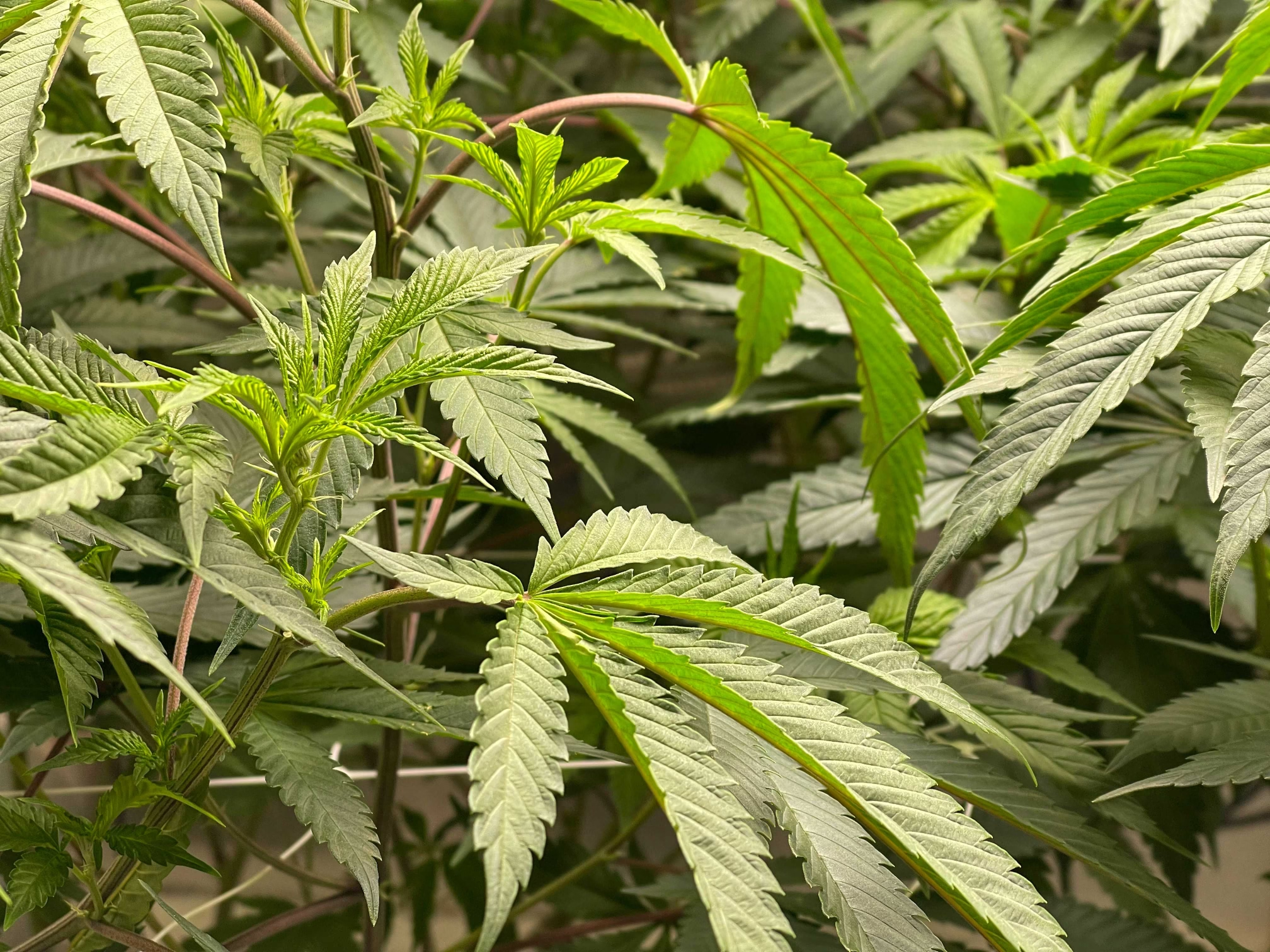
The immediate event is mechanical strain. Plant stems respond to bending, flexing, wind, touch, and other physical loads through mechanosensitive pathways commonly grouped under thigmomorphogenesis. Across plant species, repeated or substantial bending can temporarily slow extension growth and alter radial growth, tissue allocation, and structural properties.
Thigmomorphogenesis
A plant growth response to mechanical stimulation such as wind, repeated flexing, touch, or bending. The response can include temporary growth inhibition, altered stem thickness, and changes in tissue development. It explains why mechanical stress can change plant form, but it does not prove that deliberately injuring a cannabis branch will increase yield.
Supercropping goes beyond ordinary flexing because the grower intentionally creates a localized zone of internal deformation. The goal is to make the stem pliable enough to hold a new position while keeping the branch alive. That means the useful boundary is narrow: enough deformation to redirect the branch, but not so much disruption that transport and structural continuity fail.
Apical dominance is not removed in the same way as topping
Topping removes the active shoot tip and directly changes apical dominance. Supercropping usually leaves that shoot tip in place. The branch may temporarily lose vertical priority because its position changes, because growth pauses around the stressed area, and because neighboring shoots gain better access to light. This is one reason supercropping can produce a flatter canopy without removing the branch.
Do not describe this as a guaranteed hormone reset. The branch is still biologically connected to the plant, and the magnitude of the response depends on genotype, branch position, stem maturity, light, water status, and the severity of deformation.
The bend becomes a load-bearing problem
Outdoors, the branch does not recover in a quiet laboratory. Wind twists it. Rain adds mass. The branch tip continues to grow and acts as a lever. Later, flowers can add much more load. A bend that survives the first day can still fail later if the damaged section or the nearby branch union was never adequately supported.
Important: A branch is not successfully supercropped because it stays bent. It is successful only if the tissue above the bend remains functional, growth resumes, the damaged zone stabilizes, and the branch can be supported through the rest of the season.
Repair tissue is real, but a large knuckle is not the target
Plant wound research shows that damaged stems can activate cell division, callus formation, cell-wall reinforcement, and vascular reconnection around injured tissue. Broader bending research also shows that mechanically stimulated stems can alter radial growth locally. These processes help explain why a bent stem may thicken around the damaged zone.
However, the familiar grower phrase that a large “knuckle” proves a successful supercrop goes too far. A swelling tells you that the tissue responded. It does not by itself prove full vascular function, stronger final branches, higher cannabinoid concentration, or increased yield. Recovery still has to be confirmed above the bend.
“My bend formed a big knuckle. Does that mean the supercrop worked?”
Question sent by: Ethan Brooks, via email.
It means the plant produced a visible local response, but the swelling is not the final test. Check whether leaves above the bend stay normally hydrated, the branch tip resumes extension, the damaged zone stays green and firm rather than dark or soft, and the branch remains stable when wind or flower weight increases. Function matters more than appearance.
Best Timing and Plant Condition Before Supercropping
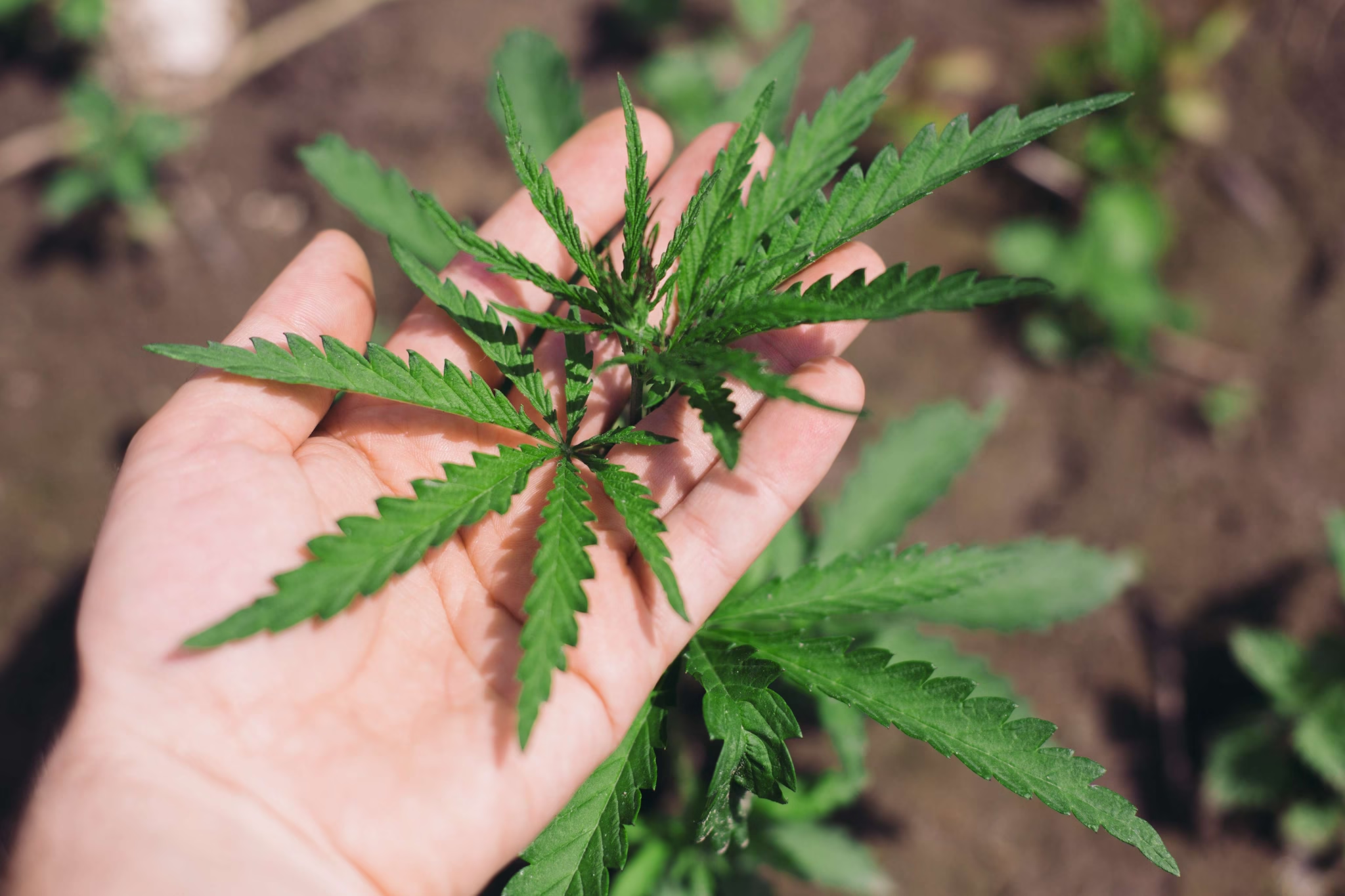
The best candidate is not defined by a universal plant age or node count. The useful question is whether the branch is vigorous, accessible, still workable, and surrounded by enough recovery time.
Choose a real structural problem
Supercropping should solve something specific. A branch may be overtaking the rest of the canopy, crowding another leader, blocking inspection access, pushing beyond a support frame, or entering a height zone where wind leverage becomes difficult to manage. If a soft tie or simple repositioning can solve the same problem, the lower-stress option is usually easier to control.
This keeps the technique from turning into ritual. A plant does not need to be supercropped simply because it is in vegetative growth.
Work with active, hydrated growth, not a stressed plant
A candidate branch should have functional leaves, normal water status, no obvious active disease around the intended bend, and no unresolved root-zone problem. Drought stress, root hypoxia, severe nutrient injury, pest pressure, recent transplant shock, heat injury, or a storm-damaged frame all reduce the margin for another major intervention.
The plant should also be anchored well enough that hand pressure on one branch does not rock the root ball or shift a container. Outdoors, this matters more than many indoor explanations acknowledge. A branch-level technique should not destabilize the entire plant.
Choose a branch that still bends progressively
Select vigorous tissue that can be softened in a short local section without transferring force into the branch union, main stem, container, or root ball.
Force a woody stem because the canopy is already too tall
Rigid tissue gives less warning before cracking. When the branch no longer yields gradually, staking, tying, selective support, or accepting the existing architecture may be safer than a late forced bend.
Recovery time is a biological condition, not a calendar number
There is no validated cannabis rule stating that every supercropped branch recovers in a fixed number of days. Plant mechanobiology research shows that growth can pause after bending and later resume, while wound repair can involve tissue reconstruction over subsequent days. The exact timing depends on the species, injury severity, tissue maturity, environment, and physiological state.
For practical outdoor work, define recovery by observation. The branch is ready for further training only after it has stable posture, functional leaves above the bend, resumed extension, and no expanding split or necrotic tissue. If those checkpoints are not met, the recovery window is still open.
Weather changes whether today is a good training day
Do not create a fresh high-stress bend immediately before strong wind, heavy rain, hail, or another event likely to load the branch. A newly deformed section has not yet stabilized. Outdoor plants also experience repeated mechanical stimulation from ordinary weather, so adding intentional injury just before an external load stacks stress at the same point.
A Conservative Step-by-Step Supercropping Method
The safest method is not the most dramatic one. The purpose is controlled redirection with the smallest injury that achieves the structural goal.
1. Decide the final branch position before touching it
Stand back and identify what the branch is interfering with. Decide where you want its tip to finish and whether that position will still make sense after several more rounds of growth. Check neighboring branches, sun exposure, inspection lanes, future flower spacing, and the route of any support tie.
If the new branch position would create a shaded pocket, rub against another stem, cross the main access path, or sit outside the support frame, solve that geometry first.
2. Choose the bend zone, not the strongest-looking point
A useful bend zone is reachable with both hands and far enough from a branch union that the force does not act directly on the joint. Avoid visibly scarred, diseased, cracked, constricted, or already damaged tissue.
Do not chase a universal internode or branch diameter. The tissue has to tell you whether it is workable. A stem that flexes progressively is different from one that resists and then suddenly snaps.
3. Support both sides of the intended bend
Use one hand to stabilize the lower section and the other to control the upper section. The purpose is to localize the force. If the entire branch swings while you squeeze one point, the stress may travel to the branch union or main stem instead of staying in the intended zone.
4. Soften gradually and stop when resistance changes
Apply gentle, progressive pressure to a short section. Growers often roll or compress the stem between fingers while supporting the branch. The key observation is a change in pliability. You do not need an audible snap, a flattened ribbon of tissue, or visible bark failure to prove that enough force was used.
If resistance remains high, stop. Move to a younger section or use a lower-stress training method. Escalating hand pressure until something breaks converts a controlled bend into an accidental wound.
Outer tissue tearing is a failure point, not a success target
A small surface split may still heal, but intentionally tearing or crushing the stem increases the amount of tissue that must reconnect and creates a larger exposed wound. Once the surface opens, stop bending farther and switch from training to stabilization and monitoring.
5. Redirect only as far as the softened section allows
Lower the branch until it reaches a useful position without pulling the softened zone apart. The final angle is not universal. A small change may solve the canopy problem. Another branch may need a greater redirection. The correct endpoint is the least deformation that achieves the planned structure while keeping the branch supported.
6. Add soft support before weather adds its own force
Use a soft, adjustable tie, stake, trellis contact, or other support that controls the branch without girdling it. Support should prevent the bend from repeatedly opening and closing in wind, but it should not turn the branch into a rigid lever attached to a single narrow point.
Check that the tie will remain visible as the canopy fills. Hidden ties are easy to forget and can constrict expanding stems.
7. Record the bend
Photograph the entire branch and the close-up bend from a repeatable angle. Mark the branch if several plants are being trained. Record why the intervention was done and what the branch looked like before training. This baseline becomes far more useful than memory when you inspect the same site later.
Field Advice: If you cannot explain the structural problem the bend is solving, do not create the injury. “Because this branch is too tall and blocks the support plane” is a reason. “Because supercropping is supposed to increase yield” is not enough.
Recovery Signs vs Failure Signs
This is the most important part of the technique. Recovery is a pattern across the branch, not a single visual feature at the bend.
| Symptom | Possible Cause | How to Confirm | Corrective Action | Prevention |
|---|---|---|---|---|
| Leaves above the bend stay turgid | Transport remains functional despite local deformation | Compare leaf posture above and below the bend and recheck after normal daytime water demand | Leave the bend stable and avoid unnecessary handling | Use progressive pressure and support both sides during training |
| Tip begins reorienting upward | Branch remains alive and responds to gravity and light | Compare the same-angle photograph over successive inspections | Maintain support without forcing the tip flat again | Plan the final branch path before bending |
| Localized thickening develops | Repair and mechanically responsive growth around the bend | Confirm that tissue remains firm and the shoot above continues growing | Do not repeatedly squeeze the swelling to test it | Judge recovery by function, not knuckle size |
| Persistent wilt above the bend | Hydraulic or vascular continuity may be substantially impaired | Compare leaves on the affected branch with neighboring branches under the same root-zone conditions | Stabilize the branch, stop additional training, and inspect for an expanding split or collapse | Avoid excessive compression and severe bends in rigid tissue |
| Split widens or branch rotates at the wound | Mechanical instability or wind reopening the injury | Check whether the gap changes when the branch moves gently in normal weather | Support the load so movement no longer opens the wound; remove tissue only if it becomes nonviable or unsafe to retain | Add support immediately after training and before forecast weather |
| Tissue darkens, softens, or dies back | Failed repair, severe vascular loss, secondary decay, or another disease process | Follow the boundary of discoloration and compare progression with dated photographs | Stop training, isolate the structural problem, and use clean tools if dead tissue must be removed | Do not train already injured or diseased stems |
Early recovery signs
The most reassuring early sign is ordinary function above the bend. Leaves remain hydrated during normal daytime demand. The tip remains alive. Petioles and small shoots do not progressively collapse. The branch holds its supported position rather than sagging farther every time the plant moves.
A tip that begins curving upward again is also useful evidence. It shows that the shoot is still responding to gravity and light. That response is more informative than the visual drama of the bend itself.
Later recovery signs
Over later inspections, look for resumed extension, stable tissue color, and a bend that is becoming less mechanically fragile. Local thickening may appear as the stem repairs and adapts to the changed load. New growth above the bend should look comparable in vigor to the rest of the plant rather than progressively smaller, pale, or wilted.
Do not set a calendar deadline such as “recovered after three days.” Plant wound studies show that vascular and tissue reconstruction occur over time, but those experimental timings come from model species, incision experiments, and graft-like systems. They are evidence that repair is dynamic, not a validated cannabis supercropping clock.
Failure signs deserve a different response
Persistent wilt above the bend is not the same as temporary droop immediately after handling. The key word is persistent. If the affected branch remains limp while neighboring branches recover normal posture under the same water conditions, inspect the bend closely.
A widening split, darkening tissue, soft tissue, foul odor, expanding necrosis, or progressive dieback above the bend are stronger failure signals. A branch that has lost structural continuity may also rotate unnaturally around the wound or repeatedly open in the wind.
“The branch drooped after I bent it. Should I cut it off immediately?”
Question sent by: Julia Schneider, via contact form.
Not from droop alone. Stabilize the branch and inspect function above the bend. If leaves regain normal posture, the tip remains alive, the tissue stays green and firm, and the split is not expanding, the branch may still recover. If wilt persists while neighboring branches are normal, or the wound darkens, softens, widens, or begins dying back, the case is moving from training recovery toward structural failure.
A surface crack changes the workflow
Once the outer tissue opens, stop treating the site as an ordinary bend. The task becomes wound stabilization. Keep the torn surfaces aligned as well as practical without repeatedly reopening them. Support the branch so wind does not lever the split wider. Keep ties from cutting into the stem as it swells.
If dead tissue later needs removal, use clean tools and follow a plant-to-plant sanitation workflow. A fresh mechanical wound can also create an entry opportunity for pathogens, so wet weather and poor canopy drying increase the reason to monitor closely.
Do not keep reopening a split to see whether it is healing
Repeated handling can enlarge the injury and repeatedly disrupt tissue that is trying to reconnect. Use photographs, tissue color, leaf function, stability, and progression over time instead of pulling the wound apart for inspection.
Use checkpoints instead of a fixed recovery countdown
| Stage / Period | Plant Status | Main Task | Risk / Check |
|---|---|---|---|
| Immediately after training | Branch redirected and supported | Photograph, confirm tie position, and leave the bend undisturbed | Look for catastrophic split, collapse, or loss of support |
| After normal daytime demand | Leaves above the bend should remain functionally hydrated | Compare posture with neighboring branches | Persistent isolated wilt can indicate impaired transport |
| As the tip resumes orientation | Branch remains alive and responsive | Confirm the new direction still fits the canopy plan | Do not repeatedly re-bend the same healing zone |
| After wind or rain | Bend should remain mechanically stable | Inspect support, tie pressure, and wound movement | Weather can reopen a partially healed split |
| Before any new major training | Extension has resumed and the previous site is stable | Decide whether another intervention is actually necessary | Stacking stress before recovery is verified increases uncertainty |
When to Stop Supercropping
Supercropping becomes less attractive as tissue stiffens, flowering advances, recovery time shrinks, and environmental load increases. There is no universal calendar date because outdoor photoperiod, cultivar behavior, latitude, plant maturity, and weather differ.
Stop when the stem no longer yields progressively
A rigid stem that resists until it suddenly cracks offers poor control. At that point, using support to manage height or load is often safer than trying to recreate an earlier vegetative training window.
This is especially relevant to primary branches that have developed significant secondary thickening. The branch may still bend under a storm load, but that does not mean it can be safely softened by hand for training.
Stop when flowering changes the cost of failure
As flowers develop, the branch carries more valuable and more fragile tissue. A failed bend can remove a substantial flowering section and can create dense damaged material that is difficult to keep dry. The later the season, the less time remains to replace lost structure.
This does not require inventing a universal “never after week X” rule. Read the plant: reproductive transition, stem stiffness, flower mass, remaining season, and expected weather together tell you whether a high-stress intervention still makes sense.
Stop when another stress has priority
Heat stress, drought, root-zone saturation, active pests, disease suspicion, recent transplanting, storm damage, nutrient injury, and major pruning all compete for the plant’s recovery capacity. Solve the higher-priority problem first. A training technique should not make diagnosis harder by adding a second stress pattern on top of an unresolved one.
Stop when weather reduces your margin
Forecast wind, heavy rain, hail, or an extended wet period raises mechanical and disease risk around a new wound. If the canopy is already difficult to support, the better intervention may be stakes, trellis adjustment, or branch redistribution without deliberate stem damage.
Stop when the structural problem is solved
Once branch height, spacing, inspection access, and support geometry are workable, additional high-stress training has no automatic benefit.
Stack techniques because the plant recovered once
A successful previous bend does not prove that another bend, topping event, pruning pass, or late-season stress will improve the plant. Reassess the current canopy before adding work.
Yield Claims vs Reality
The evidence supports a restrained conclusion: plant architecture matters, and mechanical training can change plant architecture. It does not support a fixed supercropping yield promise.
Direct supercropping trials in cannabis are limited
A recent cannabis review describes supercropping as one component of high-stress training systems such as mainlining, but also notes that scientific literature explaining these training methods remains limited. That is an important evidence boundary. A horticultural technique can be common among growers without having a strong body of controlled experiments isolating that one technique.
Research on pruning and architecture in drug-type cannabis shows that canopy manipulation can change inflorescence yield, plant physiology, light penetration, and chemical uniformity. However, those experiments usually involve topping, branch removal, defoliation, density changes, or combinations of architecture treatments. Their results should not be re-labeled as direct supercropping evidence.
Redistribution is the defensible mechanism
Supercropping can lower an over-tall branch, change which shoots receive direct light, open access into the canopy, and alter how future mass is distributed through the plant. If those changes correct an existing architectural limitation, final production may benefit indirectly.
But every intervention also has a cost. Growth may pause. A branch can fail. A wound can create a weak point. The new architecture may need more support. A poorly placed bend can move one problem instead of solving it.
Remember: The correct comparison is not “supercropped versus untouched” in the abstract. It is “did this intervention solve a real height, light, access, or support problem without creating a larger recovery or structural problem?”
More visible stress does not mean more useful response
Plant mechanobiology shows that responses can depend on the magnitude of mechanical strain. That does not mean growers should maximize strain. Controlled research quantifies mechanical stimuli under specific experimental conditions; it does not validate the idea that harder crushing produces more desirable cannabis.
The practical optimum is therefore conservative. Use only enough deformation to solve the architectural problem, then judge the result by plant function and structure.
“Will supercropping make my outdoor plant yield more?”
Question sent by: MapleGrower, via Facebook page.
Not as a guaranteed effect. It can improve architecture when one branch is too tall, crowded, poorly positioned, or difficult to support. Cannabis research supports the broader importance of canopy architecture, but direct controlled evidence for a fixed supercropping yield gain is lacking. Treat yield as a possible downstream consequence of better structure, not the reason to injure an otherwise well-shaped plant.
Late-Season Support and Final Recovery Checklist
A recovered supercrop still has to survive the rest of the outdoor season. That means the bend has to become part of the plant’s support plan, not a forgotten scar hidden inside the canopy.

Map the load path before flowers become heavy
Follow the branch from its tip back through the supercropped zone to its union with the main framework. Ask where flower weight will pull and where wind will twist. If the branch has been lowered horizontally, leverage can increase as the outer section grows longer.
Add support before the branch becomes difficult to move. A stake, trellis line, cage, or soft tie should transfer load without rubbing the wound or creating a constriction point. The branch still needs enough natural movement that it is not forced against a rigid edge.
Keep the bend inspectable
Do not bury the damaged section behind dense foliage, layered ties, or inaccessible trellis. You should be able to see tissue color, tie pressure, cracks, and movement after rain or wind. Inspection access is especially valuable if the original supercrop involved an outer split.
Recheck after weather events
A branch can look stable in calm weather and behave differently after a storm. Compare the bend with your baseline photographs. Look for a shifted tie, new cracking, rotation, darkening tissue, or a change in leaf posture above the wound.
For the whole-plant storm workflow, use the dedicated branch-support and post-storm resources rather than turning supercropping into a general weather guide.
Supercropping Recovery Decision
- Define the structural problem before bending a branch.
- Choose vigorous, workable tissue with no active injury or disease at the bend zone.
- Support both sides so force stays local instead of transferring to the branch union.
- Soften progressively and stop before outer tissue tearing becomes the method.
- Redirect only as far as needed to solve the canopy problem.
- Add soft support that prevents repeated wound opening without girdling the stem.
- Photograph the bend and record the branch so progression can be compared.
- Confirm functional leaves above the bend rather than judging recovery by knuckle size.
- Look for resumed extension and stable tissue before adding another major intervention.
- Treat persistent wilt, widening splits, darkening tissue, soft tissue, or dieback as failure signals.
- Stop high-stress training when stems are rigid, flowering raises the cost of failure, or severe weather reduces the recovery margin.
- Recheck the bend after wind, rain, and increasing flower load.
The final decision is simple
If the branch is alive above the bend, extending again, structurally stable, and easier to manage than before, the intervention accomplished its purpose. If the branch is wilting, splitting farther, darkening, losing tissue, or requiring increasingly elaborate rescue support, the intervention is failing and should no longer be treated as routine training.
Supercropping is therefore best understood as a controlled structural correction with a recovery obligation. The bend is only the beginning. Verification is what tells you whether the technique actually worked.
Share this article
A quick overview of the topics covered in this article.
Follow us
Latest articles
September 26, 2026
September 26, 2026

September 26, 2026
September 26, 2026