
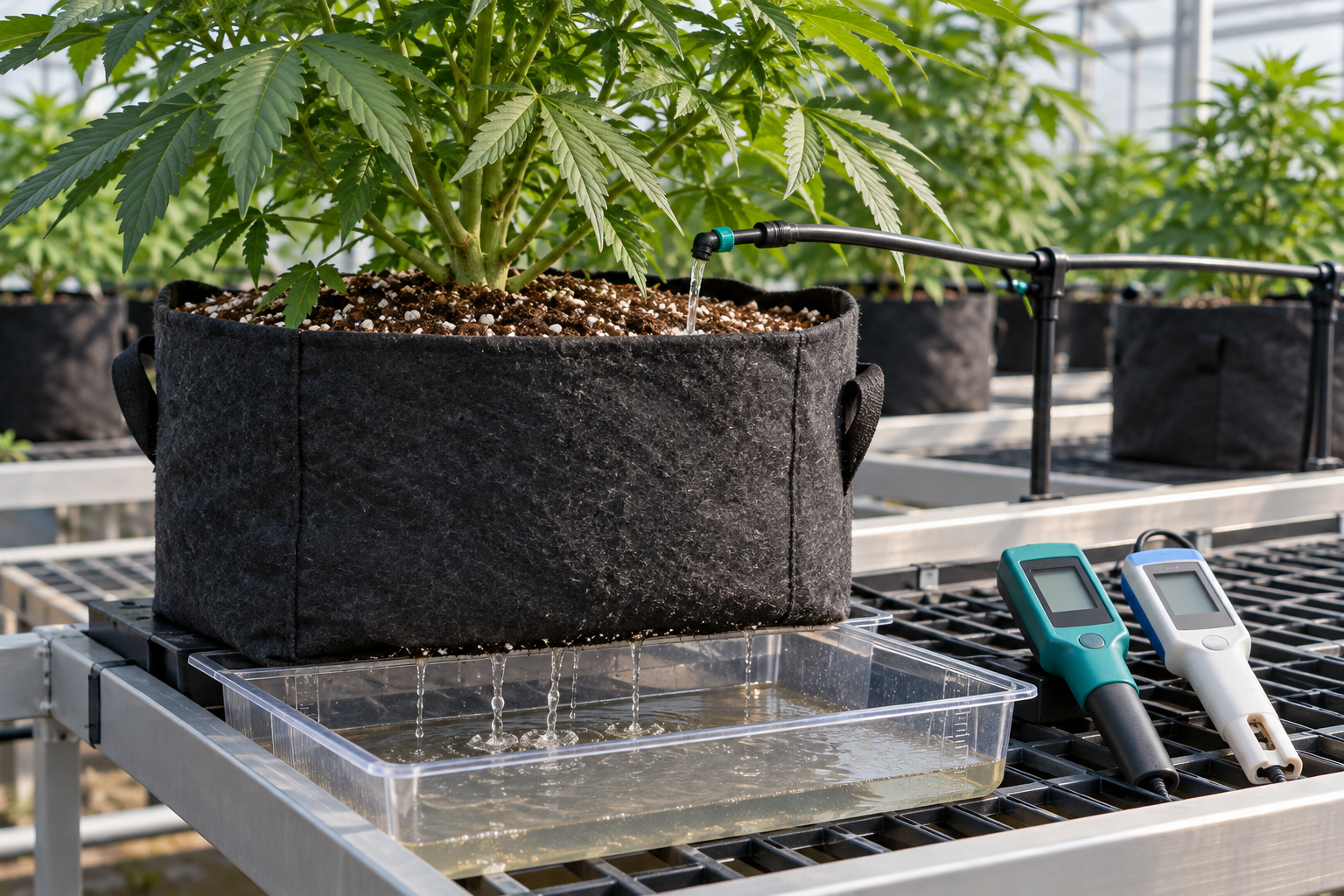
Cannabis Flushing and Corrective Leaching: Science, Myths, and When It Helps
The word flushing is often used for three different operations. A grower might stop fertilizing before harvest, rinse a salt-affected container with water, or replace a hydroponic reservoir. The same word hides different starting conditions, different goals, and different risks. Giving all three a fixed two-week schedule makes a root-zone decision look like a harvest ritual.
Direct answer: routine preharvest nutrient withdrawal has not been shown to reliably produce smoother or safer cannabis flower. In some tested systems, a limited period of nutrient withdrawal changed little while reducing fertilizer input; in others, longer restriction reduced harvested flower mass. Corrective leaching, by contrast, can reduce confirmed excess soluble salts in a draining root zone, but it should be triggered by sound measurements and stopped at a defined, method-specific target rather than by chasing clear runoff. Reservoir replacement is a third action with its own rules.
This guide explains whether and why an intervention is needed, how to separate the three practices, and how to check the result. For complete feeding design, see the Nutrients and Fertilizers Guide. For an indoor irrigation foundation that keeps watering and nutrient management connected, use Watering Indoor Cannabis. The present page does not duplicate those complete guides.
Decide Which Flushing Question You Are Actually Asking
Before doing anything to a plant, state the outcome you want. Is the goal to change flower flavor, reverse a measured increase in root-zone salinity, repair a drifting reservoir, or correct a single leaf symptom? Those questions do not share a universal procedure. The first decision is whether a physical problem exists at all. A container that drains normally, receives suitable water, and shows stable method-specific EC does not need a large-volume rinse merely because harvest is approaching.
Flushing Cannabis Before Harvest: What the Evidence Says
In the preharvest sense, flushing usually means withholding fertilizer during the final portion of flowering and irrigating with water instead. Some growers also saturate the medium until large drainage volumes appear, but nutrient withdrawal and high-volume leaching are not identical. A plant can receive plain water without enough drainage to carry salts out; a grower can correct salts earlier in the crop while supplying a suitably balanced solution afterward. Separate the operation from the intended benefit.
The quality claim is usually that stopping fertilizer will remove nutrients from the flowers and improve flavor, smoke smoothness, combustion, or ash color. Roots take up dissolved ions and plants incorporate them into cells and metabolites; watering the medium is not a direct wash of harvested tissue. The available studies test portions of this hypothesis, but none establishes a universal sensory or inhalation-safety benefit. If a grower wants to reduce fertilizer expenditure at the end of a proven production system, that is an input-economics decision rather than evidence that a flower-cleaning step is required.
Should Cannabis Be Flushed Before Harvest?
A calendar-based flush is not a mandatory finishing stage. A short, carefully evaluated nutrient-withdrawal period may be feasible in a documented system, but the risk of lost mass depends on when it begins, how complete the deprivation is, and the cultivar. If the crop is still visibly accumulating healthy flower biomass or has a compromised root zone, imposing a drastic change solely because a calendar says so adds uncertainty. Maintain an evidence-based baseline unless there is a specific input-saving protocol or a diagnosed chemical issue.
Cannabis Flushing: Science, Myths, and Corrective Leaching
For a confirmed root-zone salt problem, the word leaching describes soluble constituents moving with percolating water out of a draining container or below the relevant soil profile. The goal is to lower an elevated and correctly measured salt burden while preserving oxygen, structure, and adequate nutrition. In hydroponics, draining and rebuilding an imbalanced reservoir changes solution composition directly; it does not leach the roots in the same way as a container rinse. These distinctions determine which measurement and follow-up are valid.
| What the grower means | Actual goal | Evidence required | First responsible action |
|---|---|---|---|
| Preharvest nutrient withdrawal | Test an input-saving or production hypothesis | Cultivar/system protocol, ripeness and balanced comparison | Avoid claiming mandatory taste improvement; record a reason for any change |
| Corrective leaching | Lower verified excessive root-zone soluble salts | Standardized media EC, water analysis, drainage and plant condition | Correct input error; leach only when the medium can drain and target is defined |
| Reservoir replacement | Resolve drifting or contaminated nutrient solution | Reservoir trend, ion data when needed, oxygen, temperature and sanitation | Prepare a suitable replacement solution and maintain root function |
| Normal irrigation with some drainage | Replace water and manage ongoing salt balance | Root-zone demand, distribution, EC trend and system design | Continue an appropriate irrigation schedule without a special ritual |
Definition: Four related terms, four different observations
Nutrient withdrawal changes the feed supplied to roots. Leaching transfers soluble material out of a root zone with moving water. Drainage or runoff is the water that exits or escapes; its presence alone does not quantify the nutrient lost. Reservoir exchange replaces a recirculating solution. Never substitute one term for another when recording an experiment.
What Nutrient Withdrawal and Salt Leaching Actually Change
Plant mineral nutrients travel into roots predominantly in dissolved form. Water delivery, oxygen, temperature, root integrity, pH, and the medium determine how much reaches the plant. The root-zone solution and the flower are not one container of interchangeable salts: an ion entering tissue participates in cellular chemistry, storage, transport, and new growth. Taking fertilizer out of irrigation changes future supply; it does not pour already incorporated nitrogen, phosphorus, or potassium out through the roots.
“Can I flush even though the plant looks healthy?”
Question sent by: telluride_terp_lab, via email.
You can choose to test an end-of-cycle nutrient-withdrawal strategy in a comparable, lawful crop, but first define the outcome and preserve a matched no-flush comparison. There is no evidence-based obligation to flood an otherwise healthy container.
Preharvest deprivation changes future input, not past uptake
When feeding stops, freely dissolved nutrients may decline as plants absorb them or drainage removes them. Exchange surfaces, organic mineralization, fertilizer granules, and the existing reservoir may still contribute nutrients. Some elements can be relocated among organs as the plant develops or experiences shortage. Older leaves can yellow more rapidly under restricted feeding without proving that the flowers became chemically cleaner or more pleasant to consume. Flower tissue testing, not leaf color, addresses a flower-composition claim.
The degree of withdrawal is not binary. A complete water-only treatment differs from removing nitrogen but maintaining other elements. Replacing a reservoir with a low-strength, fully balanced solution differs from removing all nutrients. The results of one regime cannot justify every other regime. In a five-cultivar study using a controlled perlite system, nutrient-free irrigation near harvest produced mostly limited responses in biomass and the measured cannabinoid and terpenoid endpoints, though individual cultivar effects occurred. The authors interpreted the input saving favorably within that experimental context. It was not an assessment of smoke smoothness or universal field performance.
Corrective leaching moves salts, but only where water actually travels
A porous, drained medium allows water to percolate, carrying a portion of dissolved salts with it. Salts concentrated at a drying surface or in poorly wetted pockets may behave differently from salts in the main flow path. Water running down a gap beside the pot wall can create drainage before the central root ball wets. Conversely, a heavy, compact medium may remain saturated after a prolonged rinse. An apparently impressive amount of runoff may therefore remove some salts while leaving the original distribution problem unsolved.
A correctable high-EC event is an interaction among incoming fertilizer, source-water ions, evaporation, crop uptake, drainage and substrate exchange. Nitrate and chloride may be mobile in many systems, while some cations interact with exchange sites and phosphorus may precipitate or bind depending on chemistry. A single rinse need not lower every element proportionally. Most importantly, leaching cannot fix the source of accumulation if the same concentrated input or uneven irrigation resumes the next day.
Why EC falls without proving that nutrition is balanced
Electrical conductivity reflects the collective effect of dissolved ions in a measured extract or solution. A lower reading after drainage indicates less conductivity in that sample, not necessarily less sodium, improved calcium balance or resolution of a specific toxic element. Dilution can reduce conductivity temporarily, and a different sampling procedure can produce a different number from the same container. Pair root-zone EC with source-water chemistry, input history, symptoms, and specific-ion analysis when the cause matters.
A water-only intervention also changes osmotic conditions, pH behavior, nutrient ratios, and moisture status. Very low-mineral water is not automatically the best rescue fluid for every coco, organic soil, hydroponic solution or severely stressed plant. Use water or a compatible corrective solution based on the medium and a validated plan; consider laboratory or professional advice for a complicated imbalance.
Remember: A reduced EC reading proves that the collected sample contains fewer conducting ions. It does not prove that the flower has been purified, that a particular ion is safe, or that damaged roots have recovered.
Why the Answer Changes With Medium, Water, and Plant Condition
No fixed flush volume or duration transfers cleanly among a deep mineral-soil bed, a coco pot, a peat container, a perlite drip system and a recirculating reservoir. They differ in storage, drainage, microbial cycling, cation exchange, replenishment speed and aeration. The plant also changes its water use as light, temperature, root health and flower development change. Inspect the system before selecting a response, rather than picking the biggest number from another grower’s feed chart.
Container geometry, medium and drainage
A tall, coarse container can lose free water quickly under the right conditions, while a shallow or dense container may retain a saturated bottom zone after the same apparent application. Coco has meaningful exchange behavior and must not be described as chemically inert. Peat mixtures vary in lime, charge and structure. Living soil can include slow-release fertility and an active food web, but neither organic inputs nor mineral fertilizer are automatically safe from salinity. A drainage layer of stones does not cure a poorly structured root zone. Test whether the existing container can actually release added water before designing a corrective rinse.
In native ground, high salts can be confined to layers, influenced by shallow groundwater, or coupled to sodicity that damages soil structure. Simple container flushing advice does not address those conditions. Request appropriate soil testing and site-specific reclamation advice before adding large water volumes to a saline or poorly infiltrating field. Where saltwater intrusion or other contamination is possible, a source-water test and local expertise are necessary.
Source water and accumulated ions
Record water source and any recent change, including reverse-osmosis blending, well supply, municipal changes and storage tanks. Measure its EC and consult an analysis for alkalinity, sodium, chloride and relevant nutrients where warranted. A high-EC source may continually load the medium with ions that fertilizer labels never mention. Repeatedly rinsing with that same water is not a logical way to remove the source of the problem. High alkalinity can also drive root-zone pH over time even if the irrigation water pH appears acceptable.
Stage, cultivar and time remaining
A plant approaching its actual harvest maturity may have a different marginal nutrient demand from a flower still gaining dry matter, but no universal day count defines that transition. Genetics, environmental conditions and previous nutrient status change the stakes of withdrawal. The five-cultivar 2024 trial reported mostly limited yield and chemical responses. A separate 2025 experiment on two high-CBD cultivars found declining flower dry mass as flushing duration increased, with a cultivar-specific CBD concentration response that did not offset the decline in CBD yield. These are different experiments, not contradictory observations that can be averaged into a single universal rule.
A 2024 graduate thesis examining different late nutrient-withdrawal methods found that withholding nitrogen alone and withdrawing the complete supply did not have the same yield effect. In its tested conditions, flower nitrogen did not fall as leaves became depleted; water-only treatments reduced flower yield. This reinforces the need to define exactly what was removed and which endpoint matters. If the aim is to save inputs, calculate savings against potential dry-flower or total-cannabinoid losses in a comparable trial rather than presuming either outcome.
Drainage safety and environmental destination
Collect and manage drainage. Concentrated nutrient runoff can contain mobile nitrate, phosphorus or other ions that should not be routed into streams, storm drains or neighboring property. Local discharge, cultivation and wastewater rules vary, so do not treat a legal cultivation site as permission to dispose of concentrated leachate anywhere. When there is no safe capture or drainage path, the proposed high-volume rinse is not ready to perform.
Cultivation Warning
Warning: Do not rinse an oxygen-limited pot on sight
A heavy, persistently wet container with wilting foliage may have poor root oxygen, disease, cold roots or structural drainage trouble. Flooding it because the leaves look burned can intensify injury. Stabilize the physical problem and confirm the chemical diagnosis before considering controlled leaching.
A Repeatable Decision and Correction Procedure
The procedure below is designed to produce a documented decision, not a ritual. A real corrective plan requires a defined failure, a compatible measurement and a stop condition. If a plant is collapsing, address immediately dangerous conditions such as lack of water, standing water or contaminated solution while keeping a record of what was observed; do not sacrifice a plant to complete an ideal experiment.
“My coco runoff EC is higher than the input. Is flushing automatically necessary?”
Question sent by: Kaylee Mercier, via reader Q&A form.
Not from that comparison alone. Standardize collection, irrigation volume, media moisture and measurement units. Look for a rising trend and root symptoms, then check source water and recent feed changes. First runoff after an unusually dry pot may not represent the whole active root zone.
Step 1: classify the reason for intervention
Write one sentence describing the issue: “method-specific container EC has risen over three comparable tests after feed concentration increased,” or “I want to assess whether an end-of-cycle nutrient change saves fertilizer without altering harvested quality.” These statements need different methods. If the only evidence is yellow leaves, poor flavor reported after an earlier harvest or a social-media rule about white ash, do not classify the issue as excessive root-zone salts yet.
Step 2: record the baseline before changing water or fertilizer
Record cultivar, crop stage, recent fertigation, amendment history, source water, irrigation volume, apparent drainage, container wetness at more than one depth, water use and recent environmental stress. Mark representative plants and photograph comparable leaves. Use a calibrated instrument with units recorded. For recurring systems, compare a healthy plant or zone receiving the same inputs. When the original problem is an unusual solution mix, retain the batch and mixing record for diagnosis rather than inventing a new correction from a symptom chart.
Step 3: choose a measurement matched to the medium
For peat and other container media, choose a defined laboratory extraction or a standardized PourThru procedure and interpret against that method. UMass Extension demonstrates that the same EC value can be categorized differently by saturated media extract, a 1:2 extraction or PourThru. Do not compare a random runoff sample against a saturated-extract reference range. For native soil, request regionally appropriate salinity, pH and relevant ion testing. For recirculating hydroponics, measure the solution and use an ion panel where EC cannot identify which nutrients accumulated or depleted.
Collect water and media samples at repeatable times. First and later drainage fractions can differ, and water content before sampling matters. A single spot-check can be a useful warning but rarely supports an aggressive intervention by itself. If test methods are unavailable, correct obvious input errors and improve physical drainage cautiously; do not invent a precise EC diagnosis.
Step 4: rule out non-salt look-alikes
Inspect moisture at depth, pot weight or water-use trend, emitter uniformity, root condition, temperature and recent spray history. Drought can concentrate a normally mixed feed. Persistent saturation can suppress uptake despite normal medium chemistry. A nutrient deficiency may be an inadequate input rather than excess salts. Sodium and chloride may require specific tests. If the cause cannot be distinguished, select the proper water, medium or tissue test rather than adding several correction products at once.
Step 5: choose the least disruptive supported action
If there is no confirmed problem: maintain an adequate feeding and irrigation plan. Do not force a flush. If an input was mistakenly concentrated but the root zone remains stable: correct the recipe and monitor a standardized media sample before escalating to a rinse. If salts are demonstrably excessive and drainage is functional: plan measured leaching with acceptable water or a medium-compatible correction solution, protecting roots from prolonged saturation. If a reservoir has drifted: use the reservoir-management procedure for your system rather than treating it as a soil pot. If poor drainage dominates: restore oxygen and improve the cause of waterlogging; adding water is not a salt diagnosis.
Step 6: conduct corrective leaching with a stop condition
Confirm where drainage will go, confirm the growing medium is not already saturated, and record the starting method-specific EC. Apply the planned fluid evenly, not as a single forceful pour down one wall. Where a professional protocol calls for staged leaching, collect and measure comparable drainage fractions, assess whether the central root zone is actually wetted, and stop according to the selected procedure rather than chasing zero EC. Avoid universally prescribed multiples of pot volume or flood times. UF/IFAS provides crop- and method-specific container guidance, which illustrates how leaching should be tied to measurement and drainage rather than copied into a cannabis-wide rule.
Do not continue just because each additional pass produces a lower number. A low final fraction can reflect the water you just added instead of an integrated soil state. A sustained reduction in a repeatable root-zone measurement and a return to normal water use are stronger checks. Capture effluent and avoid sending nutrient-rich water to drainage systems that cannot legally receive it.
Step 7: restore an appropriate program and document the cause
After correction, restore the nutrition and irrigation schedule that meets the crop and medium, rather than leaving roots in low-nutrient water indefinitely. Address the reason EC accumulated: feed concentration, irrigation coverage, water composition, extreme dry-back, root impairment or poor drainage. If different plants share a dosing system, verify delivery uniformity before treating only the worst pot as an isolated exception. Record the intervention as one variable in the log, with the reinspection point defined in advance.
| Diagnosis supported by evidence | Intervention | What to monitor | Stop or escalation condition |
|---|---|---|---|
| Stable root zone, normal growth, no excess EC | Maintain an adequate feed; avoid a ritual rinse | Normal water use and stage-appropriate growth | Only reassess if measured evidence or plant function changes |
| High standardized EC, adequate drainage, compatible water | Staged, measured corrective leaching under a suitable protocol | Comparable media EC, drainage behavior, moisture and symptoms | Stop at method-specific correction goal; stop earlier if saturation worsens |
| Strong source-water sodium or chloride | Water quality correction and ion-specific assessment | Water report and medium-specific ion measurements | Do not repeat leaching with unsuitable source water |
| Wet root ball, droop, blocked drainage | Restore physical root-zone conditions and diagnose roots | Moisture depth, drain function, water use, tissue progression | Avoid high-volume rinsing until oxygen/drainage issue is resolved |
| Recirculating reservoir imbalance | Defined solution replacement and system check | Reservoir EC/pH trends, specific ions when needed, root health | Restore balanced solution; investigate recurrence |
Field Advice: A successful corrective intervention ends when the root-zone problem is demonstrably improved, not when the drainage looks like tap water. Record the new stable baseline before changing any other variable.
Common Myths, Misleading Symptoms, and Failed Corrections
Flushing arguments often combine an appealing visual outcome with a mechanism that was never tested. Yellow fan leaves, white ash and low runoff EC are real observations, but they answer different questions. Another recurring mistake is selecting the most extreme published result while ignoring the cultivar, nutrient withdrawal type, duration or analytical endpoint. Separate the claim from the experiment before turning it into advice.
Do
- Follow calibrated target ranges.
Avoid
- Avoid changing multiple parameters simultaneously.
Myth: plain water washes fertilizer out of the bud
Minerals are essential components of living plant tissues, not loose powder waiting to be rinsed. A change in future root supply may alter tissue partitioning or concentration over time, and the extent can be cultivar-dependent. It does not literally rinse the flower from the outside or selectively extract undesirable salts while retaining desirable components. Controlled studies have reported different changes in some flower minerals, including reductions in N, P or K under prolonged regimes, but those changes are not equivalent to proof of safer smoke, cleaner ash or better flavor.
Myth: yellow leaves prove that flushing worked
Leaf yellowing can reflect nutrient redistribution, leaf senescence, deficient input, root damage, disease or other stress. A withdrawal treatment may accelerate yellowing without causing the intended change in flower composition. A controlled nutrient-deficiency study warned that normal late flowering senescence may be confused with fertilizer disorders. Labeling every pale canopy a successful finish conceals the possibility that the plant lost productive tissue while the flowers were still developing.
Myth: white ash proves that the crop was flushed correctly
Ash color depends on combustion and the material being burned. The commercial Cherry Diesel trial evaluated ash and sensory responses across several flushing durations and did not find a statistically clear flush-related benefit. That study was conducted in one cultivar and its company-funded trial report is not a substitute for a broad independent consumer-safety analysis. Neither white nor black ash is a test for pesticide residues, heavy metals, microbial contamination or inhalation safety. Those require appropriate analytical methods.
Myth: every experiment says exactly the same thing
The commercial Cherry Diesel experiment found no significant differences in its measured flower yield, THC, terpene, taste or ash endpoints across the tested periods. The five-cultivar 2024 peer-reviewed experiment found mostly small effects and considered input-saving attractive under its protocol. The 2024 graduate research distinguished nitrogen-only withdrawal from complete nutrient withdrawal and observed a yield penalty with the latter. The two-cultivar 2025 peer-reviewed study reported reduced flower mass with longer periods and genotype-dependent cannabinoid responses. These findings cannot be flattened into either “flushing always helps” or “flushing always hurts.” They do weaken any universal promise of better taste or a mandatory duration.
The studies also did not all measure the same endpoints. Flower cannabinoid percentage is a concentration, not total cannabinoid yield. Terpene content determined analytically is not an identical measure of human aroma perception. A smoking panel is not an inhalation-toxicology assessment. A decline in fertilizer purchase does not itself prove lower environmental impact if the practice generates nutrient-rich runoff.
Myth: a mysterious additive can digest dissolved fertilizer salts
Claims that generic enzymes or microbe blends digest and remove all unused mineral nutrients require product-specific evidence. Dissolved ions are not organic residues that become harmless through a universal enzyme reaction. A biological amendment may change nutrient cycling or organic matter breakdown in a particular medium, but that is not a substitute for identifying which ions are elevated and where they will go. Do not add a new product during a root-zone crisis merely because its label uses the word flush.
A dangerous shortcut: replacing a root diagnosis with more water
Tip burn and leaf necrosis can follow concentrated fertilizer, dry roots, excess heat, salt-sensitive ions, direct spray, root disease or limited oxygen. Prolonged saturation can produce the same wilt that a grower interprets as a need for more water. If a plant is wet and drooping, the first intervention is not multiple pot volumes of plain water. Document the physical conditions and follow the differential diagnosis in the Nutrient Basics and broader nutrient guide when more background is needed.
Cultivation Warning
Warning: Flushing does not replace contaminant testing
Never claim that a water-only finish removes heavy metals, pesticides, residual solvents, pathogens or toxins from harvested flower. Product safety requires validated crop-specific testing and compliant handling, not a water treatment at the root zone.
Verify Root-Zone Results Separately From Flower Quality
Verification needs the same distinction that started the article. A corrective-leaching outcome is a change in root-zone salt condition and plant function. A preharvest-flushing hypothesis is a controlled comparison of inputs, plant performance, harvested composition or consumer endpoints. A reservoir change is verified by subsequent solution stability and root response. Mixing these into one “worked” judgment makes it impossible to learn from the result.
“The ash was dark last time. Should I use extra water before harvest?”
Question sent by: Kaylee Kensington, via grow journal submission.
Not based on ash alone. That observation cannot isolate nutrition or establish safety. Keep harvest timing and postharvest handling consistent if comparing batches, and use appropriate testing for a real contaminant concern rather than equating ash color with product purity.
Root-zone verification after corrective leaching
At a comparable moisture and sampling state, repeat the same root-zone method. Record its EC and pH, the input values, water-use trend and how drainage behaves. If values do not improve or immediately climb again, reconsider water quality, fertilizer concentration, sampling bias, uneven distribution or an underlying damaged root system. Do not chase a target borrowed from a different medium or extraction method. University extension guidance shows why method consistency matters: the same numeric EC can represent very different interpretations under SME, 1:2 and PourThru.
Follow plant response using the pace of new injury, healthy new growth and restored water use. Old burned leaf tips and necrotic patches do not heal after the chemistry improves. A stable root zone with no fresh lesions can be a successful correction even when existing leaves still look unattractive. Conversely, a single low leachate reading without restored water use can conceal saturation or root injury.
How to run a fair preharvest comparison
Use the same cultivar or genetically matched material where feasible and comparable plant size, development, light, climate, medium, nutrition history and planned harvest maturity. Compare one documented withdrawal protocol against a well-managed, continuously fed baseline. Record exactly which nutrients were stopped, when, what replaced them, irrigation volume and runoff. Do not use a weak or heavily overfed control and then call the comparison proof that flushing works. Randomize location where possible and collect enough replicate plants to avoid mistaking a single plant difference for a treatment effect.
Harvest each group at a comparable maturity using a predefined method. Dry, trim, cure, store and sample both groups consistently. Compare usable dry flower mass, cannabinoid and terpene concentration, calculated total compound yield, fertilizer and water consumption, and any measured leachate losses. If using a sensory panel, blind the samples and recognize that preference cannot prove inhalation safety. An informal home side-by-side is educational but seldom supplies enough replication to make a universal claim.
Recognize when measurements disagree
A decrease in measured salt concentration and increased leaf yellowing may occur together without proof that the plant benefited. A higher cannabinoid percentage alongside lower flower mass may reduce or leave unchanged the amount of cannabinoid harvested. A lower fertilizer bill might be offset by lost product or expensive effluent handling. Write conclusions by endpoint and system, not by one favorable figure. Where the objective was corrective leaching, do not evaluate success by how white the future ash looks.
| Claim or intervention | Measure that actually tests it | What remains unanswered |
|---|---|---|
| Salt correction succeeded | Same-method root-zone EC trend, drainage, water use and symptom progression | Which ion changed without a specific assay; condition of every root pocket |
| Flushing made the flower chemically different | Matched laboratory flower mineral, cannabinoid or terpene assays | Flavor, inhalation safety or a universal cultivar response |
| Flushing improved harvest output | Usable dry flower and total compound yield under matched conditions | Whether an observed difference generalizes to other systems |
| Withdrawal saved resources | Actual fertilizer, water and effluent accounting per usable yield | Safety or quality benefit without additional testing |
| A reservoir swap fixed a problem | Reservoir chemistry and stability, delivery, root health, growth trend | Whether the old issue came from source water, mixing or disease |
Pro Tip: Decide in advance what would count as a failed hypothesis. If the only conclusion you will accept is that flushing improves flavor, the test cannot teach you much.
The Flushing and Corrective-Leaching Decision Checklist
Use this final check whenever someone recommends a flush or a grower sees symptoms that appear to demand one. It should take you from a vague instruction to a documented, system-specific decision. When evidence is weak or drainage is unsafe, the appropriate result is to pause and obtain better information, not improvise a stronger intervention.
Standard Operating Verification Checklist
- State the objective: end-of-cycle nutrient withdrawal, confirmed salt correction, reservoir exchange, or normal watering.
- Write down plant stage, root-zone system, recent watering and fertilizer changes, and comparison plants.
- Check root moisture, drainage, source-water quality and any sign of damaged or oxygen-limited roots.
- If salinity is suspected, use a calibrated EC meter and a standardized method appropriate for that medium.
- Use an ion-specific water or laboratory test when sodium, chloride or one nutrient is the real question.
- Do not perform high-volume leaching unless the medium can drain and the collected water has a safe destination.
- Write an intervention plan with the selected fluid, measurements, stopping condition and next check.
- After correction, restore suitable nutrition and remove the actual cause of recurrence.
- For a preharvest experiment, compare equal maturity, usable dry yield, lab composition, costs and consistent postharvest handling.
- Never interpret yellow leaves, clear runoff or ash color as proof of flower purity or safety.
For general feeding decisions and nutrient availability, return to the Nutrients and Fertilizers Guide. For water delivery, wet-root risk and a separate discussion of corrective leaching, see Watering Indoor Cannabis. The question of whether nutrients themselves improve flower aroma belongs to Can Nutrients Improve Cannabis Flavor and Terpenes?. This page remains the decision resource for separating preharvest flushing claims from measured root-zone corrections.
A good flushing decision ends with a defensible outcome: no intervention was necessary, measured excess salts were corrected without impairing the roots, or a carefully compared nutrient-withdrawal protocol met a clearly defined production objective. None of those requires believing that water pulled fertilizer out of mature flowers. The objective, the measurement and the follow-up determine the answer.
Educational content. Follow applicable cultivation, irrigation, runoff and product-testing rules in your location.
Share this article
A quick overview of the topics covered in this article.
Follow us
Latest articles
November 10, 2026
November 10, 2026
November 10, 2026
November 10, 2026
