
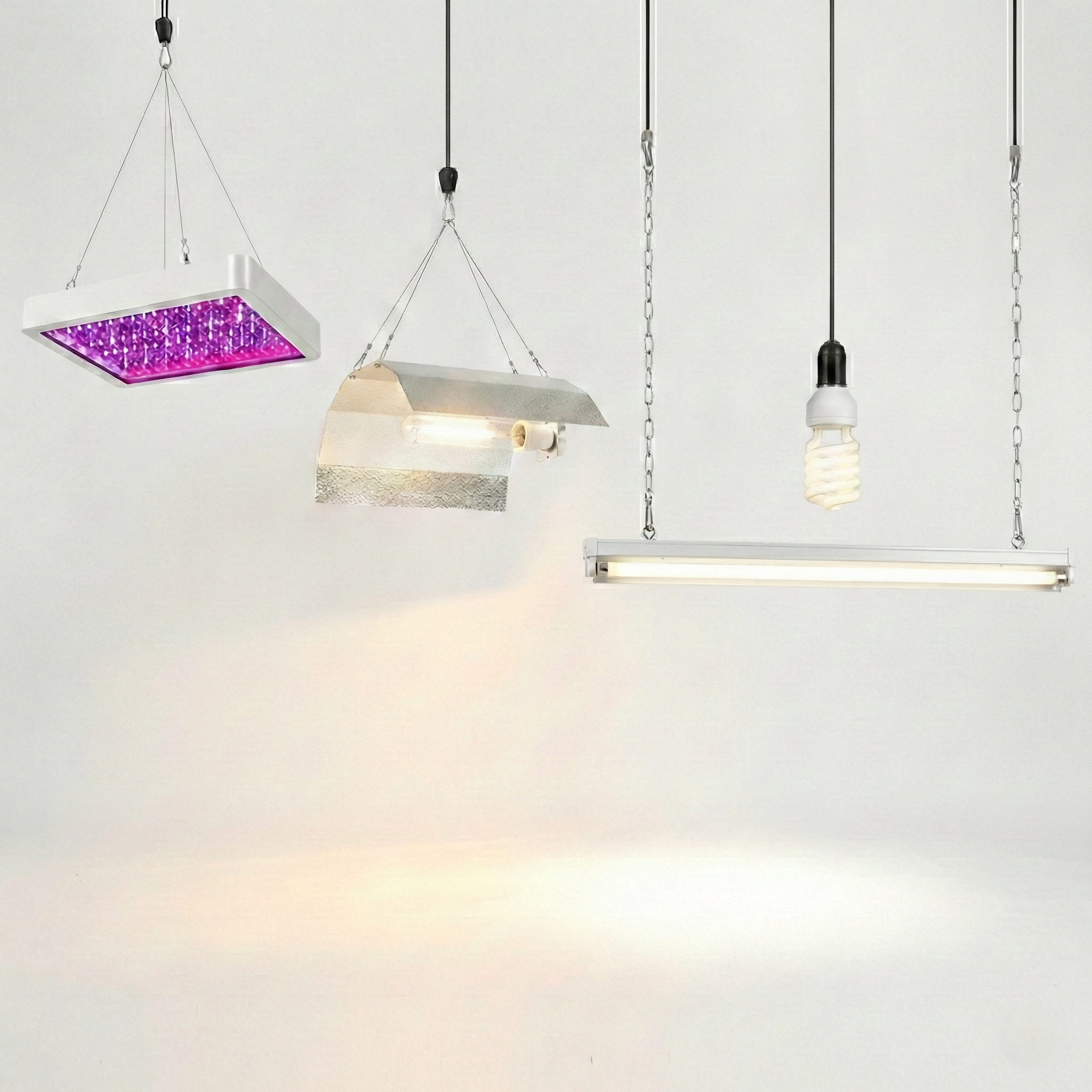
What Is the Best Grow Light for Cannabis?
Choosing a grow light can feel strangely harder than choosing a whole tent. Every product page has a large watt number, a dramatic spectrum chart, a coverage claim, and a promise that its light is the one your plants have been waiting for. The useful answer is calmer: the best grow light is the one that delivers enough even, efficient, controllable light across the canopy you can actually manage.
For most indoor cannabis gardens, that means a dimmable, full-spectrum LED bar fixture with a verified PPFD map, strong fixture efficacy, and a footprint that matches the tent. It is not automatically the highest-watt fixture, the most purple-looking fixture, or the one with the loudest “full spectrum” label. The light still has to work with the room, the canopy, the water schedule, temperature, humidity, and the way you inspect plants every day.
Let’s make the decision practical. We will separate the measurements that matter from marketing shortcuts, compare LED, HPS, fluorescent, and compact setups, then build a sensible light choice around your own growing space. The goal is not to chase a theoretical perfect lamp. It is to build a stable environment that can produce healthy, expressive flowers without turning the room into a heat-management project.
Use this guide only for lawful cultivation, with the property owner’s permission. Local rules may govern plant numbers, electrical work, visibility, odor, ventilation, and alterations to a property. When wiring, circuit capacity, fire protection, or structural work goes beyond your competence, bring in a qualified professional.
Master Advice: Buy light for the productive canopy, not for the empty floor area printed on the tent box. A smaller, evenly lit canopy that you can water, inspect, and ventilate well is more useful than a crowded space with bright corners and weak edges.
Short Answer: What Is the Best Grow Light for Cannabis?
A high-quality white or broad full-spectrum LED fixture with a separate dimmer is the best all-around choice for most indoor cannabis growers. Look for a true horticultural fixture rather than a generic shop light: it should publish its power draw, usable coverage, PPFD map, spectrum, warranty, thermal design, and fixture efficacy in micromoles per joule (umol/J).
The reason is simple. Modern LEDs can deliver useful plant photons efficiently, spread them more evenly than a single intense point source, run with less radiant heat than HPS, and let you lower intensity while plants are small. Research on cannabis has consistently shown that light quantity, canopy distribution, and fixture efficacy matter at least as much as fine spectrum tuning. In controlled comparisons, higher light intensity increased flower yield within the tested range, while the extra value of ultraviolet additions was not established for yield or cannabinoid content. That makes a stable primary light a better first investment than a collection of specialty add-ons.
PPFD is the density of photosynthetic photons reaching a square meter of canopy each second.
It is measured in micromoles per square meter per second (umol/m2/s). PPFD tells us far more about plant-usable light at canopy level than a fixture’s advertised wattage alone.
Start With the Canopy, Then Choose the Fixture
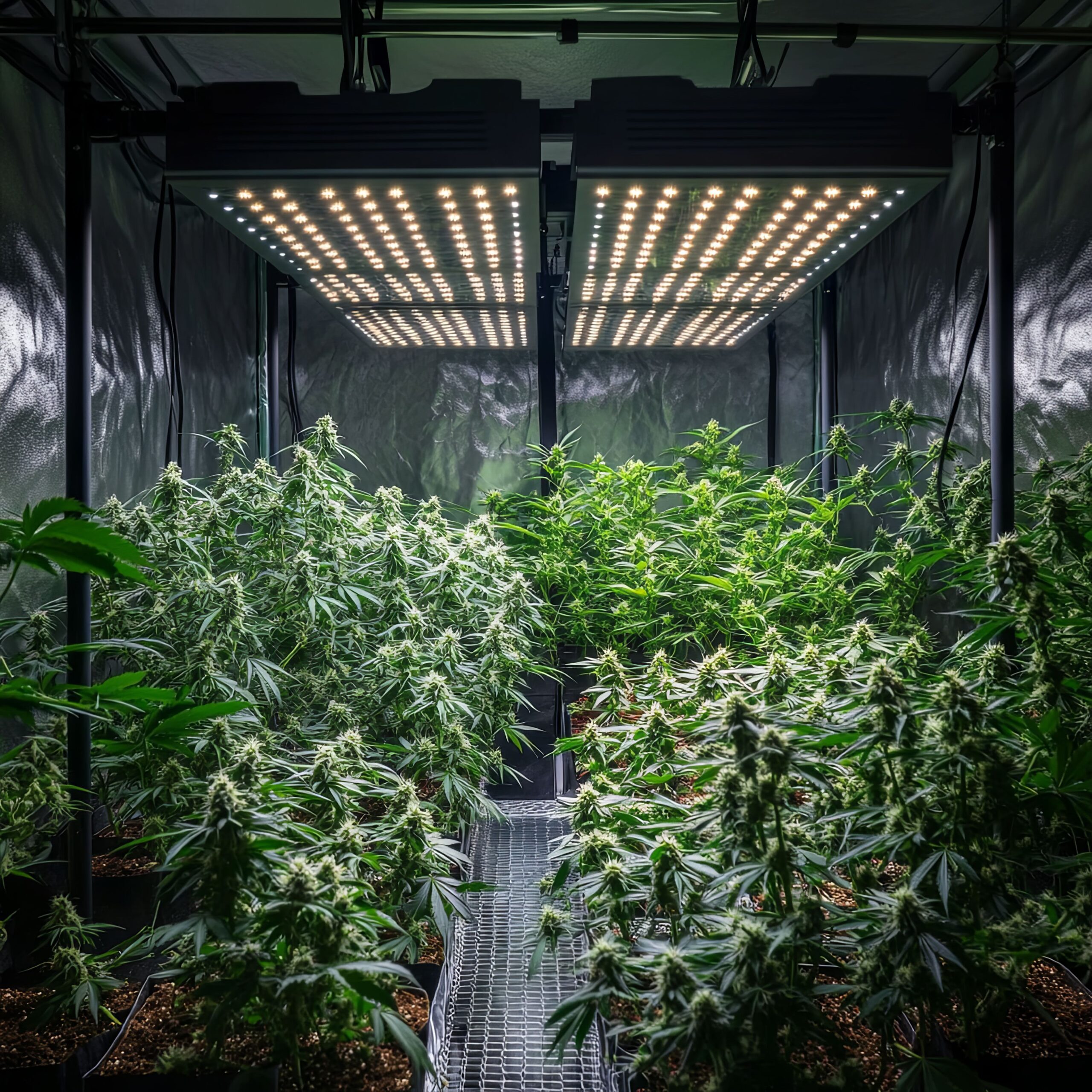
Before comparing lights, write down the real canopy dimensions. This is not necessarily the tent floor. You need room for containers, drainage, a fan, the door, cables, ducting, and your own hands. A tent may be 4 by 4 feet, but a practical canopy can be smaller once the whole working system is in place.
Next, decide whether you want a modest single-layer garden or a fully filled flowering canopy. A light that is appropriate at a lower dimmer setting for early growth may become the main fixture later. That flexibility is a major reason dimming matters. It lets the same fixture follow plant size instead of forcing you to hang a powerful light too high, or to run it hard over a small plant.
| Space | Practical lighting goal | What to prioritize | Common mistake |
|---|---|---|---|
| Small cabinet or micro space | Gentle, controllable coverage over a modest plant footprint | Dimming, low heat, safe hanging clearance, quiet airflow | Using a powerful board too close because the cabinet has little height |
| 2 by 2 foot tent | Even center-to-edge coverage for one small canopy | True 2 by 2 flower map, dimmer, external driver if heat is tight | Buying by watts without checking the map at canopy height |
| 3 by 3 foot tent | Uniform square footprint with room to raise and lower intensity | Broad fixture layout, quality driver, good passive cooling | Using a narrow light that creates a bright hotspot and weak corners |
| 4 by 4 foot tent | Even flowering coverage across a larger, accessible canopy | Bar-style fixture, tested PPFD map, efficient heat management | Assuming a single high-power point source covers every edge equally |
| Long rectangular tent | Consistent light along the full bed or row | Multiple fixtures or modular bars, separate zones if possible | Trying to stretch one square fixture across a long rectangle |
Tip: A coverage claim is only meaningful when it includes a hanging height and a PPFD map. Ask where the corners land, not only what the center peak reaches.
The Measurements That Matter More Than Wattage
PPF: total photons leaving the fixture
Photosynthetic photon flux (PPF) is the total amount of plant-usable light the fixture emits per second. It is useful when comparing similar fixtures, but it does not show where those photons land. A high PPF light with a poor optical layout can still create uneven growth inside a tent.
PPFD: photons reaching the canopy
PPFD is the working number inside the tent. It changes with hanging height, fixture shape, dimmer level, wall reflection, canopy height, and the meter position. A manufacturer map is a good beginning; measurements in your own room are better. Take readings at several points across the canopy rather than measuring the brightest center and calling the job done.
Fixture efficacy: useful photons per unit of electricity
Fixture efficacy is expressed as umol/J. Higher numbers mean the fixture produces more photosynthetic photons for the electricity it uses. It does not guarantee an ideal garden, but it is one of the cleanest ways to compare electricity efficiency when products are built for the same purpose. Current horticultural LEDs commonly exceed 2.5 umol/J; a brand that will not publish the measurement deserves extra scrutiny.
DLI: the total light delivered each day
Daily light integral (DLI) combines PPFD and hours of light. This matters because a modest PPFD over a long vegetative schedule can add up, while the same PPFD during a shorter flowering schedule delivers less total light. You do not need to calculate DLI every morning, but it is useful when comparing lighting schedules or diagnosing why a healthy plant is not responding to a change in intensity.
“My light says 600 watts. Does that mean it is enough for a 4 by 4 tent?”
Question sent by: Marcus Bell, via e-mail.
Not by itself. Actual wall draw, fixture efficacy, bar layout, hanging height, and the PPFD map determine how much usable light reaches the plants. Two fixtures with the same wattage can deliver different photon output and very different edge coverage. Start with the flower PPFD map for the exact footprint, then consider whether the room can manage the heat and electrical load at that setting.
How Much Light Does Cannabis Need?
Cannabis does not need maximum intensity from the first day. Young plants have a small leaf area, limited roots, and a short vertical stack. They respond better to a controlled start than to being placed under a full-power flowering fixture because the dimmer happens to be available.
As the canopy establishes, intensity can rise gradually. The exact target depends on cultivar, plant health, CO2 level, temperature, humidity, water availability, and the accuracy of the measurement. Treat the ranges below as practical starting points, then let leaf posture, growth rate, water use, and canopy readings decide whether to hold, raise, or reduce the setting.
| Plant stage | Starting PPFD range | What to watch | Next move |
|---|---|---|---|
| Seedling or fresh clone | 100 to 300 umol/m2/s | Leaf posture, rooting, slow water use, heat at leaf level | Increase only after roots and new growth are clearly established |
| Vegetative growth | 300 to 600 umol/m2/s | Even branching, normal internodes, stable irrigation demand | Raise gradually as the canopy fills and the environment keeps pace |
| Early flower | 500 to 800 umol/m2/s | Stretch management, even coverage, healthy top leaves | Prioritize uniformity before chasing a higher peak value |
| Established flower | 700 to 1,000 umol/m2/s | Canopy temperature, drinking rate, leaf stress, flower health | Only increase when the complete environment supports the demand |
Important: More PPFD is not a free upgrade. Stronger light increases demand for water movement, root oxygen, temperature control, nutrient balance, and airflow. If one of those systems is lagging, additional intensity can expose the weak link rather than improve quality.
LED vs. HPS vs. Fluorescent: Which Technology Makes Sense?
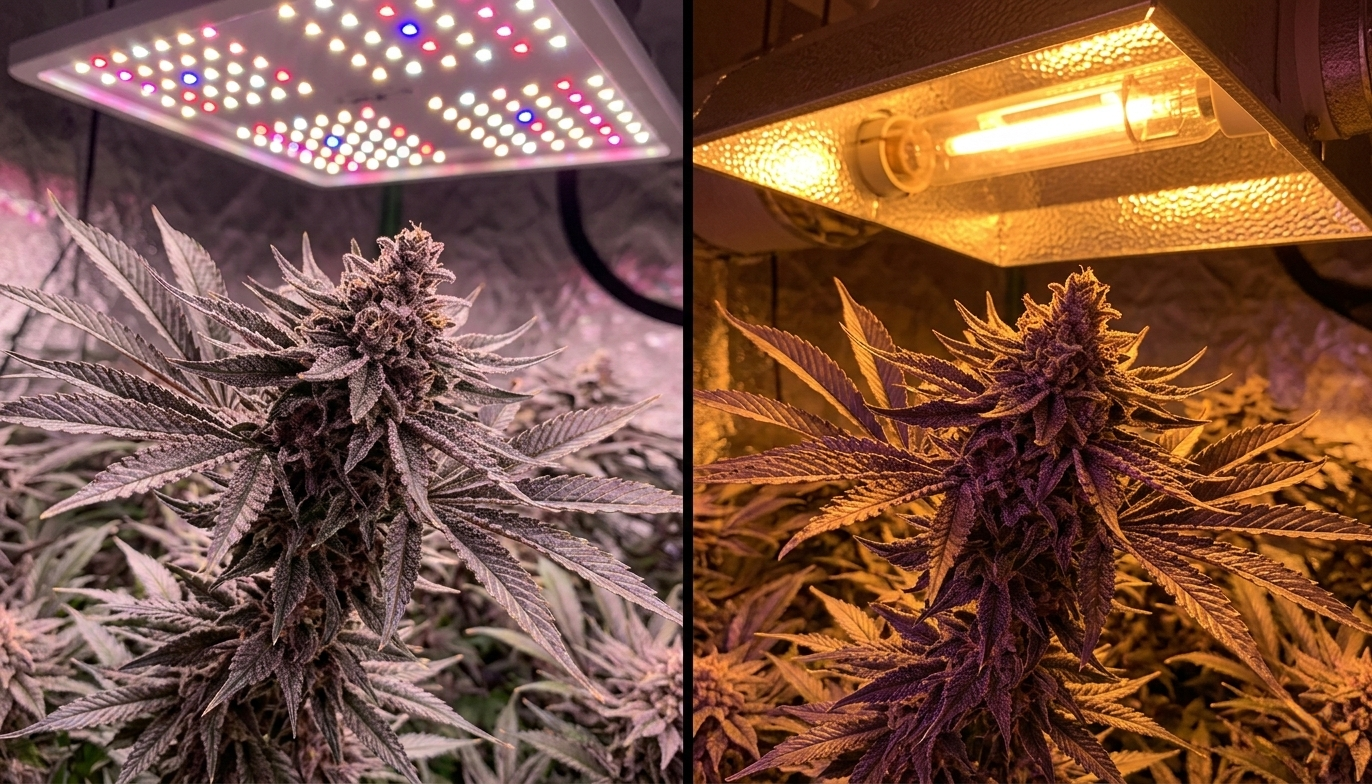
HPS can still grow cannabis, and a well-managed HPS room is not automatically inferior. Its tradeoffs are heat, bulb replacement, less flexible dimming, and a strong central intensity pattern. LEDs now make more sense for most home and small-scale rooms because they are efficient, controllable, and easier to spread over a square canopy. They also make it easier to keep the driver outside a small tent when heat is a constraint.
Fluorescent and low-output shop lights are useful for clones, seedlings, and houseplants, but they are rarely the best primary flowering light for a meaningful cannabis canopy. Compact “blurple” fixtures can technically grow plants, yet their spectrum marketing often hides weak output, poor coverage, noisy cooling, and low efficiency. A bright white or broad-spectrum fixture makes inspection easier, which has real value when you are looking for stress, pests, or flower problems.
Avoid: Do not choose a fixture because it includes a small UV switch, an oversized wattage sticker, or a colored spectrum image. Those details do not replace verified photon output, uniformity, thermal design, and a credible warranty.
Does Spectrum Matter? Yes, But Not in the Way Most Marketing Suggests
Spectrum influences plant form and can affect secondary metabolites, but it is not a replacement for enough usable light. A broad white LED with some red content is a strong all-purpose choice because it provides a balanced visual environment and supports practical inspection. Published cannabis work has found that the cost and photon efficacy of a fixture can be more important for return on electricity than small spectrum differences at high light levels.
Blue light can influence compactness and leaf behavior. Red light is highly useful for photosynthesis. Far-red can influence morphology and flowering responses, but it deserves a deliberate design rather than a reflex purchase. Too much far-red relative to the rest of the fixture can encourage stretch in a space where height is already limited. Green wavelengths are not wasted; they can penetrate deeper into a canopy and make the room much easier to read with your own eyes.
UV is the easiest category to oversell. It can add complexity and introduces genuine eye and skin safety concerns. Current cannabis research does not make UV a universal quality upgrade. Build the primary lighting, environmental control, and canopy distribution first. Specialty spectrum should be a later experiment with a clear reason, measured exposure, and proper protection.
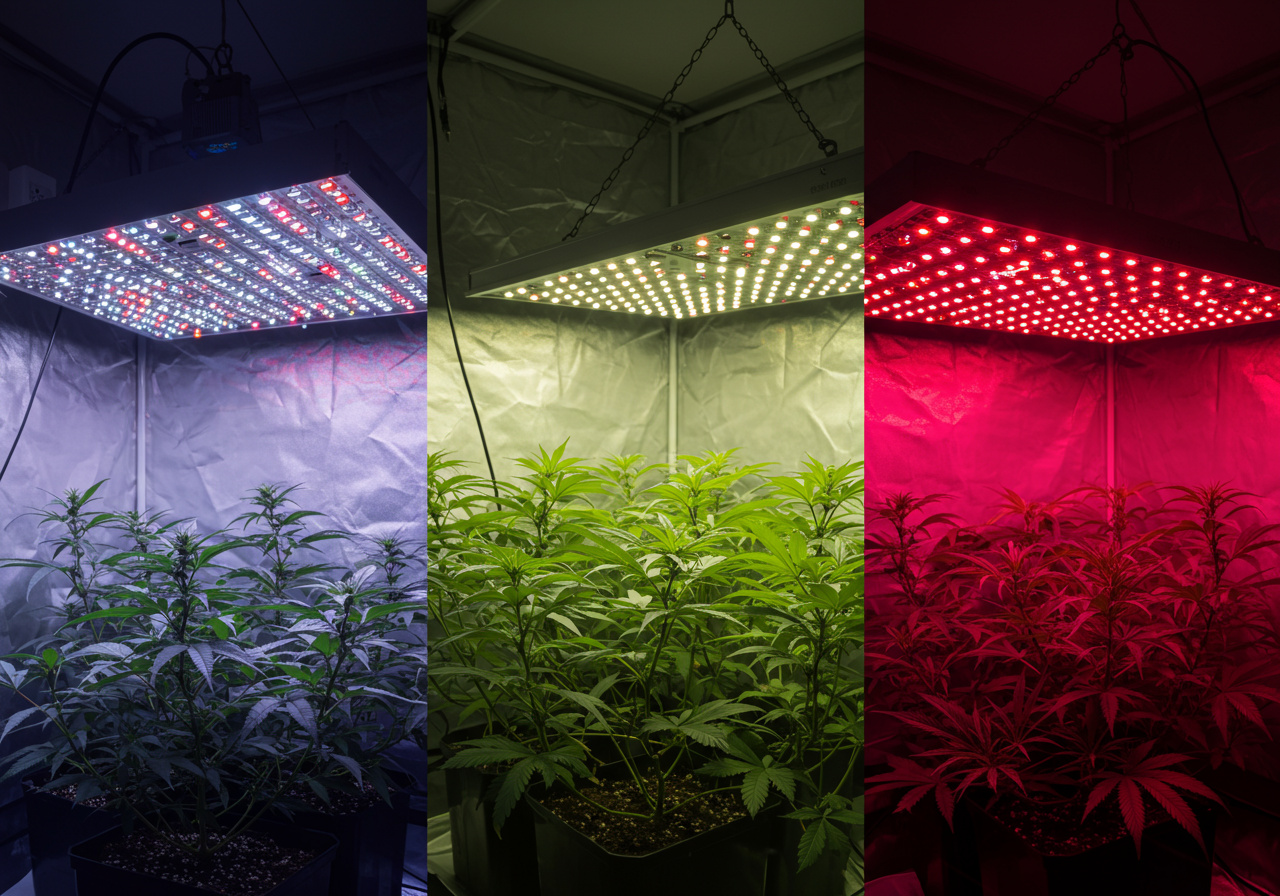
“Will a purple light make my buds more potent than a white LED?”
Question sent by: Natasha Grant, via Facebook page.
There is no reliable shortcut from a purple-looking fixture to better flower quality. What matters first is whether the light delivers adequate, even PPFD with a stable environment around it. White and broad-spectrum LEDs can grow excellent cannabis, while also letting you inspect leaf color, pests, deficiencies, and flower condition accurately. Compare fixture data and canopy measurements before judging the color of the diodes.
Why Even Coverage Beats a Hotspot
Uneven light creates uneven plants. The center can run hot and thirsty while the edges stay underlit, leaving you to manage one tent as if it contains several different environments. Bar-style fixtures help because they distribute diodes across the footprint. That does not mean every bar fixture is good, but the architecture often gives a more useful map in square tents.
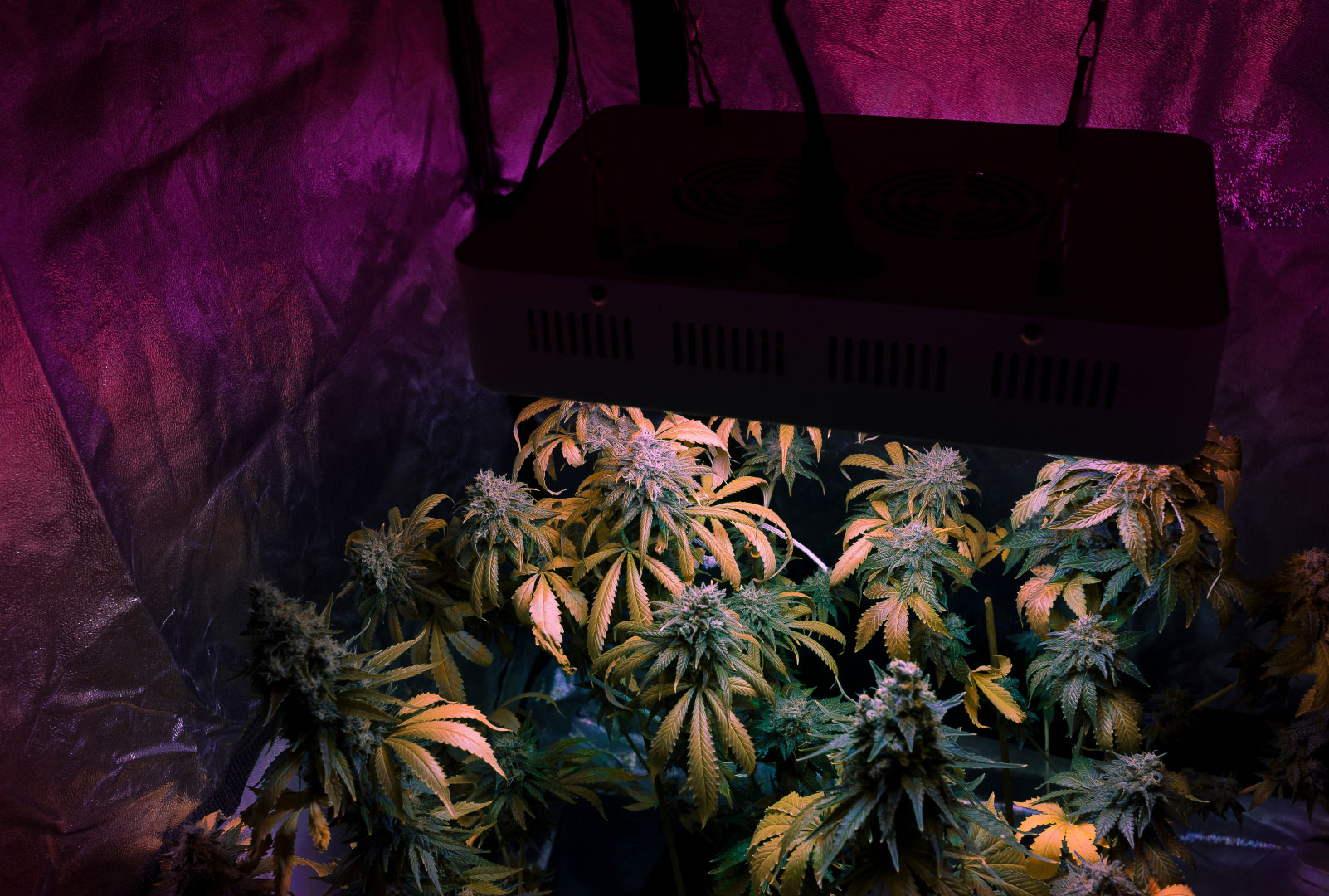
How to read a PPFD map without getting fooled by the center number
When we compare maps, start with the corners and the outside ring before looking at the highest number. A dramatic center peak can look impressive while the working canopy has weak edges. The more useful question is whether the middle and edges stay close enough that every top can be managed with the same sensible hanging height and dimmer setting.
Then picture the actual room: add a filter, a fan, containers, a trellis, and the height you lose to hanging hardware. A light that works beautifully in an empty test area may need a different height or a smaller productive canopy once the garden is in place.
Hanging Height and Dimming: Use Both Controls Together
Hanging height changes distribution. Dimming changes output. Use both. Raising a fixture can make the footprint broader but lowers PPFD; lowering it can raise center intensity and reduce the usable edge. Dimming lets you maintain a safer height while adjusting intensity in smaller steps.
Start with the manufacturer’s measured guidance, then verify at canopy level. If you do not own a quantum sensor, use the fixture map conservatively and watch the plants closely. Phone applications can be useful as rough trend tools with a suitable diffuser or calibration method, but they are not a substitute for a validated PAR meter when you need exact readings.
Pro Tip: Increase intensity in steps and keep a note beside the dimmer change: date, percent, hanging height, canopy reading, temperature, humidity, and plant response. That tiny log turns a vague lighting adjustment into something you can repeat or reverse.
Heat, Electricity, and Safety Belong in the Light Decision
A grow light is also an electrical heater. Nearly all energy used by the fixture eventually becomes heat in the room, even when the fixture is efficient. LEDs usually make heat easier to distribute and manage than HPS, but they do not eliminate the need for exhaust, circulation, and sensible electrical planning.
Check the actual wall draw, not only the model name. Confirm that outlets, extension leads, power strips, timers, and circuits are rated for the continuous load. Keep electrical connections elevated and away from runoff. Do not overload a power strip because the fixtures themselves run cool. Use equipment with a credible safety certification where available, make drip loops, and leave enough clearance around drivers and heat sinks.
How to Choose the Best LED Fixture: A Buying Checklist
- The fixture publishes actual power draw and a PPFD map for your target footprint.
- The map shows useful corners and average coverage, not only a center peak.
- The fixture is dimmable and can run comfortably through more than one plant stage.
- The stated efficacy is credible and comparable, ideally above 2.5 umol/J for a modern horticultural LED.
- The fixture shape matches the tent shape and leaves working room at the edges.
- The heat and driver placement fit the room’s ventilation plan.
- The fixture has a meaningful warranty and accessible support.
- The electrical load fits a known safe circuit and quality timer or controller.
- The hanging system, ratchets, cables, and clearances are rated and tidy.
- You can measure or at least systematically estimate canopy intensity after installation.
Common Grow-Light Mistakes and What to Do Instead
Buying by diode count or advertised watts
Those numbers can be manipulated or incomplete. Compare actual power draw, PPF, efficacy, PPFD distribution, and warranty.
Starting too intense
Young plants do not become mature faster because the dimmer begins at 100 percent. Establish roots and leaf area first, then raise intensity in measured steps.
Chasing spectrum add-ons before fixing coverage
Far-red, UV, and supplemental bars can be interesting later. A uniform primary canopy is more valuable than a complicated spectrum with uneven PPFD.
Ignoring the outer canopy
Read corners, not only the brightest point. If the edges are too weak, reduce the intended canopy size, change the fixture layout, or add a properly matched second fixture.
“My upper leaves are tacoing under LED. Should I feed more?”
Question sent by: Tyler McNeil, via e-mail.
Not as the first move. Upward leaf edges can reflect excessive light, heat, dry air, root-zone stress, wind, or several conditions together. Check canopy PPFD, fixture height, leaf temperature, room temperature, humidity, fan direction, pot moisture, and EC before changing nutrition. Lower intensity or raise the fixture if the light is clearly excessive, then give the plant time to show whether the correction worked.
A Practical Recommendation for a First Serious Light
Choose a dimmable, broad full-spectrum LED designed for the exact flowering footprint you intend to run. Favor a bar-style layout in a square tent, a published PPFD map with sensible corner values, a quality driver, and enough efficiency that the fixture can deliver the needed intensity without creating an unnecessary electrical or heat burden.
Set it up at a conservative height. Begin below the fixture’s maximum output, level the canopy, and measure or map the light across the real working area. Then increase only when roots, irrigation, temperature, humidity, and growth rate support the next step. This approach is less dramatic than buying the most aggressive fixture on the page, but it gives you a garden you can actually read and improve.
Remember: A good grow light does not work alone. It gives a healthy canopy the energy to grow; water, roots, nutrients, air movement, and stable temperature decide whether the plant can use that energy well.
Frequently Asked Questions
Is LED better than HPS for cannabis?
For most home and tent growers, a quality LED is the more practical choice because it is efficient, dimmable, and easier to distribute across a canopy. HPS can still grow excellent plants, but usually brings more heat and less flexible control.
Do I need a 1,000-watt light to grow good cannabis?
No. A fixture should be selected for the canopy footprint and target PPFD, not for a round watt number. A smaller, well-matched fixture can outperform an oversized one that creates hot spots or overwhelms the room.
Can I use a regular LED bulb or shop light?
They can support seedlings or small supplemental tasks, but are usually too weak and uneven for a meaningful flowering canopy. A horticultural LED fixture gives more predictable coverage and controllable intensity.
Do I need UV to grow high-quality flowers?
No. UV is not a primary requirement, and current research does not support treating it as a universal potency or yield upgrade. Build the main lighting and environment first; treat UV as an advanced experiment with safety considerations.
How far should an LED be from cannabis plants?
There is no universal distance. Use the fixture’s measured guidance, dimmer level, PPFD map, canopy height, and plant response. The right distance is the one that delivers even intensity without excessive leaf stress or heat.
Selected Research Behind This Guide
The recommendations here are framed as starting points because cultivar response and room conditions vary. The following open research supports the central ideas around light intensity, fixture efficacy, spectrum, and ultraviolet supplementation:
- Cannabis lighting: decreasing blue photon fraction increases yield but efficacy is more important for cost-effective cannabinoid production
- Indoor grown cannabis yield increased proportionally with light intensity, but ultraviolet radiation did not affect yield or cannabinoid content
- Influence of light spectra on the production of cannabinoids
- An update on plant photobiology and implications for cannabis production
Share this article
A quick overview of the topics covered in this article.
Follow us
Latest articles
October 27, 2026
October 27, 2026
October 27, 2026
October 27, 2026