White Rhino
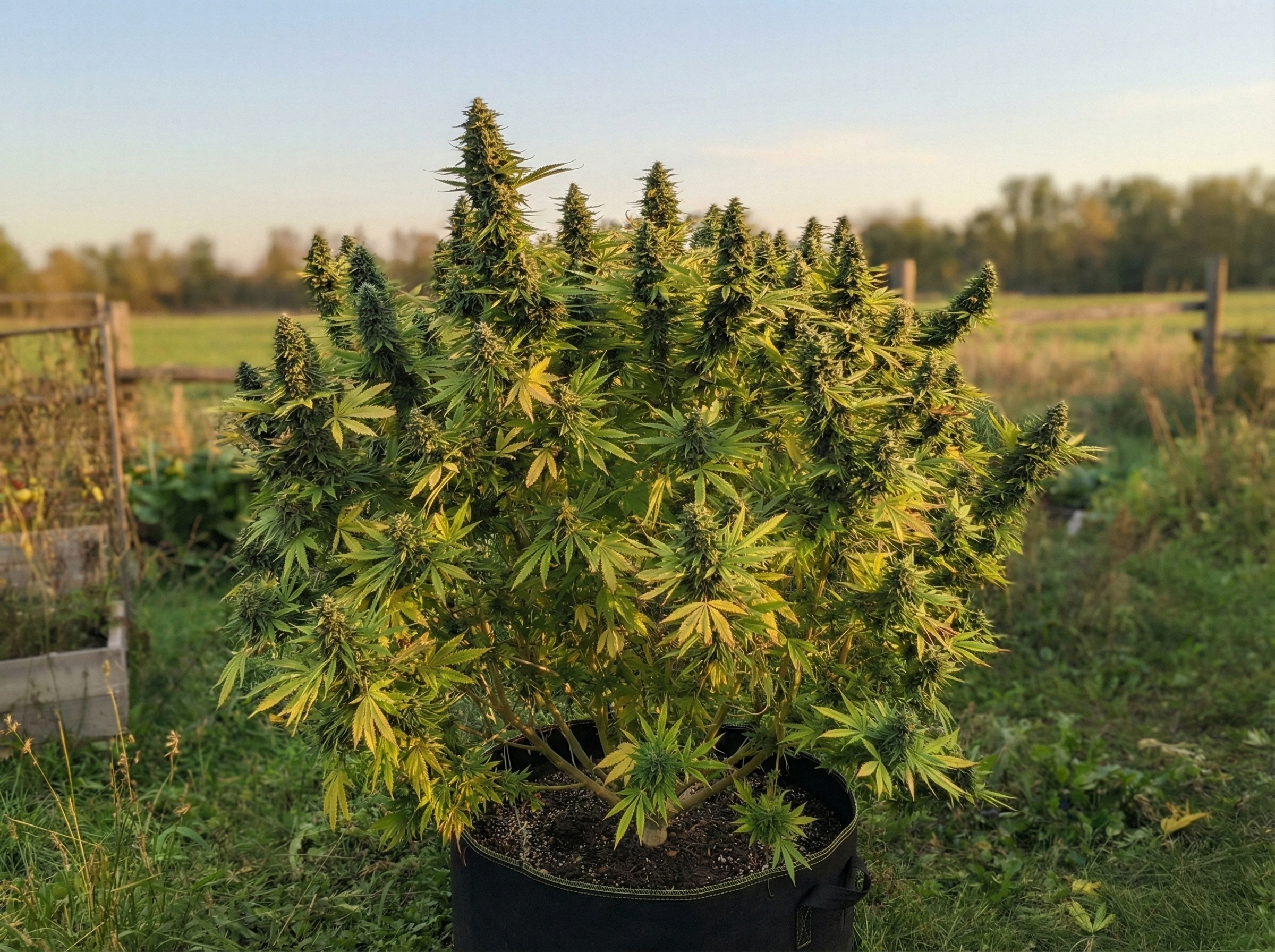
White Rhino is often described as a short, easy indica, but that description misses the part growers actually need to plan for. The plant can stay compact in vegetative growth, then push a noticeable first-three-week stretch before settling into dense, resin-heavy flowering. The result is a bush that is manageable in height yet capable of becoming extremely full inside.
Its genetic history is also less tidy than many modern summaries imply. Some records present White Rhino as White Widow crossed with a North American indica. Older descriptions connect it more broadly to Afghan, Brazilian, and South Indian ancestry within the same early White-family breeding work. The common horticultural outcome is more reliable than the paper trail: indica-dominant structure, strong branching, heavy resin, dense flowers, and a physically relaxing effect.
The main cultivation question is how to use White Rhino's vigor and flower density without allowing the bush to become a humid ball of leaves and touching colas. SOG and SCROG can both work, but they solve different problems. SOG uses the cultivar's compact central production. SCROG uses its branching. In either system, the grower must keep the interior open enough for air and inspection.
White Rhino also carries a reputation for strong feeding and high yield. That can encourage beginners to push nutrients too early. A vigorous plant with a healthy root system may indeed use substantial nutrition, but dark broad leaves can hide excess nitrogen, and a saturated root zone can make a supposedly hungry plant look deficient. More feed is only useful when the plant is actually using it.
The finished flower is usually sweet, woody, earthy, piney, and mildly skunky, with fruit or citrus appearing in some expressions. The buds can become very dense and heavily coated in trichomes, which creates excellent bag appeal and a real drying challenge. White Rhino is easy to grow adequately. Growing it well means controlling the inside of the bush and drying the dense flowers as carefully as they were grown.
Strain Features
| Feature | Details |
|---|---|
| Strain Type | Strongly indica-dominant hybrid |
| Genetic Profile | Historical lineage is disputed; commonly linked to White Widow-related material plus strong indica ancestry |
| THC | Commonly moderate to strong, often in the high teens to low 20% range |
| CBD | Usually low in most modern recreational examples |
| Dominant Terpenes | Myrcene, beta-caryophyllene, pinene, and secondary floral compounds are commonly reported |
| Flavor / Aroma | Sweet wood, earth, pine, skunk, herbs, mild fruit or citrus |
| Effect Character | Euphoric and calming at first, then physically heavy, appetite-stimulating, and potentially sedating |
| Flowering Time | Commonly about 8 to 10 weeks; many references cluster near 9 weeks |
| Outdoor Harvest | Often early October in suitable Northern Hemisphere climates |
| Grow Difficulty | Easy to moderate |
| Stretch | Moderate, often most obvious during the first three weeks of flower |
| Plant Architecture | Short to medium, bushy, strong branching, broad leaves |
| Bud Density | Dense to very dense |
| Resin Production | High |
| Training Compatibility | SOG, SCROG, topping, LST, and selective defoliation |
| Feeding Behavior | Vigorous plants can tolerate substantial feeding, but excess nitrogen is easy to hide in dark foliage |
| Mold Risk | Moderate in humid late flower because flowers and inner foliage can become very dense |
| Best Time of Use | Evening and nighttime for most users |
Genetic Lineage
White Rhino belongs to the early White-family era of cannabis breeding, but its exact parentage is described differently across historical sources. One common modern account presents White Widow crossed with a North American indica. Other older material describes Afghan, Brazilian, and South Indian components connected to the cultivar's development.
Rather than choosing one uncertain story as fact, the plant's recurring inherited traits are more useful. White Rhino generally expresses broad-leaf indica dominance, a squat-to-medium frame, strong lateral branching, heavy resin, and dense flowers. The effect is also consistently more physical and sedating than the balanced reputation associated with White Widow.
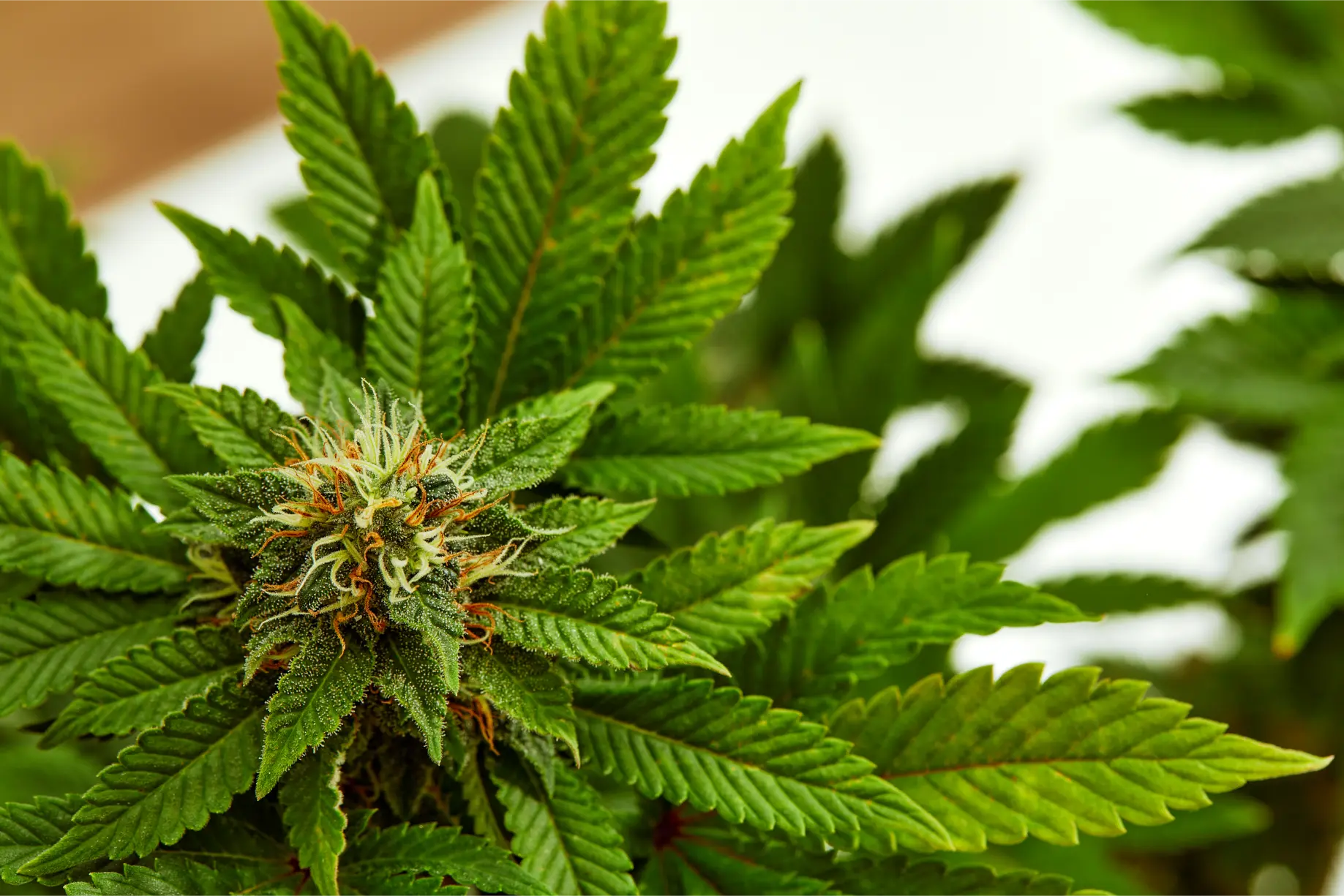
The White-family relationship helps explain the trichome coverage. Sugar leaves and calyx surfaces can become heavily coated, giving mature flowers a pale frosted appearance. The strong indica side explains why the plant can support dense floral mass without requiring a long tropical flowering cycle.
Phenotype variation still matters. Some plants remain very compact and round. Others stretch more during transition and build taller colas. Aroma can shift from woody-earthy and pine to sweeter fruit, citrus, or floral notes.
For keeper selection, the best White Rhino plant should combine dense resinous flower with enough branch spacing to remain manageable. The heaviest plant is not necessarily the best if its canopy becomes too closed to finish cleanly.
Effect Breakdown
White Rhino usually begins with a calm euphoric change rather than instant unconsciousness. Mood can lift, mental noise may soften, and the user may feel more comfortable before the physical heaviness becomes obvious.
The body phase is stronger than the mental phase for most users. Muscles relax, appetite often increases, and sitting still becomes increasingly attractive. At moderate doses, the experience can remain social. At larger doses, conversation and activity usually become less appealing.
Sedation builds progressively. The strain is often chosen in the evening because the transition from relaxation to sleepiness can be smooth rather than abrupt. Experienced users may stay awake and simply feel heavy, while lower-tolerance users can reach couch-lock quickly.
Dry mouth and dry eyes are common. Dizziness can occur when the dose is too high, especially because the body effect may continue increasing after the user already feels mentally calm.
White Rhino is not usually the best strain for complex daytime work. Its value is the opposite: it makes stillness easy. The effect profile fits food, films, quiet conversation, stretching, and sleep preparation better than productivity.
Dose also changes the balance between euphoria and sedation. A light amount can feel pleasantly calm and even somewhat social, while a larger dose emphasizes heaviness, appetite, and sleep. This makes user reports seem inconsistent when they are often describing different dose ranges.
Tolerance has a similar effect. Experienced users may describe White Rhino as relaxing but manageable. New users can experience the same flower as strongly narcotic. The strain's reputation should therefore guide caution, not predict one exact experience.
Flavor & Aroma Profile
White Rhino is not a one-note pine strain. The core is usually sweet wood and earth, with pine, herbs, and mild skunk around it. Some flowers add fruit, citrus, or a soft floral quality that becomes more noticeable after grinding.
Unbroken buds can smell dense and woody. Breaking them exposes more sweetness and resin. A good phenotype may move from pine and dry earth into almost honeyed fruit or citrus without becoming dessert-like.
On inhale, the profile is usually smooth and woody. Pine and mild sweetness arrive first. The exhale brings earth, spice, skunk, and a thicker hash-like finish. Resin-heavy examples can leave an oily sensation on the palate.
The main quality difference is cleanliness. Dense White Rhino flower that is harvested too green or dried too quickly can smoke harshly because the cultivar has enough earth and plant material to hide a poor finish. Well-cured flower separates wood, pine, sweetness, and skunk rather than blending them into rough smoke.
Large dense buds can also dry unevenly. The surface may feel crisp while the center near the stem retains significant moisture. That is a safety issue and a flavor issue. Uneven drying produces an inconsistent cure and increases the chance of internal microbial growth.
The best White Rhino is not necessarily the sweetest phenotype. It is the plant whose heavy resinous flowers remain distinct, smooth, and aromatic after the full cure.
Dominant Terpenes
| Terpene | Aroma Role | Cultivar Relevance | Scientific Caution |
|---|---|---|---|
| Myrcene | Earth, herbs, musk | Fits the heavy earthy base and is often reported in relaxing White-family strains | Does not independently cause sedation |
| Beta-caryophyllene | Pepper, dry spice, wood | Supports the woody-spicy finish and darker Kush-like character | CB2 receptor activity does not prove strain-specific medical effects |
| Pinene | Pine resin | Matches the recurring conifer note | Can vary substantially by phenotype |
| Terpineol / floral secondary compounds | Floral, lilac-like, soft sweet notes | May help explain perfume-like accents reported in some White Rhino flower | Minor terpene presence is batch dependent |
| Limonene | Citrus peel | Can contribute to brighter fruit or citrus phenotypes | Often secondary rather than dominant |
White Rhino terpene reports are not uniform enough to justify one rigid hierarchy. Myrcene, caryophyllene, and pinene are recurring anchors, while floral and citrus compounds can change the expression considerably.
The cultivar's heavy effect should not be attributed to myrcene alone. Cannabinoid concentration, dose, tolerance, and the entire chemical profile contribute to the final experience.
Indoor vs. Outdoor Growing
| Decision Point | Indoor | Outdoor |
|---|---|---|
| Canopy Shape | Compact height is easy to contain, but the interior can become extremely dense | Larger bush is possible, with more natural side lighting |
| Stretch | Moderate first-three-week stretch needs some reserve height | Usually easier to absorb outdoors |
| Training | SOG suits central production; SCROG suits branchy phenotypes | Topping and wide branch spacing are more useful than a tight screen |
| Humidity | Strong advantage because dense buds can be protected | Rain and dew are the main late-flower risks |
| Feeding | Easy to monitor vigorous demand and adjust gradually | Large root zones can support strong growth but native soil varies |
| Yield Quality | High when the interior is kept open and lower sites are selected | Potentially very high in dry climates with enough spacing |
| Drying | Controlled environment helps large dense flowers dry evenly | Outdoor harvest may require dividing oversized colas |
| Best Fit | Growers wanting compact high-resin indoor production | Warm, dry autumn regions with space for a broad bush |
White Rhino is naturally well suited to indoor production because the grower can exploit density without surrendering control of humidity. The plant does not need extreme vertical space, but it does need access to the center.
SOG is efficient when the goal is many small plants with strong central tops. SCROG is useful when fewer plants are topped and spread. The decision should follow plant count and branch behavior rather than strain reputation alone.
Outdoors, White Rhino can become much larger and highly productive. The main risk is late-season moisture. Dense buds that are an advantage indoors can become difficult after repeated rain or cold morning dew.
In a humid climate, indoor cultivation usually produces a higher percentage of clean premium flower even if the theoretical outdoor plant could be much larger.
Strain-Specific Grow Guidance
Build Width Before the First Three Weeks of Stretch
White Rhino often looks short in veg, which can tempt growers to flip too early. The plant can stretch after the transition begins, but it is not a long Haze that will automatically fill an empty room. Establish the intended branch framework before flowering.
If the plant is being topped, give the new leaders enough time to become real branches. A tiny topped plant flipped immediately may produce several small colas instead of a full canopy.
Choose SOG or SCROG for Different Reasons
SOG works because compact White Rhino plants can concentrate weight into central flowering columns with limited veg. It reduces the need for repeated branch management.
SCROG works when a branchy phenotype is given more vegetative time. The screen should spread and support the plant, not encourage the grower to pack every opening. Dense White Rhino flowers need space later.
Use the Stretch to Separate, Not to Crowd
During the first weeks of flower, guide branches away from the center. The stretch is a useful opportunity to create air channels before the buds harden.
If multiple shoots rise into the same space, select the strongest and remove or redirect the weaker one. Keeping both usually produces touching flowers and lower light quality.
Defoliate Selectively Because the Leaves Are Broad
White Rhino's large fan leaves can block several flower sites at once. Removing individual buried or overlapping leaves can improve the canopy substantially.
Do not strip the plant aggressively. A compact cultivar with a relatively short flowering cycle can lose momentum if too much healthy leaf area is removed at once. Create windows rather than a skeleton.
Keep the Productive Flower Zone Shallow Indoors
Dense upper flowers are the cultivar's strength. Deep shaded lowers usually remain leafy and small. Once stretch settles, remove shoots that cannot reach useful light.
Strong edge laterals can remain productive and should not be removed automatically. Judge each branch by its light path and airflow.
Treat Heavy Feeding as Capacity, Not a Requirement
White Rhino is frequently described as a heavy feeder, and vigorous plants can use substantial nutrition. That does not justify starting every plant aggressively.
More feed is not automatically more quality
Dark broad leaves can hide excess nitrogen. Watch for clawing, burned tips, slow water use, and excessive leafiness in flower. If the plant is not actively using more nutrients, adding them does not increase bud density.
Root-Zone Oxygen Is Especially Important in a Dense Bush
A plant with a large leaf mass can transpire strongly under good conditions, but the root zone still needs oxygen. Chronic saturation can slow growth and make the plant look deficient even when nutrients are available.
Water thoroughly and then allow an appropriate dryback for the medium and container. A predictable irrigation rhythm makes feeding decisions much easier.
Light Should Reach the Sides of the Dense Flowers
White Rhino can produce thick tops that shade themselves. Spacing main branches lets light reach more than the highest surface and improves the density of the lower portion of each cola.
Pushing extreme top intensity while the sides remain shaded is inefficient. Structural spacing usually creates more uniform flower than simply increasing power.
Support the Heaviest Colas Before They Fold Inward
Dense White Rhino tops can become heavy enough to bend strong branches. A loose trellis, stakes, or soft ties should be installed before the final swelling phase.
Support should keep colas separated. Tying several heavy tops into one bundle creates a humid center and makes inspection harder.
Watch the Center of the Cola, Not Just Room Humidity
Dense flowers can trap moisture internally. A room can show acceptable humidity while the microclimate near the stem remains wet after lights-out.
Inspect sugar-leaf bases, hidden contact points, and any leaf that suddenly dies from the base. Internal discoloration deserves immediate attention.
Harvest After Final Density and Aroma Are Complete
White Rhino can look mature early because trichome coverage is obvious. Wait for calyx swelling, reduced production of fresh pistils, mature flower trichomes, and a fully developed sweet-wood-pine aroma.
An early harvest preserves a slightly brighter head effect. A later mature harvest deepens body weight and earthiness. Do not wait beyond the safe window in humid conditions merely to increase amber trichomes.
Vegetative Time Should Match Plant Count
White Rhino can support very different indoor production models. A dense SOG may need only enough vegetative time to establish roots and one strong central axis. A low plant-count SCROG needs more time so the lateral branches are thick enough to carry the dense flowers that will form later.
The mistake is mixing the two strategies. A heavily topped plant with too little veg produces many weak branches. A long-vegged SOG plant becomes crowded before flowering has even started. The cultivar is flexible, but the production model should be chosen early.
Dense Colas Need More Than Low Room Humidity
Late in flower, the grower should think in terms of microclimates. The center of a White Rhino cola can remain more humid than the room reading suggests because tightly packed calyxes and sugar leaves slow moisture exchange.
A small amount of branch separation, selective leaf removal, and steady air movement through the flowering zone can be more useful than simply lowering room humidity further. Very dry room air can create other quality problems without fixing a physically compressed canopy.
Late Flower Should Become Simpler, Not More Aggressive
Once White Rhino has finished stretching and the main colas are established, the grower should reduce intervention. Heavy pruning, repeated branch bending, and large nutrient changes add risk without much opportunity for structural improvement.
The final weeks are better spent maintaining root health, supporting branches, monitoring internal moisture, and waiting for complete aroma and calyx maturity.
Branch Selection Should Happen Before the Buds Become Hard
White Rhino can carry many secondary branches, but not all of them deserve to flower. By the end of stretch, the grower should be able to identify which branches have enough thickness, light, and separation to support a dense top. Weak shoots hidden behind large fan leaves usually become leafy popcorn rather than premium flower.
Removing those shoots while the flowers are still small reduces later trim work and opens the interior without requiring severe defoliation. The plant keeps its useful leaf area while losing the branches least likely to return quality.
Heavy Resin Does Not Eliminate the Need for a Clean Finish
White Rhino can look impressive even when late nutrition or humidity is not ideal because the trichome coat remains visible. That can create false confidence. A frosty bud can still contain too much leaf, uneven internal moisture, or a harsh green finish.
Judge quality after drying and curing. The best run should produce flowers that remain dense without feeling wet inside, trim cleanly, and retain sweet pine and wood rather than only raw plant odor.
Outdoor Structure Should Be Open Before Flowering Begins
A large outdoor White Rhino can form a rounded bush with branches overlapping from every direction. Once flowers begin thickening, opening that structure becomes much harder. Early topping and outward branch training create permanent air lanes before the canopy becomes rigid.
The goal is not a perfectly flat outdoor plant. It is a broad framework where sunlight reaches through the center and rain can leave the plant quickly. This can protect more usable flower than allowing maximum unpruned size.
Weedth Bud Flavor Tips
White Rhino flavor is easiest to preserve when the flowers finish healthy rather than overfed. Late dark-green leafiness and immature plant taste can make the woody base harsher than it needs to be.
The brighter notes are pine, citrus, fruit, and floral sweetness. The earthy-woody base is more durable. Drying strategy should protect the top notes instead of assuming a strong indica aroma will survive anything.
Large colas may need to be divided into sensible branch sections. Keeping an oversized dense top intact for appearance is not worth an uneven dry or hidden moisture.
Avoid direct fan air. Dense buds already create a moisture gradient between surface and center. Blasting the exterior makes that gradient worse.
During cure, green bitterness should fall away while sweet wood, pine, earth, and mild fruit become more distinct. A good cure makes the smoke smoother without erasing the cultivar's heavy resin character.
Outdoor flower should be inspected carefully after rain or dew before drying. Damaged inner tissue should be removed rather than hidden inside a slow dry.
Store cool, dark, and airtight. White Rhino resin can remain aromatic for a long time when the flower is not repeatedly exposed to heat and dry air.
White Rhino can hold a strong resinous smell during drying even when the finer top notes are being lost. Do not use odor intensity alone as proof that the dry is going well. A room can smell extremely strong while pine, fruit, and floral nuance are disappearing under excess heat.
Cure separate phenotypes independently. One plant may lean sweet and fruity while another is woody and pine-heavy. Mixing them before evaluation makes it harder to identify which phenotype actually delivered the best finished flower.
Weedth Bud Boost Tips
White Rhino does not need endless tops to produce high yield. The most efficient canopy contains enough flowering branches to fill the light footprint while still allowing air between dense colas.
SOG can increase room efficiency when uniform small plants are available. SCROG can increase canopy area when plant count is limited. The wrong choice is simply whichever system creates more crowding than the room can control.
Remove weak lowers after stretch. The plant's high density potential is best used on flower sites that receive real light, not on dozens of shaded popcorn buds.
Support protects yield because a fallen heavy cola can leave the light zone, rub against another flower, or split at the branch junction.
Outdoors, plant spacing is a yield tool. A huge round White Rhino bush planted too close to another plant may produce more biomass but less clean premium flower.
Feed strongly only when the plant demonstrates demand. More nitrogen can produce more leaf mass without improving the mature flower-to-leaf ratio.
The highest-quality White Rhino harvest is one where most buds are dense, mature, resinous, and dry evenly. That is a better target than maximum wet weight.
Medical Uses & Benefits
White Rhino is commonly chosen by users seeking physical relaxation, sleep support, appetite stimulation, and pain distraction. These are user-reported patterns, not clinical proof that the strain treats a disease.
The heavy body effect may make muscular tension and persistent discomfort feel less intrusive. For some users, the calmer mental onset also reduces the emotional attention given to pain.
Sleep is a natural use case at higher doses because sedation can become strong. The strain may be less suitable earlier in the day when focus and coordination are important.
Appetite often increases. This can be useful or inconvenient depending on the user. Dry mouth, dry eyes, and dizziness are common dose-related limitations.
Most modern White Rhino flower is THC-dominant with little CBD. People who are sensitive to THC should not assume an indica label makes the experience mild.
Medical use should be discussed with a qualified healthcare professional, especially when other medications are involved.
Ideal User Profile
White Rhino suits the user who wants an old-school resinous indica experience with enough initial euphoria to avoid feeling completely flat. It fits evenings, food, films, quiet music, and sleep preparation.
Flavor preferences should lean toward pine, wood, earth, skunk, and subtle sweetness. People chasing candy or loud fuel may find it more traditional than fashionable.
Experienced users often appreciate the dense body relaxation. Beginners can also enjoy it, but should start with a low dose because the physical effect can build substantially.
For growers, it is a strong choice when indoor height is limited but good airflow and humidity control are available.
It is less ideal for someone who wants a fast daytime strain or who cannot manage the drying of very dense flowers.
Grower Notes and Feedback
Growers repeatedly describe White Rhino as bushy and strongly branching, yet several sources also mention noticeable transition stretch. The combination explains why a plant can remain short overall while still changing shape dramatically after flip.
SOG and SCROG both appear repeatedly in cultivation reports, which supports the idea that the cultivar can be run either as a compact central plant or a wider trained bush.
Feeding reports often encourage strong nutrition, but real grow behavior still depends on root health and water demand. Dark leaves should not be interpreted as automatic hunger.
Dense flowers and resin are among the most consistent positive observations. The same density increases late-flower humidity and drying difficulty.
Aroma descriptions vary from woody-pine and earth to sweeter fruit and citrus. Keeper selection should happen after cure because some of the brighter notes appear more clearly once green odors fade.
Flowering-time reports usually center around nine weeks but extend in both directions. Phenotype and environment should guide the final decision.
A common practical surprise is how much weight the plant can carry on a modest frame. Growers who assume a short plant will not need support sometimes discover the problem only after the heaviest tops begin folding inward.
The plant's forgiving reputation is deserved, but it can hide quality losses. White Rhino may still produce a respectable harvest after overfeeding or overcrowding. The difference between acceptable and excellent flower appears in trim quality, internal density, smoothness, and preserved aroma.
Weedth Editor's Note
What matters after the headline numbers
White Rhino is a plant I would grow for density, but I would never let density become the entire strategy. The cultivar already knows how to make heavy flower. My job would be to make sure those flowers have enough space to finish cleanly.
I would choose SOG if I had many uniform plants and a short veg target. I would choose a light SCROG if I had fewer branchy plants. I would not combine long veg, heavy topping, and a completely filled screen unless the room had exceptional access and dehumidification.
The center of the bush is where I would spend most of my attention. If I cannot see through the plant after stretch, I would remove weak inward shoots and a small number of blocking leaves until I can.
I would also ignore the idea that 'heavy feeder' means every plant wants more. A healthy White Rhino can use a lot. An overwatered or root-limited plant cannot. Water use and growth rate would decide my feeding, not the cultivar's reputation.
The keeper for me would be the plant that produces dense resin without closing itself completely and whose pine-sweet aroma remains clear after the cure. That combination is more valuable than raw size alone.
If I were comparing two White Rhino phenotypes, I would pay attention to how much of each plant becomes top-quality flower, not simply how much total biomass it creates. A slightly smaller plant with fewer weak lowers and better airflow would be more attractive to me than a giant leafy bush.
I would also record how long the biggest colas take to dry. A phenotype that consistently creates oversized moisture-trapping flowers may be less practical in my environment even if its raw yield is high.
Weedth Score
Growing Experience 8.4/10 Compact, vigorous, and adaptable to multiple training styles, with the main challenge being dense-canopy management.
Bud Structure & Visual Appeal 8.9/10 Very dense, frosty flowers and strong classic bag appeal.
Aroma Complexity 8.1/10 Wood, pine, earth, skunk, fruit, and floral accents are satisfying but less exotic than modern dessert strains.
Flavor & Smoothness 8.3/10 Can be rich and smooth when dried evenly; large dense buds punish rushed post-harvest handling.
Effects & High Experience 8.6/10 Deep body relaxation with enough euphoria to remain enjoyable before sedation.
Overall Satisfaction & Recommendation 8.5/10 A strong classic indica choice for indoor growers who value density, resin, and manageable height.
Personal closer: I would keep the White Rhino that stays open enough to finish cleanly while still producing rock-dense frosty tops, not the bushiest plant in veg.
FAQ
What is White Rhino's real lineage?
Historical records disagree. It is consistently connected to the early White-family breeding pool and strong indica ancestry, but the exact parent list should be treated as uncertain.
How much does White Rhino stretch?
Usually moderate, with much of the change occurring during the first three weeks of flower. It remains more manageable than long sativas.
How long does White Rhino flower?
Around eight to ten weeks is a practical range, with roughly nine weeks common in many descriptions.
Is White Rhino good for SOG?
Yes. Compact plants can form strong central flowers with limited vegetative time.
Is White Rhino good for SCROG?
Yes, especially with branchy phenotypes. Keep the screen open enough for airflow around dense buds.
Does White Rhino respond well to topping?
Usually yes. Give the plant enough time to establish the new leaders before flowering.
Is White Rhino a heavy feeder?
Vigorous plants can accept substantial nutrition, but heavy feeding should be earned by growth and water use rather than assumed.
Why are my White Rhino leaves very dark?
The cultivar can naturally be dark, but glossy deep-green leaves, clawing, slow dryback, or burned tips can indicate excess nitrogen or root-zone stress.
Is White Rhino prone to bud rot?
Dense flowers create a moderate risk in humid late flower. Keep tops separated and inspect inside large colas.
Does White Rhino need branch support?
Heavy tops can bend branches. A trellis, stakes, or soft ties are useful late in flower.
Why are my lower buds small and leafy?
The interior may be too shaded. Remove weak shoots after stretch and keep only laterals that receive useful light.
When should White Rhino be harvested?
Use calyx swelling, mature flower trichomes, reduced fresh pistils, and full aroma rather than a fixed day.
How should White Rhino be dried?
Dense flowers need an even dry. Large colas may need to be divided so the center does not remain wet after the surface feels dry.
Can White Rhino grow outdoors?
Yes, especially in warm dry climates. Autumn rain is the main concern because of flower density.
Is White Rhino good for sleep?
Many users report strong nighttime relaxation and sleepiness, particularly at moderate-to-high doses.
Similar Strains
White Widow: Shares White-family resin and genetics, but usually feels more balanced and less physically heavy.
Afghan Kush: A more traditional compact hash-plant comparison with earthier flavor and less White-family brightness.
Northern Lights: Another compact indoor indica with predictable structure and strong nighttime effects.
Romulan: Shares dense resinous indica character and pine-earth flavor, with more irregular branching in many expressions.
Super Skunk: Offers similarly productive compact growth with a stronger pungent skunk profile.
LA Confidential: A dense short-internode alternative with pine, skunk, and strong evening effects.
Share this article
A quick overview of the topics covered in this article.
Follow us
Latest articles

October 25, 2026

October 25, 2026

October 25, 2026