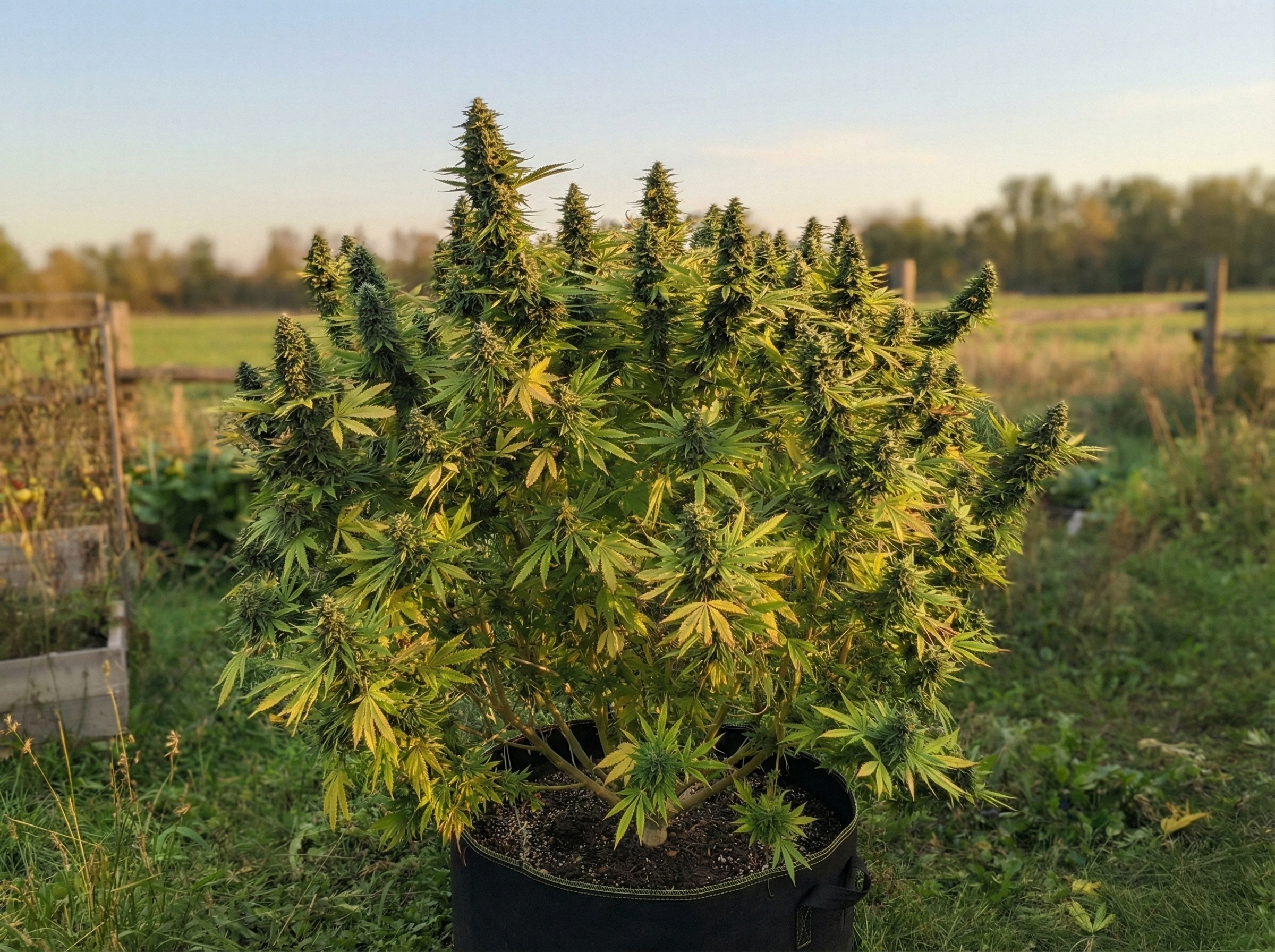
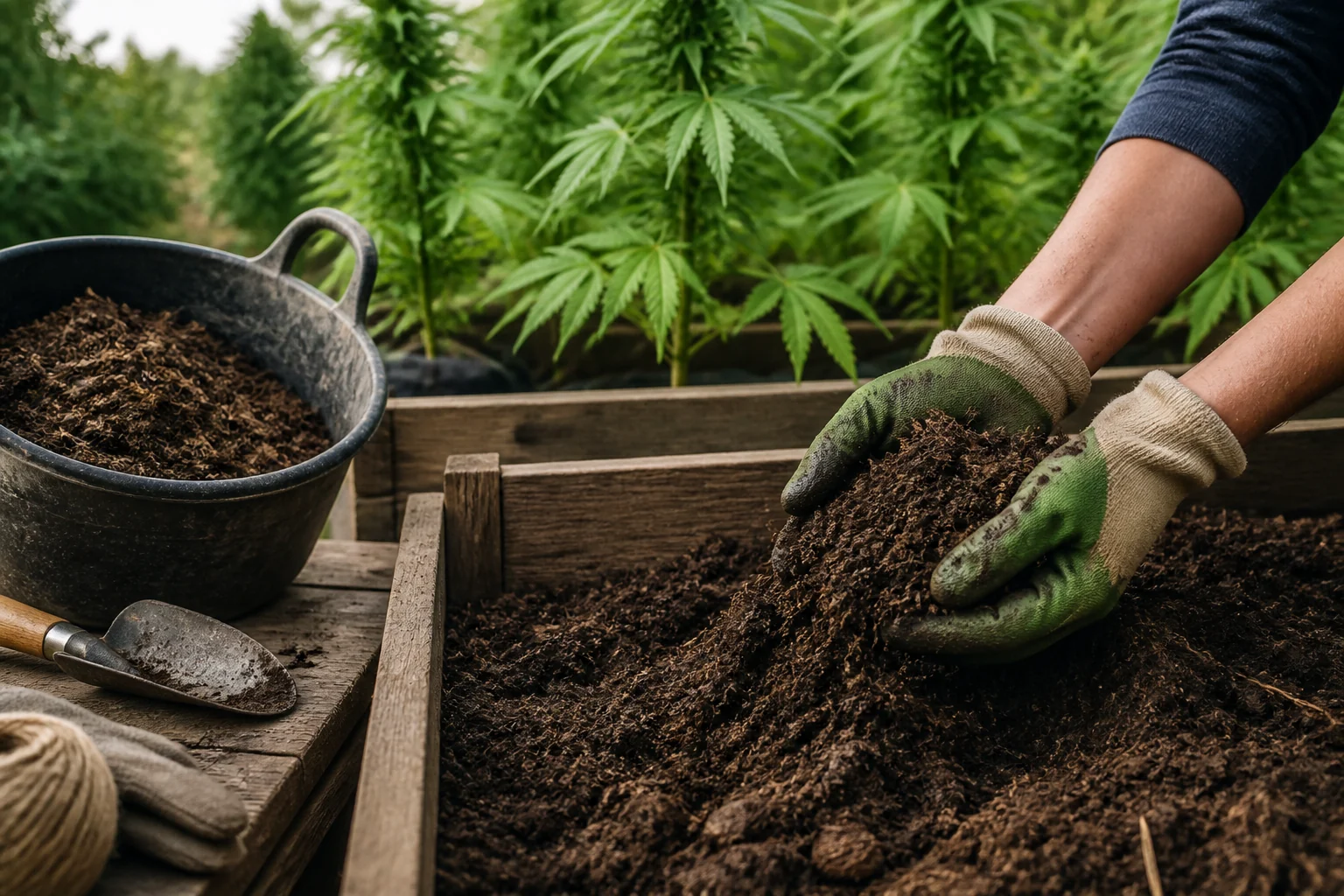
Manure in Cannabis Soil: Benefits, Salts, and Pathogens
Manure can improve cannabis soil, but only when the material, source, and application rate are known well enough to manage its nutrient load and contamination risks. Raw manure should not be treated as a normal cannabis potting amendment. Properly composted manure or a tested manure-based compost can contribute organic matter and nutrients, especially in outdoor beds and native-ground improvement, but it can still carry soluble salts, excess phosphorus, sodium, persistent herbicide residues, or other problems that are invisible by sight.
The practical question is not whether manure is “organic” or “natural.” It is whether the material has been processed appropriately, whether its chemistry fits the existing soil, and whether the grower can verify that the amendment improves the root zone instead of concentrating nutrients faster than the plant can use them. Cannabis-specific nutrition research also gives a useful warning against the “more fertility is better” mindset: higher root-zone nutrient concentrations can accumulate without improving flower yield or cannabinoid concentration.
This resource stays focused on that decision. For broader information about soil texture, compost, aeration, living soil, mineral amendments, and root-zone design, use the Cannabis Soil and Growing Media guide as the parent resource.
Resource Navigation
In This Resource
- Raw, Aged, and Composted Manure Are Different Inputs
- What Manure Can Add to Cannabis Soil
- Salts, Ammonium, and Nutrient Buildup
- Pathogens, Weed Seeds, and Persistent Residues
- Where Manure Fits, and Where It Becomes Hard to Control
- How to Evaluate Manure Before It Reaches the Root Zone
- What to Do When Manure Has Already Caused Problems
- Reinspection and Verification
Raw, Aged, and Composted Manure Are Different Inputs
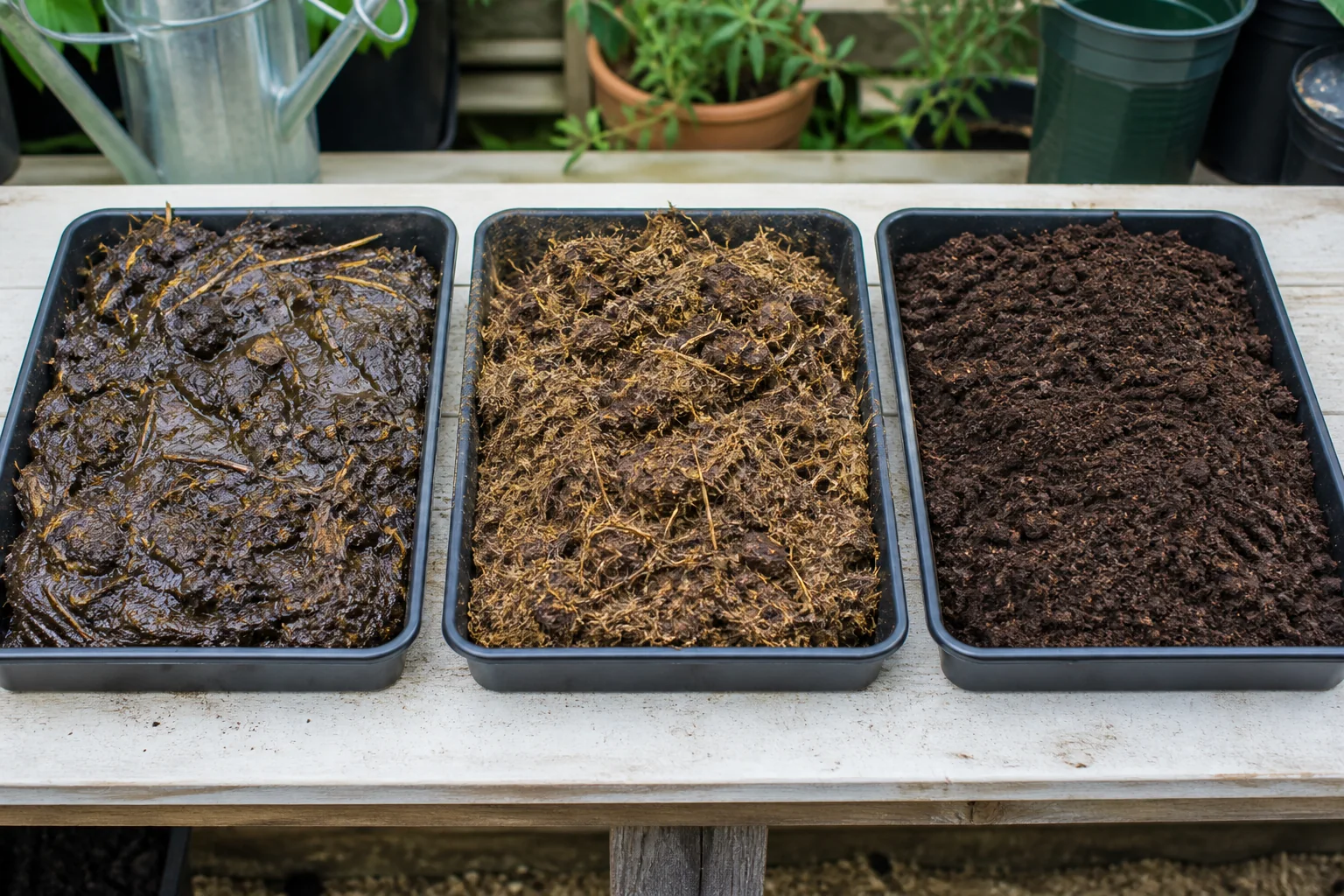
Manure becomes confusing when every animal-derived material is described with the same word. Fresh cattle manure, a dry pile that has sat behind a barn for months, a thermophilically composted manure product, and a blended manure-based compost do not have the same nitrogen behavior or the same pathogen and salt risk.
Aging is not the same as controlled composting. Time can reduce moisture, odor, and some readily available nitrogen, but a pile that simply sat outdoors does not prove that all of the material experienced conditions capable of reducing pathogens and weed seeds. Proper composting is a managed biological process that combines heat, moisture, oxygen, pile structure, and curing. The resulting product should also be evaluated for maturity and chemistry before it is treated as safe for a sensitive root zone.
Maturity, stability, and quality are not interchangeable
Maturity describes whether a compost is suitable for a particular use without unacceptable phytotoxicity. Stability describes how resistant it is to further rapid biological decomposition. Quality is broader and includes salts, nutrients, pathogens, persistent residues, foreign material, and other contaminants. A compost can look finished while still being unsuitable for cannabis soil.
| Manure Form | What It Means for Cannabis Soil |
|---|---|
| Raw or fresh manure | Contains readily available nutrients but may also contain high ammonium, soluble salts, viable weed seeds, and fecal pathogens. It is not an appropriate routine ingredient for cannabis potting soil or a material to place against young roots. |
| Aged manure | May be drier and less reactive than fresh material, but age alone does not verify pathogen reduction, salt level, nutrient balance, or maturity. Treat an undocumented pile as an unknown input until it is tested or properly composted. |
| Properly composted manure | Controlled composting can reduce pathogens, weed seeds, odors, and readily available ammonium while stabilizing organic matter. It can still contain substantial phosphorus, potassium, calcium, sodium, chloride, and other soluble salts. |
| Manure-based compost blend | May contain manure plus straw, leaves, bark, wood fiber, or other feedstocks. Bulking materials can improve structure and dilute nutrient concentration, but the final product must be judged by its analysis, not by the ingredient list alone. |
Important: “Well-rotted,” “aged,” “organic,” and “natural” are descriptive words, not laboratory results. None of them tells you the material’s EC, sodium, ammonium, phosphorus, pathogen status, or herbicide history.
What Manure Can Add to Cannabis Soil
When manure is properly processed and used at a rate the soil can absorb, it can do several jobs at once. It supplies organic matter and contributes nitrogen, phosphorus, potassium, calcium, magnesium, sulfur, and micronutrients in proportions that vary widely with animal species, feed, bedding, water intake, storage, and composting method.
The organic fraction can also improve the way mineral soil behaves. Added organic matter can help sandy soil hold water and nutrients for longer. In heavier mineral soils it can support aggregation and better pore continuity over time. It also increases the soil’s ability to hold positively charged nutrients and provides carbon for microbial communities involved in nutrient cycling.
Those benefits are most predictable when manure is part of a soil-building plan rather than the entire fertility plan. A grower who needs more organic matter may not need the amount of phosphorus or potassium that comes with a heavy manure application. Likewise, a plant that needs nitrogen does not automatically need another large dose of phosphorus.
Use manure to solve a defined soil problem
Know whether the goal is organic matter, nutrient replacement, long-term soil improvement, or a combination. Match the amendment analysis to the soil test and the actual need.
Using manure as generic “richness”
Repeatedly adding manure because the soil looks poor can raise phosphorus, potassium, sodium, pH, and soluble salts long before the root zone looks obviously overfertilized.
Cannabis nutrition research reinforces this restraint. Studies in controlled root zones have found that increasing phosphorus or total nutrient concentration above an adequate supply can raise nutrient accumulation without increasing flower yield or cannabinoid concentration. That does not make manure harmful. It means that the value of manure comes from matching supply to need, not from maximizing nutrient density.
“If composted manure has N, P, and K, can I use it as the main fertilizer for the whole grow?”
Question sent by: Ethan Brooks, via email.
Sometimes manure can replace part of a fertility program, but its nutrient ratio rarely matches cannabis demand perfectly through every stage. The larger problem is that phosphorus, potassium, calcium, sodium, and salts arrive together with the nitrogen and organic matter. Use an analysis and soil test to decide what fraction of the nutrient plan manure can reasonably supply. If one nutrient is already high, adding more manure to chase another nutrient can make the imbalance worse.
Salts, Ammonium, and Nutrient Buildup
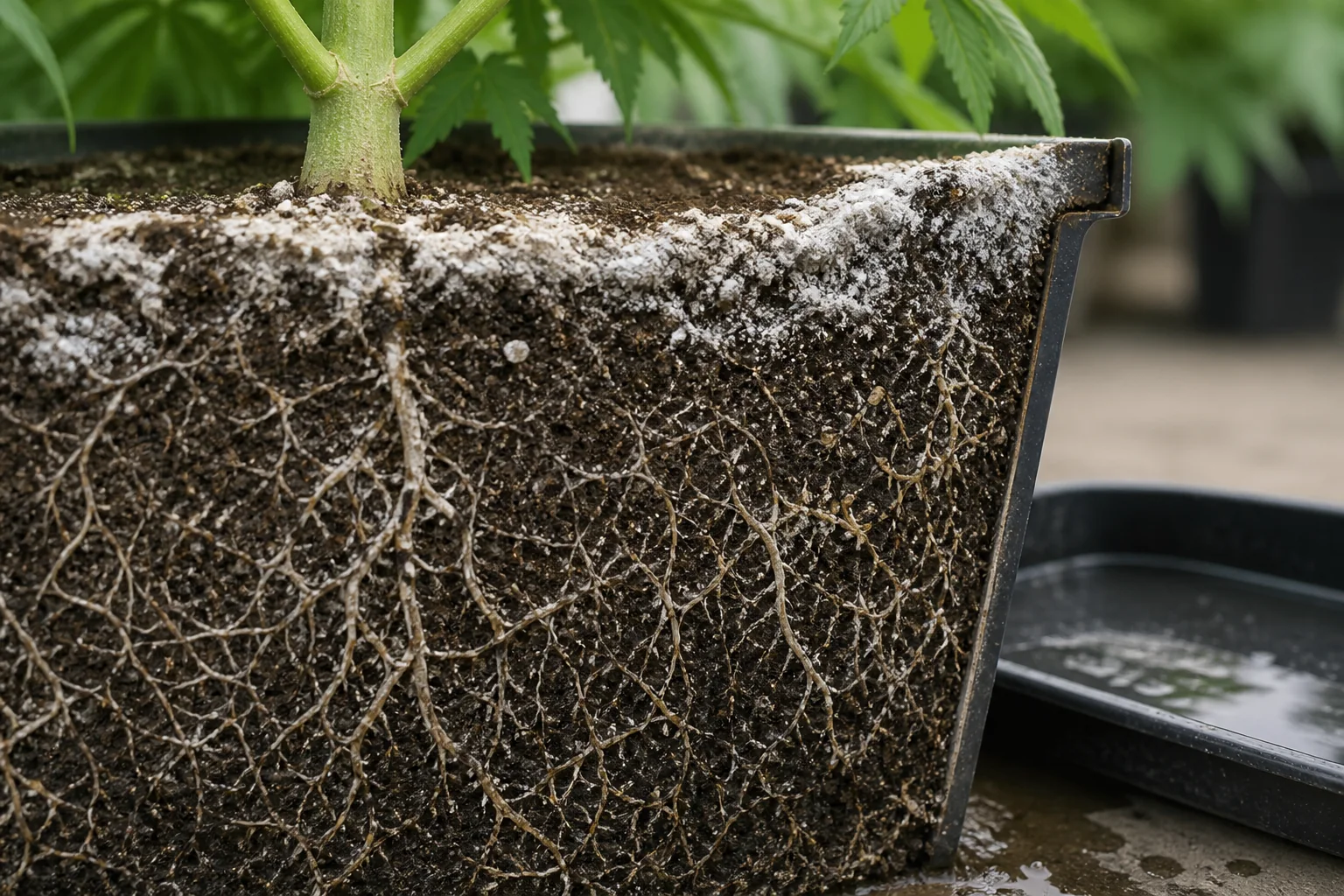
“Salt” in a root-zone discussion does not mean only sodium chloride. Plant nutrients are ions, and many manure nutrients contribute to electrical conductivity. Manure can contain soluble forms of potassium, calcium, magnesium, sodium, chloride, sulfate, ammonium, and other ions. When these remain concentrated in the root zone, the plant must work against a stronger osmotic gradient to take up water.
EC shows ionic concentration, not which ions are present
Electrical conductivity, or EC, is a practical indicator of dissolved ionic load. A high reading tells you that the solution contains many dissolved ions, but it does not tell you whether the load is mostly useful nutrients, sodium and chloride, ammonium, or a mixture. Interpretation requires the test method, water quality, and nutrient analysis.
Manure-based composts can be saltier than plant-based composts, and the risk becomes more difficult to manage in containers, high tunnels, greenhouses, arid climates, and other systems with limited natural leaching. A field soil that receives seasonal rain has a very different salt balance from a 20 L / 5 gal container that repeatedly loses water to transpiration and evaporation while the dissolved ions remain behind.
Young plants deserve extra caution. Seedlings and fresh transplants have small root systems and limited buffering capacity, so a concentrated amendment can injure roots before the grower sees a classic above-ground symptom. High ammonium is another concern with immature or raw manure. At sufficiently high levels, ammonium and ammonia can damage sensitive roots and interfere with nutrient balance.
Do not diagnose manure injury from burnt tips alone
Salt stress can resemble underwatering, overfertilization, potassium problems, root damage, or pH-related nutrient disorder. Confirm the root-zone condition with a repeatable EC test, irrigation-water baseline, and soil or media analysis before adding another amendment.
Phosphorus creates a slower problem. It does not usually announce itself with an immediate “phosphorus toxicity” look. Repeated manure or manure-compost applications can raise soil-test phosphorus over time because the application rate is often chosen to supply nitrogen while phosphorus arrives in excess of crop removal. Potassium and calcium can also accumulate depending on the source. Once the soil contains far more of these nutrients than the crop needs, the grower loses flexibility.
This is why an N-based manure rate can be misleading. If the manure contains enough phosphorus to exceed the soil’s need before the nitrogen target is met, the correct response is not to keep adding manure. The manure rate may need to be limited by phosphorus, with any remaining nitrogen supplied from a source that does not bring another large phosphorus load.
Field Advice: When a manure analysis is available, look beyond total N. For cannabis soil, EC or soluble salts, ammonium, phosphorus, potassium, sodium, pH, moisture or dry matter, and the test method can be just as important to the decision.
Animal Source Changes the Risk Profile
There is no universal ranking that makes one animal’s manure “best for cannabis.” Poultry manures commonly carry a higher nutrient and salt load than cattle or horse manure, while horse and cattle manure may carry viable weed seeds if the material has not been composted effectively. Bedding changes the picture again. Straw, wood shavings, or other carbon-rich materials can dilute nutrients and improve compost structure, but they also alter decomposition and nitrogen release.
Use the animal source as a reason to ask better questions, not as a substitute for testing. Even two loads from the same farm can differ because feed, bedding, storage, rainfall, urine capture, and composting conditions changed.
Pathogens, Weed Seeds, and Persistent Residues
The pathogen issue is often described too loosely. Fecal organisms such as E. coli, Salmonella, and Listeria are primarily human-health and contamination concerns. They are not being discussed here as diseases that infect cannabis roots in the way a root pathogen would. Raw animal manure can carry these organisms, and poor handling can move contamination through hands, tools, footwear, runoff, splash, floors, or other crop-contact surfaces.
Proper composting can greatly reduce pathogen populations, but the process has to reach the entire material. The cooler outer edge of a pile is not equivalent to the hot center. Formal composting standards therefore use time, temperature, aeration or turning, and curing requirements to increase the chance that all material is treated. A home pile that became hot once is not proof that every particle received an effective treatment.
Do not copy food-crop manure waiting periods and present them as cannabis-specific safety guarantees. Cannabis cultivation, testing, processing, and contamination rules vary by jurisdiction. A produce regulation can provide useful context about why untreated manure is managed cautiously, but it does not create a validated cannabis harvest interval.
Do not assume drying or curing makes contaminated flower safe
If raw manure, contaminated runoff, or dirty tools may have contacted harvestable plant material, treat that as a product-safety question rather than a normal soil problem. Follow local cultivation and testing rules. Plant recovery and product safety are separate decisions.
Weed Seeds Can Survive Poor Processing
Livestock can pass viable weed seeds, particularly when feed or pasture contains mature seed. Correct composting can destroy many of them, but incomplete heating can leave viable seed in cooler zones of the pile. For an outdoor cannabis bed this can create a labor problem and new competition. Indoors, bringing an unknown manure pile into a clean grow area also imports unnecessary biological material.
Persistent Herbicides Can Survive the Feed-to-Manure Pathway
A manure pile can smell earthy, look dark, and still carry residues from forage treated with persistent broadleaf herbicides. Certain pasture and hay herbicides can pass through livestock and remain active in manure or compost for extended periods. Sensitive broadleaf plants may then show distorted, cupped, twisted, or stunted new growth.
That matters for cannabis because cannabis is a broadleaf plant. Appearance alone still cannot prove herbicide carryover. Similar distortion can come from pests, environmental stress, root injury, nutrient problems, spray drift, or other causes. The practical defense is source history plus a representative plant bioassay when history is uncertain.
“The farmer says the manure has been composting for a year. Is that enough to rule out herbicides?”
Question sent by: CedarRoute, via email.
No. Composting time by itself does not prove that persistent herbicide residues are gone. Ask what the animals ate and whether pasture, hay, or bedding may have been treated with long-residual broadleaf herbicides. If the history is uncertain, test a representative sample with sensitive indicator plants before the material enters the cannabis root zone.
Remember: Composting can reduce biological hazards while leaving some chemical problems largely unchanged. Pathogen reduction, herbicide carryover, salt level, and nutrient balance are separate checks.
Where Manure Fits, and Where It Becomes Hard to Control
Manure is easiest to justify when the root zone has enough volume and drainage to buffer a variable organic input. That usually makes tested, well-composted manure more compatible with outdoor native soil, large beds, and some mature living-soil systems than with small indoor containers.
Outdoor Native Ground
In mineral soil, composted manure can add organic matter and nutrients while improving long-term structure. The decision should still begin with a soil test. If phosphorus, potassium, sodium, or pH is already high, manure may be the wrong way to add organic matter. Plant-based compost, cover crops, mulches, or another amendment may fit the physical goal without adding the same nutrient load.
Climate changes the answer. In regions with regular rainfall and well-drained soil, salts may move downward more readily. In arid climates, saline irrigation water plus manure can compound the same problem. On poorly drained clay, heavy amendment rates can also create a nutrient-rich wet zone where oxygen becomes the limiting factor. For broader site planning, see Outdoor Cannabis Growing Basics.
Raised Beds and Large Living-Soil Beds
Large soil volumes provide more buffering than small pots, but they can also accumulate nutrients for years if the same amendment recipe is repeated every cycle. A bed that performed well last season is not empty at harvest. Residual phosphorus, potassium, calcium, salts, and slowly mineralizing organic nitrogen remain in the system.
Record each manure or compost addition and periodically test the bed. If one nutrient is climbing while the plants continue to look healthy, that is the time to adjust. Waiting for toxicity symptoms means the soil has already lost much of its management flexibility.
Indoor Containers and Small Pots
Small containers magnify uncertainty. There is less soil volume to dilute the amendment, limited leaching unless the irrigation strategy deliberately creates drainage, and a higher chance that one strong pocket of manure or immature compost sits directly against roots. Indoor spaces also make biological contamination and pest introduction more disruptive.
Raw manure does not belong in indoor cannabis potting soil. A tested, mature manure-based compost can be used as one component of a deliberately formulated mix, but it should not dominate the medium simply because it supplies organic nutrients. In a small container, consistent physical structure and predictable chemistry are usually more valuable than maximum amendment strength.
How to Evaluate Manure Before It Reaches the Root Zone
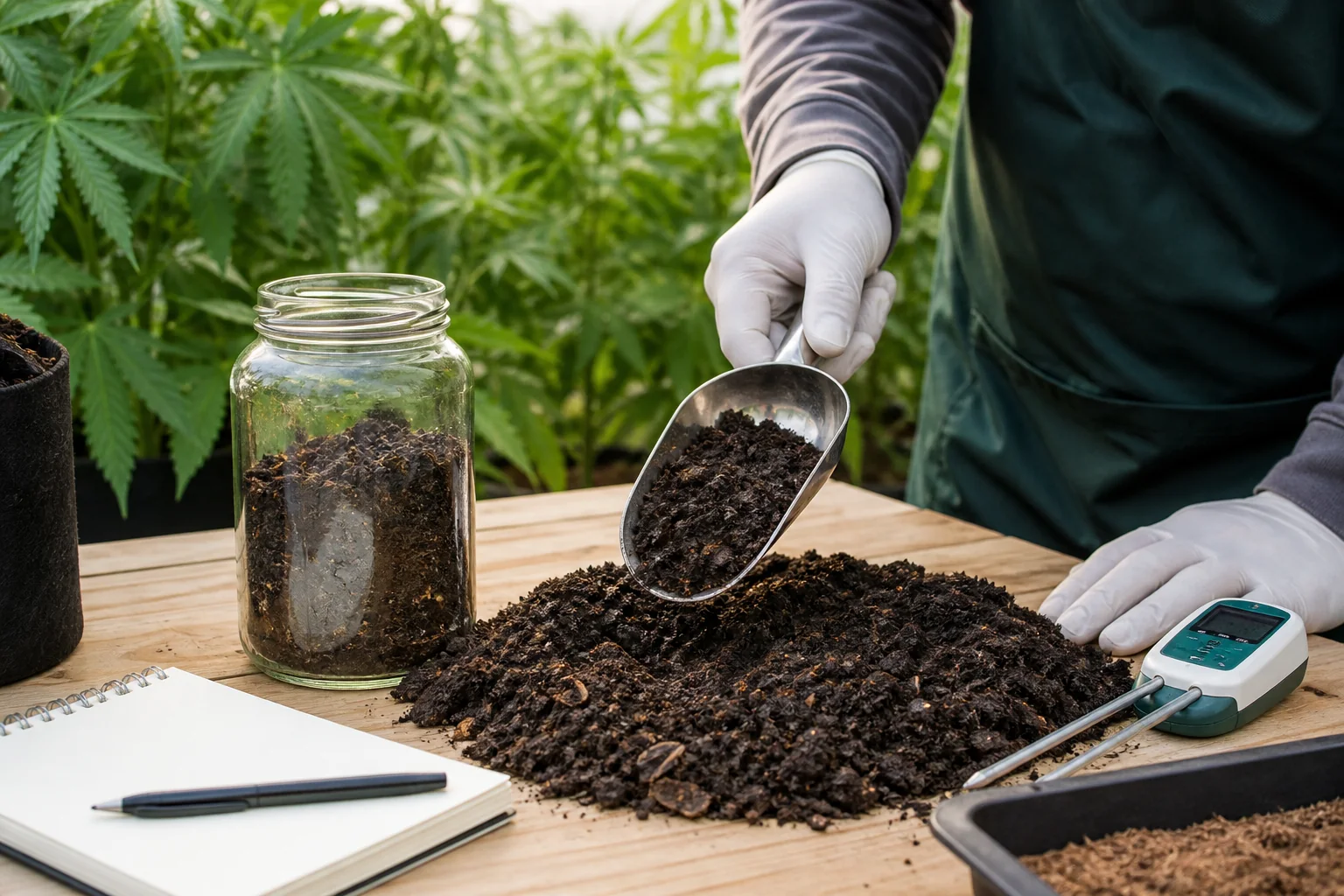
For a Role A decision, the useful sequence is straightforward: identify the material, verify the source, test the amendment, compare it with the soil, decide on a rate, and then verify the response. Skipping any of those steps means the grower is using appearance as a proxy for chemistry.
1. Establish the Source History
Ask what animal produced the manure and how the material was collected. Then ask about feed and bedding. The most useful source questions are practical:
- Was the manure collected fresh, scraped from a lot, mixed with bedding, or separated from liquid waste?
- What forage, hay, pasture, or feed did the animals receive?
- Were persistent herbicides used on pasture, hay, or bedding materials?
- Was the manure composted under a managed process or simply stacked and aged?
- Was outside soil, sludge, ash, lime, gypsum, or another material added?
- Is there a laboratory analysis from the actual batch?
If the seller or source cannot answer basic feedstock and processing questions, the manure has to be treated as an unknown input. That does not prove it is contaminated. It means the grower cannot predict what it will do.
2. Verify the Composting Process
Look for documentation that the material was actively composted and cured, not only stored. In a commercial product, that may include process records or a compost quality report. In a farm-made compost, ask how the pile was built, whether it was turned or aerated, how temperatures were monitored, and whether the finished material was allowed to cure after the hot phase.
Do not use smell as the only maturity test. Ammonia, sour odors, reheating after turning, slimy texture, and recognizable fresh material are warning signs, but the absence of those signs does not prove the compost is chemically suitable.
3. Request the Right Laboratory Analysis
A useful manure or manure-compost analysis goes beyond an NPK label. The exact test panel depends on whether the material will be used in field soil or in a potting mix, but the decision commonly benefits from total nitrogen, ammonium-N, nitrate-N, phosphorus, potassium, pH, EC or soluble salts, sodium, chloride where relevant, moisture or dry matter, and maturity or stability indicators.
Test method matters. Compost EC from a saturated extract cannot be compared casually with a 1:5 water extract because the dilution is different. The number only has meaning when the extraction method is known.
| Check | What You Are Trying to Learn |
|---|---|
| EC / soluble salts | Whether the amendment adds a concentrated ionic load that may create osmotic stress, especially in containers, seedling zones, arid sites, or soils already receiving saline water. |
| Ammonium-N and nitrate-N | How much immediately available inorganic nitrogen is present and whether high ammonium may indicate incomplete curing or a potentially harsh amendment. |
| Total N, P, and K | How much nutrient mass the application brings into the soil. This helps prevent using a nitrogen goal to accidentally overapply phosphorus or potassium. |
| Sodium and chloride | Whether non-essential or potentially harmful ions are contributing to the EC load. This is particularly useful where irrigation water already contains sodium or chloride. |
| pH | Whether the amendment may push an already alkaline root zone further upward. Manure-based composts are commonly neutral to alkaline. |
| Maturity / stability indicators | Whether the compost is sufficiently cured for the intended use and whether ammonia, organic acids, or continuing decomposition may injure sensitive roots. |
Pro Tip: For a manure-based compost intended for a container mix, use a laboratory familiar with compost and potting-media analysis. A standard field-soil test and a compost saturated extract answer different questions.
4. Compare the Amendment With the Existing Soil
Test the soil before deciding how much manure to add. At minimum, the useful baseline often includes pH, organic matter, phosphorus, potassium, and soluble salts. Depending on the site and history, calcium, magnesium, sodium, and other nutrients may also matter.
This comparison changes the question from “How much manure do cannabis plants like?” to “How much of this specific manure can this specific soil accept without oversupplying a nutrient or increasing salinity?” That is a better question because there is no universal cannabis manure rate.
5. Run a Bioassay When Herbicide History Is Uncertain
If the manure source cannot document pasture and hay herbicide history, a small plant bioassay can provide useful evidence before the cannabis bed is exposed. Extension protocols commonly use highly sensitive broadleaf indicator plants such as peas, beans, or tomatoes in a representative manure or compost mixture, alongside clean control pots.
The strength of the bioassay is the control. If the indicator plants in the amendment treatment develop abnormal growth while the controls remain normal under the same light, water, and temperature, herbicide carryover becomes a stronger hypothesis. If both groups struggle, the test did not isolate the amendment as the cause.
“Can I just mix a handful into one cannabis pot first and see what happens?”
Question sent by: Chloe, via X.
A small trial is better than treating every plant, but cannabis is not the best first detector for every manure problem. Start with source history, analysis, and a controlled bioassay when herbicide carryover is a concern. If you later trial the manure in cannabis soil, keep a comparable untreated control and change only the manure variable so the result can be interpreted.
6. Determine the Application Rate From the Limiting Nutrient
Do not choose a manure rate by volume alone. A “shovel,” “bucket,” or percentage of a soil mix has no nutrient meaning without the amendment analysis. For field and raised-bed soil, calculate how much N, P, K, salts, and sodium the proposed rate adds. The nutrient that reaches its acceptable soil target first becomes the limiting factor.
For example, if the soil already has high phosphorus, the manure rate may need to be very low or zero even when nitrogen is needed. Another nitrogen source can then supply the remaining need without bringing more phosphorus. This is a general nutrient-management principle rather than a cannabis-specific fertilizer formula.
Make a small, recorded change
Use a measured batch, record the manure analysis and soil baseline, then observe the root zone and new growth before deciding whether another application is justified.
Stacking manure with other rich amendments
Combining manure, heavy compost, castings, guano, meals, and soluble fertilizer at the same time makes excess nutrients and salt problems harder to diagnose and harder to reverse.
What to Do When Manure Has Already Caused Problems
The first correction is usually to stop adding more material. Do not respond to a suspected manure problem with another nutrient blend, microbial product, pH amendment, or “detox” treatment before the root zone has been measured. Multiple simultaneous changes erase the evidence you need to identify the cause.
If Salts or Ammonium Are Suspected
Establish a baseline with a consistent soil or media EC method and compare it with the irrigation-water EC. If the root-zone reading is elevated, identify whether the amendment, irrigation water, fertilizer program, or a combination created the load.
In a container with adequate drainage, corrective leaching may reduce soluble salts, but it should be measured rather than treated as a ritual. Use suitable water, apply it in controlled passes, collect drainage responsibly, and recheck the same root-zone metric. Do not chase a near-zero EC. The goal is to return the medium to a usable concentration without leaving it waterlogged or stripping the system blindly. The Cannabis Watering Basics guide provides broader context for source-water EC and root-zone salt accumulation.
In a raised bed or field soil, the correction may be slower. Stop the manure source, test the soil, account for irrigation water, and allow natural rainfall or planned irrigation to move soluble salts only where drainage and environmental protection make that appropriate. Excessive flushing can move nitrate or other nutrients into groundwater and surface water, so leaching is not automatically the responsible answer.
If Phosphorus, Potassium, or pH Has Built Up
These are not quick-fix problems. Stop adding the nutrient-rich amendment and use soil tests to track the trend over time. If nitrogen is genuinely needed, choose a strategy that does not also add another large phosphorus or potassium load. Do not add acidifying material by guesswork to “fight” an alkaline manure problem. Soil texture, alkalinity, calcium status, irrigation water, and buffering all affect how pH responds.
In a small raised bed with extreme overapplication, physically removing some of the manure-rich material and redistributing it to an appropriate area may be more controllable than layering additional amendments on top. Disposal and reuse must still follow local rules and contamination considerations.
If Persistent Herbicide Carryover Is Suspected
Stop moving the manure or compost into clean areas. Keep tools, piles, and containers separate until the source is understood. A plant bioassay can help determine whether the material still injures sensitive broadleaf plants. If the problem is confined to a small container, replacement with clean medium may be more practical than trying to “neutralize” the herbicide chemically.
In larger soil areas, breakdown can take a long time and depends on the active ingredient, moisture, microbial activity, temperature, sunlight exposure, and soil conditions. Do not promise that one composting cycle, one season, or one additive will solve it. Re-test with a bioassay before returning sensitive plants to the affected soil.
If the Concern Is Manure-Borne Human Pathogens
Do not use plant appearance as the test. A healthy cannabis plant does not prove that a raw manure input is microbiologically safe. Stop using the untreated material, contain it away from clean growing areas, clean tools and surfaces that contacted it, wash hands, and follow local agricultural, occupational, and cannabis-testing requirements.
If harvestable plant material may have been contaminated by splash, runoff, or direct contact, the question moves beyond horticulture. Do not assume that normal drying, curing, extraction, or combustion makes the product safe. Where product testing or destruction rules apply, follow them.
Weedth Verdict: When manure causes a problem, the safest correction is rarely “add something that cancels it.” Identify whether the failure is salts, nutrient accumulation, immature material, persistent herbicide, or contamination, then correct that specific mechanism.
Reinspection and Verification
A correction is incomplete until the grower can show that the root zone is moving in the right direction. The checkpoints below are operational, not universal biological thresholds. A severely damaged plant may need longer, and old damaged leaves do not have to become green again for the correction to be working.
First 24 Hours
Record the intervention and establish the baseline. Note irrigation volume, root-zone moisture, source-water EC, root-zone EC if measured, and the visible symptoms. Stop further manure or fertilizer additions. If contamination is suspected, separate dirty tools, shoes, containers, and amendment piles from clean areas immediately.
Do not expect damaged tissue to reverse in one day. The useful question is whether the plant is still deteriorating rapidly and whether the root zone has been stabilized enough to prevent another avoidable stress.
Around 3 Days
Repeat the same measurements using the same method. In a salt-correction case, compare root-zone EC and moisture behavior with the baseline. If the medium is still saturated after aggressive leaching, root oxygen may now be the new limitation. If suspected herbicide injury is involved, watch the newest developing tissue rather than older distorted leaves.
For a manure bioassay, three days is usually too early to declare the material safe. Keep the control and treatment under the same conditions and continue until the indicator plants have enough true growth to show a meaningful difference.
At 1 to 2 Weeks
New growth becomes more informative. Look for stable leaf shape, normal expansion, improved water use, and the absence of new tip or margin burn. Compare the plant with an untreated control when one exists. If an EC correction was made, recheck the root zone before resuming any strong feeding.
For outdoor soil, this is also a useful time to review drainage after irrigation or rain and to confirm that the amendment did not create a persistently wet, fine-textured layer. For persistent herbicide questions, continue the bioassay for the full observation period rather than stopping as soon as seedlings emerge.
Long-Term Soil Verification
Phosphorus, potassium, sodium, and pH problems are tracked over months and seasons, not only days. Keep application records and repeat soil testing at a meaningful interval for the testing method and management system. Long-term verification should show that nutrient concentrations are no longer climbing faster than the crop can remove them.
A successful manure program should become easier to manage over time. If every cycle requires stronger flushing, more pH correction, or repeated rescue of nutrient imbalances, the amendment strategy is not functioning as soil building.
Before Manure Goes Into Cannabis Soil
- You know whether the material is raw, aged, composted, or a manure-based blend.
- The animal source, feed, bedding, and herbicide history are reasonably documented.
- The composting process was managed and the material was allowed to cure.
- The batch has an analysis appropriate to its intended use.
- You checked EC or soluble salts, N forms, phosphorus, potassium, pH, and sodium when relevant.
- You compared the amendment analysis with the existing soil test.
- You did not choose a rate only by shovel, bucket, handful, or recipe percentage.
- You ran a controlled bioassay when persistent herbicide history was uncertain.
- You are not placing raw or concentrated manure against seedlings or fresh roots.
- You have a reinspection plan that uses the same measurements after application.
FAQ About Manure in Cannabis Soil
Is Cow Manure Good for Cannabis?
Properly composted cattle manure can contribute organic matter and nutrients to outdoor soil or a deliberately formulated soil blend. It is not automatically a complete cannabis fertilizer and it should not be used by volume alone. Test the material and the soil first because phosphorus, potassium, salts, sodium, pH, and nutrient availability vary by source.
Is Horse Manure Safer Than Chicken Manure for Cannabis?
Horse manure is often less nutrient-dense and less salty than poultry manure, but “safer” is too broad. Poorly composted horse manure can carry viable weed seeds and any manure can carry persistent herbicide residues through contaminated forage. Poultry manure often requires smaller application rates because its nitrogen, phosphorus, and soluble salt load can be much higher. The actual analysis matters more than the animal label.
Can Chicken Manure Burn Cannabis Plants?
Yes. Raw or poorly processed poultry manure can contain high ammonium and soluble salts, which can injure sensitive roots. Proper composting and dilution with other feedstocks can reduce the immediate harshness, but composted poultry manure can still be nutrient-dense. Do not place it directly against seedlings or use an untested high rate in a small container.
Can I Use Composted Manure Indoors?
A mature, tested manure-based compost can be one component of an indoor soil mix, but it is not the default choice for every grow. Small containers provide less buffering and indoor gardens have more to lose from imported pests, biological contamination, salts, or unknown residues. Use a documented horticultural product and keep the percentage conservative enough that physical structure and EC remain under control.
Does Earthy-Smelling Manure Mean It Is Ready?
No. A clean earthy smell is better than ammonia, sewage, sour, or rotten odors, but smell cannot measure EC, sodium, phosphorus, ammonium, herbicide residues, pathogen status, or stability. Use odor as one screening observation, not as a release test.
Does Manure Improve Cannabis Flavor or Terpenes?
There is no reliable basis for promising that manure itself makes cannabis taste better. Manure can support soil organic matter and nutrient cycling when it is used correctly, and a healthy root zone supports normal plant development. Final aroma and flavor also depend on genetics, nutrition balance, environment, harvest timing, drying, curing, and storage. Excess fertility or salt stress can work against plant health rather than improve flower quality.
Use Manure Only When You Can Explain Its Source and Load
Manure is useful when it behaves like a measured soil amendment. It becomes risky when it is treated as a symbol of fertility. The same material that adds organic matter and nutrients can also add soluble salts, ammonium, phosphorus, sodium, weed seeds, persistent herbicide residues, or fecal pathogens.
The strongest cannabis soil decision is therefore conditional: use properly composted, documented manure only when its analysis fits the soil and the grow system. Raw manure should stay out of cannabis potting soil. Aged manure without process records remains an unknown. In small containers, predictability matters more than nutrient density. In outdoor soil and large beds, manure can be a valuable long-term input when the grower measures what goes in and verifies what happens afterward.
Share this article
A quick overview of the topics covered in this article.
Follow us
Latest articles
October 25, 2026
October 25, 2026
October 25, 2026