Drying Capacity: Do Not Harvest More Than the Room Can Handle
A drying room can look spacious while being unable to remove the moisture released by its next harvest. The opposite is possible, too: a compact room with a tested layout and reliable climate control may handle a modest batch better than a large room with crowded hang lines and damp corners. Drying capacity is the largest batch the complete room can handle without losing environmental control, inspection access, or product separation. The ceiling is set by whichever requirement fails first, not by floor area alone.
Before cutting, compare the proposed harvest with the physical hanging or rack space, moisture-removal equipment at its actual operating temperature, temperature control, circulation, drainage, electrical safety, and the time needed to inspect each lot. If any essential component is unproven, shrink or stage the harvest rather than treating the equipment label as permission to load more.
This resource covers the pre-harvest capacity decision and the first-batch verification procedure. It does not replace the broader grow-to-harvest guide, the detailed drying climate discussion, or the separate decision about whole-plant versus branch drying. Follow applicable cultivation and processing rules wherever you operate.
Define the Drying-Capacity Decision Before Harvest
The practical question is not “How many plants fit?” It is “Can this particular load lose water at a controlled rate while every flower stays accessible and the environment stays within a documented, appropriate operating window?” Plant count is an especially weak capacity unit: two plants of the same cultivar may have different flower mass, attached stems, leaves, and overall geometry.
Four ceilings determine the permitted batch
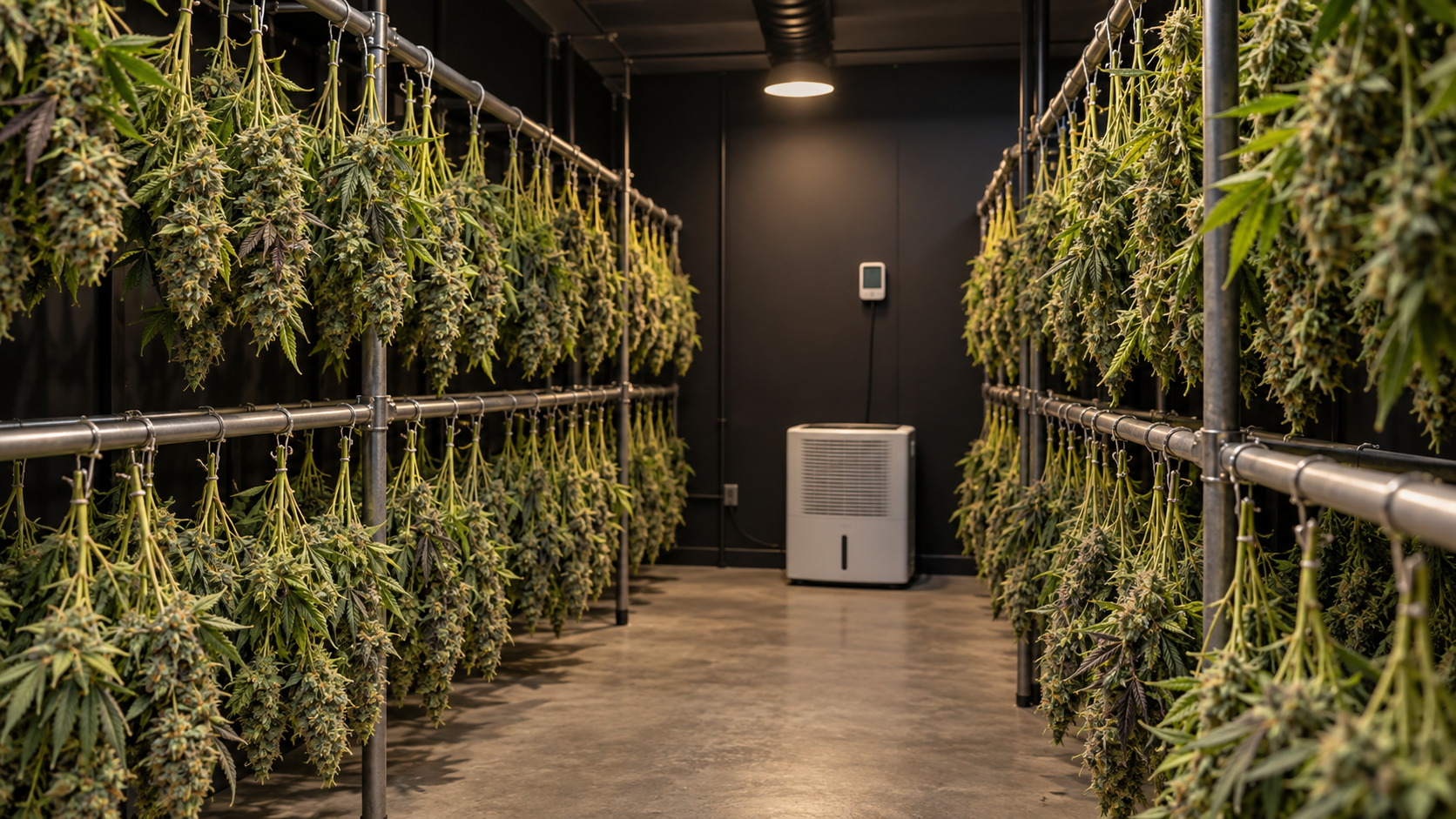
Placement capacity is the amount that can hang or rest in a single clean layer without compressing flowers, blocking access, or obstructing the room’s return and supply airflow. Moisture-removal capacity is how much water the operating system can remove under actual conditions. Thermal capacity is its ability to hold the chosen temperature while machines, ventilation, and wet material change the heat load. Operational capacity is the quantity workers can load, inspect, isolate, weigh, and unload without losing traceability. The smallest of these limits governs the batch.
Do not count another rack as added capacity unless the air around its new layers can be reached and monitored. Do not count a larger dehumidifier as additional capacity if the room then becomes too warm, its drain fails, or the flowers have to touch to fit. An apparently empty aisle may be essential space for movement and corrective action.
Define the quality decision before estimating kilograms
Write down the product type and intended lawful destination: intact marketable flowers, trimmed flower, or biomass for a different downstream process. Establish the site’s documented temperature and humidity operating window and its required finished-product tests. The numbers used for extraction biomass, commercial flower, and small-batch hand-trimmed material are not interchangeable; neither is a drying time copied from another facility.
For a pre-harvest green light, require a workable physical layout, a plausible water-removal plan, reliable drainage and power, accessible sensor positions, and a response plan if a sensor reports persistent deviation. These are operational acceptance criteria, not universal biological thresholds for cannabis.
Definition: rated versus demonstrated capacity
Rated capacity is a manufacturer or design figure determined under specified conditions. Demonstrated capacity is the largest comparable batch previously processed while the actual room maintained its conditions and passed appropriate product checks. An untested design has an estimate, not a demonstrated maximum.
Keep harvest timing separate from room convenience
A mature crop facing genuine weather or disease risk may not have the option of waiting indefinitely. But cutting it without safe downstream space is not a harmless compromise. Evaluate the harvest risk and the drying constraint together: secure lawful additional qualified space or a documented alternative process before proceeding. A capacity shortage never justifies sealing wet flowers or accepting visibly contaminated product.
Important: Do not confuse fitting material through the door with proving that the room can dry it. A room that cannot maintain safe conditions is over capacity even when the racks still have empty hooks.
Sample the Crop and Map Every Part of the Room
Capacity estimates fail early when the input is guessed. Survey the standing crop before harvest and map the drying room before moving the first branch. The aim is not laboratory precision in every plant; it is an honest range that includes the wetter, denser, and more awkward material the room will actually receive.
Build a representative harvest sample
Divide the proposed harvest into meaningful lots: cultivar or plant group, flower density, exposure to recent rain, harvest date, and processing method. For each lot, sample representative plants and record flower size classes rather than weighing only the largest showpiece cola or the easiest lower branch. The sample should include dense tops, average flowers, and smaller material if all will enter the same room.
Choose a consistent weighing basis. Fresh detached inflorescences, trimmed buds, and whole wet branches with leaves are different materials; their weights cannot be combined as though each kilogram contains the same water or occupies the same space. Note precisely whether stems, leaves, and wet trimming losses remain in the planned load. Record both the estimated batch mass and the number of hanging units or trays because mass alone does not express geometry.
Sketch the room as an inspection map
Draw the door, hanging rails, rack tiers, return and supply vents, dehumidifier, drain, fans, electrical points, and inspection aisle. Label positions such as A1 for the upper entry rack and B3 for the rear lower rail. Record actual usable rail length, tray surface area, shelf clearance, flower-to-flower separation, and whether a worker can reach each location without touching the next lot. Do not use a universal centimeters-per-branch recommendation: branch diameter, architecture, flower density, and hanging hardware change what clear separation looks like.
Leave room to isolate a suspicious piece and to unload a subset without crushing adjacent flowers. Keep air inlets, outlets, sensors, and drains clear. A layout that requires moving half the crop to check the back wall is not commissioned simply because the flower fits.
Choose sensor positions for the worst plausible zones
Use calibrated or cross-checked temperature and RH loggers at the intake or reference location, in the densest representative drying zone, and at a remote area suspected of poor mixing. Add positions at different heights when stratification is plausible. Keep sensors clear of water drips, cold surfaces, fan blasts, and dehumidifier exhaust; those locations may represent machine output rather than the air bathing the crop.
Log temperature and RH over time before and after loading. A single middle-of-room reading does not describe a crowded upper tier, the back of a whole plant, or the interior of a dense flower. Research on commercial cannabis inflorescences found that their internal microclimate can have higher humidity than surrounding ambient air. That finding supports zone sampling and product inspection, but does not supply an outdoor or indoor universal safe fan speed.
Add the resources a floor plan cannot show
Confirm power-circuit suitability, condensate handling, alarm or check schedule, cleanable surfaces, filter condition, acceptable outside-air conditions if ventilation is part of the design, and available cooling. A dehumidifier with a full bucket is effectively out of service unless automatic shutoff and emptying are reliably handled. Poorly placed extension cords or wet electrical connections are unacceptable, regardless of projected harvest value.
“My grow room is empty now. Can I count every shelf as drying space?”
Question source: Common grower question.
Only after a full-size layout test shows that flowers will stay separated, air paths and drains remain open, and you can inspect each tier. Empty shelf area is a starting measurement, not evidence that the loaded room can dry uniformly.
Translate Measurements Into a Realistic Capacity Estimate
Translate your survey into two complementary numbers: an approximate total water burden and the room’s observed ability to keep up with water leaving the crop. The first tells you the scale of the task. The second, checked at the intended temperature and humidity, tells you whether the equipment is coping. Neither yields a reliable maximum load on its own.
Estimate water to be removed, with the assumptions visible
Fresh cannabis or hemp flowers contain substantial water. An Oregon State University Extension overview describes freshly harvested hemp tissues as roughly 70–80% water; a controlled hemp drying study measured initial water fractions around 75–78% for its particular materials. Those observations give a useful illustration, not a guaranteed value for every intact plant or trimmed flower. For an explicit mass-balance example, assume a representative batch contains 10 kg of fresh flower at 75% moisture on a wet basis. That is 7.5 kg of water and 2.5 kg of dry solids.
If the illustrative target is 12% moisture on a wet basis and dry solids stay approximately constant, the expected final mass is 2.5 / 0.88, or approximately 2.84 kg. Final water is about 0.34 kg, giving an estimated 7.16 kg of water removed over the entire process. This is not a dosage, equipment selection, or universal drying endpoint. Whole branches carry different stem fractions; trimming losses, respiration, sampling, and other changes can make the observed weight loss differ from this simple water-only model.
Dividing 7.16 kg by six days gives about 1.19 kg per day as a mathematical average. It does not mean that a dehumidifier nominally rated at 1.2 liters per day is sufficient. Water release is not constant, outside-air infiltration and incidental moisture exist, and some systems exhaust water vapor rather than collecting it. Early-period peaks, colder operating conditions, and equipment downtime matter. Use this arithmetic to expose assumptions, not to choose a machine from a single average.
Definition: wet-basis moisture versus water activity
Wet-basis moisture content is water mass divided by total sample mass. Water activity, a_w, reflects water availability in the material and is measured with an appropriate instrument after the sample equilibrates. Room RH is the surrounding air condition. Equal room RH readings do not prove equal internal flower moisture or microbiological safety.
Understand what the dehumidifier label actually says
A dehumidifier labeled in liters or pints per day reports moisture removal under defined test conditions. ENERGY STAR explains that changes to U.S. testing conditions lowered published capacities for some machines because cooler air changes removal performance. Actual output in a cool drying room, at a chosen RH setpoint, with defrost cycles and different airflow may depart substantially from the headline figure. Ask for manufacturer performance data at your expected conditions and account for heat added by the unit.
A dehumidifier is only one part of the moisture balance. Ventilation can remove water vapor when incoming air has lower absolute humidity than outgoing air, but it may introduce moisture when the outside air is wetter. Cooling equipment may dehumidify while operating; cycling and controls determine how reliably. Do not add manufacturer rated dehumidification and nominal exhaust volume as if both were independently guaranteed removal.
Collect a baseline during a small representative run
Dry a smaller lawful trial batch using the intended configuration. Log each sensor over the first loading period and throughout the cycle. Weigh marked representative samples on a consistent basis with a suitable scale and record their mass trend without repeatedly handling saleable flowers. If condensate is collected in a graduated container, record actual removal and maintenance events, but recognize that its volume is not the total crop-water loss when ventilation, condensation elsewhere, or incidental sources are involved.
Watch whether all locations approach the room operating band after disturbances, whether the dehumidifier runs continuously without catching up, whether a second sensor stays wetter, and whether the product dries at different rates across lots. Repeated stable performance, representative product checks, and reliable maintenance create a local capacity baseline. A one-hour empty-room test cannot establish it.
| Measurement | What it answers | What it cannot prove |
|---|---|---|
| Fresh lot mass and trim basis | How much identified material will enter the room | Exact water mass or space occupied by hanging branches |
| Layout and access map | Whether each lot can be separated and inspected | Whether the HVAC system can remove released moisture |
| Multi-zone temperature/RH logs | Whether the loaded room stays reasonably uniform | Whether dense flower interiors are dry or pathogen-free |
| Actual condensate and run-time records | How dehumidification is behaving in this room | Whole-room moisture balance when air is exchanged |
| Repeated product mass and qualified a_w samples | Whether representative pieces are losing moisture and approaching the verified endpoint | Safety of untested pieces, or absence of pre-existing mold |
Pro tip: Keep a photograph of the tested rack layout alongside the harvest weights and sensor plots. Capacity belongs to that configuration; moving a dehumidifier or doubling a shelf changes the evidence.
Adjust Capacity for Flower Structure and Drying Method
The same measured harvest weight can create very different drying demands. Capacity planning must follow the material and process rather than assuming every cultivar and trimming method scales linearly.
Dense colas and airy flowers are different loads
Dense inflorescences retain more internal moisture in tissue that may be less exposed to room air; loose flowers have different surface-to-volume relationships. A room sensor can recover quickly while a heavy flower remains wet at its center. Separate high-density and airy samples in the inspection schedule and consider independent drying lots when their drying progress diverges. Do not infer internal safety from the outside feeling crisp.
Whole plants use volume and conceal contact points
Whole-plant hanging carries additional stem and leaf mass, takes more vertical and lateral clearance, and can hide touching flowers after foliage droops. It may slow moisture loss and lower handling, but the relevant capacity constraint is whether separated wet mass can be inspected and adequately supplied with conditioned air. Branch drying can improve spacing flexibility; smaller pieces may also dry too quickly if exposed to direct air. For the method-level comparison, see whole-plant versus branch drying.
Research comparing hang drying with wet-trim/rack processing observed different total yeast and mold counts under its particular commercial protocol, with lower counts in the hang-dried comparison. The methods also differed in trimming injury and handling, so that result is not proof that a densely loaded whole-plant room is inherently safer. A 2026 industrial air-drying study found tray drying faster than hanging under its facility conditions; it does not establish a universal per-rack maximum or a fixed endpoint for premium flowers.
Tray depth is a capacity limit, not spare storage
A tray with a loosely distributed layer is not equivalent to a pile of flowers of the same weight. Stacking creates contact points and shields parts of the product from moving conditioned air. Record actual layer depth and whether pieces touch. Reorienting or turning may be part of a documented process, but it increases handling and must not become a substitute for available drying area. Do not let a wet-trim workstation become an unconditioned holding area while the room is being loaded.
Rain, trim style, room temperature, and staged lots alter the baseline
A recent wet-weather harvest may introduce greater starting moisture or surface wetness. Different trim intensity changes wet mass, the exposure of flower surfaces, and potential handling damage. The 2026 industrial study associated a later, rain-affected harvest with higher initial moisture and a different early drying rate, but this was a specific outdoor biomass comparison, not a numerical correction factor for every flower room. Measure the actual load rather than applying a one-size-fits-all rain multiplier.
In colder rooms, compare dehumidifier data at the intended temperature and watch for defrost or limited removal. A warm room may release water more quickly but compromise volatile aroma retention. Cannabis and hemp drying studies report temperature-dependent changes in terpene profiles and other chemical measures. Do not solve a deficient moisture-removal system by raising heat until the flower dries as fast as the equipment can manage.
“Would trimming harder let me fit twice as much flower into my small drying room?”
Question source: Common grower question.
It may change wet mass and geometry but does not double verified moisture-removal or inspection capacity. Recheck representative loading, potential tissue injury, tray depth, humidity recovery, and product quality under the revised method before assigning a larger batch limit.
Recognize Overload and Its Dangerous Look-Alikes
Overload can announce itself as a room-wide humidity trend, a single hidden wet pocket, persistent condensation, or a batch that becomes uneven. None of these should be diagnosed by the middle sensor alone. Consider the product, air system, and data logger together before changing conditions.
Humidity remains elevated after loading
First check that the sensor is valid and not directly exposed to a damp wall or dehumidifier outlet. Confirm doors are closed as planned, drains work, filters are clear, the equipment is operating correctly, and incoming air is not adding moisture. If several independent zones remain outside the documented operating band despite functioning equipment, the current load is exceeding demonstrated control or the design is faulty. Separate or move material only into prepared, lawful, controlled capacity. Never simply close the doors and leave the batch overnight without a response plan.
The average RH is normal but the back rack stays damp
This is often a distribution or geometry problem rather than a lack of nameplate dehumidification. Search for branches touching, a blocked return, tightly packed trays, low-lying stagnation, and air short-circuiting from a supply straight to a return. Compare the persistent wet zone against the reference sensor, then improve separation and the designed room air pattern. The goal is mixed room air without direct fan blast onto fragile flower.
Crisp exteriors conceal slower centers
Warm or excessively dry air and local fan streams may dry exposed surfaces ahead of protected tissue. Visible shrinkage or a stem snapping does not validate the batch. Mark a representative dense flower and follow its mass trend and properly sampled water activity at the end of drying. Do not use an early jar test as permission to seal a large wet batch; move only after a verified product endpoint and appropriate safety assessment. See how to check readiness before jarring for the later transition.
Musty odors, visible fuzz, or internal brown decay
Treat suspect flowers as potentially contaminated. Stop ordinary handling of the affected lot, prevent dispersing material, isolate the area under the operation’s sanitation and testing procedure, and seek qualified diagnosis when appropriate. Do not smoke, blend, jar, or attempt to rescue visibly moldy flowers through extra drying. Moisture control can restrict subsequent growth; it does not sterilize flower or reverse pre-existing contamination.
Warning: drying is not a microbial kill step
The ASTM water-activity practice explicitly distinguishes controlling growth from eliminating organisms. A satisfactory eventual a_w result does not prove that moldy material has become safe, and room RH never substitutes for contamination controls or applicable testing.
Do not mistake an equipment alarm for a harmless measurement spike
A short door opening may produce a temporary rise in RH; a repeated or prolonged rise, a full collection tank, an iced coil, or a failed drain is a different event. Note the time and correlate it with equipment status, room access, sample weight, and neighboring sensor readings. Replace, recalibrate, or reposition a suspect logger only after checking it against another instrument. If reliable measurements are unavailable, do not certify the room for a larger batch.
| Observed problem | Likely competing causes | Immediate verification and decision |
|---|---|---|
| Room-wide RH will not recover | Excess load; undersized removal; wet outside air; equipment fault | Cross-check loggers, inspect drain and duty cycle, compare zones; reduce load if control cannot be restored |
| One rack or tier stays wetter | Crowded contact points; dead zone; sensor error | Inspect layout and compare a second logger; separate material and recheck |
| Exteriors become brittle fast | Local fan blast; heat; low room RH; mixed flower sizes | Check airflow and temperatures, sample dense interiors; do not jar on texture alone |
| Condensation or water near electrics | Cold surface; leak; faulty condensate drain | Protect personnel, stop unsafe equipment use, repair and verify before running |
| Musty or visibly altered flower | Potential microbial contamination; stagnant wet tissue | Isolate suspect lot and apply qualified disposal/testing protocol; no salvage claim |
A more serious failure is losing the ability to act: no free aisle, no empty rack, no second room, and no worker able to reach the affected section. Design reserve space and contingencies before harvest, not after the first alarm.
Run a Go, Reduce, Expand, or Postpone Workflow
Use this workflow as the operating procedure for one proposed batch. The stop/go points are explicit operational checks; their numerical targets must come from a validated process, product specification, and equipment capability rather than invented universal kilogram limits.
Step 1: define the lot, intended product, and constraints
Assign a lot identifier and record plant or cultivar groups, estimated wet weight with its measurement basis, latest acceptable harvest decision from maturity and plant health, chosen drying method, and product release requirements. Confirm the site is lawfully permitted for the planned processing, and that transport or extra facilities are authorized if your backup plan relies on them. Reject visibly contaminated material before it enters a shared drying space.
Step 2: calculate a range rather than a single false-precision answer
Take several representative wet samples and estimate the total projected fresh load, including its uncertainty. If using moisture-fraction arithmetic, identify the material and source of the assumption. Carry a plausible low and high scenario into the water-removal budget and operational plan. Verify that rack length, tray area, vertical clearance, and inspection access can accommodate the high scenario without bunching, touching, or blocking equipment.
Step 3: qualify equipment at actual conditions
Check the manufacturer removal curve at the expected room temperature and humidity or use credible site records from comparable batches. Verify working drainage, independent temperature control, alarms, power, cleaning, and acceptable air-exchange arrangements. A machine’s maximum rating is not the expected output in every drying room. If conditions are likely to differ substantially from the proven run, classify the proposed increase as unvalidated.
Step 4: commission a representative partial load
Start with a smaller batch that leaves reserve capacity and complete the intended rack pattern. Record the pre-load room baseline, loading start and finish, multi-zone trends, equipment duty, condensate, sample mass, and inspections. Maintain the planned process over an appropriate initial observation interval that captures the early wet-load response; do not declare success merely because the first minutes appear stable. Increase future loads in measured steps only after successful completed runs.
Step 5: choose Go, Reduce, Expand, or Postpone
| Decision | Evidence required | Action |
|---|---|---|
| GO | Layout accommodates load with separation and access; conditioning, safety, monitoring, and contingency are demonstrated for a comparable batch | Proceed with labeled lots, retain reserve, log and inspect |
| REDUCE | Part of the batch fits or moisture control weakens under load; smaller trial is demonstrated | Harvest only the supportable lot when agronomically appropriate; do not abandon unsafe mature material without a risk decision |
| EXPAND | Existing room fails but additional clean, lawful, tested space or engineered capacity exists | Commission added space or equipment first; repeat qualification for changed configuration |
| POSTPONE / REPLAN | No verified safe capacity, access, functional equipment, or contamination control | Do not cut solely for schedule; reassess standing-crop risk and obtain qualified alternative if delay is unsafe |
These categories are not interchangeable. “Expand” means more verified capacity, not more untested shelves; “Reduce” means a deliberate smaller batch or suitable division, not stacking the remainder on a tarp; and “Postpone” is only responsible when the crop can safely remain standing. When disease or weather forces prompt action, arrange a compliant alternate route before harvesting what the facility cannot hold.
Step 6: verify after loading and during the wettest phase
Compare zone conditions with pre-defined operating tolerances and the tested batch baseline. Review whether recovery after a loading or door event is comparable, not just whether the room briefly hits the displayed setpoint. Check front and back, upper and lower, and dense versus airy lots. Track equipment on-time, drainage, unexpected heat and worker access. If persistent differences develop, reduce local crowding, correct faults, or move material to commissioned space. Record the intervention and compare the same locations on the next check.
Step 7: verify product endpoints and close the loop
Sample separate lots and the historically slowest-drying positions. Qualified water-activity or moisture tests should follow the selected specification and methods. ASTM D8197-22 sets a recommended a_w range of 0.55 to 0.65 for finished dry cannabis flower intended for storage, but that range is not an in-process room-RH prescription and does not itself demonstrate absence of contamination. Do not turn a drying-room sensor into a finished-product certificate. Reconcile actual dried output, losses, time, uniformity, and equipment performance before changing the next batch ceiling.
“The dehumidifier reads the right number and the room holds 60% RH. Can I bring in another harvest tonight?”
Question source: Common grower question.
Not on that evidence alone. Check loaded-zone logs, product behavior, available separation, the device’s duty cycle and drain, and the result of a comparable completed run. If there is no validated reserve, a setpoint reading is not permission to add another wet load.
Do / Avoid for the first full run
Do: start below the estimated ceiling, preserve a clear access route, label lots, log multiple zones, and have commissioned backup capacity. Avoid: using plant count or empty floor area as the load limit, assuming published liters/day will occur at any temperature, crowding flowers to meet a harvest date, or declaring a batch safe from one RH reading.
Finish With Product Quality and a Repeatable Capacity Record
A safe capacity limit is a quality-control result, not a trophy for the largest number of wet kilograms loaded. A larger harvest that produces wet pockets, crushed flowers, emergency heating, or rejected product may be less useful than a smaller batch dried reproducibly. The next season’s capacity should be based on demonstrated outcomes and recorded constraints, not the biggest harvest remembered.
Protect aroma without confusing slow with stagnant
Temperature, time, ventilation and drying method influence the chemical profile. Controlled hemp hot-air research found higher temperatures reduced terpene retention in its tested biomass, while other industrial technologies produced different tradeoffs. Those results support protecting volatile material from unnecessary heat, not assigning one universal temperature or duration to every small drying room. Adequate but gentle room-wide mixing and measured moisture removal are preferable to either a direct fan blast or a closed, stagnant chamber.
Measure the finished product, not just the room
During drying, track mass and environmental behavior; near completion, select representative dense and airy material from the locations most likely to differ. For a product intended for storage, use calibrated a_w equipment and any required moisture and microbial testing. A steady room trend plus one dry sample does not clear all lots. Keep suspect material separate and follow applicable rules for rejection or disposal. Refer to the dedicated dryness-before-jarring guide for a detailed endpoint discussion.
Create a batch-capacity record worth reusing
After each completed run, write down measured input mass and what it included, arrangement, room conditions, weather or incoming-air context, equipment and condensate performance, processing dates, representative flower outcomes, waste or contamination findings, and any deviations. Save the room diagram with sensor positions. If batch A had 8 kg of trimmed flower and batch B had 8 kg of whole leafy branches, they are not replicates of a single capacity test.
Treat a consistent run as evidence only for a similar future configuration. A different cultivar density, wet-weather crop, additional rack, new ventilation schedule, or failed backup machine requires reassessment. Avoid raising capacity based on one unusually easy run, and avoid downgrading every future harvest from one bad sensor without verifying the sensor itself.
Before the next harvest, ask one question: can the current equipment, space, and people repeat the documented good batch under the conditions expected this time? If not, the action is to reduce, expand and qualify, or replan before cutting.
Final drying-capacity checklist
- The batch mass has a defined basis; dense and airy lots are identified.
- The proposed hanging or tray layout preserves separation, airflow paths, access, and an isolation option.
- Temperature control and real moisture removal are supported by performance data at expected operating conditions.
- Drainage, safe electrics, alarms, cleaning, and backup arrangements have been tested.
- Several sensor positions and representative products can be checked repeatedly.
- Go / Reduce / Expand / Postpone has been documented before harvest.
- No visibly contaminated material enters a shared drying batch.
- Finished lots receive the appropriate product-level checks; room RH alone is not a release criterion.
- The final load ceiling and its configuration are recorded for the next run.
Share this article
A quick overview of the topics covered in this article.
- Define the Drying-Capacity Decision Before Harvest
- Sample the Crop and Map Every Part of the Room
- Translate Measurements Into a Realistic Capacity Estimate
- Adjust Capacity for Flower Structure and Drying Method
- Recognize Overload and Its Dangerous Look-Alikes
- Run a Go, Reduce, Expand, or Postpone Workflow
- Finish With Product Quality and a Repeatable Capacity Record
Follow us
Latest articles
October 4, 2026
October 4, 2026