Cannabis Nitrogen Guide: Forms, Growth Stages, Flowering, and Quality
A flowering cannabis plant begins losing color from its oldest leaves. Its grower sees yellowing and switches to a stronger bloom bottle. Another plant looks almost black-green and continues producing leaves, so its grower cuts nitrogen to zero. Neither decision follows from leaf color alone. The first plant might be hungry, root-bound, waterlogged, short of magnesium, or entering normal senescence. The second might have excessive nitrogen, but its dark color could also be characteristic of its genetics and environment. Both need a diagnosis before a change in fertilizer.
Cannabis needs nitrogen during vegetative growth and continues using it during flowering. The practical question is how much plant-available nitrogen reaches functioning roots, in which form, and whether that supply supports useful leaves and flowers without unnecessary nutrient excess. Evaluate the source water, fertilizer analysis, root zone, plant stage, and growth trend together. A generic vegetative-versus-bloom label is not a measurement.
This is a nitrogen-specific reference and diagnostic resource, not a replacement for a complete fertilizer formulation. For overall nutrient interactions and the N-P-K label system, use the nutrients and fertilizers guide. For rooting-media selection and general pH principles, consult the cannabis soil and growing-media guide. Grow only where cultivation is lawful and follow applicable product, worker-safety, water-discharge, and testing requirements.
Nitrogen Begins With Plant Physiology and Root-Zone Chemistry
Nitrogen is a component of amino acids, proteins, nucleic acids and chlorophyll. It supports the machinery of photosynthesis, new tissue formation, enzyme activity and the continued work of mature leaves. Much of the green canopy is not expendable decoration during bloom: it intercepts light and supplies carbon needed for developing flowers. Nitrogen shortage can weaken that entire system before the grower sees a dramatic symptom.
More nitrogen does not simply mean more photosynthesis. When pigment synthesis and productive leaf area are no longer limited by nitrogen, additional uptake may accumulate in tissue, change the balance of other nutrients, increase vegetative allocation or fail to produce a useful yield response. Experimental cannabis work demonstrates both strong effects of deficiency and diminishing benefits from higher input. The response depends on the cultivar, production system and measured outcome.
Nitrogen as an element is not the same as a fertilizer bottle
The N in an N-P-K label reports a mass fraction of the element nitrogen under the labeling convention. It does not, by itself, describe the amount delivered at the root, its chemical form, or how much the plant can absorb at a given moment. A highly concentrated fertilizer dosed lightly and a dilute fertilizer dosed heavily may deliver similar elemental nitrogen but very different amounts of calcium, potassium, chloride, sulfate, sodium or other ions.
Read the complete guaranteed analysis, product instructions and the actual dilution. For liquid and solid formulations, record the manufacturer-specified concentration and the final measured solution rather than equating one capful, one scoop or one EC reading with a particular nitrogen dose. If two products are combined, count their nitrogen together. Optional additives can create an unrecognized second nitrogen input.
Nitrate, ammonium, urea, and organically bound nitrogen
Nitrate (NO3-) and ammonium (NH4+) are mineral nitrogen forms that roots can acquire. They differ in uptake, assimilation cost, charge and influence on root-zone ion balance. Nitrate is an anion; ammonium is a cation. Uptake of each can affect the surrounding pH, but the final direction and scale depend on relative ion uptake, substrate buffering, water alkalinity and microbial activity. A grower cannot infer the entire root-zone pH trajectory from one fertilizer label.
Urea is not the same chemical as ammonium or nitrate. Enzymatic and microbial processes can convert it into ammonium and, where conditions permit, nitrification can subsequently produce nitrate. Compost, meals and other organic materials depend on mineralization and environmental conditions before much of their nitrogen becomes plant-available. Release in a living soil is therefore less immediate and less predictable than changing a well-mixed mineral nutrient solution.
Definition: Nitrate-nitrogen is not the same reporting unit as nitrate ion
Laboratory and fertilizer reports may express nitrate as NO3- or nitrate-nitrogen as NO3-N. These are different masses for the same nitrate quantity because the first includes oxygen. Likewise, total nitrogen can include several forms. Confirm the reporting basis before comparing laboratory numbers with a feed chart or a published experiment.
Why nitrogen form changes the root zone
High ammonium input can disturb cation uptake and contribute to acidification in some systems; nitrate-dominant programs can have a different pH response. During nitrification, ammonium conversion can release acidity and requires biological activity and oxygen. Waterlogged media can suppress normal root function and alter nitrogen transformations. At the same time, nutrient solution strength affects osmotic conditions: a root surrounded by concentrated salts may absorb water poorly even if nitrogen is abundant.
One controlled medical-cannabis experiment held total supplied nitrogen constant while changing the ammonium fraction. Increasing that fraction produced strong physiological and yield losses under the tested conditions. A later deep-water culture experiment reported different favorable ratios under its particular combined ratio-and-strength treatments. These are evidence that nitrogen form matters, not instructions to copy either study ratio into every system. They differ in cultivar, environment, total concentration, cultivation method and measured chemistry.
Does nitrogen precipitate or become unavailable?
Growers sometimes describe every nutrition problem as nutrient lockout or precipitation. Dissolved nitrate is generally highly soluble, and its presence cannot be diagnosed from the EC alone. Nitrogen can become functionally unavailable when roots are damaged, the medium dries excessively, oxygen is scarce, fertilizer release is slow, nitrate is lost through leaching, or biological conversions change available forms. Other fertilizer components, particularly certain concentrated calcium and phosphate or sulfate combinations, may precipitate when incompatible concentrates are mixed. This is a formulation and delivery problem, not proof that nitrogen itself has precipitated.
Inspect a suspect mixing tank and the injection order if sediment appears. Follow the product compatibility instructions and keep incompatible concentrated stocks separate. Correct the actual chemical or root problem rather than adding nitrogen to compensate for a cloudy reservoir.
Remember: Leaf color reports how the plant has responded. Water chemistry and a complete fertilizer analysis help explain why. Neither one alone tells you how much usable nitrogen reaches the roots.
How Nitrogen Demand Changes With Stage, Medium, Water, and Environment
Demand is not a two-position switch. During active vegetative growth, expanding leaf area and stems create substantial nitrogen demand. At the transition, shoot extension and flower initiation can overlap. Flowers continue developing while roots, leaves and proteins remain metabolically active. Late in the cycle, demand and allocation may change as growth slows, but the date on a feed calendar does not reveal how much nitrogen remains in the root zone or plant.
Nitrogen Requirements of Indoor Cannabis
Indoor systems offer comparatively precise control over lighting, nutrient input and irrigation, yet that control does not give every cultivar the same nitrogen requirement. Plants with different size, productive leaf area, temperature, light interception and transpiration will not necessarily take up the same amount. A clone under modest light can respond differently from the same genotype under greater daily light and a larger canopy. Root volume and oxygen supply still place limits on how effectively additional fertilizer can be used.
A controlled vegetative study tested five nitrogen concentrations in one medical-cannabis cultivar grown in a defined soilless system. At the low end, plants showed poor growth and chlorosis; the researchers identified a midrange treatment with strong vegetative function, while still higher supply showed diminishing efficiency and restrictions in some traits. Its experimental concentration is valuable context, not an indoor-cannabis feeding prescription. Nutrient concentrations from one cultivar and medium cannot be copied without source-water, system and tissue context.
Seedlings, cuttings, mother plants, and established vegetative canopies
A newly rooted cutting or small seedling has less functional leaf area and a smaller root system than an established plant. In charged substrates, the medium may already contain nutrients before any bottled product is added. Heavy input can elevate salts near limited roots. Assess whether the substrate is pre-fertilized and whether a visibly small plant is actually producing new roots and leaves before increasing feed strength.
Mother plants differ again. Repeated cutting removes leaves and changes water uptake, while a long residence in one container increases the chance of root restriction, uneven fertigation and salt accumulation. A suddenly pale mother plant after major pruning may need root-zone inspection and time to reestablish balanced growth, not an automatic maximum-dose vegetative feed. Track irrigation behavior and the pattern of new leaves rather than reacting to an isolated older yellow leaf.
Does Cannabis Still Need Nitrogen in Flower?
Yes. Flowering cannabis still depends on functioning leaves, root activity, proteins and continuing nitrogen metabolism. Controlled flowering-stage studies supplied nitrogen throughout the experimental flowering period and documented serious performance penalties under marked deficiency. The evidence does not support replacing a complete flowering feed with zero nitrogen on the day of the photoperiod switch.
Flowering demand and fertilizer composition can change, but timing should reflect active development and root-zone reserve. After a flip, some plants continue substantial stem and leaf expansion while terminal inflorescences establish. Later, developing flowers still depend on the plant system that supports them. A grower who removes most nitrogen at the first white stigma risks reducing functional canopy before the crop finishes building flower mass. For the broader developmental sequence, use the complete indoor guide for general stage context.
Nitrogen Timing and Flower Quality
Timing affects both the crop and what a trial can legitimately conclude. One study changed nitrogen at flowering onset after a consistent vegetative period. Another tested nitrogen throughout its defined flowering treatments. Their results cannot establish that a late, abrupt nitrogen cut will reproduce a season-long deficiency treatment. Early deprivation may reduce the photosynthetic system needed to develop flowers; excessive availability can favor leaf growth without corresponding improvement in desired floral output.
Avoid deciding nitrogen supply from a generic week number, and separate the questions of protecting yield, managing nutrient waste and changing chemistry. Published evidence addresses these endpoints differently. The cannabinoid percentage of a small deficient flower is not equivalent to high total cannabinoid production; aroma quality, sensory smoothness and storage stability require evidence beyond a fertilizer label or one lab percentage.
“My bloom feed lists nitrogen. Is that a mistake after the light switch?”
Question source: Common grower question.
No. Flowering plants continue to use nitrogen while leaves, stems and inflorescences remain active. Check the complete elemental formulation and actual root-zone behavior before making a change. A bloom label is not proof that nitrogen should be absent, and the date of the switch is not a tissue-nitrogen test.
Growing medium, source water, and irrigation frequency
In recirculating hydroponics, the nutrient solution is a directly measurable reservoir, but plant uptake and top-off water can change the ion ratios over time even if EC appears stable. In drain-to-waste coco or perlite, input composition, irrigation frequency, dry-back and drain collection all influence the medium around roots. In organically amended soil, mineralization, nutrient retention, microbial activity and previous amendments create a reserve that cannot be read from the current bottle alone.
Source water contributes its own nitrate, ammonium, calcium, magnesium, sodium, bicarbonate and dissolved salts where present. Water pH alone gives little information about its capacity to shift substrate pH over repeated irrigation; alkalinity matters. A high-alkalinity source may push media pH over time, while water rich in nitrate contributes nitrogen that must be considered in an accurate elemental budget. Test a changed supply rather than assuming every tap, well or reclaimed-water source is equivalent.
Environment, genetics, and outdoor versus indoor systems
Low light, cold roots and poor oxygenation can limit growth even with sufficient fertilizer. Heat and strong light may change water demand and induce stress that resembles a feeding disorder. Environmental response varies by genotype and by the condition in which plants began flowering. Document stage, canopy position, daily light or its consistent proxy, root temperature where measurable, and irrigation changes before explaining every slowdown as nitrogen demand.
Outdoor native soil introduces weather-driven leaching, temperature-dependent microbial mineralization, heavy-rain saturation and spatial variation. A field soil test and site history have different meaning from a reservoir EC reading. Do not apply greenhouse solution concentrations as outdoor fertilizer rates. For soil-specific decisions, use the soil and growing-media guide; this resource focuses on nitrogen assessment and the consequences of its forms.
Warning: Do not treat the flowering timer as a nitrogen shutoff
The first visible reproductive structures and the end of vegetative growth are not identical events. An abrupt nutrient reset, aggressive defoliation, irrigation change and light increase on the same day can produce a diagnostic tangle. Preserve a complete nutrient supply while confirming the plant response, and change one necessary variable at a time.
Deficiency, Excess, and the Problems That Imitate Them
A nutrient deficiency is a causal diagnosis, not a leaf photograph. Nitrogen is relatively mobile within plants, so shortage often appears first in older, lower leaves as the plant reallocates it toward young tissues. This pattern is useful, but low light beneath a canopy, age-related senescence, magnesium shortage, failing roots, water stress and uneven nutrient delivery can create similar appearances. Distribution, speed and whole-plant context decide what to investigate next.
A likely nitrogen shortage
Typical clues include a general paling that begins on older leaves, moves beyond normal shaded foliage, accompanies reduced growth, and follows evidence of low nitrogen supply or reduced nitrogen availability. In the vegetative cannabis trial, particularly low supplied nitrogen produced restricted growth and chlorosis. A long-established plant in a charged soil may instead display similar symptoms when its nutrient reserve is depleted or roots cannot access the reserve because of poor physical conditions.
Ask what is happening to new growth. A small number of old yellow leaves with vigorous clean new shoots is different from accelerating whole-canopy yellowing and reduced extension. Compare the same leaf position over time under neutral lighting, then review the recipe and a compatible root-zone test. If appropriate, a laboratory can analyze specific nitrogen forms in media or tissue. A nitrogen-specific correction is warranted only when the evidence converges.
Excess nitrogen and excessive nitrogen form
Nitrogen excess can be associated with dark foliage, altered allocation, declining nitrogen-use efficiency and restricted roots or shoot development, but dark leaves alone are not a chemical assay. Leaf curling may also follow excessive light, watering problems, genetics, pest injury and broad salt stress. In the ammonium-ratio study, severe high-ammonium effects emerged with distinct physiological and tissue responses; some appeared late. A grower who sees dark leaves cannot safely infer the ammonium percentage without checking the formula.
An elevated input EC after combining several fertilizers is evidence of total salts, not proof that nitrogen alone caused the problem. Review the total ion balance, irrigation and composition. If unusually high ammonium is confirmed, changing its fraction may be more relevant than merely diluting every nutrient. Do not use an isolated research toxicity ratio as the threshold for an unrelated crop.
Nitrogen versus magnesium, sulfur, iron, and normal fade
Magnesium deficiency often produces interveinal chlorosis on older leaves rather than the more general color loss associated with nitrogen, but later damage can obscure the pattern. Sulfur shortage more commonly affects younger growth in many plants, although mobility and symptom expression vary. Iron availability problems often affect young leaves. None of these visual rules is definitive under mixed stress. A plant with several colors and burned margins may have a root-zone problem affecting multiple elements.
During maturity, senescence can draw nitrogen from old foliage while terminal flowers continue development. Early, rapidly expanding yellowing accompanied by weak roots or stalled flower growth is not automatically normal fade. Conversely, rescuing every yellow bottom leaf with fertilizer may preserve unnecessary excess late in the crop. The useful question is whether functional canopy and floral development are being lost faster than expected, and whether a measured deficiency explains it.
Salt buildup, pH drift, and oxygen-starved roots
Soluble salts can accumulate when nutrient input exceeds removal or irrigation permits concentration in the medium. High EC may impair water uptake and yield symptoms that look like shortage even though more fertilizer is present. pH drift can alter microbial conversions and the availability of several other essential elements. Overly wet or compacted media can limit oxygen and root uptake. The presence of nitrogen in a bottle cannot rescue a root system unable to function.
Inspect water movement, pot mass or medium moisture, drainage and root health where access is practical. Examine which plants decline: a single irrigation line, outer containers, lowest drainage position or the entire room. A line-specific pattern points toward delivery before it points toward a universal change in nitrogen formulation. Compare measurement methods consistently; a casual runoff reading and a laboratory saturated-media extract cannot be treated as the same measurement.
Antagonism and formulation incompatibility
Ammonium competes within a cation-rich nutritional environment, and extreme ratios can influence acquisition and tissue distribution of calcium, magnesium, potassium and other minerals. A nutrient imbalance may therefore resemble several deficits even when nitrogen is abundant. Higher fertilizer concentrations can also expose incompatible stock solutions to precipitation, leaving some elements underdelivered. Separating stock concentrates and following mixing order addresses that chemistry more directly than feeding yet another additive.
In a recirculating system, a slowly changing EC can hide individual-ion depletion or accumulation. Laboratories that measure nitrate, ammonium and the major nutrients provide much better information than an EC value alone. If suspected chemistry cannot be separated from root disease or systemic symptoms, use a professional diagnostic laboratory rather than stacking products.
| Observed pattern | Competing explanations | Confirm before action | Avoid |
|---|---|---|---|
| Older leaves pale; new growth remains vigorous | Normal lower-canopy shading, early N shortage, maturation | Stage; progression; input N; light to affected leaves | Automatic nitrogen increase |
| Older yellowing spreads while extension slows | N shortage, impaired roots, low total nutrition | Formula; root-zone test; moisture, oxygen, roots | Diagnosing from color alone |
| Young leaves pale or interveinal | Fe, S or other deficiency; pH or root issue | Which leaves; media pH; source water; lab if needed | Treating every pale tip as N lack |
| Dark leaves, tip injury, stalled uptake | Salt concentration, N excess, high NH4, water stress | Complete formula and NH4 fraction; EC trend; roots | Assuming color establishes toxicity |
| One row or container group declines | Emitter, mixing, irrigation or drainage fault | Delivery comparison and same-location samples | Changing the whole room formula |
| Late lower-leaf fade, healthy developing flowers | Senescence or manageable N decline | Flower stage; new growth; progression; root condition | Using leaf fade alone as harvest indicator |
Field advice: Use a symptom map with plant ID, leaf age, canopy position and onset date. Record what has not changed as carefully as what has changed. A stable yellow leaf and a spreading yellow pattern are different diagnostic observations.
“The lower leaves are yellow, but runoff EC is high. Should I increase nitrogen?”
Question source: Common grower question.
Not from those two observations. EC measures the combined dissolved-ion load, and runoff depends on collection method. Check the feed analysis, source water, substrate moisture, root function and whether yellowing is progressing. High salt concentration or impaired roots can make additional fertilizer the wrong first response.
What to Measure Before Changing a Nitrogen Program
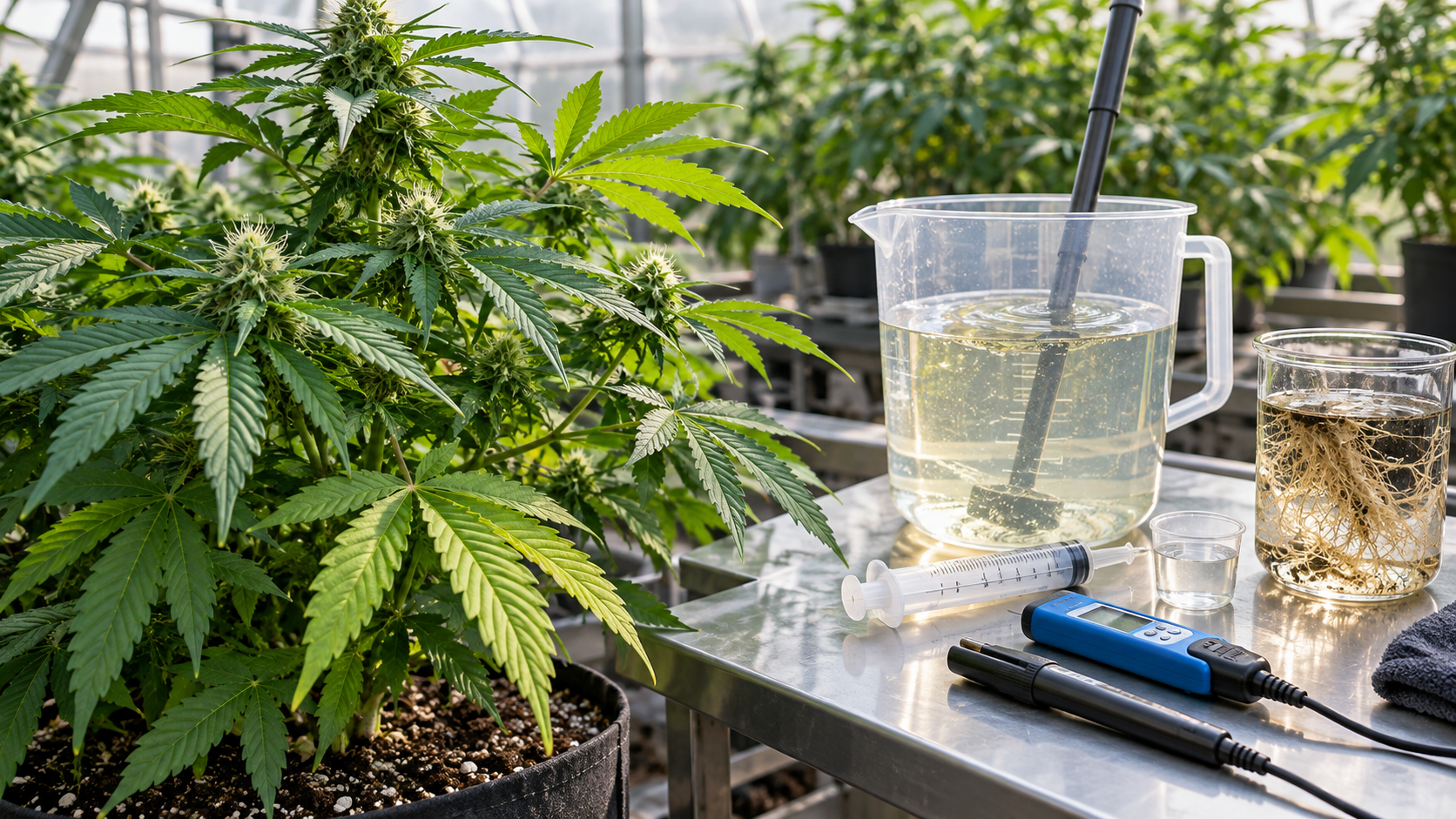
Measurement converts the symptom into a testable question. The goal is not to collect as many numbers as possible but to pair each measurement with a specific decision. Before changing fertilizer, record the stage and affected tissue; identify the exact input recipe; check source water; examine the root zone using a consistent method; then select laboratory testing when nitrogen forms or mixed symptoms remain uncertain.
Read the nitrogen line on every fertilizer label
Record total nitrogen and, where declared, nitrate-nitrogen, ammoniacal nitrogen, urea nitrogen and water-insoluble nitrogen. Confirm whether a source-water report uses nitrate or nitrate-nitrogen. Keep the complete fertilizer component list, not only the N-P-K headline. For powders, mass and final reservoir volume determine a solution; for liquids, density and label directions can matter. Do not infer elemental nitrogen ppm from a generic EC-to-ppm meter conversion.
A consumer meter labeled ppm normally estimates total dissolved solids by multiplying electrical conductivity by a device-specific factor. It does not isolate elemental N, and two solutions at the same EC can contain entirely different nitrate, potassium, calcium or sodium concentrations. When you need actual nitrogen concentration, derive it carefully from the guaranteed analysis and dilution or obtain a laboratory assay of the finished solution.
Start with source-water chemistry and alkalinity
A useful irrigation-water report includes pH, alkalinity, EC, nitrate and relevant major ions. Source-water pH describes current acidity, whereas alkalinity indicates buffering capacity and likely effects of repeated watering on medium pH. High EC may come from sodium and chloride rather than useful nutrients. Water nitrate should be accounted for in the total nitrogen budget where the concentration is meaningful.
Retest when a water source changes, when blending begins or when seasonal well or reservoir chemistry shifts. For captured rainwater, verify sanitary collection and actual composition; do not assume it supplies no dissolved nutrients or contaminants. Using an accurate report can prevent the persistent error of treating all water as chemically blank.
Input pH and EC: useful but incomplete
Calibrate meters according to their instructions and record instrument condition, sample temperature if relevant, actual mixed-solution pH and EC, and the date. The reading tells you about the prepared solution, not necessarily the solution bathing the roots hours later. Unexpected readings should prompt a repeat or calibration check before fertilizer is changed. Do not chase every small pH fluctuation with repeated acid or base additions that themselves contribute ions.
Record whether the reading is before or after fertilizer addition and whether the reservoir was thoroughly mixed. In recirculation, note top-off water, reservoir age and replacement history. In fertigation, test a representative delivered sample rather than assuming tank composition equals the concentration at every emitter.
Runoff, PourThru, saturated-media extract, and native soil tests
Container runoff can show trends, but collection timing, preceding dry-back and added water influence the result. A standardized PourThru extraction, saturated-media extract and fixed-ratio laboratory extract use different procedures and require method-specific interpretation. University extension guidance warns that identical numeric EC values can indicate very different salt statuses under different extraction methods. Choose a method, follow its protocol and compare like with like.
In soil, a laboratory soil test can estimate relevant mineral nitrogen where available and may report organic matter, pH and other context. A native field sample represents a defined depth and portion of land, not every root pocket. Do not transfer soil-test sufficiency ranges from one crop or region to cannabis without expert interpretation. If the question concerns nitrate or ammonium specifically, request those analytes; routine EC and pH results do not provide them.
Tissue analysis and representative sampling
Tissue testing measures what accumulated in sampled plant organs rather than what was supplied in the last watering. Specify the tissue type, leaf age, canopy location, stage and sampling method. Compare with reference ranges only if crop, cultivar and collection protocol are appropriate. A lab report showing high tissue nitrogen does not reveal by itself which nitrogen form is causing a new symptom, and a low leaf N result can coexist with root stress that prevents uptake.
Sample affected and appropriate comparison plants if the laboratory supports such comparisons. Do not combine old and young leaves or flower tissue in one unlabeled bag and expect a meaningful nutrient diagnosis. Record recent sprays, fertilizer applications and visible contamination, which may affect interpretation. If deterioration is localized or infectious signs are present, nutrient testing may need to accompany a separate plant-health diagnosis.
A compact nitrogen record that survives the next crop
Keep plant ID and genotype, propagation method, transition date, medium, container or bed, actual fertilizer product and dose, declared N forms, water-source report, input EC and pH, standardized root-zone values, irrigation intervals, symptom photos and one follow-up point. Record a correction on the day it is made. A response without a baseline cannot be attributed confidently to the change.
For comparative experiments, note dried usable inflorescence mass and validated laboratory chemistry, not merely greener foliage or wet harvest weight. Different drying endpoints can distort apparent yield. If no laboratory analysis is available, be explicit about that missing endpoint rather than claiming improved potency, terpene retention or smoking quality.
| Measurement | What it answers | What it cannot answer | Comparable follow-up |
|---|---|---|---|
| Full fertilizer analysis and dilution | Which N forms and approximate elemental input were intended | Whether plants absorbed them | Compare recipe and delivered sample |
| Source-water lab report | Background nitrate, salts and alkalinity | Current root-zone concentration | Repeat when source changes |
| Input EC and pH | Overall strength and acidity of mixed feed | Nitrogen ppm or single-ion balance | Calibrate and repeat at same sampling point |
| Standardized media extract / PourThru | Root-zone pH and soluble-salt trend | Exact N speciation without additional assay | Same method, timing, sampling plants |
| Tissue analysis | N status of the sampled tissue | A universal nutrient prescription or cause in isolation | Same tissue, stage and lab protocol |
| Photographs and growth log | Whether symptoms and productivity change | Exact cause without chemistry and root check | Same leaves, positions and conditions |
Warning: One EC number is not a nitrogen diagnosis
EC reflects the total electrical conductivity of dissolved ions. It does not identify nitrate, ammonium or plant uptake. Do not mix saturation-extract, casual runoff and PourThru interpretive ranges or convert meter “ppm” directly into elemental nitrogen.
How Different Nitrogen Sources and Feeding Approaches Behave
Different nitrogen programs should be compared by availability, release timing, ion balance, monitoring requirements and the production system they serve, not by a simple organic-versus-synthetic quality claim. Roots ultimately take up plant-available forms, but the path and timing by which each product creates those forms can be very different. A slow product in a cold, wet mix cannot be expected to behave like a known nitrate concentration in a controlled nutrient reservoir.
Nitrate-dominant mineral formulations
A complete mineral formulation can deliver known elemental concentrations when the product analysis and dilution are understood. Nitrate-dominant inputs allow relatively direct adjustment in inert substrates and hydroponics and are compatible with consistent monitoring. They still need suitable accompanying nutrients, an appropriate irrigation schedule, sufficient root oxygen and water chemistry control. A nitrate label is not a quality guarantee, and excessive total strength remains possible.
Avoid selecting nitrate salts only from nitrogen content. Calcium nitrate contributes calcium; potassium nitrate contributes potassium; other nitrate salts bring different ions. Adjusting one compound can move two nutrients simultaneously. A complete elemental spreadsheet or laboratory report is more reliable than swapping salts by eye.
Ammonium and ammonium-producing inputs
Small ammonium fractions can be part of a complete formulation, but large fractions have produced adverse responses in controlled cannabis experiments. Other work under different hydroponic conditions has reported different ratios as favorable for some endpoints. This disagreement makes it particularly important to report total nitrogen, the ammonium fraction, the companion ions, pH behavior and the genotype. It does not justify a universal high-ammonium or zero-ammonium prescription.
Urea, ammonium-containing salts and some organic nitrogen ultimately depend in part on transformations influenced by microbes, temperature, aeration and medium chemistry. A grower managing a living soil may have little direct control over the exact nitrate-to-ammonium ratio at each root surface. Monitor the crop and soil conditions rather than pretending a percentage on an amendment bag predicts instantaneous root exposure.
Organic amendments and living soil
Compost, meals and mixed organic amendments contribute nitrogen through mineralization and other pathways that respond to temperature, moisture, aeration and substrate biology. Their benefit may include a reserve that releases across a season, but that reserve can become inconvenient when flowering demand changes or a grower wants an immediate diagnostic correction. Organic input does not prove that nitrogen is gentle, unlimited or inherently safe from salinity and pathogen concerns.
Check amendment analysis, age, maturity, documented contamination controls and the existing substrate charge. In cold or saturated soil, slow conversion and weak roots can coincide. Adding more meal to a struggling container can create a delayed surplus once conditions improve. If a suspected shortage is severe, use appropriate laboratory advice and a known intervention rather than stacking several slow-release products.
Hybrid, liquid, dry-salt, and foliar approaches
Hybrid programs combine soluble inputs with amendment reserves; bookkeeping must include both. Liquid products are convenient but their water content does not establish crop suitability. Dry salts can support precise formulations when weighed, stored and dissolved correctly, yet concentrated incompatibilities and measurement errors are consequential. Mineral and organic liquid labels can also contain nitrogen in several chemical forms; a marketing category alone is insufficient.
Foliar nitrogen may enter through leaves in some horticultural contexts, but it cannot repair waterlogged roots, correct a contaminated stock tank or provide a reliable universal shortcut for flowering-cannabis nutrition. Sprays can burn tissue, leave residues or introduce moisture where dense flowers are vulnerable. Without crop-specific efficacy and inhalation-residue evidence, do not recommend a foliar rescue as a substitute for root-zone diagnosis. Always follow local laws and product label permissions.
Microbes and “nitrogen-fixing” products
Some soil microbes mineralize organic matter, nitrify ammonium or perform other nitrogen transformations; their functions depend on the physical and chemical environment. A product marketed as nitrogen-fixing or a microbial booster does not establish that it will supply a known quantity of available nitrogen to a specific cannabis crop. Evidence from legumes, other soil systems or a greenhouse pot study cannot simply be converted into a cannabis feeding claim.
Assess the actual nitrogen balance and plant outcome if trialing a biological product. Compare untreated and treated units under matched conditions, note the starting nitrogen reserve, and keep the measurement method identical. A greener plant after several simultaneous fertilizer changes cannot prove the microbial addition caused the response.
| Approach | Strength in the right system | Main uncertainty | Best verification |
|---|---|---|---|
| Known mineral nutrient solution | Directly calculable, adjustable elemental input | Accumulation, ion ratio, water and mixing errors | Delivered solution plus standardized root-zone check |
| Organic amended medium | Stored inputs with biological release across time | Mineralization rate and existing reserve | Soil/media test, stage and same-zone trend |
| Hybrid feeding | Combines reserve with adjustable soluble correction | Double-counted N and delayed excess | Record both inputs, test root zone |
| Liquid or dry-salt concentrate | Convenient dosing or precise weighing | Label interpretation and stock incompatibility | Actual dilution and full elemental analysis |
| Foliar or microbial addition | Potentially specialized role under proven conditions | Crop-specific efficacy, exposure and residue limits | Validated trial and root-cause confirmation |
Do / Avoid: Compare mechanisms, not marketing labels
Do: record actual elemental supply, release pathway, root-zone response and crop outcome. Avoid: assuming organic inputs cannot burn, that mineral inputs necessarily damage flavor, or that an unspecified microbial additive replaces a nitrogen budget.
A Repeatable Nitrogen Troubleshooting and Verification Sequence
A repeatable correction starts with a narrow hypothesis and ends with a follow-up on the same evidence. Changing the complete feed, irrigation frequency, reservoir pH and light intensity together may improve the crop, but it prevents a confident diagnosis. Prioritize root safety and broad system failures before adjusting the nitrogen fraction; severe wilting, root decay or equipment faults need attention independent of the leaf-color question.
Step 1: Define the failure pattern and stage
Mark the affected plants and leaves. Record whether symptoms began on old or young tissue, appeared across the entire room or only one watering group, and moved quickly or remained stable. Record stage and recent actions: transplanting, changing media, shifting photoperiod, defoliation, reservoir replacement, outdoor rain or heat. Distinguish slowed growth from discoloration alone.
Photograph the same leaves under similar lighting and mark healthy comparison growth. Normal old-leaf aging, diffuse nitrogen shortage and line-specific irrigation failure can all include yellow tissue, but they should not produce identical spatial and temporal patterns.
Step 2: Audit every nitrogen input and the water
Collect the fertilizer labels and actual dosing record. Calculate or obtain the total elemental nitrogen supplied from every base and additive where possible, including meaningful nitrate from source water. Identify nitrate-N, ammoniacal-N and urea components rather than relying on the N-P-K ratio alone. Check whether the recipe changed recently or products were mixed at the wrong concentration.
Confirm tank mixing and whether individual emitters deliver the intended solution. If one zone is abnormal, compare delivered samples from that zone with a normal zone before revising the complete system. When input chemistry is undocumented, obtain an analysis or restore a verified complete formulation rather than guessing a single supplement dose.
Step 3: Determine whether roots can use the supplied N
Review medium moisture, oxygen status, drainage, roots when accessible, source-water alkalinity and a consistent substrate extraction. A saturated container may show inadequate uptake while plenty of dissolved nitrogen is present. A strongly concentrated medium may need salt and irrigation management rather than additional fertilizer. Record the method and conditions of every root-zone reading so follow-up numbers are comparable.
If a pot is root-bound, has a failed emitter, or receives uneven water, correct the physical limitation first. If roots appear unhealthy and multiple plants decline, do not label the problem nutritional without checking disease, sanitation and environmental history as appropriate. Test nitrogen forms in the solution or tissue when a specific causal decision remains unresolved.
Step 4: Choose one justified response
When evidence confirms inadequate available nitrogen and roots function, make a controlled correction compatible with the complete nutrient formulation. When an excessive total load or high ammonium fraction is demonstrated, revise the confirmed source rather than treating darkness as the entire diagnosis. When pH drift or water alkalinity drives a mixed disorder, stabilize that system using verified guidance. Adjust the scale to the root zone, stage and prior response, not a universal ppm increment.
Record exactly what changed and why. If broad fertilizer dilution would remove necessary calcium, magnesium or other elements, reformulation may be more appropriate than reducing every ion indiscriminately. Avoid simultaneous high-dose nitrogen, magnesium and iron rescue because the next leaf response cannot distinguish which factor mattered.
Step 5: Reinspect the original plant and a control
Check the same tagged leaves and new shoot tissue, documented growth rate, irrigation behavior and standardized input and root-zone results. Older necrotic tissue will not become new tissue. Recovery is better established by arrested progression, healthy emerging leaves, renewed water use and continued flower development. If the chemistry corrected but symptoms spread, revisit the diagnosis rather than doubling the treatment.
Use the shortest observation interval that is meaningful for the identified condition and system without claiming a universal recovery-day number. Hydroponic chemistry can change quickly; tissue growth and soil mineralization can respond more slowly. Record the actual sequence, not an assumed deadline. If new patterns arise, examine whether another nutrient or root problem was present from the outset.
Step 6: Escalate rather than compound uncertainty
When several elements appear abnormal, repeated changes fail, or multiple plants develop symptoms despite correct input measurements, send properly collected media or tissue samples to a qualified laboratory. Ask a specific question, such as whether the delivered solution and plant tissue are nitrogen-limited or whether salt accumulation is restricting uptake. Provide the sampling protocol, stage and recent interventions. Laboratory numbers are evidence to interpret, not automatic instructions divorced from plant behavior.
Keep untested amendments and foliar mixtures out of flower tissue while a diagnosis is unresolved. Protect worker safety and avoid discharging concentrated fertilizer into waterways. The final validation is a stable root zone, productive leaf canopy and crop outcome, not merely a brief return to darker green.
“I changed nitrogen and phosphorus together and the plant improved. Which nutrient fixed it?”
Question source: Common grower question.
That trial cannot isolate the cause. Continue monitoring rather than retroactively assigning credit to either product. For the next comparison, establish a baseline, alter only one justified variable and evaluate the same growth points and root-zone measurements under matched conditions.
Nitrogen correction: six checkpoints
Identify the symptom pattern and stage; audit all N inputs and source water; verify root-zone and irrigation conditions; change one justified variable; photograph and measure the same plants again; escalate to a laboratory when competing causes remain unresolved.
What the Evidence Says About Flower Quality and the Final Nitrogen Decision
Plant nutrition research can overturn folklore, but it cannot make every result universal. Nitrogen trials differ by genotype, propagation history, growth stage, mineral source, rooting medium, concentration, planting density, environment and harvest endpoint. Some measure inflorescence mass, some analyze individual cannabinoid concentration, and others calculate cannabinoid yield. A recommendation is only as strong as the endpoint and system that produced it.
What controlled vegetative and flowering trials actually show
In Saloner and Bernstein’s controlled vegetative work, strongly restricted nitrogen reduced plant growth and photosynthetic performance; the reported treatment with best overall function belonged to its single tested cultivar and defined soilless environment. Their separate flowering study found yield response leveling off beyond a moderate treatment, while concentrations of several cannabinoids and terpenoids were higher in deficient, smaller plants. These are legitimate findings but do not establish that deliberately starving a crop improves its total usable yield.
A 2023 commercial glasshouse study reported lower cannabinoid concentration and total cannabinoid yield at higher N supply under its CBD-type cultivar and treatments. A 2025 CBD-type study tested several clone sources and found flower biomass rose to a plateau while genotype affected cannabinoid concentration. The differing outcomes are not a contradiction to hide. They show why a single nitrogen optimum or universal rule about potency cannot be extracted across systems.
Nitrate vs Ammonium in Cannabis Nutrition
The 2022 nitrogen-form experiment compared several ammonium fractions at fixed total supplied N. Under its cultivar and conditions, nitrate-only nutrition performed well and higher ammonium fractions sharply reduced yield and metabolic outcomes. A later deep-water culture paper examined both solution strength and nitrogen ratios, finding different responses in biomass and assayed compounds under its material. The findings should be reported together, including different cultivars, endpoints and methods. One does not establish that high-ammonium feeding is universally desirable; the other does not prove every low ammonium addition is harmful.
When comparing the papers, keep form and concentration distinct. A percentage ammonium change at fixed total N is a different intervention from changing the ratio while also changing total solution strength. Avoid treating a reported percentage of N supplied as ammonium as the same quantity as the percentage of ammonium salt in a bottle. Use the actual elemental units.
Concentration, dry mass, total compounds, and sensory quality
Cannabinoid concentration is a ratio, not the total mass harvested. A stressed plant can contain a larger percentage in less flower biomass. For production questions, measure usable dry flower weight and standardized chemical concentration, then report their combined total compound yield if validated assays are available. Distinguish this from leaf biomass, whole-plant fresh weight or a visual impression of resin.
Terpenoid profile is not identical to consumer-perceived aroma, and neither a nitrogen concentration nor a lab panel alone demonstrates smoother smoke. Drying, storage, microbial contamination and sampling affect final quality independently. Claims that excess nitrogen always causes harsh smoke, or that a preharvest nitrogen withdrawal always improves flavor, require evidence from suitable sensory, chemical and safety assessments. The current research does not justify either claim as a universal rule.
Does withholding all nutrients at the end improve flower?
Nutrient withdrawal and flushing are separate questions from maintaining sufficient nitrogen over the bulk of flowering. A 2024 controlled flushing study found generally small effects on its measured crop and cannabinoid or terpenoid endpoints. That experiment does not validate every finishing protocol or sensory claim, and it does not establish that early nitrogen deprivation is useful. Avoid using a flushing discussion to support an arbitrary day when nitrogen should be switched off.
Late-cycle adjustments should account for the actual medium reserve and whether the plant is still actively producing flowers. Nutrient input in an inert system can change rapidly; a soil amended weeks earlier may continue releasing nitrogen after liquid feed stops. Plan around tested chemistry and observed development rather than forcing both systems into a fixed zero-nitrogen finish.
The evidence checklist for product claims
Before accepting a fertilizer schedule, ask whether it identifies elemental N, the nitrogen forms and the full ion composition; the tested genetics and stage; the medium and water; a valid control; replicate plants; and an outcome relevant to your question. A photo of greener foliage is evidence of appearance, not proof of more dried flower or cannabinoids. A product claim based on other crops may provide a hypothesis but not a verified cannabis response.
Trials should also disclose whether nitrogen supply was changed alone or along with phosphorus, potassium, density, light or irrigation. If multiple interventions moved together, a positive result cannot be assigned solely to nitrogen. In practice, use peer-reviewed findings to set reasonable hypotheses, then confirm crop-specific management with repeatable measurements and, where quality matters, validated product testing.
Master advice: Protect sustained plant function first. Then distinguish whether the outcome you care about is dry usable flower, total compound yield, a verified chemical profile, nutrient efficiency or a separate sensory attribute. Different goals may imply different comparisons, but none makes nitrogen excess or deficiency a universal shortcut.
The final nitrogen decision checklist
Before increasing nitrogen, establish an actual shortage or availability problem, not simply yellow color. Before reducing it, verify excess supply, a problematic form, or a stage-specific reason supported by root-zone and plant observations. Before claiming quality improvement, verify the appropriate dry-weight and chemistry endpoints rather than relying on percentage or appearance alone.
Final decision checklist
- Confirm whether the crop is vegetative, transitioning, actively flowering or maturing from observed development.
- Know whether the nutrient number is elemental nitrogen, nitrate nitrogen, nitrate ion or a nonspecific EC-based ppm reading.
- Account for the complete base feed, optional additives, pre-amended soil and meaningful source-water nitrate.
- Confirm root moisture, oxygen, irrigation uniformity, water alkalinity and extraction-method consistency.
- Separate nitrogen shortage from magnesium or iron patterns, salt buildup, failed roots and normal senescence.
- Change only the diagnosed component and mark the same plants for a repeat check.
- Evaluate usable dry flower, chemistry and total compounds as separate production endpoints.
- Keep proprietary feed claims and experimental dose values inside their actual evidence boundaries.
For the complete elemental nutrition framework, return to the nutrients and fertilizers guide. The nutrient basics resource helps separate overlapping deficiency symptoms, while the soil and growing-media guide explains how root-zone conditions affect availability. A credible nitrogen program is one that you can describe, measure, correct and verify, not one attached to a universal week or bottle color.
Share this article
A quick overview of the topics covered in this article.
- Nitrogen Begins With Plant Physiology and Root-Zone Chemistry
- How Nitrogen Demand Changes With Stage, Medium, Water, and Environment
- Deficiency, Excess, and the Problems That Imitate Them
- What to Measure Before Changing a Nitrogen Program
- How Different Nitrogen Sources and Feeding Approaches Behave
- A Repeatable Nitrogen Troubleshooting and Verification Sequence
- What the Evidence Says About Flower Quality and the Final Nitrogen Decision
Follow us
Latest articles
October 4, 2026

October 4, 2026