
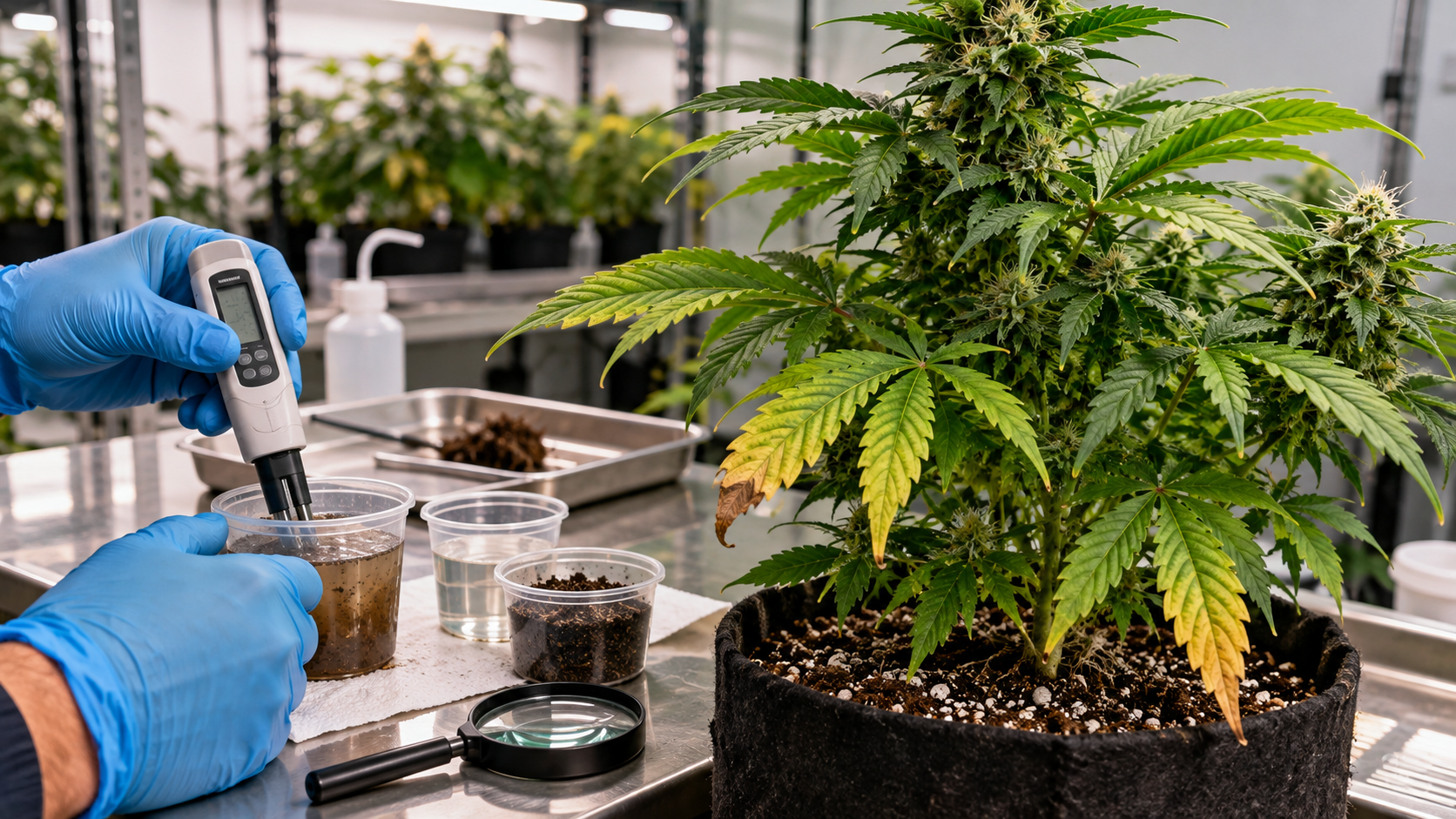
Common Cannabis Plant Problems: A Symptom-First Diagnosis Guide
A yellow leaf, a drooping top, or a brown spot tells you that the plant is under stress. It does not tell you why. The same visible symptom can result from water stress, root damage, nutrient availability, heat, light, pests, infection, or several pressures acting together.
This guide helps you narrow those possibilities without turning the first symptom into a confident diagnosis. Start with what you can observe, record, and measure. Then make the smallest useful correction, watch the plant’s response, and escalate when the evidence points to a pest, pathogen, or systemic problem.
Use this guide as the practical starting point for a plant that looks wrong today. Begin with the visible pattern, then follow the relevant pathway below.
Why a Symptom Is Not a Diagnosis
Plant diagnosis becomes more reliable when you separate symptoms from signs. A symptom is the plant’s response, such as yellowing, wilting, spotting, stunting, or tissue death. A sign is physical evidence of the causal organism, such as an insect, webbing, eggs, frass, fungal growth, spores, or sclerotia. Signs can greatly strengthen a diagnosis. Symptoms alone usually cannot.
Symptom: A visible plant response to stress or damage.
Sign: Observable evidence of a pest or pathogen itself.
For example, a wilted plant may be dry, waterlogged, root-bound, heat-stressed, recently transplanted, or affected by damaged or diseased roots. Adding more water because the plant looks thirsty could help one of those situations and worsen several others.
The goal of a first inspection is therefore not to name a disorder immediately. It is to reduce uncertainty. Ask what changed, where the symptom began, which plants are affected, how quickly it progressed, and whether you can see evidence that distinguishes one explanation from another.
Remember: Treating a visual symptom as a diagnosis is one of the fastest ways to create a second problem while trying to solve the first.
Use a working diagnosis, not a final label
A working diagnosis is a ranked explanation based on the evidence available now. It can change when you inspect the root zone, measure the growing environment, find pests under a leaf, or observe how the plant responds over the next day or two.
Write the possibilities in order instead of committing to one label. A useful note might read: “Most consistent with a wet root zone; heat stress is also possible; no visible pest signs found.” This keeps the next action tied to evidence.
Do: Compare symptoms, measurements, recent changes, and visible signs before acting.
Avoid: Applying several remedies at once. Multiple changes make it difficult to learn which factor mattered and can compound plant stress.
Some problems occur together
Real plants do not always present textbook cases. Excess root-zone moisture can reduce oxygen, weaken root function, alter nutrient uptake, and create conditions that favor root pathogens. Heat can increase water demand while a damaged root system becomes less able to supply it. Pest feeding can create wounds and reduce vigor while environmental stress limits recovery.
This is why the most useful diagnosis may be a chain of causes rather than a single name. Separate the primary driver from downstream symptoms. Correcting the driver often matters more than treating every visible effect individually.
Urgent Signs That Change the First Response
Most plant problems benefit from deliberate observation before intervention. A smaller group requires immediate containment, removal of clearly compromised tissue, or professional confirmation because delay can allow damage or spread.
Isolate first when a mobile pest may be present
Fine stippling, active insects, cast skins, eggs, honeydew, frass, or webbing justify separating an affected plant from clean plants when the setup allows it. Inspect nearby plants at the same time, especially the undersides of leaves, petioles, growing tips, and sheltered interior growth.
Do not carry tools, gloves, cuttings, or loose plant material from a suspect area into a clean area without an appropriate sanitation step. The purpose is not to declare the pest identified. It is to slow movement while identification continues.
Warning: Never use a pesticide because an image online looks similar. Confirm the target as far as practical, follow the product label and local law, and consider plant stage and residue risk. Products permitted for one crop or setting may not be permitted for cannabis.
Remove visibly decaying flower from the production area
Brown, gray, collapsing, water-soaked, or fuzzy flower tissue is not a routine cosmetic issue. Stop handling healthy flowers, isolate the affected material, and inspect the interior of nearby dense flowers. Botrytis and other flower rots can develop inside a flower before the exterior looks severely damaged.
Do not assume visibly moldy flower can be made safe by drying, trimming the outside, washing, or processing. Disposal and sanitation decisions should follow local regulations and the standards appropriate to the intended end use.
Important: A musty odor, internal flower collapse, or visible fungal growth changes the priority from “improve appearance” to “protect people, clean material, and the rest of the crop.”
Escalate unexplained systemic decline
Repeated stunting, brittle growth, abnormal branching, poor rooting, malformed new growth, or reduced flower development across clonally related plants may justify testing for systemic pathogens such as Hop latent viroid. Those symptoms are not specific enough to diagnose HLVd visually. Genetics, root stress, chemical injury, pests, and environmental problems can look similar.
If valuable stock, mother plants, or propagation material is involved, pause distribution and seek a qualified plant diagnostic laboratory. A laboratory result is more useful than repeated corrective inputs aimed at a presumed nutrient problem.
Grower question: My plant suddenly wilted even though the medium is wet. Should I water it again?
No. Wet medium plus wilt suggests that water is present but root uptake may be impaired. Check container weight, drainage, root-zone odor and appearance, temperature, and recent irrigation history before adding water.
Question sent by: MikeH_78, via email.
How to Read the Pattern Before Naming the Problem
A single leaf is weak evidence. The arrangement of symptoms across a leaf, a plant, and the growing area often provides more diagnostic value than color alone. Photograph the whole plant and the affected tissue before removing anything. Include a healthy comparison under the same light.
Distribution across the grow
Ask whether the issue affects one plant, one cultivar, one irrigation zone, one bench, one side of the room, or nearly everything at once. A sharp boundary that follows equipment, airflow, lighting, drainage, or a spray pattern raises suspicion of an abiotic cause. Random clusters can be more consistent with biological spread, but this is a clue, not a universal rule.
| Pattern | Questions to ask | Possibilities to prioritize |
|---|---|---|
| One plant only | What is unique about its roots, container, genetics, handling, or irrigation? | Root damage, local watering error, transplant injury, pest introduction, plant-specific infection |
| Plants in one zone | Do they share a light, emitter, fan, drain, intake, or environmental pocket? | Equipment issue, distribution problem, hot or cold spot, standing water, localized pest or disease focus |
| Many plants changed together | What input or condition changed immediately before symptoms? | Irrigation, feed mix, pH, temperature, light, spray injury, power or ventilation event |
| Slowly expanding clusters | Can you find pest or pathogen signs at the advancing edge? | Mobile pests, infectious disease, contaminated tools or propagation material |
Position on the plant
Record whether symptoms began on older lower leaves, younger upper growth, the canopy surface, shaded interior leaves, one branch, the crown, or the roots. Nutrient mobility can influence where deficiency-like symptoms appear, but leaf position is not sufficient by itself. Root stress, pH, salinity, light exposure, senescence, and pathogens can alter the same pattern.
Damage limited to the upper canopy may point toward excess light, heat, spray exposure, or a problem affecting new tissue. Lower-leaf decline may involve normal aging, shading, root-zone conditions, nitrogen availability, or disease. One-sided symptoms may follow airflow, a nearby heat source, a lamp footprint, or physical injury.
Speed and sequence
Sudden, widespread change after a known event often prioritizes an environmental or input-related cause. A slower progression from isolated points may raise concern about pests or disease. Neither rule is absolute. A failed irrigation event can damage plants gradually, while some biological problems can spread quickly under favorable conditions.
Reconstruct the sequence: which symptom appeared first, what appeared next, and what remained healthy? New growth that emerges normally after a correction suggests the damaging condition may have passed. Existing necrotic tissue usually will not turn healthy again, so judge recovery by new growth, progression, posture, root activity, and stable measurements.
Field Advice: Mark the edge of a lesion or photograph the same leaves from the same angle each day. Memory is a poor tool for judging slow progression.
Recent changes
Review at least the period before the symptom became visible. Look for transplanting, pruning, a new nutrient batch, altered irrigation frequency, a lamp or timer change, heat or cold events, equipment failure, pesticide or foliar application, new plants, reused containers, or a change in source water.
A recent change is not automatically the cause. It is a testable lead. Compare affected and unaffected plants that experienced the same change.
Common Cannabis Problems by Symptom
The following groups are triage pathways, not one-to-one diagnoses. Use them to decide what to inspect and measure next.
Drooping or wilting
Common possibilities: dry medium, waterlogged medium, poor drainage, root binding, root injury, high heat, low root-zone oxygen, vascular dysfunction, or advanced root disease.
Check next: container weight, moisture at more than one depth, drainage behavior, root-zone temperature, recent irrigation volume and timing, stem firmness, and roots if they can be inspected without causing major damage. Healthy roots vary by system and substrate, so compare with healthy plants grown the same way.
First low-risk move: stabilize the environment and pause reflex watering until the root-zone condition is clear. If the medium is saturated, improve drainage and correct the cause rather than attempting to solve the symptom with more input.
Yellow leaves or pale growth
Common possibilities: normal aging, prolonged root stress, nutrient shortage or imbalance, unsuitable root-zone pH, excess salts, low light, overwatering, temperature stress, or disease.
Check next: where yellowing began, whether veins remain green, whether new growth or older leaves are affected first, root-zone history, measured pH and conductivity when those tools are appropriate to the system, and whether the plant is still actively growing.
First low-risk move: verify the root environment before increasing fertilizer. A plant with impaired roots can display deficiency-like symptoms even when nutrients are present.
Tip: Compare a symptomatic leaf with a healthy leaf of the same age. Comparing an old shaded leaf with a young sun-exposed leaf can create a false pattern.
Brown spots, dead margins, or scorched tips
Common possibilities: excess fertilizer salts, uneven moisture, heat or light injury, low humidity combined with high demand, pH-related nutrient availability, physical or spray injury, leaf-spot disease, or pest feeding.
Check next: lesion shape and boundary, whether spots cross veins, whether damage is concentrated near lights or fans, the undersides of leaves, recent sprays, residue patterns, irrigation consistency, and symptom distribution across the grow.
First low-risk move: stop stacking corrective products. Confirm measurements and recent inputs. Remove only tissue that is clearly dead or poses a sanitation concern; unnecessary defoliation removes useful evidence and adds stress.
Curling, clawing, cupping, or taco-shaped leaves
Common possibilities: heat, intense light, strong airflow, root-zone stress, excess nitrogen, osmotic stress, pesticide injury, broad or russet mites, or genetic expression.
Check next: canopy and leaf temperature, distance from the light, fan direction, timing relative to feeding or spraying, new-growth distortion, and magnified inspection of growing tips and leaf undersides. Very small mites may require more than a basic hand lens and may need expert confirmation.
First low-risk move: correct a clearly measured environmental extreme and isolate suspect plants if pest signs or unexplained new-growth distortion are present.
Grower question: The leaf tips are brown, so does that prove nutrient burn?
No. Burned tips can be consistent with excess salts, but they can also appear with irregular watering, root stress, heat, or other injury. Review the whole pattern and verify the root-zone and input history before changing the feed.
Question sent by: GrowinWithDan, via contact form.
Stunted growth or short internodes
Common possibilities: inadequate root volume, root disease, low temperature, poor oxygenation, chronic overwatering, low light, pest pressure, nutrient availability problems, genetics, or a systemic pathogen.
Check next: growth rate over time, root development, stem and petiole appearance, environmental records, propagation source, cultivar comparisons, and whether clonally related plants share the pattern.
First low-risk move: compare the plant with a healthy control under the same conditions. If the pattern follows a propagation line rather than a room zone, protect clean stock and consider diagnostic testing.
White, gray, fuzzy, or powdery growth
Common possibilities: powdery mildew, Botrytis or another mold, mineral or spray residue, shed insect skins, or natural plant structures mistaken for growth.
Check next: whether material is on the surface or within damaged tissue, whether it returns after gentle removal, the presence of lesions beneath it, humidity and condensation history, air movement, dense interior growth, and magnified structure. Avoid blowing or brushing suspect spores through the grow.
First low-risk move: isolate affected plants or material, reduce handling, document the location, and seek confirmation before selecting a control. Flower contamination requires a more conservative response than a superficial mark on a vegetative leaf.
Warning: Do not rely on smell, a phone photo, or one surface feature to declare contaminated flower safe. When the intended use involves inhalation or consumption, uncertainty deserves a conservative decision.
Stippling, holes, trails, webbing, or sticky leaves
Common possibilities: mites, thrips, aphids, whiteflies, leafminers, caterpillars, beetles, plant bugs, fungus gnats, or non-pest physical damage.
Check next: both leaf surfaces, growing tips, petioles, stems, media surface, flowers, and nearby traps. Look for the organism and its life stages, not only feeding damage. Record where it appears and how the distribution changes.
First low-risk move: isolate when feasible, improve inspection coverage, and identify the pest before choosing a management action. Different organisms with similar feeding marks can require very different responses.
Brown, gray, or collapsing flower tissue
Common possibilities: Botrytis bud rot, other flower rots, insect injury followed by decay, trapped moisture, dead tissue inside dense flowers, or physical damage.
Check next: the flower interior, nearby flowers, humidity and condensation events, airflow through the canopy, insect feeding, sanitation history, and whether dead leaves pull free from within the flower. Use clean tools and avoid spreading debris.
First low-risk move: remove suspect material from contact with the crop and evaluate the surrounding area. Do not blend affected material into apparently clean material.
Plant Part and Growth Stage Clues
The same symptom carries different weight depending on where and when it appears. Seedlings, mature vegetative plants, flowering plants, and stock plants have different vulnerabilities and different consequences if a diagnosis is missed.
| Location or stage | High-value observations | Problems to keep in view |
|---|---|---|
| Seedlings and fresh cuttings | Stem constriction, media saturation, failed rooting, collapse at the soil line, temperature swings | Damping-off, propagation stress, poor aeration, desiccation, sanitation failure |
| New upper growth | Distortion, cupping, color between veins, stalled tips, pest signs under small leaves | Environmental extremes, micronutrient availability, mites, spray injury, systemic decline |
| Older lower leaves | Uniform yellowing, spots, shading, contact with wet surfaces, progression upward | Senescence, root stress, nutrient redistribution, leaf-spot disease, chronic moisture issues |
| Stem and crown | Discoloration, soft tissue, cracking, cankers, girdling, boring, vascular discoloration | Mechanical injury, crown or stem disease, borers, constriction, vascular dysfunction |
| Roots and medium | Odor, texture, color relative to healthy controls, circling, dead tips, drainage, insect larvae | Overwatering, low oxygen, root binding, root aphids, fungus gnat larvae, root disease |
| Flowers | Internal browning, dead sugar leaves, fuzzy growth, insects, trapped moisture, damaged tissue | Botrytis and other rots, caterpillar injury, powdery mildew, environmental breakdown |
Seedlings and clones can fail quickly
Young plants have small reserves and sensitive stems and roots. Collapse at the media line, constricted tissue, persistent saturation, or an expanding patch of losses deserves immediate attention to sanitation, propagation environment, irrigation, and possible damping-off. Do not reuse suspect media or tools without an appropriate sanitation process.
Flowering changes the risk calculation
Dense flowers can trap moisture and hide decay. Controls that might be acceptable in vegetative production may be unsuitable near harvest or for the intended end use. Always consider label restrictions, residue, worker safety, legal requirements, and whether the product is registered for the crop and setting.
Master Advice: Diagnose with the final product in mind. A decision that protects plant appearance but creates residue or contamination risk is not a successful correction.
Normal development can resemble a problem
Older shaded leaves can senesce. Some cultivars naturally display unusual color, leaf shape, internode spacing, or vigor. Seasonal outdoor changes, transplant adjustment, and the transition into flowering can alter plant appearance. Normal does not mean “ignore it”; it means compare the plant with its history, cultivar peers, and growth stage before treating it.
The Main Cannabis Problem Families
Once the visible pattern is recorded, sort the leading explanations into broad families. This reduces random treatment and creates a logical route to the correct detailed guide.
Water and root-zone problems
This family includes underwatering, overwatering, poor drainage, low root-zone oxygen, root binding, irrigation nonuniformity, unsuitable root temperature, and root diseases. Aboveground symptoms often overlap because all of these can reduce water and nutrient uptake.
Container weight, moisture distribution, drainage time, runoff behavior where relevant, root inspection, irrigation records, and comparison with healthy containers are more informative than leaf posture alone.
Nutrient availability and root-zone chemistry
A plant can show deficiency-like symptoms because an element is insufficient, unavailable at the current root-zone conditions, poorly distributed, antagonized by another input, or inaccessible to damaged roots. Excess inputs can also injure roots and leaf margins.
Review the full recipe and mixing order, source water, measured root-zone values appropriate to the growing system, irrigation frequency, and calibration of meters. Avoid chasing individual leaf colors with repeated additives.
Environmental and physical stress
Light intensity, heat, cold, humidity, airflow, wind, waterlogging, drought, physical damage, and spray injury can produce rapid and patterned symptoms. Equipment footprints and room maps are especially useful here. Compare measurements at plant level rather than relying only on a wall-mounted sensor.
Environmental stress can also predispose plants to biological problems. Correcting the environment does not prove that a pathogen is absent, but it removes a factor that may be driving disease development.
Arthropod and insect pests
Pest diagnosis becomes stronger when you find the organism, eggs, cast skins, webbing, frass, honeydew, or a characteristic feeding pattern. Scouting must cover upper and lower leaf surfaces, the canopy interior, stems, flowers, and the root zone when symptoms justify it.
Prevalence varies by region, production environment, season, and crop type. A pest described as common elsewhere may not be the leading explanation in your grow.
Fungal, oomycete, bacterial, viral, and viroid problems
Plant pathogens can affect leaves, stems, crowns, roots, flowers, and the vascular system. Some produce visible signs; others require microscopy, culturing, molecular tests, or professional examination. Similar symptoms may be caused by different organisms, and a single organism can produce different symptoms under different conditions.
Laboratory confirmation is especially valuable when the result will determine whether stock plants are destroyed, propagation is stopped, a facility is sanitized, or an expensive control program is started.
Grower question: Can I diagnose HLVd from weak growth and small flowers?
No. Those observations can justify suspicion, especially when a pattern follows a clone line, but they do not confirm HLVd. Protect clean propagation material and use an appropriate laboratory test for a consequential decision.
Question sent by: OldManKush, via Facebook page.
Genetic, developmental, and systemic patterns
Variegation, unusual phyllotaxy, fasciation, weak vigor, leaf deformity, and other atypical traits can be genetic or developmental. Similar appearances can also come from pests, pathogens, chemical injury, or environmental stress. Compare multiple plants from the same seed lot or clone source and track whether new growth remains stable.
Do not use a genetic explanation as a shortcut when the pattern is spreading, worsening, or associated with visible pest or pathogen signs.
A Repeatable Cannabis Diagnostic Workflow
A repeatable process is more valuable than memorizing hundreds of symptom photographs. Use the same order each time so urgent risks are contained and useful evidence is not destroyed.
1. Observe without changing anything
Photograph the entire plant, the affected plant part, and a healthy comparison. Note date, cultivar, growth stage, plant location, first symptom, symptom position, severity, and the number of affected plants. Inspect both leaf surfaces, interior growth, stems, crown, medium, roots when accessible, and flowers when present.
2. Measure the relevant environment
Measure conditions at the plant, not only at the controller. Depending on the system, useful data may include air temperature, humidity, leaf or canopy temperature, light, root-zone moisture, irrigation delivery, drainage, source water, and calibrated pH or conductivity readings. Use values as evidence within the specific system, not as universal pass or fail numbers.
3. Review timing and records
Check irrigation logs, environmental trends, feed records, meter calibration, recent maintenance, applications, transplant dates, pruning, incoming plant material, and staff movement. Match the first visible symptom to events that happened before it.
4. Rank plausible causes
List a small number of explanations. For each one, write what evidence supports it, what evidence conflicts with it, and what observation or test would distinguish it from the alternatives. Include at least one abiotic and one biotic explanation when the evidence allows both.
| Candidate cause | Evidence for | Evidence against | Best next check |
|---|---|---|---|
| Wet root zone | Heavy container, recent frequent irrigation, wilt despite wet medium | Other plants on the same schedule remain vigorous | Inspect drainage and compare roots with a healthy plant |
| Heat or light stress | Upper-canopy concentration, measured hot zone, leaf cupping | Symptoms began on shaded lower growth | Map canopy and leaf temperature across the affected zone |
| Mobile pest | Stippling and expanding plant-to-plant pattern | No pests or signs found after careful inspection | Magnified inspection and traps, followed by expert identification if needed |
5. Take the smallest useful action
Contain a suspected mobile or infectious problem. Correct a verified equipment failure or environmental extreme. Restore an appropriate irrigation interval when the root-zone evidence supports it. Avoid broad, simultaneous changes that erase the diagnostic signal.
Do: Change one meaningful variable when the situation is stable enough to test.
Avoid: Flushing, feeding, spraying, transplanting, pruning, and changing light settings all at once.
6. Reinspect on a defined schedule
Decide in advance what improvement would look like and when you will check. Existing dead tissue will not recover. Look for stopped progression, normal new growth, improved posture, renewed root activity, fewer new pest signs, and stable measurements.
If the problem progresses, revise the ranked causes. Do not simply repeat the same action at a higher intensity.
7. Verify consequential diagnoses
Use a qualified diagnostic laboratory or experienced local professional when visual evidence cannot resolve the cause, when a regulated or systemic pathogen is possible, when valuable stock is involved, or when the result will trigger a major sanitation or disposal decision. Submit representative samples and follow the laboratory’s collection instructions.
Pro Tip: Contact the laboratory before collecting. The best tissue, packaging, temperature, and shipping method depend on the suspected problem and the test.
Cannabis Problem Diagnostic Checklist
Use this checklist before posting a photo, applying a treatment, or opening a detailed problem page. It creates the minimum useful case history for yourself or anyone helping you.
- Photograph the whole plant, affected tissue, and a healthy comparison.
- Record cultivar, source, plant age, growth stage, location, and date first observed.
- State whether one plant, one zone, one cultivar, or the whole grow is affected.
- Identify where symptoms began: old leaves, new growth, roots, stem, crown, or flowers.
- Describe the first symptom and the order in which other symptoms appeared.
- Inspect both leaf surfaces, growing tips, interior canopy, stems, medium, roots, and flowers as relevant.
- Look for insects, mites, eggs, webbing, cast skins, frass, fungal growth, spores, soft tissue, and unusual odors.
- Measure relevant conditions at plant level and confirm meters are calibrated.
- Review irrigation, nutrition, environmental, application, and maintenance records.
- List recent changes and compare affected plants with unaffected plants that shared them.
- Rank two or three plausible causes and write the next distinguishing check for each.
- Contain possible mobile pests or infectious material before moving tools or plants.
- Make one evidence-based correction when safe, then schedule reinspection.
- Escalate to professional or laboratory confirmation when the decision is consequential.
The best diagnosis is not the one with the most confident name. It is the one that explains the pattern, survives comparison with alternatives, and leads to an action you can verify.
Share this article
A quick overview of the topics covered in this article.
- Why a Symptom Is Not a Diagnosis
- Urgent Signs That Change the First Response
- How to Read the Pattern Before Naming the Problem
- Common Cannabis Problems by Symptom
- Plant Part and Growth Stage Clues
- The Main Cannabis Problem Families
- A Repeatable Cannabis Diagnostic Workflow
- Cannabis Problem Diagnostic Checklist
Follow us
Latest articles
October 14, 2026
October 14, 2026
October 14, 2026
October 14, 2026