
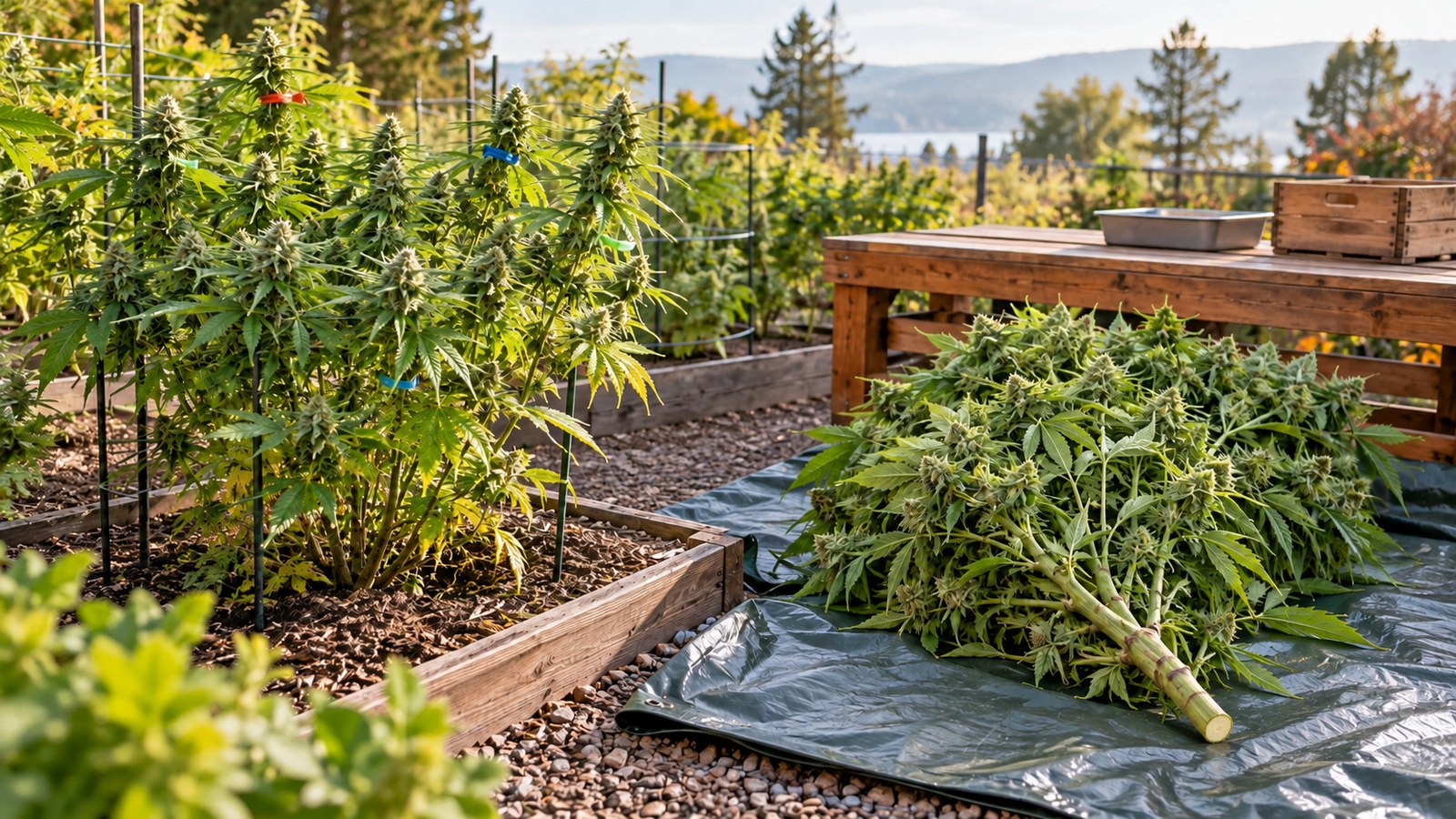
Whole-Plant Harvest vs Branch-by-Branch Harvest
A cannabis plant can look ready from above while its lower and sheltered flowers are still developing. That makes the harvest decision less straightforward than choosing between a pair of pruning shears and a saw. Should you collect every clean, usable flower in one session, or remove selected branches and allow the remainder to develop? Harvest the whole plant when maturity is sufficiently consistent, risk favors finishing together, and you can handle the entire clean crop immediately. Consider branch-by-branch harvest when identifiable sections genuinely differ in readiness, the remaining plant is sound, and you can monitor and process more than one harvest event safely.
The key is to compare the flowers that would be cut now with those proposed for later. A larger top does not prove that every lower flower is immature. An amber-colored gland does not establish a universal harvest date. Nor does leaving lower growth attached guarantee that it will acquire the same size or chemical profile as the upper canopy. A staged cut is useful only when the likely benefit exceeds the remaining exposure, handling, and processing costs.
This resource compares harvest timing and the order of removal. Cutting every branch individually on the same morning is still a single-session harvest; hanging those branches separately is a drying-method choice. Whole-plant hang drying versus branch drying belongs in a separate post-harvest discussion. For broad growing and harvest context, use the outdoor growing guide or complete indoor guide. Follow applicable local cultivation, harvest, handling, and testing rules.
Define What Whole-Plant and Branch-by-Branch Harvest Actually Mean
A harvest method answers two separate questions: which attached flowers should come off now? and what happens to them after cutting? Mixing them leads to advice that sounds precise but compares the wrong thing. A large plant can be harvested completely in one session and then divided into branches for handling. A staged harvest can yield branches that are processed in separate batches. Neither decision requires a particular hanging configuration.
Whole-plant harvest means one harvest event for the entire plant
In a whole-plant harvest, the grower confirms that the usable crop is acceptable as a group, then removes all intended material in a coordinated session. The plant may be severed at the base, or individual branches may be taken in an orderly sequence during that same event when a large or supported plant cannot be carried whole. The defining feature is that no substantial flowering portion is intentionally left to mature for a later harvest.
This method simplifies the date, plant identity, and end-of-cycle record. It can also make sense when the remaining season is unsafe, a disease concern demands a rapid disposition decision, or repeated access would damage adjacent plants. The compromise is that flowers at different canopy positions are collected together even when some are less developed. The outcome is a crop with whatever maturity variation existed at that moment; a uniform cutting date does not make individual flowers uniform.
Branch-by-branch harvest means an intentional sequence of different harvest events
In a staged harvest, identified clean branches or flower groups are collected when they meet a stated maturity and quality criterion, while other sound portions remain attached for later assessment. A later session is not automatic. Each return requires a new inspection of the retained flowers, the cut sites, weather or room conditions, plant stability, and available handling space. Staging might involve two events or more, but there is no evidence-based universal interval or number of harvest passes for all cannabis plants.
The potential benefit is avoiding a premature cut on a visibly less developed section. The costs are extra labor, more crop handling and labels, an additional wound and exposure period, and the possibility that the retained flowers do not improve enough to justify the wait. A planned second harvest is a hypothesis until repeated observations support it.
Harvest event describes when living plant sections are removed. Cutting format describes whether the material arrives in the next room as one plant, separate branches, or smaller segments. Drying configuration is a third decision. Record these separately if you want to learn which choice affected the result.
What does a better outcome mean?
Define success before cutting. For one grower it is uniformity across finished flower lots; for another it is retaining the largest amount of clean, usable dry flower within a weather window. Others may need to minimize handling hours, contamination events, or overload of the drying space. These goals can conflict. A staged harvest may produce two distinct quality grades without increasing total dry weight. A one-session harvest may simplify sanitation while requiring careful sorting of dissimilar flower groups.
Separate fresh plant weight, finished dry flower weight, discarded material, and laboratory-tested composition where testing is available. Fresh branch mass is dominated by water and includes stem and leaf; it is not comparable with usable dry flower mass. The harvest approach should not be awarded a yield advantage merely because one method leaves more stem attached to the scale.
Field Advice: Write the objective as one sentence before looking through the magnifier: for example, “Keep sound mature upper flowers separate while checking whether shaded lower flowers are still developing.” That prevents a second harvest from becoming a habit without a reason.
Sample the Canopy Before Choosing a Harvest Pattern
A whole-versus-staged decision made from the best-looking top is not a whole-plant assessment. Sample by flower position and exposure so you can discover whether the maturity difference is real, repeated, and large enough to affect the harvest. A fixed count from another research protocol is not automatically an appropriate home or commercial sampling standard. Make the sample representative of the actual canopy and expand it wherever variation or defects are found.
Map the upper, middle, lower, outer, and sheltered flower groups
Give the plant an identifier and mark its main branch groups. Examine upper terminal flowers, middle side flowers, lower or interior flowers, and any shaded or weather-facing zone with a distinct history. In a tall outdoor plant, the sunny outer lower branch may behave differently from a shaded central branch at the same height. A trained or evenly illuminated plant may show less vertical variation. Use actual exposure and growth position, not “top always ripe, bottom always unripe,” to build the map.
On a large plant, choose several representatives of each visibly different zone. If one branch looks substantially unlike its neighbors, assess it as a separate decision unit rather than averaging it away. For multiple cultivars, keep them separate. Even two plants of the same named cultivar can differ in vigor, flower initiation, and stress history.
Check comparable bract tissue and inspect the flower as a whole
With consistent magnification and lighting, observe glandular trichome heads on actual flower bracts, not only the surrounding sugar leaves. Compare a similar part of each selected flower, and note whether you are looking at outer or inner tissue. Add structural observations: bract expansion, continuing fresh floral growth, firmness relative to the cultivar’s normal appearance, signs of seed development or foxtailing, and whether apparent maturation is occurring uniformly across the section.
Capitate trichomes change in structure and appearance during flower development, but color categories are affected by genotype, tissue position, age, and how the sample is viewed. A peer-reviewed 2023 cannabis study documented differences between genotypes and among flower tissues. A 2026 study used a specific visual amber threshold in its own controlled protocol; that was a study criterion, not proof of a universal optimal harvest percentage. Never treat a single amber-trichome percentage as a validated promise of flavor, potency, or psychoactive effect.
Record repeated observations rather than a one-day impression
Photograph the same named flower group from a consistent angle and capture a comparable magnified bract view where practical. Record date, position, stage indicators, visible health, recent weather, and whether the flower continues to expand. Repeat after a practical inspection interval selected for the weather and plant, not a universal number of days. The meaningful question is whether the retained section is visibly progressing while remaining safe.
Use a simple status for each branch group: not ready, acceptable maturity, uncertain, or suspect. “Uncertain” calls for evidence and another check. “Suspect” calls for contamination control, not a rushed harvest to save the flower. Make the category independent of how beautiful or valuable the branch appears.
Inspect internal condition before touching the harvest tools
Examine dense tops, sheltered interiors, clusters touching their neighbors, previously damaged areas, and locations that remained damp after rain. Look for collapsed bracts, a dying sugar leaf emerging from an otherwise green dense flower, abnormal internal browning, gray growth, and progressive soft tissue. Avoid squeezing each cola or tearing healthy structures apart to see inside. If there is a specific suspect zone, use a low-disturbance inspection and keep contact materials out of the clean flow.
An affected flower must not be evaluated as an ordinary “early versus late” harvest unit. Separate it for appropriate disposition. If the defect is unclear, seek suitable professional diagnosis or regulated testing where available. Drying or curing is not a validated method for making visibly moldy or otherwise contaminated flower safe.
Do not blend suspect flowers with healthy harvests, trim away a visible mold patch and declare the rest safe, or use smoking, smelling, tasting, washing, extraction, or curing as an informal contamination test. Keep suspect material and its tools, gloves, and containers separate and follow applicable disposal or testing requirements.
Verify handling capacity before promising multiple harvests
Count the actual clean spaces, identified racks or receivers, available labor, and time needed to move each harvested group promptly into the next controlled operation. A small first pass can still fail if it sits in a warm wet pile while the worker continues inspecting plants. Staging helps workflow only when each wave can be documented and processed without creating backlogs.
Before the first cut, prepare plant ID, branch-group ID, harvest date, receiving label, and an explicit distinction between normal material and material on hold. If the first and second passes are meant for quality comparison, plan separate records and storage identities from the beginning. Mixing them after harvest erases the difference you wanted to measure.
“The top colas look mature but my lower branches still have fresh-looking flowers. Can I just harvest the tops and return later?”
Question sent by: Ethan Brooks, via email.
Only if the top flowers are independently ready, the lower branches are sound and genuinely developing, and the remaining plant can be monitored without unacceptable weather or disease exposure. Label the first pass and recheck the retained positions; do not assume the lower branches will finish because the tops were removed.
Interpret Maturity Signals and Use a Practical Risk Matrix
Decisions improve when each branch group is judged using four independent dimensions: current maturity, likely improvement from waiting, exposure risk, and ability to handle the harvest. These are qualitative categories for editorial decision-making, not a validated harvest model, chemical threshold, mold-risk score, or regulatory release criterion.
Use observations to distinguish real variation from optical variation
Upper flower may have received more light and developed greater biomass, yet position alone does not establish how many days earlier it chemically matures. Research has measured cannabinoid and terpene differences among upper and lower inflorescences, while other canopy architecture experiments have shown that developmental position, light distribution, density, and cultivar interact. The practical implication is to sample each portion, not to assume a universal top-first schedule.
A shaded flower may stay smaller or chemically different even if left attached. A visibly fresh flower on a sunny lower branch may still be in active development. A top that darkened after mechanical contact, heat, or disease may only look older. Repeated, comparable observations are more useful than the phrase “the lower buds need another week.”
Decision matrix: choose the harvest event, not the hanging style
| Field finding | Primary decision | What must be verified |
|---|---|---|
| Clean flowers across most sampled zones are within the intended maturity range; differences are minor. | One-session whole-plant harvest is reasonable. | All intended material can be inspected, identified, moved and processed safely. |
| Clean upper or outer groups are clearly acceptable; retained groups are observably less developed. | Consider selective branch harvest. | Remaining growth is healthy, a later recheck is possible, and exposure risk is tolerable. |
| Some groups are not ready, but worsening weather or unstable structure threatens the crop. | Reassess maturity against immediate risk; select only safe, usable material where justified. | Forecast, actual deterioration, access and handling capacity; do not call immature flower “ready” merely because rain is coming. |
| Suspicious rot, mold, chemical contamination, or floodwater exposure is present. | Hold or reject suspect material independently of harvest pattern. | Safe segregation, diagnosis or compliant disposition; unaffected groups evaluated separately. |
| Suitable processing space or staff are unavailable for the planned amount. | Resize or postpone a safe harvest event; arrange capacity first. | Receiving labels, clean space, ability to handle fresh material promptly and applicable rules. |
| Retained lower growth is declining or repeatedly unchanged rather than progressing. | Stop treating a later pass as automatic; make a new safety and quality decision. | Same-position photographs, tissue condition, development history and further exposure. |
The matrix deliberately contains no universal “cut when 20% amber” rule, flower-day limit, or staged-harvest waiting period. Published studies use different maturity measures, chemotypes, growing systems and quality endpoints. Your acceptance criterion should be explicit and feasible, not disguised as a validated industry-wide threshold.
What can the research actually demonstrate?
A 2018 investigation found chemical composition differences according to inflorescence position in its particular indoor system. A 2021 plant-architecture study reported substantial differences at low positions and suggested development or position as possible contributors. More recent controlled-environment work shows that changing within-canopy lighting can reduce variation, reinforcing that canopy position is not destiny. These experiments compare locations and production conditions; they do not isolate the causal benefit of removing upper branches on one date and lower branches later.
Laboratory cannabinoid data can answer a chemical question for the sampled tissue, provided sampling and analytical methods are valid. A visual trichome check cannot establish total terpene retention, finished flavor, inhalation safety, or total cannabinoid yield. A more uniform set of photographs likewise cannot show that staged harvesting increased dry flower production.
Consider the counterfactual before deciding to wait
The relevant comparison is not “lower flowers after waiting” versus “upper flowers harvested today.” It is “lower flowers harvested today” versus what those same lower flowers would have been if left longer, including the chance of disease, weather damage, and handling losses. In practice, one plant cannot supply both outcomes for the identical flower. Controlled trials need appropriate replication and comparable plants. A home grower can still document observations honestly, but should report a staged-harvest outcome as a grow record, not a proof that the technique caused the result.
Remember: Different dates can help separate batches by observed maturity. They do not automatically make lower flowers equivalent to top flowers, increase cannabinoid percentage, or rescue an unsafe crop.
Adjust for Cultivar, Weather, Flower Structure, and Processing Capacity
The same visible maturity contrast can justify different choices in two gardens. One plant may be stable, accessible, and exposed to a run of dry weather. Another may carry dense wet flowers before a storm, with no spare processing room. Account for conditions that change the consequences of the decision, but do not replace flower observations with a single environmental rule.
Cultivar and plant architecture change how much variation to expect
Flower density, branch length, canopy depth, pruning history, and genetic development patterns affect which sites receive light and whether flowering appears synchronous. An open, short plant with relatively even light can often be sampled and removed together without losing a major maturity distinction. A tall plant with a sheltered center or separate flowering zones may warrant mapping into multiple groups.
Do not reduce this decision to “indica whole plant, sativa staggered” or to a seed seller’s advertised flowering weeks. Those broad labels do not measure current bract development, active new growth, or hidden damage. If several plants share one cultivar name but have different weather exposure or canopy shapes, treat them as separate inspection units.
Outdoor weather can close a useful waiting window
Repeated rain, slow flower dry-down, cold conditions, heavy branch loading, and storm exposure change the risk of leaving a partial crop outdoors. Check the sequence of forecast and observed wetness rather than a single rain icon. A small amount of rain does not automatically require harvesting; persistent wetness and existing tissue breakdown require different attention from a sound, rapidly drying canopy.
When weather is the main reason for an early cut, the question belongs partly to the separate risk decision described in the outdoor comprehensive guide and its harvest and weather context. This article only asks whether the whole plant or certain independently ready, sound branches should be taken. If suspect material is present, segregate it regardless of how you decide to handle the remainder.
Indoor crop timing can also be constrained
One harvest event may be necessary when production turnover, lighting, hygiene, or other planned operations require the grow space to be cleared. Leaving lower branches attached changes the use of that space and the handling workflow. A partial harvest can also alter support load, canopy shading, or plant water demand. Do not assume that the first cut creates extra light without a tradeoff: flowers below may receive more light, but available days, leaf area, root function, and environmental stability still limit what follows.
For the general indoor harvest and flowering framework, link to the complete indoor cannabis guide rather than reproducing its entire lighting and post-harvest content here.
Flower density changes the inspection burden, not a universal cutoff
Compact inflorescences deserve particular attention for retained interior moisture, damaged sugar leaves, and unseen decay. Light, leafy inflorescences may be easier to inspect, but are not inherently free from contamination. No flower density threshold establishes a guaranteed safe waiting interval or optimal staged harvest. Evaluate actual condition in the context of recent moisture and the plant’s history.
Large branches can also be difficult to handle without bruising neighboring flowers. Prepare an accessible removal path, stable support, and a receiver for each branch. If removing one ripe branch would crush several still-developing branches, the intended precision may be lost in the process.
Drying-room capacity changes the size of a safe harvest pass
Confirm that clean fresh material can be spaced, tracked, and moved into an appropriate managed drying process without delay. A one-session cut creates a larger single intake; staged harvest creates repeated smaller intakes and potentially overlapping lots at different drying stages. Either can be manageable if there is sufficient capacity. Neither method is a substitute for verifying receiving conditions.
Do not judge capacity by the number of plants alone. Compare actual branch size, flower density, usable hanging or receiving space, access for inspection, and staffing. Fresh harvests must not be piled up for hours because the second pass is underway. Post-harvest drying research shows that processing conditions influence volatile composition and microbial outcomes, but those experiments do not prove that one harvest timing pattern is always superior.
Do: Decide how many clean and identifiable branches can move immediately into the next controlled operation; reserve distinct receiving positions for separate harvest dates.
Avoid: Cutting more than you can safely handle, then using crowded piles or an uncontrolled room to solve a scheduling problem.
Late-season plant structure becomes a second inspection task
Removing a heavy outer branch shifts loading and can expose a previously sheltered branch to wind. Inspect anchors, stakes, branch unions and neighboring supports before cutting; release any tie or trellis contact that may catch the falling limb. Afterward, check whether retained branches still carry their load safely. A partial harvest should make the plant more manageable, not leave unsupported remaining flowers to collapse.
Where an entire plant is removed at once, support remains relevant during lowering and transport. Use adequate help for large stems and plan the movement so neither the harvest nor surrounding crop contacts the ground. The objective is controlled removal with minimum flower contact, not achieving a dramatic single cut.
Recognize Failure Modes, False Readiness, and Unsafe Flower
Most avoidable errors arise from confusing an attractive external cue with maturity, or from counting the remaining crop as guaranteed future value. Harvest errors are not always fixable downstream. Distinguish biological readiness from disease and handling outcomes at each pass.
Failure: a top-only sample represents the entire plant
Large sunny colas are easy to photograph and often contain substantial flower mass. They do not represent protected interior flowers or separately initiated lateral growth. Sampling only the top makes one-session harvesting look more uniform than it may be. In the other direction, selecting the least developed lower flower can exaggerate the benefit of staging. Document the distribution and proportion of material in each group, not just its most extreme example.
Failure: sugar-leaf amber or brown pistils become a magic clock
Sugar leaves and flower bracts may show different trichome development. Pistils can darken with age, pollination, contact, environmental stress, or injury. Amber and cloudy descriptions are observational categories, not direct cannabinoid or effect assays. Use consistent bract observations, whole-flower development, the intended product specification, and repeated checks. Do not claim a particular amber percentage guarantees a specific high, aroma profile, or peak potency.
Failure: all lower buds are assumed to become top-grade flowers
Lower material can be smaller or chemically different because of light history, architecture, cultivar, and development. Removing a mature upper section may change light access, but does not reset developmental history, reverse injury, or guarantee an equal-quality second pass. Decide which lower branches have continued sound development and a plausible remaining window; document those that stall or deteriorate.
Failure: fresh weights from two methods are compared as yield
A cut whole plant carries main stem, large leaves, and water; a branch group may carry less structural material. Even two branch harvests at different starting moisture levels have incomparable fresh masses. Use consistent definitions of dry, usable inflorescence mass and separate trim, stem, and discarded material. If testing chemical content, measure a representative sample for the defined lot rather than multiplying one top-cola percentage by the whole crop.
Failure: suspect flowers are mixed with clean material
Internal rot, visible fungal growth, contaminated floodwater contact, or unexplained progressive decay changes the problem from harvest optimization to safety and disposition. Do not use selective harvest to disguise a defect or assume that adjacent flowers are cleared simply because they look normal. Segregate affected material and use approved diagnostic, testing or disposal procedures where applicable. Avoid vigorously disturbing moldy flowers or carrying contaminated tools through a healthy harvest.
Visible mold and suspected contamination cannot be made safe merely by cutting early, removing an outer patch, freezing, extracting, drying, or curing. Do not taste or inhale suspect flower to assess it. Product release, where regulated, depends on applicable controls and representative testing rather than a home visual inspection.
Failure: the second harvest causes damage to the remaining crop
A branch can snag the trellis, tear a live union, brush wet flower across another plant, or pull an anchor from soft soil. Identify the support that holds the target branch before cutting it. Use a second hand or helper to manage heavy material. Stop if the removal path is not safe. After every pass, inspect fresh wounds and the surviving structure. The tradeoff of staging includes this repeated physical exposure.
Failure: harvesting by a fixed calendar rather than reinspection
A promised return in seven days can turn into harvesting on schedule regardless of flower condition. Instead, make the second harvest conditional on a documented improvement in the intended decision unit, safe health status, and viable processing capacity. If these are absent, review the plan again. There is no universal cannabis waiting interval that converts all immature lower flowers into mature material.
“I harvested my upper branches. The lower flowers barely changed, but I had planned to cut them a week later. Should I harvest anyway?”
Question sent by: Julia Schneider, via contact form.
The calendar is not proof of readiness. Repeat the original lower-branch observations, check continuing flower development and condition, then weigh the remaining weather or production window. Record the outcome, including a decision not to harvest material that is unsafe or unsuitable.
Run a Whole-Plant or Staged Harvest From Inspection to Recheck
Use one common preparation sequence before the methods diverge. The steps are practical controls, not mandatory regulatory instructions for every jurisdiction. In a licensed operation, the approved procedures, batch definitions, testing and release requirements govern the work.
Shared preparation: establish clean material, identities, and capacity
First confirm that harvesting is permitted and the work area is safe. Map the plant and separate all suspect or contaminated material. Inspect representative flower groups, note their readiness, and decide what is intended for clean harvest. Prepare clean cutting tools, suitable handling surfaces, distinct labeled receiving locations, and a ready next-stage process. Verify enough help is available to support heavy stems and move the crop without dragging it through soil.
Create an event record: plant ID, cultivar or lot identifier where known, branch groups, date, maturity evidence, condition, selected method, responsible people if relevant, and destination. Identify the actual flower material you will weigh later. An unlabeled branch in a shared pile defeats any attempt to compare staged results.
Workflow A: complete the plant in one session
- Confirm group-level acceptance. Recheck upper, middle, and lower representative flowers. Decide whether remaining within-plant differences are acceptable for the intended outcome.
- Identify exceptions. Set aside suspect or unsuitable material for its own disposition; do not use one harvest event to combine clean and suspect flowers.
- Plan the removal path. Check base stability, trellis connections, overhead space, receiving room, and whether the plant must be divided for safe handling.
- Support and cut. Secure the load, use maintained clean tools, make controlled cuts, and carry material by sturdy stem segments rather than squeezing flowers.
- Move and label promptly. Record the single event date. If branches become separate handling units, preserve their common source and any useful position identifiers.
- Verify completeness. Inspect remaining stubs or plant base, nearby plants, work surfaces, and waste route; confirm that every clean receiving group is accounted for.
The entire plant does not need to remain intact for this to count as a whole-plant harvest. If a large plant must be sectioned for access and all intended material is collected that day, the timing method remains one-session harvest. Choose the downstream drying arrangement separately according to material dimensions and validated operating conditions.
Workflow B: select ready branches and retain defined groups
- Choose the first pass from evidence. List the exact clean, acceptably mature groups to cut, not simply “the tops.” Mark retained groups by plant and branch ID.
- Check continued viability. Confirm that the remaining flowers show development potential, no suspicious decay, and a credible weather or production window.
- Prepare a separate lot. Assign the first harvest date, branch identities, receiving container or rack positions, and any hold status before cutting.
- Cut without disturbing retained flowers. Control branch weight, release ties where needed, avoid tearing unions, and prevent flower contact with soil, shared wet surfaces, or other plants.
- Inspect the remainder immediately. Check surviving support, exposed flowers, cut surfaces, unexpected bruises, and changes in shading. Photograph the original retained inspection points.
- Set a conditional recheck. Return based on weather and observed development. Compare the same tissues and condition rather than cutting on an automatic date.
- Open a new event for the next pass. Repeat the clean/suspect assessment, harvest only acceptable material, record the new date and destination, then close the plant record when no intended clean material remains.
Keep harvest-event identities separate even when a single plant supplied both. If later mixing is allowed and useful, document when and why that happened and recognize that the resulting blend cannot preserve branch-specific comparisons. A different harvest date does not create independent genetic material; it creates another collection event from the same source plant.
After each pass, verify what actually changed
Reinspect both the cut material’s receiving status and the attached remainder. For retained flowers, compare bract appearance, continued expansion, tissue integrity, moisture behavior and structural support. Record whether a second pass remains justified. For harvested material, verify identity, separation from suspect waste, timely entry into the planned drying operation, and any visible handling damage. Do not assume a successful cut means a successful finished batch.
If weather or contamination conditions change, reopen the decision. A staged harvest is not a promise to keep the plant alive at any cost. Whole-plant harvest is not a mandate to collect every flower, including visibly unsafe material. Both methods allow rejection of material that does not meet the intended safety and quality requirements.
Do: Keep the original branch map and use the same marked retained flower sites at every recheck; record each harvest as its own event.
Avoid: Treating a first-pass success as evidence that every remaining flower will improve, or relabeling late harvest material as part of an earlier lot without an auditable explanation.
Measure outcome using the same final basis
When the batches finish their appropriate controlled drying, record usable dry flower mass using the same trim and inclusion rules. Record discarded material separately and specify when chemistry tests were performed and whether sampling was representative. Compare condition, uniformity, and actual finished product, not fresh branch weight or a single visually impressive top.
To make an informative future comparison between methods, use similar cultivars and plants, prespecify a maturity criterion, capture environmental and handling conditions, and avoid changing pruning, feeding, and drying procedures at the same time. A single season’s paired plant notes are valuable learning records, not a controlled proof that one harvest method causes a fixed yield difference.
Finish With a Quality-First Decision and Recordkeeping Checklist
A defensible harvest choice is the one that can be explained using the condition of each intended flower group and confirmed through clean handling. A whole-plant cut can be appropriate when differences are small or the window is closing. Staging can be appropriate when differences are real and a sound, observable remainder has enough time and support to develop. Neither option replaces a safety decision or an adequate processing plan.
Final decision checklist
- Define “whole” as one harvest event and “staged” as two or more intentionally separated events; decide drying format independently.
- Map representative upper, middle, lower and sheltered flower groups on each plant.
- Inspect comparable flower bracts and whole-flower development rather than using only a sugar leaf, pistil color, breeder calendar or one top cola.
- Keep suspect disease, contamination, damaged and clearly unsuitable material out of the normal harvest decision.
- Check the weather or room schedule, structural stability and the remaining plant’s ability to recover from selective cuts.
- Verify clean tools, labeled receivers, labor and adequate downstream processing space before cutting any amount.
- If maturity variation is minor and all intended clean material can be processed promptly, one-session harvest is a coherent option.
- If separate groups differ substantially and sound retained branches can be reassessed safely, consider staged harvest without promising improvement.
- Record each harvest event and branch source; compare finished usable dry mass, defects and representative quality results on the same basis.
- Stop, segregate or reject unsafe material regardless of the selected harvest pattern, and obey all applicable local requirements.
What to read next
If weather is the primary reason for considering an early cut, return to the outdoor growing and harvest overview for broader exposure management. For the full indoor harvesting context, use the indoor guide. Keep your detailed decisions about whole-plant hanging, branch hanging, trimming and curing in the separate post-harvest workflow rather than assuming they are settled by the harvest date.
The final rule is conditional, not categorical: harvest together when the acceptable crop is ready together and you can process it safely; stage only when branch-specific evidence and the remaining environment make a later decision worthwhile. The most reliable improvement is not a special number of harvest passes. It is knowing exactly what you removed, why you removed it, what you left behind, and whether the finished result met the goal.
Educational content. Follow applicable cultivation, worker-safety, testing and disposal requirements.
Share this article
A quick overview of the topics covered in this article.
Follow us
Latest articles
October 11, 2026
October 11, 2026
October 11, 2026
October 11, 2026