
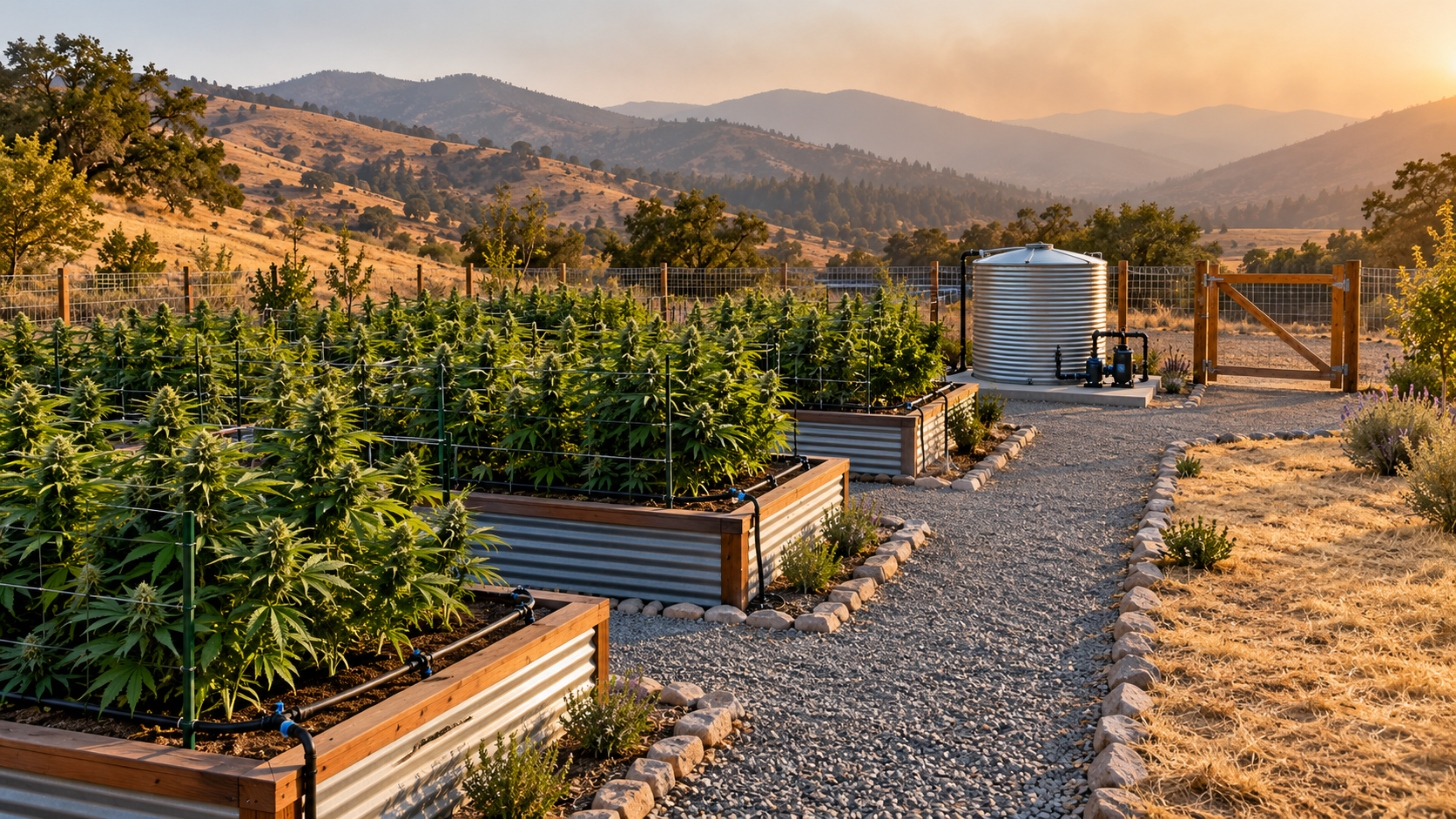
Fire-Safe Outdoor Grow Design
A fire-safer outdoor cannabis garden begins with a site you can legally access and safely leave, then reduces the fuel and ignition hazards created by the garden itself. The design must account for wildfire approaching from surrounding vegetation as well as fire starting locally at a generator, pump, damaged cable, parked vehicle, outdoor appliance, or poorly managed work area. A clear path and an evacuation plan are part of the design, not details to address when smoke appears.
There is no garden layout that can guarantee survival in a wildfire. A green canopy, irrigated soil, full water tank, fire extinguisher, or cleared strip cannot make an exposed site fireproof. Exposure depends on the landscape and the weather, including windborne embers that can travel ahead of a fire front. The practical goal is to reduce preventable ignitions, avoid connecting the garden to buildings or dry wildland fuels, preserve safe access, and know when work must stop and people must leave.
Use this resource for a lawful backyard plot, permitted rural planting, container garden, or larger outdoor cultivation site. Its focus is fire risk assessment and prevention, rather than the full growing calendar, cultivar selection, or normal irrigation design. For the wider planning process, consult the complete outdoor growing guide. Local fire authorities, land managers, building officials, insurers, and qualified electrical professionals govern the site-specific decisions that a general article cannot certify.
Define the Fire-Safety Decision Before Choosing the Grow Site
The most useful first question is not whether a particular plot gets sufficient sunlight. Ask whether that plot can be operated without creating unreasonable ignition hazards and whether occupants can leave it promptly during a wildfire. A sunny clearing at the end of a narrow dead-end track may be biologically attractive yet operationally unsuitable. An open backyard may have straightforward access but place trellises, drying vegetation, plastic screens, and containers directly against a vulnerable building.
Use three preliminary decisions. Accept a site only when lawful use, fire exposure, access, and foreseeable equipment hazards have been evaluated and the needed safeguards are realistic. Redesign when a manageable feature such as a debris pile, container arrangement, combustible attachment, or electrical placement creates avoidable risk. Reject or defer when access is unsafe, evacuation cannot be arranged, the land manager forbids the use, required approvals are unavailable, or dangerous conditions cannot be corrected before planting.
Put people and the surrounding landscape ahead of crop survival
The first design priority is the safety of residents, workers, visitors, neighbors, emergency responders, and animals. A crop is replaceable; evacuation time is not. The garden should not create an incentive to drive into a closure, stay for a last-minute harvest, run an unapproved generator during a warning, or block the only exit with a lock that cannot be opened immediately.
A secondary priority is preventing the cultivation operation from starting a fire. This means controlling engines, electricity, hot work, discarded smoking material, debris burning, vehicles, and stored fuels. The third priority is reducing loss when a wildfire arrives from outside. This requires the wider property and structure to be considered, because an isolated tidy plant bed does little if embers collect in debris against a nearby building or a combustible fence carries flames from the landscape to the structure.
Record the unit being protected
Distinguish an open field, a garden attached to a house, a detached shed or greenhouse, a rural compound with a generator, and a container plot beneath shade fabric. Their primary hazards differ. A field may require attention to approach roads, surrounding fuels, machinery and evacuation. A backyard requires a building-centered assessment of walls, eaves, decks, fences, windows, stored items, and routes used by household members. A lightweight shelter adds structural, fabric, and electrical questions.
Document the property address or authorized site reference, current access permission, responsible people, nearby occupied buildings, water supply, power source, terrain, emergency communication, and applicable fire restrictions. For a workplace, include the operating authority, trained personnel and required emergency documents. This is a planning record, not an instruction to disclose sensitive location information publicly.
Fire-safer is not fireproof
Fire-safe design means reducing identifiable ignition and exposure risks and preparing a reliable human response. No amount of garden clearance, irrigation, special planting material or equipment makes a site immune to windborne embers, radiant heat or a rapidly spreading wildfire.
Separate structural guidance from rules for an open garden
Wildfire guidance for buildings commonly describes three home ignition zones: an immediate zone extending approximately 0-5 feet (0-1.5 m) from the building, an intermediate zone of 5-30 feet (1.5-9 m), and an extended zone of 30-100 feet (9-30 m). The objective is to reduce nearby combustible material and limit opportunities for embers to start a building fire. NFPA and the Insurance Institute for Business & Home Safety emphasize keeping the immediate building zone noncombustible.
Those are building-centered mitigation concepts, not universal planting setbacks, cannabis spacing prescriptions or automatically applicable legal boundaries. They are useful where a grow adjoins a house or outbuilding. Distances and vegetation treatments for an isolated agricultural plot require a property-specific assessment, current local rules, slope and fuel conditions, and sometimes a fire professional. Some jurisdictions also regulate defensible space, structures, access width, fuel storage and emergency water separately. Treat published examples as context rather than copied legal advice.
Do not plant before resolving an unsafe escape route
If the garden has one unreliable road, an impassable gate, poor communications, or a known evacuation conflict, do not rely on a firebreak, water tank, extinguisher or last-minute vehicle trip to compensate. Change the site or resolve access with the landowner and local emergency authorities before it is occupied.
Use an honest decision register
For each hazard, record what was observed, what could happen, who is exposed, what control will be installed, who owns the correction, and how it will be verified. A simple register prevents vague assurances such as “the area has been cleared” from substituting for a measured and documented condition. Do not invent a numerical risk score that suggests scientific precision without a validated local assessment method.
| Decision | Evidence to collect | Next action |
|---|---|---|
| Proceed | Authorized site; safe access; hazards mapped; equipment inspected; workable emergency procedure | Install design and establish inspection baseline |
| Modify before planting | Removable debris, combustible layout, unsecured fuel, inaccessible disconnect or correctable gate issue | Correct and document the affected condition before proceeding |
| Defer or reject | Unsafe evacuation, unresolved high-risk equipment, prohibited access or controls outside the operator’s authority | Seek professional or authority review, choose another location, or postpone the grow |
Measure the Site: Wildfire Exposure, Access and Terrain
A site survey should follow the routes a fire, ember, worker, vehicle and emergency responder could actually take. Start with a property map and a walk completed in safe weather before the growing season. Then repeat critical observations after vegetation dries, equipment is installed, or the landscape changes. A spring photograph rarely represents the same property in late summer.
Draw a fire-exposure map, not only a planting diagram
Mark buildings, sheds, greenhouses, fuel storage, power supply, cables, pumps, tanks, vehicles, compost and leaf piles, wood fences, decks, overhanging trees, road entrances, gates, property boundaries, public paths, and adjacent wildland vegetation. Add steep slopes, narrow corridors, gullies, ridges, dead ends, drainage and known wind directions. Identify the nearest locations where smoke or fire could block the route to safety.
Use a measuring tape, wheel or reliable mapped distances for relevant features, but record the actual units and the reference points. Measure building-related zones outward from the correct building edge according to local guidance rather than guessing from the nearest cannabis pot. On an agricultural property, ask the local fire service whether access or vegetation standards are triggered by the structures, land use, or terrain. A site map is a tool for that conversation, not a substitute for it.
Follow fuel continuity from the wildland edge to vulnerable objects
Look for a connected path of burnable material: dry grass to shrubs, shrubs to low tree branches, fallen leaves beneath a fence, a wood pile beside a shed, and fabric or plastic attached to a building. Fuel continuity matters horizontally and vertically. Low branches and plants beneath trees can carry fire upward; combustible fencing may carry flame along the property toward a structure. Sparse vegetation in one spot cannot neutralize a continuous corridor elsewhere.
Inspect both the garden and the neighboring interface. You may lack authority to clear a neighbor’s land, cut protected trees, or alter a shared easement. Note the condition, communicate respectfully, and involve the land manager or relevant authority where needed. Unauthorized clearing can create environmental and legal problems while failing to address the real exposure.
Record slope, wind and dry-fuel changes together
Steep slopes can alter flame exposure and fire spread. Wind can carry embers ahead of visible flames and turn light materials into debris. Dry grass, woody litter, dead branches and accumulated clippings provide potential ignition points. A calm-day walk should therefore be supplemented with locally available wildfire hazard maps, agency fire-weather information and observations of prevailing seasonal winds.
A north-facing slope, irrigated valley floor or green crop is not automatically a safe location. Microclimates change, and ember transport can reach beyond the immediate flame front. Do not assign the site a safe status from compass direction or a single air-temperature reading. The U.S. National Weather Service issues locally calibrated fire-weather products that consider weather and fuel conditions; local forestry authorities can interpret terrain and fuel hazards in ways a home thermometer cannot.
Survey evacuation by traveling the route
Write down the normal exit, alternate exit where available, locations of locked gates, turning space, bridge or road constraints, low-clearance branches and the point where a vehicle could become trapped. Walk or drive the route legally in normal conditions. Check whether an emergency vehicle could reach the property without being blocked by parked cars, hoses, movable tanks, stacked supplies or trellis material. Obtain applicable access dimensions from the local fire authority rather than transferring an example from a US residential pamphlet to another country or an agricultural site.
For a remote site, confirm whether mobile service works where people actually work and at the entry gate. Identify another way to receive alerts or communicate if service is unreliable. Set a check-in and return procedure for people working alone. If evacuation has only one road, adopt an early-departure policy with the relevant authority rather than assuming a last-minute escape will remain possible.
“The field is open and there are no trees above it. Is that enough to call it fire-safe?”
Question sent by: Mason Reed, via email.
No. An open field can still be exposed to airborne embers, wind-driven grassfire, vehicle ignitions or a blocked access road. Inspect the field boundary, accumulated dry material, equipment locations, adjacent structures and evacuation route. Openness can reduce some direct fuel connections, but it does not establish safety by itself.
Take reproducible baseline photographs
Photograph the site entrance, both directions along the exit route, the vegetation boundary, each structure wall facing the grow, generator or power area, hose and cable runs, and fuel or waste storage. Include one overview from the same marked point each time and dated close-ups of particular hazards. A photo demonstrates a condition at one moment; it cannot certify that the site remains safe through the season.
Arrange Plants, Structures and Combustible Materials to Break Fire Pathways
Fuel management means reducing opportunities for one burning object to ignite another. It is not equivalent to scraping all vegetation from an entire property. The suitable treatment depends on whether the priority is a home, outbuilding, working area, surrounding wildland, conservation habitat or access route. An effective design removes avoidable concentrations of dry material and prevents equipment and structures from being surrounded by combustible clutter, while leaving protected vegetation and soils managed according to local environmental rules.
Start with the building, if there is one
If the grow occupies a yard next to a house, map the house and attached combustible features before placing plants. Building-focused wildfire research identifies the first approximately five feet around the exterior as especially vulnerable to embers igniting nearby fuels. Follow the applicable building and fire authorities’ instructions for creating and maintaining a noncombustible near-building area. Do not put cannabis containers, wood mulch, drying branches, potting-mix bags, plastic tubs, straw bales or decorative screens into that area as a substitute for building protection.
A wooden or vinyl privacy fence that joins a house can provide a flame pathway even if the plant bed itself is orderly. Where a fence must meet a building, examine locally accepted noncombustible transitions and have their construction approved when necessary. A metal panel alone is not a complete solution if dry leaves accumulate at its base or an attached wooden gate remains a combustible connection. Keep doors, windows, vents and access clear according to local rules.
For the broader decision about fencing and lawful screening, see whether an outdoor cannabis garden needs a fence. This fire-safety resource addresses the fence as a combustible connection, access barrier and potential source of entrapment, not as a general security or privacy selection guide.
Evaluate each garden component by what it can contribute to fire
Consider both the material and how it is used. A plastic container is combustible; so are many synthetic shade cloths, netting, polycarbonate panels, tarps, landscape fabrics, wooden stakes, cardboard, dried plant residues and stored packaging. A noncombustible metal frame may hold a combustible screen. A fabric pot may sit on dry decking or beside an exposed electrical lead. A gravel surface may reduce local ground fuels but will not protect a combustible wall if a burning shed stands next to it.
Review the actual fire-performance documentation for any product advertised as flame-retardant or fire-resistant. These terms do not mean that an entire assembly is noncombustible, suitable beside a hot engine, or safe in windborne embers. Do not invent a cannabis-specific certification for ordinary horticultural fabric. A sheltered garden may require professional design when its covers, poles and fasteners create a large wind load or occupy a regulated structure.
| Feature | Potential failure | Fire-safer design check |
|---|---|---|
| Wood or plastic fence | Flame may move along a connected combustible boundary | Assess connection to buildings; verify materials and setbacks with the fire authority |
| Shade cloth or plastic cover | Can ignite, melt, shed burning fragments or tear into power equipment | Check material documentation, mounting and separation from heat; remove when conditions or instructions require |
| Dry pruning waste and mulch | Fine fuel can collect beside walls, motors, tanks or routes | Collect regularly; place approved storage away from hazards; maintain exits |
| Wood stakes and stacked pallets | Connected or concentrated fuel close to a shed or access path | Reduce stockpiles and move authorized storage to an appropriate location |
| Gravel, paving or bare mineral ground | Reduces immediate ground fuel but does not neutralize nearby flames or embers | Use only where suitable for drainage, accessibility and local environmental rules |
| Water tank and hoses | Plastic components may fail, hoses can block escape and water may be inaccessible in a power outage | Protect the installation; keep routes clear; assess pump and outlet reliability separately |
Manage dead vegetation as the season changes
Freshly cut stems, pruned branches, dry fan leaves, failed plants and dead grass should not accumulate underneath structures or around pumps. Collect and move residues through the legally permitted waste stream before they become a season-long pile. Check that bins do not stand against building walls or block access. Where disease also affects material, use a disease-specific containment and lawful disposal procedure. A separate resource on responsible disposal of diseased cannabis material can be linked after its final public URL is verified.
Dry grasses and low limbs near the site boundary may require locally recommended thinning, pruning or mowing. Work before peak fire weather when conditions are safe. Do not use machinery or hot work during a prohibition, red-flag conditions or another locally defined stop-work period. Fuel reduction conducted at the wrong time can start the fire it was meant to prevent.
Separate crop health from wildfire resistance
Keeping plants appropriately irrigated helps horticultural health; it does not prove that they will resist wildfire. Fire-resistant landscaping guidance explicitly warns that such plants can burn, particularly when poorly maintained or exposed to severe conditions. A cannabis canopy and dense hedges should not be presented as a protective green wall. Living vegetation can be part of a managed landscape, but a crop should never be used to satisfy a noncombustible building-zone requirement.
Excess irrigation is also a poor fire-prevention shortcut. It can waste a scarce shared resource, produce runoff, waterlog roots and still leave dry vegetation or combustible structures surrounding the garden. If a water source includes a protected emergency reserve, confirm its permitted purpose and keep it distinct from routine irrigation. See backup water storage for a legal remote garden for the separate question of usable irrigation reserves.
Break fuel connections
Remove dead material, review combustible attachments and locate garden supplies away from buildings, ignition equipment and routes in accordance with site-specific guidance.
Declare a wet garden fireproof
Green foliage, watered mulch or a hose cannot replace building protection, safe equipment, fire-weather restrictions or an evacuation plan.
Avoid ecological damage during clearance
Do not clear beyond land rights, remove protected vegetation, disturb waterways or grade slopes simply to create a visually impressive strip. Bare soil can erode after rain and a poorly designed fuel break can affect habitat without reliably stopping a wind-driven fire. A September 2026 U.S. Forest Service research bulletin describes fuel breaks as tools that often help fire crews, not barriers that reliably halt fire on their own. Site-scale garden clearance must be presented with the same modesty: it reduces selected fuels but does not guarantee a fire will stop at the edge.
Field Advice: Walk the fuel pathway from the nearest wildland vegetation toward the home or work structure. Record every combustible bridge you can remove or redesign, including fences, debris, attached covers and stored supplies.
Prevent Ignition From Power, Pumps, Generators and Daily Work
An outdoor cannabis garden may use little electricity, but even modest equipment can introduce serious risks. A pump, timer, surveillance camera, security lamp, battery system or extension lead placed in a wet, dusty and vegetated setting is not equivalent to equipment installed in a protected indoor utility room. Engines, vehicles and hot tools add different ignition pathways. The safest first step is to eliminate unnecessary devices and arrange qualified installation for equipment that remains.
Inventory power before selecting the wiring
List every device, its rated electrical demand, power source, duty cycle, location, applicable enclosure rating, manufacturer requirements and shutdown procedure. Map where cords and hoses cross, where moisture collects, and which devices operate unattended. Have a qualified electrician design permanent outdoor wiring, protection, isolation and grounding appropriate to local code. Do not guess conductor sizes, overcurrent protection, waterproof connections or circuit capacity from a cannabis equipment list.
Ground-fault circuit-interrupter protection helps reduce shock risk, especially in damp or outdoor settings, but it does not make a damaged cable safe or replace correctly rated equipment and fire protection. Consult the applicable electrical code and device instructions. Outlets, junctions and connections must be suitable for their exposure and installed as complete approved assemblies; a plastic bag or taped bottle around a plug is not a weather-rated enclosure.
Do not make extension cords permanent infrastructure
A household extension cord stretched across wet ground for the entire growing season is susceptible to abrasion, water ingress, crushing, sun damage and accidental disconnection. Cords may become trip hazards during evacuation. Do not run cables through gates, under vehicle tires, through puddles or beneath combustible piles, and do not coil energized cables in bundles that prevent normal heat dissipation. Follow the manufacturer instructions for temporary use and arrange proper permanent installation for recurring loads.
Inspect accessible equipment from a safe position and with power isolated as specified by the manufacturer. Warning signs include cracked insulation, exposed conductors, wet or dirty connectors, repeated protective-device trips, heat discoloration, abnormal noise, smoke and a burning smell. Stop using suspect equipment; keep others away and contact an electrical professional. Never bypass a breaker, GFCI, thermal protection, damaged plug or other safeguard simply to keep a pump or light operating.
Position generators as a professional equipment problem
A generator combines a hot exhaust, electrical output, fuel and potentially hazardous exhaust gases. It must be operated outdoors according to manufacturer instructions, current fire restrictions and any permit conditions. The U.S. Centers for Disease Control and Prevention advises placing portable generators at least 20 feet (about 6 m) from building openings to reduce carbon monoxide exposure. That distance addresses an exhaust-exposure issue; it is not a universal wildfire separation or clearance requirement for engines near dry fuels. Follow any stricter manufacturer, fire-code or site-specific distances.
Place generators on an appropriate stable, noncombustible surface with legally required vegetation clearance, shielding, ventilation and security. Exhaust must not discharge into an occupied space, near a tent opening, toward a combustible wall or into dry vegetation. Follow local spark-arrester requirements and manufacturer maintenance schedules. A spark arrester reduces a particular hazard but cannot guarantee no ignition under extreme fire conditions. Never refuel running or hot equipment, handle fuel beside ignition sources, or store fuel in unlabeled or unsuitable containers.
Commercial operators should check local generator approvals and operating records rather than copying another jurisdiction’s rules. California’s cannabis regulator, for example, provides generator and energy-source guidance while directing operators to local air districts, utility providers and other applicable authorities. Those provisions do not create a worldwide rule for home gardens. Any new installation should be reviewed against current requirements at the actual site.
Smoke, abnormal heat or repeated electrical trips require stopping
Shut down equipment only if you can do so without approaching a fire, damaged wiring, fuel leak or other danger. Withdraw, keep others away and contact the appropriate emergency service or qualified professional. Do not reset the breaker repeatedly, cover a smoking motor with water, or attempt an improvised electrical repair to rescue the plants.
Keep vehicles and hot work away from receptive fuels
Vehicle exhaust components, mechanical failures, dragging trailer chains, rock strikes and equipment sparks can ignite dry vegetation. Choose an approved parking and loading area with appropriate ground treatment and keep vehicles out of tall dry grass. Maintain tires, brakes, exhaust and trailers. Do not assume an electric vehicle or battery-powered tool eliminates all fire risk; its charging system, damaged battery and associated wiring still need appropriate care.
Tasks such as grinding, welding, chainsaw work, mowing, trimming and fuel transfer should be planned as distinct hazard-generating operations, not casual garden chores. Check current local restrictions, permits, manufacturer controls, competent supervision, firefighting provisions required for the job and surrounding vegetation. Postpone nonessential spark-producing work when conditions or restrictions demand it. Commercial operators should implement the job-specific safety procedures required by their governing authority.
Inspect battery and solar equipment without improvising a fire system
Solar-powered irrigation or surveillance can reduce the need for a combustion generator, but it introduces electrical equipment, batteries, connectors, charge controllers and mounting systems. A weather-exposed, damaged or incorrectly installed battery system can fail. Use listed components where required, manufacturer-approved enclosures and professionally designed protective devices. Do not place batteries under piles of drying leaves, in an improvised sealed box, or where an escape path passes beside the storage area.
A small solar charger and a large stationary energy-storage system are not interchangeable. The latter may require a dedicated fire-code review, installation and emergency-response information. No battery chemistry should be declared intrinsically risk-free. Follow the manufacturer’s handling, temperature, inspection and emergency instructions and contact the relevant authority before constructing a substantial system.
Remove unnecessary ignition rather than compensating for it
Before adding a complex generator backup, ask whether a legal water-storage arrangement, scheduled irrigation, a manual operating procedure or a safer fixed power connection can meet the operational need. This is not a recommendation to sacrifice plant health; it is an engineering decision to remove avoidable failure points. A site that relies on daily improvised fueling and cords across combustible ground may need a different power architecture, location or scale.
“My pump works through an outdoor extension lead. Can I just add a GFCI and keep using it all season?”
Question sent by: Sophie Tremblay, via contact form.
A GFCI provides a particular electrical protection function; it does not change a temporary cord into a code-compliant permanent installation or eliminate damage, overheating and water ingress. Ask a qualified electrician to review a permanent outdoor circuit and suitable equipment. Stop using any compromised lead immediately.
Change the Operating Plan When Fire Weather and Vegetation Change
Fire risk is not constant through the outdoor season. Spring work may occur when surrounding plants are green and soils are moist; a later visit may take place amid cured grasses, dry debris, hot machinery and gusty winds. Repeating exactly the same maintenance routine under those two conditions is not responsible fire management. Adjust what work is allowed, who can attend and when equipment is used according to the current regional assessment.
Use the official warning system that applies to the location
Before each visit, consult the competent weather and fire agencies for current warnings, incident maps, closures, activity restrictions and evacuation notices. In the United States, a Fire Weather Watch flags the potential for critical conditions, while a Red Flag Warning indicates that critical fire-weather conditions are occurring or expected imminently under criteria established for the local forecast area. The numbers used by one National Weather Service office do not translate into universal international thresholds or even automatically into another US region.
A warning does not mean a fire is already at the garden. It means activities capable of ignition deserve special control and the site needs to be ready to respond. Conversely, the absence of a warning does not guarantee that a damaged cable, hot exhaust or debris burn is safe. Pair official alerts with visible on-site conditions and work restrictions. Canadian provinces, European jurisdictions, Australian states and other regions use their own fire-danger ratings and closure systems. Use the local system rather than converting it into US terminology.
Set task-specific stop-work rules before anyone arrives
Write down which operations must cease under a fire restriction or locally defined high-danger condition. The list may include brush cutting with spark-producing equipment, mowing dry vegetation, grinding, welding, burn piles, generator operation where prohibited, smoking, fuel transfer and other site-specific activities. Assign one person to check restrictions and communicate them to workers or helpers. Do not let an automatic schedule restart a prohibited or unsafe activity without a human review.
Not every activity requires the same response. Looking at plants from a safe, authorized location may remain possible on a day when a chainsaw or mower cannot be used. A mandatory closure or evacuation overrides routine inspections altogether. Record both the warning and the consequent operational decision so that a later observer can distinguish a planned shutdown from an equipment fault.
| Condition or signal | Operational response | Verification |
|---|---|---|
| Normal permitted conditions | Perform scheduled inspections and approved maintenance with standard safeguards | Record findings and correct routine defects |
| Drying vegetation or accumulating residues | Prioritize safe fuel maintenance before severe conditions develop | Repeat photographs of the same ground and structure interfaces |
| Fire Weather Watch or equivalent local alert | Review the forecast, restrictions, shutdown plan, communications and readiness to leave | Record current agency guidance and responsible person’s acknowledgment |
| Red Flag Warning, high-danger classification or activity ban | Stop the tasks barred by local rules and suspend nonessential ignition-generating work | Confirm equipment status and that personnel received the restriction |
| Wildfire threat, compromised road or evacuation warning | Follow the local emergency plan; those requiring extra time leave early; do not start crop salvage | Account for people after reaching a safe location |
| Evacuation order or unsafe site | Leave immediately as instructed; call emergency services where appropriate | Return only with official clearance |
Plan vegetation treatment before dangerous weather
Late-season clearance is often harder than preseason work. Dead grass has accumulated, the canopy has grown into access lanes, and shade or privacy screens may have been extended without rechecking the structure. Conduct major permitted pruning, removal and relocation while conditions are safer, not during a warning. Use hand tools or professional crews where appropriate, but do not assume that hand tools eliminate other risks such as falling branches, heat exposure or blocked access.
Keep vegetation records separate from plant-watering records. A plant can need irrigation at the same time that the operator must halt mowing or leave the property. Do not enter a threatened site just to fix irrigation. Water reserves should be designed with planned outages in mind, but reserve capacity cannot be treated as a reason to ignore an evacuation order.
Adapt to harvest season without adding new fire hazards
Harvest brings ladders, transport vehicles, tarps, drying racks, packaging, portable lights, generators and accumulated trimmed material into a site that may already be at peak dryness. Plan a designated loading location and keep it outside required access clearances. Do not stage cut branches against a building, stack boxes beneath a hot motor, or run temporary wiring through an evacuation route. Review fuel restrictions before extending work into the evening and do not use outdoor flame or improvised heating to accelerate handling.
Where smoke or ash has reached the crop, distinguish crop quality from immediate human safety. A 2025 survey of California cannabis producers documented self-reported growth impacts, operational disruptions, evacuations and variable testing practices during wildfire exposure. Its observations cannot establish a universal safe exposure duration, a predictable contaminant profile, or a rule that smoke-free-looking flower is safe. After an incident, product assessment may require qualified testing and compliance review. None of that work justifies entering a closed or damaged property.
“The forecast is hot and dry, but there is no nearby fire. Should I still postpone clearing weeds with a mower?”
Question sent by: Jordan Clarke, via X.
Check the local fire-danger level, activity restrictions, fuel condition and equipment guidance before starting. Dry grass and mechanical sparks can create a fire without an existing wildfire nearby. Do the work earlier under appropriate conditions or hire a qualified crew. No single cannabis-specific air temperature or humidity value can substitute for those checks.
Keep the weather record specific enough to improve next season
Record the date, observed dry fuels, active warning, source of the warning, wind observations, tasks stopped, actions completed and next review. Do not turn daily weather entries into a false predictive formula for the probability of fire. The purpose is to learn where a system repeatedly forces dangerous last-minute work and redesign it before the next season.
Write the Emergency Plan: Alert, Shutdown, Evacuate and Account for Everyone
Fire-safe design fails when the operator cannot explain what happens after smoke is seen, a road closes or an evacuation message arrives. The response must be usable by another authorized person, not stored only in the grower’s head or locked phone. Develop the plan with the landowner and the applicable emergency authority, and train everyone who may work at the site.
Establish a clear alert and decision chain
Identify who receives official alerts, who makes the stop-work decision, who communicates with workers and visitors, who contacts emergency services, and where people meet after leaving. For a household, include children, visitors, pets and anyone needing mobility support or extra time. For a commercial operation, follow the jurisdiction’s workplace emergency-action requirements. Oregon OSHA, for example, provides cannabis workplace guidance describing emergency-response plans and the need to control flammable waste and heat-producing equipment; its specific requirements are not universal rules for every garden.
Use the authority’s current evacuation categories and instructions. California distinguishes advisories, warnings and orders, with warnings signaling a potential threat and orders requiring immediate departure. Other jurisdictions use different labels. A garden at the end of a long single-access road may require an earlier voluntary departure than a site with multiple reliable exits. A plan should specify that judgment in advance rather than forcing workers to debate it next to the plants.
Choose the primary and alternative route before an incident
Mark the normal vehicle route, an alternate where one exists, authorized gates and their opening procedure, contact points, a meeting place outside the hazard zone and potential obstacles. Verify the route with the actual vehicle and people expected to use it. A route that requires climbing a locked fence, moving twenty grow bags, turning a trailer in a narrow lane or driving through tall dry vegetation is not ready.
Keep driveways, gates and exits free of hoses, cables, tools and parked equipment throughout the season. Never install hidden electrified fencing, traps, concealed wires or deterrents that could injure a person fleeing the site or obstruct firefighters. Protecting privacy is not a justification for dangerous access design. Where a fence is legally required, use safe exit hardware and confirm firefighter access expectations with local officials.
Define shutdown as a short optional action, not a mandatory delay
A labeled isolation point for a pump or generator can help prevent secondary hazards if it can be used safely before conditions deteriorate. Document which switches or valves are accessible, who is authorized to use them, and when shutdown must be abandoned. Do not approach a smoking electrical cabinet, fuel leak, downed power line or active flame to switch off equipment. Do not run back from a safe departure point because a controller was left on.
Remote shutdown can be useful if professionally designed and dependable, but software or mobile connectivity may fail during an outage. Test that essential functions fail to an appropriate state under the manufacturer design. Never make shutdown or rescue of a crop a condition for obeying an evacuation order. A pump left running is an operational issue for professionals after the emergency, not a reason to remain in danger.
Prepare personal essentials without prioritizing cannabis transport
Keep a communication device, appropriate first-aid provisions, water for people, transport arrangements and an accessible evacuation kit according to local emergency guidance. Households and worksites should make plans for people and animals first. Do not pack plants, dry flower, heavy grow equipment or valuable tools once evacuation is needed. Product movements, if ever permitted during an emergency, must follow regulator instructions and cannot conflict with evacuation.
Oregon’s cannabis regulator has published emergency resources addressing wildfire evacuations and exceptional licensed-product transfers. That is a state-specific example of why commercial inventory decisions belong in an approved advance plan. It is not permission for a home grower in another jurisdiction to move controlled products through closed roads or bypass possession rules.
Distinguish first-response equipment from fighting a wildfire
Where required, provide appropriate serviced extinguishers, water access and first-response equipment determined by the local fire authority and the site hazard assessment. Train personnel for their authorized roles. Portable extinguishers are suitable only for certain small, contained incipient fires when an alarm has been raised, the correct extinguisher is available, the person is trained and a clear escape route remains behind them. They are not a plan for defending a field, shed or building against a spreading wildfire.
Hoses, buckets, portable tanks and pumps may form part of an approved site protection system, but flow, pressure, access, reserve and trained personnel must be reviewed by the competent authority. Do not connect an irrigation tank to an improvised wildfire suppression network or advertise a garden hose as a substitute for municipal or professional fire response. Keep any legally required fire-water allocation separate from plant irrigation so it is not silently consumed during dry weather.
Evacuation takes priority over the plants
If authorities order evacuation, leave immediately by the instructed route. If smoke, flames or a blocked road already make the site dangerous, leave or follow emergency guidance without waiting for a formal notice. Never stay to harvest, water, move tanks, defend structures or retrieve a forgotten tool.
Practice one tabletop scenario and one safe route check
During a quiet part of the season, ask each responsible person what they would do if a warning arrived while a generator was operating and the normal road was closed. Have them locate the alerts, communication method, exit hardware and meeting place. Run a safe non-emergency route check without creating a simulated fire or disabling protective equipment. Record confusion, revise the map and repeat orientation when staffing or site layout changes.
Master Advice: The emergency plan succeeds when everyone can leave without waiting for instructions from the person who usually manages the garden.
Inspect Failure Points and Verify That Corrections Work
A fire-safety inspection is not a general stroll through the crop. Follow the same route, use the same observation points, and test whether each protective measure still works. Start at the entrance and escape path, move to buildings and nearby fuels, then inspect equipment and the garden boundary. This sequence prevents an operator from concentrating on flowers while missing a locked exit, fuel leak or new pile of dry vegetation.
Use a stop, correct and retest sequence
When an unsafe condition is discovered, stop the activity that creates or exposes the hazard. Record the condition without approaching energized, burning or unstable equipment. Assign the correction to someone qualified and legally authorized to perform it. After correction, repeat the original observation or functional check under safe conditions. An issue is closed only when the specific failure has actually been addressed, not when a checkbox has been signed.
For example, if a cable’s outer insulation has cracked, merely moving it away from a puddle does not make it serviceable. Replace or have it assessed according to the applicable procedure and verify the corrected installation. If pruning waste has filled the corridor beside a shed, moving the pile to the other side of the same shed does not remove the relevant fuel exposure. Confirm its final location and approved disposal. If an emergency gate sticks, repair it and have another authorized person demonstrate opening it promptly.
Inspect the perimeter before the equipment
Check for fresh litter, windblown debris, new dead grass, branches overhanging structures, fuel continuity into adjacent vegetation, damaged screens, and changes caused by neighboring activity. A fence installed for privacy can become a new combustible connection to a building, and a shade structure can change both access and debris accumulation. Photograph changes from the same marked position and compare them with the pre-season baseline.
Inspect the site after major wind events only when it is safe to enter. Fallen branches may strike power lines or create unstable overhead hazards. Do not touch or approach downed wires, burning material, structurally damaged sheds or unstable trees. Contact the utility or emergency authority. A separate post-storm cannabis inspection can cover crop damage once the broader site has been declared safe.
Check access as a working system
Walk the route with the same equipment a departing worker would carry. Test that doors or gates open without a hidden key or an obstruction, that hoses and power leads cannot trip people, and that parked vehicles leave usable passage. Check that route maps and assembly locations still match the site. If there is one exit, record the added exposure and the earlier departure policy. Do not claim that every garden needs exactly two exits irrespective of local design and legal context; follow the authority’s assessment and applicable workplace standards.
Verify equipment corrections with the right professional
Visual inspections can reveal cable damage, loose mounts, fuel stains, blocked vents and missing labels. They cannot certify circuit safety, battery condition, generator exhaust compliance or a structural foundation. Refer abnormal electrical and mechanical conditions to qualified personnel and obtain the test or service record appropriate to the equipment. A power monitor showing ordinary consumption cannot establish that every connection is safe. Likewise, a pump that starts successfully does not prove its controller, cable and protection devices are correctly installed.
For generators and engines, inspect and maintain according to manufacturer instructions and the local fire authority’s requirements. Document fuel and exhaust condition, approved operating location, clearance and any required spark arrester. The U.S. Forest Service’s spark-arrester guidance states that such devices cannot provide complete protection during extreme danger; restrictions or shutdown may still be necessary. If maintenance cannot be verified, do not operate the engine as though it has passed.
Inspect stored fuel and chemicals by their actual hazards
Not every fertilizer is flammable, and an ordinary nutrient container should not automatically be classified as a fuel can. Review safety data sheets for each chemical, appropriate separation, secure labeling and legally permitted storage. Keep gasoline, solvents or flammable cleaning materials away from ignition sources and incompatible chemicals. Do not keep chemicals in drinking-water or food containers. Commercial operations may have additional inventory, spill-control and personnel-training duties; the relevant rules must be checked locally.
Recognize the limits of a clear site after smoke or fire
An area can look tidy while buried roots continue to smolder, ash remains hazardous, a tree is unstable or damaged electrical equipment is energized. Never return after a wildfire until officials authorize it. Once authorized, evaluate trees, structures, utilities, water and soil hazards with qualified assistance before restarting equipment or handling crop. CDC guidance warns that ash exposure and other post-fire hazards remain after visible flames disappear. A successful fire prevention inspection is not a food or inhalation-product safety assessment.
Smoke and ash may also affect flower quality and contamination. The California producer survey reports self-assessed impacts and some post-exposure testing, but the respondents were not a controlled trial and the data cannot establish a universal clearance standard. Do not assume that rinsing, extra drying, trimming or a normal appearance makes exposed flower safe. Follow applicable testing and disposition requirements and seek qualified laboratory advice when product safety is uncertain.
A control works only when its failure mode is resolved
Verification means repeating the relevant observation, functional test or professional inspection after a correction. A photographed clean corridor verifies access at that time; it does not prove electrical safety. An electrician’s report verifies the assessed system and conditions, not a permanent absence of future faults.
Maintain a small set of observable site indicators
Useful indicators include whether exits and emergency access are unobstructed, dry debris has accumulated, combustible materials have been moved into a building zone, equipment defects remain open, official activity restrictions are being followed, alerts are reaching everyone, and training remains current. Use pass, corrective action required, or stop-work labels linked to observable findings. Avoid giving the site a manufactured fire-safety score or claiming that a particular number of clear feet around a plant guarantees protection.
Assign reinspection intervals to risk and change
At minimum, complete a documented pre-season survey and a recurring in-season check suitable for site risk, occupancy and applicable rules. Repeat inspections after substantial wind, new construction, vegetation dieback, installation of a power system, changes to access or fire-weather alerts. A weekly checklist can be useful for a small lawful garden, but it does not supersede more frequent manufacturer, workplace or authority requirements. Any immediate life-safety defect needs action when discovered, not at the next scheduled visit.
Remember: “Inspected last week” does not answer whether a gate is blocked, a generator is leaking or a red-flag restriction applies today. Recheck the hazards that can change between visits.
Fire-Safe Outdoor Grow Design: The Pre-Season and Weekly Field Checklist
The final check should turn the site plan into an operating routine. Work through the list before planting and repeat the abbreviated checks during the season. Mark each item complete, needing correction, not applicable with a reason, or stop work. Keep dates, responsible persons, photographs and relevant professional records together. If an item is outside the operator’s competence or authority, assign it to the appropriate professional rather than marking it complete.
Pre-season approval and layout
Confirm the site before planting
- Verify cultivation permission, legal access, land use, relevant fire restrictions and required approvals.
- Consult the local fire authority or land manager about wildfire exposure, structures, access and vegetation treatment.
- Map buildings, garden areas, dry fuels, slopes, engine locations, fuel storage, roads, gates and water sources.
- Identify all normal and alternate evacuation options; document any unavoidable single-road exposure.
- Walk and test the evacuation route and gate hardware with the people who will actually use them.
- Assess building-centered defensible space separately from the open-field planting layout.
- Remove or relocate unsafe combustible connections, dry debris and stacked supplies as legally permitted.
- Confirm shade fabrics, fences, trellises and other structures do not block exit or create avoidable ignition pathways.
- Have permanent outdoor electrical work and complex energy systems reviewed by qualified professionals.
- Confirm the generator, engine and fuel arrangements meet manufacturer guidance and the applicable jurisdiction.
- Document any required fire-water supply separately from routine irrigation capacity.
- Prepare alerts, emergency contacts, assembly point, employee or household responsibilities and exit instructions.
- Confirm appropriate extinguishers and training where needed; do not plan to fight a spreading wildfire.
- Photograph the baseline and record unresolved actions. Do not open the site while a serious safety condition remains.
Weekly inspections and condition-triggered checks
On a normal safe visit, begin at the access point. Check the current warning and restrictions before starting equipment. Walk the exit route and the perimeter, then inspect only equipment that can be safely examined by the operator. Photograph any change and assign a correction. Repeat after wind damage, fuel accumulation or a change in the site configuration. If warnings, closures, smoke or power hazards make entry unsafe, the inspection is canceled and the emergency procedure takes priority.
- Alerts: Verify the current local fire-danger information, active restrictions, closures and incident reports.
- People: Confirm who is on site, who is responsible, communication works and the meeting point remains available.
- Access: Inspect exit gates, roads, parking, turning space, hose and cable crossings, and emergency vehicle clearance.
- Fuels: Check dead grass, fallen branches, waste, mulch, stacked packaging and combustible materials against structures.
- Equipment: Review accessible visible condition, unusual heat, fuel leakage, cable damage and maintenance status without exposing anyone to the hazard.
- Water: Confirm any authority-required emergency provision independently of irrigation reserve, with no assumption that a hose enables fire defense.
- Change: Compare same-location photos; record new adjacent activity, dry vegetation, installed screens or blocked routes.
- Closure: For each correction, record the responsible person, evidence of retest and outstanding professional work.
Use a final stop/go check before high-risk work
Before mowing, cutting, grinding, engine operation, fuel handling or another potential ignition task, ask: Is this activity permitted today? Is the equipment suitable, maintained and safe to use? Have the surrounding fuels, trained people and required safeguards been checked? Can everyone leave promptly? If an answer is unknown and its failure could create fire, defer the task and obtain the necessary information or professional service. The cost of postponing work is not evidence that proceeding is safe.
Choose a verified response
Use current official alerts, an unobstructed escape route, maintained equipment, documented fuel controls and a prearranged evacuation plan.
Let crop value override safety
Never stay through an evacuation order, enter a closure, fight a developing wildfire or use improvised electrical and fuel systems to finish a growing cycle.
Decide what to do when the plan fails
If a serious hazard is not corrected, pause the affected operation or stop using the site. If local authorities issue an evacuation instruction, leave and account for people. Once the area is officially safe, assess damage and contamination through the appropriate professionals before resuming. Do not equate physical survival of plants with safe-to-consume flower or safe electrical infrastructure.
A fire-safer garden remains an actively managed place. The quality of its design is demonstrated by a realistic siting decision, fewer preventable ignition sources, reduced fuel connections, safe access, clear authority boundaries and documented verification. When those conditions cannot be maintained, the correct gardening decision is to change the design, postpone work or abandon the site rather than treat the crop as more valuable than the people and land around it.
Share this article
A quick overview of the topics covered in this article.
Follow us
Latest articles
October 18, 2026
October 18, 2026
October 18, 2026
October 18, 2026