
Hugelkultur for Cannabis: Benefits, Risks and Bed Design
Hugelkultur can work for outdoor cannabis, but it is not a shortcut that turns buried logs into a maintenance-free, self-watering bed. The useful version is a deep, stable raised bed with a limited woody core, a generous layer of real growing soil above it, a drainage path below it, and irrigation that is adjusted from measurements rather than folklore. A fresh mound built mostly from wood is a poor place to transplant a valuable cannabis plant immediately.
The distinction matters because cannabis is a fast-growing annual with a large seasonal demand for water, oxygen, and available nutrients. Decomposing wood can eventually contribute pore space and water storage, but the same bed can also settle, create dry voids, temporarily immobilize nitrogen near the wood, or remain too wet where fine soil overlies a coarse layer. Hugelkultur should therefore be treated as a site-specific bed design, not as a universal recipe.
What is hugelkultur?
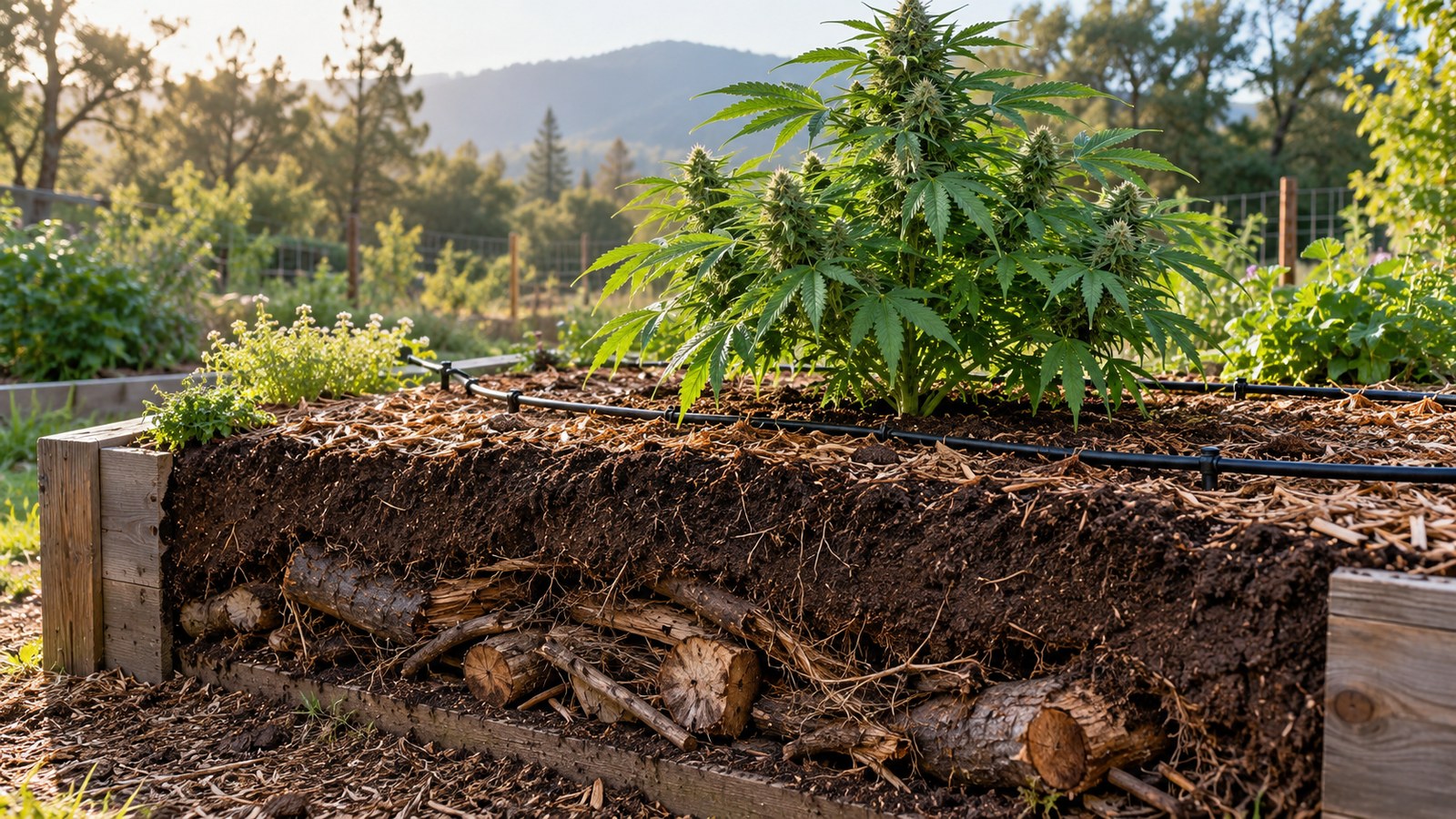
Hugelkultur—German for “mound culture”—is a planting bed built over or around woody material such as logs and branches. Smaller organic residues and soil fill the spaces, while the crop grows in the mineral-soil and compost layer above the wood. As the buried wood decomposes, the bed changes physically and biologically over several seasons.
How Hugelkultur Actually Works
A hugelkultur bed is not one uniform root medium. It is a vertical profile with different materials, pore sizes, decomposition rates, and water behavior. The upper layer should function as the immediate cannabis root zone. Below it, smaller organic material fills gaps and connects the soil to a woody core. The lowest layer is the site’s native soil or a bed floor that must allow excess water to leave.
Wood does not begin as a perfect sponge. Dry, intact logs may absorb water slowly, and large air gaps around them can interrupt capillary movement. As fungi and other decomposers colonize the wood, its structure changes. Cracks, softened tissue, and decomposed surfaces can hold more water than fresh wood, while the bed loses volume and settles. The practical benefit, when it occurs, develops over time.
The buried carbon also changes nutrient cycling. Microbes decomposing high-carbon material need nitrogen to build biomass. Where fresh chips, sawdust, or small branches have extensive contact with the growing soil, those microbes can temporarily convert mineral nitrogen into microbial biomass. This is nitrogen immobilization: the nitrogen has not vanished, but it may be less available to cannabis roots during a critical growth period. Large logs have less surface area than the same volume of chips, so the effect is usually concentrated near the wood–soil interface rather than evenly across the whole bed.
Keep the plant in a real soil root zone
Give the transplant a deep, continuous layer of tested soil above the woody core. The root ball should not sit in a pocket of sticks, unfinished compost, or open voids.
Treating wood as cheap potting mix
Logs can occupy part of a deep bed, but they do not replace the stable mineral soil, mature compost, pore structure, and available fertility required by a fast-growing annual crop.
What the Evidence Supports—and What It Does Not
Direct controlled research on drug-type cannabis grown in hugelkultur beds is not available in the published literature reviewed for this guide. The recommendations below combine research on hugelkultur-style beds, established soil science, university raised-bed guidance, and Cannabis sativa studies on root-zone water and growing media. That makes them evidence-informed design rules, not proof that a hugelkultur bed will outperform a conventional raised bed for cannabis.
The limited comparative research also warns against repeating promotional claims as facts. In a small subarctic garden-bed study, standard raised boxes and hugelkultur-style boxes produced more kale biomass than in-ground plots, but the differences were not statistically significant. Both elevated bed designs warmed earlier and held substantially less moisture than the in-ground treatment during the study. In other words, elevation, climate, bed geometry, and exposure affected the result; buried wood did not automatically create a wetter bed.
| Claim | Evidence-Based Reading |
|---|---|
| “The bed waters itself.” | Decomposed wood may add water storage, but new beds still require irrigation and monitoring. Elevated mounds can also dry faster in wind and sun. |
| “Buried wood supplies all nutrients.” | Wood is carbon-rich and nutrient release is slow and variable. Cannabis fertility should still be based on soil tests, plant response, and the chosen production system. |
| “More wood means a better bed.” | Excess wood reduces the volume of stable soil, increases settling, and can create voids or sharp moisture transitions. |
| “Raised means well drained.” | Elevation can help, but water still needs an outlet. A saturated subsoil, low site, sealed bed floor, or surrounding runoff can keep the lower root zone wet. |
| “Nitrogen deficiency is guaranteed.” | Immobilization risk is greatest where fresh, high-carbon material contacts soil. Its severity depends on particle size, age, placement, moisture, temperature, and available nitrogen. |
Is Hugelkultur Right for Your Cannabis Site?
Start with the site, not the wood pile. Cannabis and hemp perform best in a deep, fertile, well-drained root zone; extension guidance consistently warns that Cannabis sativa does not perform well in persistently wet soil. A woody raised bed may be useful where a grower has clean untreated logs, enough space for a broad stable bed, a reliable drainage path, and time to let the profile settle. It is a poor choice where the site already collects stormwater, the wood source is uncertain, or the crop must be transplanted into a freshly built mound immediately.
| Site Condition | Practical Decision |
|---|---|
| Hot, dry summer; deep, draining soil | A low, wide woody-core bed may be worth testing if irrigation water is limited and the bed can be monitored. |
| Humid climate; frequent heavy rain | Prioritize drainage, moderate bed height, erosion control, and rapid re-aeration. Use less wood and never block the outlet. |
| Heavy clay in a low area | Do not dig a deep wood-filled basin. Move the bed upslope or use a broad raised profile with a confirmed outlet. |
| Dry, windy exposed mound | A steep classic mound may lose water from its large surface area. Use a lower profile, mulch, wind protection, and measured irrigation. |
| Fresh bed needed this season | Use a conventional raised bed or keep the woody core small and far below a generous soil layer. Expect settling and monitor nitrogen. |
| Unknown demolition or treated wood | Do not bury it in a cannabis bed. Use wood with a known species and treatment history. |
Do not turn a poorly drained hole into a buried bathtub
Excavating into clay and filling the hole with coarse wood and loose soil does not guarantee drainage. Water can enter the amended zone and stall at the native-soil boundary. Observe the site during prolonged rain and confirm where excess water can actually go.
A Cannabis-Specific Bed Design
For cannabis, a low and wide profile is usually easier to irrigate, support, and protect than a steep traditional mound. A broad bed also provides a more stable base for trellis posts and reduces the dry upper slope created by wind exposure. Exact dimensions depend on climate, soil, cultivar, plant count, and local rules, but the proportions below are safer starting principles than copying one universal diagram.
- Native-soil connection: Loosen the surface without creating a deep sealed pit. Remove perennial roots and confirm drainage. Hardware cloth may be appropriate where burrowing animals are a known problem, but impermeable plastic should not block water and root movement.
- Woody core: Use a modest layer of partially decayed logs and thick branches. Keep large pieces below the main planting layer and away from the stem position.
- Void-filling layer: Pack spaces with smaller branches, leaf mold, finished compost, and native soil. The aim is contact without turning the whole bed into fine wood chips.
- Growing layer: Place a continuous depth of screened topsoil and mature, low-salt compost above the wood. For a large seasonal cannabis plant, err toward more real soil, not less.
- Surface protection: Add a moderate organic mulch after transplant establishment, leaving the stem base open and visible.
A practical minimum is to keep the transplant’s initial root ball entirely within the upper soil layer, with ample soil below and around it before roots reach the woody transition. In a fresh bed, 30 cm (12 in) of soil is often too little for a large cannabis plant once settling begins. A deeper soil cap—commonly 45–60 cm (18–24 in), site and bed permitting—creates a more forgiving establishment zone. This is a design recommendation, not a cannabis-specific research threshold.
How Don Mega behaved in our hugelkultur bed
We grew Don Mega in a mature, low-profile hugelkultur bed built with partially decomposed untreated wood beneath a deep layer of forest loam, finished compost, and mineral soil. We chose this cultivar because its fast vegetative growth and heavy flowering branches make changes in water availability and root-zone fertility easy to see. The bed supported vigorous lateral growth, but it did not behave like a self-watering system. The upper soil still dried faster than the woody transition during hot, windy periods, so we checked both depths before changing the irrigation schedule.
Our clearest observation was that bed age and soil depth mattered more than the amount of buried wood. The settled bed gave the roots a continuous soil zone, while distributed drip lines prevented one wet pocket from forming beside the stem. Don Mega stretched strongly after the transition to flower and required early trellis support. Its dense late-season flowers also made overhead rain protection and continuous lateral airflow more important than trying to keep the bed constantly moist.
Based on that run, we recommend building the bed at least one season before planting a high-value crop when possible, using a modest woody core, and keeping 45–60 cm (18–24 in) of tested growing soil above it. Place multiple low-flow emitters across the active root zone, verify moisture below the surface, and reduce nitrogen only from plant response and soil data—not because the bed contains wood. With Don Mega, install structural support before the flowering stretch and protect the finished canopy from autumn rain without enclosing airflow.
“Can I plant cannabis in the bed as soon as I finish building it?”
Question sent by: Marcus Reed, via email.
You can, but a fresh bed is the least predictable version. Saturate it, fill voids, top it up after the first settlement, and keep the plant in a deep soil layer. If possible, build in fall, grow a cover crop, and transplant cannabis the following season after the profile has settled and drainage has been observed through real weather.
Choose Wood and Fill Materials Carefully
The best wood is clean, untreated, locally identifiable, and already beginning to decay. Partially rotted hardwood accepts water and fungal colonization more readily than a dry, resin-rich log. Species lists should not be treated as universal rules because decay rate, allelopathic compounds, pests, and local availability vary. When the species is uncertain, keep it out of a high-value crop bed.
| Material | Primary Function | Air / Water Effect | Best Use | Caution |
|---|---|---|---|---|
| Partially decayed logs | Long-lived woody core | Creates macropores; water storage may increase as decay advances | Lowest core of a deep, broad bed | Large voids and settlement if poorly packed |
| Thick untreated branches | Bridges spaces between logs | Improves contact when layered tightly | Around and above larger wood | Fresh twigs have more surface area and greater short-term nitrogen demand |
| Mature compost | Stable organic matter and nutrients | Improves aggregation when used moderately | Mixed with topsoil and used to fill small gaps | Excess compost can raise salts or phosphorus and may dry water-repellent |
| Leaf mold | Partly decomposed organic matter | Helps bridge pores and moderate moisture | Thin transition layer or soil amendment | Do not use contaminated or diseased debris |
| Fresh chips or sawdust | Rapidly colonized carbon | Many contact points; can change wetting sharply | Surface mulch after aging, not the main root mix | Highest nitrogen-immobilization risk when mixed into soil |
Exclude painted, stained, glued, creosote-treated, composite, or demolition wood. Modern residential pressure-treated lumber used as a bed frame is a separate risk question from burying unknown treated material throughout the root zone. For an internal woody core, untreated wood with a traceable source is the clearest choice. Avoid wood carrying active disease, invasive insects, or plants likely to resprout. If black walnut or another species with allelopathic concerns is the only available material, age or compost it first and seek local extension guidance rather than assuming every crop will respond the same way.
Manage Water, Nitrogen, pH, and EC
Water the soil profile, not the hugelkultur story
Install irrigation so it wets the upper root zone evenly. One dripper beside the stem can leave most of a broad bed dry, while a long soak can saturate the wood–soil boundary. A ring of emitters or parallel drip lines can expand with the canopy. Verify the wetting pattern by checking moisture at several positions and depths after a measured irrigation event.
During the first season, expect the bed to behave more like a new raised bed than a mature forest floor. New wood may not be fully hydrated, exposed slopes may dry quickly, and fine material may settle into gaps. Cannabis water use also changes with plant size, temperature, wind, humidity, and flowering stage. No fixed “days between watering” rule can account for those variables.
Separate nitrogen management from guesswork
Do not respond to every pale leaf by adding fertilizer. First check moisture, drainage, root-zone temperature, pH, EC, and whether the symptom is limited to the oldest leaves. If the bed is wet and oxygen-poor, additional feeding may increase salt stress without restoring uptake. If the plant is actively growing, the root zone is aerated, and testing indicates low available nitrogen, use a measured correction appropriate to the soil test and growth stage.
Building with aged wood, limiting fine chips in the topsoil, and using mature compost reduces risk. Planting a cover crop before the cannabis season also gives the bed time to settle and exposes weak zones before a valuable transplant depends on them. Do not bury large quantities of raw manure to “balance” the wood; nutrient release, pathogens, salts, and oxygen demand can become harder to control.
Test pH and soluble salts in the actual growing layer
Sample the soil where roots are feeding, not a mixture of half soil and half decaying log. Cannabis/hemp extension guidance commonly places a workable mineral-soil pH around 6.0–7.0, but the correct amendment rate depends on soil buffering and laboratory recommendations. Compost, irrigation water, native soil, and decomposing materials can all influence the bed over time. Retest rather than applying lime, sulfur, or fertilizer from a generic recipe.
“My first-year hugelkultur cannabis is pale. Should I add more nitrogen?”
Question sent by: Olivia Chen, via contact form.
Possibly, but confirm the cause first. Check whether the bed remains wet below the surface, whether roots are sitting at the wood interface, and whether pH or EC is limiting uptake. Compare a soil test with the pattern of symptoms. Correct verified nitrogen shortage in small measured steps; do not bury a broad fertilizer dose into an oxygen-poor bed.
How to Build the Bed
- Confirm legality and location. Follow local cultivation, visibility, setback, plant-count, and security rules. Choose full sun, practical water access, and a site that does not receive contaminated runoff.
- Map water movement. Inspect after real rain. Mark the direction of runoff, low points, and a safe outlet. Do not place the bed across a drainage route unless it was engineered for that purpose.
- Test native soil. Check texture, compaction, drainage, pH, organic matter, fertility, and potential contamination. A raised bed does not isolate roots permanently from the ground below.
- Set the footprint. Build a low, wide bed that can be reached from paths without stepping into it. Plan anchors and trellis posts before burying wood.
- Prepare the base. Remove perennial weeds and loosen the surface. Excavate only when the subsoil and outlet make that safe; otherwise build upward.
- Place and wet the wood. Put partially decayed logs at the bottom, fit branches around them, and soak dry material thoroughly. Keep the core below the future transplant zone.
- Fill every large void. Use native soil, leaf mold, and mature compost between pieces. Water while building so hidden cavities become visible before planting.
- Add the growing layer. Use tested loam/topsoil with a moderate proportion of finished compost. Shape the top gently so irrigation infiltrates instead of running down steep sides.
- Saturate, settle, and top up. Apply a measured deep irrigation, wait for the profile to settle, then add soil where depressions form. Repeat before transplanting if time allows.
- Install distributed irrigation. Use multiple emitters or lines and verify output. Make access easy for flushing, inspection, and seasonal expansion.
- Transplant into soil. Keep the root ball in the upper growing layer, protect it from wind, and maintain a visible gap between mulch and stem.
- Record the first season. Log irrigation volume, rainfall, moisture at depth, soil-test results, settling, plant color, and canopy growth. Adjust from the bed’s behavior.
Before a cannabis transplant enters the bed
- The site has been observed during or after sustained rain.
- All buried wood is untreated and its source is known.
- Large voids have been packed and the profile has been saturated once.
- The soil cap remains deep enough after initial settling.
- The growing layer has current pH, fertility, and EC information.
- Irrigation wets more than one narrow column beside the stem.
- Runoff leaves safely without eroding soil or reaching sensitive water.
- Trellis and wind-support anchors will not tear through major roots later.
Troubleshooting a Hugelkultur Cannabis Bed
| Symptom | Possible Cause | How to Confirm | Corrective Action | Prevention |
|---|---|---|---|---|
| Upper soil dries while the center stays wet | Uneven profile, steep sides, or overlong irrigation | Probe several depths and positions after a measured event | Split irrigation, widen emitter coverage, and improve surface mulch | Build a lower profile and commission the wetting pattern |
| Pale older leaves during rapid growth | Low available nitrogen, wet roots, pH, or low root volume | Soil test, moisture check, EC/pH trend, and symptom pattern | Fix drainage first; then make a measured nutrient correction if verified | Use aged wood, deep soil, and baseline testing |
| Plant wilts although soil is wet | Root-zone oxygen shortage or disease | Inspect moisture at depth, drainage time, odor, stem base, and roots where possible | Stop schedule-based watering and restore a drainage pathway | Avoid low sites and sealed or buried basins |
| Surface collapses beside the stem | Unfilled void or rapid wood settlement | Probe gently outside the root crown and map the depression | Support the plant and top-dress gradually without burying the stem | Fill voids, pre-soak, and settle before transplanting |
| Water runs off the mound | Steep slope, crusting, dry-repellent surface, or excessive emitter rate | Observe the first minutes of irrigation | Lower the application rate, pulse irrigation, roughen the surface, and mulch lightly | Use broad geometry and distributed low-flow outlets |
Annual maintenance
Expect the bed to lose height as materials decompose and gaps close. Top-dress with tested soil or mature compost when necessary, but do not bury the cannabis stem or add the same amendment automatically every year. Recheck pH and soluble salts, inspect emitter output, restore mulch, repair erosion, and confirm that lower soil still re-aerates after rain.
If performance becomes uneven, compare zones within the same bed. A moisture probe or careful hand sampling at the upper soil, the wood interface, and the outer edge can reveal whether one side is dry while the center remains saturated. Hugelkultur beds are spatially variable by design; management should acknowledge that variability rather than averaging it away.
The Bottom Line
Hugelkultur for cannabis is best understood as a long-term raised-bed experiment, not a proven yield technology. The bed can recycle clean woody material and may become more moisture-buffered as decomposition advances. It can also settle, immobilize nitrogen near fresh wood, dry unevenly, or trap water at a restrictive boundary.
The safest cannabis version is conservative: build on a draining site, use a modest aged-wood core, fill voids, provide a deep continuous soil layer, distribute irrigation, and verify conditions with soil tests and moisture observations. If those controls are not possible, a conventional raised bed filled with a known soil mix is the more predictable choice.
Research and Extension Sources
- Washington State University Extension: Hügelkultur—What Is It, and Should It Be Used in Home Gardens?
- Oklahoma State University Extension: Creating a Hügelkultur
- ARCTIC: An Examination of Outdoor Garden Bed Designs in a Subarctic Community
- Penn State Extension: Immobilization and Mineralization of Nitrogen in Agricultural Soils
- University of Minnesota Extension: Raised Bed Gardens
- Oregon State University Extension: Soil, Seedbed Preparation and Seeding for Hemp in Oregon
- Agronomy: Growing Mediums for Medical Cannabis Production in North America
- Horticulturae: Variation in Hydric Response of Two Industrial Hemp Varieties to Induced Water Stress
Share this article
A quick overview of the topics covered in this article.
- How Hugelkultur Actually Works
- What the Evidence Supports—and What It Does Not
- Is Hugelkultur Right for Your Cannabis Site?
- A Cannabis-Specific Bed Design
- Choose Wood and Fill Materials Carefully
- Manage Water, Nitrogen, pH, and EC
- How to Build the Bed
- Troubleshooting a Hugelkultur Cannabis Bed
- The Bottom Line
- Research and Extension Sources
Follow us
Latest articles
October 18, 2026
October 18, 2026
October 18, 2026
October 18, 2026
