
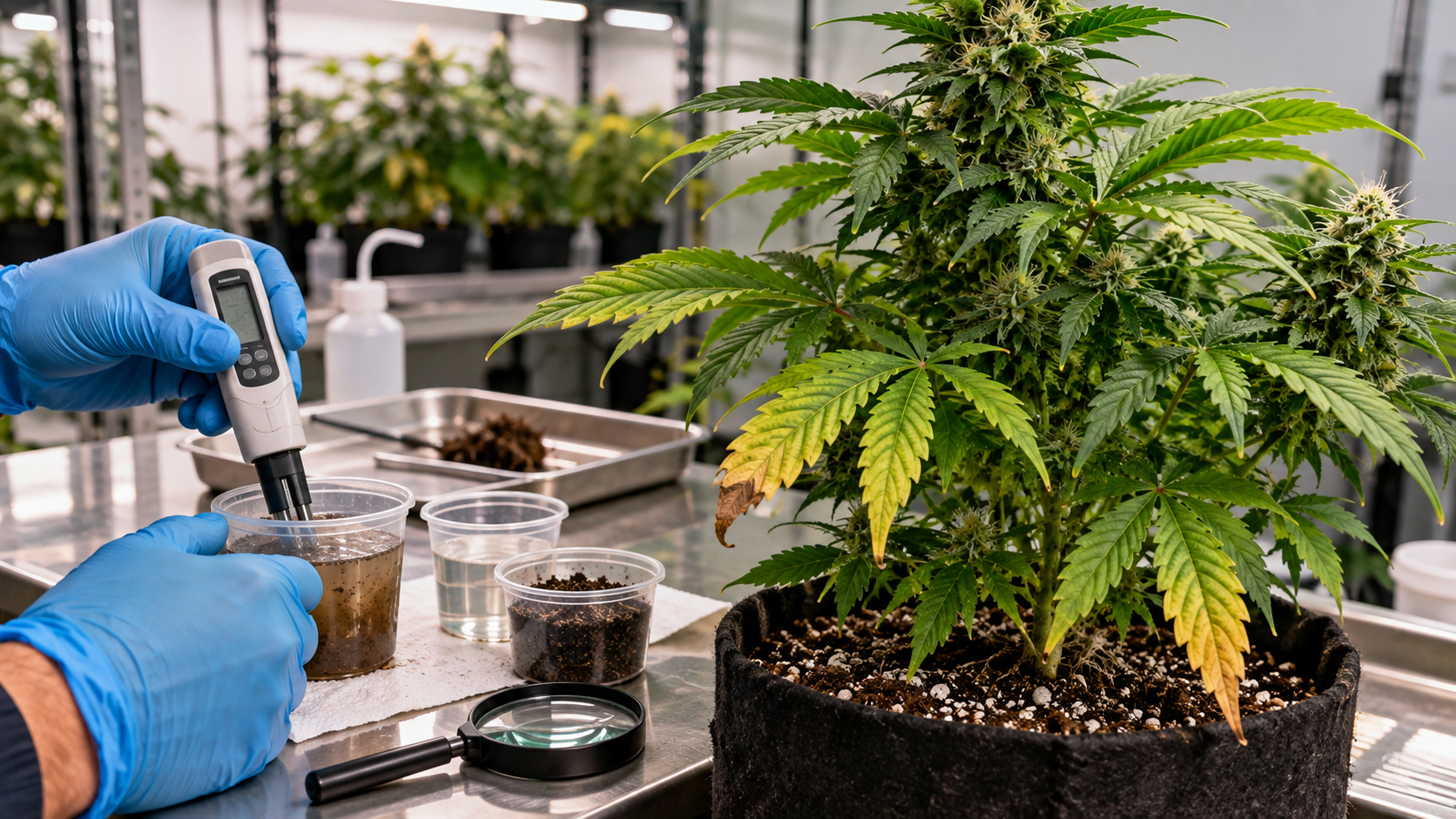
Thrips on Cannabis: Identification, Containment, and Control
Thrips on cannabis are easy to miss and easy to misdiagnose. Early feeding may appear as a few pale scratches, silvery patches, or distorted leaves. Those marks can resemble spider-mite injury, residue, physical abrasion, or environmental stress. Meanwhile, the insects may remain hidden inside young growth, beneath leaves, or around flowers.
A useful response begins with evidence. Confirm a slender insect or wingless larva, look for dark fecal spots and compatible feeding scars, map where fresh injury is occurring, and inspect the plants connected by handling, airflow, or source material. Sticky cards can reveal adult activity, but they do not prove that the crop is clean and they do not replace direct plant inspection.
This guide explains how to identify thrips on cannabis, separate their injury from common look-alikes, contain movement, choose controls that fit the crop stage and production system, and verify whether the population is actually declining.
What Thrips Are
Thrips are very small, narrow-bodied insects. Adults are commonly about 1 to 2 millimeters long and have slender wings edged with fine fringes. Immature thrips are wingless and often pale cream, yellow, or orange. Color varies by species and life stage, so color alone is not a dependable identification feature.
Western flower thrips
Frankliniella occidentalis, a small and widely distributed thrips species that feeds on leaves, growing points, and flowers. It often shelters in protected plant tissue and can be difficult to control because eggs are inserted into plant tissue, several life stages may be present together, and many populations have a history of pesticide resistance.
Western flower thrips is one important greenhouse pest, but it is not the only thrips that may occur on cannabis or hemp. Onion thrips and other species can also be present. Species differ in where they concentrate, how they behave, whether they prefer foliage or flowers, and how they respond to management. Precise identification may require a microscope and qualified expertise.
Thrips feed by damaging surface cells and removing their contents. The injured area can lose its normal color and reflect light as a silvery, pale, or bronze scar. Feeding on tissue before it unfolds may later appear as streaks, distortion, or irregular holes as the leaf expands. Small dark fecal spots near the scars can strengthen the case for thrips, but the insect itself is still the most useful evidence.
Important: Silvering is a symptom, not a species identification. Confirm living thrips or larvae and a compatible pattern before building a control program.
The life cycle protects part of the population
Thrips pass through egg, larval, prepupal, pupal, and adult stages. Females commonly insert eggs into leaves, stems, or flower tissue. The feeding larvae remain on the plant, while prepupal and pupal stages of several important species may occur in protected plant sites or in the growing medium. Adults can walk, jump, or fly to new tissue and nearby plants.
This divided life cycle matters. A contact treatment aimed at exposed adults and larvae may not reach eggs inside tissue or pupae in sheltered locations. Adults caught on cards may decline while larvae remain on the crop, or leaves may appear quiet while new adults emerge from the medium. Effective verification therefore follows more than one life stage and more than one sampling method.
Cannabis-specific evidence is still developing
Thrips are regularly reported on greenhouse and field-grown hemp, but their economic importance is not identical in every system. Outdoor plants may outgrow light feeding, especially where natural enemies are active. Indoor plants, young stock, and high-tunnel crops can face greater pressure because host tissue is continuously available and the environment protects the pest.
Do not import a treatment threshold from ornamental flowers or vegetables and present it as a universal cannabis rule. Cultivar, plant age, production goal, flower quality, market requirements, natural enemies, and the rate of population increase all influence the decision.
How to Identify Thrips on Cannabis
Begin with the plant pattern. Note whether the first injury appeared on one incoming clone batch, near a doorway or vent, around a flowering hotspot, on young leaves, or along an outdoor edge. Inspect apparently healthy neighbors and retain plant-source information. The distribution often explains how the problem entered and where it may move next.
Look for silvery scars and black fecal spots
Thrips injury often appears as irregular pale streaks, silvery patches, or scraped-looking scars rather than uniform yellowing. Tiny black or dark brown specks may occur on or beside the damaged surface. On expanding leaves, earlier feeding can become stretched into distorted tissue, streaks, or small tears.
Inspect the newest injury rather than relying on an old damaged leaf. Old scars remain after the pest has left or been controlled. Fresh silvering at the edge of an expanding patch, accompanied by larvae or adults, is much more useful for deciding whether the infestation is active.
Inspect protected tissue with magnification
Use a hand lens or suitable magnifier to inspect both leaf surfaces, veins, petioles, growing tips, folded leaves, and flowers. Adult thrips are elongated rather than round and may move quickly when disturbed. Their narrow, fringed wings are a strong clue when the insect can be viewed clearly. Larvae are smaller, wingless, and often pale.
Do not stop after finding one adult. Look for larvae and fresh feeding on the plant. An adult on a sticky card proves that a flying thrips entered the monitoring zone, but it does not reveal which plant is supporting reproduction.
Use a white-paper tap test
Hold clean white paper or a white tray beneath suspect foliage or flowers and tap the plant firmly. Moving, slender insects are easier to see against the light surface. Examine them with magnification and contain the material afterward.
The tap test is a detection aid, not a complete identification. Springtails, predatory mites, small flies, and other organisms may also fall from a plant. Record the body shape, movement, wings, plant injury, and sampling location together.
Do not tap suspect plants over clean benches, propagation trays, harvested material, or open growing media. Use a surface that can be contained and cleaned.
Use sticky cards to measure adult flight
Blue and yellow sticky cards can detect adult thrips. Blue is often used for targeted thrips monitoring, while yellow attracts a broader range of flying pests and can make mixed-pest scouting easier. Card color does not solve placement, counting, or identification errors.
Place cards consistently at canopy level, label them by location and date, and read them on a fixed schedule. Replace cards before dust, insects, or plant contact make counts unreliable. Compare trends within the same monitoring system rather than comparing unrelated rooms or card layouts.
Sticky cards underrepresent eggs, larvae hidden on the plant, and pupal stages in protected sites. A low catch can coexist with active leaf injury. Direct inspection and card counts should be interpreted together.
“I see silver streaks and black dots. Is that enough to call it thrips?”
It is a strong reason to inspect, but not enough by itself. Examine protected tissue with magnification and tap suspect leaves over white paper. A useful diagnosis combines a slender adult or wingless larva with fresh feeding scars, fecal spots, and a crop pattern that fits. If no organism is found, keep spider mites, residue, abrasion, edema, and other leaf injuries in the differential.
Question sent by: TylerB420, via email.
Map adults, larvae, injury, and crop connections separately
Record which plants have trapped adults nearby, which plants contain larvae, and which plants show fresh damage. These are related but not interchangeable observations. Larvae on a plant are stronger evidence of local reproduction than a single adult on a card. New injury beyond the original zone is evidence of spread even if overall trap counts remain modest.
Tag confirmed plants and select sentinel leaves or shoots for repeat inspection. Photograph the same tissue under similar light. Record plant stage, cultivar, room position, source batch, nearby host plants, and recent pesticide or biological-control releases.
Thrips Look-Alikes
Several cannabis problems produce pale marks, distorted growth, or surface material. The fastest route to a useful answer is to match the symptom with physical evidence and choose a check that can separate the leading possibilities.
| What you find | Possible explanation | Best next check |
|---|---|---|
| Irregular silver streaks or scars with dark fecal spots and slender insects | Thrips feeding | Inspect protected tissue and use a white-paper tap test to find adults or larvae |
| Sticky honeydew, cast skins, curled tender growth, and pear-shaped insects in colonies | Aphids | Inspect leaf undersides and shoots for cornicles, live nymphs, and colony structure |
| Powdery white adults rise from foliage while flat oval nymphs remain beneath leaves | Whiteflies | Inspect several leaf ages for eggs, crawlers, nymphs, adults, and honeydew |
| Dense, fine pale stippling with round eggs, mites, cast skins, or silk beneath leaves | Spider mites | Examine leaf undersides with magnification and look for webbing or round-bodied mites |
| Bronzing, curling, and brittle growth without visible thrips or webbing | Hemp russet mites | Use stronger magnification or submit representative tissue for identification |
| Hardened, blistered, twisted, or stalled new growth | Broad mites, spray injury, heat, or developmental stress | Inspect the youngest tissue and review recent applications and environmental records |
| Serpentine trails or expanding blotches inside the leaf | Leafminer larvae | Hold the leaf to light and inspect the internal mine for a larva or frass trail |
| White or pale material resting on the surface without feeding scars | Spray residue, minerals, dust, or powdery mildew | Inspect its structure and distribution and determine whether it is residue or fungal growth |
| Uniform chlorosis or marginal burn without insects or scars | Root-zone, nutrient, pH, heat, or water stress | Check tissue age, crop distribution, roots, irrigation history, and verified measurements |
| Scuffs concentrated where leaves, trellis, fans, or workers contact the canopy | Physical abrasion | Trace contact points and monitor whether injury expands without insects |
Spider mites produce finer stippling
Spider-mite feeding commonly begins as many fine pale points. Round eggs, slow-moving mites, cast skins, and fine silk may be found on the underside of leaves. Thrips injury is often larger, more irregular, and accompanied by black fecal spots and narrow insects. Both pests can occur on the same plant, so one confirmed organism does not exclude the other.
For a full comparison of mite evidence and response, use the Spider Mites on Cannabis guide.
Russet and broad mites may require stronger magnification
Hemp russet mites are minute and elongated, while broad mites and their eggs can be difficult to resolve with an ordinary hand lens. Both may affect new growth and cause bronzing, curling, or distortion. The absence of visible thrips does not make a distorted plant pest-free.
Residue and abrasion do not reproduce
Dried sprays, hard-water deposits, dust, and physical rubbing can create pale marks. Review application history and canopy contact points. Mark affected leaves and check whether new injury develops. A nonliving residue will not produce larvae, fecal spots, or a rising sticky-card trend.
Combine fresh injury, living adults or larvae, fecal spots, crop distribution, and repeated monitoring before calling the problem thrips.
Diagnosing from a silver patch alone or using one sticky-card adult as proof that every damaged leaf has the same cause.
How an Infestation Develops and Spreads
Thrips can enter with cuttings, mother plants, ornamentals, weeds, growing media, people, carts, and airflow. Adults can fly or be carried to new plants. Larvae crawl across touching foliage, while protected life stages can escape a treatment and later renew adult activity.
Incoming plants can carry hidden eggs and larvae
A clone may look clean while eggs remain inserted in its tissue. Larvae may shelter around veins, folded leaves, or growing points. If incoming plants are placed immediately beside mother stock or propagation trays, the exposure expands before monitoring has time to detect it.
Keep batches separate, maintain source labels, and inspect repeatedly through an observation period. Include non-cannabis plants, weeds, and plant debris near production because many thrips species have broad host ranges.
Flowers and young growth provide shelter
Western flower thrips often concentrate in flowers and pollen, while other species may be more common on foliage. Growing tips, folded leaves, bracts, and dense flowers protect insects from contact sprays and casual scouting. Opening a few representative sites is more useful than viewing only the upper leaf surface.
The medium may contain transitional stages
Some important thrips leave the plant to complete prepupal or pupal stages in the growing medium, floor debris, or sheltered crevices. The exact pattern depends on species and production system. This means a program focused only on adult flight or upper foliage can miss part of the population.
Keep media surfaces, floors, drains, and bench areas free of fallen leaves and weeds. Do not assume that replacing a sticky card or removing one scarred leaf interrupts the life cycle.
Warm protected production can support continuous generations
Development rate depends strongly on temperature. Indoor and high-tunnel systems can provide continuous host tissue and favorable conditions for overlapping generations. Because eggs, larvae, pupae, and adults may coexist, apparent improvement after one intervention can be followed by renewed activity.
Use local crop observations rather than a universal number of days between checks. Reinspection timing should consider temperature, the product label if a lawful pesticide is used, beneficial-organism biology, and the life stages found in the grow.
What to Do When You Find Thrips
The first response should preserve evidence and reduce movement. Do not begin by carrying suspect plants across a clean room or applying several products before the pest and exposure boundary are understood.
1. Confirm the organism and active injury
Collect an adult or larva from the plant or card, examine it with suitable magnification, and record where it was found. Look for fresh scars and fecal spots on the same plant. If species-level identification will change biological or chemical control, submit a representative specimen to a qualified laboratory or extension service.
2. Define the connected crop
Inspect plants that touch the confirmed plant, plants from the same source batch or mother, plants handled with the same tools, and plants around nearby cards with rising counts. Include weeds and ornamentals inside or near the production structure. Mark confirmed, exposed, and apparently clean zones separately.
3. Contain work and plant movement
Work clean areas first and confirmed areas last. Avoid shaking plants or brushing flowers against clothing and carts. Bag heavily infested removed tissue before carrying it out. Clean tools and change or clean gloves before returning to clean stock.
If a plant can be isolated without scattering insects, move it in a closed or carefully contained manner. If safe movement is not possible, create a controlled work zone around it and manage it in place.
4. Reduce severe hotspots deliberately
Removing heavily infested leaves or shoots can lower pressure, especially in vegetative crops. Removal also reduces leaf area and can scatter insects if rushed. Bag material immediately, avoid excessive defoliation, and preserve enough marked tissue to verify whether fresh feeding continues.
5. Audit crop stage, beneficials, and legal options
Record whether the crop is in propagation, vegetative growth, early flower, or dense late flower. Identify beneficial mites, minute pirate bugs, rove beetles, or other natural enemies already present. Before using a pesticide, verify that its label and local rules permit the crop, site, pest, and growth stage.
Do not spray cannabis flowers with dish detergent, household cleaners, bleach, alcohol mixtures, concentrated essential oils, or improvised pesticide recipes. These mixtures can injure tissue, leave residues, harm workers and beneficials, and make the original diagnosis harder to verify.
6. Establish a fixed monitoring route
Select cards and sentinel plants inside the confirmed zone, along its boundary, and in the apparently clean area. Inspect the same locations on the same schedule. Record adults per card, larvae or a consistent plant rating, fresh feeding scars, new affected plants, and beneficial activity.
“My sticky cards are catching adults, but I cannot find larvae. Should I spray?”
Not from the card count alone. Identify the trapped insect, inspect foliage and flowers directly, and look for fresh injury. Adults may be arriving from another host, or the plant search may be missing protected sites. A treatment decision should combine the trend, plant evidence, crop stage, exposure pathway, beneficials, and the action threshold defined for that grow.
Question sent by: NorthernMike, via contact form.
Vegetative, Flowering, Mother-Plant, and Outdoor Response
The same thrips count does not carry the same consequence in every crop. Propagation role, flower development, harvest proximity, market standard, plant value, natural enemies, and access for coverage all change the response.
| Crop situation | Priority inspection | Primary response goal | Common mistake |
|---|---|---|---|
| Seedlings and rooted cuttings | Source batch, tender leaves, tray edges, neighboring propagation material | Prevent an exposed batch from entering clean production | Mixing batches because only a few scars are visible |
| Vegetative plants | Young growth, leaf undersides, contact points, cards, and growing-medium surface | Reduce reproduction before canopy closure and flowering | Watching cards while ignoring larvae on leaves |
| Mother plants | Entire canopy, repeated cutting zones, stock-line and treatment history | Stop long-term distribution through clones | Taking cuttings from an infested mother because the top looks clean |
| Early flowering plants | Developing flowers, bracts, leaves beside flowers, fresh scars, beneficials | Prevent insects and injury from becoming embedded in dense flowers | Extending a vegetative spray program without checking flower restrictions |
| Late flowering plants | Flower interiors, trapped insects, fresh damage, contamination, nearby plants | Protect clean material and make a conservative quality decision | Trying to spray or rinse contaminated flowers into acceptability |
| Outdoor or high-tunnel plants | Edges, weeds, nearby hosts, flowers, windward areas, and natural enemies | Detect expanding hotspots while conserving biological control | Treating light cosmetic injury with a broad-spectrum product that removes predators |
Propagation requires source control
Pause movement of an exposed batch while it is assessed. Do not distribute cuttings from a confirmed mother. Inspect new growth repeatedly, retain source identity, and keep exposed tools, domes, trays, and work surfaces separate from clean propagation.
Vegetative crops offer the widest intervention window
Vegetative plants usually provide better access to leaves and growing points, greater tolerance for selective pruning, and more time for follow-up before harvest. Use that window to interrupt reproduction and confirm a downward trend before the crop enters flower.
Flowering increases shelter and quality risk
Thrips can shelter in developing flowers where contact coverage becomes difficult. Flower applications raise additional concerns about residues, phytotoxicity, trapped moisture, worker exposure, preharvest restrictions, and market requirements. A product used on ornamental flowers is not automatically lawful or suitable for cannabis flowers.
Visible insects, fecal material, shed skins, or significant feeding inside marketable flower require a conservative quality decision. Do not assume that trimming, rinsing, extraction, or processing automatically makes contaminated material acceptable.
Outdoor injury does not always require treatment
Field-grown hemp can carry thrips with little overall damage when plants are growing rapidly and natural enemies are active. That does not mean every outdoor infestation is harmless. Record whether fresh injury is expanding, whether young plants or flowers are affected, and whether predator activity is holding the population stable.
Control Options and Their Limits
Thrips management works best as an integrated program. Exclusion, sanitation, direct scouting, physical reduction, biological control, environmental management, and lawful pesticide use each address different parts of the life cycle. A single tactic rarely reaches every egg, larva, pupa, and adult.
Exclusion and sanitation remove entry and refuge
Use appropriately maintained insect screening where ventilation design allows it. Seal avoidable openings, manage weeds inside and around protected structures, remove plant debris promptly, and avoid moving uninspected ornamentals into production. Screen condition and airflow consequences should be checked rather than assumed.
Clean floors, bench gaps, carts, trays, and media spills that can shelter life stages or host weeds. Sanitation supports control, but surface cleaning alone will not remove eggs embedded in living plant tissue.
Physical reduction can lower local pressure
Bagging heavily infested leaves or discarding a severely affected plant can remove many organisms immediately. A directed water spray may dislodge thrips from suitable vegetative plants, but runoff, electrical safety, movement of insects, leaf wetness, and disease risk must be managed. Water is not appropriate for every room or flower stage.
Predatory mites work best before pressure is high
Neoseiulus cucumeris, Neoseiulus swirskii, and related predatory mites are used against young thrips larvae in protected crops. They do not consume every thrips stage equally and may not provide rapid rescue of a severe infestation. Temperature, humidity, release timing, distribution, alternative food, crop structure, and pesticide residues all affect performance.
Because many thrips predators target early larval stages, preventive or early releases are generally more useful than waiting for widespread scars and high adult catches. Use supplier guidance together with independent technical information and measurements from the actual room.
Ground-dwelling beneficials target another part of the cycle
Predatory mites such as Stratiolaelaps scimitus, rove beetles, and certain entomopathogenic nematodes may help suppress thrips stages associated with growing media. Their performance depends on species, substrate moisture, temperature, application quality, and compatibility with other inputs.
These organisms complement canopy predators; they do not replace plant inspection. If most reproduction is occurring inside flowers or folded tissue, treating the medium alone will not solve the infestation.
Minute pirate bugs can attack larvae and adults
Orius species are generalist predators that can consume thrips larvae and adults and may be valuable in some greenhouse or outdoor systems. Establishment can be influenced by day length, temperature, pollen, prey availability, crop type, and pesticide history. Release plans should be developed for the actual production system rather than copied from an unrelated crop.
Soaps, oils, and microbial products require contact and compatibility
Insecticidal soaps, horticultural oils, and certain microbial insecticides can suppress thrips when a lawful label allows their use. Coverage of protected sites is difficult, and eggs inside tissue or pupae in the medium may escape. Plant injury can occur when concentration, temperature, light, water status, or mixing is unsuitable.
A product described as natural can still harm predatory mites, Orius, pollinators, or microbial agents. Confirm product-specific compatibility and intervals before combining chemical and biological controls. Never infer cannabis use from a label for ornamentals or another crop.
Insecticides require resistance and residue planning
Western flower thrips has a well-documented capacity to develop resistance. Repeated use of one mode of action can select survivors, while poor coverage exposes hidden insects to sublethal deposits. If a pesticide is necessary, rotate effective modes of action according to the label and a qualified resistance-management plan rather than rotating brand names alone.
Use only products permitted for the crop, site, pest, growth stage, and jurisdiction. Follow the label for rate, interval, maximum applications, personal protective equipment, re-entry, preharvest timing, coverage, and disposal. Cannabis pesticide rules and residue standards vary, so advice from another location is not legal authorization.
Match canopy and media tactics to the life stages found, preserve compatible beneficials, and verify legal use before every application.
Repeating one chemistry, mixing improvised products, or assuming an adult-card decline means hidden larvae and pupae are gone.
“Can predatory mites eliminate a heavy thrips problem by themselves?”
They can be an important part of control, but many predatory mites mainly attack early larvae and work best before the infestation is severe. A heavy population may require hotspot removal, improved sanitation, action against media-associated stages, additional compatible predators, or a lawful selective product. Verify larvae, adult flight, fresh injury, and predator survival instead of assuming a release equals control.
Question sent by: GreenhouseGary, via Facebook page.
Virus-like symptoms require separate confirmation
Several thrips species transmit plant viruses in other greenhouse crops. That fact does not make silver scars or distorted cannabis growth a virus diagnosis. If unusual rings, line patterns, systemic distortion, or unexplained decline continues after the insects are identified and managed, isolate the plant and seek appropriate laboratory testing.
Do not infer a specific cannabis virus from thrips presence alone. Feeding injury, pesticide damage, nutrient stress, mites, and pathogens can overlap visually.
Prevention and Verification
Prevention depends on blocking entry, finding small populations early, and checking whether management changed reproduction. Old scars will not disappear, and an empty card does not prove the crop is clean.
Build an entry barrier
Keep incoming plants separate from established stock and inspect them more than once before release. Record supplier, source mother, batch, arrival date, and inspection results. Examine packaging, trays, and any companion plants. Manage weeds and volunteer plants near doors, vents, and greenhouse edges.
Use clean tools and clothing for propagation and mother plants. Define worker movement from clean to observation to confirmed areas. Do not return to a clean room with the same gloves, cart, or open waste container used in an infested zone.
Combine fixed-route scouting with hotspot checks
Use a repeatable route and consistent cards so trends can be compared. Add direct plant checks near doors, vents, incoming stock, flowering hotspots, previous infestations, and nearby weeds. Tap representative plants and inspect young tissue, leaf undersides, and flowers rather than relying on a top-down canopy view.
Keep card density, height, replacement interval, and counting method consistent. Record unusual events such as open doors, new plant arrivals, pruning, pesticide use, or beneficial releases that can change the count.
Verify control with multiple signals
| Checkpoint | What to record | Evidence that supports progress | Reason to escalate |
|---|---|---|---|
| Initial confirmation | Adults, larvae, fresh scars, fecal spots, trap locations, affected plants, source connections | A defined exposure boundary and marked monitoring sites | Larvae across several zones, flower involvement, or uncertain species |
| Early follow-up | Adults per card, larvae per sample or rating, new scars, new plants, beneficial activity | Declining larvae and no expansion beyond the boundary | Fresh injury or larvae increasing despite treatment |
| Later follow-up | New growth, flower checks, media-associated activity, recurring hotspots, predator survival | Clean new tissue, stable low card trend, and no local reproduction | Adults rebound after a quiet period or larvae appear in clean zones |
| Cycle review | Incoming batches, mothers, weeds, screens, debris, tools, movement, treatment history | The entry or reservoir pathway has been corrected | The same source line or room area starts the next infestation |
Use the same sampling units and method at each check. A drop from an overloaded card to a fresh card is not a valid trend unless the exposure period and placement are comparable. Likewise, a clean leaf chosen after treatment cannot be compared with the worst leaf selected before it.
Continue follow-up long enough to detect emergence from protected eggs and pupae under the actual temperature and crop conditions. Follow label intervals when a lawful pesticide is used. The goal is sustained suppression of reproduction and spread, not one inspection with fewer visible adults.
Thrips prevention and response checklist
- Quarantine and label incoming plants, cuttings, trays, and mother lines.
- Inspect young growth, leaf undersides, flowers, and protected plant sites with magnification.
- Use white-paper tapping and sticky cards as complementary detection tools.
- Record adults, larvae, fresh scars, fecal spots, and crop distribution separately.
- Map confirmed, exposed, and apparently clean plants.
- Work clean areas first and confirmed areas last.
- Bag infested tissue before moving it through the grow.
- Remove weeds, fallen leaves, and media spills that provide hosts or shelter.
- Check crop stage, local law, label, residue risk, and beneficial compatibility before treatment.
- Match canopy and media controls to the life stages actually found.
- Reinspect the same cards, plants, and sentinel tissue with the same method.
- Judge progress by fewer larvae, lower comparable adult catches, clean new growth, and no spread.
The practical decision rule
Treat silver scars and black specks as reasons to investigate, not as a diagnosis made from appearance alone. The name becomes useful when living thrips or larvae, compatible injury, crop distribution, and growing history fit together.
Once confirmed, manage the whole life cycle and exposure pathway. Protect clean stock, contain movement, reduce severe hotspots, target plant and media stages with compatible controls, and verify the result through repeated plant inspection and adult monitoring. The goal is not to make an old scar disappear. It is to stop new feeding, reproduction, and spread.
Share this article
A quick overview of the topics covered in this article.
Follow us
Latest articles
October 21, 2026
October 21, 2026
October 21, 2026
October 21, 2026
