
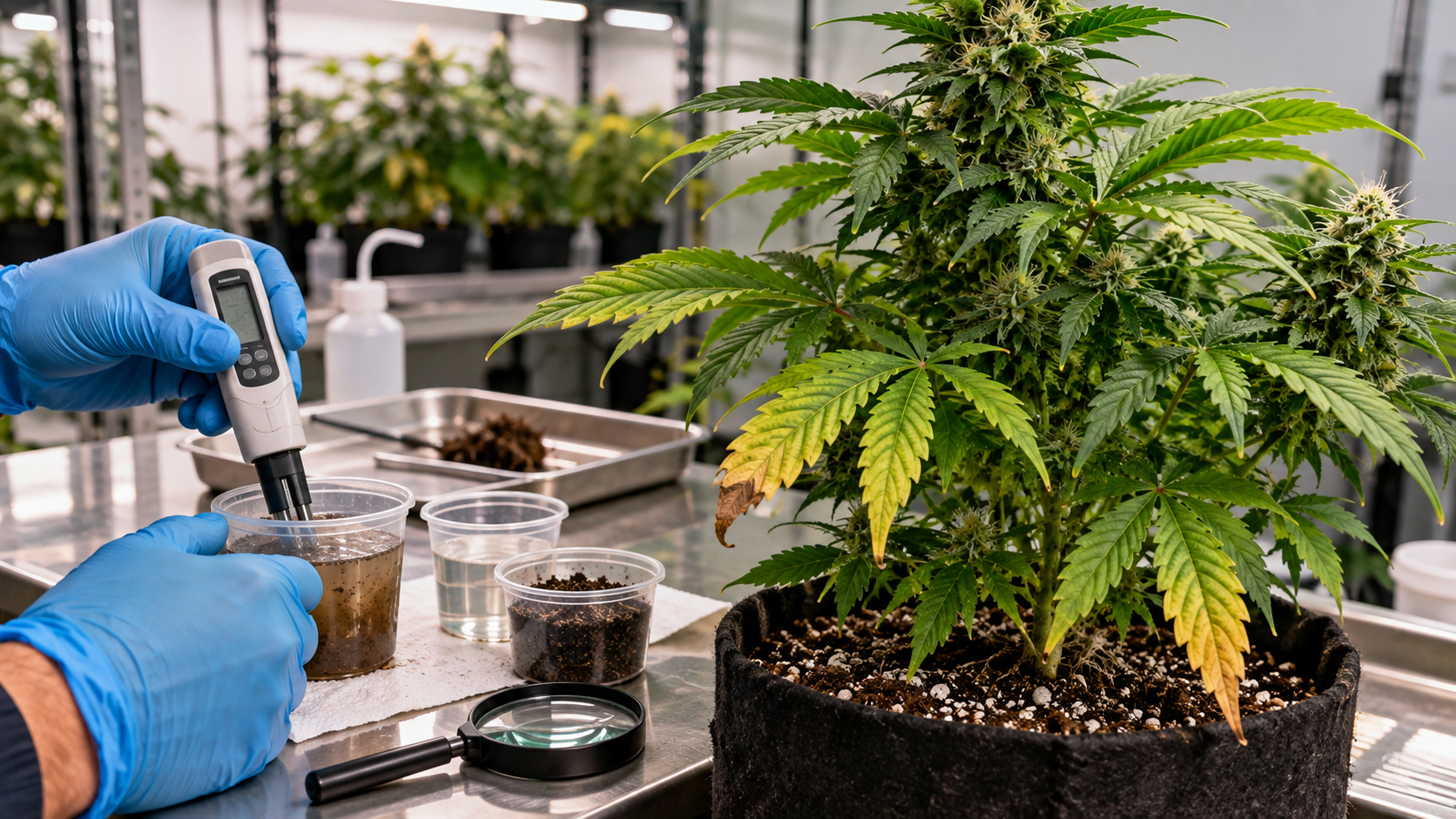
Whiteflies on Cannabis: Identification, Containment, and Control
Whiteflies on cannabis are easy to notice when clouds of white adults rise from a disturbed canopy, but the flying insects are only one part of the infestation. Eggs and flattened immature stages remain attached beneath leaves, where they continue developing after many adults have been removed. Sticky honeydew, yellowing, leaf drop, and dark sooty mold may follow as populations increase.
A useful diagnosis requires more than seeing a small white insect. Confirm adults and immature stages on the same crop, inspect their body shape and behavior, map where colonies are developing, and separate whiteflies from aphid cast skins, leafhoppers, moth flies, scale insects, residue, and other causes of yellowing. Then choose a response that fits the whitefly species, crop stage, production system, beneficial organisms, and local pesticide rules.
This guide focuses on foliar whiteflies in indoor, greenhouse, and outdoor cannabis production. It explains how to identify an active population, contain movement, compare control options, and verify that reproduction has stopped rather than judging success from one quiet sticky card.
What Whiteflies Are
Whiteflies are small sap-feeding insects in the family Aleyrodidae. Despite the name, they are not true flies. They are more closely related to aphids, scales, and mealybugs. Adults have two pairs of powdery white wings and usually rest beneath leaves. Their young develop through a mobile first stage followed by flattened, mostly immobile stages that can resemble tiny scales.
Whitefly
A small piercing-sucking insect in the family Aleyrodidae. Adults have white, wax-covered wings, while eggs and flattened immature stages develop mainly on leaf undersides. Both adults and nymphs feed on plant fluids and may produce sticky honeydew.
Several species can occur in protected crops
Greenhouse whitefly, Trialeurodes vaporariorum, and the sweetpotato or silverleaf whitefly complex, Bemisia tabaci, are important pests in protected agriculture. Cannabis and hemp can host whiteflies, particularly in greenhouse production and warm climates. Species identity is useful because appearance, temperature response, insecticide resistance, virus relationships, and biological-control performance can differ.
A photograph of one adult rarely supports species-level identification. Examine late immature stages, adult wing posture, crop history, geography, and diagnostic characters under suitable magnification. When species identity will change the program, preserve representative leaves and adults for an entomologist or diagnostic laboratory.
The life cycle leaves several targets on one leaf
Females place small eggs on leaf surfaces, commonly beneath leaves. The first immature stage, called a crawler, has legs and moves a short distance before settling. Later nymphal stages remain attached and feed in place. The final immature stage becomes thicker as the adult develops, and an adult emerges through an opening in the case.
Eggs, crawlers, settled nymphs, late immature stages, and adults can overlap in a continuously growing crop. A treatment that affects exposed adults may spare eggs or attached nymphs. Those survivors can produce another adult wave, which is why whitefly programs depend on repeated scouting and life-stage records.
Feeding and honeydew create different kinds of damage
Adults and nymphs insert piercing-sucking mouthparts into plant tissue and remove sap. Increasing populations may contribute to yellowing, reduced vigor, drying, and premature leaf drop. These symptoms are not specific to whiteflies and must be supported by finding the insects.
Whiteflies also excrete sugary honeydew. Leaves below a colony may look shiny or feel sticky, and sooty mold fungi can grow on the deposit. The dark film is secondary growth on honeydew, not proof that a fungus invaded the leaf. Honeydew can lower visual quality, collect debris, interfere with photosynthesis, and contaminate flowers or equipment.
Important: A cloud of adults confirms that winged whiteflies are present, but it does not reveal how many eggs and nymphs remain beneath the leaves or whether the population is reproducing on cannabis.
How to Identify Whiteflies on Cannabis
Begin with the plant, not the trap. Select leaves from several heights and crop zones, turn them over carefully, and inspect with a hand lens. Record adults, eggs, crawlers, settled nymphs, empty emergence cases, honeydew, sooty mold, and fresh plant injury separately.
Use adult behavior as a scouting clue
Adult whiteflies often lift from the lower leaf surface when foliage is disturbed and then settle again nearby. They are tiny, with yellowish bodies hidden partly beneath white wings. This short fluttering movement differs from the strong flight of many fungus gnats and from the crawling behavior of aphid nymphs.
Do not shake every plant in the room. Disturbing heavily infested plants can spread adults and make counts inconsistent. Use a repeatable inspection method on selected leaves, working from clean areas toward confirmed hotspots.
Find eggs and nymphs beneath the same leaves
Whitefly eggs are very small and may be arranged singly, in arcs, or in partial circles depending on species and how the female moved while feeding and laying. Newly laid eggs can be pale and become darker as they develop. Dust, glandular hairs, and dried spray droplets can obscure them.
Settled nymphs are flattened, oval, and translucent to pale. They can look like scale insects pressed tightly against the leaf. Late stages become easier to see as the body thickens and adult structures develop. A mixed-age population beneath multiple leaves is stronger evidence of crop colonization than one trapped adult.
Interpret emergence holes and parasitism
An empty whitefly case shows that an adult already emerged. Natural or released parasitoid wasps also develop in whitefly nymphs. Parasitized greenhouse whitefly nymphs may darken, while parasitized Bemisia can remain tan or brown. Parasitoid emergence commonly leaves a neat circular hole; whitefly emergence may leave a more irregular or T-shaped opening.
Color and hole shape are useful clues, not universal rules. Record intact live nymphs, darkened cases, empty cases, and parasitoid adults separately. Spraying because black cases look alarming can destroy the beneficial organisms already contributing to control.
Trace honeydew upward
A sticky upper leaf may simply be catching honeydew from insects feeding above it. Follow the vertical path into the canopy and examine every leaf underside, petiole, and tender shoot above the deposit. Check nearby floor surfaces, pots, support material, and equipment for fresh droplets.
Guttation, resin, foliar sprays, spilled inputs, and other sap feeders can also leave shiny deposits. Honeydew becomes diagnostically stronger when it occurs with living whitefly adults and nymphs in a compatible distribution.
Use sticky cards to measure adult movement
Yellow sticky cards are useful for detecting adult whiteflies and comparing movement through time. Place and label cards consistently just above the canopy, raise them as plants grow, replace them on a fixed schedule, and identify the catches. A rising adult trend can reveal dispersal before obvious plant damage appears.
Cards do not measure eggs or attached nymphs. A low card count can occur while a large immature population develops beneath leaves. Pair card counts with repeatable leaf sampling and record the same plant zones each time.
Do not carry an uncovered, heavily infested plant through clean production. Adults can fly from disturbed foliage, and infested leaves can transfer eggs and nymphs to carts, clothing, tools, and nearby plants.
“White insects fly up when I touch the plant, but the sticky cards are almost empty. Can it still be whiteflies?”
Question sent by: TylerB420, via email.
Yes. Card placement, card age, airflow, and the number of dispersing adults all affect trap catches. Inspect leaf undersides for adults, eggs, and flattened nymphs. A reproducing population on the plant matters more than one card total.
Map incidence and pressure
Record how many plants have confirmed live stages, which leaves and canopy levels are affected, whether adults are dispersing, and whether honeydew or sooty mold is increasing. A few adults on one incoming clone require a different response from mixed life stages across every mother plant.
Mark representative leaves or plants and photograph the same surfaces under similar light. Use a consistent count or rating, such as adults per leaf, live nymphs per defined leaf area, or the percentage of sampled leaves with active stages. Consistency is more important than false precision.
Whitefly Look-Alikes
Small pale insects, white flecks, sticky leaves, and yellowing occur in several cannabis problems. Match the organism, life stages, residue, and crop pattern before choosing a treatment.
| What you find | Possible explanation | Best next check |
|---|---|---|
| Powdery white adults flutter from leaves; flat oval nymphs remain beneath them | Whiteflies | Inspect several leaf ages for eggs, crawlers, settled nymphs, adults, and emergence cases |
| Pear-shaped insects in colonies, cornicles, cast skins, and honeydew | Aphids | Use magnification to confirm body shape and paired cornicles |
| Slender insects with silver scars and dark fecal spots | Thrips | Tap foliage over white paper and inspect protected tissue for larvae and adults |
| Immobile bumps or cottony wax with honeydew | Soft scale insects or mealybugs | Examine attachment, wax, segmentation, and nearby mobile crawlers |
| Wedge-shaped insects that jump quickly from foliage | Leafhoppers | Inspect body shape, hind legs, feeding injury, and trap specimens |
| Small dark flies around pots and wet media | Fungus gnats | Inspect antennae, wing pattern, media moisture, and larvae in the root zone |
| White powder or droplets without bodies, legs, or developing life stages | Powdery mildew, spray residue, minerals, or dust | Inspect structure and determine whether the material grows, wipes, dissolves, or remains inert |
| Yellowing without insects, honeydew, or sooty mold | Root, nutrient, water, light, temperature, or normal aging | Check tissue age, crop distribution, roots, environment, and recent changes |
Aphids have a different body and colony structure
Aphids are broader and pear-shaped, usually with long antennae and paired cornicles near the rear of the abdomen. Most colony members are wingless, although winged aphids can occur. Their cast skins may look like white insects from a distance. Use the Aphids on Cannabis guide when colonies, cornicles, and cast skins fit better than flat whitefly nymphs.
Thrips leave silver scars rather than honeydew
Thrips are narrow insects that run, hide in protected tissue, and leave irregular silvering with dark fecal spots. They do not produce the typical whitefly combination of powdery adults and scale-like nymphs beneath leaves. For the complete comparison, use the Thrips on Cannabis guide.
Fungus gnats center on the root zone
Fungus gnat adults are darker, longer-legged flies found near wet media and drainage areas. Their larvae develop in the growing medium. Whitefly adults usually rest beneath foliage, and their immature stages remain on the leaf. Trap location and direct inspection of leaves and roots separate these pathways.
Powder and residue do not develop through life stages
Powdery mildew, mineral deposits, spray residue, dust, and trichome fragments can appear white. None will produce eggs, crawlers, flat feeding nymphs, or winged adults. Examine the material under magnification and revisit marked leaves to see whether insects develop.
Confirm adults and attached immature stages on representative cannabis leaves before building a whitefly program.
Diagnosing every flying white insect, sticky leaf, or pale speck as whiteflies.
How an Infestation Develops and Spreads
Whiteflies commonly enter protected production on infested cuttings, mother plants, seedlings, ornamentals, weeds, or residual crops. Adults can fly within a room and may follow air movement. Eggs and nymphs move with the leaves and plants that carry them.
Incoming plants can hide an immature population
A quick top-down inspection may miss translucent eggs and nymphs beneath lower leaves. A plant can appear quiet while the next adult generation develops. Keep incoming batches identifiable and physically separated long enough for repeated underside inspections.
Do not place new plants beside mother stock, propagation trays, or long-cycle flowering rooms before completing the observation process. Review the entire batch when one plant is positive, because shared source material and handling connect the risk.
Adult dispersal expands the inspection boundary
When adults rise from several plants or appear on cards outside the original zone, expand scouting along airflow, worker routes, touching canopies, and plant movement. Inspect apparently clean plants for immature stages rather than waiting for another adult cloud.
An adult on a card does not prove that the nearest cannabis plant is colonized. It may have arrived from another crop, weed, or outdoor source. Reproduction is confirmed by compatible eggs and developing nymphs on the plant.
Warm protected production supports overlapping generations
Whiteflies can reproduce continuously where host plants and suitable temperatures remain available. Development time varies with species, temperature, host quality, and other conditions. Warm conditions may accelerate population increase, but heat alone should not be treated as a species diagnosis or a control program.
Stock plants and long-cycle crops connect generations. A low population that persists on mothers, ornamentals, or weeds can repeatedly seed cleaner rooms. The reservoir must be found and managed, not merely the adults visible in one flower room.
High nitrogen and dense growth can complicate control
Soft, lush growth can favor several sap-feeding pests, while a dense canopy hides leaf undersides and reduces spray coverage. Correct verified overfeeding and improve access, but do not diagnose fertility from whitefly presence alone or starve the crop as a pest treatment.
Ants and pesticide disruption can weaken natural control
Ants may collect honeydew and interfere with predators or parasitoids. Broad-spectrum pesticides can also kill beneficial organisms and allow surviving whiteflies to rebound. Record ant activity and the pesticide history before introducing biological controls.
What to Do When You Find Whiteflies
The first response should preserve diagnostic evidence while reducing movement. Do not begin by shaking every plant, fogging the room, or stacking several unmeasured treatments.
1. Confirm living adults and immature stages
Inspect leaf undersides with magnification. Record eggs, crawlers, settled nymphs, late stages, adults, and empty cases separately. Photograph representative leaves and preserve specimens if species identification may affect the program.
2. Define the exposure boundary
Trace plant source, arrival date, mother line, room transfers, pruning order, carts, clothing, airflow, doors, vents, weeds, and ornamentals. Label confirmed, exposed, and apparently clean groups. Treat connected plants as an investigation zone until scouting shows otherwise.
3. Contain handling and plant movement
Work clean areas first and confirmed areas last. Assign tools where possible, clean shared equipment according to a documented procedure, and bag removed leaves before moving them. Avoid carrying open waste through clean production.
4. Reduce severe hotspots without scattering adults
Heavily infested leaves or plants may hold large numbers of immobile stages. Careful removal can immediately reduce pressure, but aggressive stripping can launch adults and stress the crop. Enclose the material before cutting and remove it from the production area promptly.
5. Inspect reservoirs and beneficial activity
Check mother plants, previous crop remnants, weeds, ornamentals, and warm peripheral areas. Look for parasitoid adults, darkened or tan parasitized cases, circular exit holes, predators, and ant trails. Preserve evidence of biological control unless a specialist recommends otherwise.
6. Establish a baseline before treatment
Choose marked leaves, plants, and cards that can be sampled repeatedly. Record live nymph density or incidence, adult counts, new honeydew, sooty mold, and crop injury. A baseline makes it possible to distinguish real suppression from ordinary movement between life stages.
“I vacuumed most of the adults. Does that mean the infestation is finished?”
Question sent by: GreenhouseGary, via contact form.
No. Removing adults may reduce immediate egg laying and dispersal, but eggs and attached nymphs can remain beneath leaves. Continue sampling marked leaves through the next expected emergence period and watch for new adults, fresh crawlers, and expanding honeydew.
Do not use an unregistered household pesticide, improvised mixture, or crop-unsafe systemic product on cannabis. Legal crop use, application site, growth stage, worker protection, residue limits, and harvest implications must all be verified.
Vegetative, Flowering, Mother-Plant, and Outdoor Response
| Crop context | Main concern | Response priority |
|---|---|---|
| Propagation and incoming clones | Hidden eggs or nymphs can enter multiple production rooms | Separate batches, retain source identity, inspect repeatedly, and reject or contain infested material |
| Vegetative plants | Rapid canopy contact and repeated handling can spread adults | Open the canopy for inspection, reduce hotspots, and establish biological control early when appropriate |
| Mother plants | Persistent colonies can travel with every cutting | Protect clean genetics, map line-specific risk, and do not take cuttings from confirmed plants |
| Early flower | Honeydew and adults can move into developing flowers | Escalate scouting, reduce contamination sources, and narrow controls to crop-safe options |
| Late flower | Residue, moisture, dead insects, honeydew, and sooty mold can compromise harvest quality | Prioritize containment, sanitation, conservative legal decisions, and product-quality assessment |
| Outdoor cannabis | Migration from surrounding hosts may overlap with natural enemies | Map edges and nearby hosts, identify the species, conserve beneficials, and intervene only from repeated evidence |
Propagation requires batch-level decisions
Small plants provide limited leaf area, so a modest number of adults can establish quickly. Eggs and nymphs also move unnoticed on cuttings. Keep trays labeled, prevent leaf contact between batches, and repeat inspections before material joins a clean room.
Vegetative plants provide the widest management window
Vegetative plants generally allow better access to leaf undersides and more flexibility for pruning, washing, biological releases, and lawful products. Use that window to stop reproduction before canopy density and flowers make coverage more difficult.
Mother plants can become long-term reservoirs
A mother plant connects many rooms and crop cycles. Inspect lower and interior foliage rather than judging only fresh tips. If a line remains positive despite repeated measures, compare the value of retaining it with the continuing risk to clean propagation.
Flowering raises contamination concerns
Honeydew, sooty mold, dead insects, cast cases, and spray residues are more difficult to manage once flowers become dense. Moisture-based tactics can also alter disease risk. Decisions should account for crop value, harvest timing, legal residue standards, and whether quality can be protected.
Outdoor populations require ecological context
Outdoor adults may arrive from surrounding hosts, while parasitoids, lacewings, lady beetles, and other predators may suppress colonies. Record both pest development and natural-enemy activity. A few transient adults do not automatically justify a broad treatment that removes beneficials.
Control Options and Their Limits
Whitefly control is strongest when exclusion, sanitation, physical reduction, biological control, environmental management, and lawful pesticides are integrated. Each tactic reaches different life stages and has different effects on the crop and beneficial organisms.
Physical removal lowers pressure but rarely completes control
Bagging and removing heavily infested leaves can eliminate many attached nymphs. A directed water spray may dislodge adults and some young stages on plants that tolerate it. Consider runoff containment, electrical safety, drying time, disease risk, and movement of dislodged insects.
Vacuuming adults is sometimes used as a pressure-reduction step. It does not remove most eggs or settled nymphs, and careless airflow can disperse insects. Treat it as one measured tactic, not proof of eradication.
Parasitoids must match the whitefly and environment
Encarsia formosa and Eretmocerus eremicus are commercially used whitefly parasitoids. Their relative performance depends on the whitefly species, temperature, crop duration, pest density, light, release timing, and pesticide residues. Parasitoids are most useful when introduced early against low populations.
Release cards and carriers should be handled according to supplier and independent technical guidance. Place them away from direct intense light when instructed. Record parasitized cases and emergence holes, and temporarily reposition sticky cards if they are capturing released adults.
Predators cover eggs and young stages
Predatory mites such as Amblyseius swirskii can feed on whitefly eggs and crawlers under suitable conditions and may also contribute to thrips programs. The predatory beetle Delphastus, lacewing larvae, lady beetles, and other predators can consume whitefly stages.
Performance depends on temperature, humidity, alternative food, canopy structure, prey density, and prior pesticide exposure. A predator name on an invoice does not prove establishment. Scout for the beneficial organism and the whitefly stages it should be affecting.
Microbial products require coverage and suitable conditions
Products based on entomopathogenic fungi may suppress whiteflies where the product is lawfully labeled. Performance varies with organism and strain, target stage, coverage, humidity, temperature, ultraviolet exposure, and pesticide compatibility. Research concentrations are not application instructions.
Soaps and oils depend on direct contact
Insecticidal soaps and horticultural oils can affect exposed whitefly stages when permitted for the crop and site. Thorough coverage of leaf undersides is essential, and repeated applications may be required because eggs or later-emerging adults survive.
Plant injury can occur with unsuitable concentration, temperature, light, water stress, or mixing. Oils, sulfur, soaps, microbes, and beneficial organisms are not automatically compatible. Follow the current product label and documented intervals.
Insecticide resistance changes chemical decisions
Important whitefly populations, especially within the Bemisia tabaci complex, have histories of resistance to multiple insecticide groups. Repeating one mode of action can select survivors even when brand names change. Poor coverage, protected life stages, and reinvasion can also resemble resistance.
Use only products permitted for cannabis, the production site, the target pest, and the growth stage. Follow label requirements for rate, interval, maximum applications, personal protective equipment, re-entry, preharvest timing, and disposal. Consult local extension or a licensed adviser when identification, legality, or resistance strategy is uncertain.
Match the control program to confirmed life stages, species when necessary, crop stage, environment, beneficial organisms, pesticide history, and local law.
Judging control from adult knockdown alone or repeating one contact treatment while eggs and nymphs continue developing beneath leaves.
“Should I release Encarsia as soon as I see whiteflies?”
Question sent by: Canuck420, via Facebook page.
Early release can be useful, but first confirm the whitefly, estimate pressure, review temperature and crop duration, and check recent pesticide residues. Encarsia formosa performs best in suitable greenhouse conditions and at relatively low pest levels. Species and environment may favor a different parasitoid or a combined program.
Virus concerns require specific evidence
Some whiteflies transmit important plant viruses in other crops. Whitefly presence does not prove a cannabis virus, and yellowing or distortion alone cannot identify one. If persistent systemic patterns, unusual mosaic, severe stunting, or unexplained decline continues after pest pressure is addressed, isolate representative plants and seek an appropriate laboratory diagnosis.
Prevention and Verification
Prevention centers on clean plant entry, removal of reservoirs, routine underside inspection, and fast response before adults disperse. Verification requires evidence that immature development and new adult emergence are declining.
Build an entry barrier around living plants
Inspect all incoming clones, seedlings, mother plants, ornamentals, and biological-control banker plants. Keep source, batch, and arrival records. Separate new material from established stock and repeat inspection across enough time to detect hidden immature stages.
Maintain screens and door discipline appropriate for the facility without compromising airflow. Remove weeds and crop residues that can carry whiteflies. Plan movement from clean areas to observation areas and confirmed zones.
Scout cards and leaves on the same schedule
Count identified adults on labeled yellow cards and inspect a defined number of leaves from consistent canopy positions. Add risk-based samples near incoming plants, doors, vents, mother stock, weeds, and previous hotspots. Keep adult trap data separate from plant-stage data.
Verify the interruption of reproduction
| Checkpoint | What to record | Evidence supporting progress | Reason to escalate |
|---|---|---|---|
| Initial confirmation | Adults, eggs, crawlers, live nymphs, empty cases, honeydew, sooty mold, source connections | A defined exposure boundary and marked sampling units | Mother-stock involvement, several rooms, uncertain species, or flower contamination |
| Early follow-up | Live nymphs per leaf or incidence, new adults, card trend, parasitoid cases, predators | Fewer live young stages and no spread beyond the original zone | New colonies, rising card counts, or increasing honeydew |
| Later follow-up | New emergence, fresh crawlers, clean expanding leaves, beneficial establishment | No local reproduction and stable clean boundary plants | Another adult wave or positive plants outside the boundary |
| Cycle review | Incoming batches, mothers, weeds, screens, waste, airflow, tools, pesticide history | The entry or reservoir pathway has been corrected | The same source line or room begins the next infestation |
Use the same sampling units and schedule after each action. Old yellowing, sooty mold, and honeydew can remain after live pressure falls, so judge progress by declining living stages, lack of new crawlers, reduced adult emergence, and clean new growth.
Continue follow-up long enough to include immature stages present before treatment. One inspection with no flying adults does not prove that eggs and nymphs are gone.
Whitefly prevention and response checklist
- Quarantine and label incoming plants, cuttings, trays, and mother lines.
- Inspect leaf undersides for adults, eggs, crawlers, and flattened nymphs.
- Use yellow cards for adult movement, not as proof that leaves are clean.
- Record live stages separately from empty and parasitized cases.
- Trace honeydew upward and investigate sooty mold and ant trails.
- Map confirmed, exposed, and apparently clean crop zones.
- Work clean areas first and confirmed areas last.
- Bag infested leaves before moving them through production.
- Check mother stock, weeds, ornamentals, and crop remnants as reservoirs.
- Match biological controls to the whitefly, environment, and pesticide history.
- Verify cannabis legality and label directions before applying any product.
- Confirm progress through fewer live nymphs, reduced emergence, and no spread.
The practical decision rule
Treat white adults, sticky leaves, yellowing, and black surface growth as reasons to investigate, not as a complete diagnosis from appearance alone. The diagnosis becomes useful when adults, eggs, flattened nymphs, emergence cases, honeydew, crop history, and distribution fit together.
Once confirmed, manage both the population and its pathway. Protect clean stock, contain movement, reduce severe hotspots, correct reservoirs, choose compatible biological or legal chemical controls, and verify the outcome on marked leaves. The goal is not one adult-free moment. It is to stop immature development, new emergence, and spread.
Share this article
A quick overview of the topics covered in this article.
Follow us
Latest articles
October 21, 2026
October 21, 2026
October 21, 2026
October 21, 2026
