
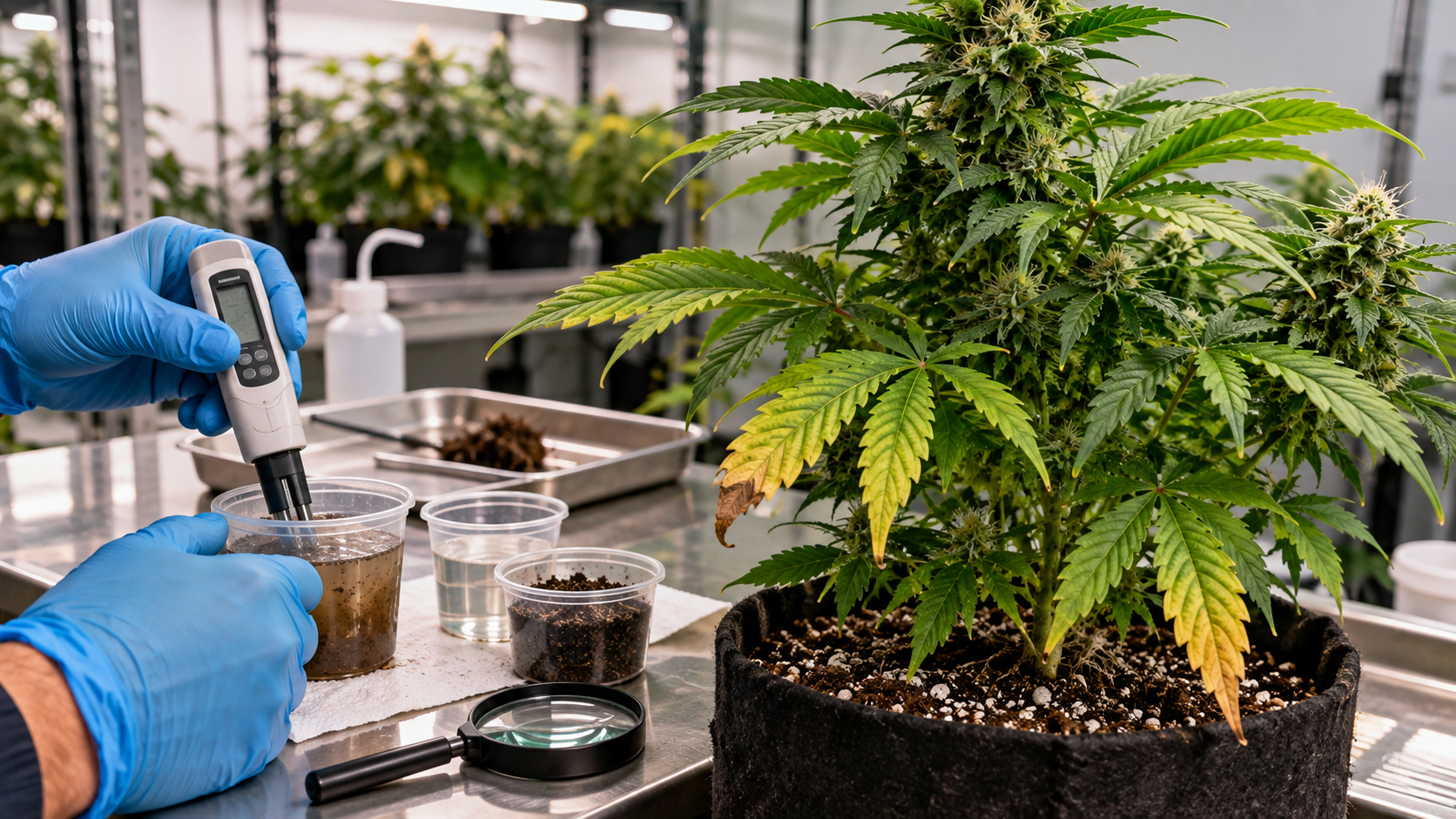
Aphids on Cannabis: Identification, Containment, and Control
Aphids on cannabis can build from a small, hidden colony into a sticky canopy surprisingly quickly. Early signs may be a few pale insects beneath a leaf, white shed skins, curled young growth, or shiny honeydew. Those clues are useful, but none should be interpreted alone. Whiteflies, root aphids, scale insects, residues, and several kinds of plant stress can create overlapping symptoms.
A reliable response begins by finding the organism. Look for a pear-shaped body, long antennae, paired cornicles near the rear of the abdomen, living nymphs, and a colony pattern that fits the damage. Then map the affected plants, trace source material and worker movement, protect clean stock, and choose controls that fit the aphid species, crop stage, production system, beneficial organisms, and local law.
This guide focuses on foliar aphids, especially the cannabis aphid, Phorodon cannabis. Root-feeding aphids require a different inspection path and are addressed separately so that activity above the canopy is not confused with a root-zone infestation.
What Aphids Are
Aphids are soft-bodied, piercing-sucking insects that feed from plant vascular tissue. Most individuals in an active colony are wingless. Crowding, declining plant quality, seasonal change, or other conditions can produce winged forms that disperse to new plants. A colony may therefore remain localized for a time and then generate adults capable of moving farther through the grow.
Cannabis aphid
Phorodon cannabis, a specialist aphid associated with cannabis and hemp. It feeds above ground on leaves, stems, and reproductive tissue, can reproduce rapidly without mating during active growth, and may persist year-round in continuously lit indoor production.
Cannabis aphids vary in appearance with age, season, and form. They may be cream, pale yellow, green, pinkish, or light brown. Winged individuals are darker in places and can look different enough that a grower mistakes them for another pest. Color is therefore a supporting feature, not a diagnosis.
The most useful aphid features are the pear-shaped body, relatively long antennae, and a pair of small tubular structures called cornicles near the rear of the abdomen. These can be difficult to see without magnification. Nymphs resemble smaller adults and molt as they grow, leaving white cast skins attached to leaves, stems, or flowers.
Important: White cast skins and sticky honeydew are strong aphid clues, but confirm living insects and their body features before choosing a control.
Rapid reproduction changes the response window
During the growing season, female aphids can give birth to live female offspring without mating. The nymphs mature and begin reproducing, allowing overlapping generations to develop quickly. In outdoor seasonal systems, sexual forms and eggs may appear as the season changes. Indoors, suitable light and continuous host plants can support ongoing asexual reproduction.
This biology makes early detection unusually valuable. A few aphids on one shoot may still be manageable as a localized colony. The same colony left through several reproductive cycles can cover growing tips, stems, and flowers and produce winged dispersers.
Honeydew creates secondary evidence
Aphids excrete sugary liquid called honeydew. It can make leaves, floors, pots, and equipment feel sticky or appear shiny. Sooty mold fungi may grow on the deposit, creating a dark surface film that reduces light interception and lowers visual quality. Ants may collect honeydew and protect aphid colonies from predators or parasitoids.
Honeydew does not prove which sap-feeding insect is present. Whiteflies, soft scales, and mealybugs can also produce it. Inspect directly above the sticky surface and examine the organism rather than diagnosing from residue alone.
Several aphid species may appear in cannabis production
The cannabis aphid is an important specialist, but other aphids have been collected from hemp and cannabis systems. Cotton or melon aphid and green peach aphid may appear, although host suitability and sustained colonization vary. Rice root aphid is a separate concern around roots and growing media.
Species identity matters when choosing parasitoids because many parasitoid wasps attack a limited range of aphids. Generalist predators may accept several species, but their establishment and performance still depend on crop structure, environment, prey density, and pesticide history.
How to Identify Aphids on Cannabis
Start with the distribution. Record whether the problem began on one incoming clone batch, one mother line, sheltered lower growth, tender shoots, flower clusters, a greenhouse edge, or plants visited by ants. Inspect apparently healthy neighbors because a new colony may be present before curling or honeydew becomes obvious.
Look for colonies on protected plant parts
Examine leaf undersides, petioles, stems, growing tips, and flower tissue. Aphids often cluster rather than distributing evenly. Adults and nymphs may align along veins or gather on soft expanding tissue where vascular feeding is accessible.
Use a hand lens to check body shape, antennae, legs, and cornicles. A living colony usually contains several sizes because nymphs and adults overlap. Finding only empty white skins does not establish that live aphids remain, so continue searching nearby tissue.
Separate honeydew from ordinary moisture or residue
Fresh honeydew forms clear, shiny, sticky droplets. Deposits may accumulate on leaves below the colony even when few aphids are visible on that lower leaf. Trace the vertical path upward into the canopy and inspect stems, petioles, and flowers above the deposit.
Guttation, foliar sprays, resin, and spilled inputs can also leave droplets or films. Honeydew becomes more convincing when it occurs with live aphids, white cast skins, ants, or sooty mold in a compatible pattern.
Read cast skins correctly
Aphid cast skins are pale or white, lightweight, and shaped like small empty insects. They often remain stuck in honeydew. A large number of skins shows that aphids developed at that site, but the skins can persist after a colony has been removed or controlled.
Do not count cast skins as living aphids. Record them separately, then search for active nymphs and adults. Progress should be judged by live colony size, fresh honeydew, clean new growth, and spread to additional plants.
Use sticky cards for winged movement, not colony size
Yellow sticky cards can catch winged aphids entering or dispersing within a greenhouse. Most aphids in a colony are wingless, so a low card count does not mean the crop is clean. Direct visual inspection is required.
Position and label cards consistently, replace them on a fixed schedule, and identify trapped insects rather than treating every small winged body as an aphid. Card trends can help locate periods of dispersal, but plant counts or repeatable colony ratings are more useful for measuring local reproduction.
Do not shake or carry a heavily colonized plant through clean production. Winged adults, dislodged nymphs, honeydew, and infested plant material can spread through contact and handling.
“I found white shells and sticky spots but very few bugs. Is that still an active aphid infestation?”
It may be recent or active, but the residue alone cannot answer the question. White shells are cast skins and honeydew can remain after aphids are gone. Inspect the tissue directly above the sticky area, growing tips, stems, and leaf undersides with magnification. Record living nymphs and adults separately from old skins and residue.
Question sent by: MikeH_78, via email.
Map colony incidence and severity
Record the number of plants with confirmed live aphids, the plant parts colonized, the approximate colony size or a consistent rating, winged forms, honeydew, ants, mummies, predators, and fresh plant injury. A few aphids confined to one removable shoot create a different decision from small colonies distributed across every mother plant.
Mark sentinel leaves or shoots and photograph them under similar light. Count or rate the same units at each follow-up. Randomly choosing the worst plant before treatment and a clean plant afterward produces a misleading trend.
Aphid Look-Alikes
Sticky leaves, white specks, curled growth, and small insects occur in several cannabis problems. Match each symptom with physical evidence and choose the next check that separates the leading possibilities.
| What you find | Possible explanation | Best next check |
|---|---|---|
| Pear-shaped insects in colonies, paired cornicles, cast skins, and honeydew | Foliar aphids | Inspect body features with magnification and map living nymphs and adults |
| Small white winged insects that lift from foliage, with flat immature stages beneath leaves | Whiteflies | Inspect leaf undersides for scale-like nymphs and identify trapped adults |
| Slender insects with silver scars and black fecal spots | Thrips | Use a white-paper tap test and inspect protected tissue for adults and larvae |
| Immobile bumps or cottony masses producing honeydew | Soft scale insects or mealybugs | Examine attachment, wax, segmentation, and nearby crawlers |
| Fine stippling, round eggs, cast skins, or webbing below leaves | Spider mites | Use magnification to look for round-bodied mites and silk |
| Winged insects near pots with larvae or feeding activity in the root zone | Root aphids or fungus gnats | Inspect roots, drainage holes, media surface, and adult body features |
| Swollen tan or dark aphid-shaped bodies with a circular exit hole | Parasitized aphid mummies | Preserve and monitor them as evidence of parasitoid activity |
| Curled or yellow growth without insects, honeydew, or cast skins | Root stress, nutrient imbalance, spray injury, heat, or other stress | Check roots, environment, application history, tissue age, and crop distribution |
Whiteflies move differently and leave different immature stages
Adult whiteflies are powdery white and often rise from the plant when foliage is disturbed. Their immature stages are flattened and attached to leaf undersides. Winged aphids hold clear wings differently and retain an aphid-shaped body with long antennae and cornicles.
Thrips are narrow and leave silver scars
Thrips are elongated insects that commonly produce irregular silvering and dark fecal spots. Aphids are broader and pear-shaped, feed in colonies, and produce honeydew and cast skins. For the full evidence path, use the Thrips on Cannabis guide.
Root aphids require root-zone evidence
Rice root aphid and other root-associated aphids can occur around cannabis roots, including in hydroponic production. Winged dispersers may be caught above the canopy and mistaken for fungus gnats or foliar aphids. Do not diagnose a root infestation from one trap catch.
Inspect the root ball, drainage holes, media surface, reservoir edges, and root-zone residues. Look for living colonies on roots and confirm body features. Foliar cannabis aphid management should not be assumed to solve a root-zone population.
Beneficial activity can resemble pest mortality
Parasitoid wasps develop inside aphids and leave swollen, hardened bodies called mummies. A circular exit hole indicates that an adult parasitoid emerged. Predatory midge larvae may appear orange, lacewing larvae are active elongated predators, and lady beetle larvae look very different from adult lady beetles.
Identify these organisms before spraying. Removing mummies or killing predators can eliminate part of the control already working in the crop.
Confirm a living aphid, cornicles, colony pattern, cast skins, honeydew, and the affected plant part before choosing a response.
Treating every sticky leaf, white speck, or winged insect as a foliar cannabis aphid.
How an Infestation Develops and Spreads
Aphids can enter with clones, mother plants, seedlings, ornamentals, weeds, clothing, tools, or winged adults from outside. Wingless nymphs move across touching leaves and equipment. Workers can transfer aphids during pruning, training, scouting, and harvesting.
Incoming plants and mother stock create connected risk
A small colony can hide beneath leaves or around tender growth and pass through a quick intake check. If the plant joins a mother room, every cutting and handling event can distribute the exposure. Keep batches traceable and separate long enough for repeated inspection.
Inspect mother plants from lower interior leaves to new growth. Do not take cuttings from a confirmed colony or assume that an apparently clean top proves the stock line is clean.
Winged aphids mark a change in movement
Winged forms may develop as colonies become crowded or plant quality changes. Their appearance means the response boundary may need to expand beyond touching plants. Inspect the surrounding zone, review card catches, and check other host plants and weeds.
A winged aphid does not prove that it reproduced on the nearest cannabis plant. The correct interpretation combines adult location, living colonies, fresh plant injury, and the direction of crop or air movement.
Ants can protect colonies
Ants are attracted to honeydew and may move among aphid colonies. In some systems they defend aphids from predators and parasitoids. An ant trail into the canopy is therefore both a scouting clue and a possible disruption to biological control.
Trace and correct the ant entry path with methods appropriate for the site and crop. Do not place unapproved baits or household products where they can contact plants, irrigation, beneficial organisms, workers, or marketable material.
Lush growth can favor buildup
Excessive nitrogen can produce soft, dense growth that favors many aphid species and makes interior scouting more difficult. Correct verified overfeeding, but do not starve the crop or diagnose fertility from the presence of aphids alone.
Dense canopies also increase leaf contact and hide colonies from contact sprays and visual checks. Pruning and spacing should improve access without scattering insects or creating unnecessary plant stress.
What to Do When You Find Aphids
The first response should reduce spread while preserving enough evidence to identify the aphid and measure the result. Do not begin by spraying every plant or carrying infested branches to a shared work table.
1. Confirm that the colony is alive
Use magnification to find living nymphs or adults and paired cornicles. Record the plant part, room position, source batch, and colony size or rating. Separate live aphids from cast skins, mummies, and dead insects.
2. Determine whether the problem is foliar or root-zone
Inspect foliage and growing points for foliar colonies. If activity centers near the media, drainage holes, reservoir, or roots, investigate root aphids and fungus gnats separately. A winged insect on a card is not enough to choose between these paths.
3. Define the exposure boundary
Inspect touching plants, the source mother or clone batch, plants handled with the same tools, and nearby plants below honeydew or ant trails. If winged aphids are present, expand the search to nearby cards, vents, doors, weeds, and alternate hosts.
4. Isolate and remove hotspots carefully
When practical, separate confirmed plants or establish a controlled work zone. Small localized colonies may be reduced by bagging an infested leaf or shoot immediately. A heavily colonized low-value plant may be safer to discard than to maintain as a source, especially in propagation.
Avoid aggressive shaking or uncontained pruning. Excessive defoliation can stress the plant, scatter aphids, and remove the marked tissue needed for follow-up.
5. Protect beneficial organisms
Look for mummies, parasitoid exit holes, lady beetles, lacewing larvae, hoverfly larvae, and predatory midge larvae. Record their distribution before selecting any spray. Even soaps, oils, and microbial products can interfere with biological control depending on direct exposure and timing.
Do not spray cannabis flowers with dish detergent, household cleaners, bleach, alcohol mixtures, or improvised essential-oil recipes. These mixtures can damage tissue, leave residues, harm workers and beneficials, and make verification harder.
6. Establish repeatable monitoring
Choose sentinel shoots in the confirmed zone, at the boundary, and within apparently clean stock. Count live aphids or use a consistent abundance class. Record fresh honeydew, new cast skins, winged forms, mummies, predators, ants, and new affected plants.
“I caught winged aphids on yellow cards but cannot find a colony. Should I treat the whole room?”
Not from the cards alone. Winged adults may have entered from outside or moved from another host, while most colony members are wingless and remain on the plant. Identify the trapped insect, inspect likely host plants and protected tissue, check roots if the activity centers near pots, and increase scouting until the source is found or repeated checks remain negative.
Question sent by: GrowinWithDan, via contact form.
Vegetative, Flowering, Mother-Plant, and Outdoor Response
Aphid abundance is only one part of the decision. Crop age, propagation role, flower development, harvest proximity, market standard, natural enemies, and access for coverage change the consequence of the same colony.
| Crop situation | Priority inspection | Primary response goal | Common mistake |
|---|---|---|---|
| Seedlings and rooted cuttings | Source batch, tender growth, tray edges, neighboring propagation material | Keep an exposed batch out of clean production | Mixing trays because the colony looks small |
| Vegetative plants | Leaf undersides, shoots, stems, honeydew below the canopy, and cards | Reduce reproduction before canopy closure and flowering | Removing one colony without checking connected plants |
| Mother plants | Entire canopy, cutting sites, lower interior leaves, stock-line history | Prevent continual distribution through clones | Keeping an infested mother solely because the genotype is valuable |
| Early flowering plants | Leaves beside flowers, bracts, stems, honeydew, cast skins, and beneficials | Stop colonies before contamination enters dense flowers | Using a vegetative-stage spray plan without checking flower restrictions |
| Late flowering plants | Flower interiors, living aphids, skins, honeydew, sooty mold, and nearby plants | Protect clean material and make a conservative quality decision | Trying to wash or spray contaminated flowers into acceptability |
| Outdoor or high-tunnel plants | Edges, new growth, weeds, ant trails, winged forms, and natural enemies | Detect expanding colonies while conserving biological control | Treating a stable colony without measuring predators or spread |
Propagation requires traceability
Pause movement of a confirmed batch and inspect the source mother. Keep domes, trays, tools, and work surfaces separated. A cutting without visible adults can share an exposure history and may carry small nymphs that escaped a rapid inspection.
Vegetative plants provide the widest management window
Vegetative crops usually tolerate selective pruning and provide better access for water sprays, contact products, or beneficial releases. Use the time before flower to verify that live colonies are declining across the connected crop, not only on the most visible plant.
Flowering increases contamination and residue concerns
Dense flowers can retain aphids, cast skins, honeydew, sooty mold, spray deposits, and moisture. Coverage becomes less reliable while legal and market restrictions become more important. A product permitted on an ornamental or vegetative crop is not automatically lawful or appropriate for cannabis flowers.
Visible colonies or significant residue inside marketable flower require a conservative quality decision. Trimming, rinsing, extraction, or processing should not be assumed to make contaminated material acceptable.
Outdoor systems may have strong natural control
Lady beetles, lacewings, hoverfly larvae, parasitoid wasps, predatory midges, and other natural enemies can suppress outdoor colonies. Record both aphid growth and beneficial activity before intervening. A broad-spectrum treatment can remove predators and allow surviving aphids to rebound.
Control Options and Their Limits
Aphid control is strongest when exclusion, sanitation, physical reduction, biological control, ant management, crop nutrition, and lawful pesticide use are combined. No single tactic reaches every hidden nymph, winged adult, or protected colony.
Physical removal can reduce a localized colony
A directed stream of water can dislodge aphids from plants and crop stages that tolerate it. Reach leaf undersides and contain runoff. Consider electrical safety, disease risk, movement of dislodged insects, leaf wetness, and whether the room can dry promptly.
Bagging an infested shoot or discarding a severe hotspot immediately removes living aphids and developing nymphs. The benefit disappears if open waste remains beside the crop or brushes against clean plants during removal.
Parasitoids must match the aphid
Aphidius, Aphelinus, and other parasitoid wasps can be central to greenhouse aphid programs. Their host ranges differ. A parasitoid effective against green peach aphid or cotton aphid may not perform equally against cannabis aphid.
Confirm the aphid species and use current supplier and independent technical guidance before release. Start early, distribute releases through the risk area, and monitor mummies and exit holes. Temporarily reposition sticky cards when recommended because cards can capture released parasitoids.
Predators cover different situations
The predatory midge Aphidoletes aphidimyza attacks many aphid species. Its larvae feed in colonies, while the adult is a small nocturnal fly. Day length, temperature, humidity, floor or media conditions for pupation, and pesticide residues affect establishment.
Lacewing larvae, lady beetles, and hoverfly larvae also consume aphids. Lady beetle adults may leave enclosed production, and generalist predators can consume other beneficial organisms. Predators should be released and evaluated as part of a program, not treated as decorative proof that control has occurred.
Entomopathogenic fungi have environmental requirements
Fungal biological products based on organisms such as Beauveria bassiana may suppress aphids when a lawful label permits their use. Cannabis-specific studies show potential against Phorodon cannabis, but performance depends on strain, application, coverage, temperature, humidity, aphid pressure, and crop conditions.
Research concentrations are not application instructions. Use only the labeled product rate and site. Check compatibility with parasitoids, predators, other microbes, and any recent pesticide residues.
Soaps and oils depend on direct contact
Insecticidal soaps and horticultural oils can reduce low aphid populations when legally permitted. They have limited residual activity and require thorough contact with the colony. Hidden leaf undersides, shoots, and flowers reduce coverage.
These products can injure plants under unsuitable concentration, light, temperature, water stress, or mixing conditions. Oils, sulfur, soaps, microbes, and beneficial insects are not automatically compatible. Follow the product label and documented intervals.
Systemic and contact insecticides require special caution
Aphids feed from vascular tissue, so systemic products are used in some crops. That does not make them appropriate for cannabis, inhaled products, or flowering plants. Residue limits, worker protection, preharvest timing, crop registration, and jurisdiction-specific rules must be verified.
If a pesticide is necessary, use only a product permitted for the crop, site, pest, and growth stage. Follow the label for rate, interval, maximum applications, personal protective equipment, re-entry, coverage, and disposal. Rotate effective modes of action when required rather than rotating brand names alone.
Match the control to a confirmed aphid species, colony level, crop stage, beneficial program, environmental conditions, and legal label.
Releasing one predator into a heavy colony, repeating one chemistry, or spraying because old cast skins and honeydew remain visible.
“Can ladybugs or parasitoid wasps clean up a heavy aphid infestation by themselves?”
They may contribute, but a heavy, honeydew-covered colony is a difficult starting point. Adult lady beetles can disperse, and parasitoids work best when matched to the aphid and introduced early. Reduce severe hotspots safely, correct ant interference, protect compatible beneficials, and track live nymphs, colony expansion, mummies, and predator survival.
Question sent by: OldManKush, via Facebook page.
Virus-like symptoms need a separate diagnosis
Aphids transmit important plant viruses in many crops, and several aphid species are associated with virus transmission in hemp literature. Aphid presence does not prove that a cannabis plant has a virus. Feeding, nutrient stress, mites, pesticide injury, and pathogens can all produce distortion or discoloration.
If mosaic, rings, unusual line patterns, systemic distortion, or unexplained decline persists, isolate the plant and seek an appropriate laboratory test. Do not name a virus from leaf appearance or aphid presence alone.
Prevention and Verification
Prevention depends on excluding aphids, detecting colonies before dispersal, and learning whether reproduction actually stopped. A clean sticky card and a leaf without visible adults are not enough.
Build an entry barrier
Separate incoming plants and inspect them repeatedly before they share space, tools, trellis, or workers with established stock. Record supplier, source mother, batch, arrival date, and each inspection result. Manage weeds and uninspected ornamentals near production.
Maintain suitable screens at doors and vents without ignoring airflow consequences. Use clean tools and clothing for propagation and mother rooms. Define worker movement from clean to observation to confirmed zones.
Scout the plant, not only the card
Follow a fixed route and inspect sentinel shoots, lower leaves, new growth, stems, and flowers. Add risk-based checks near incoming plants, doors, vents, weeds, ant trails, and previous hotspots. Look upward from fresh honeydew and downward from winged-card activity.
Record live aphids separately from cast skins and mummies. A parasitoid mummy should not be counted as a reproducing adult, and an empty cast skin should not be counted as mortality caused by a treatment.
Verify control with repeated evidence
| Checkpoint | What to record | Evidence that supports progress | Reason to escalate |
|---|---|---|---|
| Initial confirmation | Live nymphs and adults, colonies, winged forms, honeydew, ants, mummies, source connections | A defined exposure boundary and marked sentinel shoots | Mother-stock, flower, or root-zone involvement; uncertain species; several crop zones |
| Early follow-up | Live aphids per shoot or rating, new colonies, fresh honeydew, beneficial activity | Fewer live nymphs and no expansion beyond the original zone | New colonies, more winged forms, or increasing honeydew |
| Later follow-up | Clean new growth, comparable card trend, ants, mummies, predators, recurring plants | No local reproduction and stable clean boundary plants | Rebound after apparent control or movement into flowers |
| Cycle review | Incoming batches, mothers, weeds, screens, tools, waste, crop nutrition, ant pathways | The entry or reservoir pathway has been corrected | The same source line or room location begins the next infestation |
Use the same sampling units and schedule. Old curling will not straighten reliably, so judge improvement through clean expanding tissue and declining live colonies. Honeydew and cast skins may remain until surfaces are safely cleaned or leaves are removed.
Continue follow-up long enough to cover overlapping generations under the actual conditions. Follow label intervals when a lawful pesticide is used and release schedules when biological controls are used. One quiet inspection does not prove that hidden nymphs or source plants are gone.
Aphid prevention and response checklist
- Quarantine and label incoming plants, cuttings, trays, and mother lines.
- Inspect leaf undersides, shoots, stems, and flowers with magnification.
- Confirm a pear-shaped body, antennae, and cornicles rather than relying on color.
- Record living aphids separately from cast skins, mummies, and dead insects.
- Trace honeydew upward and investigate ant trails.
- Use sticky cards to detect winged movement, not to declare the crop clean.
- Separate foliar aphid evidence from root-zone aphid evidence.
- Map confirmed, exposed, and apparently clean plants.
- Work clean areas first and confirmed areas last.
- Match parasitoids to the aphid species and release predators early.
- Check crop stage, local law, label, residue risk, and beneficial compatibility before treatment.
- Verify progress through declining live colonies, clean new growth, and no spread.
The practical decision rule
Treat sticky leaves, white skins, and curled growth as reasons to investigate, not as an aphid diagnosis from appearance alone. The diagnosis becomes useful when living pear-shaped insects, cornicles, colony structure, honeydew, growing history, and crop distribution fit together.
Once confirmed, manage the colony and its pathway. Protect clean stock, contain handling, reduce severe hotspots, correct ant or weed reservoirs, match biological or legal chemical controls to the aphid and crop, and verify the result on marked plants. The goal is not to remove every old skin. It is to stop live reproduction and spread.
Share this article
A quick overview of the topics covered in this article.
Follow us
Latest articles
October 21, 2026
October 21, 2026
October 21, 2026
October 21, 2026
