PPFD and CO2: When Supplemental Carbon Dioxide Matters
Supplemental carbon dioxide is one of the most powerful yield accelerators in modern indoor horticulture, yet it is also one of the most frequently wasted investments. Introducing 1,500 PPM of compressed gas into a grow room without matching Photosynthetic Photon Flux Density (PPFD), canopy leaf temperature, and transpirational vapor pressure deficit produces zero biological advantage while inflating operational overhead. Determining the precise quantum threshold where light saturation ends and carbon limitation begins is the definitive foundation for running high-efficiency, commercial-grade cannabis facilities.
- Direct Answer: The Quantum Threshold Where CO2 Supplementation Becomes Necessary
- Photosynthetic Kinetics: How Carbon Dioxide Drives Rubisco and the Calvin Cycle
- Environmental Variables: Temperature, VPD, Irrigation, and Light Intensity Scaling
- Step-by-Step Implementation: Dialing PPFD to CO2 PPM Across Growth Stages
- Common CO2 Mistakes: Wasting Gas Under Insufficient Light and Cold Canopies
- Verification and Diagnostics: Monitoring Assimilation Rates, Canopy Health, and Sensors
- Final Decision Checklist and Companion Weedth Resources
Direct Answer: The Quantum Threshold Where CO2 Supplementation Becomes Necessary
The definitive threshold where supplemental carbon dioxide begins providing measurable yield, photosynthetic, and biomass benefits occurs at a Photosynthetic Photon Flux Density (PPFD) of 800 μmol/m²/s. Below this light intensity, ambient atmospheric air (approximately 400 to 450 PPM CO2) provides more than enough carbon substrate to satisfy the light reactions of photosynthesis. In unsupplemented rooms operating below 800 PPFD, light is the absolute limiting factor; injecting supplemental gas produces negligible dry-weight yield gains while escaping through exhaust ventilation.
Once canopy irradiance surpasses 800 μmol/m²/s, the biological bottleneck reverses. The photochemical machinery within the chloroplasts generates chemical energy (ATP and NADPH) faster than the enzyme Rubisco can fix carbon dioxide from ambient air. At this saturation junction, carbon dioxide becomes the strict rate-limiting factor. Without supplemental CO2, cannabis plants experience photoinhibition, energy dissipation via non-photochemical quenching, and eventual photobleaching under high photon bombardment.
Between 1,000 and 1,500 μmol/m²/s PPFD, supplemental CO2 is not merely beneficial; it is biologically mandatory. To safely assimilate photon flux at this intensity without suffering cellular damage, the ambient carbon concentration must be elevated to 1,100 to 1,500 PPM. When combined with elevated daytime air temperatures (82°F to 85°F) and tailored vapor pressure deficits, elevated CO2 accelerates net photosynthetic carbon assimilation by 25% to 35%, decreases crop cycle duration, and pushes commercial harvest yields beyond 2.0 to 2.5 grams per watt.
Photosynthetic Photon Flux Density (PPFD) and Net CO2 Assimilation ($A_{net}$)
PPFD measures the quantity of photosynthetically active photons (400 to 700 nm) delivered to a one-square-meter surface per second, expressed in μmol/m²/s. Net CO2 Assimilation ($A_{net}$) represents the rate at which leaves incorporate atmospheric carbon into organic sugar molecules via the Calvin cycle minus respiratory carbon loss, measured in μmol CO2/m²/s. Supplemental CO2 raises the light saturation plateau of $A_{net}$, enabling the plant to convert ultra-high PPFD into floral biomass.
Understanding this biological relationship requires abandoning the belief that carbon dioxide acts like an additive fertilizer. CO2 is not plant food in the traditional liquid nutrient sense; it is an atmospheric substrate that must remain in stoichiometric balance with photon arrival rates, leaf temperature, and stomatal conductance. Injecting CO2 without providing the photons required to energize the Calvin cycle produces zero return on capital expenditure.
Fundamental Horticultural Law: Photons provide the electrical power; carbon dioxide provides the structural bricks. Running intense light without CO2 causes solar burnout; running CO2 without intense light leaves unused bricks sitting on an idle construction site.
Photosynthetic Kinetics: How Carbon Dioxide Drives Rubisco and the Calvin Cycle
To engineer a truly optimized indoor climate, cultivators must comprehend the enzymatic kinetics occurring within the leaf mesophyll. Cannabis sativa utilizes the C3 photosynthetic pathway. In C3 plants, the initial fixation of atmospheric carbon dioxide is catalyzed by the enzyme ribulose-1,5-bisphosphate carboxylase-oxygenase, universally known as Rubisco. Rubisco is the most abundant enzyme on Earth, yet it possesses a profound evolutionary flaw: it cannot cleanly distinguish between carbon dioxide and oxygen.
Carboxylation versus Photorespiration
When Rubisco binds with carbon dioxide ($CO_2$), it initiates the carboxylation reaction, combining CO2 with a 5-carbon sugar (RuBP) to yield two molecules of 3-phosphoglycerate (3-PGA). These molecules enter the Calvin-Benson cycle, utilizing ATP and NADPH generated during the light-dependent reactions to synthesize glucose, cellulose, terpenes, and cannabinoids. This is the productive engine of plant biomass accumulation.
However, when atmospheric CO2 levels are low relative to ambient oxygen (which makes up roughly 20.9% of atmospheric air), Rubisco mistakenly binds with oxygen ($O_2$). This initiates the oxygenase reaction, known as photorespiration. Photorespiration produces 2-phosphoglycolate, a toxic metabolic byproduct that the plant must break down through an energy-intensive scavenging cycle spanning chloroplasts, peroxisomes, and mitochondria. Under standard atmospheric conditions (420 PPM CO2) and typical room temperatures, photorespiration squanders 25% to 35% of the total photochemical energy generated by your grow lights.
Suppressing Photorespiration Through Carbon Saturation
By elevating indoor CO2 concentrations from ambient (420 PPM) to enriched levels (1,200 to 1,500 PPM), growers shift the physical competition at the Rubisco catalytic site overwhelmingly in favor of carboxylation. The increased ratio of dissolved CO2 to O2 inside the chloroplast stroma competitively inhibits the oxygenase reaction. Photorespiration drops below 5%, allowing virtually every quantum of photon energy captured by chlorophyll antennae to be converted directly into stable carbohydrates and floral yield.
The mathematical representation of this kinetic shift is documented by the Farquhar, von Caemmerer, and Berry (FvCB) biochemical model of C3 photosynthesis. Under low irradiance, carbon assimilation is strictly RuBP-regeneration limited ($A_j$), governed by the rate of electron transport driven by incident photons. Under high irradiance, assimilation becomes Rubisco-activity limited ($A_c$), dictated by internal substomatal CO2 concentration ($C_i$). Supplemental CO2 elevates $C_i$, unlocking maximum enzymatic velocity ($V_{cmax}$) and shifting the light saturation plateau upward from 800 PPFD to over 1,500 PPFD.
Furthermore, saturated carbon availability profoundly influences photoprotective thermal dissipation within the thylakoid membrane. When photons strike Photosystem II faster than the Calvin cycle can consume excitation energy, excess energy accumulates as high transmembrane pH gradients. Under ambient CO2, this forces the plant to engage non-photochemical quenching (NPQ) via the xanthophyll cycle, converting violaxanthin to antheraxanthin and zeaxanthin to dissipate excess energy as harmless heat. While protective, NPQ wastes light energy that could otherwise build flowers. Elevating CO2 provides an immediate metabolic sink for electron transport products, preventing photochemical over-reduction, drastically reducing NPQ dissipation, and maintaining Photosystem II operating efficiency (\Phi_{PSII}) above 0.65 even under 1,400 μmol/m²/s PPFD.
Can I compensate for weak grow lights by simply pumping 2,000 PPM CO2 into my room?
Question sent by: Marcus Vance, via email.
No. Photosynthesis is an absolute stoichiometric process governed by Liebig’s Law of the Minimum. Under weak lighting (such as 300 to 400 PPFD), the light-dependent reactions generate very little ATP and NADPH. Without these high-energy chemical carriers, the Calvin cycle cannot process incoming carbon molecules regardless of how densely concentrated CO2 is in the air. Elevating CO2 beyond 600 PPM under 400 PPFD yields zero additional growth, wastes money on bottled gas, and can create dangerous worker safety hazards without any yield benefit.
Environmental Variables: Temperature, VPD, Irrigation, and Light Intensity Scaling
Introducing supplemental carbon dioxide into an indoor grow space alters every physiological feedback loop within the crop. Cultivators who treat CO2 as an isolated variable frequently experience negative outcomes, including leaf necrosis, tip burn, and stunted floral growth. True optimization requires re-balancing four interconnected bioclimatic pillars: leaf temperature, vapor pressure deficit, root-zone electrical conductivity, and photon flux.
Thermal Shift: Why CO2 Demands Higher Temperatures
In ambient conditions (420 PPM), the optimal leaf temperature for cannabis photosynthesis sits between 75°F and 78°F (23.9°C to 25.5°C). Beyond 80°F, the solubility of CO2 in cellular water drops faster than the solubility of O2, causing Rubisco oxygenase activity (photorespiration) to spike aggressively. However, when ambient CO2 is enriched to 1,200 to 1,500 PPM, the excess carbon molecules completely overcome this solubility penalty. Furthermore, higher temperatures accelerate the kinetic movement of Rubisco enzymes, boosting catalytic reaction rates.
Consequently, the thermal optimum for cannabis shifts upward by 5 to 8 degrees Fahrenheit under elevated CO2, rising to 82°F to 86°F (27.8°C to 30.0°C). If you inject 1,400 PPM CO2 into a cold room maintained at 72°F to 74°F, enzyme turnover remains sluggish, and the plant cannot utilize the available carbon. To harness supplemental CO2, you must intentionally allow room air temperatures to run warm.
Stomatal Conductance and Transpiration Dynamics
A fascinating botanical response to enriched carbon dioxide is partial stomatal closure. Guard cells surrounding the stomatal pores monitor internal carbon concentrations ($C_i$). When $C_i$ surges due to high ambient CO2, guard cells partially contract, reducing stomatal aperture by 20% to 40%. Because CO2 molecules diffuse inward through the boundary layer driven by a steep concentration gradient, carbon assimilation continues at maximum speed even with narrower pores.
However, water vapor diffusing outward experiences increased resistance. As a result, whole-canopy transpiration volume drops by 15% to 25% under enriched CO2 compared to ambient air at identical temperatures. This increases the plant’s Water-Use Efficiency (WUE), allowing cannabis to produce more dry-weight biomass per liter of water transpired. Cultivators must calibrate dehumidification curves accordingly, recognizing that latent moisture loads may slightly decrease while sensible thermal loads rise.
This reduction in transpirational flux carries critical implications for non-mobile nutrient transport, particularly calcium ($Ca^{2+}$) and boron ($B$). Because calcium moves through the plant almost exclusively via passive xylem mass flow driven by transpirational pull, partial stomatal constriction under elevated CO2 can inadvertently starve rapidly expanding apical meristems and nascent floral bracts of structural pectins. To counteract this bottleneck without overloading root zones with excess salts, commercial cultivators maintain a robust leaf vapor pressure deficit (1.2 to 1.4 kPa), ensure vigorous oscillating air movement across the canopy to thin boundary layers, and supply soluble silica (potassium silicate or monosilicic acid) to reinforce cellular wall integrity during explosive floral bulking.
| Crop Stage / Lighting Zone | Target PPFD (μmol/m²/s) | Recommended CO2 (PPM) | Daytime Air Temp (°F / °C) | Target Leaf VPD (kPa) |
|---|---|---|---|---|
| Seedling & Early Veg | 200 – 400 | 400 – 500 (Ambient) | 76°F – 78°F (24.4 – 25.5°C) | 0.8 – 1.0 |
| Late Veg & Transition | 500 – 750 | 600 – 800 | 78°F – 82°F (25.5 – 27.8°C) | 1.0 – 1.2 |
| Peak Bloom (Wks 3 – 6) | 900 – 1,200 | 1,100 – 1,300 | 82°F – 85°F (27.8 – 29.4°C) | 1.2 – 1.4 |
| Ultra-High Irradiance Bloom | 1,200 – 1,600 | 1,300 – 1,500 | 83°F – 86°F (28.3 – 30.0°C) | 1.3 – 1.5 |
| Late Ripening (Final 14 Days) | 600 – 800 | 400 – 500 (Ambient) | 72°F – 75°F (22.2 – 23.9°C) | 1.1 – 1.3 |
Step-by-Step Implementation: Dialing PPFD to CO2 PPM Across Growth Stages
Executing a successful carbon enrichment program requires an orderly, stage-specific standard operating procedure. Implementing supplemental CO2 abruptly or at incorrect growth phases leads to wasted resources and vegetative distortion. Follow this four-stage operational sequence.
Stage 1: Seedlings, Clones, and Early Vegetative (Ambient Baseline)
Young seedlings and freshly rooted clones possess fragile root systems and small leaf surface areas. Target PPFD ranges from 200 to 350 μmol/m²/s. At this stage, keep CO2 injection equipment shut off, allowing fresh air exchanges to maintain ambient levels of 400 to 450 PPM. Injecting supplemental CO2 into nursery or seedling environments provides zero growth acceleration and risks creating toxic gas concentrations around juvenile tissues.
Stage 2: Late Vegetative and Stretch (Moderate Enrichment)
As canopies form a dense green carpet and light levels ramp up to 500 to 750 μmol/m²/s, begin introducing supplemental gas. Calibrate environmental setpoints to maintain 600 to 800 PPM CO2. This moderate enrichment thickens leaf cuticles, strengthens main stems, and accelerates internodal branching. Maintain daytime air temperatures at 78°F to 82°F with a Leaf VPD target of 1.0 to 1.2 kPa to preserve steady vegetative transpiration.
Stage 3: Peak Floral Bulking (Weeks 3 to 7: Maximum Enrichment)
During weeks 3 through 7 of the 12/12 flowering cycle, cannabis enters its most metabolically aggressive phase. Calyxes multiply rapidly, floral clusters swell, and trichome heads proliferate. Push lighting fixtures to full commercial output: 1,000 to 1,400 μmol/m²/s PPFD. Simultaneously elevate CO2 concentrations to 1,200 to 1,500 PPM.
To support this intense carbon assimilation rate, adjust the room climate:
- Increase room air temperature to 82°F to 85°F (27.8°C to 29.4°C) to optimize Rubisco carboxylation kinetics.
- Target relative humidity between 62% and 68% RH to keep true Leaf VPD in the sweet spot of 1.2 to 1.4 kPa.
- Maintain high internal air circulation (0.4 to 0.8 m/s across the canopy crown) to prevent stagnant boundary layers and ensure continuous gas exchange at the stomatal opening.
- Monitor substrate drybacks closely. Even though water-use efficiency improves, biomass volume expands rapidly, requiring frequent, smaller irrigation pulses (crop steering) to prevent root-zone electrical conductivity spikes.
Stage 4: Late Ripening and Senescence (Final 10 to 14 Days: CO2 Flush)
During the final two weeks before harvest, floral cell division ceases, and the plant transitions into secondary metabolite synthesis and senescence. High light intensity and elevated CO2 provide diminishing returns and can actively degrade volatile monoterpenes. Shut down CO2 injection systems, allowing the room to return to ambient atmospheric levels (400 to 450 PPM). Simultaneously lower light levels to 600 to 750 PPFD and drop daytime air temperatures to 72°F to 75°F (with night temps at 64°F to 68°F) to preserve delicate aromatic terpene profiles and encourage anthocyanin coloration.
Common CO2 Mistakes: Wasting Gas Under Insufficient Light and Cold Canopies
Operating a sealed, gas-enriched indoor facility introduces engineering complexities that do not exist in conventional ventilated rooms. Understanding these common pitfalls prevents catastrophic crop damage and unnecessary equipment expense.
Mistake 1: Injecting CO2 into Continuous-Exhaust Rooms
The single most widespread operational blunder among novice cultivators is running CO2 burners or compressed gas tanks in rooms with continuous inline exhaust fans. In a ventilated room that exhausts air every 2 to 3 minutes for temperature control, injected CO2 is immediately sucked outdoors through the ductwork before plant stomata can absorb it. Carbon dioxide enrichment is only economically viable in sealed, closed-loop facilities equipped with dedicated mini-split air conditioning and commercial dehumidifiers to manage heat and humidity without exhausting air.
Mistake 2: Running Elevated CO2 at Low Temperatures
Injecting 1,400 PPM CO2 into a room held at 72°F (22.2°C) produces virtually zero yield benefit. At low temperatures, the biochemical reaction rates of Rubisco and Calvin cycle enzymes are constrained by temperature kinetics. The plant cannot process the excess carbon, and high ambient concentrations may actually induce stomatal sluggishness. To unlock the benefits of 1,200+ PPM CO2, you must allow room daytime air temperatures to reach 82°F to 85°F.
Mistake 3: Supplementing CO2 During the Dark Period
Plants only utilize carbon dioxide during the photoperiod when light-dependent reactions produce ATP and NADPH. During the night cycle (lights-off), photosynthesis halts completely. Instead, cannabis plants respire, consuming oxygen and releasing carbon dioxide into the room. Injecting CO2 in the dark wastes compressed gas, drives room CO2 levels to dangerously high levels (exceeding 2,500 PPM), displaces oxygen required for cellular respiration, and stresses root-zone aerobic biology.
Mistake 4: Burning Fossil Fuels Without Ethylene and CO Audits
Natural gas and propane CO2 burners produce carbon dioxide via combustion. However, if burners are poorly tuned, suffer from low oxygen supply, or accumulate yellow tipping on burners, incomplete combustion produces carbon monoxide (CO) and ethylene gas. Ethylene is a potent plant hormone that causes severe downward leaf curling (epinasty), premature pistil browning, and flower abortion at concentrations as low as 0.05 PPM. Always calibrate combustion burners and consider compressed liquid CO2 tanks for total chemical purity.
The 1,500 PPM Illusion: How a Michigan Commercial Facility Wasted \$3,200 Monthly on Ineffective CO2
We audited a 50-light commercial facility in Michigan that was struggling with mediocre yields of 1.2 grams per watt despite continuous 1,500 PPM CO2 supplementation via bulk liquid dewar tanks. The grower was spending over \$3,200 per month on liquid CO2 deliveries and could not understand why flower colas remained loose and airy.
The investigation: We conducted a full photon and thermal sweep across the room. First, the fixtures were dimmed to 550 μmol/m²/s PPFD because the grower feared leaf tip burn. Second, the room HVAC was locked at 73°F daytime air temperature. At 550 PPFD and 73°F, the crop was light-limited and temperature-stalled; photosynthetic kinetics dictated that the plants could only utilize 500 to 600 PPM of CO2. Over 60% of the purchased gas was simply leaking through building penetrations or lingering unabsorbed.
The turnaround: We turned off the CO2 tanks temporarily, ramped the LED fixtures to full power delivering 1,150 μmol/m²/s across the trellis, raised HVAC setpoints to 83.5°F, and set the CO2 controller to 1,200 PPM. Within 10 days, internodal spacing tightened, daily water uptake increased by 35%, and the subsequent harvest achieved 2.15 grams per watt, slashing monthly gas consumption in half while increasing total cured yield by 78%.
When analyzing commercial facility gas consumption, cultivators must evaluate building infiltration rates (measured in Air Changes per Hour, or ACH). Even in ostensibly sealed rooms, atmospheric pressure differentials driven by HVAC blowers can push hundreds of cubic feet of carbon-enriched air through unsealed electrical conduit boxes, drywall seams, and door sweeps every hour. Performing a smoke-pencil or acoustic pressure leak test reveals these hidden escape paths, ensuring that injected gas remains inside the active plant zone.
Additionally, growers should understand the thermodynamic cooling effect of liquid CO2 expansion. When high-pressure liquid CO2 expands through an injection solenoid orifice into atmospheric pressure, it undergoes an endothermic phase change that chills surrounding air and can form localized dry ice pellets. Positioning injection manifolds directly above high-velocity oscillating fans ensures that chilled gas is instantly vaporized, dispersed, and tempered into the warm room airstream before falling onto sensitive top canopy calyxes.
Do
Match CO2 Concentrations Directly to Measured PPFD
Maintain 1,100 to 1,400 PPM CO2 only when canopy PPFD exceeds 900 μmol/m²/s and room temperatures are dialed to 82°F to 85°F.
Avoid
Inject Gas into Rooms with Continuous Exhaust Fans
Never run supplemental CO2 in ventilated setups where intake and exhaust fans dump conditioned air outdoors continuously.
Verification and Diagnostics: Monitoring Assimilation Rates, Canopy Health, and Sensors
Maintaining rigorous oversight of indoor carbon dynamics requires precision instrumentation, proper sensor placement, and systematic calibration routines. Carbon dioxide is an invisible, odorless gas, making automated monitoring essential for crop success and occupational safety.
Understanding NDIR Sensor Architecture and ABC Logic Risks
Modern environmental computers measure carbon dioxide using Non-Dispersive Infrared (NDIR) optical sensors. An NDIR sensor directs an infrared light beam through a sampling chamber toward an optical filter tuned to the 4.26 μm absorption band of CO2. The degree of infrared light attenuation correlates precisely with the concentration of CO2 molecules in the chamber.
However, commercial cultivators must beware of Automatic Baseline Calibration (ABC logic). ABC algorithms assume that over a 7-day to 14-day period, the sensor will be exposed to fresh outdoor air containing 400 PPM CO2, automatically resetting the lowest recorded reading to 400 PPM. In a sealed commercial grow room operating continuously at 1,200 PPM, the lowest reading might be 900 PPM during a lights-off period. If ABC logic is enabled, the sensor will falsely recalibrate 900 PPM as 400 PPM, causing the controller to inject massive over-concentrations of gas (often exceeding 2,200 PPM). Always disable ABC logic on horticultural NDIR sensors and execute manual calibrations using certified outdoor air or calibration gas canisters every six months.
Sensor Height and Airflow Stratification
Carbon dioxide has a molecular weight of approximately 44 g/mol, making it significantly heavier than ambient air (roughly 29 g/mol). In a completely still room without mechanical air movement, CO2 will naturally sink and form a dense layer along the floor trays. However, in an engineered indoor facility with proper canopy circulation fans (operating at 0.3 to 0.7 m/s across the bench), thermal convection and turbulent air mixing completely eliminate gas stratification.
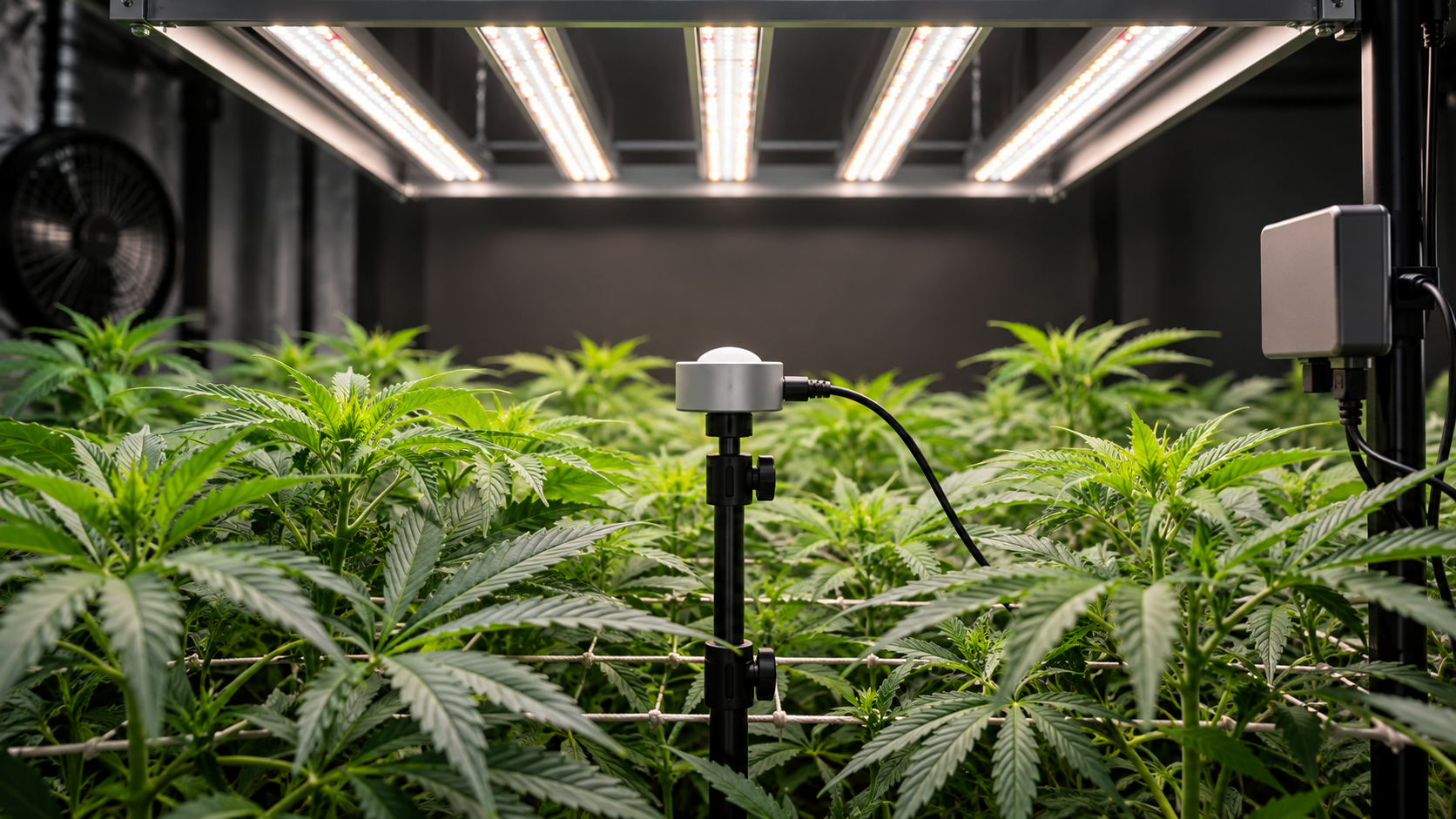
Position your NDIR sensor probe at canopy crown height, directly adjacent to your aspirated air temperature and relative humidity sensors. Shield the probe from direct radiant photon flux to prevent thermal drift inside the optical sampling chamber.
Validating Assimilation Kinetics with A/Ci Response Curves
In advanced commercial cultivation facilities and genetic breeding labs, agronomists do not rely solely on ambient room sensors to judge carbon efficacy; they quantify physiological assimilation using portable infrared gas analyzers (IRGA) equipped with sealed leaf chambers. By clamping a leaf into the microclimate chamber and varying carbon concentrations across a range of 100 to 1,800 PPM while holding PPFD constant at 1,200 μmol/m²/s, operators generate an empirical $A/C_i$ response curve. This biological curve precisely identifies the inflection point where Rubisco becomes saturated for that specific cultivar, establishing whether the strain thrives at 1,200 PPM or requires 1,500 PPM to express maximum floral density.
Is there any benefit to pulse-injecting CO2 rather than maintaining a constant setpoint?
Question sent by: Devon Miller, via email.
Maintaining a tight, constant setpoint (with a narrow hysteresis band of ±50 PPM) is vastly superior to wide-pulse injection. When CO2 concentrations fluctuate wildly (e.g., swinging between 600 PPM and 1,400 PPM), plant guard cells constantly open and close stomata to adjust to shifting internal carbon levels. This perpetual mechanical adjustment disrupts steady-state transpiration and creates unnecessary stress on vascular tissues. Calibrate your environmental controller to maintain a stable, uniform carbon concentration throughout the entire daytime photoperiod.
Final Decision Checklist and Companion Weedth Resources
Before investing capital into carbon dioxide generation equipment or expanding your facility photon output, verify your readiness against this comprehensive operational decision checklist:
PPFD & Supplemental CO2 Engineering Checklist
- Measure average canopy PPFD with a calibrated quantum flux meter; confirm light levels reach at least 800 μmol/m²/s before supplementing.
- Verify that the cultivation space is fully sealed with closed-loop HVAC cooling and commercial dehumidification rather than continuous exhaust fans.
- Scale CO2 concentrations systematically: 450 PPM in early veg, 800 PPM in late veg, and 1,200-1,400 PPM during peak bloom under 1,000+ PPFD.
- Elevate daytime room air temperature to 82°F-85°F (28°C-29.5°C) to accelerate Rubisco carboxylation and avoid cold-canopy stalls.
- Maintain relative humidity between 60% and 68% RH in peak bloom to hold true Leaf VPD between 1.2 and 1.4 kPa.
- Disable Automatic Baseline Calibration (ABC logic) on all indoor NDIR CO2 sensors to avoid severe measurement drift.
- Install life-safety CO2 atmospheric monitors with audible alarms set to trigger if room levels reach 5,000 PPM (OSHA PEL threshold).
- Taper CO2 back down to ambient 450 PPM during the final 10 to 14 days of ripening to protect delicate aromatic terpene fractions.
Mastering the stoichiometric harmony between quantum photon flux and atmospheric carbon concentration transforms indoor cannabis cultivation from guesswork into predictable, repeatable bio-manufacturing. By driving Rubisco kinetics at maximum velocity under high-irradiance arrays, growers unlock the true genetic potential of their cultivars while maximizing resource efficiency.
Final Verdict: Photons ignite the engine; carbon fuels the build. Never pump gas into a stalled motor, and never redline your lighting without supplying the carbon necessary to protect and nourish the canopy.
To expand your technical cultivation foundation with our companion foundational guides, continue exploring Weedth resources below.
Share this article
A quick overview of the topics covered in this article.
Follow us
Latest articles
October 29, 2026
October 29, 2026
October 29, 2026